
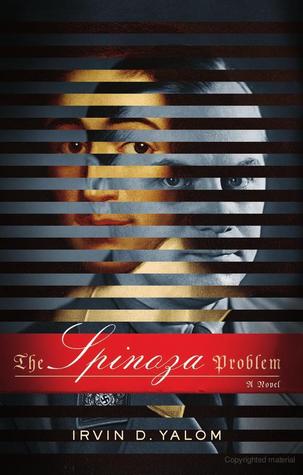
More on this book
Community


Kindle Notes & Highlights


And the fifth part, ‘On the Power of the Understanding,
Of Human Freedom,’ also has relevance to my work and should have interest for you. This is the part that I imagine was the most beneficial for Goethe.”
“A couple of thoughts about the first two parts—” Friedrich glanced at his watch. “They are for me the most difficult and most abstruse sections, and I’ve never been able to understand every concept. The major point is that everything in the universe is a single eternal substanc...
This highlight has been truncated due to consecutive passage length restrictions.
he says that if triangles could think they would create a triangular god.
To
Spinoza, Nature and God are synonyms; you might say he...
This highlight has been truncated due to consecutive passage length restrictions.
“You have to wait until parts four and five. First he establishes that we live in a deterministic world loaded with obstacles to our well-being. Whatever occurs is a result of the unchanging laws of nature, and we are part of nature, subject to these deterministic laws. Furthermore, nature is infinitely complex. As he puts it, nature has an infinite number of modes or attributes, and we humans can only apprehend two of them, thought and material essence.”
I believe that all religions—Catholicism, Protestantism, Islam, as well as Judaism—simply block our view of the core religious truths.
hope for a world someday without religions, a world with a universal religion in which all individuals use their reason to experience and to venerate God.”
“Does that mean you wish for the end of Judaism?” “For the end of all traditions that interfere with one’...
This highlight has been truncated due to consecutive passage length restrictions.
My permanent excommunication gives me the task now of refashioning my entire identity and learning to live without being Jewish or Christian, or any other religion. Perhaps I shall be the first man of such a sort.”
“I think I have true control only over one thing: the progress of my understanding.”
“Let me tell you something of the ideas of Epicurus, a wise, ancient Greek thinker. He believed, as any rational person must, that there is no world to come and that we should spend our only life as peacefully and joyfully as possible. What is the purpose of life? His answer was that we should seek ataraxia, which might be translated as ‘tranquility,’ or as ‘freedom from emotional distress.’ He suggested that a wise man’s needs are few and easily satisfied, whereas people with implacable cravings for power or wealth, perhaps like your uncle, never attain ataraxia because cravings breed. The
...more
I haven’t pointedly chosen ataraxia as my goal but instead point myself toward the goal of perfecting my reason.
Reason is leading me to the extraordinary conclusion that everything in the world is one substance, which is Nature or, if you wish, God, and that everything, with no exception, can be understood through the illumination of natural law.
As I gain more clarity about the nature of reality, I, on occasion, knowing I am but a ripple on the surface of God, experience a state of joyousness or blesse...
This highlight has been truncated due to consecutive passage length restrictions.
Perhaps Epicurus is right to advise us to aim for tranquility. But each person, according to his external circumstance...
This highlight has been truncated due to consecutive passage length restrictions.
inner mental characteristics, must pursue it in his own p...
This highlight has been truncated due to consecutive passage length restrictions.
People like people who are interested in them.
Bento entirely agreed with Epicurus’s insistence that man’s needs were few and easily satisfied.
If you think that uncertain things can be made certain by reason, you’ll accomplish nothing more than if you strived to go insane by sanity.
All is subject to the laws of Nature, and it is possible, through our reason, to grasp this chain of causality. I believe this is true not only for physical objects but for everything human, and I am now embarking on the project of treating human actions, thoughts, and appetites just as if they were a matter of lines, planes, and bodies.”
“Does that mean we can’t simply decide to have certain thoughts? I can’t decide to turn my head one way and then another way? That we have no simple free choice?”
“I do mean exactly that. Man is a part of Nature and therefore subject to Nature’s causative network. Nothing, including us, in Nature can simply choose capriciously to initiate some action. There can be no separate dominion within a dominion.”
Tell me about a dominion within a dominion.” “I mean that since man in every way is a part of Nature, it is incorrect to think that man disturbs, rather than follows, the order of Nature. It is incorrect to assume that he, or any entity in Nature, has free will. Everything we do is determined by either outside or inside causes. Remember how I demonstrated to you earlier that God, or Nature, did not choose the Jews?”
“So, too, is it true that God did not choose mankind to be special, to be outside of Nature’s laws. That idea, I believe, has nothing to do with natural order but instead comes from our deep need to be special, to be imperishable.”
And one of the most important things I’ve learned is that it is unreasonable to try
to control things over which we have no control.
“Ataraxia. Epicurus believed that the major disturber of ataraxia was our
fear of death, and he taught his students several powerful arguments to diminish it.” “Such as?” “His starting point is that there is no afterlife and that we have nothing to fear from the gods after death. Then he said that death and life can never coexist. In other words: where life is, death is not, and where death is, life is not.”
“Epicurus has yet another argument, the symmetry argument, that may be stronger yet. It posits that the state of nonbeing after death is identical to the state of nonbeing before birth. And though we fear death, we have no dread when we think of that earlier, identical state. Therefore we have no reason to fear death either.”
“For an argument to have ‘calming power’ supports the idea that no things, in and of themselves, are really good or bad, pleasant or fearsome. It is only your mind that makes them so.
Just the other day I read a passage by a Roman
‘No dread dares to enter the heart that has purged itself of the fear of death.’ In other words, once you conquer the fear of death, you also conquer all other fears.”
I must learn to turn reason into a passion.”
Spinoza says that reason is no match for passion and what we must do is to turn reason into a passion.”
Therapists are different. We’re odd ducks. Most other people don’t share our passionate curiosity about the mind.
Hitler, too, had been set afire by Chamberlain’s Foundations of the Nineteenth Century and would claim, to the end of his life, that Chamberlain (along with Dietrich Eckart and Richard Wagner) were his primary intellectual mentors.
Hitler leaned forward, his mouth close to Chamberlain’s ear, and said, “I treasure your words in your great book, Foundations of the Nineteenth Century: ‘The Germanic race is engaged in a mortal struggle with the Jews that is to be fought not only with cannon but with every weapon of human life and society.’”
“Herr Chamberlain, I promise that I am the man who will wage that war for you,” and went on at great length to describe his twenty-five-point program and his absolute unshakeable determination to have a Jew-free Europe.
Alas! If all men were wise, and benign as well then the Earth would be Paradise whereas now it is often a Hell!
his cultural beliefs that the highest good consisted of riches, fame, and the sensual pleasures. These goods, he insisted, were not good for one’s health.
‘Please allow me to love God in my own fashion.’”
“First, Franco, I use the term ‘Nature’ in a special way. I don’t mean the trees or forests or grass or ocean or anything that is not manmade. I mean everything that exists: the absolute necessary, perfect unity. By ‘Nature’ I refer to that which is infinite, unified, perfect, rational, and logical. It is the immanent cause of all things. And everything that exists, without exception, works according to the laws of Nature. So when I talk about love of Nature, I don’t mean the love you have for your wife or child. I’m talking about a different kind of love, an intellectual love. In Latin I
...more
“An intellectual love of God?” “Yes, the love of the fullest possible understanding of Nature, or God. The apprehension of the place of each finite thing in its relationship to finite
causes. It is the understanding, in so far as it is possible, of the univ...
This highlight has been truncated due to consecutive passage length restrictions.
“Yes, the laws of Nature are only another, more rational name for the eternal decrees of God.”
“So it differs from ordinary human love in that it involves only one person?” “Exactly. And the loving of something that is unchanging and eternal means that you are not subject to the loved one’s vagaries of spirit or fickleness or finiteness. It means, too, that we do not try to complete ourselves in another person.”
“Bento, if I comprehend you aright, it must also mean that we must expect no love in return.” “Exactly right again. We can expect nothing back. We derive a joyous awe from a glimpse, a privileged understanding of the vast, infinitely complex scheme of Nature.” “Another lifetime project?” “Yes, God or Nature has an infinite number of attributes that will forever elude my full unders...
This highlight has been truncated due to consecutive passage length restrictions.
The great anti-Semite Goethe would turn over in his grave if he discovered that a Jew had received a prize that carries his name.
