
More on this book
Community


Kindle Notes & Highlights

Read between
October 25 - November 29, 2025

We do moral reasoning not to reconstruct the actual reasons why we ourselves came to a judgment; we reason to find the best possible reasons why somebody else ought to join us in our judgment.
“If there is any one secret of success it lies in the ability to get the other person’s point of view and see things from their angle as well as your own.”
And if you do truly see it the other person’s way—deeply and intuitively—you might even find your own mind opening in response. Empathy is an antidote to righteousness, although it’s very difficult to empathize across a moral divide.
In the same way, each individual reasoner is really good at one thing: finding evidence to support the position he or she already holds, usually for intuitive reasons. We should not expect individuals to produce good, open-minded, truth-seeking reasoning, particularly when self-interest or reputational concerns are in play. But if you put individuals together in the right way, such that some individuals can use their reasoning powers to disconfirm the claims of others, and all individuals feel some common bond or shared fate that allows them to interact civilly, you can create a group that
...more
I had escaped from my prior partisan mind-set (reject first, ask rhetorical questions later) and began to think about liberal and conservative policies as manifestations of deeply conflicting but equally heartfelt visions of the good society.
Democrats often say that Republicans have duped these people into voting against their economic self-interest. (That was the thesis of the popular 2004 book What’s the Matter with Kansas?.)61 But from the perspective of Moral Foundations Theory, rural and working-class voters were in fact voting for their moral interests. They don’t want to eat at The True Taste restaurant, and they don’t want their nation to devote itself primarily to the care of victims and the pursuit of social justice. Until Democrats understand the Durkheimian vision of society and the difference between a six-foundation
...more
Societies that forgo the exoskeleton of religion should reflect carefully on what will happen to them over several generations. We don’t really know, because the first atheistic societies have only emerged in Europe in the last few decades. They are the least efficient societies ever known at turning resources (of which they have a lot) into offspring (of which they have few).
if you are trying to change an organization or a society and you do not consider the effects of your changes on moral capital, you’re asking for trouble. This, I believe, is the fundamental blind spot of the left. It explains why liberal reforms so often backfire,43 and why communist revolutions usually end up in despotism. It is the reason I believe that liberalism—which has done so much to bring about freedom and equal opportunity—is not sufficient as a governing philosophy. It tends to overreach, change too many things too quickly, and reduce the stock of moral capital inadvertently.
...more
Liberals stand up for victims of oppression and exclusion. They fight to break down arbitrary barriers (such as those based on race, and more recently on sexual orientation). But their zeal to help victims, combined with their low scores on the Loyalty, Authority, and Sanctity foundations, often lead them to push for changes that weaken groups, traditions, institutions, and moral capital. For example, the urge to help the inner-city poor led to welfare programs in the 1960s that reduced the value of marriage, increased out-of-wedlock births, and weakened African American families.72 The urge
...more
Newt Gingrich, the new speaker of the House of Representatives, encouraged the large group of incoming Republican congressmen to leave their families in their home districts rather than moving their spouses and children to Washington. Before 1995, congressmen from both parties attended many of the same social events on weekends; their spouses became friends; their children played on the same sports teams. But nowadays most congressmen fly to Washington on Monday night, huddle with their teammates and do battle for three days, and then fly home on Thursday night. Cross-party friendships are
...more
McCain).78 Morality binds and blinds. This is not just something that happens to people on the other side. We all get sucked into tribal moral communities. We circle around sacred values and then share post hoc arguments about why we are so right and they are so wrong. We think the other side is blind to truth, reason, science, and common sense, but in fact everyone goes blind when talking about their sacred objects.
If you want to understand another group, follow the sacredness. As a first step, think about the six moral foundations, and try to figure out which one or two are carrying the most weight in a particular controversy. And if you really want to open your mind, open your heart first. If you can have at least one friendly interaction with a member of the “other” group, you’ll find it far easier to listen to what they’re saying, and maybe even see a controversial issue in a new light. You may not agree, but you’ll probably shift from Manichaean disagreement to a more respectful and constructive
...more
Once people join a political team, they get ensnared in its moral matrix. They see confirmation of their grand narrative everywhere, and it’s difficult—perhaps impossible—to convince them that they are wrong if you argue with them from outside of their matrix. I suggested that liberals might have even more difficulty understanding conservatives than the other way around, because liberals often have difficulty understanding how the Loyalty, Authority, and Sanctity foundations have anything to do with morality. In particular, liberals often have difficulty seeing moral capital, which I defined
...more
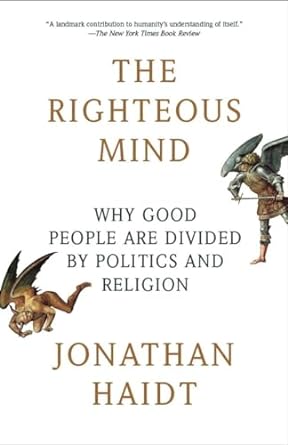
This book explained why people are divided by politics and religion. The answer is not, as Manichaeans would have it, because some people are good and others are evil. Instead, the explanation is that our minds were designed for groupish righteousness. We are deeply intuitive creatures whose gut feelings drive our strategic reasoning. This makes it difficult—but not impossible—to connect with those who live in other matrices, which are often built on different configurations of the available moral foundations.
