
More on this book
Community


Kindle Notes & Highlights

Read between
April 12 - April 16, 2025

Finally, I leaned in to hug her goodbye, one last time. I pressed my cheek to hers. I felt the dampness of her skin, the jangle of her fragile bones. I thought about how brave she had been, how wonderful, how alive, and wished I could have given her more time.
But the emotion I encounter most in the examination room, more potent and insidious than fear, is shame.
The women who apologize to me for being sick are part of a medical legacy, passed down over hundreds of years and still visible today. From that legacy, a story has emerged. It’s a story about what a woman’s body should look like and how it should feel, in work, in play, in learning and thought, in sex, in motherhood, in sickness and in health—and yes, even on her deathbed.
The problem is, the story is not true.
the fault lies less with the individual men than with the system in which they lived and labored.
Western medical storytelling has largely eschewed the discussion of women’s bodies, let alone elevated them as powerful, capable, or of equal worth to men’s.
It haunts our footsteps as we navigate the medical maze of women’s health that was built by men whose ideas about women, while sometimes well-intentioned, were limited at best, paranoid, misogynist, and abusive at worst.
One recent study revealed that women operated on by men have significantly worse outcomes, including death, than when operated on by women. (As for the men, their outcomes were the same whether a man or woman operated on them.)
it is to ask for a medical world that is more human, more holistic, more capable of seeing the patient as a whole person and not just a series of broken parts.
We need to stop apologizing for our medical needs, and start asking the questions that lead to better knowledge, better health, and better lives. We need to ask how to cultivate a relationship with our bodies that is not just comfortable, but joyful; how to know when something isn’t right and to advocate, not apologize, for our needs; how to navigate a healthcare system that will never be perfect but could be better; how to be as assertive, as informed, and as confident in the care we deserve in a doctor’s office as we are in the rest of our lives.
It is possible to deplore the pressures that women feel to conform to a stereotyped standard of beauty, while at the same time defending their right to make their own decisions. —Marcia Angell, MD, editor in chief, New England Journal of Medicine, 1992
As is so often the case in medical history, where racism took root in the scientific community, misogyny was not far behind.
a far more familiar, and timeless, frustration: one of women being lectured to by doctors who did not listen to them, even when the women possessed information, and firsthand experience, that the doctors did not.
From the late 1800s through the 1950s and beyond, the social, cultural, and moral baggage associated with the female skeletal system coalesced into a preoccupation with posture. Standing up straight was not just a mark of good health, but of high class and strong moral character; slouching, conversely, suggested that something was wrong in body and soul.
another form of prejudice that is by now familiar to any student of medical history: the notion that any problem mainly afflicting women must have a psychosomatic component.
Ehlers-Danlos patients, 70 percent of whom are female, suffer from such extreme hypermobility that they can eventually dislocate their joints while asleep—but they also often wait more than a decade to be diagnosed, owing to the tendency of people, including physicians, to assume that their flexibility is not just a natural feminine trait but a desirable gift.
to make up for her athleticism on the field, a woman had to be seen as a caricature of femininity off of it.
But while the boundaries had shifted, they were no less narrow, no less punishing,
By the 1960s, the question of whether exercise itself was medically recommended was no longer in dispute; doctors agreed that physical activity was beneficial to everyone, regardless of sex. But for women, this advice had acquired an aesthetic, and decidedly unscientific, gloss: the exercises recommended for women were meant to make the body not stronger, and not healthier, but smaller.
At the same time, the conventional wisdom about women and exercise was that they lacked all motivation to do it, being possessed of weak motivation to go with their weak bodies. The way doctors approached women’s physical fitness was of a piece with a broader medical paternalism, and a tendency among physicians to assume that if a woman was unhealthy, it was her own fault.
In some senses, we have come a long way from the bad old days when doctors believed that women would deform their pelvises or detach their uteruses by doing the wrong kind of exercise. In others, we are still beholden to all the same foolish fears: That a woman with a strong and capable body cannot also be a good mother. That the time and energy a woman spends exercising is time and energy wasted. That a woman’s strength is unsightly, unseemly, and unfeminine. That the most important thing a woman’s body can be is small.
even once the taboos surrounding exercise faded away, the ignorance created by those taboos persisted.
What we need now in her place is not a new boogeyman, but an icon: one who is strong, fast, fearless, and ready to take up space.
a doctor whose valuable belief in listening to patients coexisted alongside a second, far less enlightened set of beliefs about women’s hearts, women’s health, and women’s trustworthiness as interpreters of what was happening in their bodies.
How could any doctor diagnose what he had already convinced himself didn’t exist?
cardiac medicine was designed with a male patient in mind, while women presenting with heart complaints were understood to be suffering from neurosis, anxiety, or hysteria.
Together, medicine and culture had spawned an idea as potent as it was poisonous, one that the scientific breakthroughs of the day could mitigate but never entirely dispel. The idea was just this: that there is something beautiful, and wonderfully feminine, and powerful and empowering at once, about a woman who can’t breathe.
realized that they could flatter women into consuming their highly addictive product just as long as they positioned it as empowering—and particularly if the encouragement came with a doctor’s seal of approval.
the medical community now ends up taking its cues from the culture—in this case, one that says respiratory health is a woman’s problem to solve, rather than a doctor’s to diagnose.
Respiratory medicine is plagued by the same tendency as other fields to write off a woman’s symptoms as anxiety without searching more deeply for an organic cause.
Another patient, whose asthma attack was misdiagnosed as a panic attack, was still being scolded by medical staff to just calm down until she went into respiratory distress from lack of oxygen.
“But when fear stops us from asking questions, it stops us from solving treatable problems.”
for women with heavy and continuous exposure to cleaning products—which is to say, either working-class women who clean for a living or women in traditionally gendered arrangements that leave them responsible for the bulk of the household upkeep—the harm caused can be equivalent in its effect on the lungs to smoking a pack of cigarettes a day, every day, for twenty years.
As is so often the case, things are better than they used to be while still not being good enough.
These women weren’t just difficult to treat, physicians decided; they were difficult, period. They were making themselves sick and miserable.
The difference between psychology and physiology is merely one of complexity. The simpler bodily processes are studied in physiological departments; the more complex ones that entail the highest levels of neural integration are studied in psychological departments. There is no biological significance to this division; it is simply an administrative affair, so that the university president will know what salary goes to which professor.”
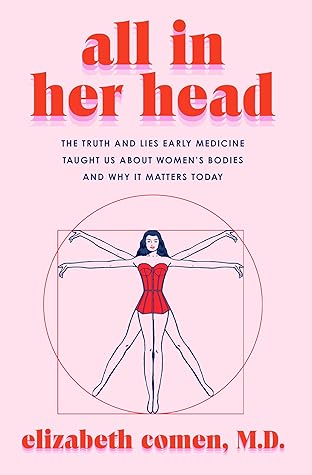
Medical history is full of moments in which a woman suffering from a functional illness—that is, an illness with no apparent cause—was told that her condition was psychosomatic, all in her head.
The mistake doctors made, and continue to make, is imagining that a disease that’s in the patient’s head must therefore, in some sense, be a fabrication over which the patient has control.
the root of a patient’s bloating, pain, and diarrhea may well be all in her head, in that it literally originates there. But is she imagining it? Responsible for it? Is it her fault that stress manifests in her body in the form of a disease that’s extremely difficult to treat?
Such is the nature of so much medical progress: at the intersection of experimentation and exploitation, healing and harm, desperation and innovation, a solution suddenly breaks through.
Historically, the lack of a safe, free place to pee has often served to keep women close to home and out of the public sphere;
Under his watch, a powerful and toxic idea wove its way into the fabric of government, of medicine, and of American society: when it came to the spread of disease, women were always to blame, and never to be trusted—not with their freedom, not with their healthcare, not even as authorities on what was happening in their own bodies.
For some, there is no blood test to detect them, no scans on which the disease will make itself known; there is only the patient’s own knowledge of her body, her experience. Her voice is everything, and yet, too often, nobody listens.
After centuries of being held responsible for getting everyone else sick, it should come as no surprise that women are now also blamed—or taught to blame themselves—for their own immunological problems, whether they’re accused of faking it, exaggerating it, or just making bad choices that leave them vulnerable to disease.
For as long as doctors have treated female patients, they have also doubted and dismissed them as constitutionally unbalanced. Nervous. Hysterical. Anxious. The words change, but the song remains the same, and this is true even despite myriad other positive advancements in the medical system at large.
Women are drama queens (so don’t treat their pain; it’s not really that bad). Women can’t handle the intellectual and emotional rigors of equal participation in society (so when they develop a degenerative disease that leaves them unable to think or even move, we don’t need to be urgent about it). Women who behave in difficult or frustrating ways aren’t just annoying, they’re abnormal (so let’s pump them full of mood stabilizers; it’ll be doing us all a favor).
This is how we find ourselves, still, in a world where women who have nothing wrong with them are steered into medical solutions for ordinary human problems—while women in genuine crisis are waved away.
Within the first two months of 2023, a series of patients suffering from the same problem came to psychiatrist Allie Baker’s office. All were women, and all had postural orthostatic tachycardia syndrome, a condition that results from dysautonomia (or a disorder of the parasympathetic nervous system) surrounding the regulation of blood pressure (per the Circulatory chapter, this condition is also known as Grinch syndrome because of its association with an undersized heart). All were experiencing classic symptoms: dizziness, fainting, heart palpitations, shortness of breath. But all of them, in
...more
But before that happened, each of them was riddled with guilt and anxiety at being so physically impaired by a problem that doctors wrote off as something of their own making: It’s all in your head.
Neurological disorders are nebulous, and express themselves differently in each patient. “You have to kind of go by the patient’s subjective experience of what it feels like to be in their body,” she says. But when it comes to who has their subjective experience listened to, a discrepancy emerges: “In my thirty years of practice, I’ll just tell you, it’s women a lot more than men who end up in my office with an incorrect diagnosis of anxiety alone.”
