
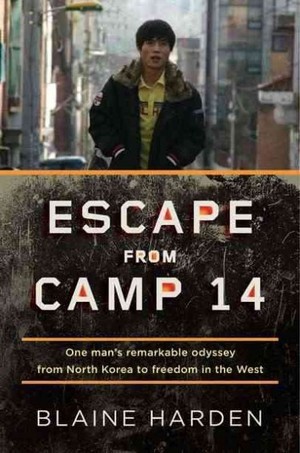
More on this book
Community


Kindle Notes & Highlights

Read between
September 11 - December 8, 2015

Love and mercy and family were words without meaning. God did not disappear or die. Shin had never heard of him.
Unlike those who have survived a concentration camp, Shin had not been torn away from a civilized existence and forced to descend into hell. He was born and raised there. He accepted its values. He called it home.
The South Korean government estimates there are about one hundred fifty-four thousand prisoners in the camps, while the U.S. State Department and several human rights groups have put the number as high as two hundred thousand.
A distillation of their testimony by the Korean Bar Association in Seoul paints a detailed picture of daily life in the camps. A few prisoners are publicly executed every year. Others are beaten to death or secretly murdered by guards, who have almost complete license to abuse and rape prisoners. Most prisoners tend crops, mine coal, sew military uniforms, or make cement while subsisting on a near-starvation diet of corn, cabbage, and salt. They lose their teeth, their gums turn black, their bones weaken, and, as they enter their forties, they hunch over at the waist. Issued a set of clothes
...more
This highlight has been truncated due to consecutive passage length restrictions.
The next level was the wavering or neutral class, which included soldiers, technicians, and teachers. At the bottom was the hostile class, whose members were suspected of opposing the government. They included former property owners, relatives of Koreans who had fled to South Korea, Christians, and those who worked for the Japanese colonial government that controlled the Korean Peninsula before World War II. Their descendants now work in mines and factories. They are not allowed into universities. Besides dictating career opportunities, the system shaped geographic destiny, with the core class
...more
“The theory behind the camps was to cleanse unto three generations the families of incorrect thinkers. So it was inconsistent to allow another generation to be born.”
It is difficult to overstate the importance of rice in North Korean culture. It signifies wealth, evokes the closeness of family, and sanctifies a proper meal. Labor camp prisoners almost never eat rice and its absence is a daily reminder of the normality they can never have.
Among the elite in Pyongyang, one of the most coveted signifiers of status is an electric rice cooker.
The mountains of North Korea are crisscrossed with swift rivers, large and small. Their hydropower potential is such that ninety percent of the electricity on the Korean Peninsula prior to partition came from the North.1 But under the Kim family dynasty, the North Korean government has failed to build or maintain a reliable national electricity grid linked to hydroelectric dams, many of which are located in remote areas. When the Soviet Union stopped supplying cheap fuel oil in the early 1990s, city-based, oil-powered generators sputtered to a halt. The lights went out across much of the
...more
Kim Il Sung’s most important intellectual achievement—his brilliant juche idea—asserts that national pride goes hand in glove with self-reliance. As the Great Leader explained it: Establishing juche means, in a nutshell, being the master of revolution and reconstruction in one’s own country. This means holding fast to an independent
position, rejecting dependence on others, using one’s own brains, believing in one’s own strength, displaying the revolutionary spirit of self-reliance, and thus solving one’s own problems for oneself on one’s own responsibility under all circumstances.2 None of this, of course, is even remotely possible in a country as ill governed as North Korea. It has always depended on handouts from foreign governments, and if they end, the Kim dynasty would probably collapse. Even in the best of years, it cannot feed itself. North Korea has no oil, and its economy has never been able to generate enough
...more
North Korea would have lost the Korean War and disappeared as a state without the help of the Chinese, who fought the United States and other Western forces to a stalemate. Until the 1990s, North Korea’s economy was largely held together by subsidies from the Soviet Union. From 2000 to 2008, South Korea propped up the North—and bought itself a measure of peaceful c...
This highlight has been truncated due to consecutive passage length restrictions.
Since then, Pyongyang has become increasingly dependent on China for concessional trade, food aid, and fuel. A telling measure of China’s growing influence is that in the months prior to Kim Jong Eun’s official emergence in 2010 as the chosen successor to Kim Jong Il, the ailing elder Kim traveled twice ...
This highlight has been truncated due to consecutive passage length restrictions.
Unlike any other aid recipient in the world, North Korea’s government insisted on sole authority for transporting donated food. The demand angered the United States, the largest aid donor, and it frustrated the monitoring techniques that the U.N. World Food Program had developed around the world to track aid and make sure it reached intended recipients. But since the need was so urgent and the death toll so high, the West swallowed its disgust and delivered more than one billion dollars’ worth of food to North Korea between 1995 and 2003.
During these years, refugees from North Korea arrived in the South and told government officials that they had seen donated rice, wheat, corn, vegetable oil, nonfat dry milk, fertilizer, medicine, winter clothing, blankets, bicycles, and other aid
items on sale in private markets. Pictures and videos taken in the markets showed bags of grain marked as “A ...
This highlight has been truncated due to consecutive passage length restrictions.
Bureaucrats, party officials, army officers, and other well-placed government elites ended up stealing about thirty percent of the aid, according to estimates by outside scholars and international aid agencies. They sold it to private traders, often for ...
This highlight has been truncated due to consecutive passage length restrictions.
Their relationship echoed, in many ways, the bonds of trust and mutual protection that kept prisoners alive and sane in Nazi concentration camps. In those camps, researchers found, the “basic unit of survival” was the pair, not the individual. “[I]t was in the pairs that the prisoners kept alive the semblance of humanity,” concluded Elmer Luchterhand, a sociologist at Yale who interviewed fifty-two concentration camp survivors shortly after liberation.
By any measure, these expectations were absurd. No one had escaped from Camp 14. Indeed, just two people other than Shin are known to have escaped from any political prison camp in North Korea and
Men serve ten years, women seven. With more than a million troops on active duty, about five percent of the country’s population is in uniform, compared with about half of one percent in the United States. An additional five million people serve in the army reserve for much of their adult lives. The army is “the people, the state, and the party,” says the government, which no longer describes itself as a communist state.
His context had been twenty-three years in an open-air cage run by men who hanged his mother, shot his brother, crippled his father, murdered pregnant women, beat children to death, taught him to betray his family, and tortured him over a fire. He felt wonderfully free—and, as best he could determine, no one was looking for him.
One trend, though, is clear. The number of North Koreans seeking asylum in South Korea has increased nearly every year since 1995. Forty-one arrived in 1995. By 2009, the number had jumped to nearly three thousand. More defectors turned up in the South between 2005 and 2011 than had fled North Korea over the entire period since the end of the Korean War in 1953. By 2012, there were about twenty-four thousand defectors in South Korea.
Activist pastors from South Korean churches invented the escape trade in the late 1990s and early 2000s, hiring border operatives who greased the palms of North Korean guards with cash donated by parishioners in Seoul. By the time Shin hit the road, defectors themselves, many of them former North Korean military and police officers, had taken over the trade and were quietly running for-profit operations.
During the famine, train station cleaning staff made rounds with a wooden handcart, collecting bodies from the station floor, wrote Demick. There were widespread rumors of cannibalism, with claims that some children hanging around the station were drugged, killed, and butchered for meat. Although the practice was not widespread, Demick concluded it did occur. “From my interviews with defectors, it does appear that there were at least two cases . . . in which people were arrested and executed for cannibalism.”
These TV programs have demolished decades of North Korean propaganda, which claims that the South is a poor, repressed, and unhappy place, and that South Koreans long for unification under the fatherly hand of the Kim dynasty.
South Koreans have paid close attention to the price tag of German unification. The proportional burden on South Korea, some studies have found, would be two and a half times greater than on West Germany after it absorbed the former East Germany. The studies found that it could cost more than two trillion dollars over thirty years, raise taxes for six decades, and require that ten percent of the South’s gross domestic product be spent in the North for the foreseeable future. South Koreans want reunification with the North, but they do not want it right away. Many do not want it during their
...more
South Koreans work more, sleep less, and kill themselves at a higher rate than citizens of any other developed country,
Although the suicide rate in most other wealthy countries peaked in the early 1980s, it continues to climb in South Korea, doubling since 2000. The suicide rate in 2008 was two and half times higher than in the United States and significantly higher than in nearby Japan, where suicide is deeply embedded in the culture. It seems to have spread as a kind of infectious disease exacerbated by the strains of ambition, affluence, family disintegration, and loneliness.
“Shin is still a prisoner,” said Andy Kim, a young Korean American who helped run LiNK and who, for a time, was Shin’s closest confidant. “He cannot enjoy his life when there are people suffering in the camps. He sees happiness as selfishness.”
In California, Shin began giving God all the credit for his escape from Camp 14 and for his good fortune in finding a way out of North Korea and China. His emerging Christian faith, though, did not square with the time line of his life. He did not hear about God until it was too late for his mother, his brother, and Park. He doubted too that God had protected his father from the vengeance of guards.
When Shin was finished, when he told the congregation that one man, if he refuses to be silenced, could help free the tens of thousands who remain in North Korea’s labor camps, the church exploded in applause.
THE TEN LAWS OF CAMP 14
