
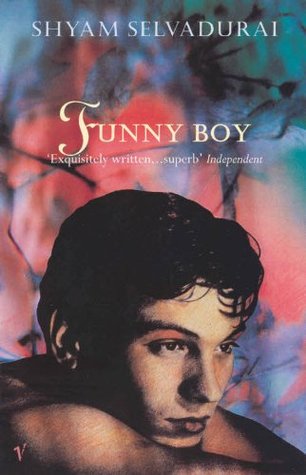
More on this book
Community


Kindle Notes & Highlights


Alternative spelling of almirah? = cupboard/small wardrobe not fixed to the wall
Nose stud
Like the earth-goddess in the folktales, she was not to be disturbed from her tranquillity. To do so would have been the cause of a catastrophic earthquake.
Spiritual power of elder woman
The second territory was called “the girls’,” included in which, however, was myself, a boy.
First sign of queering!
incomprehensible to me.
World he can’t understand
if it was Cinderella or Thumbelina, I was the much-beleaguered heroine of these tales.
For me the culmination of this game, and my ultimate moment of joy, was when I put on the clothes of the bride.
In the hierarchy of bride-bride, the person with the least importance, less even than the priest and the page boys, was the groom. It was a role we considered stiff and boring, that held no attraction for any of us. Indeed, if we could have dispensed with that role altogether we would have, but alas it was an unfortunate feature of the marriage ceremony.
We sensed that beneath her benevolence lurked a seething anger, tempered by guile, that could have deadly consequences if unleashed in our direction.
“A boy cannot be the bride,” she said with deep conviction. “A girl must be the bride.”
Talking in binaries...
“You’re a pansy,” she said, her lips curling in disgust. We looked at her blankly. “A faggot,” she said, her voice rising against our uncomprehending stares. “A sissy!” she shouted in desperation. It was clear by this time that these were insults.
American insults that barely tough him because he doesn’t know the meaning/context. Innocence of a less homophobic world? Or did homophobia ‘not exist’ in Sri Lanka?
They gazed at me in amazement as if I had suddenly made myself visible, like a spirit.
First experience of being ‘outed’, first sense of shame associated to gender constructs
he was the only one not laughing. Seeing
Cannot be funny for him to have an effeminate son, although the others may mock lightly
both my parents kept their eyes averted from me.
Avoiding taboo subject, worse than tackling head on
“If he turns out funny like that Rankotwera boy, if he turns out to be the laughing-stock of Colombo, it’ll be your fault,” my father said in a tone of finality. “You always spoil him and encourage all his nonsense.”
Idea of nature/nurture rather than modern theories like Butler’s of performativity
“What do I encourage?”
Queer identities erased by unwillingness to speak them
Nearest definition in Tamil I can find is worm/s - so a ord, or long piece of fabric?
“You should have been a film star, Amma.”
Interesting to call parent by first name at such a young age
I stared disbelievingly at the door.
Motif of outside/inside - he has been ‘outed’ and no longer allowed into this heteronormative space he admires
It was clear to me that I had done something wrong, but what it was I couldn’t comprehend. I thought of what my father had said about turning out “funny.” The word “funny” as I understood it meant either humorous or strange, as in the expression, “that’s funny.” Neither of these fitted the sense in which my father had used the word, for there had been a hint of disgust in his tone.
Always euphemisms, no one says what they mean.
“Because the sky is so high and pigs can’t fly, that’s why.”
First introduction to strict gender binaries, has been able to go unnoticed before
“If the child turns out wrong, it’s the mother they always blame, never the father.”
“That’s stupid.”
The truth and innocence of youth, like the child in the emperor’s new clothes - pointing out things that don’t make sense
I had broken her cheerful façade, forced her to show how much it pained her to do what she was doing, how little she actually believed in the justness of her actions.
“Why can’t he play with the girls?” she said. “Why?” Amma said and started up the car. “Because the sky is so high and pigs can’t fly.”
“I’ll trade you Arjie for Sanjay.”
Commodification of queer bodies
said “girlie-boy” again.
Repeating words, repeating behaviour - becomes reality
And with that, I forever closed any possibility of entering the boys’ world again.
Very binary thinking!
Why should I be punished?”
Why should I be punished for performing my gender?
Now both the beach and the sea, once so familiar, were like an unknown country into which I had journeyed by chance. I knew then that something had changed. But how, I didn’t altogether know.
Key quote, beginning to understand nature of gender and the restrictions it imposes on us.
It isn’t ignorance, a kind of wisdom. Always changing, always becoming, in flux.
Water as a motif - chimes through episodes, always changing and reforming, also idea of travelling between states (both literal and physical)
The large waves, impersonal and oblivious to my despair,
Beautiful personification.
I knew that I would never enter the girls’ world again.
Very binary thinking as he’s being taught. Will it be true?
And then there would be the loneliness. I would be caught between the boys’ and the girls’ worlds, not belonging or wanted in either.
Sad, inevitable state of queer people I’m communities that don’t understand; reality
A PROPOSAL ARRIVED
Immediately very heteronormative, almost aggressively so
“An engineer!” one of the aunts cried. “How wonderful for Radha.”
With zero thought if she likes him - but it’s a v different culture so probably not seen as sexist to them...
There was going to be a wedding in the family!
At this point very ambiguous whether he is effeminate/camp, or gay/camp or transgender. Interested to find out! Although he doesn’t have to fit into any of those categories at all of course, since everything is a spectrum 😊
The Radha Aunty of my mind was plump with big rounded hips. She had a fair complexion and large kohlrimmed eyes. Her hair was straight and made into an elaborate coiffure on top of her head, and she wore a Manipuri sari with a gold border.
Very stereotypical view of the feminine, although he’s only seven to be fair! Constructing an image taken directly from popular culture as doesn’t know any different
“devil’s temperament.”
Clearer idea of strictness of gender roles from this sentence. His mum was remarkably lenient in comparison - difference between generations or just character?
I stared at her in shock. She couldn’t have been more different from the way I had pictured her. The first and biggest difference between the imagined Radha Aunty and the real one was the colour of her skin. She was a karapi, as dark as a labourer. Worse, her long hair was frizzy like Ammachi’s and it seemed about to burst out of the clip that held it in place at the back of her neck. She was thin, not plump, and, as Amma would have said, “flat like a boy.” Instead of a sari, she wore a halter-top and strange trousers that were tight to the knee and then became wider. Further, the heels on her
...more
All these performative feminine things that are an expectation... not everyone in their culture submits. Was it going to London that changed things?
she was different from other adults.
She’s different, ‘queer’
Although the play was boring, I found myself envying the children who were in it, because they got to wear make-up and costumes and dance around the stage.
“Should have been a girl with those eyelashes.”
As though eyelashes denote gender
Even our servant was Sinhalese, and, in fact, we spoke with her only in Sinhalese. So what did it matter whether Anil was Sinhalese or not?
Sinhalese must be lower class, don’t they have caste system in Sri Lanka... will RESEARCH.
Ahem...
Sinhalese constitute about 75% of the Sri Lankan population and number greater than 16.2 million. The Sinhalese identity is based on language, historical heritage and religion. The Sinhalese people speak Sinhala, an insular Indo-Aryan language and are predominantly Theravada Buddhists, although a small percentage of Sinhalese follow branches of Christianity. The Sinhalese are mostly found in North Central, Central, South and West Sri Lanka.
Sinhalese Buddhist nationalism has a fractious relationship with other religious communities like Christians, with protests often being organised by Buddhist nationalist organisations
“She’s such a racist,” Radha Aunty said to me. I looked at Radha Aunty. I did not understand the meaning of the word “racist,” but I could tell that it was not a nice thing.
Words are just words at this point, Arjie doesn’t understand this here
“But is that a reason to hate every Sinhalese?”
Voice of reason!
somehow saw her differently now.
Sees grandma differently after her prejudices? Pettiness?
“This was twenty years ago, in the fifties, son. At that time, some Sinhalese people killed Tamil people.”
Ammachi often talked about the Tigers. She was on their side and declared that if they did get a separate state, which they would call Eelam, she would be the first to go and live in it.
Sinhalese was “the real language of the future.”
Erasure of past
The feeling of fear that we might get caught and the thrill of doing something forbidden
Pleasure/fear complex as discussed in Gothic literature
