
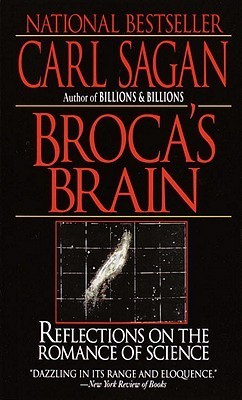
More on this book
Community


Kindle Notes & Highlights

by
Carl Sagan
Read between
December 30, 2019 - January 2, 2020

These are times of stunning changes in social organization, economic wellbeing, moral and ethical precepts, philosophical and religious perspectives, and human self-knowledge, as well as in our understanding of that vast universe in which we are imbedded like a grain of sand in a cosmic ocean.
As long as there have been human beings, we have posed the deep and fundamental questions, which evoke wonder and stir us into at least a tentative and trembling awareness, questions on the origins of consciousness; life on our planet; the beginnings of the Earth; the formation of the Sun; the possibility of intelligent beings somewhere up there in the depths of the sky; as well as, the grandest inquiry of all—on the advent, nature and ultimate destiny of the universe.
But both in borderline science and in organized religion there is much that is specious or dangerous. While the practitioners of such doctrines often wish there were no criticisms to which they are expected to reply, skeptical scrutiny is the means, in both science and religion, by which deep insights can be winnowed from deep nonsense.
But, as I hope will emerge, these topics are connected because the world is connected, and also because human beings perceive the world through similar sense organs and brains and experiences that may not reflect the external realities with absolute fidelity.
By far the most exciting, satisfying and exhilarating time to be alive is the time in which we pass from ignorance to knowledge on these fundamental issues; the age where we begin in wonder and end in understanding. In all of the four-billion-year history of life on our planet, in all of the four-million-year history of the human family, there is only one generation privileged to live through that unique transitional moment: that generation is ours.
“They were apes only yesterday. Give them time.” “Once an ape—always an ape.”… “No, it will be different.… Come back here in an age or so and you shall see.…” The gods, discussing the Earth, in the motion picture version of H. G. Wells’ The Man Who Could Work Miracles (1936)
SCIENCE IS A WAY of thinking much more than it is a body of knowledge. Its goal is to find out how the world works, to seek what regularities there may be, to penetrate to the connections of things—from subnuclear particles, which may be the constituents of all matter, to living organisms, the human social community, and thence to the cosmos as a whole.
Even so straightforward a question as whether in the absence of friction a pound of lead falls faster than a gram of fluff was answered incorrectly by Aristotle and almost everyone else before the time of Galileo.
Science is based on experiment, on a willingness to challenge old dogma, on an openness to see the universe as it really is. Accordingly, science sometimes requires courage—at the very least the courage to question the conventional wisdom.
Beyond this the main trick of science is to really think of something: the shape of clouds and their occasional sharp bottom edges at the same altitude everywhere in the sky; the formation of a dewdrop on a leaf; the origin of a name or a word—Shakespeare, say, or “philanthropic”; the reason for human social customs—the incest taboo, for example; how it is that a lens in sunlight can make paper burn; how a “walking stick” got to look so much like a twig; why the Moon seems to follow us as we walk; what prevents us from digging a hole down to the center of the Earth; what the definition is of
...more
This highlight has been truncated due to consecutive passage length restrictions.
For myself, I like a universe that includes much that is unknown and, at the same time, much that is knowable. A universe in which everything is known would be static and dull, as boring as the heaven of some weakminded theologians. A universe that is unknowable is no fit place for a thinking being. The ideal universe for us is one very much like the universe we inhabit. And I would guess that this is not really much of a coincidence.
To punish me for my contempt for authority, Fate made me an authority myself. EINSTEIN
No testimony is sufficient to establish a miracle, unless … its falsehood would be more miraculous than the fact which it endeavors to establish. DAVID HUME, Of Miracles
The history of science is full of cases where previously accepted theories and hypotheses have been entirely overthrown, to be replaced by new ideas that more adequately explain the data.
Perhaps I need not mention that such quantitative testing of hypotheses is entirely routine in the physical and biological sciences today. By rejecting the hypotheses that do not meet these standards of analysis, we are able to move swiftly to hypotheses in better concordance with the facts.
SCIENCE FICTION— A PERSONAL VIEW
Many scientists deeply involved in the exploration of the solar system (myself among them) were first turned in that direction by science fiction. And the fact that some of that science fiction was not of the highest quality is irrelevant. Ten-year-olds do not read the scientific literature.
The four large moons of Jupiter were discovered by Galileo, whose theological contemporaries were convinced by a vague amalgam of Aristotelian and Biblical ideas that the other planets could have no moons. The contrary discovery by Galileo was disconcerting to fundamentalist churchmen of the time. Possibly in an effort to circumvent criticism, Galileo called the moons the Medicean satellites—after his funding agency. But posterity has been wiser: they are known instead as the Galilean satellites.
MUCH OF HUMAN HISTORY can, I think, be described as a gradual and sometimes painful liberation from provincialism, the emerging awareness that there is more to the world than was generally believed by our ancestors.
Some computers can play world-class checkers. Chess is of course a much more complicated game than tic-tac-toe or checkers. Here programming a machine to win is more difficult, and novel strategies have been used, including several rather successful attempts to have a computer learn from its own experience in playing previous chess games. Computers can learn, for example, empirically the rule that it is better in the beginning game to control the center of the chessboard than the periphery.
The ten best chess players in the world still have nothing to fear from any present computer. But the situation is changing.
Bertrand Russell once told of being arrested because he peacefully protested Britain’s entry into World War I. The jailer asked—then a routine question for new arrivals—Russell’s religion. Russell replied, “Agnostic,” which he was asked to spell. The jailer smiled benignly, shook his head and said, “There’s many different religions, but I suppose we all worship the same God.” Russell commented that the remark cheered him for weeks.
The most beautiful thing we can experience is the mysterious. It is the source of all true art and science. He to whom this emotion is a stranger, who can no longer wonder and stand rapt in awe, is as good as dead: his eyes are closed.… To know that what is impenetrable to us really exists, manifesting itself as the highest wisdom and the most radiant beauty which our dull facilities can comprehend only in the most primitive forms—this knowledge, this feeling, is at the center of true religiousness. In this sense, and in this sense only, I belong to the ranks of the devoutly religious men.
...more
I am fascinated by the point—which I stress in my book The Dragons of Eden—that the pain of childbirth is especially marked in human mothers because of the enormous recent growth of the brain in the last few million years. It would seem that our intelligence is the source of our unhappiness in an almost literal way; but it would also imply that our unhappiness is the source of our strength as a species.
We can understand why the oligarchy might favor religion when, as is often the case, religion justifies oppression—as Plato, a dedicated advocate of book-burning, did in the Republic. But why do the oppressed so eagerly go along with these theocratic doctrines?
Voltaire argued that if God did not exist Man would be obliged to invent him, and was reviled for the remark.
Those who raise questions about the God hypothesis and the soul hypothesis are by no means all atheists. An atheist is someone who is certain that God does not exist, someone who has compelling evidence against the existence of God. I know of no such compelling evidence.
Only through inquiry can we discover truth.
HOFFMAN, BANESH, Albert Einstein: Creator and Rebel. New York, New American Library, 1972.
