
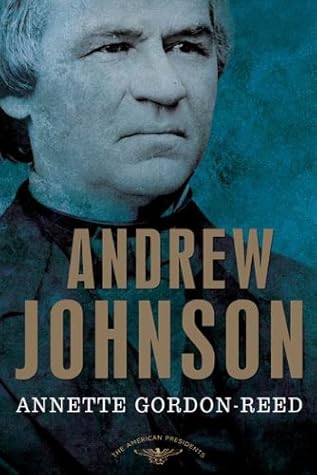
More on this book

Kindle Notes & Highlights

Read between
June 7 - June 24, 2021

Throughout the entirety of his political career Andrew Johnson did everything he could to make sure blacks would never become equal citizens in the United States of America. Tragically, he was able to bring the full force and prestige of the American presidency to the effort.
While we can debate what types of actions can be said to reveal a basic character, and how many transgressions make a pattern of behavior, the idea that one’s character matters seems intuitively right, and may be a starting point for explaining what made an Abraham Lincoln and, for purposes of this book, what made an Andrew Johnson.
The historian Eric Foner has noted that “apart from education law … Johnson’s political career was remarkably devoid of substantive accomplishments, especially in light of his long tenure in various offices.”
Johnson’s hostile attitude toward black people must be reckoned with, although some commentators have deemed attention to his racism as “presentism,” that is, applying today’s standards to the past and making a negative judgment about a historical figure.12 But to say that
Andrew Johnson was a racist and sought to maintain and extend white supremacy in America is a statement of incontrovertible fact, not merely a judgment.
In many ways, Johnson’s weaknesses mirrored those of his era. But in the American system of government—even with three supposedly coequal branches—the executive is the prime mover, the so-called energy of the government.15
In Johnson’s later formulation, slavery was not primarily the destroyer of black lives. Its chief harm was that it prevented lower-class whites from rising to take their rightful place at the head of
the table—that and all the race mixing that was going on within the institution.
Contemplate for a moment the mentality that saw railroads as bad because they allowed people to move to their destinations so quickly that they didn’t need to stop at taverns on the way. What about the towns and taverns that would spring up along the destinations that the railroad brought people to? They did spring up, and many people during Johnson’s time foresaw that they would. This, from a man who as a fugitive from his apprenticeship had to walk thirty, sometimes seventy miles to get places, and whose family
crossed the Blue Ridge Mountains dodging mountain lions and bears. Johnson’s lack of forethought, and his poor understanding of the concept of progress in the world, would resurface in his days as president when he was called upon to imagine the future of the newly reconstituted United States.
“Altogether … he was forcible and powerful, without being eloquent. He held his crowd spellbound. There was always in his speeches more or less wit, humor, and anecdote, which relieved them from tedium and heaviness.”7
He was now the rarest of birds—the only senator from a state that had seceded who remained in the United States Senate.
Lincoln decided to treat these recaptured areas more like territories and put them under the authority of military governors. The first one he appointed was
Andrew Johnson, who on March 4, 1862, became military governor of the state he had once served as a civilian governor.
Lincoln’s Emancipation Proclamation in January 1863 put the issue directly on the table for him, and Johnson had to decide whether to follow Lincoln’s cue or side with the more conservative
Unionists who wanted to keep slavery in place. In the end, he came to the conclusion that maintaining slavery would prevent the restoration of the Union, which he always insisted was his only concern.
Howard Means pointed out, the last time many of them had seen the vice president was when he was drunk at the inauguration embarrassing himself, Lincoln, and all who witnessed the display. Despite his many flaws, however, Johnson had not risen in the world by being a fool.
He was determined to achieve his goal of the speedy reincorporation of the southern states all by himself, acting by presidential proclamation to bring in the rebel states before Congress came back into session in December 1865. After Virginia came North Carolina, then six other southern states, including the one that had led the South out of the Union: South Carolina. Johnson asked nothing of these states save that they recognize the end of slavery by ratifying the Thirteenth Amendment. This was perfectly in keeping with his understanding of what had happened when the southern states rebelled
...more
Treating the desire for black votes as illegitimate or corrupt suggests that black votes somehow aren’t “real” votes. That the language of affect—caring about—so often crept into the critique of the Republicans’ motivations reveals the paternalism at the heart
of many whites’ view of blacks, whom they construed as “children” within the American family.
it shall be a government for white men.”
The killing off of land reform ensured that the vast majority of southern blacks would be unable to achieve personal
independence and would have to work for their former masters, now back in the saddle courtesy of Johnson. Johnson’s liberal theory of pardons for the planter class and his scuttling of land reform executed a one-two punch to the freedmen. These moves would stunt blacks’
acquisition of property, wealth, and power for ...
This highlight has been truncated due to consecutive passage length restrictions.
By autumn the provisional governors Johnson had rushed to put in place before Congress came back from recess duly organized conventions and elections. The results were predictable. The most conservative element came to power and enacted statutes, the notorious “black codes,” to regulate the lives and behavior of blacks. T...
This highlight has been truncated due to consecutive passage length restrictions.
slavery as po...
This highlight has been truncated due to consecutive passage length restrictions.
11 For example, Mississippi’s code, among other draconian provisions, “required all blacks to possess, each January, written evidence of employment for the coming year. Laborers leaving their jobs before the contract expired would f...
This highlight has been truncated due to consecutive passage length restrictions.
to arrest by any white citizen.” Hunting and fishing became crimes for blacks, meaning that they could not find independent ways to ...
This highlight has been truncated due to consecutive passage length restrictions.
Johnson gave them grounds in 1867, when long after people had told him to do it he sought to remove Secretary of War Edwin M. Stanton in what both radicals and moderates in Congress saw as a violation of the Tenure of Office Act.
Congress had passed the act, ironically enough, because it believed that Johnson was abusing his discretion in the appointment and removal of officials in order to thwart congressional Reconstruction while elevating his own program for the South.
The man who would take Johnson’s place, should he be removed from office, frightened important segments of society and was cited as a main cause for the reluctance to remove Johnson. That man was Senator Benjamin F. Wade
of Ohio, a noted radical Republican. On issues of public policy he was the polar opposite of Andrew Johnson. He believed in such things as women’s suffrage, which subjected him to total derision.
The former president was a proud Mason, and the local Masonic temple played a great role in the funeral proceedings.
The French political philosopher Joseph de Maistre said, “Every nation has the government it deserves.”
