
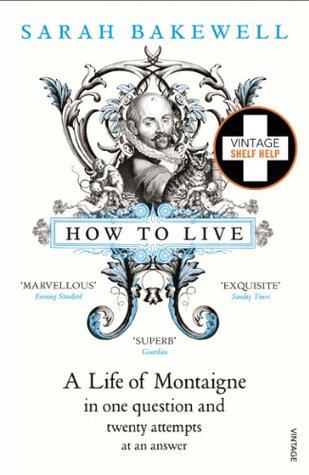
More on this book
Community


Kindle Notes & Highlights

Read between
January 22 - February 26, 2020

Long after the sixteenth-century Stoic Montaigne was forgotten, readers in troubled times continued to think of him as a role model. His Essays offered practical wisdom on questions such as how to face up to intimidation, and how to reconcile the conflicting demands of openness and security. He also provided something more nebulous: a sense of how one could survive public catastrophe without losing one’s self-respect. Just as you could seek mercy from an enemy forthrightly, without compromising yourself, or defend your property by electing to leave it undefended, so you could get through an
...more
Among the many readers who have responded to this aspect of the Essays, one can stand for all: the Austrian Jewish writer Stefan Zweig, who, living in enforced exile in South America during the Second World War, calmed and distracted himself by writing a long personal essay on Montaigne – his non-heroic hero.
When Zweig19 first came across the Essays as a young man in turn-of-the-century Vienna, he admitted, the book made little impression. Like Lamartine and Sand before him, he found it too dispassionate. It lacked ‘the leap of electricity from soul to soul’; he could see no relevance to his own life.
Even when Montaigne turned to topics that ought to have been more appealing, such as sex and politics, his ‘mild, temperate wisdom’ and his feeling that it was wiser not to involve oneself too much in the world repelled Zweig. ‘It is in the nature of youth that it does not want to be advised to be mild or sceptical. Every doubt seems to it to be a limitation.’ Young people crave beliefs; they want to be roused.
Zweig survived the First World War, but this was followed by the rise of Hitler. He fled Austria and was forced to wander for years as a refugee, first to Britain, then to the United States, and finally to Brazil. His exile20 made him ‘defenseless as a fly, helpless as a snail’, as he put it in his autobiography. He felt himself to be a condemned man, waiting in his cell for execution, and ever less able to engage with his hosts’ world around him. He kept sane by throwing himself into work. In his exile, he produced a biography of Balzac, a series of novellas and short stories, an
...more
Zweig knew that Montaigne disliked preaching, yet he managed to extract a series of general rules23 from the Essays. He did not list them as such, but paraphrased them in such a way as to resolve them into eight separate commandments – which could also be called the eight freedoms: Be free from vanity and pride. Be free from belief, disbelief, convictions and parties. Be free from habit. Be free from ambition and greed. Be free from family and surroundings. Be free from fanaticism. Be free from fate: be master of your own life. Be free from death: life depends on the will of others, but death
...more
It seemed – and this was how Zweig himself saw it – that the real value of Montaigne could be seen only when one had been pushed close to this extreme point. One must reach a state where one had nothing left25 to defend but one’s naked ‘I’: one’s simple existence.
Only a person who has lived through a time that threatens his life and that valuable substance, his individual freedom, with war, power and tyrannical ideologies – only he knows how much courage, how much honesty and determination are needed to maintain the inner self in such a time of herd insanity.
Those who take Montaigne as a hero, or as a supportive companion, would argue that he did not advocate a ‘do-as-thou-wilt’ approach to social duty. Instead, he thought that the solution to a world out of joint was for each person to get themselves back in joint: to learn ‘how to live’, beginning with the art of keeping your feet on the ground.
I turn my gaze inward,6 I fix it there and keep it busy. Everyone looks in front of him; as for me, I look inside of me; I have no business but with myself; I continually observe myself, I take stock of myself, I taste myself … I roll about in myself.
Montaigne, the political conservative, proved himself a literary revolutionary from the start, writing like no one else and letting his pen follow the natural rhythms of conversation7 instead of formal lines of construction. He omitted connections, skipped steps of reasoning, and left his material lying in solid chunks, coupé or ‘cut’ like freshly chopped steaks. ‘I do not see the whole of anything,’ he wrote:
Of a hundred members and faces8 that each thing has, I take one, sometimes only to lick it, sometimes to brush the surface, sometimes to pinch it to the bone. I give it a stab, not as wide but as deep as I know how. And most often I like to take them from some unaccustomed point of view.
Montaigne admitted that his titles had little obvious connection with the contents – ‘often they only denote it by some sign’.
What he loved above all about his travels was the feeling of going with the flow. He avoided all fixed plans. ‘If it looks ugly on the right,7 I take the left; if I find myself unfit to ride my horse, I stop.’
He did not like to plan, but he did not like to miss things either. His secretary, accompanying him and (for a while) keeping his journal for him, remarked that people in the party complained about Montaigne’s habit of straying from the path whenever he heard of extra things he wanted to see. But Montaigne would say it was impossible to stray from the path: there was no path.8 The only plan he had ever committed himself to was that of travelling in unknown places. So long as he did not repeat a route, he was following this plan to the letter.
On the whole, however, he made a point of shaking up his habits while travelling. Unlike other travellers, he ate only local food9 and had himself served in the local style. At one point in the trip he regretted that he had not brought his cook with him – not because he missed home cooking, but because he wanted the cook to learn new foreign recipes.
He blushed to see other Frenchmen overcome with joy whenever they met a compatriot abroad. They would fall on each other, cluster in a raucous group, and pass whole evenings complaining about the barbarity of the locals. These were the few who actually noticed that locals did things differently. Others managed to travel so ‘covered and wrapped in a taciturn and incommunicative prudence, defending themselves from the contagion of an unknown atmosphere’ that they noticed nothing at all.
Everything engaged Montaigne’s attention, or that of his secretary, who was writing at his direction.
This was the great destination, the centre of European culture: Venice and Rome had called to him all his life. But he now discovered that he preferred less well known places. Had Montaigne had his way, remarked the secretary as they reached the Alps, he might have turned towards Poland or Greece20 instead, perhaps just to prolong the whole trip. But he met with opposition, and so agreed to follow the Italy route like everyone else. He soon recovered. ‘I never saw him less tired or complaining less of his pains,’ wrote the secretary now, ‘for his mind was so intent on what he encountered, both
...more
Venice,21 one of their first major Italian stops, confirmed his fears about over-popular tourist destinations. As the secretary put it, he found it slightly less wonderful than people said it would be. Still, he explored it with no lack of zest, hiring a gondola and meeting all the interesting people he could find, and he was won over by Venice’s bizarre geography, its cosmopolitan population, and its government as an independent republic.
To be a Roman was to be a citizen of the world, which was what Montaigne wanted to be. He accordingly sought Roman citizenship, an honour which was granted towards the end of his four-and-a-half-month stay. This pleased him so much that he transcribed the document in its entirety in a chapter about vanity in the Essays. He realised that ‘vanity’ was the right category, but he did not care. ‘At all events I received much pleasure in having obtained it.’
benediction.
I mortally hate to seem a flatterer, and so I naturally drop into a dry, plain, blunt way of speaking … I honour most those to whom I show least honour … I offer myself meagrely and proudly to those to whom I belong. And I tender myself least to those to whom I have given myself most; it seems to me that they should read my feelings in my heart, and see that what my words express does an injustice to my thought.
The source of the problem, just as in the seventeenth century, was a distaste for his Scepticism. Nineteenth-century readers were disturbed by it in a way few had been since Pascal. They did not mind Montaigne doubting facts, but they did not like him applying Scepticism to everyday life and showing emotional detachment from agreed standards. The Sceptic epokhe, or ‘I hold back’,21 seemed to show an untrustworthiness in his nature. It sounded very much like the greatest bugbear of the new era: nihilism.
Nihilism,22 for the late nineteenth century, meant godlessness, pointlessness and meaninglessness. It could be used as code for atheism, but it suggested something even worse: the abandonment of all moral standards. In the end, ‘nihilist’ became almost synonymous with ‘terrorist’. Nihilists were people who, having no God, threw bombs and advocated the destruction of the existing social order.
Over in England, the theologian Richard William Church26 concluded an otherwise admiring study by opining that Montaigne had too overwhelming a sense of ‘the nothingness of man, of the smallness of his greatest plans and the emptiness of his greatest achievements’ – all a clear indication of nihilism.
In taking up his pen he did not set up for a philosopher, wit, orator, or moralist, but he became all these by merely daring to tell us whatever passed through his mind, in its naked simplicity and force.
On one of the rare occasions when Montaigne referred to himself as a philosopher at all, it was to say that it happened only by chance: he was an ‘unpremeditated and accidental philosopher’.
He also observes that anyone who thinks too much about all the circumstances and consequences of an action makes it impossible to do anything at all – a neat summary of Hamlet’s main problem in life.
The similarities may just be because both writers were attuned to the atmosphere of their shared late-Renaissance world, with all its confusion and irresolution. Montaigne and Shakespeare9 have each been held up as the first truly modern writers, capturing that distinctive modern sense of being unsure where you belong, who you are, and what you are expected to do. The Shakespearean scholar J. M. Robertson believed that all literature since these two authors could be interpreted as an elaboration of their joint theme: the discovery of self-divided consciousness.
Even those who did not use the title often wrote in a recognisably digressive, personal way. While French literature became ever more poised and formal, England produced a series of oddballs such as Robert Burton, who described his way of writing, in his vast treatise The Anatomy of Melancholy,13 as coursing ‘like a ranging spaniel, that barks at every bird he sees’.
Montaigne did not smear his words around like Joyce, but he did work by revisiting, elaborating and accreting. Although he returned to his work constantly, he hardly ever seemed to get the urge to cross things out – only to keep adding more. The spirit of repentance was alien to him in writing, just as it was in life, where he remained firmly wedded to amor fati: the cheerful acceptance of whatever happens.
Montaigne knew that some of the things he had done in the past no longer made sense to him, but he was content to presume that he must have been a different person2 at the time, and leave it at that. His past selves were as diverse as a group of people at a party. Just as he would not think of passing judgement on a roomful of acquaintances, all of whom had their own reasons and points of view to explain what they had done, so he would not think of judging previous versions of Montaigne. ‘We are all patchwork,’ he wrote, ‘and so shapeless and diverse in composition that each bit, each moment,
...more
A more private kind of writerly self-doubt sometimes afflicted him, all the same. He could not pick the book up without being thrown into creative confusion. ‘For my part,7 I do not judge the value of any other work less clearly than my own; and I place the Essays now low, now high, very inconsistently and uncertainly.’ Each time he read his own words, this mixture of feelings would assail him – and further thoughts would well up, so out would come his pen again.
On the title page of one of the copies he worked on, Montaigne wrote the Latin words, ‘viresque acquirit eundo’, from Virgil: ‘It gathers force9 as it proceeds’. This might have referred to how well his book had been doing commercially; more likely, it described the way it had collected material by rolling like a snowball down a hill. Even Montaigne apparently feared that he was losing control of it. When he gave his friend Antoine Loisel a copy of the 1588 edition, his inscription asked Loisel to tell him what he thought of it – ‘for I fear I am getting worse10 as I go on’.
The Essays always seemed to Gournay the perfect intelligence test. Having asked people what they thought of the book, she deduced what she should think of them. Diderot would make almost the same observation of Montaigne in a later century: ‘His book is the touchstone of a sound mind. If a man dislikes it, you may be sure that he has some defect of the heart or understanding.’
A new English translation would be urgently needed, since the two otherwise excellent ones that dominate the market now, by Donald Frame and M. A. Screech, are firmly of the Bordeaux Copy era. We would go back predominantly to the source text used by John Florio, Charles Cotton, and the Hazlitt dynasty.
They are held together above all by their shared pursuit of eudaimonia or human flourishing, and by their belief that the best way of attaining it is through equanimity or balance: ataraxia. These principles bind them to Montaigne, and through him to all the later readers who come to the Essays looking for companionship, or for a practical, everyday wisdom they can use.
set forth a humble and inglorious life1; that does not matter. You can tie up all moral philosophy with a common and private life just as well as with a life of richer stuff. Indeed, that is just what a common and private life is: a life of the richest stuff imaginable.
He drew a similar lesson from the fact of ageing in general. It was not that age automatically conferred wisdom. On the contrary, he thought the old were more given to vanities and imperfections than the young. They were inclined to ‘a silly and decrepit pride,6 a tedious prattle, prickly and unsociable humours, superstition, and a ridiculous concern for riches’. But this was the twist, for it was in the adjustment to such flaws that the value of ageing lay. Old age provides an opportunity to recognise one’s fallibility in a way youth usually finds difficult. Seeing one’s decline written on
...more
Our being is cemented7 with sickly qualities … Whoever should remove the seeds of these qualities from man would destroy the fundamental conditions of our life.
Life should be an aim unto itself,7 a purpose unto itself.
Either this is not an answer at all, or it is the only possible answer. It has the same quality as the answer given by the Zen master who, when asked ‘What is enlightenment?’, whacked the questioner on the head with a stick. Enlightenment is something learned on your own body: it takes the form of things happening to you. This is why the Stoics, Epicureans and Sceptics taught tricks rather than precepts. All philosophers can offer is that blow on the head: a useful technique, a thought experiment, or an experience – in Montaigne’s case, the experience of reading the Essays. The subject he
...more
Some might question whether there is still any need for an essayist such as Montaigne. Twenty-first-century people, in the developed world, are already individualistic to excess, as well as entwined with one another to a degree beyond the wildest dreams of a sixteenth-century wine-grower. His sense of the ‘I’ in all things may seem a case of preaching to the converted, or even feeding drugs to the addicted. But Montaigne offers more than an incitement to self-indulgence. The twenty-first century has everything to gain from a Montaignean sense of life, and, in its most troubled moments so far,
...more
This highlight has been truncated due to consecutive passage length restrictions.
Perhaps some of the credit for Montaigne’s8 last answer should therefore go to his cat – a specific sixteenth-century individual, who had a rather pleasant life on a country estate with a doting master and not too much competition for his attention. She was the one who, by wanting to play with Montaigne at an inconvenient moment, reminded him what it was to be alive. They looked at each other, and, just for a moment, he leaped across the gap in order to see himself through her eyes. Out of that moment – and countless others like it – came his whole philosophy.
There they are, then, in Montaigne’s library. The cat is attracted by the scratching of his pen; she dabs an experimental paw at the moving quill. He looks at her, perhaps momentarily irritated by the interruption. Then he smiles, tilts the pen, and draws the feather-end across the paper for her to chase. She pounces. The pads of her paws smudge the ink on the last few words; some sheets of paper slide to the floor. The two of them can be left there, suspended in the midst ...
This highlight has been truncated due to consecutive passage length restrictions.
