Spaceflight


Failure is Not an Option: Mission Control From Mercury to Apollo 13 and Beyond
Carrying the Fire: An Astronaut's Journey
A Man on the Moon
The Right Stuff
First Man: The Life of Neil A. Armstrong
Lost Moon: The Perilous Voyage of Apollo 13
Riding Rockets
The Last Man on the Moon: Astronaut Eugene Cernan and America's Race in Space
Moon Shot: The Inside Story of America's Race to the Moon
Apollo 8: The Thrilling Story of the First Mission to the Moon
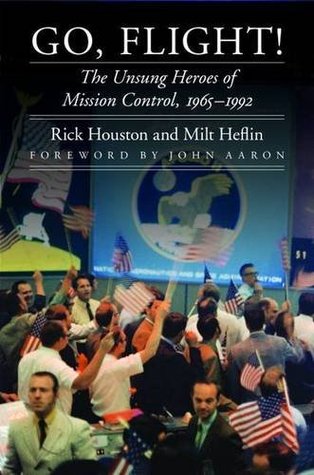
Go, Flight!: The Unsung Heroes of Mission Control, 1965–1992 (Outward Odyssey: A People's History of Spaceflight)
Rocket Men: The Daring Odyssey of Apollo 8 and the Astronauts Who Made Man's First Journey to the Moon
We Seven: By the Astronauts Themselves
Flight: My Life in Mission Control
Starman: The Truth Behind The Legend Of Yuri Gagarin
Space Launch Complex 10 by Joseph T. Page IIBuilding Moonships by Joshua StoffHidden Women by Rebecca RissmanStages to Saturn by Roger E. BilsteinThe New Guys by Meredith Bagby
Launching the Space Age
43 books — 6 voters
Amelia, the Venutons and the Golden Cage by Evonne BlanchardAmelia, the Moochins and the Sapphire Palace by Evonne BlanchardCosmos by Carl SaganThe Right Stuff by Tom WolfeThe Martian Chronicles by Ray Bradbury
A Space.com Reading List
23 books — 16 voters

Starship's Mage by Glynn StewartA Big Ship at the Edge of the Universe by Alex WhiteMusketeer Space by Tansy Rayner RobertsRaven Stratagem by Yoon Ha LeeFirst Don by J.S.  Fields
Magical / Psychic Spaceship Pilots!
71 books — 23 voters

Carl Sagan
One consequence of this train of argument is that, even if civilizations commonly arise on planets throughout the Galaxy, few of them will be both long-lived and nontechnological. Since hazards from asteroids and comets must apply to inhabited planets all over the Galaxy, if there are such, intelligent beings everywhere will have to unify their home worlds politically, leave their planets, and move small nearby worlds around. Their eventual choice, as ours, is spaceflight or extinction.

Carl Sagan, Pale Blue Dot: A Vision of the Human Future in Space

Carl Sagan
The scope and audacity of John Kennedy’s May 25, 1961, message to a joint session of Congress on “Urgent National Needs”—the speech that launched the Apollo program—dazzled me. We would use rockets not yet designed and alloys not yet conceived, navigation and docking schemes not yet devised, in order to send a man to an unknown world—a world not yet explored, not even in a preliminary way, not even by robots—and we would bring him safely back, and we would do it before the decade was over. This ...more
Carl Sagan, Pale Blue Dot: A Vision of the Human Future in Space

More quotes...