
Demosthenes
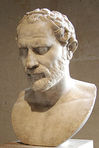
Demosthenes (384 – 322 BC) was a prominent Greek statesman and orator of ancient Athens. His orations constitute a significant expression of contemporary Athenian intellectual prowess and provide an insight into the politics and culture of ancient Greece during the 4th century BC.
Demosthenes learned rhetoric by studying the speeches of previous great orators. He delivered his first judicial speeches at the age of 20, in which he argued effectively to gain from his guardians what was left of his inheritance. For a time, Demosthenes made his living as a professional speech-writer (logographer) and a lawyer, writing speeches for use in private legal suits.
Demosthenes learned rhetoric by studying the speeches of previous great orators. He delivered his first judicial speeches at the age of 20, in which he argued effectively to gain from his guardians what was left of his inheritance. For a time, Demosthenes made his living as a professional speech-writer (logographer) and a lawyer, writing speeches for use in private legal suits.
edit descriptions of this character
No photos have been uploaded yet.
Books with Demosthenes

|
Alexander: Child of a Dream (Aléxandros, #1)
by
—
published
1998
add/edit characters
|
|

|
The Sands of Ammon (Aléxandros, #2)
by
—
published
1998
add/edit characters
|
|

|
The Peloponnesian War
by
—
published
2003
add/edit characters
|
|

|
Conquest and Empire: The Reign of Alexander the Great
by
—
published
1988
add/edit characters
|
|

|
The Pelican History of Greece
by
—
published
1965
add/edit characters
|
|

|
Demosthenes and Cicero. Alexander and Caesar (Lives, Volume VII)
by
—
published
100
add/edit characters
|
|

|
Demóstenes. La agonía de Grecia
by
—
published
1938
add/edit characters
|
|

|
The Oxford Handbook of Demosthenes
by
—
published
2019
add/edit characters
|
|

|
Of the Origin and Progress of Language, Vol. 2: to which are annexed Three Dissertation, Viz, 1. of the Formation of the Greek Language, 2. of the Sound of the Greek Language, 3. of the Composition of the Antients, and Particularly of that of Demosthenes
by |
|


