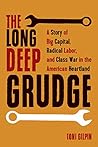
The Long Deep Grudge: A Story of Big Capital, Radical Labor, and Class War in the American Heartland

Reader Q&A

To ask other readers questions about The Long Deep Grudge, please sign up.

Answered Questions (1)

Diana Frank Here’s a quote from the book that is helpful. “Long-term vision, however, was not all that distinguished the FE leadership from labor’s mainstream: th…moreHere’s a quote from the book that is helpful. “Long-term vision, however, was not all that distinguished the FE leadership from labor’s mainstream: the rejection of the politics of productivity also generated a different conception of what effective day-to-day union representation looked like. Because FE leaders believed they had a duty not to bolster but to claw back as much corporate wealth as possible, they were obliged to thwart Harvester at every turn, so they resisted schemes that linked compensation to productivity and noisily challenged the company’s efforts to reduce labor costs by fleeing to the American South. And, most visibly, they sought to directly undermine in a myriad of ways management’s ceaseless drive for greater “efficiency” on the shop floor. “The creation of a normal working day,” Karl Marx maintained, is “the product of a protracted civil war, more or less dissembled, between the capitalist class and the working-class.” FE leaders concurred that continual combat was necessary to prevent Harvester management—through the manipulation of its deliberately dissembled piecework system—from encroaching on the limits of the agreed-upon “normal working day”; the frontline troops were the FE stewards, whose primary mission was to ensure that union members got paid what they were owed and didn’t have to work themselves to exhaustion to get it. Even once they’d conceded defeat and entered the UAW, former FE leaders like my father clung to the notion, in keeping with what the anarchists had insisted back in 1886, that to “reduce hours without cutting pay” should remain a prime directive for the labor movement. But the productivity bargain struck by Walter Reuther and the CIO mainstream meant that “the shorter workweek movement had been decisively defeated within the industrial union movement,” as historian Jonathan Cutler has noted. As a result, “the discourse of shorter hours—the vision of less work and more pay—has vanished from the horizon of possibility” and the right to define what constitutes a “normal working day” has been handed back to the employers. 4”

— The Long Deep Grudge: A Story of Big Capital, Radical Labor, and Class War in the American Heartland by Toni Glipin(less)

Unanswered Questions

About Goodreads Q&A

Ask and answer questions about books!

You can pose questions to the Goodreads community with Reader Q&A, or ask your favorite author a question with Ask the Author.

See Featured Authors Answering Questions

Learn more