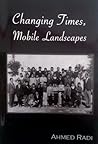
Changing Times, Mobile Landscapes

Reader Q&A

To ask other readers questions about Changing Times, Mobile Landscapes, please sign up.

Answered Questions (1)

Asmaa Zouzal This Novel, “Changing Times, Mobile Landscapes” is written by Ahmed Radi, who is an English professor in Cadi Ayyad University, Marrakech. From the fi…moreThis Novel, “Changing Times, Mobile Landscapes” is written by Ahmed Radi, who is an English professor in Cadi Ayyad University, Marrakech. From the first look at the title, the events of this novel may be about how people and their values change over time, and also the effects of technology on these new generations.
The writer shows from the very first beginning that the main character is a professor in a university which is in bad conditions; weeds are left uncultivated and classrooms are inhospitable. Both the professor and the student are not motivated and what they do is out of obligation. People are very materialist with great regard for tangible possessions, so that he teaches even in private institutions to get some extra money to preserve his dignity and live the life of some wealthy students. For the other students, they are reading for a paper called a diploma to get to the “marché de travail’’, they are between the managerial style and the real world which is dusty and kind of corrupted.

Then, there is a flash back showing the life of the professor as a student. University in that time is a place of attraction because it allows any kind of transgression. He seems that he likes the philosophy department considering it as a place of intellect and prestige; he is
fascinated by its leaders who are trained in solid argumentation. In his


English Department, he is considered superficial because of his disconnection of the real life and the problems of the nation. He is very attached to languages and the profession of teaching, even he cannot understand why many members of his family are in that profession, but his mother says that it is in the blood. He still looks back with admiration to his father who is a teacher, a good citizen who does his job as it must be done. He thinks that the teachers of that time are very honest, but heartless, they use all kind of punishment, even in the street or worse in the “hammam’’ when they ask a question or ask for an instant recitation and do not get an answer. Said still remember his personal experience of punishment; a confusing feeling of injustice and fear, cries of pain can be heard from far away. It is like a military system where everyone has to execute orders. But to teacher, all of this is done, because they want them to be reliable men. These tortures of primary school remind Said of the Koranic one, where the Fkih has no mercy toward young children with weak memories. Despite this sufferance, there is a time of recreation or “istiraha” when students feel free and liberated, when they can make parody of teachers or the Fkih himself. Even the teacher or the Fkih who want to make of a student a dependable men by punishment, Said is really against this idea, he compares it with if someone enjoys eating under the threat of a gun, then a student would learn under hard punishment.

In the end of this flashback, Said shares English language and the beauty of this world even inadequate atmosphere. Even though, he is sad not to be able to write in his Moroccan language, mentioning the silent language of his grandmother; those people do not betray their language like the new generation that become more urbanized. Also he has a feeling of guilt not to learn Amazigh language in order to preserve the continuity his grandmother and his two daughters.

Again Said as a student, but this time doing his postgraduate studies in Great Britain. He does not believe it to be in London and the fact to get his first trip by plane.
He is very happy to have his scholarship, and values it especially when he sees a few Moroccan students suffering, working in restaurants to get some money, one of them robs a book due to his meager grant. Said moves to the west of the United Kingdom; Wales. There, he meets a Scandinavian girl named Sarah. Despite the huge difference between both of them; color of skin, race… They were in love of each other. He kind of forces her to visit Morocco. She was fascinated by people and the sun of the country, but their relation does not last so long due to cultural distinction.

Said was surprised by the difference of English pronunciation across the United Kingdom, especially the historical troubles between Wales and England. All of this pushed him to think of his own country and the conflict between the various languages that it has. Said as usual is outside of the problems of the Moroccan society as of the United Kingdom; what he is struggling for is mastering his third language and gets his master degree.

The end of the novel was happy; Said meets Diana and has a good conversation about what they study and what they read, it was like they know each other for a long time, but slightly he stills recall the betray of the language of his grandmother, father and the language of the Koran, and the love with that woman. Those things are not meant to be justified.
(less)

About Goodreads Q&A

Ask and answer questions about books!

You can pose questions to the Goodreads community with Reader Q&A, or ask your favorite author a question with Ask the Author.

See Featured Authors Answering Questions

Learn more