C.W. Hawes's Blog, page 3
June 4, 2024
Ideas Come From Schenectady
When asked where he got the ideas for his stories, Harlan Ellison said Schenectady.
About as good an answer as any, I’d say.
Last week we said, following Mr. Ellison, that writers write. Just like plumbers plumb, and carpenters carpenter, and mechanics mechanic.
However, in order to write, writers have to come up with ideas for their stories. Just like comedians must come up with jokes or funny stories. Now, take my wife… Please! Ahem.
So where do writers get the ideas for their stories?
My answer to that question is: ideas are everywhere. Take anything. A scene. A person. A story. A comment someone makes. A situation. Everything that exists in the world or the mind is grist for the writer’s mill.
Way back in 11th grade, my speech teacher told the class one day (when I wasn’t there) that I was the only person he knew who could talk on any subject, for any length of time, and say absolutely nothing. Thank you, Mr. Kline.
So the next time I was in class, my classmates wanted a demonstration. The subject decided upon was what does a rainstorm feel like to a horse.
I had all of 15 seconds to prepare. I spoke for 5 minutes or so, to rousing applause at the end.
I did what all good creative writers or speakers do, I made it up and made it entertaining. Because to this day I still don’t know what a rainstorm feels like to a horse.
Ideas are everywhere. What separates writers from non-writers is that writers see the ideas and non-writers don’t.
I think this applies to all creatives. Not just writers.
Michelangelo saw David in the block of marble and chipped away until he freed him.
My post-apocalyptic cozy catastrophe, The Rocheport Saga, began with a single sentence that popped into my head one day: Today I killed a man and a woman.
That sentence turned into 2200 plus handwritten pages. So far I’ve published 7 volumes of the saga and hope to return to it some day to finish it.
I was watching The X-Files reruns and asked myself what if Mulder and Scully were pursuing Cthulhu instead of aliens. And Pierce Mostyn was born.
Ideas are everywhere. One just has to see them. Writers do and non-writers don’t. Creatives create. Non-creatives don’t. Creatives see the ideas and turn them into art, music, literature, and inventions.
Festival of Death began life as a short story assignment for a Writers Digest course. The story was about a welfare worker (I worked in the county welfare department at the time) who wanted to reduce his ever growing caseload. So he invited his clients to his home for dinner, killed them, and ate them. The idea horrified my WD instructor.
Years later the clients were being sacrificed to Aztec deities in the rituals of a neo-Aztec cult in the caves below Minneapolis. The cult was discovered and broken up by my ace PI, Justinia Wright.
Justinia Wright herself came about from a story I read featuring an amateur sleuth named Athalea Goode.
I pondered on that name. Athalea is from the Greek and means truth. Goode is English meaning good. Truth and goodness.
What if I switched it up to Latin? Justinia means justice, and Wright is English and means a maker or builder. A maker of justice.
And then drawing inspiration from my sister for her physical characteristics, Justinia Wright was born. For her Watson, I used myself as the model. And so the brother and sister PI team of Tina and Harry Wright was born. Additionally, I borrowed the ethos of the Nero Wolfe stories. And now I have 9 books and several short stories in the series and more are on the way.
Some writers get inspiration from their dreams. HP Lovecraft and Stephen King to name two well-known authors.
Dreams have never done it for me. I find more than enough material in the waking world.
I accumulate fountain pens. I like them. And sometimes I get a pen with the former owner’s name engraved on the pen. When I see that name I wonder why do I, a stranger, have the pen instead of some family member or significant person in the former owner’s life.
From that musing, my flash fiction piece, “It all goes” came about.
I buy a lot of estate pipes. Part of my desire to reuse and repurpose perfectly good items instead of dumping them in landfills.
I have several pipes made in Germany during World War II. I wonder who smoked the pipe during those years. Was it a Nazi official? A soldier? A submarine commander? A businessman?
Then how did the pipe find its way to America? And who smoked it here?
There’s a story, multiple stories, in those pipes. I just don’t know what they are yet. But it will come to me, of that I’m sure.
Ideas are all around us. Creatives see them, hear them, smell them, taste them, touch them — and turn them into wonderful things. The rest of the world just walks on by, not knowing they are there.
Comments are always welcome! And until next time, happy reading!
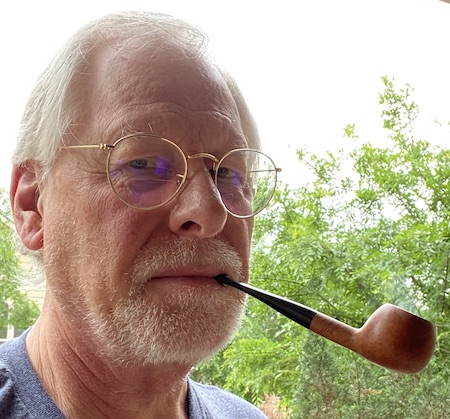 CW Hawes is a playwright; award-winning poet; and a fictioneer, with two bestselling novels. He’s also an armchair philosopher, political theorist, social commentator, and traveler. He loves a good cup of tea and agrees that everything’s better with pizza.
If you enjoyed this post, please consider buying me a cup of tea. Thanks! PayPal.me/CWHawes
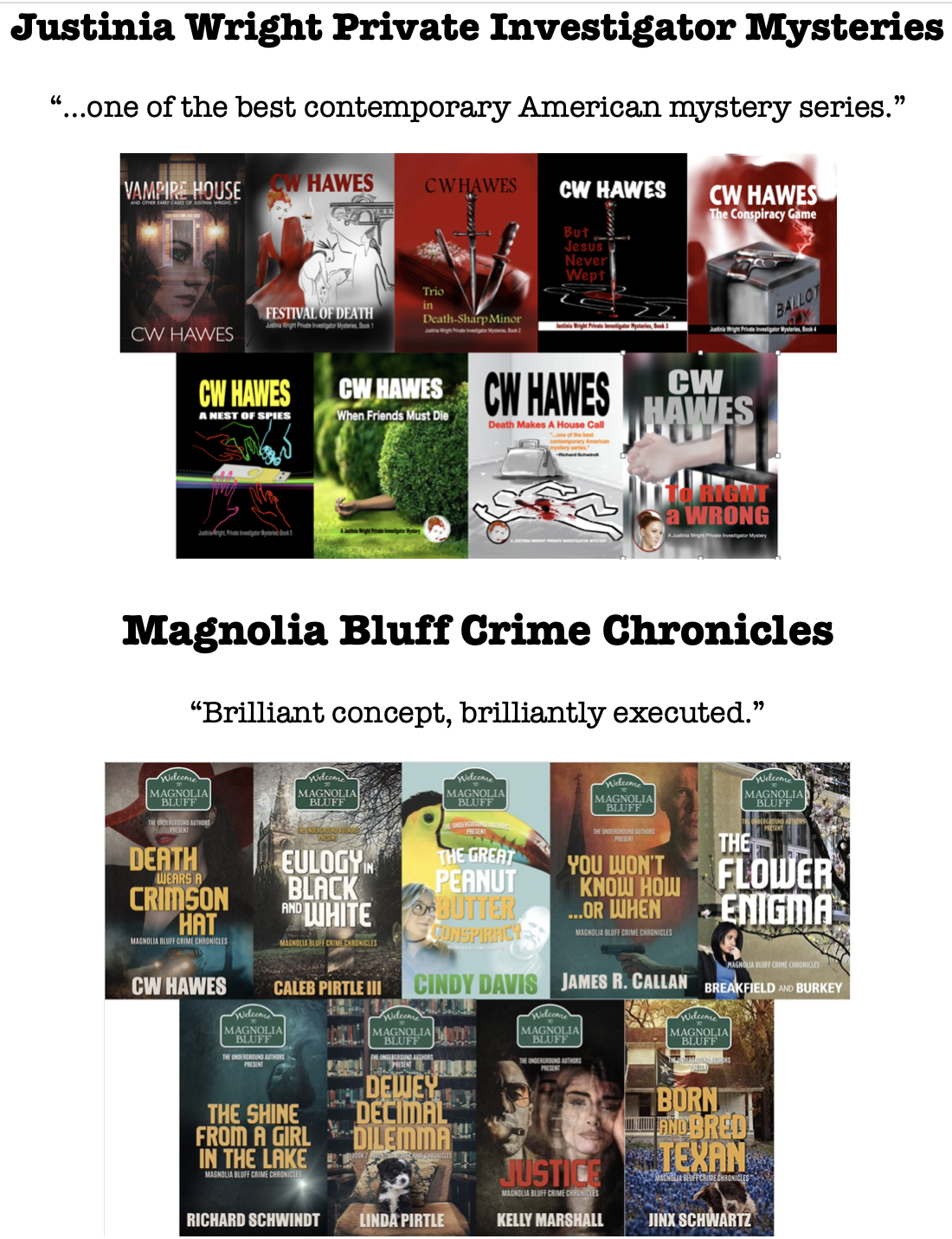
Justinia Wright Private Investigator Mysteries on Amazon!
Magnolia Bluff Crime Chronicles on Amazon!
Share This!

 The post Ideas Come From Schenectady first appeared on CW Hawes.


May 29, 2024
Writers Write
Harlan Ellison was known for his opinion that writers write. And he proved this time and again by writing at parties and in bookstore windows, just to name two frequent out of the norm places.
For Ellison, the circumstances of a writer’s life does not matter. Writers will write no matter what is going on in their lives.
Personally, I agree with Ellison. And therefore I find the writing habits of writers, especially those of successful writers, to be a most interesting study. And an instructive one as well.
Anthony Trollope
Anthony Trollope is my mentor when it comes to writing. He was a living example of Ellison’s Dictum.
After feeling his way into the writing business through three failed novels (and Trollope did view writing as a business), he hit upon his writing model.
Trollope’s manservant would wake him at 5 AM and provide him with a cup of coffee. (The servant was paid extra for this duty.) Trollope would go to his desk and spend a half-hour reviewing what he’d written the previous day.
After his review, he set his watch on the desk and proceed to write by hand with a dip pen one 250 word page of text every 15 minutes.
At the end of 2 1/2 hours, he put his pen aside and got ready for his workday at the post office. Another 10 pages and 2500 words of his story or novel under his belt.
Of note, Trollope kept a journal recording when he failed to meet his goal and why. He would then do his best to eliminate whatever it was that got in the way of him reaching his goal. Very instructive that.
Trollope maintained his part-time writing schedule for his entire life, even after he finally left his post office employment.
His annual word production amounted to over 760,000 words. Not too shabby for a part-time writer.
Hugh B. Cave
Hugh Cave began his writing career at the beginning of the 1930s. During that decade he sold 800 stories to pulp magazines. Which comes to 6 or 7 stories every month. And most of the stories were in the novelette word range.
That’s one heck of a lot of words.
Cave slowed down in the 1940s when he switched to writing for the higher paying slick magazines. During the 40s, he “only” sold around 350 stories. He might have written more, but he did take time off to fight a war.
Writers do indeed write.
The King of the Pulps
H. Bedford-Jones “…considered writing his profession in life, a means to be financially independent…” (King of the Pulps: The Life & Times of H. Bedford-Jones by Peter Ruber, Darrell C. Richardson, Victor A. Berch, p. 53)
To that end, in his 40 year career, Bedford-Jones wrote some 25 million words. An average of 625,000 words per year.
Although his output was undoubtedly greater in the first two-thirds of his career, as ill health slowed down his writing greatly in the last years of his life.
Bedford-Jones kept four typewriters busy — each with a different story.
If he reached an impasse in the story he was working on (he was a pantser and made it up as he went along), he simply slid over to the next typewriter and worked on that story.
HB-J believed writers write. No time for writers block.
The Perry Mason Man
Erle Stanley Gardner, a good friend of H. Bedford-Jones, while a partner in a law firm, wrote 100,000 words a month and endured a 90% rejection rate in order to learn the craft of writing.
But Gardner persevered through the rejections until Perry Mason made him wealthy. The rejection slips were worth it.
Writers Write
I can go on, but I think you get the point. And I haven’t even touched upon the writers working today who turn out a prodigious amount of words in order to make a buck.
Ellison was right: writers write. They do so because they have to. They are compelled to do so by a force within their beings. I know, because it is true for me.
As a reader, I’m glad writers write. Very glad. Because I am assured of an endless supply of other lives and other worlds and other experiences that I may make my own.
I am grateful for writers who write and wish for them very long careers.
Comments are always welcome! And until next time, happy reading!
CW Hawes is a playwright; award-winning poet; and a fictioneer, with two bestselling novels. He’s also an armchair philosopher, political theorist, social commentator, and traveler. He loves a good cup of tea and agrees that everything’s better with pizza.
If you enjoyed this post, please consider buying me a cup of tea. Thanks! PayPal.me/CWHawes
Justinia Wright Private Investigator Mysteries on Amazon!
Magnolia Bluff Crime Chronicles on Amazon!
Share This!
 The post Writers Write first appeared on CW Hawes.
May 21, 2024
Courtin’ Disaster: A Review
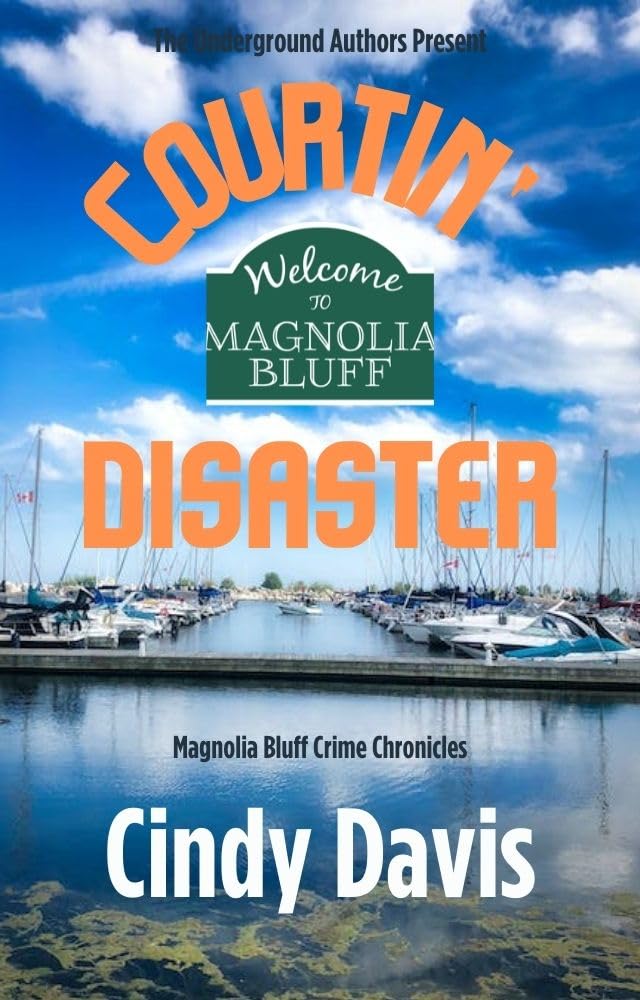
With the publication of Courtin’ Disaster by Cindy Davis, the Magnolia Bluff Crime Chronicles numbers an even 2 dozen novels.
As I posted previously, the Chronicles are actually a collection of mini-series. Each author focuses the spotlight on their special protagonists, and brings in the other characters as needed to round out the story.
Courtin’ Disaster continues the ongoing adventures of Bliss Jager, who has now settled in Magnolia Bluff.
Her top priority, aside from refurbishing and landscaping her new home, is to move her friend, Merrick Doyle, who is a ghost, to her new home, getting him out of the General Store so he can be with “family”.
Of course nothing goes according to plan, does it? And when you add murder to the mix and vengeful ex-boyfriends, it all just gets that much more exciting. Well, exciting for the reader, that is.
You can read the book’s blurb over on the Amazon page. And while you’re there, pick up a copy.
What I especially like about the Bliss Jager mini-series within the world of Magnolia Bluff is the excellent storytelling by Cindy Davis. I think this is her best work. And what makes it so is the cast of characters she’s pulled together who tell us their collective and individual stories.
Bliss, Whitney, Hannah, Merrick, Chief Tommy Jager (no relation to Bliss), and let’s not forget Diablo, reveal to us bits of who they were and who they currently are.
Which makes them real people. People no different from those I meet in the neighborhood and gradually learn who they are, learn what makes them tick.
To let the characters tell their stories is the hallmark of a great writer. As I often say, we’re just the amanuensis recording what these people tell us about themselves. And in the Bliss Jager stories, Cindy Davis is a great writer.
Courtin’ Disaster contains humor, a lot of humor; it contains a well-crafted puzzle; entertaining sub-plots; just the right amount of description to make you feel like you are right there in Magnolia Bluff; and food, let’s not forget the food. There’s lots of it. And it is delish.
I thoroughly enjoyed Courtin’ Disaster and I think you will, too. Be sure to get your copy on Amazon. Before the price goes up.
Comments are always welcome! And until next time, happy reading!
CW Hawes is a playwright; award-winning poet; and a fictioneer, with two bestselling novels. He’s also an armchair philosopher, political theorist, social commentator, and traveler. He loves a good cup of tea and agrees that everything’s better with pizza.
If you enjoyed this post, please consider buying me a cup of tea. Thanks! PayPal.me/CWHawes
Justinia Wright Private Investigator Mysteries on Amazon!
Magnolia Bluff Crime Chronicles on Amazon!
Share This!
 The post Courtin’ Disaster: A Review first appeared on CW Hawes.
May 14, 2024
Book 24 — and Counting!
This month the Magnolia Bluff Crime Chronicles will reach an even two dozen books in the series.
Twelve authors setting their stories in that idyllic Texas Hill Country town — where murder waits in the wings.
Before I go any further, you’ll probably want to pick up your pre-order copy of Courtin’ Disaster by Cindy Davis. It’s only 99¢ and you can get it on Amazon. I read a proof copy a while back and it is good.
Even though the Magnolia Bluff stories are all set in that little town nestled on the shore of Burnet Reservoir, being twelve authors, we actually have 12 mini-series rather than one big series.
I thought I’d give a quick breakdown of these mini-series so you can read them together if you so wish.
Graham Huston
Graham Huston features in two books by the late Caleb Pirtle III, the founder of the Underground Authors:
Eulogy in Black and White
Death in the Absence of Rain
Graham is the editor of the Magnolia Bluff Chronicle, the town newspaper, a position he inherited upon the murder of Neal Holland, the former editor.
I think these are the best books in the series. Written by a master craftsman of the written word. You don’t want to miss them.
Bliss Jager
Bliss is homeless by choice, but gets captured by Magnolia Bluff’s gravitational pull and can’t escape.
She’s the creation of Cindy Davis and I think the books are some of the funniest in the series.
You can read Bliss’s escapades in:
The Great Peanut Butter Conspiracy
When Bad Things Happen to Good Mice
Only the Good Die Young
Courtin’ Disaster
Father Lee/Father Frank
James Callan brings his Father Frank to Magnolia Bluff on vacation, where he solves a crime before it happens.
You Won’t Know How… Or When
JJ and Jo
Authors Breakfield and Burkey bring two characters from their Enigma series to Magnolia Bluff for some R & R. Of course, that’s not what they get.
The Flower Enigma
The Killer Enigma
Dr. Mike Kurelek
Richard Schwindt writes some of the best indie fiction being written.
His characters step out of the page every time you open the book. They are that real.
He infuses his stories with humor, suspense, and pathos. We relate to what he writes and the stories he tells because in the final analysis they are about us.
You can follow Dr. Mike’s adventures in
The Shine from the Girl in the Lake
Men Lying Dead in a Field
Caroline McCluskey
Every town of some size has a library and its head librarian, and so Magnolia Bluff has Caroline McCluskey.
Linda Pirtle has given us a charming, witty, and intelligent librarian sleuth. A worthy addition to the librarian sleuth sub-genre of mystery fiction.
Her books are funny, suspense-filled cozy mysteries, filled with a host of delightful characters, as well as a few villains. Check ‘em out.
The Dewey Decimal Dilemma
The Dog Gone Diamond Dilemma
Girlfriend Retreat… Cheaper Than Therapy
Madison Jackson
State Conservation Officer Madison Jackson leads anything but a quiet life in our town.
This mini-series by Kelly Marshall runs on high-octane suspense and plenty of thrills.
Justice
Bye Baby Bye
Blue Bonet
Jinx Schwartz brings us to the ultimate in cozy mystery delightfulness with the adventures of Blue Bonet.
Born and Bred Texan
Texas Summers are Murder
Maddy Dawson
KD McNiven introduces us to Deputy Detective Madeline (Maddy) Dawson.
Maddy is starting her career over in peaceful and quiet Magnolia Bluff. Little does she know that murder is waiting in the wings.
McNiven is known for her intense thrillers and she doesn’t disappoint.
Who Killed Lilly Paine?
Brandon Turner
Joe Congel writes top drawer fiction. I’ll read anything he writes. Why? Because it is just doggone good.
His characters are real people. They are cut from the cloth of life. They are your neighbors and co-workers.
Turner is an ex-NYC narcotics cop who chooses to early retire in Magnolia Bluff. He does so not by design but by chance. He literally puts his finger on the map and says, This is it. Little does he know he’s about to face murder once again.
Second Chances
Mike and Maureen Donovan
RC and JP Carter are new to the Underground Authors, but they aren’t new to writing. They’re the creators of the O’Rourke series of traditional mysteries with a contemporary vibe.
In their first offering in the Magnolia Bluff Crime Chronicles, they give us a paranormal mystery that is based on their own experience as paranormal investigators. It is one heck of a fun ride.
A Chance of a Ghost
Harry Thurgood and Rev. Ember Cole
I had the daunting task of writing the inaugural book of the Magnolia Bluff Crime Chronicles. And I was nervous as all get out.
That I did okay can be seen in comments such as:
“A well-crafted whodunnit that keeps the reader guessing.”
“This book is awesome!”
“…a master storyteller…”
Harry and Ember are amateur sleuths not by choice. They are forced into sleuthing by MBPD Investigator Reece Sovern who arrests them for murder on more than one occasion.
Couple some romance with mystery and characters I love writing about and you get a top-notch read.
“This book has it all. I loved it.”
Death Wears A Crimson Hat
Ten Million Ways To Die
Who Mourns Elektra?
Read the books from 1 to 24, or read them randomly, or read them as mini-series. The Magnolia Bluff Crime Chronicles has something for everybody.
Pick them up on Amazon.
Comments are always welcome! And until next time, happy reading!
CW Hawes is a playwright; award-winning poet; and a fictioneer, with two bestselling novels. He’s also an armchair philosopher, political theorist, social commentator, and traveler. He loves a good cup of tea and agrees that everything’s better with pizza.
If you enjoyed this post, please consider buying me a cup of tea. Thanks! PayPal.me/CWHawes
Justinia Wright Private Investigator Mysteries on Amazon!
Magnolia Bluff Crime Chronicles on Amazon!
Share This!
 The post Book 24 — and Counting! first appeared on CW Hawes.
April 30, 2024
What Am I Reading These Days?
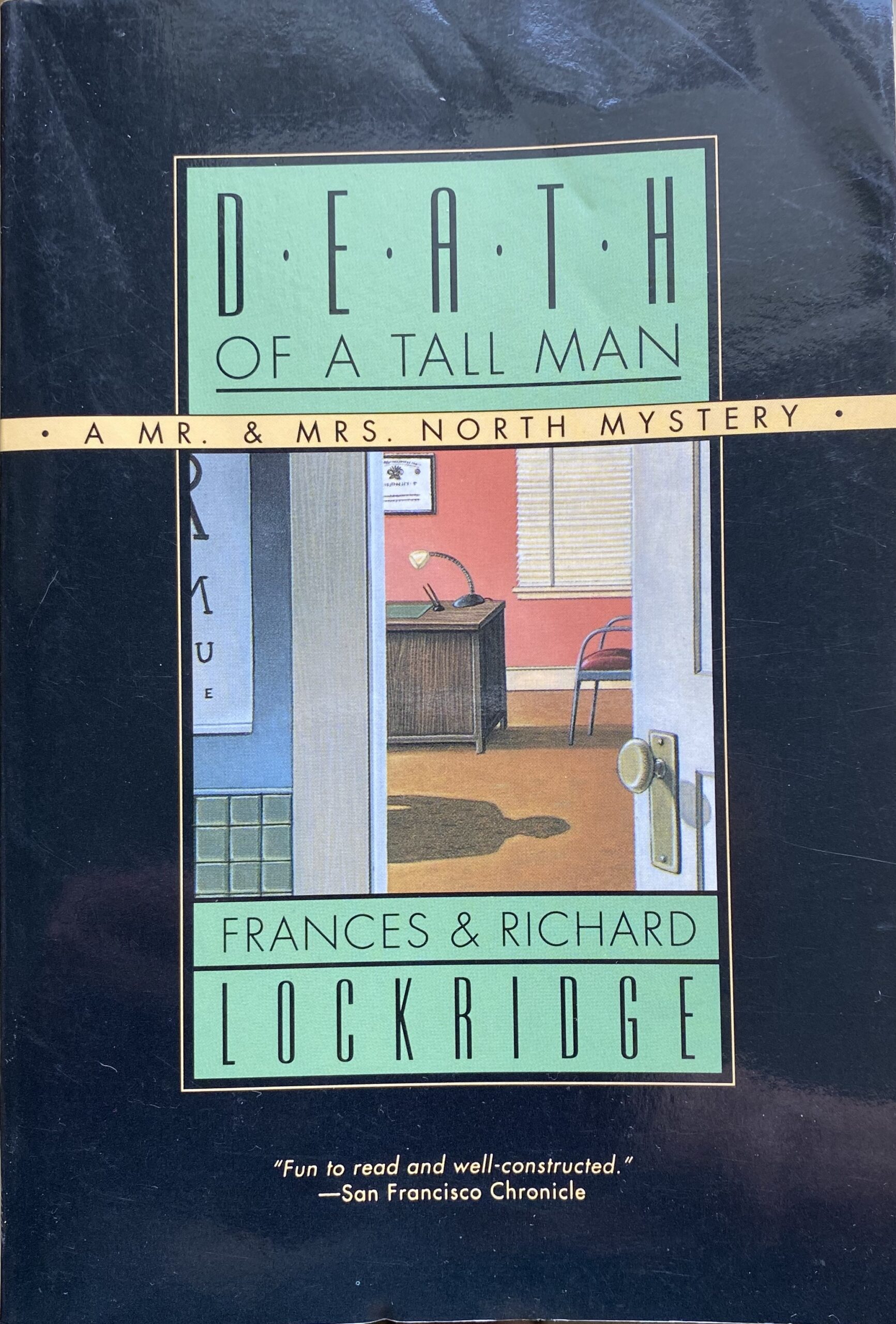
What am I reading these days? Mysteries!
By necessity. Although I do very much enjoy mysteries, in spite of my reading them of necessity.
But why by necessity? Because I’ve started writing my next Magnolia Bluff mystery and if I don’t read in the same genre I’m writing in my mind starts coming up with ideas in the genre I’m reading.
Don’t know why that happens, but it does. And I don’t particularly want flying saucers in my murder mystery.
And at the moment I’m reading the delightful Mr. and Mrs. North mysteries.
The Mr. and Mrs. North mysteries were the creation of Frances and Richard Lockridge.
The novels ran from 1940 to 1963, when Frances died and Richard decided not to continue the series alone.
The setting is New York City, where Pam and Jerry North live and get involved in the murder investigations of their friend, Homicide Lieutenant Bill Weigand.
These thoroughly enjoyable mysteries are pretty much unknown today. But the series was very popular in the ‘40s and ‘50s. The books spawned a Broadway play, a movie, a radio show that ran from 1942 to 1954. And a TV series that ran for 2 seasons (1952 to 1954), totaling 57 episodes.
What’s the attraction? Colorful characters with whom you fall in love, plenty of humor, a good measure of suspense, and clever whodunit storylines.
The books are great fun. Thoroughly entertaining. A pleasant way to spend a few hours. I can see why they were so popular in the 40s and 50s.
But like all old books some of the novels contain language and attitudes that are no longer accepted as belonging to proper society today.
So if you are easily offended by how our parents, grandparents, or great-grandparents may have acted or spoken — it’s probably best if you not read the books.
If you aren’t so offended, pick yourself up a few. You will be in for a rollicking good time.
Comments are always welcome! And until next time, happy reading!
CW Hawes is a playwright; award-winning poet; and a fictioneer, with two bestselling novels. He’s also an armchair philosopher, political theorist, social commentator, and traveler. He loves a good cup of tea and agrees that everything’s better with pizza.
If you enjoyed this post, please consider buying me a cup of tea. Thanks! PayPal.me/CWHawes
Justinia Wright Private Investigator Mysteries on Amazon!
Magnolia Bluff Crime Chronicles on Amazon!
Share This!
 The post What Am I Reading These Days? first appeared on CW Hawes.
April 24, 2024
My Favorite Pencils
I love pencils. Pencils with soft, creamy leads. The kind that flow across the paper as though they were ink: 3B to 6B work best for me.
It’s a bit difficult to find such in the sea of No. 2 (HB) pencils.
Why did the HB pencil become the standard? I have no idea. It’s a hard lead and leaves a faint, light line; unless you press the heck out of it. And who wants to do that? Tendonitis and carpel tunnel, you know.
So if one doesn’t use the old No. 2, what does one use? Good question, that. And I have a few answers.
Woodcased PencilsThe woodcased pencil dates back to the middle of the 1500s. But the pencil as we know it today was simultaneously invented in the 1790s by Joseph Hardtmuth in Austria and Nicolas-Jacques Conté in France.
There are dozens of pencil brands available, but only two are made in the USA. The companies are General Pencil Company and Musgrave Pencil Company.
Both companies make excellent pencils that are very easy on the wallet and whose quality matches or surpasses most of the foreign competition. They are the pencils I use almost exclusively.
Of the two companies, I prefer the pencils from Musgrave because I find their lead has a softer and creamier feel to it. It flows onto the paper like ink.
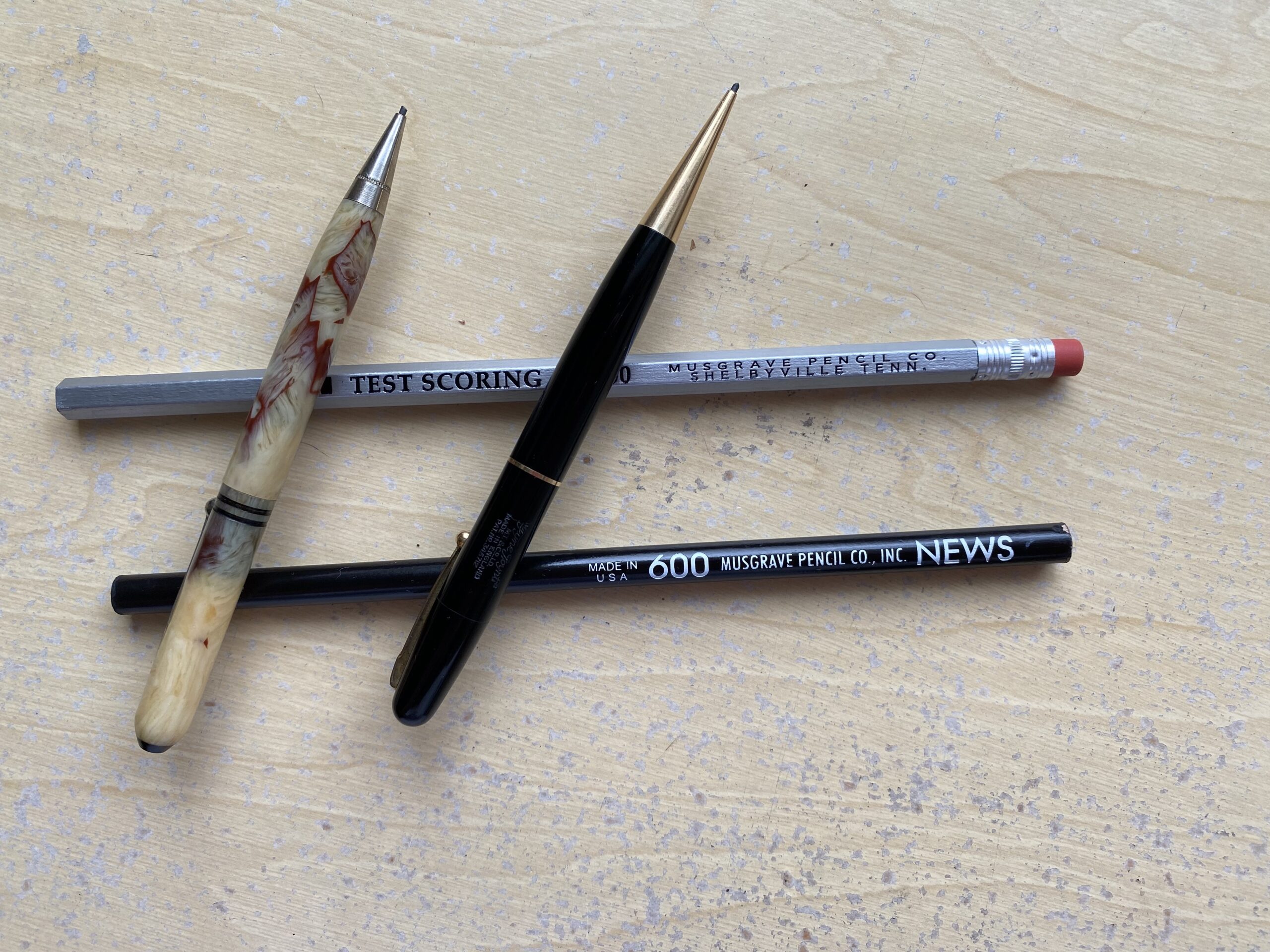
The 600 News and the Test Scoring 100 are my favorite Musgrave pencils. The lead in those two is soft and dark. Easy on the hands. No writer’s cramp. And I find them to be superior to the newly reintroduced and highly talked about Blackwing pencils, which are Japanese made. And run $2.50 per pencil compared to the 600 News at $1.17 and the Test Scoring at 85¢.
You can buy Musgrave pencils direct from the company: https://musgravepencil.com
Mechanical PencilsI’m a big fan of mechanical pencils. They are very economical. Much more so than woodcased pencils. And their length never changes, so the feel is consistent in the hand. Plus, the pencil will last several lifetimes when given reasonable care. And the lead sticks are dirt cheap.
My go to pencils are a vintage Sheaffer and a vintage Mabie Todd “Fyne Poynt”.
They use .046 inch/1.1mm leads. The same size found in woodcased pencils.
Both pencils twist to push the lead forward. To load the pencil, simply retract the pusher a bit, insert the stick of lead, then retract all the way.
The Sheaffer and Mabie Todd are my favorites out of the small collection I have. The Sheaffer has a beige-yellow base with red, gray, and black swirls; a black end cap; and silver-colored clip and front cone. The Mabie Todd is black, with gold-colored clip, mid-ring, and front cone. Both are very stunning pencils.
Occasionally I’ll use a lead holder. My interest in them goes back to high school drafting class.
To load a lead holder, you press a button at the back of the pencil body which extends the “claw” from the front. You then insert the lead and let go of the button. The “claw” holds the lead in place.
What’s especially nice about lead holders is that they are about the same length as a new woodcased pencil — and they never get shorter!
The Joy of PencilsPencils are a cheap alternative to pens. They produce a fairly consistent line, won’t skip or blob on the paper, won’t dry up, will write at any angle, will always start (I hate when a pen won’t write), and they don’t leak (making them great to use on airplanes, and safe to put in your shirt pocket).
I love pencils and find that I reach for them more often than a pen these days.
Find yourself a good vintage mechanical pencil on eBay and you’ll have a companion for life.
Or visit the Musgrave website and pick up the best woodcase pencils available today.
Comments are always welcome! And until next time, happy reading!
CW Hawes is a playwright; award-winning poet; and a fictioneer, with two bestselling novels. He’s also an armchair philosopher, political theorist, social commentator, and traveler. He loves a good cup of tea and agrees that everything’s better with pizza.
If you enjoyed this post, please consider buying me a cup of tea. Thanks! PayPal.me/CWHawes
Justinia Wright Private Investigator Mysteries on Amazon!
Magnolia Bluff Crime Chronicles on Amazon!
Share This!
 The post My Favorite Pencils first appeared on CW Hawes.
April 16, 2024
A Chance of a Ghost Review
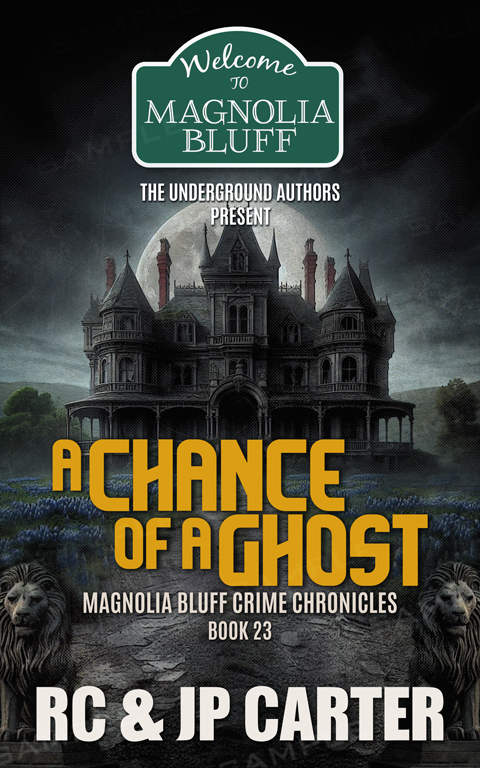
I’m offering you a vacation. To beautiful Magnolia Bluff, Texas. In the heart of the Texas Hill Country. Beautiful scenery. Wineries. A quaint little town. With murder and ghosts.
My fellow Underground Authors, Rob and Joan Carter, have their book, A Chance of a Ghost, on pre-order for only 99¢.
It’s Book 23 in the Magnolia Bluff Crime Chronicles series and it’s a spooktacularly thrilling mystery.
I just finished reading an ARC. And it didn’t disappoint. What’s especially fun about A Chance of a Ghost is that we get to see how ghost “busters” actually work.
Rob and Joan are members of the Tampa Bay Spirits, a group that investigates paranormal activity. And they bring their experience to the newest murder mystery in the Magnolia Bluff Crime Chronicles.
Mike and Maureen Donovan, (fictional) members of Tampa Bay Spirits, depart Tampa and find themselves in Magnolia Bluff to help Mike’s cousins rid their newly renovated home of whatever it is that is making doors slam and things move.
But they no sooner arrive than Mike has a premonition that someone in town is going to die. And that’s something they hadn’t counted on.
Mike and Maureen meet Harry Thurgood, the owner of the Really Good Wood-Fired Coffee and Ice Cream Emporium (known as the Really Good to the locals), and Mike begins to suspect that Harry is the man who is to be murdered: burned to death in his own coffee shop. And probably not while roasting coffee beans.
Then the Donovans meet Bertram and George, the ghosts who have been causing all the ruckus trying to get someone’s attention to help Bertram solve a century old mystery.
The Carters take us on a twisty-turny rollercoaster of a ride as Mike and Maureen try to help the ghosts move on and prevent Harry from becoming living barbecue.
In addition, we learn how paranormal investigators actually work. How they try to contact the dead and discover what they need in order to stop haunting a house. We also discover that not all spirits are friendly Caspers.
There is plenty of suspense, action, and thrills in A Chance of a Ghost. It’s an entertaining page turner that I found regretting having to put down. You know, like to eat or sleep.
So grab your copy today! It’s on pre-order for only 99¢ on Amazon.
Then put on your deerstalker and get your infrared cameras ready.
Comments are always welcome! And until next time, happy reading!
CW Hawes is a playwright; award-winning poet; and a fictioneer, with two bestselling novels. He’s also an armchair philosopher, political theorist, social commentator, and traveler. He loves a good cup of tea and agrees that everything’s better with pizza.
If you enjoyed this post, please consider buying me a cup of tea. Thanks! PayPal.me/CWHawes
Justinia Wright Private Investigator Mysteries on Amazon!
Magnolia Bluff Crime Chronicles on Amazon!
Share This!

 The post A Chance of a Ghost Review first appeared on CW Hawes.
April 9, 2024
The Magnus Archives: A Review
The fiction podcast format is filled with amazingly talented creatives.
I’m currently listening to season 1 of The Magnus Archives, a Rusty Quill production.
I’ve listened to 22 of the 40 episodes and am very impressed with the quality of the production and voice acting.
Thus far, most of the episodes consist of one actor, Jonathan Sims, who is the head archivist of The Magnus Institute, a fictional agency located outside London that investigates the paranormal.
What began as one off episodes of Sims reading a report of some bizarre occurrence, is slowly developing into a connected story. I’m just about dying to see how this develops and can’t listen to the episodes fast enough.
Each episode is a self-contained story, with a slowly developing overarching storyline.
Jonathan Sims is an incredibly creative writer with an awesome imagination. He is also a very talented voice actor.
The music is top drawer. Spookily eerie. And sets not only the mood, but intensifies the suspense.
You can catch The Magnus Archives here on the Rusty Quill website. The show is also on Spotify and YouTube.
Four complete seasons of the arcane, bizarre, terrible, and horrific. This is horror done up right.
And the best thing about fiction podcasts is that you don’t have to set aside time to watch. You can listen on the go. And podcasts are so much better than audiobooks. Seriously.
Tune in to The Magnus Archives. The YouTube link is here. The show is fabulously well done by the very talented folks at Rusty Quill. Enjoy!
Comments are always welcome! And until next time, happy reading!
CW Hawes is a playwright; award-winning poet; and a fictioneer, with two bestselling novels. He’s also an armchair philosopher, political theorist, social commentator, and traveler. He loves a good cup of tea and agrees that everything’s better with pizza.
If you enjoyed this post, please consider buying me a cup of tea. Thanks! PayPal.me/CWHawes
Justinia Wright Private Investigator Mysteries on Amazon!
Magnolia Bluff Crime Chronicles on Amazon!
Share This!
 The post The Magnus Archives: A Review first appeared on CW Hawes.
April 2, 2024
The Lovecraft Investigations: A Review
Since the 1920s, the BBC has been producing radio dramas. Today, BBC 4, aka BBC Sounds, is still producing radio dramas. They have also ventured into fiction podcasting. And boy, oh boy, do they put on a class act.
I recently listened to all four seasons of The Lovecraft Investigations and was very impressed, for the most part. The production was top drawer. The writing, by Julian Simpson, was superb for the first three seasons, and then hiccuped in season 4.
Mr. Simpson, in the fourth season, lost the story in his fanatical quest to bash fascists in the British government. The propaganda overwhelmed the narrative and, for me, became distracting.
That written, the overall quality of The Lovecraft Investigations is truly superb and I will listen to the next season, should a fifth one be produced. Unless, Mr. Simpson decides, once again, that politics is more important than good storytelling.
The format is a podcast within a podcast and works extremely well. The stories are exceedingly loose adaptations of the work of HP Lovecraft. I would call them Lovecraftesque, with barely any Lovecraft being present.
It works, though, and that is what is ultimately of importance.
Matthew Heawood and Kennedy Fisher are true crime podcasters who stumble onto the strange disappearance of Charles Dexter Ward — and thereby get sucked into a nightmarish secret world of monsters and occult magic.
The writing is excellent, the voice acting superb, the sound effects are magnificent. There is really nothing here not to like. And if you relish fascist bashing, season four will be your cup of tea.
While each season is more or less complete in itself, Simpson has tied the four together to form an overarching story. So you do want to start at the beginning. That way everything will make sense.
You can listen to the episodes for free on the BBC’s website. They are also available on various podcast services, such as Apple and Spotify.
All in all, I can highly recommend The Lovecraft Investigations. In my opinion, they’re far more satisfying entertainment than most of the tripe on the TV.
Start season 1, episode 1 on the BBC here.
Comments are always welcome! And until next time, happy reading!
CW Hawes is a playwright; award-winning poet; and a fictioneer, with two bestselling novels. He’s also an armchair philosopher, political theorist, social commentator, and traveler. He loves a good cup of tea and agrees that everything’s better with pizza.
If you enjoyed this post, please consider buying me a cup of tea. Thanks! PayPal.me/CWHawes
Justinia Wright Private Investigator Mysteries on Amazon!
Magnolia Bluff Crime Chronicles on Amazon!
Share This!
 The post The Lovecraft Investigations: A Review first appeared on CW Hawes.
March 12, 2024
Scripted Fiction Podcasts: the radio drama reborn
The other day, one of the members of the Underground Authors (my writing group) asked if I’d consider entering the fiction podcast category of the Austin Film Festival annual podcast competition.
The idea being to enter 3 scripts drawn from Death Wears a Crimson Hat (Book 1 of the Magnolia Bluff Crime Chronicles).
Not having any idea what a scripted fiction podcast was, I did a bit of research. Basically, the scripted fiction podcast was the contemporary reincarnation of the old radio drama.
What many of you who are younger than myself may not realize is that before television people listened to the radio for entertainment. Not only music did they listen to, but also dramas. Plays, as it were, adapted to listening rather than seeing.
Scripted fiction podcasts are the same thing: plays adapted to listening, rather than watching. Audio dramas, as it were.
Whereas TV and movies rely mostly on what we see and hear, the podcast relies solely on what we can hear.
A scripted fiction podcast is a story with dialogue, music, and sound effects to convey the tale. There is nothing to see and everything to hear.
I’ve been reading old radio drama scripts and have listened to quite a few contemporary fiction podcasts. And have found that I like them very much. Sort of like an audio book on steroids.
Here is a sample of what I’ve listened to thus far:
The Lovecraft Investigations: The Case of Charles Dexter Ward, Episode 1
Take a listen and you’ll understand what I’m writing about. A drama, story, that is written to be listened to.
They’ve been around for quite awhile, since 2012.
What I especially like about scripted fiction podcasts is that they are dialogue dependent. Which is what my writing style is.
I get flak that my books and stories are too skimpy on the description. And that’s because I think most description is unnecessary. I don’t like reading it and often skim or skip it entirely. And if I don’t like, then there are others who don’t as well. And it’s those folks that I write for.
So it may be that I’d make a better script writer than a novelist. Maybe. Won’t know until I try, eh?
And try I intend to. Of course, the obstacles to getting a scripted fiction podcast produced are fairly large. Like getting a play produced. Or a movie produced. Unless one does it one’s self.
But that is something to consider down the road. In the meantime, I’m going to try my hand at writing one. If the writing comes easy, then the rest of it can be considered. No sense considering the obstacles if I don’t like writing the things.
If I was making beaucoup bucks on my books, I’d most likely not even consider scripted fiction podcasts. But I’m not making beaucoup bucks. So what do I have to lose? Nothing, that’s what.
Stay tuned and I’ll let you know how this new writing adventure plays out.
Comments are always welcome! And until next time, happy reading!
 CW Hawes is a playwright; award-winning poet; and a fictioneer, with a bestselling novel. He’s also an armchair philosopher, political theorist, social commentator, and traveler. He loves a good cup of tea and agrees that everything’s better with pizza.
If you enjoyed this post, please consider buying me a cup of tea. Thanks! PayPal.me/CWHawes
Justinia Wright Private Investigator Mysteries on Amazon!
Magnolia Bluff Crime Chronicles on Amazon!
Share This!
 The post Scripted Fiction Podcasts: the radio drama reborn first appeared on CW Hawes.