Loren Rhoads's Blog, page 44
July 19, 2016
All morbid, all the time
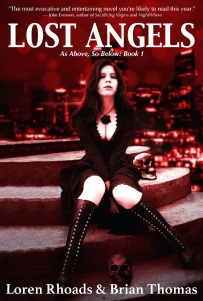 Suddenly I have a bunch of things to tell you about.
Right now, Lost Angels is on sale on Smashwords. You can get the ebook in nearly any format for half-off if you use the code SSW50 when you buy the book here: https://www.smashwords.com/books/view/624284
I wrote about Sex-Positive Succubi at We Read with a Glass of Wine:
I’ll be chatting with Elizabeth Black on The Women Show this Thursday (7/21) from 6:30 – 7 PM EST.We’ll be talking about Wish You Were Here: Adventures in Cemetery Travels, cemetery blogging, and Death’s Garden Revisited, the project for which I’m collecting essays about people’s relationships with cemeteries. You can listen live, or check the conversation out later as a podcast here: http://www.blogtalkradio.com/bennetpomerantz2/2016/07/21/the-women-show-with-your-host-elizabeth-black-her-last-show
The Fright Mare anthology is now available on Audible! It includes my story “Sakura Time,” which was inspired by my visits to the ateliers of art doll makers in Tokyo mixed with Ringu and Dark Water: http://www.audible.com/pd/Fiction/Fright-Mare-Audiobook/B01HTTE406/ref=a_search_c4_1_1_srTtl?qid=1468816167&sr=1-1
And last but definitely not least: you can enter to win a copy of my favorite new novel Black Light on Goodreads: https://www.goodreads.com/giveaway/show/194298-black-light


July 8, 2016
Lost Angels signing tomorrow
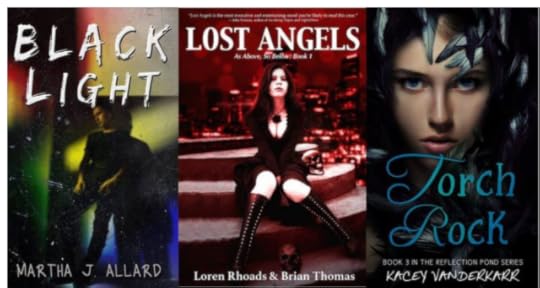
Saturday, July 9, at 1 pm EST, the Barnes & Noble at Genessee Valley Mall in Flint, Michigan is hosting a three-author signing.
Martha Allard will be signing her rock-n-roll vampire novel Black Light, which has been described as “a compelling, haunting love story.” She was just interviewed by our local paper here.
Brian Thomas will be signing the first volume of our succubus/angel series, Lost Angels. Brian rarely does appearances, so this is your opportunity to meet the other half of the team…the brilliant, obsessive research half. Wish I could be there, too!
Kacey Vanderkarr will be signing the third book in her Reflection Pond series, Torch Rock. There is about to be war in Faerie. Every page is full of twists, turns, and suspense.
Details of the event are on the Barnes & Noble page.

July 7, 2016
The Dangerous Type turns 1
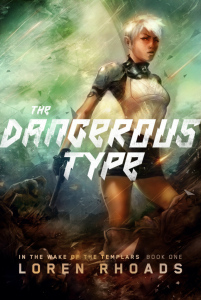 Today is the birthday of the first volume in my space opera trilogy. In honor of The Dangerous Type, I’ll give away a copy of the book (as paperback, ebook, or audiobook), if you’ll answer the question below.
A book birthday is such a strange milestone. This time last year, I was leveled by pneumonia brought on by working really hard to write the third book in the trilogy in four months while simultaneously contending with the editorial changes on the second book and trying to do the advance promotion on the first book. I had finally reached the place I had always wanted to be and it came close to killing me.
It took my body months to recover from the pneumonia. Because I was sick and weak all summer, I didn’t really take time to enjoy the triumph of getting books out in July, September, and November of the same year. I couldn’t look up from my computer screen, pounding out the next guest blog post.
Looking back, it was an amazing year. The trilogy turned out to be just as challenging and dark as I’d envisioned, as centered around the characters and their broken galaxy as I hoped. I got to explore what being chaotic neutral is all about. I am immensely proud of how things turned out.
And The Dangerous Type drew some nice attention:
Barnes & Noble chose it as one of their space operas to read while you were waiting for Ann Leckie’s Ancillary Mercy to come out.
io9’s put it on their Must-Read Science Fiction for July.
Geek Dad wrote a glowing review.
Publisher’s Weekly accused me of bringing grimdark to space opera.
I got to do my first book signing at my local Barnes & Noble in Michigan.
The Dangerous Type came out as my first audiobook in September on Audible.
I got to rave about my experiments with persona on Mary Robinette Kowal’s blog.
I read The Dangerous Type at the World Horror Convention in Atlanta, the World Science Fiction Convention in Spokane, and Borderlands Bookstore in San Francisco.
Charlie Jane Anders invited me to read at my first Writers With Drinks and told the audience my book “fucking rocks.”
In honor of The Dangerous Type‘s birthday, I’d like to give away a copy of the novel, either as a paperback, ebook, or audiobook. Tell me, in the comments below, what your favorite science fiction novel is.

July 6, 2016
Home Again, Home Again
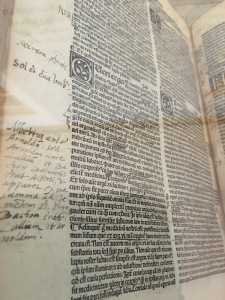
John Dee’s annotations, Royal College of Physicians
This year was a big anniversary for Mason and me, so he suggested we celebrate with a big trip. That’s how we found ourselves headed for London, Barcelona, and Paris last month.
I love London, but I hadn’t been there in 20 years. Our hotel was perfectly situated near Tottenham Court Road and within walking distance of the British Museum, which absorbed the first whole day. The highlight was tracking down John Dee’s wax seals, tucked in a case in the Enlightenment Gallery. John Dee fascinates me: such a learned man, talking to angels through a crystal.
Luckily enough, the Royal College of Physicians had gathered together some of Dee’s books for the first time since they had been stolen from his house in the 1580s. It was amazing to see his annotations and marginalia in books on medicine, astronomy, and science. They also had one of Dee’s angel-scrying crystals there.
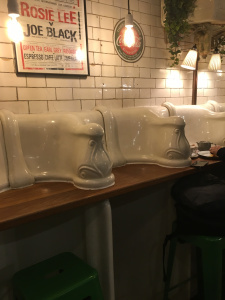
Inside Attendant Coffee, London
Afterward, we stopped at Attendant Coffee, a truly underground coffee bar inside a remodeled Victorian “public convenience,” otherwise known as a men’s toilet.
One of my cemetery idols suggested an exhibit of David Bowie photos, so we met her there, then went out to lunch. Carole Tyrrell leads iconography tours of Nunhead Cemetery — and I very much would have liked to go there with her, but there just wasn’t time.
That evening, Mason and I took our daughter to the cemetery where our adventures began: glorious Highgate. As we trailed a guide through the western side of the cemetery, 400 feet above the city below, thunder rumbled overhead. I figured that it would be poetic if I met my end, roaming yet another cemetery in the rain. Somehow we all survived and the storm blew past. The highlight of the tour was setting foot inside the catacombs and seeing the old Victorian coffins within.
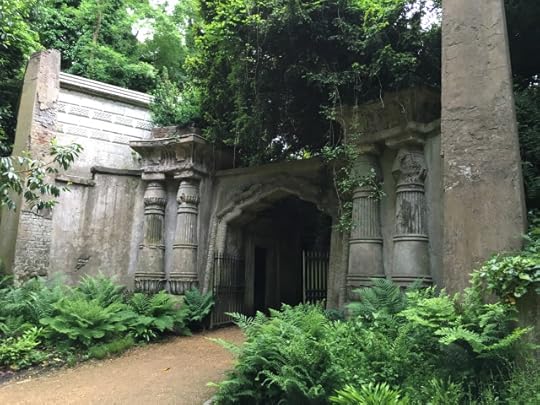
I’m not kidding. Highgate Cemetery is glorious.
Our last day in London, I dragged the family to the Tower so they could see the crown jewels and I could visit the Royal Chapel, where the headless bodies of three English queens lie.

The Kiss of Death by Jaume Barba, 1930.
Then it was off to Barcelona. This was our third attempt to visit: the first was derailed when the Gulf War kept canceling our flights, the second was prevented when my pregnancy turned high risk and my doctor forbade me to travel. I worried that something would happen to turn us away this time, but instead we had a great time in Spain. All of us would like to go back someday.
Day 1 started off with exploring Poblenou Cemetery, home of this amazing “El beso de la muerte.” We followed that with tapas at a cafe across from the cemetery where Mason accidentally ordered little crunchy fishes with eyes. Talk about morbid.
Monday we finally got to see Gaudi’s mind-blowing Sagrada Familia. It was, by far, the most beautiful church I’ve ever been inside. And the most terrifying: we took the elevator up into the towers, so we could look down over the city. I understood going up that we’d have to climb more than 300 steps down. I didn’t know that they wouldn’t have an inside railing — only a drop of 300 feet straight down inside their coil. Generally I am not troubled by heights, but that first 100 steps down was one of the hardest adventures of my life.

Orb near Antonin Gaudi’s grave in Sagrada Familia
The other highlight of the cathedral was being able to catch a glimpse of Gaudi’s grave down in the crypt. My photos captured a lovely ball of pink light, seemingly sitting on the bench inside the chapel where Gaudi is buried.
Mason tracked down another coffeeshop to perk us up afterward. Satan’s Coffee has the best cold brew I’ve ever tasted. It also played reggae music, which was a hell I had not imagined.
We spent our last day in Barcelona inside the air-conditioned aquarium. My black-and-white patterned dress was a huge hit with the cuttlefish, who each came over in turn to check me out. The aquarium had an enormous tank in which you could cage-dive with their sharks. I was tempted only until I found out it cost 150 euros each (minimum of 2 guests). My daughter would have come along, but 300 euros works out to about $350 for the two of us. Too much to spend on a whim.
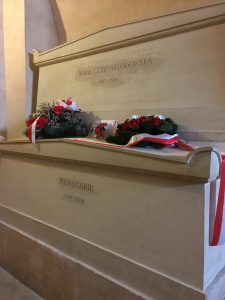
Marie & Pierre Curie’s monuments in the Paris Pantheon
Then we were off to Paris. We made the pilgrimage to the Pantheon, so I could visit Alexandre Dumas and Marie Curie’s graves. We discovered the Paris Cat Cafe, but it had no cats, sadly. We visited Van Gogh’s portrait at the d’Orsay and saw the Apollinaire exhibit at l’Orangerie, but this was more a trip for visiting bookstores and eating pastries than for seeing art.
Monday we walked up Rue des Martyrs to Sacre Coeur. Last time I visited, 20-some years ago, you could visit the saints’ bones in the crypt. That was closed now — unless, perhaps, you could see them if you bought a ticket to climb to the dome. We didn’t, so I don’t know.
We roamed Montmartre until we came to the cemetery. The rain waited until we stepped past the gates, but we all had umbrellas and there were many feral cats, so my daughter was entertained as I photographed every single thing that caught my eye.
Tuesday was a quieter day. We wandered the Passage Verdeau, a covered shopping street that offered toy stores, antique shops, and box after box of vintage postcards: pretty much heaven.
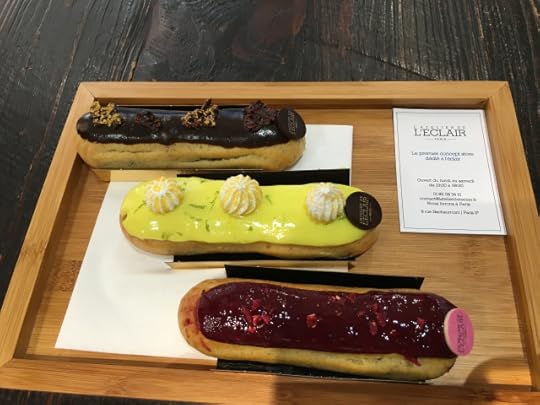 After that, we trekked over to L’Atelier des Eclairs, a whole restaurant dedicated to my favorite French dessert as a child. Beyond looking like a jewelry display, the eclairs were amazing. I had red raspberry with cassis, Mason had tart lemon and lime, and Sorrell had the best chocolate thing I may have ever eaten.
We took the Chunnel train back to London the day of the attack on Istanbul. Luckily, we were able to shield our daughter from the lone television in the waiting room.
 It was cold in London, but we made one more trip to Waterstone’s Books, to stock up for the flight home. Afterwards, I led a detour over to Treadwell’s Books. I was hoping to find a book on Dion Fortune and the battle waged by British ritual magicians against Hitler during World War II. I came up blank in the first two sections I scoured and was just about to ask when it felt like someone tapped me on the shoulder. There, behind me, was The Magical Battle of Britain: The War Letters of Dion Fortune, edited by Gareth Knight.
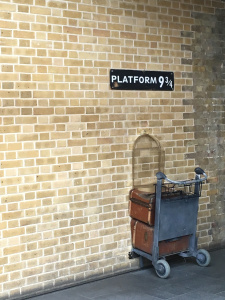
In the morning, there was only time for breakfast at Black Sheep Coffee and a stop by Platform 9-3/4s at Kings Cross Station. I picked up the earrings of my house (Ravenclaw, of course) and we were off on the first leg of our journey home.

June 29, 2016
Dreadful Tales interview
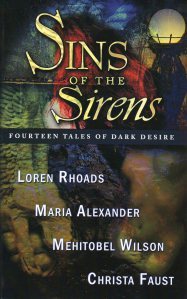 How were you approached to contribute to SINS OF THE SIRENS? Did you know who else would be contributing to the anthology?
During the World Horror Convention in San Francisco, John Everson took me out for a drink in the Tenderloin and asked if I’d be part of a four-woman anthology for Dark Arts. Many years earlier, he’d read “The Angel’s Lair” in the slush pile for Dark Regions and, while he couldn’t sell his bosses on the story then, it always stuck in his mind. In fact, he’d tracked me down at my first World Horror Convention ever — in Denver — to tell me how much he’d liked the story. So my character Lorelei is the reason that John and I got to be friends.
In San Francisco, he honored me by asking me first – of all the women he could have chosen – to be in the book. He tossed out a couple of other names, some of whom didn’t end up in Sirens, but he also mentioned Maria Alexander and Mehitobel Wilson, both of whom I knew from working at Gothic.Net back in the day.
Each story included in this anthology is vastly different from the other. “The Angel’s Lair” is supernatural fantasy; “Sound of Impact” is a realistic tale of clandestine lovers; “Still Life With Broken Glass” is also realistic, a tale of sexual perversions and morbid curiosities; and finally “Last-Born” goes back to the style of your first entry – supernatural fantasy. How did you decide which stories to include? What was the inspiration behind each? And why do these fit with the theme of SINS OF THE SIRENS?
Actually, I gave John a bunch of stories and he made the final selection. He wanted a balance of two that were previously published and two that would be original to the anthology. Of the stories he didn’t choose, one of them was gay vampire porn, initially published in City Slab, and one was lesbian horror that will probably never be published, since it’s too far out there. It’s erotica, but the narrator is very young.
In terms of the stories that made the cut, “The Angel’s Lair” was written as a serial via emails to a friend, who lived in LA and continues to be obsessed by devil girls. I wanted to write about a party girl who walks into something far beyond her ken and knocks the universe on its ass.
“Sound of Impact” spun out of an essay I was writing about the old displays at the Griffith Observatory. I was, shall we say, enhanced during my visit there and was quite shocked by the pictures sent up on the Voyager spacecraft. How would aliens make any sense of our genitals or the image of a human giving live birth? When I converted the essay to fiction, I didn’t know how it would end, but a friend of mine really did joke about planting a bomb in my luggage at the Burbank Airport. Luckily, that was pre-9/11.
“Still Life with Broken Glass” came from my years living in Ann Arbor and roaming around late at night. I worked in the English Department and spent a lot of time amused by the grandiose schemes for getting published and becoming famous that the students and professors engaged in.
I thought the story would never see print. Originally, the characters were male, but I had one magazine tell me that they would publish it only if I made them straight, rather than gay. Eventually, I pitched it to Thomas Roche for the NOIROTICA series with the two female main characters, since he said he never got enough lesbian stories. He accepted it right away, but that book still hasn’t come out. The story won the fiction contest at one of the World Horror Conventions. Eventually, it was published in Cemetery Dance.
“Last-Born” features my favorite character, Alondra DeCourval. Her adventures have appeared in Not One of Us, Wily Writers, and will be coming soon in the next issue of Instant City as well as in THE HAUNTED MANSION PROJECT from Damnation Press. Alondra stories always spin from their setting. In this case, it was New Orleans, where I had some dear friends living at the time. They introduced me to several voodoo practitioners and led me around the Bywater and I got caught in a New Orleans downpour. So the story was born.
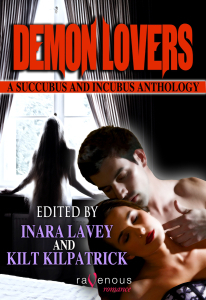 Lorelei is the main seductress in “The Angel’s Lair,” but just recently made a comeback in the DEMON LOVERS anthology. Can you give us some background on Lorelei? How did she come to be, and why were you inspired to bring her back? (We are grateful you did, by the way!)
I’m glad you liked “Never Bargained for You”! I’m really proud of how that story turned out. It was written specifically for the Demon Lovers book after the editor decided she wanted to put together a succubus collection – and I had to be in it. I was so flattered that I had to write something special for her. I’m looking forward to reading it aloud for the first time at the World Horror Convention in Salt Lake in March.
I had a friend in college who was jaw-droppingly beautiful. When she walked into a room, conversation stopped. She also happened to be amazingly fun. She had so sense of where her limits were – or should be – and every moment you spent with her was dangerous and exciting and sexy as hell. Lorelei was inspired by her.
“Sound of Impact” was set in Los Feliz like fellow SINS OF THE SIRENS author Maria Alexander’s “The Last Word.” Did you realize your stories shared that connection? Are you also a California native?
No, having the stories set in the same neighborhood was a complete surprise. I’m originally from Michigan and live in San Francisco, but for several years, I spent a lot of time in Los Angeles, collaborating on a novel inspired by “The Angel’s Lair.”
You were the editor for Morbid Curiosity for 10 years. Can you tell us about the non-fiction publication? How did you and the other contributors find these morbid stories? What’s the craziest thing you ever came across?
Morbid Curiosity was designed as a way for me to publish confessions from strangers. A lot of them ended up being friends, and appearing in issue after issue, but that hadn’t been my intent going in.
One of my favorite things about publishing the magazine was hosting the live events, where contributors got up to read their confessions in public. Those often inspired audience members to submit their own experiences.
For a while I hosted open mics, too, inviting people to get up and tell their stories live without notes. That’s how I met Brian Keene, Rain Graves, Maria Alexander, Simon Wood, Mehitobel Wilson, Christa Faust… all sorts of wonderful people.
One of the stories in the magazine (reprinted in MORBID CURIOSITY CURES THE BLUES) was about assisting the suicide of a friend dying of AIDS. It’s clear in the story that the dying man had no chance of recovery, that he was grateful to have his friends end his suffering. Still, assisted suicide is legally murder. Even without a body, and no evidence other than this confession, there’s still no statute of limitations on murder. I called the Hemlock Society for their advice about publishing the original piece; Scribner’s lawyers went over it before the book went to press. I read it one night on the book tour, which was intense.
There are only 10 issues of Morbid Curiosity. Was it always the intention to do a run of just 10 or did other circumstances end the publication?
No, 10 just seemed like a good number to go out on. Each issue took up about a year of my life and I wanted to do more of my own writing.
You have an obsession with graveyards and blog about your travels at Cemeterytravel.com. You’re also a member of the Association for Gravestone Studies. Can you tell us what fascinates you about cemeteries and how this interest started?
I grew up down the road from the graveyard where my family is buried, so I felt a connection to their stones. During the First Gulf War, I ended up in London by accident. I bought a copy of an amazingly beautiful book of cemetery photos called HIGHGATE CEMETERY: VICTORIAN VALHALLA, which inspired me to poke around this wildly overgrown sculpture garden full of broken angels. That started my obsession.
How many cemeteries / graveyards have you visited over the years?
Literally hundreds. Whenever I travel, I ask around about what local cemeteries are worth visiting. Last November, when I went to Ohio while my dad had heart surgery at the Cleveland Clinic, I took an afternoon to explore Lake View Cemetery. I’ve been to Hiroshima’s Peace Park and the Bone Chapel at Kutna Hora, graveyards in Rome, Venice, Florence, and Pompeii, cemeteries in Paris and Prague, and – one year – my husband and I rented a car on the East Coast to visit 17 cemeteries in 10 days. There’s still so much more I want to see!
Do you have a favorite? If so, which one (or two) and why?
That’s a hard question. Mount Auburn in Cambridge, Massachusetts may be the most beautiful cemetery I’ve ever visited, but I love Cypress Lawn in Colma, California, too. When they asked me to come talk about cemetery travel this coming April, it was one of the best things that’s ever happened to me.
Back to your fiction. You write in varying styles and the stories in SINS OF THE SIRENS are a good sampling of that diversity. Between erotica, paranormal fantasy, and science fiction, is there a genre in particular you favor most?
I don’t see boundaries, really. The novel I just finished in a Hong Kong-style kung fu revenge space opera with a Hammer Horror villain. It’s science fiction, because there are spaceships, but there are mad scientists and monsters and lots of sex. I wish other writers would mix it up more.
I noticed on your website that you don’t mention horror as a genre you write. Of course, I consider “horror” to be a pretty broad term that is often an umbrella for other subgenres. Do you consider some of your writing straight horror? Why or why not?
I think both “Sound of Impact” and “Still Life with Broken Glass” are as close to pure horror as I’ve written. I guess it depends how you define horror. I’m only tangentially interested in the “real world” as a setting, probably because I read so much nonfiction and hang out in so many graveyards. When I read – and write – for pleasure, I want something that takes me away from the mundane. I decided pretty early on that killing someone was a cheap way to add tension to a story.
I’m not sure if that answers your question.
Maniac.com recently posted (I think just before the start of Women in Horror month) a list of the Top 20 Greatest Horror Writers of All-Time, but they didn’t include any female writers. Not even an honorable mention! I’ve been asking all the women I’ve had the opportunity to speak with about their thoughts. What do you think about lists like this that so casually omit female writers? (link below)
http://www.mania.com/top-20-greatest-horror-writers-alltime_article_113153.html
A lack of imagination.
One of the best times I’ve ever had at a convention was when the Persephone Writers put on a game show. Two contestants volunteered to guess if a piece read by the female members of Persephone had been written by a woman or a man. In cases when the contestants did not know the work, they could not guess. One of the contestants was Gary Braunbeck.
The piece I read was an excerpt from Daphne du Maurier’s “The Birds,” which inspired Hitchcock’s movie. It’s harrowing. The contestants guessed Brian Keene had written it.
To counter that, who are your favorite female genre writers currently? Not necessarily straight horror, but even paranormal fantasy, sci-fi, supernatural thrillers, or whatever…
Gemma Files is number one on my list. I adore Marie Rutkoski’s YA trilogy. Maria Alexander’s stories are sexy as hell. Dana Fredsti has a great sense of humor. Lisa Morton’s Castle of Los Angeles is really fun.
What do you have coming up that fans will be excited about? What’s next for Loren Rhoads?
I’m really looking forward to the publication of THE HAUNTED MANSION PROJECT, which I hope will be available by the end of March. It’s an anthology put together by a gang of horror writers who attended the first writing retreat at a haunted house in Northern California. Yvonne Navarro is in the book, along with Weston Ochse, S. G. Brown, Sephera Giron, Eunice Magill, and a host of others. I’ve got an Alondra story in it, as well as the true story of my encounter with the ghost.
I’m working hard to proofread the manuscript for WISH YOU WERE HERE, a collection of my cemetery travel essays that were published on Gothic.Net, Morbid Outlook, Morbid Curiosity, TRAVELERS’ TALES, and a bunch of other places. That book should also be out late next month.
My chapbook ASHES & RUST is now an ebook for the first time. It collects four horror/science fiction stories about sex, drugs, rock’n’roll and apocalypse.
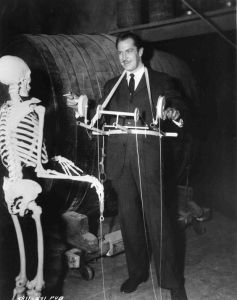 Last one… Vincent Price has just invited you to the House on Haunted Hill and wants you to pick the four other guests. Who do you pick, dead or alive, and why?
I’d want to go with my Haunted Mansion companions. I’ve already survived a weekend in an old, dark house with them – and I know, among that crowd, I’m the Final Girl. It shouldn’t be that hard to talk them into it.
This was originally published as “Ladies of Sins of the Sirens: Interview with Loren Rhoads” by Meli Hooker, Dreadful Tales, February 21, 2012.

June 27, 2016
What a Twisted Web We Weave
 My first memory is of a spider. In the memory, it’s sunset in the summertime. I’m not sure I’d ever been up that late: Michigan sits on the edge of the Eastern Time zone, so the sky in summer remains light until nearly ten o’clock. In the memory, I am standing on my big girl bed in the first house my parents owned, a tiny two-bedroom in the village of Flushing. They moved out to the farm just before I started kindergarten, so at the oldest, I was four when the memory was made.
I stood up on my bed and gazed out the window at the blood-smeared sunset. I’d never seen the sky look so beautiful. On the opposite side of the screen, a spider web spanned the window. I was fascinated by its intricate connections. Across it ambled a black spider. At some point, she pirouetted on the web to reveal the crimson hourglass burning on her belly.
I knew the spider was scary, but I’m not sure I understood why. I slammed the window shut. Despite the humidity, I huddled down on my bed, pulling the sheet over my trembling body. I cried myself to sleep.
The problem with this memory, of course, is that while Michigan has black widow spiders, they prefer woodland to suburbia. They don’t spin webs that are in any sense geometric. They favor holes and woodpiles and undisturbed brush to a west-facing window in town.
It’s more likely that I saw a black widow on Mutual of Omaha’s Wild Kingdom or some other nature show on TV. Perhaps what I think of as the earliest thing I can remember is merely the earliest dream I can recall, the primal nightmare.
For years I treasured the memory of that spider, that fear, as the first conscious experience imprinted on my soul. Only decades later, when I played for a while with the idea of writing an autobiography, did I realize that the memory could not possibly be true.

June 22, 2016
Reading vs. Writing
 Do you remember the first book you ever read, and the impact it had on you?
One of the first grown-up books I remember reading was Ray Bradbury’s The Illustrated Man. The poetry of the language blew me away. I learned that things could be lovely and terrifying simultaneously.
What are your five favorite books, and why?
Something Wicked This Way Comes by Ray Bradbury
American Gods by Neil Gaiman
The Bloody Chamber by Angela Carter
Owls Hoot in the Day-time by Manly Wade Wellman
The Adventures of Dr. Taverner by Dion Fortune
They all share the belief that this is another world beyond what we can see, a world of beauty and danger. I try to bring that kind of depth to my fiction.
What’s the story behind your latest book?I wrote the story that opens Sins of the Sirens as a gift for Brian Thomas. It was meant to be a standalone story. He surprised me by writing a second and third chapter — getting my succubus Lorelei possessed by a human soul. After that, I had to write what happened next. We kept trading back and forth until we had a book and then some. Lost Angels really is only the first half of Lorelei & Azaziel’s story. The second half will be out in November as Angelus Rose.
What do you read for pleasure?
I read everything: magazines, horror novels, kids’ books, YA, histories of graveyards, and travel guides.
What is your e-reading device of choice?
The kindle app on my phone.
Describe your desk.
A whirlpool of chaos. If I spent as much time organizing as I do reading blogs about organizing, my desk would look amazing.
Where did you grow up, and how did this influence your writing?
I grew up on a farm in mid-Michigan — without cable TV, a home computer, or video games. It gave me a lot of time to read and daydream. It helped that my mom was a librarian and never censored anything I read. I was able to fill myself up with stories.
When did you first start writing?I started telling myself stories when I was 4 or 5 and my mom still insisted on naptime. I didn’t start writing them down until I got a typewriter for my birthday in 8th grade.
What motivated you to become an indie author?
I came up through zine writing and publishing. Any venue to get the word out is a good venue.
What book marketing techniques have been most effective for you?
Twitter, Facebook, and Pinterest: the unholy trinity of social media.
This interview was initially published on Smashwords on 2014-03-02.

June 20, 2016
Exes and Ohs
Previously published on Not Now, Mommy’s Screaming:
In 2008, John Everson published a story of mine about a succubus who falls in love with an angel. “The Angel’s Lair” had the honor of opening the collection called Sins of the Sirens. John had especially nice things to say about it in his introduction.
That first Lorelei story expanded into the novel As Above, So Below, which was published by Black Bed Sheets in 2014. Another Lorelei story appears in Ravenous Romance’s Demon Lovers anthology. There are no angels in that one, but plenty of magic. And Led Zeppelin.
As a succubus, Lorelei is sex embodied. She is able to read her prey, alter herself to meet their desires, but she doesn’t feel invested in their happiness other than as a point of pride. She takes her pleasure from a sense of control. She guides her lovers’ responses in such a way that it’s a lot like masturbation with a live person as her sex toy.
That is, until she sets her sights on the angel Azaziel. Lorelei tries to manipulate him into doing what she needs, but she can’t read him, except in flashes. From that point on, her relationship with him is a contest of wills, each grappling with what they like and need and expect from the other in terms of sex.
Writing for Lorelei taught me a lot about how I wanted to approach Raena Zacari, the former assassin in my Templars trilogy. Sex for Raena is even more overtly about control. She grew up as a slave who served as a bodyguard and slept with her teenaged mistress. When Raena ran away to join humanity’s Imperial diplomatic corps, she fell into a worse situation, where her commanding officer made her his “aide” and set about proving his dominance. Raena discovered the benefits of playing with her master’s arousal as a way to buy back some control.
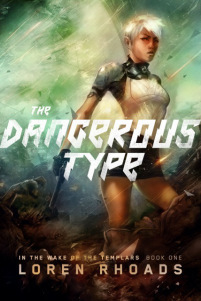 One of the things that makes Raena differ from Lorelei is that she doesn’t make a sound during sex, which provokes her male lovers. One of them takes it as an emblem of her damage. The other sees it as a challenge: if he can just break her down, get beyond her defenses, he can make her stay.
Of course, Raena would have to care enough to play the game. Instead, she – like Lorelei – takes her pleasure where she finds it, without excuse or guilt. She allows her lovers to exhaust themselves against her, but as soon as their attention drifts, she’s busy getting something for herself. Exploring the limits of feminine sexuality as a way to define character was really fun to write.
And, yeah, I’m interested in masochism, that chasm of desire where the dom is a plaything and the sub is in complete control: uncontainable, unbreakable, barely quenchable. In my novels, every time one character acts violently against another, that violence is a mirror. No one likes their own reflections, except the creatures at the center of the mirrors – Lorelei and Raena – who see this all as play and the mattress as the best playground of all.
About the Author:
Loren Rhoads is the author of The Dangerous Type, Kill By Numbers, and No More Heroes — the In the Wake of the Templars trilogy — all coming from Night Shade Books in 2015. She’s the co-author with Brian Thomas of a succubus/angel novel called As Above, So Below and solo author of a collection of travel essays from graveyards around the world called Wish You Were Here: Adventures in Cemetery Travel. She’s also the editor of The Haunted Mansion Project: Year Two and Morbid Curiosity Cures the Blues: True Tales of the Unsavory, Unwise, Unorthodox, and Unusual.

June 15, 2016
Interview from SF Signal (RIP)
Posted on February 29, 2016 by Carl Slaughter in Interviews // 0 Comments
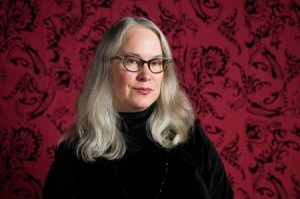
Loren Rhoads is the author of the “In the Wake of the Templars” space opera trilogy. She is also the author of the “As Above, So Below” paranormal novel. The Dangerous Type, the first book in the Templars trilogy, made io9’s list of must read science fiction, Barnes & Noble’s sci fi/fantasy picks, and Barnes and Noble’s 9 Space Operas’s to Read While You’re Waiting for Ancillary Mercy. The second edition of As Above, So Below will be out in April and a sequel will be out in November. She is writing a collection of short stories in the Templars universe. Her next novel is about the Alondra DeCourval character who appeared in “Fright Mare: Women Write Horror; in “The Haunted Mansion Project: Year One, Sins of the Sirens,” and in “Evermore: Tales of Murder, Mystery, and the Macabre.”
Loren answered a few of my questions about the In the Wake of the Templars trilogy, and more!
Carl Slaughter: From starship captains to police detectives to mercenaries to sorceresses to monster slayers, the fiction landscape is littered with kickass heroines. Where sos Raena, the protagonist of your “In the Wake of the Templars” trilogy, fit in this landscape?
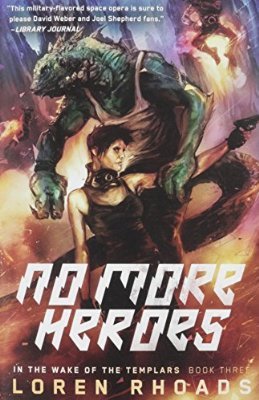 Loren Rhoads: Raena Zacari was an assassin. Until her imprisonment, she worked for the wrong side of the galactic war, which trained her to kill. Over the course of the Templar trilogy, she learns to stop letting murder be her first reaction. I wanted to look at how difficult it is to break the patterns of the past, especially to move beyond the habits of violent response.
CS: Raena’s persona is a major theme of THE DANGEROUS TYPE. What persona does she view herself as having, what personas do the other characters view her as having, how accurate are these perceptions, and how do these perceptions affect character interaction?
LR: When Raena steps out of her tomb, she doesn’t know who she really IS. She only knows who she WAS – and that person was determined by who was giving her orders. Throughout The Dangerous Type, people who knew her 20 years in the past react to her as if she’s still that person they used to know. Some of them – Sloane and Thallian, in particular – do not want her to have changed. They aren’t interested in getting to know the person she is, only in controlling the person she was. The book shifts from their points of view to Raena’s over the course of the story, as she moves out of their shadows and finds her place in the post-War galaxy.
CS: Which actress would you cast as Raena for a screen adaptation?
LR: This turned out to be the most difficult question of the interview! I guess Emeraude Toubia from the Shadowhunters series might be a good fit. She can rock the high-heeled boots, anyway. Really, as I wrote about Raena, I had Misty Copeland, the amazing ballet dancer, in mind.
CS: I quote from the jacket copy of THE DANGEROUS TYPE: “smugglers, black market doctors, and other ne’er-do-wells sprawled across a galaxy brimming with alien life.” I quote from the jacket copy for KILL BY NUMBERS: “media obsessed pirates.” I quote from the jacket copy for NO MORE HEROES: “androids, drug dealers, journalists, and free-running media hackers.” This is in addition to the main character, her lovers, her enemies, and her entourage. How do you keep track of the scene count, development, and interaction they warrant, and fit them all into the story arc?
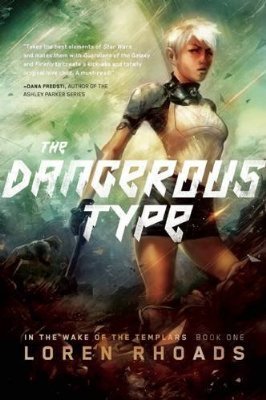 LR: Actually, those descriptions include Raena’s lovers, enemies, and entourage, too. The ne’er-do-wells, media pirates, and hackers are all members of the Veracity’s crew. In terms of fleshing out all the characters, Scrivener has been a lifesaver. I used to write everything in Word, which led to a lot of cutting and pasting as I moved scenes around. It was easy to lose track of subplots, because I don’t write things in order. Scrivener makes it really easy to see all the different points of view and to make sure they are developing as needed.
CS: Publishers Weekly accused you of trying to bring grimdark to space opera. What is grimdark and is Raena’s story indeed grimdark?
LR: The term grimdark comes from the game Warhammer 40K, whose tagline is “In the grim darkness of the far future, there is only war.” So grimdark started out as science fiction, got applied to fantasy (think Game of Thrones), and now is wrapping a tentacle around space opera.
CS: In an essay called “The Appeal of Grimdark” on SFSignal, C.T. Phipps boils grimdark down to two questions: “Is the situation screwed up beyond all repair? Do your heroes fight anyway?”
LR: That is exactly what I was aiming for: Raena knows as soon as she walks out of her tomb that if Thallian survived the War, he will hunt her down. He will exhaust every resource, expend every minion, until he gets her back.
She’s prepared to surrender until Doc reminds her that Raena is the last person left in the galaxy who knows how Thallian thinks. She’s the only person who can bring him down. From that point on, Raena is fairly clear-eyed about her role. Thallian trained her as a killer. She’s going to kill everyone who gets between her and her former commander. She doesn’t see herself as a hero, only as an agent of fate. She’s avenging the Templars because she’s the only one who can.
CS: Brutality is a word that popped up in reviews. Plenty of speculative fiction, including space operas, includes brutality. Is the Templars saga any more brutal than other speculative fiction stories?
LR: I was surprised by the charges of brutality in the Templar books. There is a fair amount of violence, but most of it is over quickly. The only honestly brutal murder happens off the page, but is dissected in the galactic media afterward. Very few innocents are killed, because there are almost no innocents in the books. And while children die in the first book, they have been trained up as soldiers by a madman. Raena tries to spare them, but her mercy is wasted.
CS: The story includes a lot of erotica. How do Raena’s sexual relationships fit into the character development and character interaction?
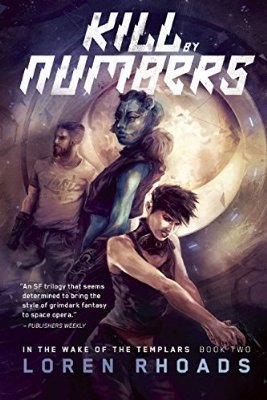 LR: The erotica is really a very small part of The Dangerous Type: 10 scenes out of 168. I wanted to explore all the ways that people try to control each other. Sex is definitely part of that equation. Also, in the first book, the characters have been separated for decades. It’s easier for them to connect with their clothes off than it is for them to talk, at least at first. Raena’s sexuality is less bound by gender than by her attraction to people as individuals. By the end of the series, she’s dating outside her species. The openness is a feature of her experimentations to find out who she is.
CS: Why did your publisher ask you to use a decidedly female pen name, why did you find that ironic, and how did you respond?
LR: My given name was the most common girl’s name the year I was born, so I never felt it belonged to me. I started using Loren the year I went to Clarion, which was 1986, so it’s reasonably well established.
When the publisher accepted this trilogy, they were excited about presenting science fiction written by a woman. There were some discussions early on about asking me to use a more feminine pen name so that people could see my gender from the book cover. I’m still not certain why that was important. My photo appears inside the books, in case anyone needs to categorize me.
I’m not at all opposed to using pen names. This time, though, I had 18 months to write, polish, publish, and promote three books. There just wasn’t time to create a new persona and redo all my social media. I was relieved when the publisher agreed I should focus on getting the books written.
CS: Most authors have a policy against responding to reviewers. It’s kind of an unspoken taboo in the publishing industry. But in various guest blogs, you responded at some length. Why was this important?
LR: First off, I would never dream of directly challenging a reviewer. I absolutely believe that reviewers have every right to their opinions. I also understand that they are writing for readers, not for me.
That said, topics came up in reviews that I found surprising and wanted to address at length. We’ve touched on some of them here: the charges of brutality, bringing grimdark to space opera, the amount of erotica in my action story. Those subjects inspired me to think more about them – and I had a lot of guest posts to write, since I was doing my first blog tour. It felt important to try the criticisms on for size, to see where they reflected my story and where they actually told more about the reviewers’ tastes.
CS: What’s the connection between your lead female character and gangs of feral boys?
LR: I hadn’t realized until I reread A Clockwork Orange, that my novels often have packs of teenage boys in them. InThe Dangerous Type, Raena fights Thallian’s cloned sons. In the first As Above, So Below novel, Lorelei runs with a Vietnamese gang.
In both cases, the boys are inspired by kids I knew when I was in college. I had been hired to lead D&D games for a church youth group of eight teenaged boys. I can’t remember what precipitated the attack now, but the boys wrestled me onto my back on the gaming table, held me down, and started to unbutton my blouse.
These were nice boys, individually. We were in a church. There were people upstairs. Unfortunately, the pack mentality took over. I am lucky that they liked me more than they wanted to hurt me.
I guess, in my books, I am still fighting them off.
CS: What’s the connection between Raena’s character and fashion?
LR: This question made me laugh. Raena grew up in a militaristic cult before she was captured by slavers and sold to a war profiteer as a bodyguard for his daughter. Later Raena serves aboard an Imperial warship and wears a uniform. When the Templars series begins, she’s just come out of prison. For the first time in her life, she can choose what she wants to wear. She doesn’t have any idea what will look good on her, so she optimizes for color.
CS: How did ballet inspire Raena’s character?
LR: I studied ballet for 15 years and was quite serious about it. One of the girls I danced with went on to join Joffrey Ballet. I continue to be awed by the strength, speed, and power of dancers, especially by Misty Copeland. Ballet dancers provided the physical model for Raena.
CS: Who is Mary Sue and why does she get so much attention?
LR: Mary Sue was a character in a Star Trek satire in the 70s. She was a remarkably young, beautiful, and wise character who took command of the Enterprise when all the familiar characters were stricken after an away mission.
Mary Sue accusations are thrown out every time a female character is judged too good or strong or smart. Most recently, it happened with Rey inThe Force Awakens. Male protagonists who fit those attributes are considered normal: say, a farmboy who has never seen a star fighter before not only survives his first major battle in space, but also manages to blow up the Death Star. However, if a scavenger who has already shown fighting skills picks up a lightsaber and fights off an injured opponent, that is deemed unbelievable. Therefore, Rey must be a Mary Sue.
My protagonist Raena was labeled a Mary Sue in one of the reviews, but I wouldn’t want to be Raena on a dare. In fact, one of my inspirations for Raena was the old silent Aeon Flux cartoons from MTV’s Liquid Television. I don’t think Raena is perfect in any sense. She’s just very good at killing people.
CS: In one of the sequels, the protagonist is put on trial. How do you mix sci fi and courtroom drama? How do you get sci fi fans interested in legal proceedings?
LR: Well, I hope that No More Heroes is interesting because there’s never any question that Raena is guilty as hell. The drama is in how she is going to face the charges. Also, I wanted to explore how a government might use the legal process as a moneymaking venture, rather than as a venue to provide justice. As in the earlier books, I wanted to look at issues of power and prejudice. I am not a fan of courtroom TV, so I wanted to peer beyond courtroom theater to see what plays out behind the scenes.
CS: Why do journalists factor so heavily in the latter part of the story?
LR: I studied journalism at university, then published Morbid Curiositymagazine for 10 years, so I’m intrigued by the power of citizen journalists. I love the way cell phone cameras and the Internet have put the “news” in the hands of average citizens. I have long felt that the world can only be changed by someone with a story to tell. At the same time, I’ve studied bias and spin. I understand how a story can be manipulated to hone its impact. I wanted to put the galaxy in the hands of journalists on a mission.
CS: Is your “Claustrophobia” short story a direct prequel to THE DANGEROUS TYPE or just the inspiration?CS:
LR: Thirty years ago, “Claustrophobia” was the first Raena story I published. It was Star Wars fanfic. Raena no longer lives in that universe, but the events in that original story – which ended with Raena locked in a tomb – led directly to the beginning of The Dangerous Type. So I guess it’s a direct prequel, albeit with some retconning along the way.
CS: Why is it important to Raena’s character development and important to the plot that she be entombed and for such a long time? Why is it important that she not age and not be able to die during her entombment?
LR: The character interactions in The Dangerous Type were based on friendships I have had since high school. We interact with each other based on things that were said and done decades ago, but when we see each other in person, it’s clear that time has marked us and we cut each other slack. I wanted to spin that for the novel. What if a friend showed up from your past, someone you had a brief but very intense relationship with, and they looked exactly as you remember them? It would be challenging to treat that person as if time had passed for her as well, especially if you don’t want her to have changed at all.
CS: The nature of her tomb causes her to be ageless and immortal while she’s in it. Is this science or fantasy?
LR: I was listening to Decipher SciFi podcast the other day and they explained how Star Wars should be read as fantasy. Maybe all space opera is fantasy in science drag. There are definite fantastic elements to theTemplar books, particularly surrounding Templar technology. I took Clarke as my motto: “Any sufficiently advanced technology is indistinguishable from magic.”
In these novels, the Templars were an old race, possibly the first to have traveled to the stars. Before their annihilation, they controlled trade throughout the galaxy. Common devices, from translators to star drives, were based on their technology. After a human-engineered plague wipes them out, their tech lies scattered around the galaxy. Some of it can be made to work by the galaxy’s survivors, but the science behind it is poorly understood. In fact, in the second book, tesseract spaceship drives – derived from Templar tech – are breaking down. That causes shortages and riots as food and people can no longer be safely transported from planet to planet.
CS: Why isn’t every creature in the universe scrambling to camp out in this tomb? Why aren’t the creators of this tomb selling times shares? Why aren’t criminals trying to muscle in on the action?
LR: Fair question. The short answer is the effect only works on things that are shut up inside the tomb.
The longer answer is that only people who know Raena know that she didn’t age during her imprisonment. She’s in no hurry to tell anyone else, because she’s afraid the galaxy will try her for war crimes if they knew whom she served.
CS: AS ABOVE, SO BELOW is just as epic as the Templars trilogy and the characters are just as interesting. Any idea why it didn’t get the publicity mileage Templars did?
LR: The rights have finally reverted to me and Brian again, so a second edition is coming out in April, followed by the sequel in November. Hopefully, having a new publisher will make all the difference for those books.
CS: Theology is a major element of AS ABOVE, SO BELOW. What kind of research did you do on theology to prepare for writing the book?
LR: Brian Thomas, my co-author, served as a researcher in the library at 20th Century Fox for ten years. He worked on TV shows like The X-Files andMillennium, Buffy, Angel, and The Omen. His knowledge of religious history and angelic lore is breathtaking.
CS: Is AS ABOVE, SO BELOW a Romeo and Juliet story?
LR: It’s not a direct parallel, but as with any story where the lovers come from opposing armies, there are elements of Romeo and Juliet. There are also echoes of the Hatfields and the McCoys.
CS: One of the characters in AS ABOVE, SO BELOW becomes host to another character’s soul. Do they have dialog? Is there a struggle for control?
LR: Yes. The succubus Lorelei becomes possessed by the ghost of a mortal teenager. Their conversations are some of my favorite parts of the book.
CS: How did publishing a Star Wars fanfic mag for a local science fiction convention lead almost directly to a 3 book contract with a major sci fi publisher for an original story?
LR: Well, it was “almost directly” over the span of decades. Inspired by theThieves’ World books in the 1980s, my friends and I wrote a shared world anthology around original characters who lived in the Star Wars universe. “Claustrophobia,” the original Raena story, appeared in a zine calledAnthology, which was published for the MediaWest Convention in 1986.
Over the next 11 years, the Anthology zine morphed into Tales of a New Republic, which published five more stories that I wrote about Raena and her nemesis, Thallian. I really liked the characters and toyed on and off with writing more about them, but I’d lost interest in writing more fanfic.
Finally, in 2003, I used the National Novel Writing Month to hammer outThe Dangerous Type. I stripped out all the Star Wars elements of Raena’s backstory, which wasn’t hard to do since she had been so tangentially connected to Star Wars in the first place. The only thing I retained was the human Empire reaching out into space and getting slapped down by a Coalition of humans and aliens. In The Dangerous Type, the War is long over and the survivors have settled into the aftermath. The Templars are still mourned and there is a lot of prejudice against humanity for causing the genocide.
In 2012, I used another NaNoWriMo to bang out a sequel to the first unpublished novel. That second book was called No More Heroes, until the story altered so much that the title didn’t fit. (It was eventually published asKill By Numbers.)
I’d been friends with an independent press editor for years – we both worked at Borderlands Bookstore for a while — but he’d never wanted anything I’d written before. In the summer of 2013, I mentioned that I had this Hong Kong-style revenge space opera with a Hammer Horror villain – and a Nanowrimo draft of a sequel. Would he be interested in reading them?
He asked to see The Dangerous Type in August 2013. Two weeks later, he asked to see what I had of Kill By Numbers. Then he asked me if I thought I could write a third book. He wanted to pitch the series to the publisher as a trilogy.
CS: The first book in the Templars trilogy came out in the summer of 2015. The first and second sequels came out almost back to back in the fall of 2015. Aren’t you supposed to wait 6 months to a year between novels in the same universe to provide marketing and logistics time for the publishers and reading time for the fans?
LR: I would have preferred to have the books come out farther apart. In fact, when I signed the contract in January 2014, the plan was for The Dangerous Type to come out in July 2015, followed by Kill By Numbers in November 2015, and No More Heroes to come out in 2016. Somewhere along the way, the schedule got truncated, so that all three books came out in a five-month period in 2015.
It was absolutely brutal to write to that schedule. Between mid-October 2014 and June 2015, I wrote 150,000 new words and turned in three finalized novels. Before I could get very far on the promotion for The Dangerous Type, I came down with pneumonia. The publisher’s publicist was begging me to finish my piece for Mary Robinette Kowal’s blog the day I got my diagnosis.
If I had had any choice, I would have pushed for a longer gap between the books, but the publisher explained the schedule as binge-Netflixing for books.
CS: What’s the premise for the AS ABOVE, SO BELOW sequel, DIES IRAE?
LR: Dies Irae was the perfect title for the second succubus/angel book, but it’s too hard for most people to pronounce, so I think the new title will beAngelus Rose.
In the first As Above, So Below book (now called Lost Angels), the angel Azaziel puts a mortal soul into the succubus Lorelei, which leads to the biggest exorcism LA has ever seen.
In Angelus Rose, the sequel, Lorelei discovers that she wasn’t the only experiment Azaziel was doing with mortal souls. This time, the demon prince of LA decides to make war over what she uncovers.
CS: What kind of research was involved in your “Wish You Were Here” documentary and what did you learn in the process?
LR: “Wish You Were Here” is my collection of cemetery travel essays. It’s kind of a memoir of my life as lived in cemeteries around the world. Many of the essays were written for a monthly column on Gothic.Net, so it was a gradual process – first, of discovering how much I didn’t know, then of finding some answers about memorial customs around the world. The thing I learned that surprised me most was that graveyards have fashions, as people’s beliefs about death transform. I also find it fascinating how motifs change in meaning from place to place and over time. I think everyone should add a graveyard or two to their vacation travel.
CS: Is the setting for the Haunted Mansion project real or fictional?
LR: The Haunted Mansion is a real place. It’s a huge house in Marin County, California that serves as a wedding venue and retreat center. Twice, Rain Graves set up writers’ retreats there. A small group of writers, painters, and ghost hunters would spend a long weekend in the house. Afterward, we’d put together an anthology of stories and poems inspired by the retreat. The fiction in the books was supplemented by site reports and nonfiction essays about the hauntings.
Most of the people involved in the Haunted Mansion Project were horror writers: Weston Ochse, Yvonne Navarro, Angel Leigh McCoy, Rena Mason, SG Browne, Chris Marrs, ES Magill, Lisa Morton, Sephera Giron, and more. I had the honor of editing The Haunted Mansion Project: Year Two.
CS: Morbid Curiosity has been described as an underground cult magazine. Is that an accurate description?
LR: Yes. Morbid Curiosity collected true first-person essays about “the unsavory, unwise, unorthodox, and unusual.” It was published annually between 1996 and 2006. It didn’t take subscriptions, so I mailed a postcard to everyone on my mailing list every time an issue came out – and they responded by writing fan letters and sending checks. It was an amazing community.
CS: How did editing Morbid Curiosity for 10 years contribute to your speculative fiction writing?
LR: I read a huge number of essays for the magazine over the years, so I learned a lot about the nature of memory, story, and personifying the first-person narrator. I also hosted open mics at the World Horror Convention for years, which introduced me to writers at all levels. The combination of working with all those words and meeting all those people gave me a really good foundation when I returned to fiction, which was my first love.
CS: With Raena’s story concluded, what’s next? More sequels in the “As Above, So Below” universe?
LR: Actually, I’ve been writing short stories in the Templar universe. I had to cut a lot from Raena’s story in order to fit it into three books. For instance, I lost everything I’d written from Vezali’s nonbinary-gendered point of view. I’m looking forward to fleshing out more of the background stories.
This month, February 2016, saw another story about my magical monster hunter Alondra DeCourval published. This story appears in Fright Mare: Women Write Horror. Other stories about Alondra’s adventures have appeared in the books The Haunted Mansion Project: Year One, Sins of the Sirens, and in Evermore: Tales of Murder, Mystery, and the Macabre, among other places. I’d like to find a home for a novel about Alondra and her real-world magic.
I think As Above, So Below will probably stay with just the two novels. Brian and I wrote part of a third book, but it may never be finished. It was really dark, which you know is saying something, coming from me.
CS: Any advice to aspiring speculative fiction writers?
LR: Don’t give up. It was a long road from writing Star Wars fanfic to a three-book contract, but I learned a lot along the way. Keep telling the stories that you want to read, keep sending them out, and keep meeting people. You never know when you’ll finally get your chance to put the right manuscript in the right hands.
Carl Slaughter wrote many reviews for Tangent before moving to Diabolical Plots as a reviewer and later an interviewer. He conducted 50 plus interviews for Diabolical Plots. For the past 14 years, he has traveled the globe teaching ESL (English as a Second Language) in 6 counties on 3 continents. Carl has traveled to 18 countries and counting. (He’s tired.) In college, Carl studied journalism, broadcasting, advertising, English, speech, and history. For several years, he was a stringer for the Associated Press. His essay on Chinese culture was published in Beijing Review. His essay on Korean culture was published in The Korea Times, as was his expose on the Korean ESL industry. His travel/education reports about Thailand occasionally appear on the Ajarn website. Carl subscribes to the Mike Resnick philosophy of fiction: It’s all about the characters. Check out Carl’s Diabolical Plots interviews, his Facebook photos with his students of all ages from around the world, and a short Youtube video of Carl with some VERY excited Thai kindergarteners.
Also on SF Signal:
Loren Rhoads

June 13, 2016
Vintage Travel Memories
 Two years ago, Nienke Krook interviewed me for her blog, The Travel Tester. She starts out by saying:
“What is your most memorable childhood travel memory?” That’s what I’ve asked over 50 travel bloggers and other travel addicts. These are their personal stories and photos.
Hi Loren, do you remember the first time you went travelling?
Not the first time, but when I was four, my parents drove down to Virginia to visit my mother’s extended family. While we were there, my parents took the bus tour of Arlington National Cemetery. At John F. Kennedy’s grave, my mom — busy with my little brother — thought my dad had me. Until they got off the bus at the next stop, they didn’t realize that I wasn’t with either of them.
I don’t remember being lost or feeling scared, although I must have cried.
All I remember is a nice lady who took me on the bus back to the Visitor Center, where she fed me butterscotch candies from her purse until my parents came back for me.
The kindness of strangers is vastly underestimated.
Did your parents travel much before you were born?
My mom’s father owned a corner grocery, so they rarely traveled. My dad’s father worked two jobs: as a farmer and on the assembly line at Buick, so about the only time either of my parents traveled as children was to visit family.
My folks married very young. They met at junior college, got married, and moved to a house trailer together while they went to university. I was born two years later, so they didn’t have much time to travel together without kids.
Since I left home, they’ve toured Russia, visited farms in Holland and Germany, and taken numerous cruises around the Caribbean. Wherever they go, my mom always photographs cemeteries for me.
What was your favourite holiday destination as a child, a teenager and an adult?
Childhood
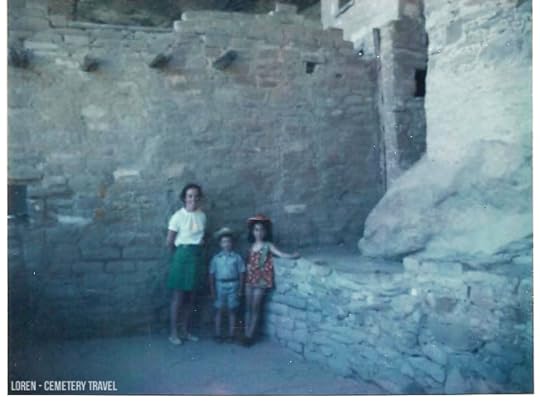
When I was 8, my parents took us to Mesa Verde in Colorado. The abandoned Cliff Palace seemed so magical! I couldn’t understand why the Anasazi built such a beautiful city, only to abandon it. I daydreamed about living there for a long time.
Teenager
When I was in college, my mom took me on a vacation — just the two of us — to Toronto. We rode the train there, which was an adventure in itself. I remember being awed by the architecture and the shopping. The city seemed so huge and lively, compared to Detroit, the nearest big city to my home. Once I met my husband at university, we drove to Toronto for weekends. I loved the thrift shops. I bought a silver leather coat.
Adult
It’s hard to pin myself down to a favorite destination now. For my birthday last year, my family drove up to the California Gold Country. The first night, we drove into Murphys a little before sunset. We discovered the historic graveyard, still in use, and poked around as the sky turned golden. Three deer strolled through, completely at peace. It was such a lovely evening, with my favorite people in the world, doing what I most love to do.
 Can you tell me what your memory is with these images?
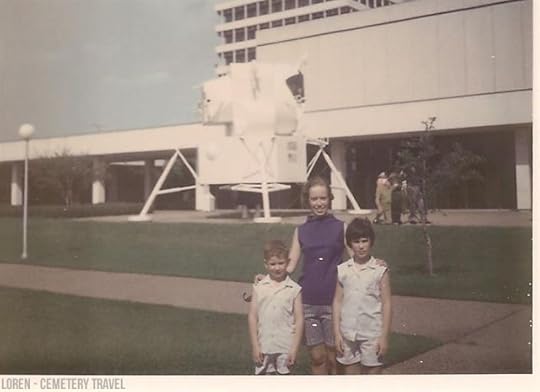
My dad worked in the accounting office at Buick. Every summer he got sent somewhere to count cars at a port before they were shipped overseas. This was before computerized inventory, so someone had to physically count each car in person.
The summer this photo was taken, my dad was sent to Houston. My brother and I spent all day in the hotel pool while he worked, but on the weekend, we went to the Houston Space Center, where they oversaw the Apollo missions to the moon.
I remember my parents getting me out of bed to watch the moon landings on TV. I thought at the time that I wanted to be an astronaut, to go into space and set foot on distant lands. What I really wanted to do was travel.
Can you remember a specific travel item/gadget you used to take on a trip as a child?
My mother used to read books into a cassette recorder, so we could listen to them while we traveled. Old-style audio books!
Did the way you travelled as a child changed much when you grew up?
When I was a kid, my parents were all about driving vacations. They’d put me and my younger brother in the back of the truck camper and head west. I got to see Yellowstone and the Rocky Mountains, Mount Rushmore and Bryce Canyon.
My husband and I prefer to fly to a city somewhere and spend a week exploring. We like to stay somewhere long enough to find a favorite café, sit in the park, visit all its bookstores, and wander through all its graveyards.
Finally: What is your best tip for making a trip memorable?
Do one thing everywhere you go. I always visit cemeteries, whether I am in New Orleans, Maui, New York, Tokyo, Pompeii. Cemeteries always tell me a lot about a place. The people I see visiting them tell me a lot, too. That one lens opens up the whole society, wherever you go. My husband uses hot chocolate as his magnifying glass. My daughter likes to explore the ice cream.
While you’re focused, you find amazing things along the way.
If you want to read more of Loren’s stories, be sure to visit her website:
Cemetery Travel