Brett Weiss's Blog, page 20
April 10, 2019
Retro Video Game Review - Paperboy for Nintendo 64
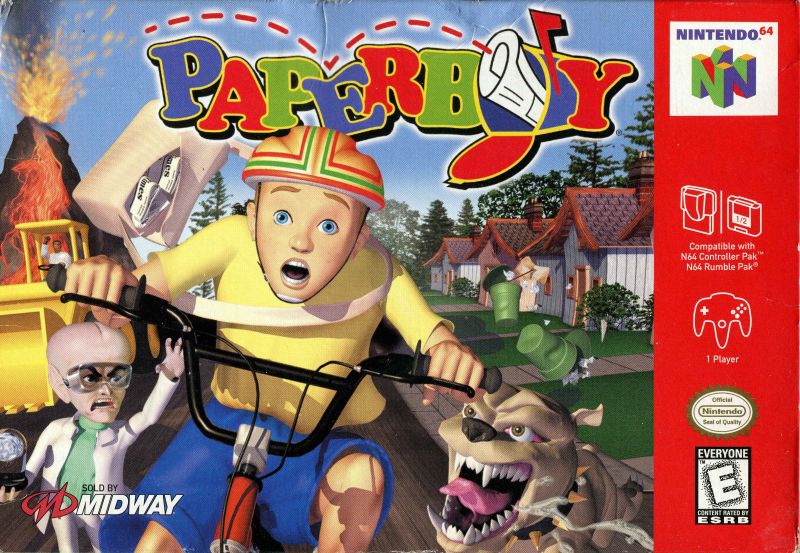 PaperboyNintendo 64Publisher: Midway Home EntertainmentDeveloper: High Voltage SoftwareGenre: Mission-Based Racing1999
SYNOPSIS:
An updated remake of the 1985 arcade hit, Paperboy for the Nintendo 64 puts you in the role of a Paperboy or Papergirl. Your job is to get on your bike and deliver newspapers to your subscribers within a specific amount of time.
While peddling along in the various 3D neighborhoods, you must avoid cars, cats, dogs, rolling tires, bad kids, kids on tricycles, workers and other dangerous obstacles (over 100 in all). Houses line both sides of the street and you must throw the papers in mailboxes and on porches. The farther you are from a mailbox when you throw a paper, the more time you will earn.
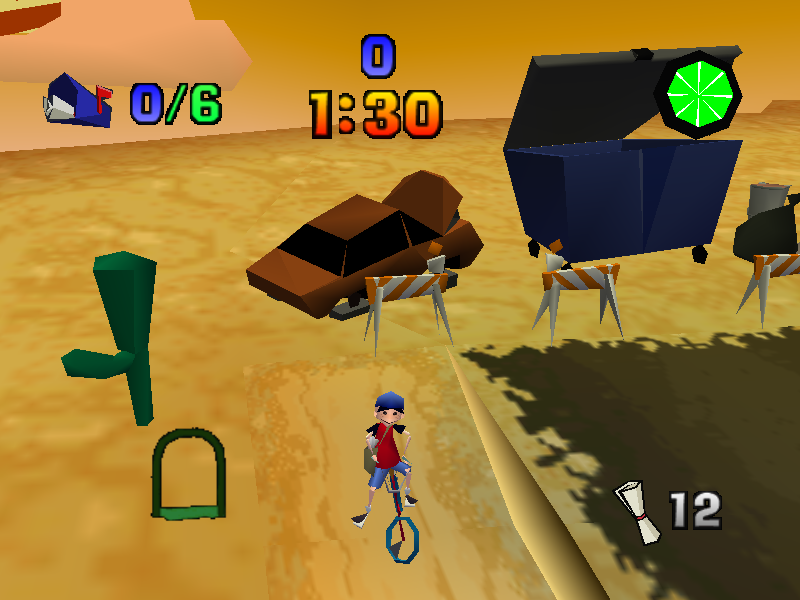 To help you with your delivery route, the following power-ups are available: Paper Spray enables you to scatter papers in all directions at the same time; Super Jump sends you high into the air; Monster Potion makes your character stronger (not to mention uglier) and able to throw papers harder; and Rocket Boost makes you fast and invincible. You score points for every paper you deliver and for jumping ramps and performing bicycle tricks like Handstands and Tailwhips. You also get points for breaking windows of non-subscriber's houses and for throwing papers at various obstacles.
There are more than 45 delivery routes in Paperboy. Each has a Bonus Course that can be accessed by collecting the three Bonus Coins hidden within each level. The game takes place in many different neighborhood environments, such as the desert, the beach, a spooky monster town and a park, where you must deliver papers to campers. Throughout the game you'll encounter a number of boss characters that you must confront, with the first being a monster running loose in Dr. Tesla's Castle!
REVIEW:
With its original concept, addictive challenges, handlebar controls, and sarcastic wit, the original Paperboy by Atari Games was an arcade smash. To do well in the game, players had to think of many things at once: aiming, steering, going fast or slow, restocking and conserving ammo, and avoiding or throwing papers at a wild assortment of obstacles.
 It was a challenge to ride by the homes of subscribers and non-subscribers, as different strategies were required for each. Non-subscribers' homes were basically shooting galleries while subscribers' homes required a single, accurate toss of a newspaper. To get really good at Paperboy, many quarters were required.
Paperboy for the Nintendo 64 has many of the same objectives and goals as the original game. It all boils down to delivering papers to subscribers while abusing non-subscribers. In addition, the game is loaded down with the typical features one might expect from a late 1990s update of a mid-1980s Arcade classic.
You'll find tons of new obstacles, the ability to do bicycle tricks, a variety of power-ups, a diverse array of delivery routes and, of course, 3D graphics. The question is this: do the enhancements actually improve upon the original game or at least make the Paperboy concept fresh and exciting for a modern audience? The answer is a resounding no.
 The original Paperboy was a linear experience. Once you passed by a subscriber's home, you could not go back, so you lost a customer if you didn't manage to land a newspaper on their porch or in their mailbox. In the remake, you can wander all over the place and go back to homes you may have missed and get them each a paper.
This aspect of the gameplay takes away some of the immediacy of delivering papers and removes the necessity of aiming correctly the first time around. In fact, aiming isn't much of a factor in the new game. Since the playfield is 3D, all you have to do is ride your bicycle right up to a mailbox or porch and simply drop a paper off. In the original Paperboy, throwing a newspaper in a mailbox was both challenging and risky.
Nonlinear gameplay and 3D graphics simply don't mesh well with the Paperboy concept. While the original game required full concentration and genuine skill on the part of the gamer, the Nintendo 64 version is challenging only because of poor, loose controls. Also, performing bicycle tricks and hunting for coins is boring and seems like a wasted effort since each level is timed.
The graphics in this game are weird and ugly. Slanted houses, odd angles and triangular characters add up to an unpleasant visual experience. The music and sound effects, which are flat and ordinary, could've easily been achieved on the less powerful Super NES.
Paperboyfor the Nintendo 64 is a contrived and convoluted mess. It proves that 3D graphics and nonlinear gameplay don't necessarily make for a better game. If you own a PlayStation, do yourself a favor and pick up Arcade's GreatestHits/The Atari Collection 2. It includes the original Paperboy as well as five other arcade classics, all in their original forms.
Check out sample pages of my books on Amazon HERE.


April 9, 2019
Retro Video Game Review - Chuck Norris Superkicks for ColecoVision
 Chuck Norris SuperkicksColecoVisionPublisher: XonoxDeveloper: XonoxGenre: Beat-’em-up/Fighting.1983(Images courtesy of MobyGames and 8BitCentral)
SYNOPSIS:
Martial arts legend, film star, and noted tough guy Chuck Norris got his very own video game back in the day with Chuck Norris Superkicks, an early entry in the beat-’em-up genre. You take on the role of the robed one as he attempts to reach an ancient monastery in order to rescue a famous leader who is being held hostage.
You begin the game as a white belt, but by defeating attackers, scoring points, and learning new martial arts skills (such as somersault superkicks and forearm blocks), you will earn each of the colored belts associated with the "Tang Soo Do" style of karate. Every time you gain a belt, you get extra time. In order to reach and enter the monastery, which is guarded by ninja assassins(masters of karate and camouflage), you must achieve the highest rank of all—black belt.
 Chuck Norris Superkicks consists of seven levels: Path to the Monastery, Attack by the Rice Fields, Attack in the Foothills, Ambush on the Waterfront, The Village Attack, The Approach to the Monastery, and Inside the Monastery. You must walk up pathways from screen to screen, avoiding tall grass along both sides of the path. The manual instructs you to use your "sixth sense" intuition to choose the correct route. Impassable barriers such as fallen trees block off some of the pathways.
Many times throughout the game, Chuck will stop walking, and the action will switch to a close-up perspective. This is when you must punch, kick, and otherwise fight off Yakuza, Dorobo, Tengu, and other warriors, guards, and bandits who attack from both sides of the screen. After you clear a wave of enemies (some of which throw stars), you will continue on your way.
REVIEW:
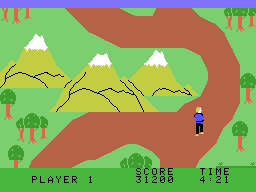 Among gamers who seek out oddball titles, Chuck Norris Superkicks is often the subject of ridicule. The reasons for this are many as the game is replete with unintentional humor. If you walk on the tall grass, seconds fly off your timer with every step you take. Are the designers of this game telling me that world-renowned karate expert ChuckNorris is vulnerable to unkempt greenery? Also, the snow-capped mountain peaks alongside the walkways are tiny in relation to their surroundings. They look ridiculous.
 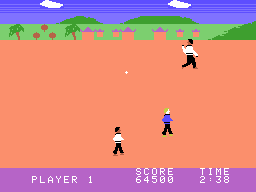 The manual suggests that you use your "intuition" when walking up pathways in order to determine the correct route. This annoying bit of new age nonsense only means that lady luck plays a role in the game. If you walk up an obstructed pathway, you must turn around, walk a different direction, and repeat the same level. It's not a huge ordeal to fight the same fights over again, but this bit of hooey is annoying and redundant.
On a more positive note, Chuck Norris Superkicks is an unusual game for its time and something of a novelty. Gaining fighting moves as you progress from level to level is a cutting-edge concept. Especially cool is the somersault superkick. However, the game never really picks up until you reach the final stage. Up until this point, the levels are brief and easy to complete.
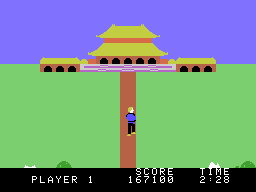 Once you reach the monastery, a seemingly endless flow of ninjas come after you. The more you defeat, the deadlier they become as their camouflaging abilities increase. It's challenging and even enjoyable to dodge the thrown stars while trying to punch or kick ninja after ninja—this is the point at which you can really boost your score. Interestingly, the graphics take a marked leap in quality as well. The inside of the monastery, with its rich blue hues, wall dragon and flickering candles, is tastefully and elegantly designed.
The game has a nice musical intro, and redundant, but competently done music plays during fight scenes and when you progress from one level to the next. The sound effects are about average for a third-party ColecoVision title.
Overall, Chuck Norris Superkicks is an uneven and sometimes laughable gaming experience. The inclusion of pathways makes the game a quest of sorts, but the actual walking and avoiding "killer weeds" is a little dull. In fact, first six levels are less than exciting. Level seven is fun, though, and the game was clearly ahead of its time in terms of combat and RPG elements. If you’ve only played the blockier, less detailed Atari 2600 version, or you’ve never played it at all, the game is worth checking out for its novelty value.
Check out sample pages of Brett Weiss's books HERE.
April 8, 2019
Retro Video Game Review - Airlock for the Atari 2600
 AirlockAtari 2600Publisher: Data AgeDeveloper: Data AgeGenre: Fixed screen platformer1982(Images courtesy of MobyGames.com)
SYNOPSIS:
Resting perilously on an undersea ledge, your disabled nuclear submarine has begun taking on water. With time at a premium and torpedoes going off within the sub, you must save your crew from imminent disaster.
The two playfields in Airlock consist of five platforms (viewed from the side) that represent compartments of a submarine. To save your sinking sub, you must run across each platform and grab a couple of hatch keys within a ten-second time limit. After you grab both keys, you must enter an elevator that will take you up to the next compartment.
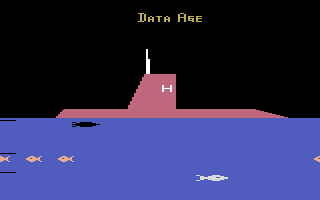 While running across the compartment floors, you must avoid or jump over torpedoes that have shaken loose due to a strange undercurrent from deep beneath the ocean floor. When you make it to the top one or two (depending on the skill level) stages or you run out of time, the game is over. There is no high score in this game and no continuation of play. You either finish your task or you don't.
REVIEW:
 Airlockfor the Atari 2600 is, simply put, a piece of garbage. For starters, it's incredibly short. Unlike most games from this era, Airlock doesn't continue indefinitely as long as you stay alive. Once you have retrieved all of the hatch keys and made it to the top of one or two screens (depending on which difficulty level you are playing), the game is over. There is no high score to concern yourself with and no extended playing time.
Another problem with this wretched game is how easy it is. You can easily beat the game the very first time you play it; it takes about a minute on the easiest difficulty level. However, even when cranking the game up to the hardest level, you will likely only take a few tries. After that, pull the game out of your Atari 2600 and never play it again.
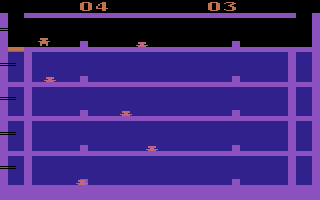 Aside from the fact that the game is short, easy, and pointless, the action itself is dull. The obstacles are lame and redundant, the jumping action is boring, and the two levels are unimaginative. There is nothing wrong with the concept of having to make it to the top of the screen in a certain period of time, as that is certainly a tried and true video game staple, but this game is sluggish and very basic.
The graphics in Airlock are about as bad as the game itself. The introductory screen featuring the submarine and the fish is tolerable, but the actual game play screens are hideous. The platforms are plain and simple. The little man you control is a squarish stick figure that doesn't move a single part of his body; he merely glides along sideways. Even worse, the torpedoes that you must dodge and jump over look almost exactly like your character!
Shame on Data Age for releasing such a vapid, ridiculously inane cartridge with almost zero replay value. Shovelware like this played a role in creating the Great Video Game Crash of 1983.
April 7, 2019
Retro Video Game Review - Blueprint for the Atari 5200
 BlueprintAtari 5200Publisher: CBS ElectronicsAction Puzzle/Maze1983
(Images courtesy of MobyGames.com)
SYNOPSIS:
The nasty old troll, Ollie Ogre, is once again terrorizing a peaceful community in the maze game, Blueprint. This time he's chasing Daisy Damsel. Therefore, with blueprint in hand, it's up to you to build a contraption to knock off that pesky creature. However, weapon parts are hidden in bomb-laden houses throughout the neighborhood, and you're on a time limit.
A neighborhood in this game consists of ten houses, eight containing parts and two containing bombs. To advance to the next neighborhood, you must find all the parts (one at a time), position them in their proper places on the blueprint (a rectangle at the bottom of the screen), and use the completed device to thwart Ollie and rescue Daisy. If you pick up a bomb instead of a part, you must defuse it in a hurry by hauling it to the monster pit at the bottom right side of the screen.
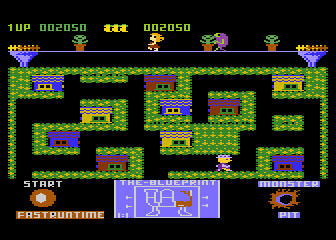 In addition to bombs, you must concern yourself with Sneaky Pete, the neighborhood nerd who lives in the bomb pit. He'll surface from time to time to push a start button at the lower left portion of the screen that will slip your parts off the blueprint. In level three, you'll be harassed by Fuzzy Wuzzy, a vengeful fellow whose advances were once spurned by Daisy. In all the levels, as Ollie relentlessly pursues Daisy across the top of the screen, he will sometimes knock flowerpots off the ledge. When a flowerpot hits bottom, it will grow feet and bounce your way.
Once you complete your contraption, a warning signal will sound, alerting you that it's time to rescue Daisy. So, push the onscreen start button to activate the device allowing you to fire basketballs at Ollie as you maneuver horizontally along the lower portion of the screen. One lucky or skillful shot will knock Ollie on his duff. Begin Blueprint with five lives and gain a new one when you score 20,000 points. Choose from seven skill levels.
REVIEW:
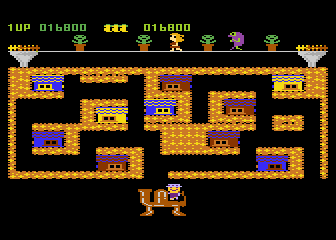 When I first played Blueprint for the Atari 5200 back in the day, I had no idea what to expect. I had never played (or even heard of) the arcade version. With a name like Blueprint, the game seemed like some kind of needlessly complicated strategy contest or an esoteric simulation of some sort. In short, I was prepared to be utterly bored. Much to my delight, I discovered that Blueprint is a maze game, a very strange and original one at that. And while some of my favorite games are dot-munchers (Ms. Pac-Man and Lady Bug come to mind), I found it refreshing to play something different.
One interesting aspect of Blueprint is that it forces you to use your memory. This is unusual for a maze game. A crucial aspect of gameplay is remembering which of the ten houses you entered. This may sound easy, but when the action gets hot and heavy, it's easy to forget, especially when you're down to one or two more pieces of the contraption. With the help of the pause button, you could cheat and slap stickers on the TV screen to indicate which houses you've been in, but you wouldn't want to do that, would you? Another plus is the strategy. You can speed up and slow down at will, and a speed indicator monitors how much speed you've used. This lets you cruise quickly when trying to get rid of a bomb or dodge an enemy, while letting you save energy when you're walking around the maze unencumbered. I haven't even mentioned the clever onscreen start button and monster pit!
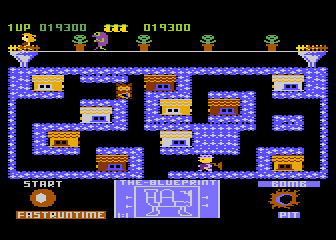 By now, you probably think I'm crazy about Blueprint and would recommend it. Unfortunately, after playing the game for an extended period, I found enough flaws to make it one of the lesser titles in the formidable Atari 5200 library. The most annoying thing about the game is Fuzzy Wuzzy. Not only is his name stupid and unoriginal, but he also gets in the way when you're trying to get rid of a bomb or go to another part of the maze. Sure, that's his job, and a game without enemies is like a story without conflict, but he is a classic overachiever. But sometimes, no matter what you do, Fuzzy will not stray from his path and your only options are to make a suicide run or let the clock expire. This isn't challenging—it's frustrating and unfair. I like a cunning enemy as much as the next gamer, but I don't like a cheater!
Another frustrating moment occurs after you've built the basketball-shooting device. You work hard to build the contraption, but the scene in which you actually use it is much too short. All you have to do is hit Ollie Ogre a single time with a basketball -- a fast and fun, yet underutilized part of the game. Expanding this sequence would make Blueprint half maze-game and half shooter—a very cool notion.
Finally, the controls aren't precise enough, making it too easy to go into the wrong house when trying to turn a corner. Adding to the list of drawbacks are only one maze design, only one route between the right and left sides of the maze, you can't see the timer, and the game just isn't as cute or as addicting as Ms. Pac-Man, Lady Bug, or Mouse Trap.
April 6, 2019
Retro Video Game Review - Carnival for the Intellivision
 Carnival for the IntellivisionColecoFixed Screen Shooter1982
(Images Courtesy of MobyGames.com)
SYNOPSIS:
Get ready for some old-fashioned shooting gallery action with Carnival for the Intellivision, which is based on Sega’s 1980 arcade cult classic. You control a gun that moves across the bottom of the playfield as yellow ducks, red owls, white rabbits and other horizontally moving targets advance assembly line style down the screen. When a duck reaches the lowest of the three rows, it can break from formation and fly down to gobble up ten of your bullets. Shoot the fiendish fowl if you can.
Other moving targets include numbers and letters. Shooting the numbers 5 and 10 will gain you extra bullets. Shooting the letters B-O-N-U-S in order will net you the amount of bonus points displayed in a box at the top right side of the screen.
 A plus-minus target is situated on the left, above the moving targets. Depending on whether a plus or minus symbol is currently on display, shooting this target will reward you with or take away a certain number of points or bullets.
You'll waste a bullet and not score any points, but if you want to turn off the circus-type music that plays throughout the game, you can shoot a little musical note. Hit it again to turn it back on. More importantly, a wheel of rotating pipes turns continually at the top center of the screen, and you must shoot all these pipes before you can finish a level. If you leave even one pipe unharmed after you destroy all the targets, ducks and more ducks will begin filling the playfield.
After you complete each level, you take part in a bonus round in which you must shoot a bear (or bears) as many times as you can before he walks or runs off the screen. Every time you hit him, he will change directions and begin moving faster. After the bear gets away, you enter a new level of play filled with targets and a fresh set of pipes. The game ends only when you run out of bullets.
REVIEW:
During the early 1980s, Coleco ported eight of their ColecoVisioncoin-op conversions to the Intellivision: Carnival, Donkey Kong, Donkey Kong Junior, Lady Bug, Mouse Trap, Turbo, Venture, and Zaxxon. Of these games, Carnival is arguably the most arcade-like in its faithfulness to the design and playability of the original game.
Although less aesthetically pleasing and clunkier to control (the gun pauses for a split-second when you press left or right on the disc) than the original game and the ColecoVision version , this rendition of Carnival is an acceptable copy, considering the relative limitations of the Intellivision. It looks about as well as can be expected, and it comes with all the proverbial bells and whistles. The Atari 2600 version of the game lacks the bonus rounds, in which you must shoot a bear that walks faster and faster across the screen, but the Intellivision game has all the elements of play in place. The Atari 2600 game is also lacking in difficulty levels, which this version thankfully keeps intact from the ColecoVision port.
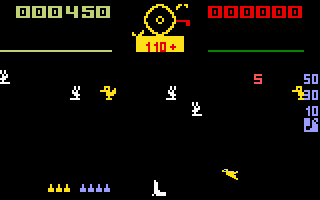 Unlike most shooters of this type, which give you unlimited ammunition, Carnival makes you earn additional ammo by firing at extra-bullet targets. This aspect of the game is crucial in that it makes the aiming and timing your shots very important. Adding to this are the pipes, which rotate on a wheel at the top of the screen. These are tough to hit, but you should take them out as soon as possible as new targets continue pouring out as long as at least one flag remains standing.
The ducks, which increase in number the deeper you get into the game, can fly down to eat your bullets, and you can add or take away from your score or ammunition dump by hitting a plus-minus target. Also cool is the fact that you must shoot the letters in BONUS in the correct order to rack up the extra points.
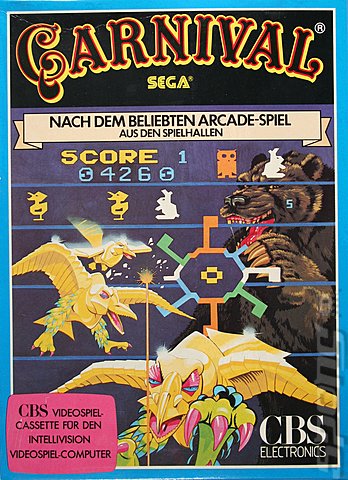 Carnival is more than an ordinary, mindless shoot-'em-up thanks to these features, and the Intellivision version of the game is about what you'd expect: a blockier and clunkier, but competent rendition of the arcade and ColecoVision semi-classic.
April 2, 2019
Sega Genesis Mini - Sega Genesis Book
 There’s lots of excitement about the Sega Genesis Mini, a console featuring 40 built-in games. Ten titles have been announced so far: Ecco the Dolphin, Castlevania: Bloodlines, Space Harrier II, Shining Force, Dr. Robotnik's Mean Bean Machine, ToeJam & Earl, Comix Zone, Sonic The Hedgehog, Altered Beast, and Gunstar Heroes. The system, produced by Sega, will release September 19, 2019 with a retail price of $79.99.
 With this in mind, it’s a good time to check out ClassicHome Video Games 1989-1990: A Complete Guide to Sega Genesis, Neo Geo andTurbografx-16 Games, the FIRST and ONLY book to feature write-ups for EVERY U.S. release for the Genesis. It also features write-ups for every game for the Neo Geo and TurboGrafx-16. (The cover dates of 1989-1990 simply refer to console era—every game for each console is included.) You can order a signed copy direct from me HERE.
You can check out YouTube reviews of the book HERE and HERE.
March 26, 2019
The Game Chasers - The Movie

 Think you know The Game Chasers? Think again! In my new article for CultureMap Fort Worth, Billy discusses their forthcoming film, how he met Jay, the birth of their YouTube channel, and more. Turns out Billy isn't really a "chode". :) Click HERE for a quick read. Enjoy!
March 24, 2019
SNES Omnibus Writer Spotlight #47 - Blair Farrell
 Few people have been as enthusiastic about The SNES Omnibus project as Blair Farrell, whose specialty is superhero video games. Not only has Blair enthusiastically contributed stories to The SNES Omnibus: The Super Nintendo and ItsGames, Vol. 1 (A–M) and The SNES Omnibus: The Super Nintendo and Its Games,Vol. 2 (N–Z), he’s shared posts, written a review, and in general been very supportive. Blair knows his stuff, and you can check out his work on ComicGamers Assemble. Plus, he’s a super nice guy and a geek in the best sense of the word. Thanks, Blair, for going above and beyond!
Here’s Blair’s bio from The SNES Omnibus Vol. 1:
 Blair Farrell has been playing video games obsessively in some capacity since he was five years old, beginning with the NES and up to the PlayStation 4. Another of Blair’s hobbies is reading comics, and in 2012 he combined his two loves and created Comic Gamers Assemble, a website dedicated to comic book-themed video games. Since that time, he’s published more than 1,000 articles—everything from editorials to features to reviews of comic book-flavored video games, both past and present.
March 21, 2019
NOW AVAILABLE! -- The SNES Omnibus: The Super Nintendo and Its Games, Vol. 2 (N–Z)
 My new book, The SNES Omnibus: The Super Nintendo and Its Games, Vol. 2 (N–Z), is now available! You can order copies direct from me by simply sending $59.98 PayPal (U.S. only, includes shipping):
Autograph Options Signed by Author $49.99 USD Unsigned $49.99 USD

Or, you can Venmo $59.98 to @BrettWeiss-18. (U.S. shipping only.) Just let me know if you want me to personalize the autograph and what you want me to say.
Check out this YouTube review of the book. For a full-screen look at the review, click HERE. Thanks for reading!
SNES Omnibus Writer Spotlight #46 - Barry Shank
 Barry Shank runs the Facebook group Gamers Helping Gamers, a community of people who are passionate about video games. What sets the group apart from the pack is its mission to help members find games for one another for a “bro price,” typically 30 percent or so below market value. The only rule is that you can’t “flip” or resell the games you get at a discount—it’s about the love of the hobby.
Barry, by all accounts a devoted family man and solid citizen, also contributed some nostalgic stories my SNES Omnibus project, a two-volume set featuring every U.S. release for the beloved Super Nintendo console. Barry is all about supporting the community and having a good time. He even asked me my favorite question (I’m paraphrasing): “When buying the books, would it help you more to buy them direct from you?” Yes, it does. Thanks, Barry!
Here’s Barry’s bio from the SNES Omnibus books:
Barry Shank, who began gaming on the Atari 2600, is the founder of GHG (Gamers Helping Gamers) on Facebook. He started buying games for the Atari from the flea market in the ’80s with his dad, who refused to spend more than $3 per game. From there, he moved on to the Genesis and now has a game room that contains every console since. His current passion is working with his group to help people find the games they want at reasonable prices.