Andrew Sullivan's Blog, page 51
December 23, 2014
Americans Learn To Stop Worrying And Love Torture, Ctd

Many atheists are surely passing around this post. One writes:
Dear Andrew (welcome back!), Chris et al: What jumped out at me in the chart accompanying your post is that the ONLY group of Americans in which a majority do not consider US torture justified is people with no religion. Hmmm. I thought that there was no morality without religion?
American religion is in pretty bad shape – or its leaders are terrible communicators, or it’s been totally hijacked by the RWNJ media – when Godless atheists exhibit more traditional morality than either Protestants or Catholics. That 40% of atheists approve of torture is appalling to this atheist, but I’ll take it over the huge majorities of “believers.”
Another non-believer sends the above graphic. Another piles on:
I’m proud of my group (non-religious people)’s views on torture being the most enlightened. It’s a big reason why I ran from Christianity.
I wholeheartedly agree that most American Christians are not Christians in the slightest. It’s another reason I despise most American Christians – they claim to be inherently better than everyone else, especially Atheists and Agnostics – yet are obviously not. They support our modern Rome blindly; they put money ahead of everything; they support torture; they support persecution of minorities; they believe that supporting war is Christian; they don’t know their holy texts as well as Atheists and Agnostics do; etc.
Another is more nuanced:
Can we finally put an end to the notion that humans need God or religion in order to be moral? There is perhaps no act more morally corrupt than torture, but we find that the only religious group to disapprove of torture was: the non-religious. Protestants and Catholics considered torture justified by a margin of more than three to one. If the numbers were reversed, we would hear no end that this proves that without religion, you can’t have a true moral compass.
I won’t make the opposite claim – that religion is morally corrupting – because I think the actual relationship between religiosity and morality is essentially nil.
I appreciate your writing in part because you are unapologetically devout and at the same time profoundly respectful of non-believers. I would like to see more atheists extend the same respect toward the believers. Yet I still get the sense at times that you and other believers can’t quite grasp how an atheist‘s morality can be quite as good as yours. And so you resort to writing, “the staggering levels of support for torture by Christians merely reveals that very few of them are Christians at all.” Poppycock. They are Christians who have given in to fear and/or rage – something to which all of us, whether Christian, Hindu, Muslim or atheist are vulnerable.
So I repeat: Enough of the notion that without God or religion we can’t be truly moral. Letting go of that belief will take us another step toward truly religiously tolerant society where men and women are judged by their actions, not by their religious garb.
Another reader:
I sent your recent post on torture to my dad, who is a professor at a theological seminary in the U.S. My dad and I don’t usually see eye-to-eye on political or religious issues (me being a socialist atheist, him being a conservative evangelical), but our beliefs converge when it comes to torture. He responded to my e-mail with the following:
Thanks for this. I’m going to print off a copy and include a new topic on “torture” in my Old Testament Biblical Theology class notes on “Torah and Ethics.” It will also fit under my lectures on “image of God,” which are in two classes.
Last but not least, a dissent from a theology professor:
The US Catholic bishops have made plenty of mistakes, but overlooking torture is not one of them, as you claim in your post. They did “stand up and be counted” on this issue, starting in 2005 right up to the present. Here‘s the resource page. And here is the 2008 study guide “Torture is a Moral Issue”.
Now, could they have done more? Sure. But you have to admit that the Catholics in the pews don’t respond very well to the top-down moral preaching that the bishops advise already. The support of Catholics for torture thus indicates the complete assimilation of white Catholics to the general American population, not some lack of advocacy on the part of priests and bishops.
The USCCB was strong on this issue. Evangelical flagship Christianity Today was strong on this. Most leading figures were strong on this. Sadly, none of it could overcome our combination of nationalism and fear.
I’m aware of their efforts and indeed of the National Religious Campaign Against Torture. I’m a big admirer of their work. But it remains true that on such a profound issue, it’s scandalous that Catholics of all people can defend the torture of human beings. I don’t think the hierarchy have broken through the general noise. And I have never heard a word about it from the pulpit in the last ten years. Maybe Francis will come through.


Mental Health Break
Let the fir fly:


You’re Paying For That Well-Chosen Adjective
Dan Jurafsky’s The Language of Food examines the vocabulary of restaurant menus:
Mr Jurafsky ploughed through the descriptions of 650,000 dishes on 6,500 menus. Mid-range restaurants repeatedly insist that their food is “fresh”; this “overmentioning”, he explains, is a symptom of status anxiety. Cheap eateries swear their food is “real”. Expensive restaurants avoid such terms. The mere mention that the crab is real or the plums ripe is sufficient to conjure in diners’ minds the possibility that they might not be—the “maxim of relevance” in linguistic terms.
Pricey joints also use longer words. Mr Jurafksy calculated that every one-letter increase in the average length of the words describing a dish adds an extra $0.18 to the price. Phrases like “exotic Ethiopian spices” inflate prices too. Such foods would not be exotic to real Ethiopians. Places that label their food thus are not catering to native eaters who consume it every day; “that exotifying or orientalist stance is instead directed at non-native eaters,” he writes. Vaguely positive words, however, such as delicious or tasty, “linguistic filler words” used when restaurants have nothing genuinely valuable, such as caviar, to talk about, bring the price down by 9%.


The View From Your Window Contest: Winner #236

A reader thinks we’re being topical:
Cuba, of course.
Another gets topical himself:
In honor of Andrew’s final appearance on The Colbert Report, here’s my truthiness answer for this week’s VFYW – Portugal, because it feels like it – and no amount of facts can change my mind.
Another appreciates the “seasonal appropriate Dickensian feel” of the scene, while another, after surveying many hotel windows in coastal England, finally settles on Dover:
Somewhere in the general proximity of the White Cliffs of. I hope I’m completely wrong. Somehow I would feel better if I were barking up the wrong tree, rather than simply being incapable of climbing the right one.
The most popular incorrect guess this week gets us, at least, to the right part of Europe:
We Alaskans always feel a kind of kinship for these arctic locales. I haven’t been to Bergen, Norway in 30 years, but it reminds me of what beautiful human-scale architecture can make of these cool rainy climates and steep terrain. A few towns in SE Alaska have some similar elements (Juneau and Sitka), but we are far behind the Norwegians in building livable cities as aesthetic as these.
Our Scandinavian readers really came out of the woodwork for this week’s contest. Here’s one who recognized the right country immediately:
This made me so homesick I had to put in a guess. It looks like Denmark. Could be any small fishing village I guess, so I’ll try Nordby on Fanø where my patents live and where I wish I’d be for Christmas.
Another Dane guesses Svaneke:
No interest in hunting down the actual coordinates. But thanks for the memories. It was 1980 … expensive cigarettes … cheap herring … Soviet warships … skinny dipping … youth … Jutta …
A longtime reader seizes his moment:
I’ve been following VFYW for years, quietly, patiently waiting in the dark for an easy prey suitable for my skills would show up. And by skills I mean random coincidence and luck, because at some point some window would be from a place I could recognise. And finally. This was that one window.
The city is Ærøskøbing, which is the main city on the small island of Ærø in the southern part of Denmark. In what we Danes call the Sydfynske Øhav (the southern Funen archipelago). The photo is taken from the small hotel Pension in Vestergade 44. It’s taken from the narrow window facing north from the room called Karnappen (it does not have a number).
My process: My parents having unprotected sex could be seen as the first step in figuring this out. However, I do think it would be more correct to say that my being born into a family of sailors in another small coastal town in Denmark was the first and very important step in guessing the window. Second step was immediately recognising the view as an old Danish coastal town. Since they all pretty much look the same, I was very happy to notice the top of the ferry in the background, which narrowed it down quite a bit. The first place I thought of was Ærøskøbing. I looked at google maps and Vestergade is the only street leading to the ferry. I randomly clicked streetview on Vestergade and ended up in front of the yellow house from 1749. And that was pretty much it. Also, there’s a photo of the window on the hotel website.
I’ve sailed quite a bit in those waters, but only been on land in Æreskøbing, sailing as a teenager many years ago. It rained and we only stayed long enough to have lunch and supplies.
Another first-time correct guesser adds:
I actually stayed at this B&B many years ago. It’s one of the cosiest places I’ve ever been. If my recollection serves me right it is run by a nice English lady who serves tea at 5pm sharp with scones and her own jams and marmalades. If you ever want to step into a real life H.C. Andersen fairy tale town, Aeroskobing is the place.
Via a former winner, here are the precise windows:

Another veteran runs through the clues:
The architecture, apparent weather and license plates immediately pointed to Northern Europe. There’s a car park at the end of the road and the smokestacks of a ferry just visible above the roofs. So, small town with ferry port somewhere in the British Isles, perhaps northern France, Holland, or Scandinavia.
My first inclination was the British Isles, so I spent a while searching Google images of ferry lines around England and Ireland but none of the ships seemed to have the right yellow paint job. “Yellow ferry” wasn’t that helpful really; it turned up page after page of Corsican ferries. I then moved through the Netherlands before eventually hitting Denmark, and lo and behold, the Ærøskøbing ferry:

From there it was a hop skip and a jump to use Street View up from the harbor to the Pension Vestergade 44. The distinctive 1749 building across the street and “EL” of the “HOTEL” sign a few doors down made it easy to pinpoint the window, the half-width one in the middle of the linked streetview, on the thin face of the building perpendicular to the front.
Ærøskøbing looks like a really lovely place. I’m sure many contestants this week will point out that it’s famous as a well preserved middle-ages town, and is apparently only accessible by that ferry. I’ll also throw in that their local specialty is apparently Ærøpandekager, “very thick pancakes”, which I now want.

Here’s how another contestant also ferried to the right spot:
The clues in the picture pointed to a port in northern Europe, perhaps Germany, Scandinavia or a Baltic state. Yet as with the Halifax contest, the ship seemed to be the most important clue. I started in East Frisia working east along the coast, then around the Danish coastline before recrossing the German border into Schleswig-Holstein. When back in Germany searching ferry companies near Eckernförde, this picture of an Ærøfærgerne car ferry popped up. The ship is the M/F Ærøskøbing (Wikipedia shows the ship displaying an older livery) and it is the very same ferry docked in this week’s contest picture. Somehow I missed the company’s ferries while poking around ports in Denmark. With the M/F Ærøskøbing identified, it was easy to find the Pension Vestergade 44 in Ærøskøbing on Ærø island in Region Syddanmark, Denmark.

And this player led a small team of Facebook friends in the hunt:

Another adds:
The Pension’s website notes: “The house was built in 1784 by a sea captain as a dowry for his daughter. Much later, a well known sculptor – Gunnar Hammerich – lived here.” According to the Danish Heritage Agency it was, originally, a pharmacy.
It was the “1749” house down the street that led many to Ærøskøbing:
This week’s photo takes me back to my last semester at university, which I spent on
exchange in Denmark. Great country, with an inordinate number of extremely attractive people. Once I realised the photo was taken in Denmark, a couple of quick searches on the usual photo sharing sites later and I was able to identify the building on the right hand side of the photo as this building on Vestergade in Ærøskøbing on the island of Ærø.
Also: Thæ ådditionål lættærs in the Dånish ålphåbæt are åwæsomæ ånd I løvæ åny øppørtunity tø bust thæm øut.

But readers didn’t miss much else this week, either:
The main clue that helped me determine the country was actually the manhole cover. The radial pattern with the double division on the outer rings is a design specific to Denmark. They are made by the Norwegian foundry Ulefos Jernværk which was started in 1657:

The license plates also helped. Even though the closest one was blurry, the colors on it match a form of plate used by Danish vehicles that are for both commercial and personal use:



There’s some Dishhead heritage in the town as well:
I was so excited to see the window for this week’s contest because I recognized it immediately as the city that my family is from: Aeroskobing, Denmark. I love Aeroskobing because it is charmingly called the “Fairytale City of Denmark” due to its charming little houses. I also love the fact that most of the houses have the names of cities on the back of the houses. Because Aeroskobing is a shipping town, these towns signify the sailor’s favorite port/sailing location. The two houses that my family have are the Pacific and Alameda houses. I have attached photos of them and of the charming pension courtyard and their lovely dog, Hector:
Meanwhile, our contest warrior-poet returns:
I’m makin’ this short, I won’t pander, son,
Not on the turf of Hans C. Anderson.
And this near to Elsinore… it’s just too damn hard,
Evoking a hamlet as well as The Bard.
Houses with build dates make great Google snoopin’,
Can’t read the Danish? Just say “Aye-roosh-koopin”.
There were a lot of correct entries this week. One player tries to stand out:
Since everyone is going to guess this one, I will refine my guess by speculating that the photographer is 37 years old, male, approximately 6’1″ tall with a moustache, who prefers wearing berets and owns an extensive collection of antique glass insulators from the early 20th century.
Chini always stands apart:
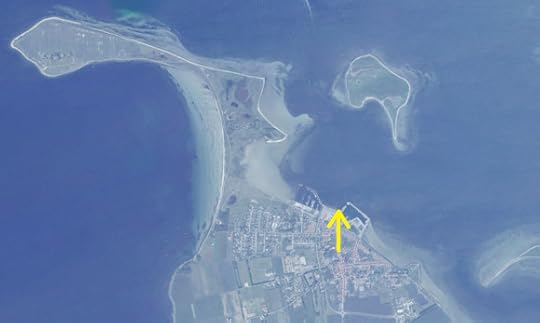
When I found last week’s view it brought back miserable memories of trudging uptown for supplies, bedraggled and sleep deprived after Sandy hit. Finding this week’s location, on the other hand, initially evoked no memories at all, but it should have. Two years ago the Dish featured one of the hardest contests of all time in VFYWC #134. It was so hard that only one person found the right country despite our having a whole extra week during Christmas to hunt for it. I remember being so lost that I briefly searched the Texas coastline. But that’s the beauty of the contest; this week’s location is only 25 miles away from that one but it’s a thousand times easier to find. Why? As always, the clues…

Another hard-core regular is equally compelled to keep playing:
There’s a singular feeling that Dish contest veterans get when you find that one image or street view and you know you’ve nailed it. It’s a rush of adrenaline and pride, like finding that lost earring that your wife dropped under the couch. It’s what keeps me coming back, even after winning the contest.
And this reader finally takes the plunge:
I think this is the first time I have actually really TRIED to solve a VFYW. This despite having followed the Dish for many, many years, and enjoying reading the entries to the contest. But this time I was sitting with my girlfriend, pointing out interesting articles on the Dish, as I often do. I had mentioned the VFYW contest to her before, and now I thought I’d demonstrate what the fuss was all about. I already had an idea that this picture might be from Denmark (where I live), since the architecture and the ferry in the background was very reminiscent of old Danish fisher villages. Details that immediately stuck out were the lamp post, the sewer cover, the cobblestones, and the license plates on the cars. So, what remained to be determined was what city…
This ended up being a fun conclusion to a browsing session that started with a discussion of depictions of the Madonna – my girlfriend has a Master’s in Art History and her thesis was on depictions of the Madonna in the Renaissance. Like many others have said, this is what I love about the Dish – you never know what you are going to encounter – art, politics, sexual mores, or a sudden trip down memory lane (I grew up near Ærø, but have only been to Ærøskøbing once, almost 35 years ago, to visit a cinema that was showing Abbot and Costello Meet Frankenstein…).
And the Dish absolutely depends on word of mouth like the above to reach new readers, so if you need a last-minute gift idea, consider sharing the Dish. Meanwhile, the last prize of 2014 goes to a 17-contest veteran:
This week’s view is from the Pension Vertergade 44 in AErøskøbing, Denmark.
Based on a picture on the pension’s website this is a view from the room named Karnappen looking down Vestergade to the ferry, which is visible in the picture.My first thought on seeing the picture was Iceland – perhaps Reykjavik – but that didn’t pan out. Then I focused on that ferry, and the markings on the funnels. That led me to the AErofaergne which run between the island of Funen and AErø in Denmark. Didn’t take long after that to figure out the rest. This is one of those contests that has revealed someplace new and interesting that I now want to visit. So, thanks for that.

When combing our inbox for contest candidates, this week’s view really stood out, as it was taken on a very special day by one of our most accomplished regular players. She explains:
Coolest second anniversary ever!!! I don’t know how intentional it was to post that picture on that date but you made my year, especially because my husband has been working overseas and got home for the holidays just the day before.
I took that picture on the morning of our wedding day, December 20, 2012, in Ærøskøbing, Denmark, on the island of Ærø. The view is from the Pension Vestergade 44 in the Karnappen room.
I cannot say enough about Pension 44 and its owner Susanna. We went back just this summer (my husband purchased tickets as a 1st anniversary present) and stayed there again, and we hope to return many more times.
When Danes would find out that we were both American and getting married in Denmark—in the winter, no less—the response was always, “WHY?!” My husband and I met in Spain but for two Americans getting legally married in a lot of European countries is possible but a hassle. Recalling a Rick Steves episode covering Ærø, I Googled “get married in Denmark” and discovered two things: First, that getting married is a relatively smooth process there even for non-nationals. It’s a popular destination for not only Danes marrying non-Danes, but EU citizens marrying non-EU citizens or partners from other EU countries. Second, we found Louise, who runs Danish Island Weddings in Ærøskøbing (also notice she owns the domain “getmarriedindenmark”—smart gal). In the two years
since our wedding the island has become increasingly popular as a wedding destination and Louise’s business has grown with it, deservedly so. Ours was a sort of planned elopement—the only people there were us, the officiant, and our two witnesses were Louise and our photographer Camilla, who lives and does much of her fantastic work on the island.
All this is not meant to sound like an ad, but our wedding and our stay in Ærøskøbing was everything we could have possibly asked for. We made friends there that we saw again this summer. We can’t wait for our next trip back.
Thank you so much for an extra chance to re-live this day on our second wedding anniversary! I’m including a picture taken at the same time looking the other way down the street and, because I can’t help myself, one of our wedding pictures taken in the town (the latter c/o Camilla Jørvad Photography).


Thanks so much for sharing. We’ll start off 2015 with a much harder view, so come back on Saturday if you crave a good puzzle amidst the eggnog and revelry. Until next year …


A Good Closer?

There has long been a pattern to Barack Obama’s political career on the national stage. There are moments of soaring moral clarity and inspiration; there are long periods of drift or laziness or passivity; and there are often very good fourth quarters. The 2008 campaign was an almost perfect coda: the sudden initial breakout, then a strange listlessness as he allowed the Clintons to come back in New Hampshire, turning the race into a long and grueling battle for delegates, then a final denouement when he made up with the Clintons and stormed into the White House. Or think of healthcare reform: a clear early gamble, followed by a truly languorous and protracted period of negotiation and posturing, and then a breakthrough. Or marriage equality: an excruciating period of ambivalence followed by a revolution. On climate: a failed cap and trade bill … followed by real tough fuel emissions standards, new carbon rules from the EPA and an agreement with China.
If you were to track this pattern – strong start, weak middle, winning final streak – throughout his entire presidency, you might have expected his worst year to be the one when he was just re-elected and had the wind at his back. And you would be right. 2013 was truly awful. But you’d also expect his final years to be strong. Until recently, much of the Beltway was engaged in a rather sour judgment on this score. He was an anachronism, shellacked for the second time by the midterms, a crippled fowl hobbling toward mediocrity. The future belongs to … Mitch McConnell!
Or not. The latest reports on economic growth suggest that Obama is now presiding over the strongest economy in more than a decade. Back in 2009, this was in no way predictable, or even likely. Compared with America’s international competitors, it’s powerful evidence that Obama’s early measures to save the US economy from the abyss were more successful than many will concede. The country, meanwhile, has experienced an energy revolution – a win-win (apart from the planet) which has also given both Putin and Khamenei the collywobbles. Sure, this was not an Obama initiative, but he didn’t get in the way. The potential for solar power has also never seemed brighter.
Crime remains at historic lows; the deficit has been slashed; healthcare costs – the key indicator of future debt – have been falling; inflation remains low; interest rates have not soared as many conservatives predicted; and unemployment is half what he inherited.
Millions more have reliable and portable health insurance coverage in a program performing somewhat better than anyone predicted a year ago. Although the right-wing media noise machine has done its best to obscure all of this, it will surely eventually sink in, even though polarization has made big shifts in opinion highly unlikely. And on the politics of it all, Obama’s coalition remains a demographically formidable one as you look ahead. His bold unilateral move on immigration turned out to be a political winner (against my judgment at the time). Latinos, African-Americans, gays, unmarried women all remain a powerful base for the GOP to counter. And Obama’s persona was and is critical to keeping that coalition together.
On foreign policy, we end the year with Putin reeling, Netanyahu facing re-election, Syria’s WMDs removed and destroyed, withdrawal from Afghanistan almost completed, and a nuclear deal with Iran still possible. Yes, we have one huge step backward – the decision to re-engage in the sectarian warfare in what remains of Iraq. But so far at least, the engagement has been limited, the Islamic State has been contained, a new Iraqi prime minister holds out more hope than Maliki, and the Kurds and the Shiites have a much better relationship. The new relationship with Cuba is also a mile-stone toward a saner, less ideological foreign policy.
Obama likes the final stretch. It’s liberating for him, quite clearly. And clarifying for the rest of us. My point is a simple one: the long game has always mattered to this presidency, and we are now very much in the fourth quarter. That’s when Obama has always been strongest. And the story of this presidency isn’t close to being told yet.
Know hope.
(Photo: President Barack Obama holds a press conference during which he discussed Sony Pictures’ decision not to release “The Interview” in wake of the alleged North Korean hacking scandal at The White House on December 19, 2014 in Washington, DC. By Leigh Vogel/WireImage via Getty.)


December 22, 2014
A Poem From The Year

There isn’t another political or current affairs blog I know of that has poems suddenly poking up all over the place. It’s one of the things I’m proudest of here at the Dish – because it makes the implicit point that wisdom comes in many guises and that there are more ways to understand life than explainer-journalism. All of this is very fine and dandy in theory, but none of it would be possible in practice without our Poetry Editor, Alice Quinn. In the world of poetry, Alice is a legend. Her impeccable taste and depth of knowledge, her passion for the form, and her dedication to its survival and its necessity are the stuff of literary lore. And sometimes it seems not only that she knows a poet’s work, but that she actually knows him or her, and is or was a friend. So when I think of how we can sustain the kind of culture that the now-dying liberal arts magazines once did, I hope the integration of poetry into blogging is one small sally into the prevailing winds.
Alice was Knopf’s poetry editor from 1976 – 1986 and the New Yorker’s poetry editor for the next twenty years, and is now the executive director of the Poetry Society of America. And, every Christmas, we invite our poetry-loving readers to express their appreciation by joining the Society. This year, they are running a special year-end membership campaign from now until January 2nd. While supplies last, anyone who joins at the basic membership level gets a signed, limited-edition broadside of “Frogs” by Gerald Stern with an extra $10 donation. Any donation is tax-deductible—and for a short time, you also get a beautiful broadside in the bargain. Sign up for your membership here.
In the week ahead, we’ll also be looking back at a few of the poems offered this year, chosen by Alice and Matt Sitman, our literary editor – think of it as an idiosyncratic “greatest hits” of Dish poetry. Each of these poems will include a link to the Poetry Society of America’s membership drive. The first poem we’re revisiting is below.
“For Malcolm X” by Margaret Walker:
All you violated ones with gentle hearts;
You violent dreamers whose cries shout heartbreak;
Whose voices echo clamors of our cool capers,
And whose black faces have hollowed pits for eyes.
All you gambling sons and hooked children and bowery
bums
Hating white devils and black bourgeoisie,
Thumbing your noses at your burning red suns,
Gather round this coffin and mourn your dying swan.
Snow-white moslem head-dress around a dead black face!
Beautiful were your sand-papering words against our skins!
Our blood and water pour from your flowing wounds.
You have cut open our breasts and dug scalpels in our
brains.
When and Where will another come to take your holy place?
Old man mumbling in his dotage, or crying child, unborn?
(From This is My Century: New and Collected Poems by Margaret Walker © by Margaret Walker Alexander. Reprinted by kind permission of the University of Georgia Press. Photo of Martin Luther King, Jr. and Malcolm X, March 26, 1964, from the United States Library of Congress‘s Prints and Photographs division via Wikimedia Commons)


Quote For The Day
“We have been silent witnesses of evil deeds; we have been drenched by many storms; we have learnt the arts of equivocation and pretence; experience has made us suspicious of others and kept us from being truthful and open; intolerable conflicts have worn us down and even made us cynical. Are we still of any use? What we shall need is not geniuses, or cynics, or misanthropes, or clever tacticians, but plain, honest, and straightforward men. Will our inward power of resistance be strong enough, and our honesty with ourselves remorseless enough, for us to find our way back to simplicity and straightforwardness?” – Dietrich Bonhoeffer, “Letters and Papers From Prison.”


Citizen Canine

Zack Beauchamp interviews philosopher Will Kymlicka:
ZB: So what’s wrong with just saying we’ll take a number of steps to protect animal rights without going so far as to declare them citizens?
WK: As I’ve said, the core of our theory is the idea of membership. It’s a rich concept if you think about it seriously: it’s the idea that domestic animals belong here. It’s where we disagree with one strain of animal rights theory, which says we should extinguish domesticated animals because it was a mistake ever to bring them in.
We need to create a shared interspecies society which is responsive to the interests of both its human and animal members. That means that it’s not just a question of how you ensure that animals aren’t abused. If we view them as members of society — it’s as much their society as ours — then it changes the perspective 180 degrees. The question is no longer “how do we make sure they’re not so badly treated?” We instead need to ask “what kind of relationships do they want to have with us?”
That’s really a radical question. It’s one we’ve never really bothered to ask. I think there are some domesticated animals that enjoy activities with us — I think that’s clearest in the case of dogs, but it’s also true of other domesticated animals whose lives are enriched by being part of interspecies activities with us. But there are other animals who, if we took what they wanted seriously, would probably choose to have less and less to do with us. I think this would be true of horses.
(Photo by Flickr user alaindemour)


Face Of The Day

A man wears a costume as he attends the draw of Spain’s Christmas lottery, which is named ‘El Gordo’ (Fat One) at Teatro Real on December 22, 2014 in Madrid, Spain. This year’s winning number is 13437. The top prize of 4 million euros will be shared between ten ticket holders. The total prize fund is worth 2.24bn euros. By Pablo Blazquez Dominguez/Getty Images.


Losing Your Faith In Santa, Ctd
Readers continue the popular thread:
I remember the moment I knew for a fact that Santa wasn’t real. All my life, Santa used different wrapping paper than my mom. Gifts from my parents were in one style and Santa’s gifts looked completely different. One July, when I was 11 or 12, I was helping my mom clean out the garage and I came across Santa’s wrapping paper. I was old enough that I had a good idea that Santa wasn’t real, but I remember the look my mom and I exchanged. Mom said, “Well, that’s that. Don’t tell your little sister.” And I didn’t.
The next Christmas, when Santa used the special paper again, I felt like I was in on some big secret. I knew the truth! My sister figured it out logically a year later. She was 8. I am clearly the slow one of the family.
Another’s reason for disbelief was pretty simple:
Santa had the same handwriting as my parents.
Another reader:
I had been suspecting Santa was a myth for a few years, but when I was 10 I cornered my dad because he somehow couldn’t lie to me when asked a straight question. (As an 8 year old who had just
finished D.A.R.E., I caught him burning incense and smoking, I thought, a cigarette. Being the smart ass I was, I asked, “are you smoking marijuana?” His answer was, “Yes, don’t tell your mother.” I didn’t.)
I asked him if Santa was real, and he told me no – it was him and my mom. To this day he says my face dropped, my heart broke, and that he’s always regretted telling me. I remember it differently. I remember being glad he told me the honest truth and didn’t keep lying to me like all the other adults. Of course I WANTED Santa to be real, I still do! That’d be awesome! But I had already found their stash of presents and he was just confirming what I already knew.

Another confesses:
I should probably keep this to myself, but what the Hell:
I held on to a belief in Santa until an embarrassingly late age. I may have been as old as 12, certainly over 10, but either way much too old to still be believing in Santa. I don’t recall arguing with other kids who told me the truth, just an iron-clad confidence they were wrong. Besides, I remain to this day much too gullible and trusting.
I was in the kitchen with my mother when my oldest sister, who was six years older than me, walked into the kitchen and asked my mother for help writing a paper for school about the reaction children have upon learning that Santa is not real. I was stunned and crestfallen. I responded with “you could just watch me” or something to that effect and left the room.
I wasn’t angry at my parents or siblings for allowing me to continue to hold onto such a childish belief. I was more embarrassed that I had allowed myself to believe in such a ridiculous idea for so long. The Santa concept falls apart even under mild questioning that it was deflating to think I had never pressed it.
Another can relate:
I love this thread, please keep it up! Like several others have mentioned, I also believed in Santa for a longer time than I probably should have. I, too, hung on due to some clever lies from my parents and my certainty of their own human nature.
My first picture with Santa from my first Christmas was actually my dad in a Santa suit. I of course didn’t know that at the time, and I guess when “Santa” was holding me, being an 8 month old, I grabbed his beard and PULLED. Out came a tuft of rental Santa beard fluff, and my parents saved it in one of those hinging jewelry boxes.
When I started to doubt Santa at an early age due to some school kids who brought me to tears by telling the truth, my parents pulled out my picture with Santa and the beard fluff as proof of his existence. That’s all I needed to defend Santa for years: “I have a piece of his beard!” (By the way, Andrew, to this day I have profound respect for beards and love that my husband has one.)
Another reader:
I found out when I was eight. I don’t recall exactly what tipped me off, probably the logistical impossibility of visiting so many kids on a single night. Whatever my reasoning, I confronted my mother with my suspicions and, after some hemming and hawing about it, she finally admitted the truth. Far from being disappointed, I was indignant that I had been lied to, not only by my parents but every other adult, as well. This was an injustice that had to be remedied.
So the next day at school, my teacher started saying something about Santa. I raised my hand, and proudly informed everyone in my third grade class what I had learned. I honestly thought (1) they would be happy to learn the truth and (2) they would be as upset with adults as I was. This is not what happened.
Every single kid in my class, including my best friend, Jimmy, was outraged, all right, but not with our teacher, their parents, and every other lying adult, but with me. Pretty much everyone in class started yelling at once, saying I was wrong, stupid, etc. I had to be sent out of the room so the teacher could placate my classmates, probably by telling them I was a kook and of course Santa is real.
I was flabbergasted. I thought I would be hailed as a hero for uncovering the sordid truth, but instead I was a pariah. No one played with me at recess that day, nor for a number of days thereafter. Jimmy and I finally reconciled after I made some mealy-mouthed concession about how I was wrong and there really was a Santa Claus. Everyone else eventually forgot about it after Christmas passed, but I never did. Third grade was a long time ago, but I can still see the hateful looks on their little faces after I spouted off about Santa.
I can’t say this changed my life or anything, but it was a pretty damn good lesson about human nature, though it took me a few years to fully absorb that. But now that I have kids of my own, I’m all in on filling their heads full of Santa nonsense. So clearly I didn’t learn that lesson.
Another confronted another kind of spite:
Back in the early 1950s, I was in kindergarten and a neighbor girl who was a couple of years older offered to help me write to Santa. We were upstairs in my house, both writing our letters, and she misspelled “from” as “form”. Even then I was a stickler for accuracy, so I informed her that she had misspelled it. Probably irked at being corrected by a younger child, she snapped back, “So what! There’s no Santa Claus anyway – it’s your parents.”
I rushed downstairs to check with my mother, but as soon as I heard my neighbor’s words, I knew they were true. My mom’s face (probably a long time before she thought she would have to confront this question) just confirmed it.
Another reader ends on a brighter note:
My sister did it the best way. Her son was simply not disbelieving despite being like 10 years old – way too old to still believe in Santa. So last Christmas Eve, she woke him up at 2am and told him: “I have something to tell you. Me and your Dad are Santa Claus. He’s not real. But we have exciting news! Now, YOU get to be Santa for your little sister.”
And my nephew has kept that secret now. And he relishes his role as his sister’s secret-keeper.


Andrew Sullivan's Blog

- Andrew Sullivan's profile
- 153 followers