Elizabeth Benedict's Blog, page 3
July 16, 2015
Me, My Hair and I in Harper's Bazaar and on Quartz!
It's becoming clear to me that hair has, well, legs.
Two more of the essays in our upcoming anthology have recently been published in advance of the Sept. 29 pub date. You can read Marita Golden's searing essay, "My Black Hair," on Quartz, under the title "My Black Hair: A Tangled Story of Race and Politics in America," by clicking HERE.
And you can read Alex Kuczynski's (kind of naughty) piece on the hair that's usually hidden, in the August issue - not currently on-line - of Harper's Bazaar, under the title "To Ladyscape or Not." Trust me: You'll love the photo that runs with the piece. And love the piece.
Two more of the essays in our upcoming anthology have recently been published in advance of the Sept. 29 pub date. You can read Marita Golden's searing essay, "My Black Hair," on Quartz, under the title "My Black Hair: A Tangled Story of Race and Politics in America," by clicking HERE.
And you can read Alex Kuczynski's (kind of naughty) piece on the hair that's usually hidden, in the August issue - not currently on-line - of Harper's Bazaar, under the title "To Ladyscape or Not." Trust me: You'll love the photo that runs with the piece. And love the piece.


May 8, 2015
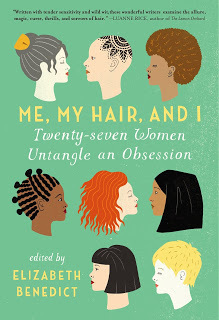
Me, My Hair and I: 27 Women Untangle an Obsession
Book news! It'll be here September 29, 2015, published by Algonquin Books. Support your local indie bookstores. In the meantime, read about the book
here
.

April 29, 2015
What We Talk About When We Talk About Money
My personal essay, "What We Talk About When We Talk About Money" is just out in Salmagundi's 50th anniversary issue, along with a group of essays on the subject for which I was a guest editor, by Rick Moody, Phillip Lopate and Howard Norman. Each piece is a striking testament to the elemental, immutable, sometimes harrowing power of money, to its fertility as a storytelling device, and to all the ways it makes us feel and act and think about ourselves, our families, and our place in the world.
What We Talk About When We Talk About Money
by Elizabeth Benedict
In this corner is my kindly grandfather, who liked to say, whenthe subject of our not having enough came up, “It’s just money.” In theopposite corner, a different message from my mother, who longed for somuch: “All you need is money.” When I was eight years old, I showed myfather an ad in The New York Times for a dog coat at Saks Fifth Avenuethat cost nineteen dollars. I wanted him to be astonished with me, and hewas, sort of. “I wouldn’t pay nineteen dollars for a dog,” he spat.
I too was a small creature who needed a coat now and then -needed him to buy me these coats, and I could see that he had attacheda monetary value to small creatures and their needs. This is no doubt theunconscious reason I applied for my first job, at a greeting card store on the Upper East Side of Manhattan, at the age of nine. It would take afew dozen years of therapy to make that connection. At the time, I justthought it would be fun to be there, with the cheerful women owners andthe colorful decorations changing every month or two with the holidays –more fun than our apartment, where bitterness and money troubles rockedaround the clock. Early on, I learned that the word itself — m-o-n-e-y— is loaded, charged with everything human: longing, ambition, power,comfort, success, failure, disappointment, loss, fear, shame, blame, andrage. So loaded it might as well be a gun.
In Light Years, James Salter writes: “Life is weather. Life ismeals.” But no, life is money. Money and stories of money. Who amongus does not have a hundred of them? A thousand? Anecdotes, dominant
narratives, comedies, tragedies, aphorisms, moral tales, and of coursejokes. They come bunched in themes. Wanting money. Needing money.Feeling foolish for wanting more. Feeling crappy for not having it.Fighting over it. Having it, then losing it. Getting too much too fast – allthose sad lottery stories that I read and think, I wouldn’t do that if I won$400 million! Anger at those who have too much. At leaders who answeronly to money, who choose money over justice, corporations over people,profits über alles.
Consider this: It is easier for a camel to go through the eye of aneedle than it is for a rich man to get into heaven. No one says that anymore.No one even knows what it means, so many people are so fuckingrich – Forbes counted 1645 billionaires in 2014 – even in places whereeveryone used to have the same amount of money or none at all: China,Russia, India. And there’s this: As a general rule of etiquette, for whateverthat’s worth nowadays, we are not supposed to talk about money, not supposedto say, “How much do you have?” or “How much do you make?” or“Want to know what I’ve got?” Not supposed to, but many of us do, livingdeep in the age of confession, of Internet aliases, of an endless stream ofTMI. I can click my mouse and learn how much my neighbor gave to apolitical candidate. In twenty-five seconds, I can find out how much just about anyone’s house is worth, what their real estate taxes are, sometimeseven the size of their mortgage. N+1 produced an anthology, MFA vs NYC, about how writers support themselves these days. The contributors skewyoung, as editors and writers for N+1 tend to, and in these pieces manydiscuss the details of their financial lives, including the amounts of their advances and their rents, with a monetary candor we never got from SaulBellow, John Updike, or even the king of TMI, Philip Roth.
I learned in high school and college that novels are about moneyand status. Gatsby , obviously. Pride and Prejudice – maintaining theproperty, marrying appropriately. Narratives are driven by plots involvingmoney – because so much of life involves those plots: the wanting, theneeding, the calamities that all this desire brings. Certain dramas – TheMerchant of Venice, A Doll’s House – reek of money and the darkness ofdebt. And then there are movies, noir and otherwise, where the hungerfor money drives more narratives than the pursuit of sex: bank heists,blackmail, gambling, money laundering, marrying for money. How toMarry a Millionaire. It’s a Wonderful Life. Bonnie and Clyde. Oceans 11,12, and 13. In the list of symptoms for certain mental illnesses - bipolardisorder, borderline personality disorder - two of them are overspendingand racking up debt. Does this mean that money is an illness – or just thatit drives us crazy?
What is it, after all? A concept. A system. A symbol. A value.A commodity. A means of exchange. Sometimes an object: coins, bills,cashier’s checks, plastic cards. It’s protean, it’s elastic, it’s fixed. It’s a lure, a comfort, a weapon, all of which gives it a lot in common with thatother cosmic trickster, sex. But it is not optional. You can choose where tolive, whom to marry, whether to be celibate, to shoot heroin or eat flowers, but you cannot opt out of submitting to the rule of money, whether it’sUS dollars or Kenyan shillings. It has been so essential for so much ofrecorded history – arriving as soon as people produced more agriculturethan they could eat, and had a reason to sell the excess - it’s surprisingthat the ancients did not include it in the list of essential elements: fire, water, earth, air, money. You are born and sooner or later – directly orindirectly – it lands on you, a fishing net impossible to escape.
It took until 2000 for scientists to name the study of the effectsof money on the brain – “neuroeconomics” – and among the things theylearned is that the craving for it is located, along with most other cravings,in the hypothalamus, or the ventral striatum, and the fear of not havingenough is located, along with most other fears, in the amygdala. While usingMRIs to study the brain, a Stanford scientist, Brian Knutson, saw that theimages that caused the most brain activity, more than sex and decapitatedbodies, were those involving money. An article in Forbes reports the MRIsrevealed that “offers of cash caused a surge of dopamine in a tiny piece ofneural machinery called the nucleus accumbens.” George Loewenstein,a Carnegie Mellon economist quoted in the piece, tried to make sense ofthe observations: “According to standard economic theory, money is ameans to an end. When you get money, you shouldn’t experience immediatehappiness. What all the scanning research is showing is that peopleget immediate pleasure and pain from obtaining and losing money.” Addto the MRI data whatever else we learn about money growing up – thatwe’re entitled to it, that we don’t deserve it, that Dad ran off with what wehad – and it’s not surprising that it can easily send us over the edge, intotailspins, fits of rage, revenge, despair, and/or greed that destroy familiesfor generations. Consider the divorce from hell or a will that ends up incourt.
Like so many subjects that make us uncomfortable, it spawnsjokes. The best end up in combination with other subjects that make usuncomfortable: marriage, divorce, religion. 1. Why is divorce so expensive?Because it’s worth it. 2. Three Jews walking down a road see a sign ona church: $100 to Convert. Harry decides to go in, and when he comesout an hour later, his friends pepper him with questions. “Did you get themoney?” says one. Harry is indignant: “Money! That’s all you Jews thinkabout!”
All I think about is money. When I was in my twenties, therewas a joke going around - or maybe a real study — that went somethinglike, “Men think about sex forty times an hour. Women think about sextwenty-two times an hour.” Whatever the numbers were. It was funny.It was true. I probably think about money twenty-two to forty times anhour. Sex, not so much anymore.
Until I was in my late thirties, I was an ordinary writer-artist-dunceabout money. I lived from book to book and scraped together small pilesfrom book reviewing, editing, and part-time teaching jobs. During thetime I wrote my second and third novels, I was married to someone whohad more money than I did. I wasn’t cunning about money, but I wasn’tso dumb as to marry another near pauper, and during that time, I had goodhealth insurance and a nice place to live. After I got divorced, I made moremoney teaching and writing books than I ever had. Later in the 1990s, Ihad to take care of my ailing aunt, who had about $150,000 invested inthe stock market – and then my sick mother, who had $30,000 in CDs.
By that time, I owned a few shares of something or other, andsome retirement funds from teaching, and I grilled a wealthy cousin abouthow to invest and manage this small fortune. I was serious about it, becauseI had to be, and it took a lot of effort to figure out how to make my aunt’s and my mother’s money last, without just keeping it in a savingsbank. Then some good fortune came my way – a year-long contract towrite a monthly column for Japanese Playboy – that turned into two years.It was a phenomenal amount of money for cranking out a few pages ofsilly, soft-core porn once a month. Earning and investing it added to mysense of myself as a Person Who Knows About Money. I was in charge of three
accounts at Merrill Lynch and became a demon at reading themonthly statements and calling my broker to discuss rates of return andwho knows what else. I need to call my broker, I would say to whoeverwas nearby. It was thrilling, like Halloween for kids. I could pretend Iwas someone else entirely. Sorry, that’s my broker on the phone.
All of this coincided with the crazy rise in the stock market, whenmillions of other dunces like me behaved like little John D. Rockefellers,reading the financial pages, and becoming part of the “investor class,”along with bus drivers, janitors, and high-flying high school students.
On a dinner date with an economist in 1999, trying to sound wise in theways of money, I said that I had “made some money in the stock market.”Maybe he’d have some stock tips for me. Maybe we could swap. “That’snot hard in this market,” he said drily.
I took the insult without flinching and did not regale this serious man with stories of my stock market hijinks. They had taken place inthe preceding months, on occasional visits to the apartment of my dearfriend – let’s call her P. She came from a working class family who knewjust enough to save well, and P. had recently inherited her share of thesavings. In the spirit of the times – which, if you recall, were frenziedwith the promise of a market that had no upper limit – she had gotteninto the habit of day-trading large quantities of stocks. I was tradingmuch smaller amounts, in less risky ways, but I got into the spirit of itmyself. P. is a serious person, but has a zany side too, and when we gottogether for dinner, we talked about our investments – and all the moneywe were making – with a feverish excitement and much out-of-controllaughter. We would often end up at her computer, where we did copiousamounts of research about the stocks we were planning to buy the minutethe market opened, so that we could sell them at huge profits later that day, or perhaps the following week. “I think I’ll buy two thousand sharesof this one,” she might say. “At what?” “Now it’s $4.50. It opened thismorning at $3.90. If I can buy it at $4.50 and it goes up two dollars, I canmake $4000 in a few days. Maybe I should buy four thousand shares. IfI sell the BQE – how much have I made on that?” “What’s BQE?” “It
went up twenty dollars in the last two weeks.” “Why didn’t you tell me?I would have bought some! What kind of company is it? Tech? Biotech?Something else?” “Who knows what it is. If it goes up, we like it. If itgoes down—”
We laughed at our antics until we cried, laughed at what weknew to be our hysteria, at the absolute insanity of what we were doing.We played it like a comic routine, as though there were an audience. Wewere Lucy and Ethel in the chocolate factory. We were – as it turnedout – Thelma and Louise about to nosedive into the Grand Canyon. HadI explained all of this to the economist, I’m certain he would not havelaughed. He wouldn’t have cracked a smile, the prig. And he would havetold me this was a bad idea. Come to think of it, based on what little Imentioned, he did say something along those lines.
My friend made a fortune and lost it. She got out with her shirtintact but somewhat tattered. I lost a few buttons on my own. WhateverI did – not that I can remember, because I’ve tried pretty hard to repressthe details – didn’t hurt my aunt’s and my mother’s fortunes, only myown, but not permanently. There was a stock I should have sold when itwas worth $20,000, and then suddenly it was worth $6000. There wasanother – and another and another – but my only huge regret was selling200 shares of Apple that I’d bought for about $60 each in the mid-1990s.If I had never sold it, and it had just split and split again over the years, itwould be worth a great deal today – I try not to calculate how much – andI would not be scrounging around doing what I do, which is both workingvery hard and worrying about money. It’s just money, after all. Right?
At the same time, I’ve had a peculiarly privileged life in the wayof some artists and writers who have had an occasional hit, followed byyears or even decades of what might be called “belt-tightening,” what awriter friend calls “the period when I had to buy the small eggs.” For ashort while in the 1990s, I owned a house on Martha’s Vineyard with myfirst husband, and even though year-rounders on the island are some of the poorest people in Massachusetts, the image of those who live there asloaded dies hard. It was difficult to say where I lived when I lived therewithout people looking askance at me, as though I had just flown in onmy private jet.
During many periods since then, I have rented houses on the islandthrough friends for far below market rates, and occasionally in winter.
Fifteen years ago, I became friends with another writer in a winter rental.She soon left the island and moved to a semi-feudal estate in the Englishcountryside, where she rented the gardener’s cottage – which happened tohave no heat – on this vast property. A good number of our phone calls andemails in the years since then have been about how broke we are, whichcould often send us into peels of self-mocking laughter and regret, fauxand otherwise, that we had spent our lives as writers. Some of the laughterwas that we lived as the idle rich do, having met on the Vineyard and nowchatting away in the middle of the day, she on her estate and I in a tonyManhattan apartment (never mind that I was renting a room), when notliving with my boyfriend-who-became-my-husband near Boston. In onesuch desperate conversation, she said, “Our bohemian lifestyles wouldbe much more endearing if we were thirty years younger.”
Independently of each other, we had followed Grace Paley’sadvice for writers: Keep your overhead low. We do not redecorate. Wedo not build additions onto what property we own. We shop in thriftstores and drive ancient cars. We are both happily married to extremelynice men whose financial contributions are necessary but not sufficient to maintaining our lives of genteel poverty. We do what writers do whodon’t have secure teaching jobs or wealthy spouses or trust funds: we getby, more or less, on our wits. For ten years, my friend was on a handsomeretainer with a management consulting firm, and though she had never been either an employer or an employee, her job was to write managementtraining programs. One day she complained to me about how inconvenientit was for her to have to show up in the company’s office – once a year. I tried to explain to another friend how funny this line was to me, but thisfriend, who endured a more ordinary struggle to make ends meet, lookedat me with something near contempt. Living with this much uncertaintyand insouciance – but also a weird confidence that someone would appearbefore long and pay us a lot of money to ghostwrite a book or edit a paperon desalination plants in Saudi Arabia – is hard to explain to those whodon’t have the constitution to live this way.
At one point, my friend in England and I had an editing companythat we promoted on-line. Over a period of several years, we got a total ofthree inquiries from men with names that sounded made up and who hadideas for projects that were as colorful and off the wall as their names. Biff
Ziff (not his real name, but somewhat like his real name) wanted my helpwriting a book about the psychopathic Mob killers who used to eat at hisrestaurant – and which he claimed that Steven Spielberg wanted to readwhen it was finished. After I told him that I didn’t think I was the right person to help him – because I could tell he didn’t have the money to payme up front and had no idea what it meant to write a book – I called myfriend in England. “My fear is that if I see Steven Spielberg’s next movieis about this guy and his restaurant,” I told her, “I will shoot myself.” Sheassured me that I had nothing to worry about. And now – four or five years later – my friend and I are not nearly so desperate. In recent years, thingshave picked up: one of us inherited some money and the other has a newbusiness that’s more lucrative than Biff Ziff-like projects. Yet now andthen, I’m slightly sad that we don’t laugh as much as we used to aboutbeing destitute.
Thinking about money as much as I do, several years ago I decidedto pull together an anthology of personal essays by writers on thesubject. The publisher I approached felt that because I’m not a “moneyexpert” – a Suze Orman, I suppose, or an “Adam Smith” – they couldn’tpromote such a book the way they wanted to, and I shelved the idea. Butof course I am a money expert, having applied for my first job at the age of nine at the greeting card store, and having known exactly how muchmoney my father made that year - $4000.00 – and how much our rent was– $375.00 a month. When I didn’t get the job, I got another, walking thedog of a woman in our building every day before school for twenty-fivecents a walk. I used the money to buy pajamas for the summer camp myparents sent my sister and me to, for which they borrowed the moneyfrom my grandparents, and the purpose of which was to send the childrenaway so they could “save the marriage.” What more does anyone needto know about money than that – along with all I’ve learned in the yearssince, including the art of investing and losing money while laughinghysterically?
It can often feel like money is the only thing that matters in ourlives, and of course it matters immensely – because money equals food,clothing and shelter. And so much else. Even though I’m not as financially fragile as I have been for much of my adult life, I still think about moneygoing to sleep and waking up, getting dressed and cooking dinner. That’s
me, I thought, when I came across this line in Penelope Lively’s novelHow It All Began: “She walked to the bus stop, thinking about money.”
When I was in my twenties, I took a shower one morning andwondered how I’d pay my rent two months later, and when I got out,the phone rang. It was an editor I didn’t know saying that he’d pay methree thousand dollars to interview a country singer for a magazine thatpromoted a tobacco company – Philip Morris. I said yes in a flash. How could I have said no? This was a story I told myself and others about howI managed to live the way I do: I took a shower and the phone rang – andthere was money. Years later, in my stock-buying days, another friendconvinced me to buy some shares of a tobacco company. I did, but soldthem a day or two later when I realized I didn’t want to make money – orgod forbid lose money – on Big Tobacco. It would have been harder thanexplaining that I lived on Martha’s Vineyard. I don’t think the magazine isstill around, but if it were – I have thought this through, believe me – andif an editor called me again with a juicy offer, this time I’d say no.
All you need is money.
April 15, 2015
Grief, Longing, Gratitude~Pop-up Book Groups for Mother's Day
What's the most meaningful gift your mother ever gave you - the one that opens the door to your rich, complicated relationship with her?
When I asked 30 amazing women this question - including many writers whose work you know well - What My Mother Gave Me was the answer. The collection was an instant hit and a New York Times Bestseller when it came out two years ago, and it's still going strong. Among the contributors: Joyce Carol Oates, Mary Gordon, Katha Pollitt, Rita Dove, Karen Karbo, Eleanor Lipman, Dahlia Lithwick, Sheila Kohler, Caroline Leavitt, Roxana Robinson, and pastor and writer Lillian Daniel.
In honor of Mother's Day - May 10th - Book the Writer has arranged two pop-up book groups - one in Manhattan, one in Princeton - to discuss the book and talk to the editor (me) and several contributors at these events. Book the Writer brings authors to homes to talk in intimate settings to book groups. Space is limited. Scroll down to reserve now.
[image error]
On Monday April 27th, from 7.30 to 9.30, I'll be in an apartment in NYC, with contributors Elinor Lipman, Sheila Kohler, and BOOK THE WRITER founder, Jean Hanff Korelitz. For reservations and ticket information (reservation and fee are necessary):http://www.eventbrite.com/e/in-celebration-of-mothers-day-a-bookthewriter-pop-up-book-group-with-elizabeth-benedict-what-my-tickets-16082582437
On Saturday May 9, from 3.00 to 5.00, I'll be at Gratitude Yoga on Witherspoon Street in Princeton, with Jean Korelitz, and a surprise guest or two. For reservations and ticket information (reservation and fee necessary): http://www.gratitudeyoga.org/2015/03/30/6894/
"Each essay is beautifully crafted, and editor Benedict provides the perfect balance of emotions. For anyone trying to understand mother-daughter relationships, this collection provides the answer." —Publishers Weekly
“Original tributes by celebrated novelists, poets and journalists detail the regard in which the writers hold their mothers or their memory of their mothers even as they contemplate complex parent/child relationships in retrospect.” —Louisville Courier-Journal
"The complexity and soul-deep connection of the mother-daughter bond is vividly explored in this emotionally eloquent collection of essays." —Family Circle
"Longing, grief and hard-won forgiveness pervade this essay collection by a stellar group of writers as they take stock of the gifts, visible and invisible, their mothers left behind." —MORE Magazine
When I asked 30 amazing women this question - including many writers whose work you know well - What My Mother Gave Me was the answer. The collection was an instant hit and a New York Times Bestseller when it came out two years ago, and it's still going strong. Among the contributors: Joyce Carol Oates, Mary Gordon, Katha Pollitt, Rita Dove, Karen Karbo, Eleanor Lipman, Dahlia Lithwick, Sheila Kohler, Caroline Leavitt, Roxana Robinson, and pastor and writer Lillian Daniel.
In honor of Mother's Day - May 10th - Book the Writer has arranged two pop-up book groups - one in Manhattan, one in Princeton - to discuss the book and talk to the editor (me) and several contributors at these events. Book the Writer brings authors to homes to talk in intimate settings to book groups. Space is limited. Scroll down to reserve now.
[image error]
On Monday April 27th, from 7.30 to 9.30, I'll be in an apartment in NYC, with contributors Elinor Lipman, Sheila Kohler, and BOOK THE WRITER founder, Jean Hanff Korelitz. For reservations and ticket information (reservation and fee are necessary):http://www.eventbrite.com/e/in-celebration-of-mothers-day-a-bookthewriter-pop-up-book-group-with-elizabeth-benedict-what-my-tickets-16082582437
On Saturday May 9, from 3.00 to 5.00, I'll be at Gratitude Yoga on Witherspoon Street in Princeton, with Jean Korelitz, and a surprise guest or two. For reservations and ticket information (reservation and fee necessary): http://www.gratitudeyoga.org/2015/03/30/6894/
"Each essay is beautifully crafted, and editor Benedict provides the perfect balance of emotions. For anyone trying to understand mother-daughter relationships, this collection provides the answer." —Publishers Weekly
“Original tributes by celebrated novelists, poets and journalists detail the regard in which the writers hold their mothers or their memory of their mothers even as they contemplate complex parent/child relationships in retrospect.” —Louisville Courier-Journal
"The complexity and soul-deep connection of the mother-daughter bond is vividly explored in this emotionally eloquent collection of essays." —Family Circle
"Longing, grief and hard-won forgiveness pervade this essay collection by a stellar group of writers as they take stock of the gifts, visible and invisible, their mothers left behind." —MORE Magazine
October 1, 2014
"Such a sad book .. such a joy to read"
I am still moved that Anne Tyler said that "The wonder is that such a sad novel could be such a joy to read" about my second novel, The Beginner's Book of Dreams, when it was published by Knopf back in the 20th century. It's available in a special ebook promo campaign about novels about art for October - for $1.99. “Splendid . . . a bold, expressive view of growing up absurd in New York City . . . a reminder of the capacity of the wounded human spirit to rise to the occasion, which is life.” —The New York Times Book Review.
August 9, 2013
Back from the Dead ~
I'm thrilled to announce that my first two novels, one of which was shortlisted for the National Book Award and the LA Times Fiction Prize, and one of which is my sentimental favorite, have both been brought back to life this week as ebooks by Open Road Media. They are Slow Dancing and The Beginner's Book of Dreams.
You can get them in various eBook formats, in links here.
Slow Dancing: http://www.openroadmedia.com/slow-dan...
Beginner's Book of Dreams: http://www.openroadmedia.com/the-begi...
Elizabeth Benedict Open Road Author Page: http://www.openroadmedia.com/elizabet...
Open Road is highlighting a selection of National Book Award finalists and from August 6 – 19, they are running a sweepstakes for an ereader filled with all the ebooks in the promotion.
The campaign landing page is now live at openroadmedia.com/essentials. Slow Dancing is featured on the Adult tab.
I'm told there are ads on Shelf Awareness, Booklist, The Millions, Fiction Writers Review, HTML Giant, Largehearted Boy, Smith Magazine, The Nervous Breakdown, The Rumpus, Three Guys One Book, Vol. 1 Brooklyn, and more.
You can get them in various eBook formats, in links here.
Slow Dancing: http://www.openroadmedia.com/slow-dan...
Beginner's Book of Dreams: http://www.openroadmedia.com/the-begi...
Elizabeth Benedict Open Road Author Page: http://www.openroadmedia.com/elizabet...
Open Road is highlighting a selection of National Book Award finalists and from August 6 – 19, they are running a sweepstakes for an ereader filled with all the ebooks in the promotion.
The campaign landing page is now live at openroadmedia.com/essentials. Slow Dancing is featured on the Adult tab.
I'm told there are ads on Shelf Awareness, Booklist, The Millions, Fiction Writers Review, HTML Giant, Largehearted Boy, Smith Magazine, The Nervous Breakdown, The Rumpus, Three Guys One Book, Vol. 1 Brooklyn, and more.
June 8, 2013
Don't Sweat the College Admissions Essay
I wear many hats as a writer, editor and coach. This is the time of year when I start working with rising high school seniors on their college application essays. Right now, we're just working on the Common App essay - the famous/infamous essay that drives everyone nearly crazy - because that's the only essay that is on-line and certain. The supplementary essays that many schools require don't go on-line until late summer or September 1st. This photo is part of my logo, and I think it reflects how overwhelming this whole process can be. One of my goals is to make it less daunting.

I love working with students. I love getting to know the families, and helping all with this important and complicated passage in their lives. This past year, my clients got dozens of fine schools, including Harvard, Yale, Brown, Smith, Vassar, Bryn Mawr, Colgate, Cornell, UMichigan, UVirginia, NYU, NYU Law, Skidmore, George Washington, the SUNYs, UMass, and Franklin and Marshall. I'm available to help with the Common App essay and the supplements, and to help students fill out their applications. I work in person, by phone, email, and Skype, in the Northeast, and around the country.
I also work with those applying to graduate school in any discipline. Scholarships are available to low-income families with verification.
For more information and testimonials, please visit my company website: Don't Sweat the Essay.

I love working with students. I love getting to know the families, and helping all with this important and complicated passage in their lives. This past year, my clients got dozens of fine schools, including Harvard, Yale, Brown, Smith, Vassar, Bryn Mawr, Colgate, Cornell, UMichigan, UVirginia, NYU, NYU Law, Skidmore, George Washington, the SUNYs, UMass, and Franklin and Marshall. I'm available to help with the Common App essay and the supplements, and to help students fill out their applications. I work in person, by phone, email, and Skype, in the Northeast, and around the country.
I also work with those applying to graduate school in any discipline. Scholarships are available to low-income families with verification.
For more information and testimonials, please visit my company website: Don't Sweat the Essay.
May 25, 2013
Paris in the Twenties
I got into this line as a work as a fiction writer, though I've published mostly nonfiction in recent years. (I'm always writing a novel somewhere in the background.) Here's a short story the Saturday Evening Post just reprinted, Paris in the Twenties, which appeared originally in Narrative Magazine on-line. Thanks to both publications for their support.
May 20, 2013
Is it Real or is it Memorex?
Click here to watch our evening at the NY Society Library, talking with editor Elizabeth Benedict, and contributors to WHAT MY MOTHER GAVE ME, Margo Jefferson, Martha McPhee, Roxana Robinson on May 9, 2013.
http://www.youtube.com/watch?v=BaQUa0...
http://www.youtube.com/watch?v=BaQUa0...
It's a New York Times Bestseller!
I just learned that our anthology, What My Mother Gave Me: 31 Women on the Gifts That Mattered Most, found its way to #16 on the upcoming NY Times Bestseller list, for paperback nonfiction. We were all a little taken aback, and completely thrilled.
Thanks to everyone here for noticing, for reviewing the book, and for your eloquent and generous comments. This is my favorite one-line review from - of all places - Family Circle magazine: “The complexity and soul-deep connection of the mother-daughter bond is vividly explored in this emotionally eloquent collection of essays.”
Thanks to everyone here for noticing, for reviewing the book, and for your eloquent and generous comments. This is my favorite one-line review from - of all places - Family Circle magazine: “The complexity and soul-deep connection of the mother-daughter bond is vividly explored in this emotionally eloquent collection of essays.”