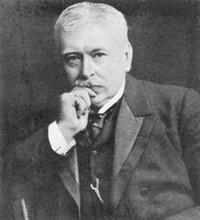
Sir Patrick Manson GCMG, FRS (3 October 1844 – 9 April 1922) was a Scottish physician who made important discoveries in parasitology, and was the founder of the field of tropical medicine. He graduated from University of Aberdeen with degrees in Master of Surgery, Doctor of Medicine and Doctor of Law. His medical career spanned China, Hong Kong, and London. He discovered that filariasis in Humans is transmitted by mosquitoes. This is the foundation of modern tropical medicine, and he is recognized with an epithet "Father of Tropical Medicine". His discovery directly invoked the mosquito-malaria hypothesis, which became the foundation in malariology. He eventually became the first President of the Royal Society of Tropical Medicine and HygieSir Patrick Manson GCMG, FRS (3 October 1844 – 9 April 1922) was a Scottish physician who made important discoveries in parasitology, and was the founder of the field of tropical medicine. He graduated from University of Aberdeen with degrees in Master of Surgery, Doctor of Medicine and Doctor of Law. His medical career spanned China, Hong Kong, and London. He discovered that filariasis in Humans is transmitted by mosquitoes. This is the foundation of modern tropical medicine, and he is recognized with an epithet "Father of Tropical Medicine". His discovery directly invoked the mosquito-malaria hypothesis, which became the foundation in malariology. He eventually became the first President of the Royal Society of Tropical Medicine and Hygiene. He founded the Hong Kong College of Medicine for Chinese (subsequently absorbed into the University of Hong Kong) and the London School of Hygiene & Tropical Medicine.
Manson was inflicted with gout during his service in China. His recurring condition worsened with age and died of it in 1922.
Patrick Manson was inspired by his elder brother, David Manson, who worked in Shanghai in medical service, to join medical officer post in the Customs Service of Formosa (now Taiwan). Manson traveled to Formosa in 1866 as a medical officer to the Chinese Imperial Maritime Customs, where he started a long career in the research of tropical medicine. His official daily duty involved inspecting ships docked at the port, check their crews and keep the meteorological record. He also attended to Chinese patients in a local missionary hospital where he was exposed to a wide variety of tropical diseases for his postgraduate training without any supervision. His only research tool was a combination of clinical skill, hand lens and good record keeping. He was in good terms with the native Chinese, learning Mandarin and befriending them. However due to political conflict between China and Japan over the occupation of the island, he was advised by the British Consul to leave. After 5 years in Formosa, he was transferred to Amoy, on the Chinese coast where he worked for another 13 years. Once again he again served the local Chinese patients at the Baptist Missionary Society's Hospital and Dispensary for the Chinese. His brother David joined him for 2 years.
From 1883 to 1889, Manson worked in Hong Kong. He was the first to import cows from his native Scotland to Hong Kong and thus establish a dairy farm in Pok Fu Lam in 1885 and the company Dairy Farm in Hong Kong. However his most significant works are in medical education. He was the founder of the Hong Kong College of Medicine for Chinese, where Sun Yat-sen was one of his first pupils. In 1896, through his contacts at the Foreign Office, Manson managed to secure the release of Sun after he had been kidnapped in London by Chinese officials. Sun went on to become the first President of the Republic of China. In 1911 Hong Kong College of Medicine for Chinese became the University of Hong Kong.
Honors and awards:
Elected Fellow of the Royal College of Physicians in 1895 Elected to the Royal Society in 1900. Knighted KCMG in 1903 and GCMG in 1912. Awarded the Fothergill medal in 1902. Awarded an honorary Doctorate of Science by the University of Oxford in 1904. First president of the Royal Society of Tropical Medicine and Hygiene in 1907. The Manson Medal is awarded triennially by the Royal Society of Tropical Medicine and Hygiene. A human trematode parasite Schistosoma mansoni is named in his honour....more

 Sign in with Facebook