
Massad Ayoob's Blog, page 128
August 18, 2013
ZIMMERMAN VERDICT PART 14: THE JUDGE
Of all the key figures in the courtroom during the Zimmerman trial, I found Judge Debra Nelson the most enigmatic.
Some of Zimmerman’s advocates called her the fourth prosecutor. It’s true that she granted more approaches to the bench to the prosecution than to the defense, and those who kept count said she sustained far more objections from the prosecution than from the defense. Her insistent questioning of the defendant himself as to whether he chose not to testify is something I haven’t seen before in more than 40 years in the criminal justice system.
I would have liked it if she had allowed prior bad acts by the late Trayvon Martin to come in to the jury. At the same time, as I’ve explained earlier in this blog series , she was well within judicial prerogative to make the decision to keep that material out.
The trial lasted a month, and it’s been more than a month since the jury delivered a verdict. I’m still waiting to hear how she will rule on the requests the defense made for sanctions against the prosecution for the prosecution’s failure to provide discovery material – evidence – in a timely manner.
But, hey: did you watch Judge Nelson when the jury verdict was read? Is it my imagination, or was she wearing a very slight smile, a smile as inscrutable as the Mona Lisa’s?
Share or Bookmark


August 12, 2013
ZIMMERMAN VERDICT PART 13: ANGELA COREY
In the last installment, I said that it was the coach who sent the prosecution team in to try to win a game that never should have been played. The police had determined they didn’t have probable cause. The highly respected state’s attorney who had responsibility for the case, Norman Wolfinger, apparently agreed. When the plaintiff-orchestrated cause celebre created public outcry, Wolfinger scheduled the matter for the grand jury. But Florida Governor Rick Scott turned it over to Angela Corey, the state’s attorney for the Jacksonville area, to act as special prosecutor.
Some have blamed Scott for this. I can’t, at least not at this time. “The perception is the reality,” it’s said, and when the people who elected them cry out for a deeper investigation, those in charge have a duty to act. This is, in part, what the grand jury is for. While I think it should have been left in Wolfinger’s capable hands, I can understand Scott’s decision. His choice of Ms. Corey, however, is open to question in hindsight.
I gave Ms. Corey the benefit of the doubt as I watched this case unfold. I had hoped she would simply present the evidence to the grand jury. When she didn’t, instead indicting on her own, it was inescapably obvious why: she had to have known that the grand jury would refuse to indict, once they had seen the evidence.
The job of the defense is to be a zealous advocate for the defendant. The prosecutor’s role is different. She is supposed to be the minister of justice, every bit as responsible for exonerating the innocent as for aggressively prosecuting the guilty. It is an egregious breach of prosecutorial ethics to, for example, prosecute for Murder a man who the evidence shows is telling the truth about acting in self-defense. And of course, there is the very serious breach of both rules and ethics encompassed in withholding evidence from the defense, a matter which in this case is still hanging in the air.
The right is unhappy with the special prosecutor. National Review had this to say about Ms. Corey: http://nationalreview.com/article/353633/angela-coreys-checkered-past-ian-tuttle/page/0/1. The left apparently isn’t too thrilled with her either, as seen in the Daily Beast, here: http://www.thedailybeast.com/articles/2013/07/19/angela-corey-s-overzealous-prosecution-of-marissa-alexander.html . Her fellow attorneys seem, for the most part, to be aghast at how she has handled the Zimmerman case, as seen here in law professor Jonathan Turley’s blog: http://jonathanturley.org/2013/07/18/zimmerman-prosecutors-angela-corey-under-fire-for-public-comments-and-allegedly-threatening-action-against-harvard-law-professor/ .
The most damning moment for Ms. Corey in this case was her commentary to the press after the acquittal. A prosecutor should respect the system, and the jury’s verdict. The man she assigned to spearhead the state’s case, Bernie de la Rionda, obviously understood that. One journalist asked both of them to describe the defendant and the deceased in a single word.
De la Rionda chose the words “lucky” for defendant George Zimmerman, and “victim” for the deceased Trayvon Martin. He knew how to straddle the line. Despite Zimmerman’s ordeal, a lot of people think anyone who is facing life in prison and gets set free is “lucky.” And “victim” is the term that is generally and automatically used for someone who is killed.
But Corey described the young man who was shown by the evidence as the one who started the fatal battle as “prey,” and the man the jury had just found Not Guilty of Murder as “murderer.”
The difference is profound. It doesn’t just show her to be a bad loser, it shows her to be utterly contemptuous of the jury, and the system she is sworn to serve. Her answer was simply egregious.
There are those who believe that Ms. Corey took the case and tried to destroy Zimmerman’s life because, in the cases mentioned in the links above, she had lost voter support in the African-American community and thought that prosecuting Zimmerman would be a good political move. If one accepts that, it begs the question, “How did that work for ya, Ms. Corey?”
What some call “the next Trayvon Martin case” – a white guy who wound up shooting a black teen in Jacksonville after an argument that began with the latter and his friends playing loud music in an adjacent vehicle – falls into Ms. Corey’s jurisdiction. The Florida Civil Rights Association has called for the case to be taken out of Angela Corey’s hands, because they think after the Zimmerman case, she doesn’t have enough credibility to prosecute this one.
Share or Bookmark


August 8, 2013
ZIMMERMAN VERDICT PART 12: RATING THE LAWYERS (PROSECUTION)
While there were two lawyers at the defense table, there were three at the State’s: Bernie de la Rionda, John Guy, and Richard Mantei. With about a hundred lawyers to pick from, knowing her office would be in the spotlight, State’s Attorney Angela Corey wouldn’t have put anyone on the team she thought would make her look bad.
Mantei was third chair, and the lowest guy on the totem pole gets the scut work in any organization. For instance, he was the one they sent in to argue that the state had proven its case when it hadn’t during the argument for judgment of acquittal. Perhaps the two senior guys didn’t want to be on film forever BS-ing the judge. I suspect Mantei is a good prosecutor when he actually has a case.
The lead prosecutor in the courtroom was de la Rionda. He’s the only one of the three I’ve seen live in a courtroom, and I can tell you that he knows the law and presents himself with articulate confidence. De la Rionda is said to have an extraordinarily high conviction rate. Why he accepted a case like this, as close as he is to retirement age, I cannot understand. His frustration was obvious throughout the Zimmerman trial; I can’t imagine a man with his skill and experience being so abrasive in front of a jury for any other reason.
In second seat was Guy, by far the best orator on that prosecution team. My students have heard me warn them about attorneys who seem to have majored in drama and minored in law, and Guy certainly fit that mold in Zimmerman. Remember his “Fucking punks” opening, and his breathless assertion that the defendant killed the deceased “because he wanted to”? If he is as good a prosecutor as I hope he was when he really had a case, he may be disgusted enough after this trial to quit. If so, he’ll have a future in theater. I would suggest something Shakespearean, because the Zimmerman case gave him experience in things that were “full of sound and fury, signifying nothing.”
I’ve seen other cases, more than one in Florida, where assistant prosecutors flatly refused to argue a case for conviction when the evidence showed the defendant wasn’t guilty. That didn’t happen here. Perhaps they truly believed Zimmerman was guilty, though it’s hard for me to believe that, given the evidence they must have studied at great length. On the other hand, they worked for Angela Corey, who does not have a public history of treating kindly those employees who go against her wishes.
I’ve seen many people on many a forum and blog call these prosecutors incompetent. I don’t think they were. They simply had no case. If you hired the greatest chefs in the world to cook for you, and you stocked the larder with feces, the best you could hope for them to put on the table would be a big, steaming pile of shit. And in the end, through no lack of argumentation skills on their end, that’s how these three prosecutors’ case ended up.
Now, forevermore among their peers, they’re stuck with the blemish of this case, and the accusations of withholding evidence which have come along with it, and which don’t seem to have been fully resolved at this writing. When retirement comes to each, I doubt that any will consider trying this case to have been their best career move.
Before you blame the team, blame the coach who sent them into a game that never should have been played. We’ll discuss their coach later.
Share or Bookmark


August 4, 2013
ZIMMERMAN VERDICT, PART 11: RATING THE LAWYERS (DEFENSE)
Watching the Zimmerman trial in 2013 was like watching the OJ Simpson trial in 1995: while the general public got a hell of an education on how these things work thanks to live TV trial coverage, those “in the business” were assessing the skills and strategies of the key players.
The face of the defense was that of a two-man team, Mark O’Mara and Don West. The general consensus was that they did a helluva good job, and that O’Mara was the best lawyer in the courtroom during that trial. Some criticized him for not being harsher on some witnesses; I respectfully disagree. When the jurors finally tell their stories in full detail, I think you’ll find that his gentility scored big points with them. The jury figures out early in the trial that the lawyers are the Alphas and the witnesses are the Betas in the cross-examination dialogue…they tend to identify more with the “ordinary people” witnesses than with the “power-figure” lawyers…and they consciously or subconsciously resent those who bully the witnesses called by the opposing side. O’Mara got his points across without brutalizing anyone called by the state.
Don West was co-counsel in the truest sense of the term: he was O’Mara’s partner in the battle, not his sidekick. West’s long career in criminal defense practice has made him a master of caselaw and rules of evidence. But he also knows how to handle witnesses. Those who wanted a conviction complained that he was hard on Rachel Jeantel, the inarticulately angry young woman who had been speaking with Trayvon Martin just before the fight in which he was shot. I must profoundly disagree. He could have gone MUCH harder… and come across as a bully. He came across, instead, as the avuncular older man who just couldn’t get what she was saying, and let the jury come to their own conclusion that she was confessing to multiple lies.
West got a lot of crap about the “knock-knock” joke he used early in the defense’s opening statement, and clueless talking heads will mention that for as long as the case is discussed. The lightweights also said that he spent too much time on details of the defense case in that opening. But for as long as people like me teach Continuing Legal Education courses on trial tactics in self-defense cases, West will be better remembered for laying out the defense’s key elements in detail at the beginning of trial, so that each time one of the state’s witnesses spouted BS from the stand, the jury had the defense’s theory of the case to compare it to, and could recognize the BS when they heard it.
Of course, when you rate the players, you have to look at both teams…and we’ll discuss the other team next. (Spoiler alert: they were more skilled than the trial made them appear.)
Share or Bookmark



July 31, 2013
ZIMMERMAN VERDICT PART 10: THE SEMANTICS
Anyone who has trained with me in the last few years has heard me talk about what I call “combat semantics.” Smart debaters know that many words in our language have multiple shades of meaning, and they’ll often try to tell people that one of those words meant “B” when you used it, when in fact you really meant “A”. We saw this in more ways than one in the Zimmerman case.
At a bail hearing in April of 2012, George Zimmerman told the family of the deceased Trayvon Martin that he was “sorry.” The next morning, newspapers all over the country ran headlines like “Killer Apologizes.”
We all speak English here. You apologize for having done something wrong. When you say “I’m sorry” in any number of contexts, such as this one, you’re probably trying to convey, “I’m sad for your loss, and I feel compassion for you, and I wish this bad thing had never happened.” But another connotation of “sorry” is “I apologize,” and “apologize” in turn carries the connotation of guilt. At the risk of cliché, “Self-defense is never having to say you’re sorry.”
Another example – already discussed earlier in this blog series, in one of the commentary sections – is “pursue” versus “follow.” It is clear from the evidence that for a brief period of time, Zimmerman followed Martin – indeed, he answered “Yeah” when the dispatcher asked him if he was following the other person. Those who wanted to pillory Zimmerman turned that into an imperfect synonym: “He pursued him!”
To “pursue” carries the connotation of intent to seize and control. A police pursuit is intended to end with the laying on of hands which takes the pursued into custody. Pursuit of wild game implies the intent to turn the animal into a carcass that will be butchered and devoured. Even “pursuit of happiness” implies that when you succeed, you will possess that happiness. There is absolutely nothing in evidence to indicate that Zimmerman ever did, or even ever intended to, lay hands on Martin and take control of him. But this simple choice of words – by those who indeed did “pursue” Zimmerman in their way – helped to convince much of a nation that Zimmerman’s actions were not what the evidence now shows them to be.
“Combat semantics” is a debater’s game. Trial lawyers, if you think about it, are debaters playing for much higher stakes than the high school Debate Society.
And clearly, many of those who were out to hang Zimmerman were, uh, master debaters.
Share or Bookmark


July 28, 2013
ZIMMERMAN VERDICT PART 9: THE PROPAGANDA FACTOR
Can someone spoon-feed BS to the media and sucker them into believing it? Well, watch this TV newscast from California after the recent crash of a Korean airliner in San Francisco, and tell me what you think…
Something similar happened in the Zimmerman case. The family of the deceased, understandably filled with grief and anger that their unarmed son had been shot to death by a man never arrested for it, hired Attorney Benjamin Crump. Crump in turn brought in a high-powered public relations firm associated with left wing political causes, as reported by the Washington Post: http://articles.washingtonpost.com/2012-04-12/lifestyle/35450681_1_trayvon-martin-story-george-zimmerman-unarmed-teenager .
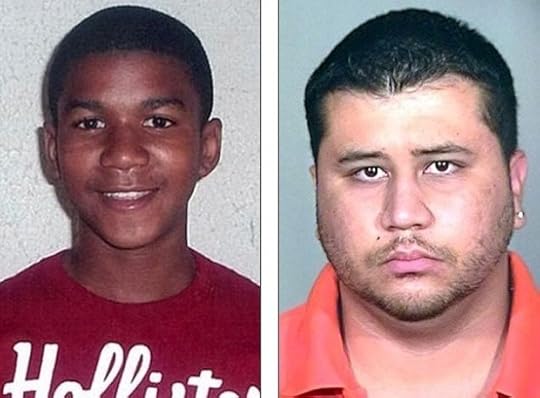
The story fed to the press would outrage anyone…and, predictably, it outraged everyone. The family provided a picture of Trayvon at age 12 or 13, which the media ran with the ugliest picture of Zimmerman they could find. The meme of a huge armed adult “stalking” a “helpless child” was born fully grown, to a Godzilla-like size. It loomed over America unopposed. The investigating officers and the State’s Attorney’s Office knew that the evidence showed something else: Zimmerman attacked by Martin, who towered over him, beat him to the ground, clearly smacked his head into the concrete, and might have even gone for his gun. But cops and good lawyers don’t try their cases in the press, and no voice rose loud enough with the facts to drown out the roar of the fantasy.

We can only imagine Zimmerman’s own emotional turmoil at that time. Like many Americans in their twenties, he was not yet fixed on a career and far from his peak earning years: the cost of hiring attorneys must have been terribly intimidating. He did not stay in touch with his original attorney, Craig Sonner – who, I thought, had an excellent grasp of the case and would have done very well for him – and Sonner and his co-counsel had nothing to work with. By the time Zimmerman had retained Mark O’Mara, the false perception had become a national reality. While O’Mara did an excellent job of trying to get the truth to the public, it was too late: his voice was simply drowned out by the media’s “all Trayvon, all the time” crusade against his client.
The egregious editing of the dispatch tape by one major network, and the false report by another claiming that Zimmerman’s clearly visible, well-documented head injuries were non-existent, will be taught as warnings in journalism school for evermore. I expect that legal settlements by those networks in the suits brought by Zimmerman will be huge.
One function of the grand jury is to reassure the public that a case has been investigated and the evidence evaluated. The State’s Attorney of jurisdiction, Norm Wolfinger, had a reputation for being both tough and fair, and had already scheduled this matter to go before the grand jury in the next session, when he stepped away from the case, apparently at the request of Governor Rick Scott, who appointed Angela Corey as special prosecutor. It was necessary to show an outraged public that their anger had found receptive ears.
When Ms. Corey announced that she would bypass the grand jury, it was clear to any criminal justice professional that she was going to indict him on her own, via an offer of information. There is generally one reason why a chief prosecutor will take a case away from a grand jury: the prosecutor wants an indictment and doesn’t think a grand jury that has heard the evidence will deliver one.
At this point, the die was cast. The show trial was inevitable, and America had experienced a triumph of propaganda that would have been worthy of Joseph Goebbels or Josef Stalin. Even today, after the opportunity to watch three weeks of intensive trial broadcast live minute by minute which brought much of the truth to light, a majority of Americans seem to be ignorant of the facts and still convinced that a self-appointed vigilante racially profiled a black child and murdered him. Never mind that the facts in evidence clearly showed otherwise.
When that TV station in California realized they had been pranked on the “Sum Ting Wong” broadcast, they admitted it and apologized. The mass media, sadly, has not done the same in the Zimmerman matter.
Share or Bookmark


July 26, 2013
ZIMMERMAN VERDICT PART 8: THE QUANTITY OF INJURY ARGUMENT
Professionals in the justice system knew that the prosecution was desperately scraping the bottom of the barrel when they tried to make it look as if George Zimmerman wasn’t justified in shooting Trayvon Martin because Martin hadn’t hurt him badly enough yet.
Anyone smart enough to pass a bar exam and research the laws of self-defense and use of force, would know that you don’t have to sustain a gunshot wound before you shoot the criminal gunman pointing his weapon at you. Similarly, you don’t have to let the guy fracture your skull or spill your brains onto the sidewalk before you are justified in stopping him with lethal force.
The whole purpose of self-defense in any form is to prevent the other man from injuring you. At the deadly force level employed in this case, the force is justified to stop the man before he inflicts a mortal or crippling injury upon you.
Photos taken immediately after the shooting, along with eyewitness testimony, confirm that Zimmerman’s nose was smashed into a swollen mess, and there was blood all over the back of his head from the lacerations there. Whether or not the physician’s assistant who saw him later could confirm that the nose was broken, the evidence supports not only the violent sucker punch to Zimmerman’s face that he said began the encounter, but also his contention of his head being smashed against the hard underlying surface of the sidewalk. It doesn’t much matter whether your opponent is banging a chunk of hard sidewalk into your head, or banging your head into that part of the sidewalk. Either way, profound or fatal brain injury is the likely result if it continues.
Why wasn’t he killed or knocked unconscious by the first few such strikes? The neck muscles are among the strongest in the body. A few months after birth, they become involuntary muscles which hold your head up without having to think about it. When you instinctively resist the hands that are smashing your head into the pavement, those muscles help you mitigate the force to some degree. But with each blow of the back of your head against that unforgiving surface, you become less and less able to resist. Soon, the inevitable happens, and fatal or crippling brain damage ensues.
From what the evidence shows us, deadly force was indeed warranted at the time Zimmerman pulled the trigger and fired the single shot of the encounter. The lay jurors, even the one who couldn’t quite distinguish between homicide and murder when she talked about it on TV Wednesday, understood that.
The argument that Zimmerman didn’t sustain enough injury to warrant using deadly force in self-defense is simply a false argument. An argument so blatantly bogus that the knowledgeable observer can’t help but wonder what motivated the lawyers who raised it in the first place.

[image error]
Share or Bookmark


July 24, 2013
ZIMMERMAN VERDICT PART 7: WHY THE JURY DIDN’T LEARN ABOUT TRAYVON MARTIN
The discovery materials which the defense finally received from the prosecution after a long and arduous fight revealed Trayvon Martin to be deeply into drugs, and a young man who reveled in street fighting, and more. (Didn’t seem to have much respect for women, either.) None of that was allowed in.
The reason tracks to something found in the Federal Rules of Evidence in the Rule 404 series, particularly Rule 404(b). Among other things, it means that prior bad acts of the person you harmed, IF THEY WERE NOT KNOWN TO YOU AT THE TIME YOU HARMED HIM, cannot be used by you to defend inflicting that harm. This is because, being unknown to you, they had no part in your decision to act as you did, and it is that act and that decision for which you are being judged at trial.
Some courts have disagreed with that. The Massachusetts State Supreme Court in two precedent cases, and the Arizona State Supreme Court in one, have ruled that if the deceased had attacked people previously a manner similar to how the defendant described being attacked by him, that the jury SHOULD be allowed to know. (There was reference in the discovery materials to Martin having punched out a school bus driver.) There is no such precedent in Florida that I know of. State Supreme Court decisions from other jurisdictions do not bind on other states, but can be used as persuasive argument during a pre-trial motion in limine to allow such evidence.
Back in 1984, I was on the defense team as an expert witness called by two of the finest attorneys I’ve ever worked with, the great Roy Black and the brilliant Mark Seiden. Mark and I later served two years together as co-vice chairs of the forensic evidence committee of the National Association of Criminal Defense Attorneys, and Roy’s courtroom accomplishments are legend. It would be worth your time to read Roy’s autobiography “Black’s Law.” In the 1984 trial, Roy and Mark defended Miami Police Officer Luis Alvarez against Manslaughter charges in the shooting death of one Nevell “Snake” Johnson. (There were interesting parallels between that case and Zimmerman’s. An officer of Hispanic descent had shot a 20-year-old black man who was reaching for a gun as that officer and another attempted to arrest him. The shooting triggered a race riot. A scapegoat was needed. Janet Reno, then State’s Attorney there, indicted the cop.)
In that case, the state had portrayed the late Mr. Johnson as a perfect specimen of innocent young manhood, and this is what opened the door for the judge to consider the 40-page memorandum of law that Black and his team put before the bench. The judge set aside 404(b) to allow the defense to rebut that characterization, and the jury got to hear an elderly black woman describe the terror she had experienced when Nevell Johnson had made her the victim of an armed robbery. To make a long story short, Alvarez was acquitted. (Which triggered another race riot, but that’s another story.)
The lead prosecutor in Zimmerman, Bernie de la Rionda, was too smart to open that door. I understand why Judge Nelson did not allow evidence of prior bad acts by Trayvon Martin to go in front of the jury. Interestingly, though – at the very end of the trial, when it was too late for the defense to do much of anything about it – second seat prosecutor John Guy made the state’s final argument to the jury, a soliloquy rife with references to Martin, who was much taller than the man he attacked, as a “child.” “Child” was also used in this respect by New York City Mayor Michael Bloomberg after the verdict, and was Martin family lawyer Ben Crump’s refrain from the beginning.
Yet the Trayvon Martin who emerged from the state’s reluctantly-provided evidence, the evidence the jury didn’t see, was something else entirely. (Discovery available here.)
If Guy, Bloomberg, or Crump had ever met 17-year-old Trayvon Martin in life, and called him a helpless “child” to his face, I strongly suspect Martin would have kicked them in the balls.
Share or Bookmark


July 23, 2013
THE ZIMMERMAN VERDICT, PART 6: “WHAT IF” VERSUS “WHAT IS”
Much of this case came down to speculation versus fact. We saw it in the trial, we saw it in the prosecution’s case, we see it even in comments on this blog. In the spring of 2012, in the question/answer session that followed the CATO Institute “Stand Your Ground Symposium”, a sincere young man who happened to be African-American asked me if SYG protection would have been in effect for Trayvon Martin if he had been violently attacked by George Zimmerman, and had killed Zimmerman in self-defense. My answer was “Yes, of course.” And I would give the same answer now.
The only problem with that hypothetical is, there is nothing to substantiate it, and there is a large body of facts in evidence to support the jury’s verdict that Zimmerman was not guilty of murder, or any lesser included offense. A large body of collective evidence showing that it was Martin who attacked Zimmerman, and not vice-versa.
“What if Zimmerman hadn’t gotten out of his car, and just driven on to his destination, the Target store?” Well, certainly, the confrontation would not have occurred. But that pales in comparison to what if Trayvon Martin had not attacked him and smashed his head into the sidewalk? In following a strange man who was looking into windows in a community riven by burglaries and even a home invasion, Zimmerman never broke the law. Indeed, had it not ended in death, most would have appreciated him taking notice and calling the authorities…as people had done earlier, when the head of the homeowner’s association in that community had chased down and captured a burglary suspect.
“What if Zimmerman had avoided any danger by not getting involved at all?” Well, if the nineteen firefighters killed last month in Arizona hadn’t “gotten involved,” they wouldn’t have died either. Does that make them responsible for their own deaths? Review the case of Kitty Genovese and then get back to me with your “Don’t get involved” argument. But take a long look in the mirror, first, and ask yourself how long you’d want to live with looking in the mirror of the face of someone who “didn’t get involved” enough to pick up a phone to help Kitty Genovese, and didn’t do what a reasonable and prudent person would construe the voice of authority on that phone asked you to do.
“What if Zimmerman hadn’t carried that evil gun?” Well, with Zimmerman having his head smashed against the sidewalk and being unable to escape, Trayvon Martin would probably have stood trial for the murder of George Zimmerman. The evidence and testimony are consistent with Zimmerman’s account of what happened. So is something the jury never learned of during trial: the lie detector test (voice stress analysis) which Zimmerman passed shortly after the shooting, and which confirmed that he was telling the truth. He also passed the “bullshit detector test” of not one but two veteran police officers who expertly and vigorously interrogated him, without defense counsel present.
“What if it turned out that Zimmerman had made the first confrontation and pulled his gun on Martin, causing Martin to jump him and beat him in self-defense?” That WOULD have been justifiable for Martin…but there is ABSOLUTELY NO EVIDENCE TO INDICATE THAT IT DID HAPPEN. Stop and think: would a man hungry to kill, with a loaded gun already in his hand, have taken the savage beating Zimmerman did, for at least 40 seconds, before firing?
“What if” is not the standard of the law, nor the standard of logic. “WHAT IS” remains the standard for both. The evidence, not a hypothetical “theory of the case,” is what counts in every aspect of the real world…the real world of the courts, and the real world of the streets.
A duly empanelled jury determined the truth from the facts in evidence and the testimony presented. Even the testimony of the prosecution’s witnesses overwhelmingly favored the defense.
And that was only the evidence the jury was allowed to see. There was much more evidence which was confirmatory to Zimmerman’s account of a clear-cut self-defense shooting. We’ll get to that soon in this space…and why the jury was not allowed to see it.
Share or Bookmark


July 21, 2013
ZIMMERMAN VERDICT PART 5: THE GUN STUFF
The firearms and ballistics evidence in this case was very important, one reason why the Kel-Tec PF9 9mm death weapon was first and foremost in the minds of journalists reporting on Eric Holder’s recent decision to have all evidence in this case held pending Federal investigation (again). One of the area newspapers reported in March that the death weapon was found with a spent casing still in the chamber. This would have been consistent with someone’s hand grabbing the gun and retarding the slide mechanism at the moment of the shot, and I surmised as much in the one blog entry I made on it at that time, prior to being contacted by the then-defense team and confidentiality issues kicking in from then on.
It turned out that this was not the case. The officers who recovered the evidence unloaded the death weapon. The spent casing from the one shot fired in the incident was recovered from the ground on which it had ejected, and another live round was ejected from the firing chamber after the officer removed the magazine. All eight cartridges, the gun’s full capacity, were accounted for. The pistol had functioned normally, as designed.
Prosecutor John Guy, in his dramatic opening statement, made a big deal out of the fact that Zimmerman carried the Kel-Tec with a live round in the chamber, as if this implied malice and a man looking to kill someone. Over in CNN Headline News Land, Nancy Grace took up the same cry. Zimmerman’s after-the-assault attackers even made a big deal out of the fact that he had a pistol with no dedicated manual safety. Ms. Grace claimed that he carried it with the safety off, and when a friend of Zimmerman’s was on her show and told her the gun HAD NO safety catch per se, she yelled at him that he was wrong, she knew all about Kel-Tec PF9s, and implied that Zimmerman must have flicked the safety off beforehand. (Premeditation, don’t cha know?)
Of course, the PF9 pistol DOESN’T have a safety catch. Ms. Grace apparently Googled “Kel-Tec PF9” and mistook the slide lock lever for a safety lever. Did any of you folks ever hear her apologize to Zimmerman’s friend, who was right when she was wrong? Let me know, ‘cause I must have missed it if she did.
For perspective, very few American police officers carry guns with manual safety levers. The most popular police pistols don’t have them, including the Glock and the SIG, the two most widely used. The Smith & Wesson Military & Police has an optional ambidextrous thumb safety, but most police departments order those guns without that feature, and the same is true for the majority of defensive pistols bought these days by America’s armed citizens. The old style service revolver didn’t come with a safety either.
Like those revolvers, semiautomatics such as the Kel-Tec are normally carried ready to fire with a simple pull of the trigger, i.e., with a round chambered.
Another element I warned O’Mara and West about back in second quarter 2012 was that they could expect the prosecution to attribute malice to Zimmerman for loading with hollow points. Such ammunition is standard in virtually every police department in our nation, and is the overwhelming (and logical) choice of armed citizens. The expanding bullet is less likely to ricochet, and it is more likely to stop inside the body of the offender instead of passing through to strike an unseen bystander. It also, historically, stops gunfights faster, saving the lives endangered by the attacker who had to be shot. Finally, for that latter reason, it reduces the number of wounds the offender must suffer before he stops forcing good people to shoot him. Except for the ricochet factor, all of those elements were present in the Zimmerman>Martin shooting. The prosecution didn’t harp on this as much as I expected, but prosecutor Richard Mantei did bring it up: http://statelymcdanielmanor.wordpress.com/2013/07/09/george-zimmerman-hollow-points-and-reality/ .
Fortunately, the defense covered this superbly. They did so with the testimony of material witness Mark Osterman, the Federal Air Marshal who trained Zimmerman, told him to get a double action only pistol with no manual safety and carry it with a round in the chamber. His personal knowledge carried more weight than any outside expert could ever have brought to the game, but defense expert Dennis Root did a good job of batting clean-up and filling in other points. Together, they tanked the bogus allegations of the prosecution in this case insofar as guns, ammunition, and malice or premeditation that could be ascribed to either.
The take-away is not to avoid such unmeritorious courtroom attacks by carrying a .25 auto with an empty chamber. The take-away is, be able to logically explain your choice of gun and method of carry. The defense did exactly this, to their credit.
This case, of course, was about much more than guns, and we’ll continue with that in the next entry.
Share or Bookmark


Massad Ayoob's Blog

- Massad Ayoob's profile
- 65 followers

