
Michael Bailey's Blog, page 14
July 17, 2018
BONES ARE MADE TO BE (RE-)BROKEN
Get ready to break some bones on July 24th, 2018, or re-break them if you’ve broken them already. Either way, mark your calendars for the re-release of Paul Michael Anderson’s debut fiction collection, Bones Are Made to Be Broken!
Some history: A few years ago, I had the pleasure of working on this collection in terms of editing and interior design. This project started out as a joke in that Pat R. Steiner produced a mock cover for a nonexistent Paul Michael Anderson collection and I commented on social media with “I’d publish that!” Well, that book eventually happened under an imprint from another publisher. It looked something like this:
[image error]
I now have the pleasure of reintroducing this book for its second printing, this time directly through Written Backwards. Paul has a thing with bridges, you see, and so the image below is my preferred vision for the cover, which also includes some incredible blurbs and review snippets, which we’ll get to shortly.
[image error]
What’s new? Well, the first thing is the price. We were able to reformat the book in a way that allows for a $14.95 price tag. This new version comes in at 426 pages, so that’s quite a steal! All the original stories are included, as well as artwork by Pat R. Steiner, a foreword by Damien Angelica Walters (author of Cry Your Way Home, Paper Tigers), yet this new version includes a few surprises : Story Notes (previously only included in the deluxe hardback), an updated acknowledgments, and a new afterword by Bracken MacLeod (author of Come to Dust, 13 Views of the Suicide Woods, and Stranded). This thing is packed with awesome content.
What do other writers think about Bones Are Made to Be Broken? How about some blurbs, for starters:
“A dark carnival of rigorous intelligence and compassion” – Jack Ketchum
“Moody, compelling, and drowning in wonder” – Erinn L. Kemper
“A treasure for any horror or dark SF fan’s library” – Marge Simon
“A deftly told, beautifully written collection of horror and humanity” – Mercedes M. Yardley
“Challenges the mind and punches the gut” – Craig DeLouie
“Stories that creep inside and make a nest of your innards” – Kristi DeMeester
“Intense and emotionally crippling” – Stephanie M. Wytovich
“A truly superb collection of deeply unnerving short stories” – Jonathan Maberry
Yes, Bones Are Made to Be Broken is quite the collection, which includes fourteen short stories, one of which is a novelette and another the title novella (well worth the admission on its own, or so I’m told). But don’t take it from me, reviewers seem to like the collection as well. Here’s what a few of them have to say:
“Endlessly stunning, supremely disquieting” – Fangoria
“An outstanding collection” – Gingernuts of Horror
“A striking horror experience” – Splatterpunk
“Full of character-driven, emotionally-charged stories” – This is Horror
“Stories with depth, heart and soul” – The Grim Reader
“Hands down the best book I’ve read all year” – Horrortalk
“Riveting” – Litreactor
“An absolute must-read collection” – Unnerving Magazine.
So, mark your calendars. We’re going to reintroduce the world to Bones Are Made to Be Broken in trade paperback on July 24th, 2018, with a digital edition forthcoming.


June 4, 2018
DIVERSITY IN SMALL PRESS
There has been a lot of discussion lately about female to male ratios within anthologies, and a lack of female presence and diversity in general. Lisa Morton, president of the Horror Writers Association, recently recapped a study from 2010 of Women in the Horror Small Press, which is around the time Written Backwards first started publishing anthologies. This got me thinking about my own projects over the years, so I put all the data I have into a spreadsheet.
My goal with these anthologies has always been to find new voices (the reason I started the press in the first place) and to place them alongside legends, no matter the individual. For the last five years, however, I have consciously widened my scope, reaching out to more diverse writers from all genres, hopefully to bring you some amazing books along the way.
Anyway, I encourage all small presses to research their own data, to see how they’ve either progressed or retrogressed over the years. One thing I’ve noticed (at least with Written Backwards) is that the percentage of women submitting fiction has grown from 10.53% to almost 50% in the last 10 years, which would lead one to believe the amount of fiction we should be seeing in anthologies today should reflect such higher numbers.
April 23, 2018
PRISMS
[image error]
Although this book will not be published through Written Backwards (scheduled to be released through PS Publishing in 2019), I am proud to announce the next dark science-fiction anthology co-edited by the always-incredible Darren Speegle, and by yours truly.
Prisms is perhaps the most diverse project I have ever had the pleasure of working on, and has a ratio of 50:50 male to female writers, which has been both a dream and goal of mine these last few years.
What is the prism, in this case? The dispersion of humankind into the spectrum of herself / himself; an object, a place, or something figurative; the human condition as it relates to the self, or to humankind in general; ascension; translation …
Prisms will include the following entirely original fiction:
“We Come in Threes” – B.E. Scully
“The Girl with Black Fingers” – Roberta Lannes
“The Shimmering Wall” – Brian Evenson
“The Birth of Venus” – Ian Watson
“Fifty Super-Sad Mad Dog Sui-Homicidal Self-Sibs, All in a Leaky Tin Can Head” – Paul Di Filippo
“Encore for an Empty Sky” – Lynda Rucker
“Saudade” – Richard Thomas
“There is Nothing Lost” – Erinn L. Kemper
“The Motel Business” – Michael Marshall Smith
“The Gearbox” – Paul Meloy
“District to Cervix: The Time Before We Were Born” (novelette) – Tlotlo Tsamaase
“Here Today and Gone Tomorrow” – Chaz Brenchley
“Daylight Robbery” – Anna Taborska
“The Secrets of My Prison House” – J. Lincoln Fenn
“A Luta Continua” – Nadia Bulkin
“I Shall but Love Thee Better” (novelette) – Scott Edelman
[image error]
* Please note that these are not the official covers for Prisms; they are simply mock-ups I created during the conception stages of this project.
February 2, 2018
WiHM (WOMEN IN HORROR MONTH)
February is home to a few important things worth celebrating: Black History Month, my birthday (I turn 39 this year, in case you were wondering), and Women in Horror Month. WiHM for short. February is a strange month, no doubt. Sometimes it has 29 days, and sometimes 28. The word is even difficult to say: Feb-ru-ary (not like brewery, despite how some pronounce it) and it’s often misspelled with a third ‘r,’ making it sound more like library than the month it’s supposed to be. (And please note that library only has two r’s despite most mispronouncing it li-bary with only one). Where was I going with all this? Oh, yeah. Women in Horror Month!
[image error]
WiHM is no way implies that you should only read works by female writers in the month of February. That’s just stupid. You should be reading female writers as often as you can, horror or not. But this month, February, is an internationally-recognized time to celebrate women in horror, so that’s what we’re going to do, and I’m going to point out a few female writers that deserve more attention. These women are not arranged in any particular order; they are arranged chaotically, in fact, because that’s how my mind works. Some of these names you may recognize, some you may not; either way, you should be reading what these women are writing, and so I’m going to share a few places to perhaps start.
Emily B. Cataneo – She popped into my head first for three reasons: 1) Dallas Mayr (Jack Ketchum) originally ousted her as a writer to watch and he’s been on my mind lately; 2) She’s a brilliant new writer with indescribable prose; and 3) I published one of her first short stories (if not her very first) called “A Guide to Etiquette and Comportment for the Sisters of Henley House” for Chiral Mad 2. Dallas asked if I’d be willing to give her a try, Emily sent me the story, and the rest is history. Since then, I’ve published “The Rondelium Girl of Rue Marseilles” for Qualia Nous, “The Black Crow of Boddinstraße” for Chiral Mad 3, and will be publishing her again in the forthcoming Chiral Mad 4, a short story called “In Her Flightless Wings, a Fire,” co-written with Gwendolyn Kiste. Where else can you find her work? Buy her debut fiction collection, Speaking to Skull Kings and Other Stories, which made the Bram Stoker Awards preliminary ballot. It’s incredible.
Gwendolyn Kiste – This is how my mind works. I think of one writer and it leads to another. I’d never heard of Gwendolyn prior to reading the collaborative “In her Flightless Wings, a Fire,” but quickly remedied that by reading And Her Smile Will Untether the Universe (which it does). This fiction collection shows her range with storytelling, and rightfully made the Bram Stoker Awards preliminary ballot this year. I also look forward to picking up her recently released novel Pretty Marys All in a Row.
Notice all these hyperlinks? I’ve made it easy for you to click these titles and add them to your Amazon carts. You can thank me later, and your wallet can hate me later.
Damien Angelica Walters – If you haven’t read Damien, you should fix that. I’ve had the pleasure of publishing some of her short fiction, namely “The Whipping Girls” in Chiral Mad 3, “Filigree, Minotaur, Cyanide, Bloom” in Adam’s Ladder, and will be proudly publishing her again in Chiral Mad 4 with a novelette called “Golden Sun,” which she co-wrote with Richard Thomas, Kristi DeMeester & Michael Wehunt (can you imagine collaborating with 3 other writers?). She also provided the introduction to Paul Michael Anderson’s debut fiction collection, Bones Are Made to Be Broken. But Damien didn’t seek me out, I sought her. This was after reading her novel Paper Tigers. Check out her new fiction collection, Cry Your Way Home.
Roberta Lannes – The female writers I’ve listed so far have incredibly powerful voices, which of course makes me think of Roberta Lannes. Gene O’Neill is responsible for pointing me in her direction. “She doesn’t flinch,” he said, which, if you know Gene, is perhaps one of the greatest compliments he could possibly give to a writer. And she later provided a short story called “The Raven in a Dove’s Nest” for The Library of the Dead, and later “Painting the Burning Fence” for Adam’s Ladder. I’m still discovering Roberta Lannes, but you should know that what I’ve read so far of her stuff is some of the strongest writing I’ve ever had the pleasure of reading. She doesn’t flinch. Ever.
Lisa Morton – Most horror aficionados know her as the President of the Horror Writers Association. She’s also probably one of the most recognizable names on this list (both her fiction and nonfiction), so I’m not going to go into too much detail. Writing about Gene and about Adam’s Ladder lead my brain here, since her story “Eyes of the Beholders” appears in that anthology (the first time I’ve published her work, believe it or not), and she provided the introduction for Gene O’Neill’s re-release of The Burden of Indigo. I’ve read her fiction for years, but I’m just now getting around to her nonfiction. So where should you start? I’d recommend Ghosts: A Haunted History, or The Samhanach and Other Halloween Treats. Especially if you love Halloween. Lisa’s a big fan of that holiday. Or simply Google- or Amazon-search her by name. She’s in just about every horror anthology out there, and rightfully so.
Rena Mason – The Horror Writers Association led me here, to Rena’s name. She’s been volunteering at the HWA for years, and over the years we’ve become good friends. But her writing is kind of spectacular as well. I highly recommend her debut novel The Evolutionist, which won the Bram Stoker Award for Superior Achievement in a First Novel. And her short fiction can be found in a few anthologies I’ve edited: “Ruminations” in Qualia Nous (which I rejected for Chiral Mad 2 for consistency, but later specifically requested for Qualia Nous; a good decision, ultimately, since she ended up winning the Stoker that year for short fiction), as well as “Jaded Winds” for The Library of the Dead, and most recently “I Will Be the Making of You” for Adam’s Ladder. Can you tell I’m a fan of her work? You should be too.
Hopefully, by this point, you’re not too taken aback by me mentioning a bunch of short fiction published in anthologies I’ve edited. That’s not the point. I’d like to think that I have good taste in female writers, and so I keep publishing them as I find them. Once you find something good, you tend to stick with it, right? There’s a reason these names keep popping up in my anthologies. They are all incredible writers, which leads me to …
Mercedes M. Yardley – I first met Mercedes at KillerCon in Las Vegas, around the time I first met Dallas Mayr and Gene O’Neill. I tried on a pair of her high heels, because we happen to share shoe sizes, and we accompanied Mason Ian Bundschuh’s ukulele renditions of Nine Inch Nails and, well, I should be mentioning her writing. Anyway, she took home the Bram Stoker Award for Superior Achievement in Long Fiction a few years ago for her story Little Dead Red. She also has a wonderful novel out called Pretty Little Dead Girls that you should add to your cart if you haven’t already. Unfortunately, I’ve only published one of her short stories, “The Dead Collection” in Chiral Mad 3. Yes, Mercedes likes the word “Dead,” and loves writing dark little things about death. Her most recent short story, “Loving You Darkly” is currently on the Bram Stoker Awards preliminary ballot.
Okay, time to talk about some women I haven’t published. Agreed?
Sarah Pinborough – You probably know this name by now. If you don’t, there’s something missing from your library. Sarah’s been doing this for a while, and most recently she’s had a nice string of luck in the publishing world. What we all hope for as writers. One of my favorite novels last year was one of hers, called Behind Her Eyes, which is phenomenal. If you’re a fan of Gillian Flynn or J. Lincoln Fenn (don’t worry, I’ll get to them very soon), Sarah Pinborough is right up your alley. She’s written many books, such as The Language of Dying and a few fiction collections. Look her up, and start reading everything she’s given us so far.
Gillian Flynn – You probably know her; if not by name, by book title, or perhaps by movie title. She’s perhaps most well-known for her novel Gone Girl (which was made into a decent movie with Ben Affleck, Rosamund Pike, Neil Patrick Harris, and Tyler Perry, and the score composed by none other than Trent Reznor and Atticus Ross of Nine Inch Nails (See how my mind works? I’m already back to NIN)). Anyway, before that, Gillian was responsible for two books I love dearly: Sharp Objects, and Dark Places. Give those two books your time, and then read Gone Girl if you haven’t, or if you’ve only seen the movie. If you like those, you’ll probably like Damien Angelica Walter’s previously mentioned Paper Tigers.
J. Lincoln Fenn – What can I say about J. Lincoln Fenn? Well, if there’s a female version of Chuck Palahniuk out there (in terms of clean, quick prose), she’s it. I first learned of her work from the Bram Stoker Award novel jury. This was one of the books / authors I’d never heard of who submitted work for consideration. The book was Dead Souls, an incredibly well-written sophomore novel from a newish writer. Each word in that book packs a punch, not a single word wasted. Both Jack Ketchum and Chuck Palahniuk come to mind when I think of her self-editing pen. So, of course, I sought out more of her work and found Poe, which I also enjoyed. So much, in fact, that I reached out to J. Lincoln Fenn (I quickly learned this was a pen name), and I now have a short story of hers for a future anthology I’m putting together.
Tlotlo Tsamaase – You’ve probably never heard of her … yet, but Tlotlo is a writer from Botswana. I first discovered her while reading submissions for Dark Regions Press. I fell in love with a manuscript she’d submitted for consideration and desperately wanted to publish it. But she was seeking agents around that time, and so of course I wanted her represented instead of her book going to small press (I’m crazy, right?). I even created a book cover that will never be used. Anyway, I saw her incredible potential, in other words. I’m not sure what the current status is on that novel (I’m avoiding mentioning the title only for this very reason, or in case it changes), but I’m hoping we’ll see Tlotlo Tsamaase in print soon, anywhere and everywhere books are sold. So, where can you find her? Try her website for now. I reached out to her for a short story for the same anthology mentioned above (with new work by Fenn and perhaps others on this list).
Linda D. Addison – Okay, I have a confession. Until only a few years ago, I was under the impression that Linda was a poet. Well, she is a poet, but I thought she was only a poet. I know, kinda dumb on my part, but I have to say this: Linda’s poetry is so incredibly important to the horror genre (or any genre, for that matter), that perhaps this overshadowed her fiction writing talents, at least from my perspective. She’s also a brilliant editor and public reader. And I know she’s probably reading this, so I have another confession to make. Until only a few years ago, I was also under the impression that we were around the same age (her looking younger than me, of course). Not until I was in a hotel room with Brian Keene (who also thought she was much younger), Dallas Mayr (who is infinite), Linda Addison (the poet and writer), and a few others, did I learn that she’s in fact old enough to be my mother (my young mother and, of course, another part of me wishes she was my mother). Linda’s incredible. She’s also receiving the Horror Writers Association’s coveted Lifetime Achievement Award this year, which is well-deserved. Her anthology, Sycorax’s Daughters is a good place to start to see her mad editing skills, and it’s currently on the preliminary ballot for the Stoker. I’d point you to some of her fiction, but I’m not there yet. I’m still learning what she’s done outside of poetry (forgive me).
Stephanie M. Wytovich – While we’re on this poetry kick, I can’t help but mention a few poetry collections by Stephanie M. Wytovich (who is also a fiction writer, which I already knew because I did some preliminary work on her first novel, The Eighth (although she is probably just learning this because I sometimes work behind-the-scenes)). The book was nominated for a Bram Stoker Award for Superior Achievement in a First Novel, although that year she instead won a Stoker for her poetry collection, Brothel. I was fortunate enough to get some of her poetry for Chiral Mad 3. She’s on the Bram Stoker Award preliminary ballot again this year with her new poetry collection, Sheet Music to my Acoustic Nightmare, and a Guest of Honor at next year’s StokerCon event in Michigan. She’s good people.
Lisa Mannetti – You’ll always see Lisa’s name pop up around award season, whether it’s the Bram Stoker Awards or the Shirley Jackson Awards. There’s a reason for that. She can write. My only regret is that I have never published one of her stories. I hope to someday fix that. And if she’s reading this … well, Lisa, let’s make that happen sooner rather than latter. So what of hers do I recommend? How about the Bram Stoker and Shirley Jackson Award-nominated novella The Box Jumper? That’s where I’d start, anyway. Or perhaps The Gentling Box, which took home one of those awesome statues a few years ago. Or simply search her name at Amazon and you’ll get a boatload of anthologies containing her work.
How about some up-and-comers:
B.E. Scully – Along with Roberta Lannes, Bobbi Scully (aka B.E. Scully) has that same “no flinch” vibe with her writing that Gene O’Neill is so often talking about. In fact, Gene first introduced me to this wonderful writer, and now we’re close friends. “She doesn’t mess around,” he’d said, and he was right. Along with her involvement with Firbolg Publishing, Bobbi has been cranking out some incredible fiction. I know this, because I’ve placed some of her work in my anthologies. Look for her story “The Mythic Hero Most Likely to Squeeze a Stone” in Adam’s Ladder, “Dog at the Look” in You, Human, and a new short story in that same forthcoming anthology I’m editing that includes work by J. Lincoln Fenn and Tlotlo Tsamaase.
Erinn L. Kemper – Ah, one of my only beta readers. I don’t typically let anyone other than my wife read work before it’s published, but there are/were a few. Dallas Mayr was one of them. Gene O’Neill and Darren Speegle sometimes get the opportunity. And then there’s Erinn. For some reason she (and Meghan Arcuri, below) sometimes offers to read my ugly stuff before I can make it less ugly, and for some reason I let her. Why? Because she’s good. Very good. So good, in fact, that she and F. Paul Wilson have a collaborative novella appearing in the forthcoming Chiral Mad 4. Yes, F. Paul Wilson. And I know of some other incredible veterans with their eyes on her as well. If Paul thinks she’s good, and I think she’s good, she must be something brilliant, no? I’m desperately waiting on her first novel, but in the meantime, you can find her short fiction all over the place. I place her work whenever and wherever I can. She’s in just about every anthology I’ve ever worked on, and I’m constantly recommending her work to other editors.
Meghan Arcuri – We’ve gone through a few Borderlands Press boot camps together, and over the years we’ve become close friends. I was also her mentor in the Horror Writers Association (for as long as they’d let me; apparently there are time-limits), and even placed her first professional sale, a story called “Inevitable” in the first volume of Chiral Mad. I guess you could say that it was inevitable all this happened, because Meghan is going places. Her story “Watch Me” then appeared in Chiral Mad 3, and it was then I realized Meghan was trying to tell me something with her titles. Watch me, she was saying, as if she knew she was making a name for herself one story at a time. She doesn’t have a story appearing in the forthcoming Chiral Mad 4 (nor did she have one in Chiral Mad 2), but she’s odd, I guess, and will most likely appear in Chiral Mad 5 (because the number is odd, get it?) if such a thing happens, and her story will probably be titled something like, “See, I Told You!”
There are many women writing in the horror genre that deserve attention during Women in Horror Month (and every other month, for that matter), and I wish I had time to include every single one, and with recommendations and links. And there are many others involved in various book-related things composing their own lists of women in horror you should be reading. My advice? Start taking names. Start reading. Let’s celebrate!
Here are a few bonus names (some you may already know, some you may not) in no particular order): Jessica May Lin, Laura Lee Bahr, Yvonne Navarro, Mary SanGiovanni, Autumn Christian, Sarah Langan, Seanan McGuire, Caitlín R. Kiernan, Lucy A. Snyder, Rachel Autumn Deering, Kaaron Warren, Elizabeth Hand, Tananarive Due, Helen Marshall, Chesya Burke, Lucy Taylor, Kelli Owen, Elizabeth Massie, Chris Marrs, Amber Fallon …
I could go on and on, and wish I could write about every single one, but, you know, reality.
January 20, 2018
I WILL BE THE REFLECTION UNTIL THE END
The Horror Writers Association recently announced the Preliminary Ballot for the Bram Stoker Awards, and my story “I Will Be the Reflection Until the End” (first published in Tales from the Lake, Vol. 4 by Crystal Lake Publishing) is on the long-list for Superior Achievement in Short Fiction. With permission from the publisher, you can read the story in its entirety here for a limited time. I hope you enjoy!
“I Will Be the Reflection Until the End”
by Michael Bailey
“Don’t judge each day by the harvest you reap but by the seeds that you plant.” – Robert Louis Stevenson, Admiral Guinea
“Life will find a way.” – Michael Crichton, Jurrasic Park
My sister used to collect cherry plum pits in her napkin, secretly, under the kitchen table. A strainer full of mixed yellow and red and deep-purple fruits would separate us each spring, with a small bowl next to it to collect the pits—although mine were typically the only ones in there—and a plate beneath the strainer to collect any drips from the rinsed fruit. My sister was coy like that. Her lie had become our lie, and every once in a while she’d throw a pit in the bowl to make it look like we were being honest. She knew I wouldn’t bring it up to Mom, because that meant I could have more if I kept my mouth shut. It was one of the few secrets we kept from Mom in our youth. Call it a sibling bonding moment.
We sat one morning—the day Tari entrusted me with another of her secrets—eyeing each other, neither saying a word as we ate as many of the cherry plums as the years we’d lived up until that point, and then some. Mom’s rule. Any more than your age and you’ll find yourself sick, she used to say, her polite way of not saying diarrhea, a word she despised. We of course both knew what she was talking about because we’d been there, and she’d been there, although neither of us had ever seen our mother eat her age in cherry plums. And of course we ate more than our summed ages, because of the napkin Tari kept under the table. Mom probably knew, but it was a fun thing for kids our age to do, a part of growing up.
Tari was ten, then, and I had recently turned eight, which meant I got an extra one this year. We’d both leaned forward, counting as I tossed in another of my pits. Twenty, and then eighteen again as Tari moved the two extras into her napkin before Mom could count them herself and pretend to be upset. “I won’t tell if you won’t tell, Cubby,” her expression told me.
She’d call me that most times instead of Chicago—the city from which I was named—because that’s where Dad was from and he’d always try to watch a Cubs game whenever one was on, which wasn’t often because they typically “sucked,” as Mom would say, since she was a San Francisco Giants fan. My sister and I had these nicknames for each other, because neither of us much liked our given names. Tari was short for Ontario, the street in The Windy City on which Dad used to work before he moved to California. Sometimes she’d call me Chicago, but only if she were mad; the name sometimes sounding like a swear.
Another pit disappeared under the table. How many Tari had tucked away was a mystery. How many Mom had had was a mystery as well, since she was thirty-eight and was entitled to thirty-eight. By the time the strainer was half empty and Mom said Okay, that’s probably enough, Tari had discretely wadded the napkin into her pocket. We’d had our fill by this point. I knew I had. Then Mom smiled and said, “Well maybe a few more each,” taking one from the bowl herself and tossing another to each of us. And we had to eat them, despite what our stomachs told us. These things were candy. And what child ever denied just one more cherry plum?
I never saw Mom throw any of her pits into the bowl; I half-expected her cheeks to be full of them, tucking them away, like a chipmunk collecting acorns for winter.
“Want to pick more after the two of you eat some real breakfast?” she’d asked, meaning something with protein, probably eggs again, or yogurt. We’d picked a strainer’s worth of cherry plums the previous night, but now those were half-gone from the three of us annihilating them one-by-one. Dad would have helped in the cause, but he worked a lot of weekends around this time and was gone before any of us had woken up. I’ll need about twice what you picked yesterday to make jam. How about each of you fill a gallon-size Ziploc: one of you pick yellow, the other red.
Kay, we’d said in unison, and the next thing we knew, we were running through the yard out back with empty plastic bags billowing behind us.
[ Click the book image to purchase. Tales from the Lake, Vol. 4 is also on the ballot for Superior Achievement in an Anthology. ]
There were cherry plum trees scattered around the property; you just had to find them. The two biggest trees with the always-bigger cherries were on the outskirts of the driveway in the front yard, up by the well, but those were about done because they were always in what Mom called “direct light,” and most of the other trees—although their fruits smaller—were by the creek out back, because water ran most the year; those fruits had turned from green to a varied spectrum of yellows and reds, and were prime for picking, their branches sagging from both sweet and sour marble-sized balls that helped define our childhood springtime.When we had first moved to the property, the trees were nonexistent to us, hiding amongst the bay trees and birch and California oaks; not until our first early spring there had they made their presence known, the trees exploding seemingly overnight with either white or pink popcorn-like flower bursts.
I remember one time picking what resembled a cherry from one of the gingko biloba trees—this was late summer, so I should have known—and sinking my teeth into the hard flesh of what I can only describe tasted the way Dad’s socks sometimes smelled. Dad harvested them each year—the gingko fruits, not the socks—and always intended to do something with them. He’d collect them after they’d fall to the ground, and would let nature shrivel them up until they looked like orangey-brown prunes, and then would peel away the rotting flesh to reveal the seeds beneath. They smelled awful. He could never find the time to roast them, as intended, although he always told us how the seeds would split apart like pistachios to the good part—the part you’d panfry in oil and spices. They were supposed to be good for you, for your memory or something, but we never had the chance to try them while living there. Dad did manage to make tea from dried gingko leaves and lemon mint collected from the property, and that was delicious, and we always had a generous supply of bay leaves to put in spaghetti sauces he and Mom made from scratch, but besides what we’d pick from our garden, Tari and I loved collecting fruit that grew naturally around the yard: blackberries, figs—only Mom liked figs—and cherry plums.
In total, there were probably a dozen or so cherry plum trees throughout the property, all wild, native, and that fascinated me. We’d always had a vegetable garden growing up, from as far back as I can remember, but we had done everything by hand, sometimes starting the plants from seedling, sometimes from seed, pulling weeds, trimming them back, endless watering. A lot of hard work went into keeping those plants from simply shriveling up and dying, as they would’ve without any help. Yet these cherry plum trees yielded some of the most delicious fruits we’d harvested, and it took absolutely zero effort on our part, besides collecting them. Every year we looked forward to cherry plum season. The trees were planted there from birds dropping seeds or whatnot, according to Mom, and then, by design, the trees would drop their spoiled fruits to the ground each year to create new life, new trees, their roots pulling water from the ground from rain and the always-running creek. Unlike our ever-dependent garden, the trees took care of themselves.
You ever feel sad, Tari said that day, stopping halfway to the cherry plum trees, taking them? She’d reached into her pocket to pull out the crumpled napkin. She dumped the used pits into her other hand, twenty or more.
What do you mean?
Taking the plums. You ever feel sad taking them?
Do you?
Sometimes. I know they’re just plants, and don’t have feelings, but sometimes I wonder if they do; have feelings, I mean.
Where we stood, when she revealed this to me, there was a dip, a small valley of sorts, which ran from one side of the property to the other. Grass grew greenest there for two reasons: because heavy rainfall in the winter sometimes created a shallow pathway for the water to run so it wouldn’t collect against the house, and because this was where the leech line ran from the house. The ground was softest there compared to all other parts of the yard.
I don’t feel bad, I told her. If we don’t eat them, the birds will, or the bugs. We later learned there were deer and fox and bobcat and skunk and bear, all of which ate the fruits, or so their scat told us. We even had a river otter one year when the February rain—it always seemed to rain the hardest then—was nonstop for a solid week and rose the creek a good three feet, so that it roared to life the following month. You shouldn’t feel bad, I told her.
They’re here for us, I’d always thought.
I know. Sometimes my mind just works that way, though. She tossed a few pits at her feet and buried them into the ground with her toe, threw some toward me, and threw some as far as she could along the “greenline,” as we’d sometimes called it—all one word. Someday maybe these can be trees, she said.
My stomach had ached then, and at first I thought it was from eating twice my age in cherry plums, but later, much later, I realized the pit in my stomach was in fact a feeling of empathy for the pits in the bowl, the ones I’d thrown in the trash.
And then Tari reached into her other pocket and pulled out another handful.
How many did you eat? I’d asked.
Instead of answering, she smiled, knowingly, held out her hand to me, and dumped them into the cup I’d reflexively made with my hands beneath hers. One at a time, I threw the pits along the greenline—the amount adding to our combined age, and then some.
She’d taken them out of the trash; she must have.
From that point onward, pits from the cherry plums I’d eat were never thrown out. We’d collect them each day and made a routine of tossing them along the greenline.
The next spring, we walked the property to look for seedlings, and after not finding any, we changed from tossing to planting, burying them a few inches into the ground with trowels. Over the years there must have been thousands upon thousands planted there, but none had ever sprouted from our efforts. The trees along the creek multiplied plenty, though, on their own.
There were perhaps thirty cherry plum trees spread along the creek banks by the time we’d moved closer to the high school where Tari was accepted. I was in seventh grade at the time and didn’t want to change middle schools, but I wasn’t old enough yet for my opinion to matter. Our new place was closer to Dad’s work, closer to the fields where we’d play soccer and baseball during the sports seasons, closer to just about everything; one of the benefits, I guess, of moving into the city. Sometimes we’d go back to pick blackberries or cherry plums from what we’d always refer to as “the property,” but it was never the same as when we’d lived there.
Every year was the same: more trees along the creek, popping up like matchsticks, and the same tree-less greenline between the creek and the house. I went there again after Tari had gone to college, me and Mom and Dad, the three of us trying to pick final memories from the place.
We rarely saw Tari outside of holidays and birthdays when she’d come home for a few days. Her junior college was an hour away, but she might as well have been out of state, or out of country, for that matter. She’d blossomed into a woman over the years, but unlike the intensely-colored cherry plum trees each spring, she’d not exploded into something wonderful in her early adulthood, but something not so wonderful. She’d somehow imploded, collapsing into herself like a dying star…into a black soul, perhaps. She wasn’t gothic, by any means, but dark, and something about her wasn’t right.
Mom and Dad always said Ontario was an old spirit, linked to the world in ways none of us would ever understand. She reacted differently to certain things, felt more deeply than the rest of us. Connected. She’d learned to avoid the news because all it ever was was bad. Media is a reflection of our wrongdoings in this world, she’d said once, maybe when she was thirteen. Wars crushed her. Poverty and famine kept her rail-thin. When the buildings in New York fell, she fell with them, both metaphorically and literally; we’d watched the plane fly into that second building when both our ages were single digits and she had cried like I’d never seen a person cry before, and she crumbled to the ground in tandem with the buildings. I was too young to understand, but her crying led me to crying.
Years later I’d reflect on the little things about her: the way she’d look after plucking a flower, as if she’d killed something beautiful; the careful way she’d walk, always looking down to make sure she avoided stepping on anything alive; the way she’d thank the plants when we’d take from them; the way she’d always eat everything on her plate, nothing ever going to waste. We’re taking their unborn children, she’d say sometimes, about the plants, so we better make the best of everything they’re giving us. I watched her turn from carnivore to herbivore, from vegetarian to various stages of vegan. Tari was a minimalist, even in childhood. She never had a lot of toys, never asked for—nor desired—anything on birthdays or around Christmastime, and her room was always spotless. Whereas I was the exact opposite.
She said something that morning we’d first thrown cherry plum pits together, something that’s stuck with me my entire life, a phrase that defined my sister in both its simplicity and its complexity: I will be the reflection until the end.
I’m as old now as my parents were then, and I’m still trying to figure out my reflection in this world. She’d figured it out at ten. I’m not even sure Tari knew I’d heard her say those words, because she’d whispered them as cherry plum pits rained over us.
We saw less and less of her while I finished out high school in the country and she moved on to college in the city, while Mom and Dad’s attempts at us seeing her grew more and more prevalent, almost to the point of desperation. Come home we miss you, was a common phrase to hear Mom say over the phone—as if those five words were instead five syllables to a much longer single word—although she only ever talked to Tari’s voicemail. Why does she even have a cell phone if she never uses it, Dad would say sometimes, as a statement, not a question.
It took Tari those first few years of community college to figure out what she wanted to pursue, and she eventually chose art, which wasn’t too surprising. Growing up, she was always into coloring and sculpturing and for the most part creating somethings out of nothings. What was surprising was that she came home at all. We hadn’t seen her for most of the year, although as soon as she’d walked through the door, it was as if she’d never left.
You should be happy, Dad, she’d said before anything else, I’m moving closer to Chicago, meaning The Windy City, not me. Back to your roots. Oh, hey, Cubby! she added, giving me a fragile hug. She felt thinner, if that were possible, and her eyes bore dark circles. She had looked so tired, then. Man, you’ve gotten tall, she’d said, and it was true; I’d grown a good four or five inches those final years in high school.
I had once looked up to Tari, but now she would forever look up to me, a sentiment that is, yes, now both literal and metaphorical.
What’s in Chicago? I think it was Dad who’d said that, which was funny, since he of all people should’ve known.
The Art Institute of Chicago, Tari said, and by the enthusiasm behind her voice, I instantly knew it would be good for her. She needed a drastic change in her life, a change country life couldn’t offer.
Mom had thought the opposite: How are you going to survive in the city? Oh, and hi, by the way. Haven’t seen you in a while. Your birthday present’s in the living room.
You know I’m not big on presents, Tari said, and that was the last of the softer spoken words that afternoon.
Her birthday was September 13th and this return home of hers was for Thanksgiving. She’d left her present, still wrapped, on the living room coffee table after the fight that had quickly ensued. There were a lot of words spoken between her and Mom, and a few supportive words by Dad, but apparently none of these words were important enough to remember now. Tari calmly gathered the rest of her things from the house, walked out the front door, and after some goodbyes, she simply drove off—not in the typical angry storm-off one would expect after such a fight, by any means, but that was Tari; she was never one to raise her voice, not even in argument.
I followed her to her car—a beat-up hatchback of some kind—and hugged her again, longer this time, and a part of me thought she’d break. I didn’t know when I’d see her next: a month, a year, ever again? Her car was already packed, every inch of it. She was apparently on her way to Illinois and this was simply one of her pit stops before going. She started the long drive that same afternoon. Three days later she texted to let me know she got there safely. She’d texted Mom, too, I later found out. Ontario was on her way to become a city girl.
She’d send me some of her photography every once in a while—her primary area of study—and it was good. The images, sent primarily through text, focused on life taking back what it could from the city, or so I soon put together. The first was a picture of an old Presbyterian church, a gothic-looking castle of sorts with thick green Ivy covering nearly the entire stone building. Others included zoomed-in shots of the tops of smaller skyscrapers that she’d apparently taken from taller skyscrapers, roofs adorned with greenery: trees, shrubbery, flower gardens, vegetable gardens. Some of the images were both sad and beautiful: a close-up shot of a pane of glass with the white imprint from a bird that had flown into it; a crack in some section of sidewalk from which a single purple wildflower started to bloom.
Along with her art, she’d randomly send long facts about the city through texts, some in the form of questions: Did you know there are over 6000 homeless in Chicago? But it’s going down, so I guess that’s good. 50 people were shot in the city this weekend, but not me, yearly average of 3 per day. Did you know nearly every sidewalk down the Magnificent Mile is adorned in the fall with beautiful displays of cabbages and kales? There are signs in each box warning the homeless that the plants are sprayed to look nice, so they’re not edible. Wonder what they’ll plant in spring. Probably enough to not feed 6000 homeless. Maybe the decreasing homeless population is from death. The Buckingham Fountains hold 1.5M gallons of undrinkable water. There are so many skyscrapers in Chicago and so tall they create wind. You’d think we’d harvest that energy. There are metal-looking statues of people in a small section of Millennial Park and no one seems to go there. I sat next to a metal man sitting on one of the park benches, for nearly an hour. They look so lonely, these fake people. Did you know the Chicago River used to run the opposite direction? Used to run into Lake Michigan. Civil engineering reversed the flow. Pollution is so bad you can’t eat the fish. Did you know the John Hancock building is made from 5M pounds of aluminum? Remember recycling Dad’s beer cans when we were little. Imagine recycling that building. LOL. The buildings in Chicago are like teeth, cutting the sky, devouring the heavens. The city’s taken the stars and will never give them back. When are you coming to visit? Come see the metal people.
Eventually I did. For high school graduation Mom and Dad got me a roundtrip ticket to Chicago, and enough cash to pay for a taxi to and from the airport, and for food during my stay. They didn’t tell Tari I was going, wanted it to be a surprise. They put me up in a slanted-looking hotel called Sofitel Chicago Water Tower, because it was in “the safe part of the city”—the heart—which apparently surrounds a stretch of Michigan Avenue known as the Magnificent Mile. I spent some of the money to go to the top of the John Hancock building, where on the 94th floor you can walk around the perimeter of the building for a 360° view of the city, and part of Lake Michigan, which looks like an ocean. According to the information displays, when I was looking south, I was looking at not only Illinois, but Indiana, Michigan, and Wisconsin. This was where Tari had taken that first rooftop photo she’d sent me. She was curious, like me, and had leaned against the glass, in the exact spot I had first leaned against the glass, and nearly straight down was the green rooftop of the smaller skyscraper she’d shot, adorned with grass and trees and potted flowers—a defiance of nature, perhaps from someone who’d moved in from the country, like Tari.
I spent that first day walking Michigan Avenue, both during the day and then again at night, and it was like two different worlds. Tari was right, you can’t see stars from the city—not like back at home where you could sometimes see the white stripe of the Milky Way—but the buildings create their own starlight at night and it’s somewhat magical. It’s a beautiful city. Chicago’s your name, Dad had said, you may as well see what it’s all about. Beautiful, sure, but I could never live there.
Show me the metal people, I texted Tari the next day.
Cubby! she’d texted back, and then a time and an address to something called The Bean. She knew I was in the city because I had sent her my own from-above photo of the rooftop. I later found out The Bean was exactly that—a giant chrome jellybean-looking thing, which was close to the Art Institute. I’d seen it in a movie once, but didn’t know it was in Chicago. It was fall, so the maple trees in Millennial Park were in the middle of turning from yellow to red, like the cherry plums we used to harvest. Against the reflection of The Bean was an obfuscated, bendy reflection of the city at my back, with the trees in the foreground impossibly bending inward. You could walk underneath the thing as well, and see an endless circular reflection of yourself staring up. I couldn’t help but wonder if this is how Tari saw the world. She found me there, staring up into the swirl… the two of us staring up.
I can’t believe you’re here, she’d said.
I can’t believe it, either.
We walked around the park for hours, admiring what she probably saw on a daily basis on her way to and from school: fountains hiding within canopies of trees, odd over-sized statues, a pair of green-copper lions, the creepy and mostly empty park of lonely metal people. It was this part of the park that intrigued me most. The statues were life-size, some alone, some staring up into the sky, others just standing there, one holding the hand of a child, and of course I recognized the one sitting on the bench from the photo she’d sent me. I took a selfie with this one, both our heads tilted back, eyes closed.
She showed me the Art Institute and her studio, and then we walked to an exhibition of her work in one of the old churches close to my hotel, the one with the ivy overtaking the stonework. One of her displays included a dozen or so pictures—“Reflections of the City”—taken from placid pools of rainwater collected on the streets. Another of her pieces was a blown-up digitally-enhanced shot I recognized as part of the Magnificent Mile, taken from the center of the street late at night; the city was captured in vibrant color with the tops of the skyscrapers glowing purples and reds and greens, the shops and surrounding buildings exploding in neon and seemingly violent light, headlights and taillights streaking white and crimson along either side, with the plant life in each modified to dull black-and-white, which I guess was the entire point.
Car horns must have been blasting around her when she’d taken the shot. And another was a simple picture of the Chicago River taken at dusk; the river runs through the middle of the city, yet she had somehow captured some sort of wide-angle view of only the water, the city reflected off of its wavy surface like the broad strokes in a Monet painting. She had an eye for capturing light, and I knew she’d spent hours on some, waiting for that perfect moment when the sun peeked between buildings, or fell behind false horizons of the cityscape.
There’s a lot hiding in this city, she’d told me while I was there, but at first I thought she meant beauty and life. She’d seemed as happy as I’d ever seen her, but there was still that darkness behind her eyes, as if she could see things in this world the rest of us couldn’t, like some sort of tear had opened, exposing another layer onto our existence, and she could see everything ugly that had leaked through.
She eventually moved back home, to country-life, but not by choice.
Her last text to me read: I can no longer reflect. Is this the end?
I hadn’t put it together then, but those words scared me, and later scarred me. I had tried texting, calling—this was about a year after I’d visited her—but she’d never replied. I’d thought of calling the Art Institute of Chicago to track her down, but only ever thought of doing it; instead, I’d figured those thoughts on reflection and the end were more of Tari’s typical anti-normality. It wasn’t until a few days later when Mom took the call from Mercy Medical that we’d discovered she’d cut herself, both arms, lengthwise, from palms to elbows. The student she lived with had come home to find her naked in the bathtub, no note or anything, and thought she was dead; campus police determined she wasn’t and called the ambulance.
She’d tried killing herself, what she’d meant by the end.
What if I had stayed with her in Chicago? What if I had continued to call? These questions haunt my mind, even today. There were countless things I could have done, that anyone could have done, but we didn’t.
And this is how we got her back, not by action, but by reaction.
Tari moved home that same week, but as Mom and Dad both knew—and I knew as well—home was a place other than this. Home was not Ontario or Chicago; home was Tari and Cubby and where we grew up, what we always called “the property.”
Somehow the following spring we moved back there, all of us. Mom and Dad didn’t mortgage the place—couldn’t afford it, really—but the owner had owned multiple properties by this point and let us rent the house for as long as we’d need, which turned out to be seven years. It seemed the same as we had left it, the California oaks stretching their limbs to the ground, the smell of bay trees down the driveway, the gentle flow of the creek, which we all knew must have roared the month prior, and the cherry plum trees and their spectacular blossoming.
Tari would never be the same after what she’d done to herself, what she knew she had done to all of us, but something in her expression changed as we were pulling into the driveway. She’d seen something we hadn’t. Tari was first out of the car and yanked on my arm so that I’d go with her, and she seemed so fragile to me, her arms like matchsticks ready to ignite, as skinny as they’d been when she was ten and I was eight, only bandaged now, and I couldn’t help but stare at them. She held my hand, smiling as she led me to the backyard, nearly at a run under the dusk sun, to the greenline, to the hundreds of cherry plum trees that ran along its course.
January 2, 2018
OUR CHILDREN, OUR TEACHERS
2017 was not the greatest of years, so Written Backwards is starting off 2018 by publishing a few pocket-sized paperbacks by Michael Bailey.
Our Children, Our Teachers is a standalone novelette dedicated to (and written for) Jack Ketchum, and is available (as of January 1st) to purchase on Amazon.com for only $5.95. Either use the money to buy some kind of designer vente coffee, or buy the book. One will stay with you; the other will pass through you. Children are often our greatest teachers, but what happens if their lesson is too heavy to hold? In Our Children, Our Teachers, a high school in rural Brenden, Washington (a fictitious town from the novels Palindrome Hannah and Phoenix Rose) is taken hostage by a gathering of unlikely students trying to teach the world a new lesson …
And …
Enso is available once again, also for only $5.95 as a pocket-sized trade paperback. Previously only published in a 100-numbered / signed edition (most of which burned to ash in the California wildfires), the book is now available unsigned. Enso features four intertwined children’s fables about the circle of life, and illustrations by L.A. Spooner.


November 28, 2017
YEAR OF THE DRAKEIN
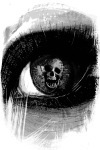
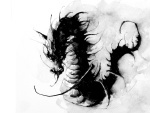
Year of the Dragon will not return until 2024, but next year, 2018, will hopefully be the year I unleash Drakein upon the world, a project I’ve been working on for over ten years. Drakein-5 is a hallucinatory street drug taken in the form of eye drops, and the fuel behind Psychotropic Dragon, the composite novel / meta-novel I’m co-writing with _________________ (name withheld).
[image error]
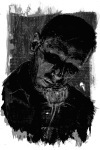
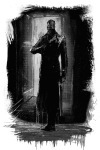
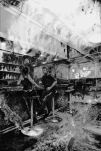
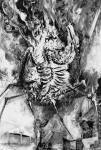
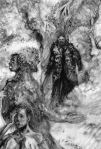
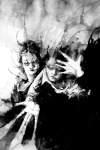
Basically, it’s a novelette wrapped around a novella wrapped around a short novel, illustrated throughout by the likes of Daniele Serra, Glenn Chadbourne, L.A. Spooner, and Ty Schuerman. This book is going to be completely insane. One of the darkest projects I’ve ever attempted. Currently there are over 50 illustrations: some full-page, some half-page, some swimming on and off the page.
The novelette is 10,000 words, the novella will be 20,000, and the short novel portion is around 45,000. Here’s a snip-it from the novel:
She remembered holding the syringe that first time, hands trembling. Such a small thing—a third the size of your typical medicinal syringe, the needle a quarter-inch long. Smaller than a cigarette. “Looks like water,” she had said to Chase. The clear liquid inside appeared iridescent under direct sunlight, as if having an oily consistency. She heard it turned bluish-green under black lights. “What happens if I take more than two drops?” Chase had looked away, then, smiling out of the corner of his mouth. “It’s like any drug. Affects each differently. Two drops, no more. It’ll last a couple hours max, and then it’s back to earth. After you level, you can take more.
What’s a composite novel? “A composite novel is a literary work composed of shorter texts that—though individually complete and autonomous—are interrelated in a coherent whole according to one or more organizing principles.”
Who is my collaborator? Well, that has to be kept a secret for now, but know that it is someone well-loved in the writing community. Perhaps someone you might not expect.
Some of you have been waiting a long time for this book, so I’m going into overdrive to finally make it happen. Here’s a snip-it of the novelette, in case you can’t wait that long.
Somnambulism. That’s what my psychiatrist calls it. Differentiating between dream state and reality is often difficult, which is probably part of the reason for the sleep deprivation. A fear of falling asleep. What if I don’t wake up? What if I can’t wake up? What if the reality I think I know is the dream, or vice versa?
What can you expect out of this book? Expect the unexpected. Expect to be knocked completely out of your socks. Expect to become part of the book, hallucinating from your own dose of Drakein. This book is a trip.
Psychotropic Dragon is a unique collaboration. Along with the writing, this strange book has had many assists along the way. Jack Ketchum, John Skipp, Gary A Braunbeck, Douglas E. Winter, Thomas F. Monteleone, F. Paul Wilson … all have helped this book become something special.
That’s all I can reveal for now, along with Ketchum’s full blurb:
Psychotropic Dragon is addictive, scary, and at times, mind-blowing. But it’s the human element that keeps you turning the pages, the wounds to the psyche which we recognize immediately. The human element … and a fierce narrative style. – Jack Ketchum


September 26, 2017
ADAM’S LADDER – 100% FUNDED!
Thanks to your help, Adam’s Ladder is now completely funded! This next anthology by Written Backwards has raised enough funds to pay all contributors professional rates for their work.
The book will be released in trade paperback and eBook in mid-October, and in deluxe hardback the following month. There is still time to pre-order one of the signed & numbered deluxe hardbacks, but these are very limited (only 100 ever produced). What now? Well, we still have about 20 days remaining in the campaign, which means we are on our way to unlocking free books!
When the campaign reaches $7,000 (less than $450 away), campaign backers will receive a free trade paperback of the first Written Backwards anthology, Pellucid Lunacy (10th anniversary edition), and when it reaches $8,000, this unlocks another free trade paperback of the (to-be-revealed) next book in the illustrated Allevon series (I’ll give you a hint: it’s a short novel). So, keep the pre-orders coming, help us reach our unlock goals (which are close!), and you will get some free books to go along with your copy of Adam’s Ladder.
Basically, if you pre-order a deluxe hardback now (or if you already have), you will get 2 free additional trade paperback books when we reach these goals.


September 20, 2017
ADAM’S LADDER – 82% FUNDED!
Update, as of 11:00am, 09/20/17: We are nearly there!
Adam’s Ladder is now 82% funded, thanks to your generosity, and to an incredibly lucky campaign backer who snagged the signed Stephen King book. Along with pre-ordering in eBook, trade paperback, and deluxe hardback, there are a few editing and book design packages available, but they are going fast. There is even a $4 option for coffee lovers, and rare/signed books available now and again throughout the campaign. Help us get to 100% so we can bring this book to life! Once completely funded, unlocks will be made available to offer campaign-backers free books as our way of saying thanks!
To see how you can help, click the image below, or anywhere you see Adam’s Ladder. This is an all-or-nothing campaign. Written Backwards has taken over production of this book from another publisher, so pre-orders are vital in bringing this book to life, and to assure that writers and artists are paid professionally for their work. Upon reaching 100% funding, Adam’s Ladder will immediately go into print production, with trade paperbacks and ebooks available in October, and the hardbacks in November. So, you won’t have to wait long to receive your books.
[image error]
If you are thinking about pre-ordering the deluxe hardback, please note that only 100 of these will ever be produced, so they will be quite the collector’s item. The 100-numbered limited hardcover edition of Adam’s Ladder, signed by editors Michael Bailey and Darren Speegle, will be bound in black leatherette, with silver foil stamping on the cover and spine, a full-color wraparound dust jacket, and printed on 60# natural offset paper. Those pre-ordering the hardback will also receive a trade paperback of Adam’s Ladder, as well as the eBook. And if we reach our unlock goals, you can expect up to two additional free trade paperback books and an eBook of the next anthology by Written Backwards, for as little as $95.
Support small press, and we will keep cranking out quality fiction!
The full Table of Contents includes:
“Ch-ch-changes” – Chaz Brenchley
“Filigree, Minotaur, Cyanide, Bloom” – Damien Angelica Walters
“How He Helped” – Ramsey Campbell
“Spirits” – Gene O’Neill
“The Mythic Hero Most Likely to Squeeze a Stone” – B.E. Scully
“My Father, Dr. Frankenstein” – John Langan
“Undersound” – Mark Morris
“A Laughing Matter” – Erinn L. Kemper
“The Serile” – Paul Meloy
“Eyes of the Beholders” – Lisa Morton
“Strings” – Tim Lebbon
“Sliced Bread” – Jeffrey Thomas
“I Will Be the Making of You” – Rena Mason
“Nameless Citizen” – Brian Evenson
“Painting the Burning Fence” – Roberta Lannes
“Pitty This Busy Monster Not” – Scott Edelman
“An End to Perpetual Motion” – Mark Samuels
“Swift to Chase” – Laird Barron


September 14, 2017
ADAM’S LADDER PRE-ORDER CAMPAIGN!
Written Backwards is taking over the production of Adam’s Ladder, an anthology of dark science fiction co-edited by Michael Bailey and Darren Speegle, but we need your help to bring this book to life!
To help fund this project, an Indiegogo campaign has been established and will now through October 15th. This is an all-or-nothing campaign, so help out if you can. Full funding will assure that all contributors receive professional payment for their work. And upon funding, campaign backers won’t have to wait long to receive their book orders. The trade paperback and eBook are scheduled for release in mid- to -late-October, with the deluxe hardback available in November.
Click the Adam’s Ladder cover below to visit the Indiegogo campaign.
[image error]
What is to Become of Humankind?
The future of humankind as an ever-changing organism is a subject of much debate. Where is our evolutionary path leading? Will the next rung take the form of mental transcendence, will it set humankind on a course toward divinity, or will this uncertain path involve a dark and terrible reversion? Co-editors Michael Bailey and Darren Speegle present eighteen tales of dark science fiction that explore the course of evolution, written by some of the best literary minds in the fields of science fiction and horror:
Laird Barron – “Swift to Chase”
Chaz Brenchley – “Ch-ch-changes”
Ramsey Campbell – “How He Helped”
Scott Edelman – “Pity this Busy Monster Not”
Brian Evenson – “Nameless Citizen”
Erinn L. Kemper – “A Laughing Matter”
John Langan – “My Father, Dr. Frankenstein”
Roberta Lannes – “Painting the Burning Fence”
Tim Lebbon – “Strings”
Rena Mason – “I Will Be the Making of You”
Paul Meloy – “The Serile”
Mark Morris – “Undersound”
Lisa Morton – “Eyes of the Beholders”
Gene O’Neill – “Spirits”
Mark Samuels – “An End to Perpetual Motion”
B.E. Scully – “The Mythic Hero Most Likely to Squeeze a Stone”
Jeffrey Thomas – “Sliced Bread”
Damien Angelica Walters – “Filigree, Minotaur, Cyanide, Bloom”
Adam’s Ladder will be published in eBook, trade paperback, and in a 100-numbered / limited edition (signed by its editors, Michael Bailey and Darren Speegle).
Does it have a book trailer?
Click this image below:
What will the trade paperback look like?
Something like this:

What is to Become of Written Backwards?
Over the last ten years, Written Backwards has published multiple award-winning anthologies, fiction collections, and standalone novels and novellas, ranging from dark science fiction to horror. Previous anthologies include the Bram Stoker Award-winning The Library of the Dead, the Benjamin Franklin Award winning (and Stoker nominated) Qualia Nous, and three volumes of Chiral Mad (the latest also up for a Stoker). Books published by Written Backwards have seen eight individual works nominated for the prestigious Bram Stoker Award, with three of those stories taking home the statue. Other stories/poems have been nominated for the Nebula, the Rhysling, and others. Foreword Reviews Book of the Year, the Indie Book Awards, the Independent Publisher Book Awards, the Eric Hoffer Book Award, the International Book Award … Written Backwards titles have seen over two dozen literary accolades over the years through its handful of titles! But we need your help bringing the next project to life: Adam’s Ladder.
With your help, Written Backwards can continue in its legacy to:
Seek out diverse voices, both new and well-established.
Pay writers, poets, and artists professional rates.
Provide fair publishing contracts.
Design and publish some of the most beautiful books imaginable.
What is to Become of this Campaign?
You’re probably wondering where your money will go for this particular campaign. Here’s the breakdown:
63.64% – goes directly to the writers, which includes professional payment at a per-word rate, plus the cost of contributor copies for the various editions of the book.
31.22% – goes directly to publication costs for the eBook, trade paperback, and hardback editions of the book.
5.14% – covers shipping.
And that’s it. Zero profit will be made from this campaign. Any additional funds raised will go directly to future Written Backwards projects, some of which are already lined up as expansions/unlocks within this campaign.
This is an all-or-nothing campaign, so if it doesn’t reach it’s goal, the project gets canned. Anthologies (let’s face it), are expensive to make (but we all want them), mostly because there are so many incredible contributors involved. We need to raise $6,500 to make this book happen, so we’ve come up with some enticing perks.
And that’s how you can help …
Written Backwards has some tricks to bring you even more great (and FREE) books in the form of campaign unlocks and future anthologies.

Pellucid Lunacy was the first anthology published by Written Backwards, and after ten years, the book is getting a face-lift. When the campaign reaches $7,000, all backers (contributing $95 or higher) will receive a complimentary copy of the trade paperback!

The title and author of the third illustrated book in the Allevon series by Written Backwards will be revealed when the campaign reaches $8,000, and all backers (contributing $95 or higher) will receive a complimentary copy of the trade paperback.

The title and tentative cover of the next dark science fiction anthology by Written Backwards will be revealed when the campaign reaches $12,000, and all backers (contributing $95 or higher) will receive a complimentary digital copy in either PDF or EPUB.
[ to-be-announced ] will include fiction by:
Michael Marshall Smith
Ian Watson
Roberta Lannes
Scott Edelman
B.E. Scully
Lynda Rucker
Brian Evenson
Erinn L. Kemper
Chaz Brenchley
Tlotlo Tsamaase
Gene O’Neill
Richard Thomas
Paul Meloy
… and others TBA





![[image error]](https://writtenbackwards.files.wordpress.com/2018/06/written-backwards-m-f.jpg)