Bryan Collins's Blog, page 104
June 22, 2016
The Inciting Incident: 7 Tips For Starting Your Story With a Bang

Do your friends or family yawn when you show them your latest work of fiction? Are you struggling to start your story in a way that your readers never forget?
Do you want to light a fuse in your story so that your readers just have to read on and discover how the tale turns out?
I’ve spent the last few months rewriting a collection of short-stories, and I’ve faced all of these problems.
I won’t lie to you.
It’s disheartening to read something you spent hours on and realise you (never mind yo...


June 7, 2016
Self-Care for Writers: What You Need To Know
 Before I started blogging, I worked as a care worker for people with intellectual disabilities.
In that job, I learnt a lot about what is self-care and how important it is to take time out from hard work to recover.
Although I don’t work as a carer any more, the importance of taking time out to look after your mental health is an important practice.
It’s particularly important for writers because we spend so much time alone, in a room with only our ideas for company.
More recently, I had th...
May 3, 2016
How to Apply Deliberate Practice – the Smart Person’s Guide

Are you ready to master your craft?
Do you want to become a writer, who rises above the crowd?
Have you got what it takes to turn deliberate practice into part of your writing life?
Two years ago, I read the bookOutliers: The Story of Successby the Canadian writer, Malcolm Gladwell.
In his popular psychology book, Gladwell explains it takes 10,000 hours to master a discipline, like playing the violin or writing.
He writes:
“In fact, researchers have settled on what they believe is the magic...
April 26, 2016
How To Do a Weekly Review… For Writers

When was the last time you asked yourself if you’re becoming a better writer?
Do you want to know what you should write next and what you should stop doing?
Is it difficult to balance writing with other parts of your life?
There’s a simple strategy that will help you answer these questions and gain clarity in what you’re doing.
It’s calledthe weekly review.
What Is a Weekly Review?The weekly review is a productivity strategy business people and professionals use to take charge of their liv...
April 21, 2016
A Manifesto for Obsession

My wife wants to know what I’m doing.
“Sitting alone in a room is a strange way to pass your time,” she says, “and on a hot Summer’s day; it’s almost noon.”
“I don’t have a choice,” I say. I don’t look away from the computer screen, and my fingers still move across the keyboard. “I have to get this finished.”
“You’re obsessed,” she says.
“I’m not obsessed,” I say. “I’m just focused.”
She closes the door and leaves me to it, but we both know she’s right.
I like focusing on a single idea for h...
April 12, 2016
Deliberate Practice and Malcolm Gladwell’s 10,000 Hour Rule: Here’s What You Need to Know
Are you ready to master your craft?
Have you got what it takes to make deliberate practice a part of your day-to-day life?
Do you want to become a writer or creative professional who rises above the crowd?
A couple of years ago, I read the book Outliers: The Story of Success by the Canadian writer Malcolm Gladwell.
In his popular psychology book, Gladwell explains it takes 10,000 hours to master a discipline like playing the violin or writing.
He writes:
“In fact, researchers have settled o...
April 5, 2016
How To Read More Often (When You Don’t Have Any Time)

The German blacksmithJohannes Gutenberg invented the printing press sometime before 1450.
His invention enabled the printing of lengthy texts that people were able to use to spread their ideas.
In 1518, the theologian Martin Luther used Gutenberg’s invention to print German copies of his Latin book 95 Theses.
The subsequent popularity of this book across Europe became one of the driving forces of the Protestant Reformation.
Gutenburg’s printing press enabled the dissemination of ideas that...
How To Read Every Day (When You Don’t Have Any Time)
Are you stuck in the dark ages?
If you don’t read regularly, you are.
The German blacksmithJohannes Gutenberg invented the printing press sometime before 1450.
His invention enabled the printing of lengthy texts that people were able to use to spread their ideas.
In 1518, the theologian Martin Luther used Gutenberg’s invention to print German copies of his Latin book 95 Theses.
The subsequent popularity of this book across Europe became one of the driving forces of the Protestant Reformation...
How To Find Time To Read Everyday (When You Don’t Have Any)
Are you stuck in the dark ages?
If you don’t read regularly, you are.
The German blacksmithJohannes Gutenberg invented the printing press sometime before 1450.
His invention enabled the printing of lengthy texts that people were able to use to spread their ideas.
In 1518, the theologian Martin Luther used Gutenberg's invention to print German copies of his Latin book 95 Theses.
The subsequent popularity of this book across Europe became one of the driving forces of the Protestant Reformat...
March 29, 2016
How to Create a Mind Map: A Practical Guide
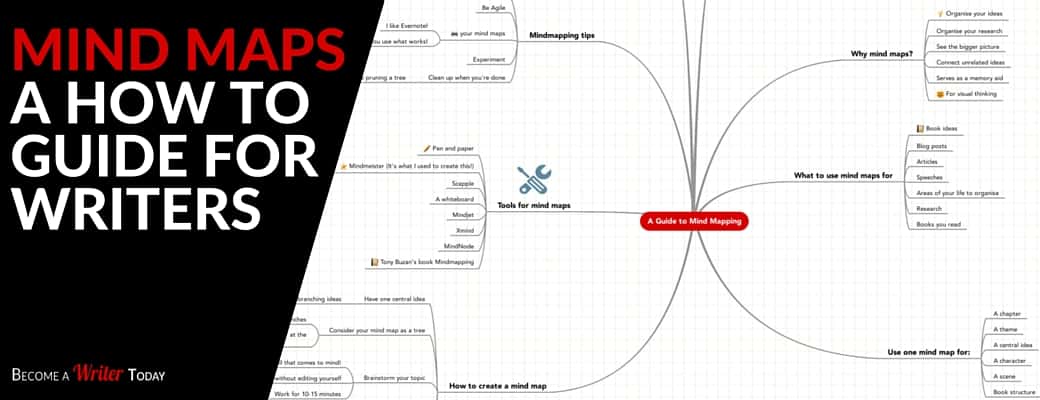
Do you want to get your ideas onto the page faster? Or do you need to organise your ideas for an article or a book before you write?
A mind map is a diagram of visual information, based on a single concept or idea.
Mind mapping is a proven and practical, creative technique for organising your ideas and research and for coming up with new and better ideas for your articles and books.
Why Use Mind Maps?The artist and inventor, Leonardo da Vinci, said, “Everything is connected to everything el...