Abel Keogh's Blog, page 2
October 8, 2025
The Third Reason Relationships with Widows and Widowers Thrive
Are you tired of feeling like you’re living in someone else’s story? In this video, I’ll show you how to build a new traditions and fresh memories with a widower—without getting stuck in the shadow of his late wife. You’ll learn:
Why repeating old traditions can keep your relationship stuck in the past
How to start new rituals that make your marriage feel alive and uniquely yours
Simple ways to blend old memories with new beginnings—especially if kids are involved
Your relationship deserves its own story. It’s time to stop replaying the past and start creating the future—together.
I’m Abel Keogh, author of the book, Dating a Widower, and today we’re going to discuss the third of three reasons marriages to widows and widowers thrive. And what is that reason? It’s that they make new memories and start new traditions together.
Let me break it down for you. People are creatures of habit and widows and widowers are not different. They’ve often spent decades living a certain way with someone else. It’s not just the big things like holidays or birthdays, but the restaurants they frequented, the vacations they took, the TV shows they enjoyed, and the way Saturday mornings started. Over time, these routines become second nature. They’re comforting and familiar. However, you must create new memories and traditions together for your relationship to thrive.
In my coaching sessions, many clients tell me they felt they were living in the widow's or widower’s marriage to their late spouse. For example, they go to the same beach house he and the late wife visited every summer, decorate the Christmas tree with her ornaments, and eat the same breakfast he used to make for her. At first, it felt like they were being included in something special, but slowly, it started to feel like they were a guest in someone else’s story.
To be fair, most widows and widowers aren’t doing this to be hurtful. They don’t always realize that by keeping old routines, they’re unintentionally leaving their new partner on the outside looking in. Some even think they’re honoring the new relationship by sharing what was special in the past. However well-meaning they are, your relationship doesn’t need to be an extension of the past. It deserves to be a life with new memories and traditions reflecting the two of you.
Now, making new memories and starting new traditions go both ways. If you want a relationship that feels fully alive and grounded in the present, you must also be willing to step outside your patterns. That might mean letting go of how you’ve always done things, especially if you’ve been single or divorced for a long time and developed your own rituals. Maybe you’ve always traveled to your sister’s for Thanksgiving or decorated a certain way for the holidays. A strong relationship means being willing to blend, adapt, and start fresh together, not just expecting the widower to do the heavy lifting.
On a personal level, when Julianna and I were first dating, I made this mistake. I took her to restaurants that Krista and I loved and trails that we had hiked together. I didn’t do this to relive the past, but because I knew the food and scenery were good. However, it didn’t take long to realize something felt off. Even if the place was “neutral,” some emotional weight still lingered. So, I made a conscious decision to start fresh. I began planning new trips, finding different restaurants, and creating our go-to spots. Julianna brought ideas too—places and experiences I wouldn’t have picked on my own but grew to love. We built our new life as a team. That’s why, twenty-two years later, the goofy traditions, the new places, and the shared rituals we created together are the glue that holds us close. It’s what makes our relationship feel real, not recycled. Your relationship should feel similar.
If the widow or widower you’re with resists change or if you find yourself clinging to past routines, rituals, or identities, take that as a sign that it's time to shake things up. Suggest new places to visit and new traditions to start. Start small if needed. If either of you constantly defaults to what’s always been done out of habit, guilt, or fear of disappointing others, that’s a rut, not a life.
If you or your widowed partner has young children at home, be thoughtful about how you transition. You don’t have to erase everything. Children need continuity, especially after loss. However, you can still introduce new ideas and blend the old with the new. One woman I coached came up with a great approach: at Christmas, she kept a few of the family’s traditional ornaments for the kids but added new ones that reflected her story and personality. It made the home feel like everyone belonged. That’s the kind of intentionality that builds a life.
That solution may not work for you or the widow/widower you’re with, but if you put the effort into building a life that feels like yours, it will lead to a long and wonderful relationship where the past is honored but not repeated, one where both of you feel at home.
I’m Abel Keogh, author of the book, Dating a Widower and I’ll see you all next Wednesday.


September 27, 2025
New Dating Guide Covers and Editions
Big updates are here! My best-selling dating guides are getting a complete refresh. Dating a Widower has a bold new cover, and both Life with a Widower and Marrying a Widower are being fully rewritten—with fresh covers and brand-new audiobooks to go with them. You’ll find the updated Dating a Widower cover below. If you haven’t read it yet, now’s the time—it’s the go-to guide to help you know if the widower in your life is truly ready to open his heart to you. Updates to the other two books are coming very soon!
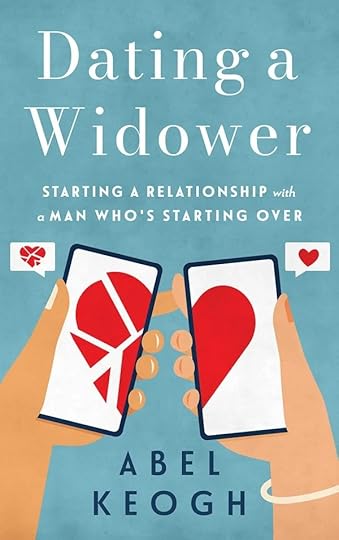 Learn more Get Your Copy
September 16, 2025
Widow's Fire: The Hidden Trap After Loss
Widow’s fire is the sudden, overwhelming desire for sex and intimacy that often hits widows and widowers in the weeks and months after losing a spouse. It feels normal—and it is—but giving in to it through casual hookups creates more problems than it solves. In this video, I explain why widow’s fire can sabotage healing, damage future relationships, and leave behind a trail of broken hearts. I’ll also share healthier ways to handle that desire so you can move forward, heal fully, and be ready for lasting love again when the time is right.
Let’s Talk about Widow’s Fire
Hi, I’m Abel Keogh, author of the book Dating a Widower and today, we’re going to talk about something that a lot of people don’t understand—widow’s fire—and why it keeps widows and widowers from forming healthy, long-term relationships.
For those who may not have heard the term before, “widow’s fire” refers to a sudden, overwhelming desire for sex, intimacy, or connection that often shows up just weeks or months after losing a spouse. It feels confusing, even shocking, because it collides with grief. One moment you’re crushed by loss, and the next you’re consumed by the urge to be touched, held, or desired again.
That’s normal. It’s part of being human. But here’s the problem: using sex or casual hookups to fill that spouse-shaped hole in your heart doesn’t bring healing—it delays it. And more often than not, it creates a whole new set of problems.
I was reminded of this by a post I saw on X. A young widow wrote:
“My widower guy friends who deeply loved their wives are coping by sleeping with everyone. I’m kind of impressed because it seems to be working for them.”
When I asked her what she meant by “working,” she said:
“Well, they do seem happier now, but I assume it’s also a way for them to ignore what’s going on.”
Her observations are actually spot on. It does look like it’s working—for a while. Widow’s fire can create the illusion of happiness. But what she couldn’t see—and what I’ve seen over and over again in my work with widows and widowers—is that widow’s fire doesn’t heal anyone. In fact, it does the opposite. It complicates grief, makes future relationships harder, and leaves unnecessary damage in its wake.
Here’s why:
It offers temporary relief, not healing.
Hooking up may take the edge off your grief for a night, but it doesn’t deal with the pain underneath. It’s like putting a bandage on a broken bone. You wake up the next morning with the same emptiness—sometimes even worse—because deep down, you know sex alone can’t bring your spouse back or repair your heart.
It sabotages future relationships.
Widow’s fire runs on impulse and short-term thinking. By chasing that immediate high, you never give yourself the space to grieve, reflect, and do the work of moving forward. When the fire burns out, you’re left trying to start a real relationship with the baggage of unprocessed grief—and often, with habits or patterns that make bonding with someone new a lot harder.
It confuses grief with attraction.
When you’re hurting, it’s easy to mistake the relief of intimacy for genuine love. You might convince yourself you’re falling for someone new, when really, you’re just desperate to fill the emptiness. Those false starts often lead to rushed commitments, messy breakups, and even more emotional wreckage down the road.
It stunts emotional growth.
Grief, as brutal as it is, can lead to strength and personal growth if you work through it. But when you mask that pain with hookups, you sidestep the lessons grief is meant to teach you. Instead of learning resilience and building a new life, you stay stuck in survival mode—unprepared for the healthy, lasting relationship you may want later.
It leaves others hurt and confused.
Every time a widow or widower uses someone to satisfy that fire, there’s usually another person who walks away heartbroken. They thought they were building something real—while the grieving spouse was just looking for a way to numb the pain. That trail of broken hearts doesn’t just hurt others; it creates guilt and regret that adds to the burden of grief.
Some of you are probably thinking, Abel, what’s the alternative? How can you handle that very real desire for intimacy without derailing your healing? Here are four healthy ways to deal with it:
Channel the energy into physical activity. Exercise—running, cycling, lifting weights, or even walking—gives your body an outlet, boosts endorphins, and takes the edge off in a way that builds you up instead of tearing you down.
Spend time with trusted friends, family, or even a support group. Share your story. Let people see you. That connection meets your need for closeness without pulling you into something destructive.
Focus on personal growth. Learn a skill, take a class, or dive into a hobby you’ve always wanted to try. Widow’s fire is your heart and body screaming for something new—redirect that energy into building yourself up instead of burning yourself out.
Seek professional help if needed. The right grief counselor, therapist, or coach can help you sort out the emotions and desires you’re feeling. Sometimes just talking it through things and getting professional guidance makes the fire less overwhelming.
Now, let me be clear: wanting intimacy after loss is normal. It doesn’t mean you loved your spouse any less, and it doesn’t make you a bad person. It just means you’re human. What matters is how you respond to that desire. Giving in to widow’s fire is no better than trying to drown your grief in alcohol, drugs, or any other temporary fix. It soothes for a moment, but it prevents the deeper healing your heart really needs. And until you do that hard work of grief, you’ll never be fully present for yourself—or for anyone else who wants to love you.
The truth is, there are not shortcuts when it comes to working through grief. There’s no fast lane, no escape hatch, no magic formula. Healing only comes when you face your pain head-on, feel it, and let it reshape you. That’s not easy, but it’s worth it—because on the other side of grief is strength, clarity, and the ability to build a future you can be proud of. And when you’ve done that work, intimacy will no longer be a distraction or a crutch. It will be real. It will be lasting. It will be a bond built on honesty, trust, and commitment—not just the need to feel something in the moment.
So here’s the bottom line: Giving in to widow’s fire keeps you stuck in survival mode. If you want to heal, move forward with life, and, at some point, a healthy, lasting relationship, resist the urge to throw a quick fix on your pain. Give yourself the gift of time. Do the work of healing. And when the time is right, you’ll be able to love—and be loved—in a way that honors both your past and your future. That’s when you’ll discover that love after loss isn’t just possible—it can be deeper, stronger, and more meaningful than you ever imagined.
September 2, 2025
Why Widows and Widowers Will Never Be Their “Old Self” Again
When someone loses a spouse, they’re forever changed. Widows and widowers don’t go back to being their “old self” — and that’s not always a bad thing. In this video, Abel Keogh, author of Dating a Widower, explains how grief can either harden or refine widows and widowers and what that means for future relationships.
Hi, I’m Abel Keogh, author of the book Dating a Widower and recently, a viewer left the following comment on my YouTube channel:
"Abel, I’m dating a widower who lost his wife 1.5 years ago. There are no major red flags, and though we do have some issues, we are working through them. The problem is that my widower boyfriend is concerned that he’s not his old self anymore. He says he used to be more joking and lighthearted, and now he’s more of a serious person. Do you have any ideas on how to get more of his old self back?"
Great question. Here’s my answer: loss changes you. When you lose a spouse, the way you see the world and interact with others is forever altered. Your widower isn’t going to be exactly his “old self,” and that’s not necessarily a bad thing. What matters is how he’s changed since his loss.
Some widows and widowers struggle after loss. If they’re not careful, grief can pull them in the opposite direction. Instead of softening their hearts, it can harden them. They can become bitter, cynical, or so focused on their own pain that they stop showing up for others. Some withdraw entirely, shutting people out. Others lean too heavily on their kids, friends, or a new partner to carry the weight of their grief.
Grief can also make people careless. They might neglect their health, finances, or responsibilities. Some numb themselves with alcohol, overspending, or rebound relationships. Anger, irritability, and impatience can replace kindness and compassion. And perhaps the most damaging of all, they can get stuck in the past—clinging so tightly to their late spouse and old routines that they miss out on building a new, meaningful life.
But grief can also refine and reshape a person. For those willing to work through the pain, it can teach patience, resilience, and compassion. Loss often sharpens priorities: wasted time and meaningless drama don’t matter as much, relationships are valued more, and loved ones are appreciated in ways they weren’t before. Life feels fragile, so every day is lived with greater focus and intention.
For many, grief strips away pretense. There’s no energy left to fake or play games. Instead, it fosters honesty and authenticity. You learn to show up as yourself, unapologetically, and to invest your time in things that truly matter.
I can give a personal example. In the days after Krista’s first death anniversary, I did some soul searching to make sure I was ready to marry Julianna. Mentally, I felt profoundly changed—like I had aged and grown 20 years wiser. As a result, I was:
More compassionate
More grounded and focused
More resilient
More patient
More grateful
More spiritual
More serious
Less judgmental
More intentional
More present
I’m not perfect—far from it—but my loss forced me to learn some hard lessons. Those changes helped shape me into someone ready for a lasting, loving marriage. Had I gone the opposite direction, allowing bitterness or self-centeredness to take hold, there’s no way Julianna and I would have enjoyed 22 years together and raised seven kids.
At the end of the day, loss changes all of us. Some people let grief harden them; others let it refine them. Your widower isn’t going to return to his old self, but that doesn’t mean he can’t be a better man than he was before. The real question isn’t whether he’ll crack the same jokes or carry the same lightness he once did—it’s whether the man standing in front of you today has grown into someone stronger, wiser, and more intentional. That’s the version of him you need to evaluate, because that’s who you’ll be building a life with.
I’m Abel Keogh, author of the book, Dating a Widower, and I’ll see you all next Wednesday.
August 26, 2025
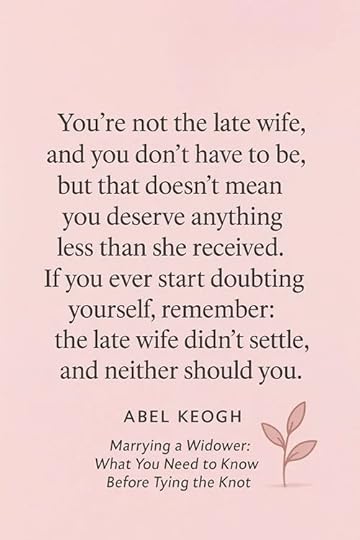
You're Not the Late Wife
From the second edition of Marrying a Widower….coming next month!
August 19, 2025
Upset That Your Widowed Mom or Dad Is Dating?
If you’re an adult and upset that your widowed mom or dad is dating again, relationship coach Abel Keogh adds some needed perspective to this heartbreaking issue.
If you’re an adult and upset that your widowed mom or dad is dating again, this message is for you.
I get it. It’s hard to see Mom or Dad dating again. Maybe you're still grieving. Maybe it feels like a betrayal to see them with someone else. Maybe you're worried they’re rushing into something. Or maybe it just stings to see them building a new life, which means spending less time with you.
Whatever the reason, your pain is real. But here’s the truth: you lost a parent. That’s heartbreaking. But your surviving parent? They lost a spouse. A partner. The person they built their life with. And now, they're trying to rebuild that life without them.
You might think it’s too soon. You might not like who they’re dating. You might feel it’s “disrespectful” to your deceased mom or dad, but you don’t get to set the timeline for someone else’s grief—or their healing. But you don’t get to decide when someone else is allowed to feel love again. How would you feel, for example, if your parents told you who you could or couldn’t date, marry, or share your life with? Would you consider that disrespectful?
You know what else is disrespectful? Telling your mom or dad they should be content being alone. Telling them they can only come to events if they leave their new love back home. Withholding visits to their grandchildren because you don’t like their decisions or that their life, moving forward, must revolve around your feelings and sit quietly on the sidelines.
Let me be clear: your parent is still alive and they still have love to give. They still want connection, companionship, and joy. Loving someone else doesn’t diminish their love for their late spouse, for you, or anyone else. And while he or she doesn’t need your blessing to pursue these things, they do want you to be part of this new chapter with them.
If you make their new partner feel like an outsider, if you lay down ultimatums like, “You can come, but she can’t,” or “I don’t want him around my kids,” you’re not protecting your family. You’re trying to control it. That’s not concern, that’s manipulation. And it hurts your parents and your relationship with them more than you realize.
No one’s asking you to forget your late mom or dad. But if you truly love the parent who’s still here, show it. Support them. Let them live. Let them be whole again—not frozen in time to fit your comfort zone. Get to know the new person in their life and give your surviving parent a chance to show what love looks like.
So ask yourself honestly: Are you honoring your parents, or are you just angry they’re moving forward without your permission? Is it worth destroying a relationship just because you don’t approve of their choices? You don’t have to embrace their new love or agree with their decision to move forward, but you should at least give them a chance to move forward in life.
I’m Abel Keogh, author of the book, Dating a Widower, and I’ll see you all, next Wednesday.
August 12, 2025
What Running Couldn't Fix

I can’t remember the exact day I laced up those old running shoes, but I remember the mirror.
I had been sitting behind a desk for over a year, working my first “real” job out of college. The tech company stocked free snacks and sodas, and I’d been living off both. At six-foot-three, I carried my 235 pounds better than most, but there was no mistaking it—I had let myself go. Standing shirtless in front of the mirror that evening, I didn’t recognize the man staring back. He looked worn out and soft, weighed down by more than just extra pounds. I needed to fix something and wasn’t sure where to start. So, I reached for an old pair of running shoes.
They were beat-up, dusty, and shoved in the back corner of my closet. I laced them up and stepped out into a hot July evening. From the street, I had a clear view of the sun setting behind Antelope Island in the middle of the Great Salt Lake. I hadn’t regularly exercised in over a year, so I set a modest goal: run one mile. I remember almost nothing from that run except a neighbor mowing his lawn who paused long enough to give me a look—a mix of pity and curiosity—as I shuffled by.
I finished the run without stopping, but my side ached and my legs throbbed from the effort. Still, the pain felt earned. It was something real and solid in a life that was slowly unraveling. My wife Krista and I had been married for almost two years, and our relationship was starting to fray. I worked during the day, and she worked evenings, and between the long commutes and schedule differences, we barely saw each other during the week. On weekends, we were often pulled into the orbit of her family. Krista had a complicated, somewhat co-dependent relationship with her parents, and the time we might have spent reconnecting as a couple was usually devoted to dealing with their problems. It felt like our marriage, instead of being a shared life, was becoming a support system for everyone else.
I ran again the following evening. It was another slow, heavy mile, minus the neighbor. The next night, I did yet another mile. The mileage wasn't much, but those lumbering runs gave me traction when it felt like other parts of my life were slipping.
Little by little, my daily mileage increased. Before long, I found myself at the high school track each evening, circling its familiar loop alongside others who showed up in the fading light. We didn’t speak, but there was comfort in the shared rhythm—the steady beat of footsteps, the rise and fall of breath, the silent agreement to keep going. We were strangers, but we each carried something heavy, hoping that forward motion might ease a burden we couldn’t fully leave behind.
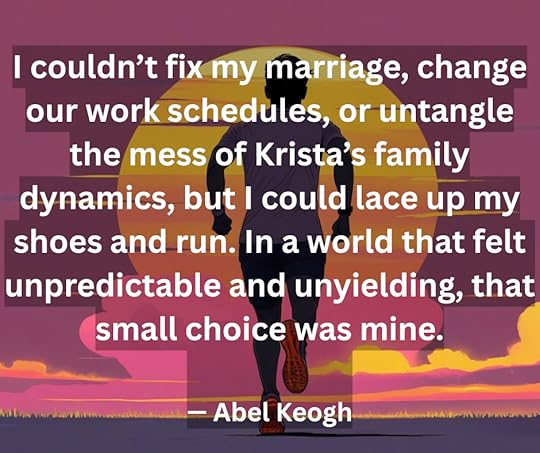
I couldn’t fix my marriage, change our work schedules, or untangle the mess of Krista’s family dynamics, but I could lace up my shoes and run. In a world that felt unpredictable and unyielding, that small choice was mine. I reclaimed part of myself one step and one mile at a time. Somewhere along the way, the soda lost its appeal, and the snacks no longer offered comfort. The weight came off—50 pounds in six months—but what mattered more was the sense of control I began to regain. When everything else felt out of sync, running gave me something solid to hold on to. It became proof that progress, however small, was still possible. For the first time in years, I could point to something and say: this is working. And for a while, that was enough. After I lost the weight, running became more than exercise—it became a ritual, a rhythm, and a refuge. Most of all, it gave me a way to face the things I couldn’t control and clarity to start repairing what I could.
When Krista and our nine-day-old infant daughter died the following year, there was no manual for how to survive that kind of loss. But each morning, the road was there. The pavement didn’t offer advice or try to cheer me up. It simply let me run. Mile after mile, I tried to sort through the grief, confusion, and the unbearable silence of a home that had once been full. Running didn’t fix the hole inside me. It couldn’t. However, it gave me time to breathe, space to think, and a rhythm to steady myself as I slowly figured out what could be fixed and what I had to let go.
When I started dating again, running became a bridge. I met a woman named Julianna. She was strong, focused, fresh off a recent marathon win, and already training for the next. Eventually, we grew close enough that she let me into that part of her world. Every morning at 5:00 a.m., I drove to her apartment for training runs. We didn’t talk much, but those quiet miles gave us something solid: time together without distractions and shared effort side by side. These morning runs didn’t fix my past, but they helped me build something in the present. Step by step, breath by breath, running helped us figure out how to move forward and navigate the unique issues of dating a recent widower. Running didn’t solve my problems or resolve Julianna’s concerns, but it showed my dedication and became something we could build a relationship on.
We married soon after. The years that followed were joyful, but chaotic. We had three kids in under three years, which meant diapers, sleepless nights, and a house that was never quiet. There were stretches when the money ran short, and jobs felt more draining than stable—seasons marked by layoffs, difficult bosses, and days we counted down until quitting time. Illness visited too, uninvited and unplanned, reminding us how fragile stability can be. And, like every couple, we had our share of hard conversations and growing pains as we built a life together. Running couldn’t pay bills, cure sickness, or solve arguments, but it gave us time to reflect and a rhythm we could share.
At first, we pushed one jogging stroller, then two, the second being a double-wide. As the kids got older, they biked alongside us. To this day, they remember being bundled in blankets on frosty mornings or pedaling through puddles to see who could make the biggest splash.
As our family grew from three to seven children, our challenges differed from the ones I’d known before. When Krista and I worked opposite shifts and her family’s needs often swallowed up our weekends, life felt scattered and disconnected. Now, the noise of babies crying and toddlers squabbling still drained me, but it came from something we were building together—a life that, for all its chaos, finally felt like it belonged to me too. Alongside the exhaustion came moments of laughter, wonder, and small joys like sticky hugs, unexpected questions, and giggles echoing through the house, making it easier to bear. Running didn’t quiet the craziness, but it gave us an outlet and a ritual. Each run was a reminder, however brief, that we were still moving forward together.
Four of our seven kids eventually became runners themselves. We’ve paced them through 5Ks and training runs, watched them struggle, sweat, and find their stride on cross-country and track teams. Not all stuck with it—one chose swimming, another volleyball, and the youngest is still figuring it out. I’ve learned I can’t shape their paths, but I can run beside them, help them push through a hard mile, and show them what it looks like to keep going. They’ve each learned, in their own way, what running taught me years ago: life doesn’t always go as planned, but there’s value in the effort and in finishing what you can.
These days, I mostly run alone—thirty or forty quiet minutes each morning to think, pray, ponder, or simply let the silence stretch. Sometimes I run with Julianna or one of the kids, especially when someone needs space to talk or just be close. Occasionally, a neighbor joins me, and we fall into an easy rhythm, the way runners do, when effort is shared. I’m not chasing times or distance. I run to stay centered—to begin the day with something steady, something that reminds me I’m still here, breathing, and capable of taking the next step. My body doesn’t recover like it used to. The miles leave their mark, but I still lace up—not because I expect running to fix anything, but because it’s already carried me through more than I ever thought I could bear.
Running didn’t save me. It didn’t erase the sorrow of losing Krista or solve the mess that came after. However, it gave me something solid beneath my feet when everything else felt uncertain. It helped me grow into the kind of man and father Julianna and my children needed. It gave me rhythm when life felt scattered, breath when the weight was heavy, and forward motion when standing still would’ve been easier. Along the way, it gave Julianna and me a way to build something new in the life we were creating together.
This month marks twenty-five years of running—tens of thousands of miles, countless mornings, and one quiet truth I keep learning: you don’t have to fix everything or have all the answers. Sometimes it’s enough to keep moving—step by step, breath by breath—toward the life that’s still unfolding in front of you.
###
August 5, 2025
Choosing Between My Grandson and My Fiancée
Relationship Coach Abel Keogh answers the following question from a viewer: "What about my relationship with my grandson who is turning 13 this week? The problem is that he needs me to be at his party but his mom refuses to let me bring my future wife . Her excuse is she just doesn’t know this lady enough to allow her around her family .I’m put between either going without her and hurting my fiancé or not going and hurting my grandson. How do I handle this situation without dying inside my own heart?"
Abel’s Answer: This is an awful situation that you find yourself in, and unfortunately, it’s one that many widows and widowers experience when their adult children aren’t happy that mom or dad is dating again. You love your grandson, and you want to be there for him. But here’s the hard truth: What his mom is doing is engaging in manipulative behavior, and going to that party without your fiancée will only reward and reinforce her behavior.
The excuse that she “just doesn’t know” your future wife sounds reasonable on the surface—but let’s be honest: if she wanted to know her, my guess is that she’s had plenty of chances. In fact, she could use this party as a chance to get to know her better. What his mom is really saying is, “I don’t like your relationship, so I’m going to control how and when it’s allowed to exist around my family.”
That’s not a healthy dynamic, and if you give in, you send a clear message: she can control your future marriage by holding your grandson over your head. That’s not fair to you, your fiancée, or even your grandson—who is being used as leverage.
So what do you do? You stand up for your relationship by kindly but firmly telling your grandson’s mom that you won’t attend events where your future wife isn’t welcome. If she wants a real relationship with you, it needs to be built on love and mutual respect, not ultimatums and manipulative behavior.
I don’t know if your 13-year-old grandson has a phone, but I would call or text him and let him know that you can’t make the party, but wish him a happy birthday and see if there’s another time you can visit. I feel bad that he’s caught in the middle of this, but the only way the situation will improve is by taking a stand and letting his mom know that her manipulative and unreasonable behavior won’t be tolerated.
July 10, 2025
The Joke About Two Devils Who Opened a Store
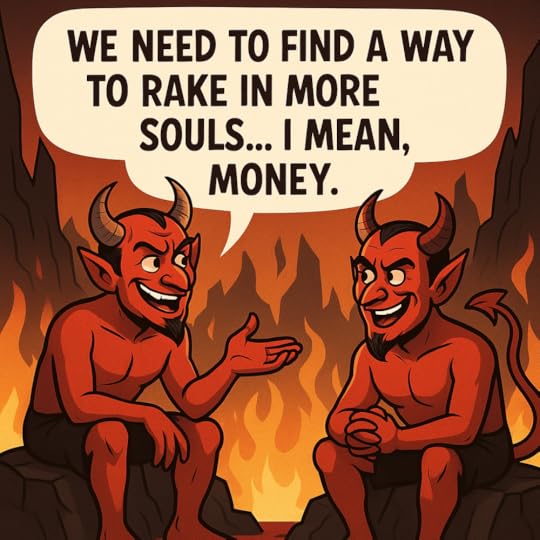
Two devils were sitting in Hell, looking bored. One devil sighed and said, "You know, Hell just isn’t as profitable as it used to be. We need to find a way to rake in more souls... I mean, money."
The second devil raised an eyebrow. “Oh? And how do you suggest we do that?”
The first devil grinned. “I’ve got it. We need to open a store. But not just any store. A place that makes the shopping experience so miserable that people think they’re getting a deal, but in reality, it’s pure hell. And they’ll keep coming back for more.”
The second devil thought for a moment. “Alright, I’m intrigued. What's your master plan?”
“Easy,” said the first devil. “We charge a membership fee. Not enough to make them angry, but enough to make them feel like they’re part of some exclusive club. No one wants to feel left out, especially when their pride is on the line.”
The second devil chuckled. “Yeah, that’ll get them hooked. What else you got?”
“We sell everything in bulk,” said the first devil, rubbing his hands together. “12 packs of olive oil, 50-pound bags of rice. You know, stuff they’ll never use but will think is a deal. We’ll play on their greed. They’ll end up buying way more than they need. Waste everywhere. It’ll be glorious!”
The second devil grinned. “I love it. And let’s throw in free samples at choke points in the store. Not only will they think they’re getting a taste of something special, but we’ll create bottlenecks so people can’t move! Nothing says hell like being stuck in an aisle for eternity.”
“Exactly!” said the first devil, his eyes gleaming. “And then we only open a few checkout lines. The lines will be long, torturous—just like their shopping experience. They’ll spend hours getting their stuff, and by the time they leave, they’ll feel like they’ve earned their deal!”
The second devil clapped his hands. “This plan is perfect! It’ll be pure chaos—and we’ll make a fortune! Now we just need a name.”
The first devil thought for a second, then snapped his fingers. “I’ve got it. We’ll call it... Costco.”
July 8, 2025
The Second Reason Marriages to Widows and Widowers End in Divorce
In this episode of Widower Wednesday, Abel Keogh, author of Dating a Widower, shares the second reason marriages to widows and widowers fall apart: Their partner doesn't set and enforce healthy boundaries when dating. Learn about the necessity of setting healthy boundaries in this video.