Douglas J. Bornemann's Blog, page 2
July 31, 2021
Skilled Writing: The Agony and the Ecstasy
Oh, and, by the way, the ebook version of Practical Phrendonics is currently on sale for 99 cents.
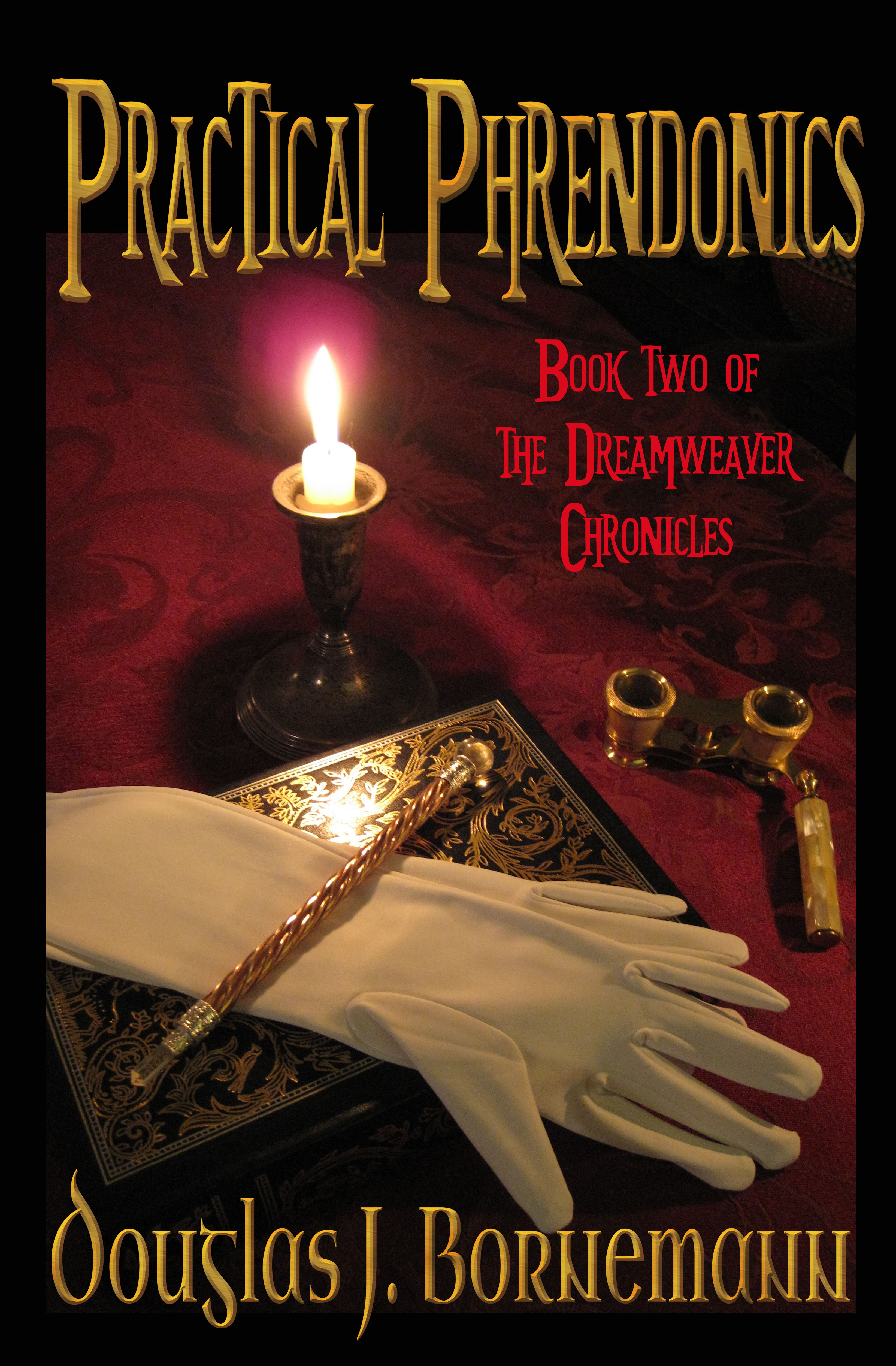 Practical Phrendonics is Book One of the Heiromancer Trilogy
(to which The Demon of Histlewick Downs is a standalone prelude).Acquiring expertise first requires recognizing the need…
Last year’s publication of Hanged Man’s Gambit, the final book of the Heiromancer Trilogy, was the culmination of over fourteen years of work. When I started, I hadn’t the slightest idea what I was in for. From years of running games, I knew a little something about developing characters and the elements that make a plot meaty and satisfying, but publishing is a different beast. After law school and a Ph.D., I was also under the impression I knew how to write. I didn’t – at least not at the level necessary to publish a professional-level novel. Of all the things I needed to learn, that was far and away the toughest. Writing well requires more than vision. It requires more than talent. It requires more than a basic grasp of grammar. It requires more than being widely read. While all these things are helpful, professional-level novel writing requires expertise.
How does one acquire expertise?
The first and hardest step is recognizing you don’t have it. If you haven’t had some training, you can safely assume that not only do you not have it, you aren’t in a position to evaluate whether you have it. That’s simply the nature of the game and a natural consequence of the Dunning-Kruger effect. All beginning writers go through this. Those who don’t get past it before they publish are responsible for the continuing truth of Sturgeon’s Law. Assuming that since you’ve read novels that you are now qualified to write them is like accepting a job as a master chef because you’ve eaten at a few fancy restaurants. Chefs train for years to master techniques and learn the subtleties of their craft. While you might be a good home cook, if you haven’t trained, you’re not a chef. Mastery of a craft like writing requires an understanding of the prevailing culture, an appreciation for what’s already been done, and a vision for the boundaries you intend to push. You need to know, for example, why certain approaches (like the main character describing herself in the mirror) are verboten; why info-dumps are problematic; why tense scenes require a more staccato delivery; what constitutes overuse (or awkward use) of dialogue tags; what makes for a workable inciting incident; the differences between good grammar and clear, strong prose; how to recognize and eliminate unnecessary repetition; how to identify and eliminate plot-irrelevant details; how dialogue is properly punctuated; and a thousand other things. Only once you understand these rules can you both employ them effectively and know when to productively break them.
The second step is to recognize that to achieve some measure of craft, you’ll need trained guidance. Books on the subject can help, but nothing gets the message across more effectively than feedback on your own work by someone who’s already acquired the requisite expertise. Your mother, even if she’s rigorously honest, might only be able to tell you something’s wrong. Without the appropriate expertise, she likely won’t be able to tell you why elements of your story rub her the wrong way or strike her as amateurish. Your best bet is to find a skilled editor who is willing to both edit your prose and explain the reasons underlying those edits. That, of course, is a huge challenge in its own right. Because you’re now aware of the Dunning-Kruger effect, you’ll realize that since you’re not in a position to evaluate the quality of your own prose, you’re probably even less well positioned to evaluate those edits.
So, how will you be able to evaluate whether the editor you’ve selected has any more expertise than you do? It is a bit of a chicken-and-egg problem. First, recognize that since there’s no regulatory body governing minimal competence for editors, anyone can hang out a shingle and charge you for the service. To complicate things further, some folks claiming to be editors are little more than scammers. Next, recognize that even non-predatory editors may be afflicted by Dunning-Kruger – they may simply not recognize their editorial skills aren’t up to par. My best suggestion is to attend writers’ conferences (such as The Southern California Writers’ Conference). Assemble a cohort of friends who are also trying to acquire writing expertise and get their honest feedback as a way to start acquiring some expertise that you can then use to help you evaluate editorial work. Professional editors also often attend writers’ conferences, and you can get an idea of whether some of these folks’ personalities would be a good fit. Check editorial credentials such as past clients and also check the Preditors and Editors website (once it’s back up and running). And most importantly, when you’re ready – when you feel you can’t possibly make those pages any better – get sample edits (preferably for the same pages) from multiple vetted editors. Many reputable editors will do such sample edits for free. Multiple samples will enable you to compare the editors’ methods and to see how their suggestions affect your prose. Even if you’re choosing from a group of highly capable editors, there’s as much art as science to editing – your artistic styles won’t always mesh.
Also be aware that Dunning-Kruger applies equally those who will review your work. When you publish, you’ll be submitting your book to a broad range of readers. The majority won’t be in a position to meaningfully comment on your level of craft because they simply haven’t acquired the level of expertise that would enable them to evaluate it. You acquire that expertise because it provides readers with a smoother, less-jarring, more-immersive reading experience, not because you expect readers to recognize what a skilled craftsperson you’ve become. That you’ve improved the reader experience will increase the chances for positive reviews, but will not guarantee them. For some, burnt tater tots and TV dinners are the epitome of haute cuisine, and if that’s what they like, reviewing them accordingly isn’t necessarily wrong. That also means if you don’t serve tater tots, those folks simply won’t review you well, regardless of your facility with the foie gras. On the other hand, that smaller fraction of readers who have acquired a measure of writing acumen are likely to expect high-level craft as a matter of course. It therefore won’t occur to them to praise a work for its craftsmanship, but they will be among the first to crucify you should you fail to live up to their exacting craftsmanship standards. Thus, it’s predictably rare for a review to accurately recognize and appreciate hard-earned writerly skills, but when it happens, it’s an occasion to be cherished.
/
Likes (0)Dislikes
 (0)
(0)


May 31, 2021
Chaos & Whimsy

I’m reporting from my first visit to NOLA, where Genelle and I are celebrating our 24th wedding anniversary. For me, the French Quarter’s main draw has been architectural, and we have now spent many hours wandering its narrow streets imbibing its historic essence. The filigreed balconies and private courtyards suggest a stately calm completely at odds with the touristy bustle of a holiday long weekend. Genelle pointed out this building, and we felt its banner nailed the local ambience. On deeper reflection, it also captures something essential about our first twenty-four years together. With luck, that special something will continue to infuse the next twenty-four. Laissez les bons temps rouler, mon amour!
Likes(0)Dislikes(0)
October 28, 2020
Histlewick Review
I’m pleased to share this book review for The Demon of Histlewick Downs. It does a great job of highlighting many of the qualities that make DoHD special. See it here at The Bookwyrm’s Guide to the Galaxy (or click the image below).
Likes
(0)Dislikes(0)
October 10, 2020
Bittersweet Milestone
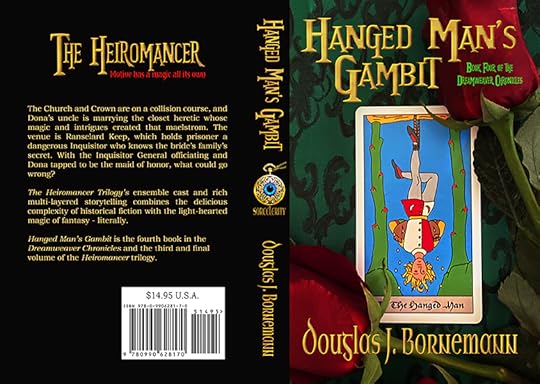
Today, fourteen years to the month after I first put pen to paper, I finally hit the publish button on Hanged Man’s Gambit, the third book of the Heiromancer Trilogy. I finished the trilogy’s first draft in 2011 and shortly thereafter began attending the Southern California Writers’ conference, where I embarked on a new journey – learning all I didn’t know about writing, editing, and publishing.
Long-time editor Jean Jenkins was a fixture at that event and one of its founding members. The conference, and Jean in particular, instilled in me an appreciation for the importance of editing and understanding publishing conventions. After soliciting sample edits for the first pages of Practical Phrendonics from a number of editors, I was convinced Jean was the right person for the job. During that edit, I wrote a prelude tale to the trilogy, The Demon of Histlewick Downs, and, on Jean’s advice, published that book first, which, in hindsight, was absolutely the right decision.
Jean didn’t just focus on the pages, though. Each editorial pass was calculated to help her clients grow as authors. Her deep editorial wisdom, conveyed through her comments on my pages, gave me both the wherewithal and confidence to switch careers – one in which I assist professors with honing their grant-writing efforts. Everything she taught about readability, pacing, unintentional repetition, active voice, common pitfalls, and clarity is every bit as important in technical writing as it was in fiction, and I’m honored to pass those lessons along.
Jean finished her edits for Hanged Man’s Gambit just a few short months ago. I was hoping to present her with a signed copy at the next in-person conference. Tragically, though, Jean passed away last Sunday, less than one week before publication. I’m proud of the work she helped me refine and of the writer she helped me become. I like to think she was, too.

Likes
(3)Dislikes(0)
September 26, 2020
About Amazon’s Star-Rating Algorithm for Books…
I recently paid for advertising to promote an Amazon free giveaway for The Demon of Histlewick Downs in anticipation of the upcoming release of Hanged Man’s Gambit. I’d hoped the promotion would not only raise awareness of the book, but also increase visibility on Amazon, perhaps even increasing the book’s rank there. So far the book has scored another 5-star review, and 2 more 4-star reviews, and Amazon’s ranking went from 3.9 to 4.0. All good right? Well, not exactly. Though the book has 14 five-star reviews and only 10 four-star reviews, the new ratings had the effect of reversing the lengths of those bars on Amazon’s Customer Reviews chart. It now appears as though Demon has received more four-star ratings than five-star, as shown below:
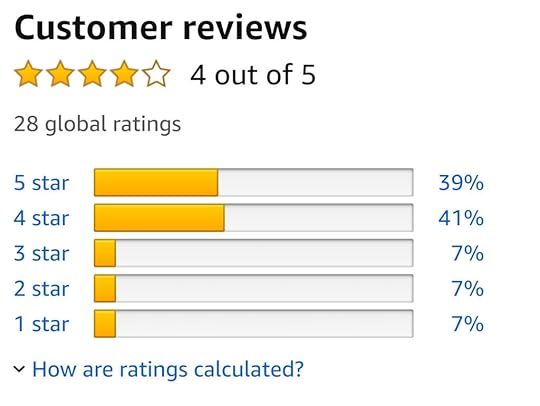
Amazon, you see, doesn’t rank the books according to the actual data they receive. Instead, they filter that data through their “algorithm.” Their use of the algorithm is reported, but buried on the site. It only shows up when one scrolls down several page’s worth of material if you click on the link that offers to tell you how ratings are calculated (see image above). Of course, most readers will assume, based on the accompanying chart, that they know how rankings are calculated, so they have very little incentive to click that link. If they did, this is what they’d see:
To calculate the overall star rating and percentage breakdown by star, we don’t use a simple average. Instead, our system considers things like how recent a review is and if the reviewer bought the item on Amazon. It also analyzes reviews to verify trustworthiness.
Most people would reasonably assume the cumulative ranking would be based on the number of stars customers gave divided by the total possible number of stars (x5). They also would assume that if a book gets more five-star rankings than four-star, the bar for the five-star ranking would be longer. Turns out, that’s not always the case.
Here’s a graph showing how the calculation would turn out for The Demon of Histlewick Downs using the raw data (uncorrupted by the algorithm).
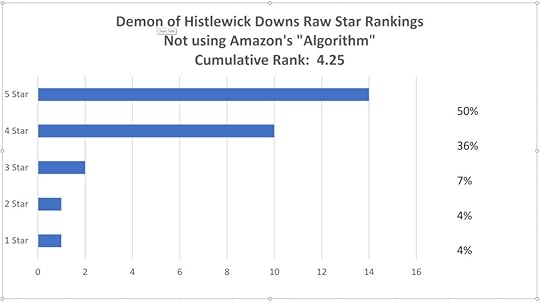
So, based on a total of 28 ratings, Amazon’s algorithm has decided that the book should rate a full quarter star lower than it rates based on the actual data. It discounts the number of five-star reviews by 11 percent, and it nearly doubled the impact accorded the single one-star review and the single two-star review the book has received. Thus, the algorithm makes those two naysayers twice as influential as any of the rest of the folks rating the book. And it does all that without telling readers how it arrives at that conclusion and without providing a comparison to the raw data. If, at some point, Amazon decides to eliminate the raw data, then regardless of how folks rank them, books will only be as good as Amazon says they are, and there would be no way to contest that determination. They’ve already recently started including “global ratings” that no longer identify who contributed the feedback, so there’s no ability to check how such folks rated other books. Do you really want an algorithm and nameless reviewers determining which books you read? Or would you rather base your decisions on the comments of real people who’ve actually read the book?
To determine whether Amazon applies the algorithm with an even hand, I checked out a book by Jeff Bezos’s ex-wife, MacKensie. Her book, The Testing of Luther Albright currently has a similar number of star ratings (32) to The Demon of Histlewick downs (28). How does this book fare with Amazon’s algorithm? Here’s what the Amazon Rankings for Luther Albright look like compared to its raw data:
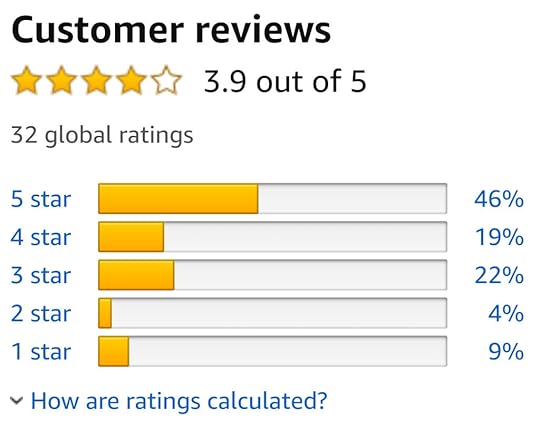
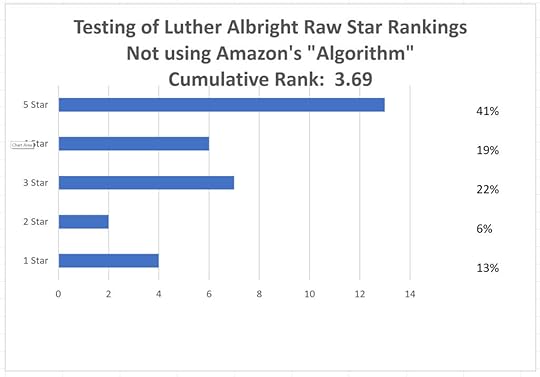
Lo and behold, Luther Albright’s cumulative rating isn’t cut by .25 stars. Rather, Amazon’s algorithm increases this book’s cumulative rating from 3.69 in the raw data to 3.9. To accomplish that feat, Amazon’s algorithm inflates the five-star ratings for MacKensie’s book from 41 percent to 46 percent, while the one-star reviews are decreased from 13 percent to 9 percent. From the raw data, Luther Albright had 6 rankings out of 32 (18.8%) that were under three stars, while The Demon of Histlewick Downs only had 2 such rankings out of 28 (7.1%). Yet, Amazon’s chart shows Luther Albright as totaling 13% for rankings below three, while Demon shows a whopping 14% (which is double the actual data). That means Albright’s 6 critical reviews are actually weighted less than Demon’s 2. What was it about those two reviews that made them so influential to Amazon’s algorithm? There’s no way to know. So, while the raw data suggests The Demon of Histlewick Downs cumulatively ranks a 4.25 compared to Luther Albright’s 3.26, Amazon’s algorithm has decided they’re pretty much the same at 4.0 and 3.9. Indeed, the star graphics for both are indistinguishable.
I might not object to Amazon providing a rating’s filter if they were to put the raw data in the same format side by side and were transparent about how they arrived at the ranking. Then informed readers would be able to compare and decide which ranking system they prefer. Unfortunately, that’s not what they do.
Buyer beware.
Likes
(0)Dislikes(0)
September 13, 2020
The Rescue (Reprise)
It’s been more than five years since a certain ginger tabby prowled permanently into our lives, and he’s still going strong. Sometimes it’s as important to celebrate the status quo as it is to invent something new. Thanks, Reshi, for all you continue to do for us.
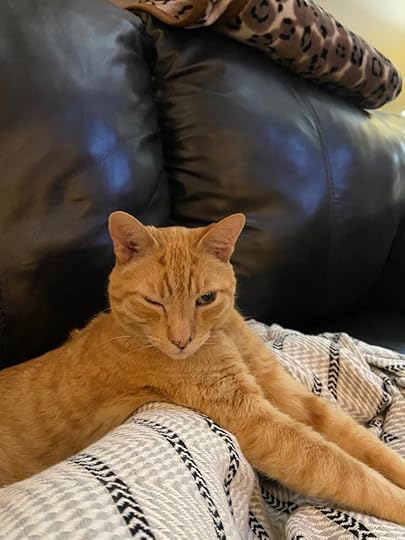 “Of course I solemnly swear not to hunt any more backyard bunnies if you open the door for me.”
The Rescue:
The very day after I e-published The Demon of Histlewick Downs (a tale of a young man’s quest to rescue his parents) in July of 2014, our much-loved 25-pound lynx point Nero passed. Within the month, my wife Genelle moved from California for a year to test drive a faculty position at the University of Kansas, while I stayed behind to ready the house for potential sale. Loss of my two constant companions was rough, but I kept busy–we’d been in the house for 13 years, with all the attendant deferred maintenance that implies.
When Genelle came to visit at Christmas, I happened across a small orange tabby sunning himself on a tin shed roof within arm’s length of our backyard wall. Thinking Genelle could use a cat fix, I invited him over. He was a slip of a thing, no more than ten pounds–but he seemed starved more for affection than for food. Still hurting from our loss, we were happy to oblige.
From that day, the Orange Cat was a regular visitor. He’d pound on the front door in the morning and I’d invite him in for a bowl of milk before work. He’d be back for more when I got home. On weekends, he’d often spend the whole day with me–sometimes binge-watching Netflix on my lap, other times directing the house repairs. Come evening I’d tell him he had to return to his family. If it was chilly, I’d get a disappointed hiss–it was the only time he wasn’t upbeat, curious, and well-behaved. He loved our bed’s white feather comforter, and anytime he wasn’t with me, I knew to find him there. I’d go move him, patiently explaining that outdoor “kittehs” (that’s catspeak) who roll in dirt were not permitted there. He’d rowr and move onto some other exploit (at least, until I wasn’t looking).
 The gift.
When it came time to sell the house, his routine was firmly in place, though there were occasional surprises. One morning he pounded on the door, mewling with particular excitement. On the way to the car, I learned why–he’d brought me a nice plump rat, which he’d displayed in the very center of the front courtyard. He beamed with pride as he posed near his prize. Presuming a “thank you” would suffice, I hopped in the car and headed to work. Of course, the rat would be gone by the time I returned at 6, right? Turns out I’d misunderstood. He was still waiting for me beside that rat when I returned 9 hours later–apparently, it wasn’t merely a trophy rat, it was an eating rat. When I demurred again, he shrugged, and ate it himself.
One day I came back from work to find him sitting squarely on the dining room table, posing smugly next to the flowers I set out for house-staging purposes. I still have no idea how he got in–whether I forgot to let him out, or if he darted in when the realtor showed the property. Whatever he did, it worked–the family shown the house that day bought it. I may never know whether he wooed them with his personal charm, or whether he simply bribed them all with rats.
 Showing the house.
By May 2015, we were caught up in the whirlwind that is packing for a cross-country move, and we still didn’t know to whom the Orange Kitteh belonged. By then, Genelle had discovered the reason he scratched so much–he was covered with fleas. It finally dawned on us that perhaps he was actually a stray. We bought a collar and put it on him with a note with our phone number and directions to call. Someone actually called that day and left a message–to the effect it wasn’t his cat. Odd, right? The next morning, our buddy returned with a brand new collar. We were disappointed, but resigned–clearly His Orangeness belonged to someone after all–though we still had no idea who. We braced ourselves for farewell.
Two days before the move, we were out in front packing up when a lady walked by, her two leashed puppies in tow. She spied our little buddy and called out to him. “Linus, want to go for a walk?”
“So,” I said. “This is your cat!”
“No, she said, “It’s not my cat.”
“Well, then, whose is he?”
Turns out, she had replaced his collar. She hadn’t known who we were, but had wanted us to know someone was looking out for him. Linus had once belonged to this lady’s neighbors, but when they got dogs, they and Linus didn’t get along, and Linus was turned out. Now on his own, he set about wandering the neighborhood, making a broad network of friends who provided food, temporary lodging, and occasional de-worming tablets. His new friends helped out when they could, but were unable to adopt him because they already had multiple pets of their own.
“Would anyone mind if we were to take him with us?”
“He’s been on his own for seven years–we’ll be sad, but he needs a forever home.”
With only one day to spare, Genelle dropped what she was doing and hauled him to the vet. After seven years homeless, the fleas were his only health issue. We adopted him on the spot, and rechristened him “Reshi.”
On moving day, folks from the neighborhood dropped by–some we’d never met–to say their fond farewells. More showed for Reshi than for us.
Yes, he is all that. And if he hadn’t taken that time to win our hearts, we might never have realized just how much we needed rescuing.
 Moving Day.
Likes
(0)Dislikes(0)
August 16, 2020
Story Tools: The Perks of Adversarial Dialogue

HENRY: The day those stout hearts band together is the day that pigs get wings.
ELEANOR: There’ll be pork in the treetops come the morning. Don’t you see: you’ve given them common cause: new sons. You leave the country and you’ve lost it.
The Lion in Winter, for which Katherine Hepburn won the 1968 Academy Award for best actress, served up intensely dramatic performances from both Hepburn and Peter O’Toole despite the fact that, during the entire show, absolutely nothing happened. The characters were cooped up in Chinon castle for Christmas Court. No one died, nothing was destroyed, nothing was created, and no one was even injured. Somehow, screenwriter James Goldman crafted a hugely successful dramatic work from a puff of pure intrigue. How could such an artificial literary construct sustain itself without some form of external action?
As I see it, Goldman, recognized the dramatic potential inherent in adversarial dialogue. Often, literary works focus on the opportunity to deliver character’s internal musings as a mechanism for keeping the reader apprised of needs, wants, and future intentions, and books are a medium uniquely suited to that approach. Once the reader and character bond, those internal descriptions can highlight the character’s priorities and generate empathy instrumental for holding the reader’s interest. Such internal dialogue is therefore a versatile tool in an author’s literary arsenal. However, it can suffer from the same limitations as other info-dump approaches – since internal dialogue is not inherently dramatic, the scene’s drama depends instead on external action.
Adversarial dialogue provides an additional tool for providing dramatic tension on those occasions when external conflicts wouldn’t advance the plot. It also provides ample opportunities to layer in subtlety. As readers, when we’re given a character’s internal thoughts, unless the narrator is unreliable, we tend to accept those musings as fact. Real life, however, tends to be more nuanced – people often significantly oversimplify their perspectives in ways that best suit their needs and biases and cast them in the most sympathetic light. Adversarial dialogue can therefore be a fantastic way to highlight a situation’s complexities in ways that would be difficult using internal dialogue alone. The aspects of a situation that a character denies (even subconsciously) can be every bit as defining as those accepted – and adversarial dialogue is a great way to draw those out.
Our culture has long appreciated the advantages of an adversarial approach for arriving at truth – indeed, that principle undergirds our entire justice system. The O.J. Simpson case exemplifies the adversarial process’s dramatic potential. That case – in essence an argument between the prosecution and a famous sports personality to convince an impartial observer to accept their version of the facts – riveted the entire country for months.
In the context of a novel, adversarial dialog can be used to wring drama out of almost any situation that has consequences based on a character’s decision, whether it is multiple characters arguing to convince an impartial observer or simply two characters arguing to determine a joint course of action. In both the O.J. case and the Lion in Winter excerpt above, the drama arises from the reader’s appreciation of the decision’s consequences – the tighter the connection between reader and character and the more severe the consequences, the greater the dramatic potential.
Of course, works that rely significantly on the use of adversarial dialogue also require more engagement from the reader. As with the O.J. case, readers will have to consider the evidence presented by various sides and use their judgment to determine whose worldview is more accurate. As a result, they will be less able to rely on spoon-fed incontrovertible truth delivered through internal dialogue. Such works tend not to be easy beach reads, and they won’t appeal to everyone. But if you crave complex nuanced situations and increased depth of character, you might find works that make ample use of adversarial dialogue, such as the Heiromancer Trilogy, worth the extra effort.
Likes
(1)Dislikes(0)
July 26, 2020
The Proof is Out There
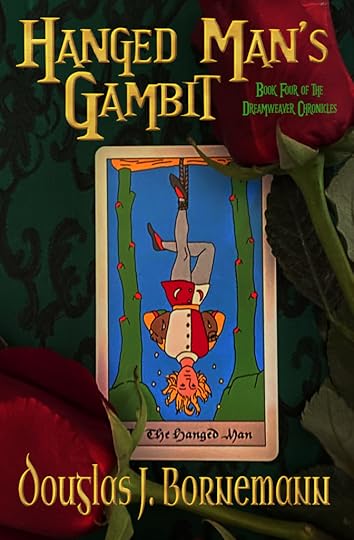
It’s been exactly a year and a day since the Raven-hosted release of A House of Cards, and what a year it’s been. If ever you ask for things to go viral, remember – it’s important to be specific. Despite a pandemic of distractions, I’ve finally cobbled together Hanged Man’s Gambit, the third and final installment of the Heiromancer Trilogy. A proof copy has been ordered and is on its way. Once it achieves final-pass editorial muster, it will be time to send out advance-reader copies for feedback. And then, the launch! I’m not sure yet what that means in the time of COVID-19, but the show must go on. Sorry to keep you hanging, but in the meantime, I thought I’d whet your appetite with a cover reveal (properly socially distanced, of course). Stay safe out there.
November 6, 2019
The “Ninth House” Scoop
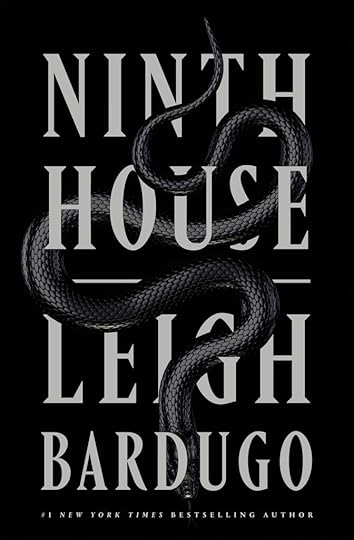
We found it at the Raven Book Store–a new release with a slick minimalist cover in shades of black and silver – a serpent insinuated among the letters of the title and the author’s name. It’s arrival was auspicious, having a release date on Genelle’s birthday. Those aspects alone would have merited a look, but the jacket copy revealed the protagonist was a Yale college student tasked with policing the occult dabblings of the institutions secret societies.
Finally – a tale situated soundly in the same subgenre as The Heiromancer.
The protagonist is a scrappy college student determined to do what’s she believes is right in the context of secret societies who’ve grown powerful from exploiting secret occult knowledge. Her father disappeared when she was young under mysterious circumstances, which was not without consequences for her childhood. At the University, she teams with an ardent young man who is himself no stranger to the occult, and together they work to solve the mysteries surrounding a number of anomalous occurrences, despite the fact that there are powerful forces who might prefer those stones left unturned.
Sound intriguing? I thought so – which is why I wrote the Heiromancer. If you think so too, give it a shot. Or, you could instead read Ninth House, by Leigh Bardugo – to which this same blurb applies equally well. Or read both and see how they compare.
Are they the same story? No. Heiromancer is a complex trilogy set in a pseudo Victorian setting while Ninth House has a simpler (by by no means simple) plot set at modern-day Yale. But a number of structural similarities are undeniable. If you like one, there’s a good chance you’ll like the other.
I have long wondered whether the specific plot elements I devised in The Heiromancer were market-worthy. The reviews for Ninth House strongly suggests they are. On the brighter side, its popularity provides a well-recognized book in a similar subgenre that I can use for comparison when pitching my own books, but for all that, a part of me can’t help feeling that, despite having published first, I’ve been scooped.
Leigh profusely thanks New Leaf Literary for all their help. I, too, queried New Leaf with Practical Phrendonics back in 2013. Ah, what might have been, if only they’d been interested back then. As Uncle Rayen sagely states in Practical Phrendonics, “far more turns on the ‘chance meeting’ or ‘accident of birth’ than on all the best-laid plans ever devised.”
July 27, 2019
Liftoff
A House of Cards got off to a great start last Thursday at a book launch hosted by The Raven Book Store here in Lawrence, Kansas. The inimitable Mary Vensel White provided an extraordinary introduction that reminded me once again of her incredible facility with words, and Genelle was on hand to serve up her incomparable homemade buttercream-frosted minicupcakes and lemonade. Genelle and I opted to appear in attire appropriate to the Heiromancer Trilogy’s pseudo-Victorian setting to lend a bit of additional ambiance. It was a magical evening of great friends and “oh so refined” celebration.
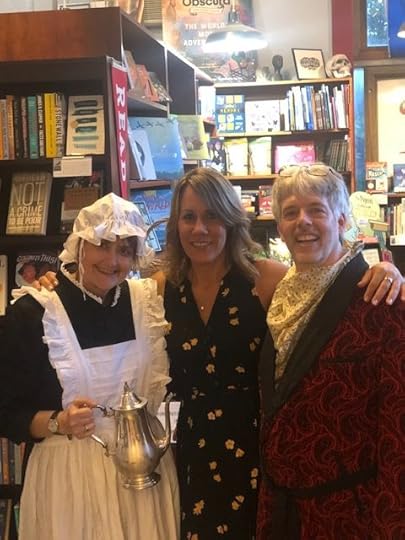 Genelle, Mary Vensel White, and me