Michelle Rene's Blog, page 2
March 19, 2017
Something Funny For Plotters
Here's a little something I came up with for the story plotters out there...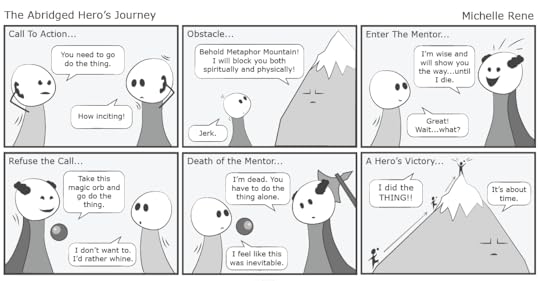


November 28, 2016
Representation Mentors Young Creatives
 Hello and welcome back to my Creative Advocacy Blog.I'll start this by telling a story from my childhood. When I was young, adults asked me the same question they asked every child. "What do you want to be when you grow up?" Most didn't care about the carefully constructed answer I prepared. They just wanted to pat my head and smile at my lovely, innocent remarks.One day, my father's mother asked me what I wanted to be, and I gave her the same answer I'd given everyone. "I want to be a writer and an artist when I grow up." The thing was she didn't pat my head, and she didn't smile. My grandmother looked down at me and scowled."You're just gonna starve," she said. "Better think of something else.""But people like Picasso and Hemingway. They didn't starve," I tried to argue."Yeah, and they're men. Look at your school books. Do you see any women? No. That's because women can't be famous artists."For years I told this story, using it as a tale of backwards thinking in rural West Texas. It wasn't until I got older that I realized she was absolutely right. If you went through my school books, you didn't see women in the pages. You didn't see many people of color either. Sure, there were a handful here and there, but not much. The same went for video games, film, and television. Where was my representation?My grandmother didn't have more than an elementary school education, but what she said was spot on as far as she knew. What right had I to think I could do more where so few women had made it? Why dare to try if it was such a long shot?Well, the answer is I'm stubborn as hell, and my mother said I could. I didn't care if it was a long shot; I was going to try. While I'm far from famous, I'm out there in the world, proving my grandmother wrong. But what about all those little girls who were told they couldn't? What about the children of different races, creeds, religions who never saw a version of themselves in the role they wanted? The ones who weren't a bull-headed girl that took every rejection as a challenge.It's hard to aspire to something that the world says is not for you. And when you try for it anyway, it doesn't always want you there. I've worked in male dominated fields, and every time it was a struggle to find footing. If you aren't in the boy's club, it's tough to find your place. Once you do, the slightest misstep can knock you back out in a hurry.The saddest part is that most don't even bother trying to get in, to break that barrier, because they can't see themselves there at all. What's the point? It's not for them.This is why representation is so important. It is why bull headed people like myself have to keep trying, keep putting themselves out there for young kids to see. We need to uncover the parts the history books left out because they did leave it out. There was representation. It got buried.Most could say women and people of color didn't do important things because they were repressed. They didn't have the opportunity. That is true to an extent, but it doesn't explain the amazing people who did. Jane Austen, Frida Kahlo, Emily Dickinson, Berthe Morisot, Mary Cassatt, Elizabeth Le Brun, Harriet Tubman, Nina Simone, Mary Wollstonecraft, Harriet Beecher Stowe, and Margaret Hamilton to name a few. I didn't know much about a lot of these ladies until I hit college.Mentors are needed. Mentors are wanted. Often times, the only mentors a child gets are the ones they see on TV, and if you can't see yourself in the faces on the screen, who is there to encourage you to try? I had my mother, but what if I didn't? What if I wasn't stubborn? What if I believed all the people who told me no? What if......?I am cheered to see media beginning to change this. I love to see people digging for the history we don't see. The history we should see. Take the movie coming out soon, Hidden Figures. This is the true story about African American women who served as the brains behind the mission to launch John Glenn into orbit. I consider myself a bit of a history buff and an admirer of space travel. Until I saw this trailer, I had never heard of these women. Never. No one I knew had either. How did this happen? Think of the struggle these women had to go through to work for NASA back then. How is this not taught in school?Hidden Figures Official SiteThink of how many kids out there might have pursued their love of math and science had they had someone like those women to look up to. How many little girls might have tried to be artists if they saw who Frida Kahlo was? How many might try their hand at writing science fiction after reading Mary Shelley?Our children need to see they can do anything no matter what they look like. They need representation. They need mentors. Barring all that, they need to hear these words from my mentor..."I used to think I was the strangest person in the world but then I thought there are so many people in the world, there must be someone just like me who feels bizarre and flawed in the same ways I do. I would imagine her, and imagine that she must be out there thinking of me too. Well, I hope that if you are out there and read this and know that, yes, it's true I'm here, and I'm just as strange as you." -Frida Kahlo
November 10, 2016
Honey vs Vinegar
 Hello once again to the creative advocacy blog. Today I would like to discuss the use of positive reinforcement as opposed to negative critique.As I have stated before, I'm a writer and an artist. I graduated from the Ringling College of Art and Design, and I've worked in a number of art related fields throughout my career. From the beginning, it was nailed into my head that to do this thing called art, I had to get used to critique. Putting your work up on the wall and having people tear it apart was part of the process. It helped you learn, and it got you ready for the real world. I can say with all honesty, it did the latter but not necessarily the former.Here's what it took me decades to understand: There is critique that builds you up and there is critique that breaks you down.When you pour you time and soul into a project, the act of pinning it up on wall or showing it to someone else takes a lot of courage. Once up there, it is open to attack. If it is torn apart, the temporal lobe of your brain that controls a lot of your emotions, creativity, and memories shuts down. If this feels threatened, either physically or verbally, it will go into safety mode. In other words, fight or flight. You know what happens after that? To say the least, your mind doesn't want to be creative.What's the alternative? How can you get better without someone teaching you what you did wrong? By having someone teach you what you did right.In college, I grew the most as an artist from the instructors who did three things: treated me with respect, expected great things from me, and taught me what about my work was really good and how to grow that. I learned more from my drawing teacher at school, Mr. Osborne, than just about anyone else while I was there. He was quiet and sweet. Never said a harsh word. He expected great things from me, and found something beautiful in every project I turned in. "This part here is just lovely, Michelle. I'd love to see more like that."Guess what that made me do. I worked my butt off to impress him. Suddenly, I was capable of things I never dreamed of because he told me I could.This idea doesn't just apply to school. I've worked under a lot of art directors. Some good, some bad. The ones who criticized everything I did, the ones where nothing was ever good enough, got only what I thought was safe to try. If you can't seem to please someone, you stop trying to innovate because they continually shut you down. However, I did my best work for those who told me I could. Those bosses who gave me some room and told me, "You are talented. Show me what you can do. I know you got this."We have created a culture of harsh critiques, of tearing something apart for it's flaws. If an instructor does this, it influences the students to do it as well. That goes out into world, and the cycle continues. This goes for most creative fields. Writing, Music, Art, it's all the same in this regard. It ensures only the hardened pitbulls survive. I am one of those. I got knocked down so many times, I should be a boxer. But I survived, and I'm telling you there is a better way."You just can't take criticism."I hate this line. It insinuates every opinion is correct, and if you don't take their advice, you are delusional. Not every bit of feedback is valid. Not every bit worth listening to. Not every bit comes from a good place. I will go into more detail in a later post about how to take feedback and tell what is worth using and what isn't.The bottom line is this. We need to view a person brave enough to show their work to world with respect. It may be horrible work, but it took them a ton of courage to show it to anyone. Find the beauty in it. Find what works. Tell them how much you like what works. You want to see more of that. Believe it or not, the other stuff, the bad stuff, will fall away over time. Building up the beauty teaches them to build on their strengths and let go of the weaknesses.I am not alone in this thinking. Over the years, I started noticing this phenomenon in my own work. It was only after I started working with my current agent that I found it had a name in the writing world. A lovely woman named Suzanne Kingsbury gave it a name. It's called the Gateless Method. To learn more about this method, her website is here...http://suzannekingsbury.net/for-writers-only/gateless-writing/In the end, the vinegar will harden you. It will prepare you to be knocked down and get back up. You will be able to adapt and push on. But the honey? Oh, the honey will expand your mind and allow you be more than you ever thought you could possibly be. The honey will set you free.
Creative Advocacy: Honey vs Vinegar
Hello once again to the creative advocacy blog. Today I would like to discuss the use of positive reinforcement as opposed to negative critique.As I have stated before, I'm a writer and an artist. I graduated from the Ringling College of Art and Design, and I've worked in a number of art related fields throughout my career. From the beginning, it was nailed into my head that to do this thing called art, I had to get used to critique. Putting your work up on the wall and having people tear it apart was part of the process. It helped you learn, and it got you ready for the real world. I can say with all honesty, it did the latter but not necessarily the former.Here's what it took me decades to understand: There is critique that builds you up and there is critique that breaks you down.When you pour you time and soul into a project, the act of pinning it up on wall or showing it to someone else takes a lot of courage. Once up there, it is open to attack. If it is torn apart, the temporal lobe of your brain that controls a lot of your emotions, creativity, and memories shuts down. If this feels threatened, either physically or verbally, it will go into safety mode. In other words, fight or flight. You know what happens after that? To say the least, your mind doesn't want to be creative.What's the alternative? How can you get better without someone teaching you what you did wrong? By having someone teach you what you did right.In college, I grew the most as an artist from the instructors who did three things: treated me with respect, expected great things from me, and taught me what about my work was really good and how to grow that. I learned more from my drawing teacher at school, Mr. Osborne, than just about anyone else while I was there. He was quiet and sweet. Never said a harsh word. He expected great things from me, and found something beautiful in every project I turned in. "This part here is just lovely, Michelle. I'd love to see more like that."Guess what that made me do. I worked my butt off to impress him. Suddenly, I was capable of things I never dreamed of because he told me I could.This idea doesn't just apply to school. I've worked under a lot of art directors. Some good, some bad. The ones who criticized everything I did, the ones where nothing was ever good enough, got only what I thought was safe to try. If you can't seem to please someone, you stop trying to innovate because they continually shut you down. However, I did my best work for those who told me I could. Those bosses who gave me some room and told me, "You are talented. Show me what you can do. I know you got this."We have created a culture of harsh critiques, of tearing something apart for it's flaws. If an instructor does this, it influences the students to do it as well. That goes out into world, and the cycle continues. This goes for most creative fields. Writing, Music, Art, it's all the same in this regard. It ensures only the hardened pitbulls survive. I am one of those. I got knocked down so many times, I should be a boxer. But I survived, and I'm telling you there is a better way."You just can't take criticism."I hate this line. It insinuates every opinion is correct, and if you don't take their advice, you are delusional. Not every bit of feedback is valid. Not every bit worth listening to. Not every bit comes from a good place. I will go into more detail in a later post about how to take feedback and tell what is worth using and what isn't.The bottom line is this. We need to view a person brave enough to show their work to world with respect. It may be horrible work, but it took them a ton of courage to show it to anyone. Find the beauty in it. Find what works. Tell them how much you like what works. You want to see more of that. Believe it or not, the other stuff, the bad stuff, will fall away over time. Building up the beauty teaches them to build on their strengths and let go of the weaknesses.I am not alone in this thinking. Over the years, I started noticing this phenomenon in my own work. It was only after I started working with my current agent that I found it had a name in the writing world. A lovely woman named Suzanne Kingsbury gave it a name. It's called the Gateless Method. To learn more about this method, her website is here...http://suzannekingsbury.net/for-writers-only/gateless-writing/In the end, the vinegar will harden you. It will prepare you to be knocked down and get back up. You will be able to adapt and push on. But the honey? Oh, the honey will expand your mind and allow you be more than you ever thought you could possibly be. The honey will set you free.
September 26, 2016
Creative Advocacy
 Hello and welcome to my blog about Creative Advocacy.To begin, I'd like to take a moment to clarify something. Although I am a writer and an artist, when I discuss creative advocacy, it is in reference to all forms of creativity. Whether it be music, dance, game design, etc, being an advocate for the arts is the same. The reason I say it is all the same is because it is all about the same thing...story.This may seem obvious when discussing writing as we writers deal in story, but I think it applies to all forms of expression.What is a song if not a story put to music? Dance is telling tales and emotions through movement. You paint a portrait, you tell a story about that person in that moment of their life. What about when you're on a large video game/film team, and your piece is just one of millions of pieces to make something bigger? It's part of the bigger story, and it's important.Why is this important? Why advocate for creativity?Unfortunately, the world we live in doesn't always understand how much it needs storytellers. I've worked in a lots of different creative fields and the same problems arise. We creatives love what we do, and thus, many people think we should do it for free. We aren't always seen as valid professionals like say a banker or a plumber would be. Some of us are laughed at by family members or told to "get a real job".The world doesn't always value us. Most people wouldn't think much about spending five dollars on a latte, but ask them to spend less than that on a book or a song? That's a different story. We don't always value ourselves as a result.Without us there would be no books, no games, no television shows, no films, no art, no music, no theater. These are billion dollar industries. If we didn't tell our stories, the human experience would never be recorded or shared or empathized. We creatives capture the intangible parts of life and share it with the world so we might feel connected in some way. Creatives are needed.We are important, and we are afraid to say we are. We are afraid the world will call us frauds and devalue what we pour our souls into. A lot of times, it does just that.This is why we need advocates. It shouldn't just be the tough, stubborn voices that get heard. Those who have lived the life long enough to have a thicker skin than the rest. It should be everyone cheering each other on and inspiring others. Go to that bar where your friend's band is playing. Go to your friend's art opening. Encourage your nephew to keep drawing his comic book. Show up at the niece's musical even if the other kids sing off key. You can be an advocate without breaking the bank. Sometimes, it's just a kind word.Putting yourself out there is so difficult. Placing work you made is soul wrenching and hard, but it's also so important. We need it just as much as we need anything else in life.I'll quote Kevin Smith because he said it better than I can. "It costs you nothing to encourage an artist, and the potential benefits are staggering."