
Garette Johnson's Blog, page 5
August 23, 2018
Alternative Futures, Trends and Accumulating “Shit vs. Stuff”
We’re living in a modern age of physical and mental overload. The words “too much” and “not enough” come to mind. Simultaneous trends of maximalism and minimalism permeate our culture. As an attendee this past July at ESP Trendlab’s “Alternative Futures” Whitespace 2018 conference, I came away with powerful insights on trends impacting categorical direction. Buzz terms from “Shit/Stuff,” “Stuffocation,” “Affuenza” and “Liquid Identity” were my top takeaways of the day. Upon further speculation of these themes, I’d like to unpack thoughts on what, why, and how toward the future concerning consumerism, culture and sustainability.
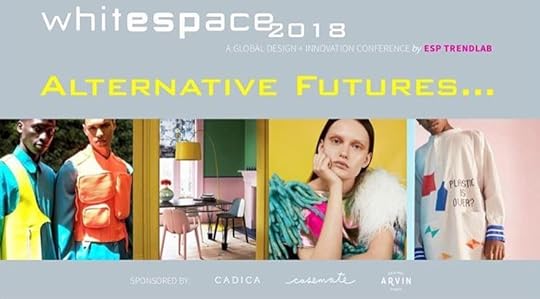
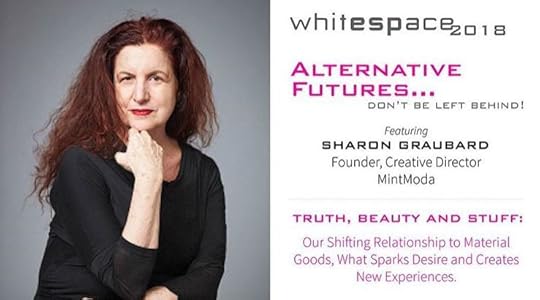
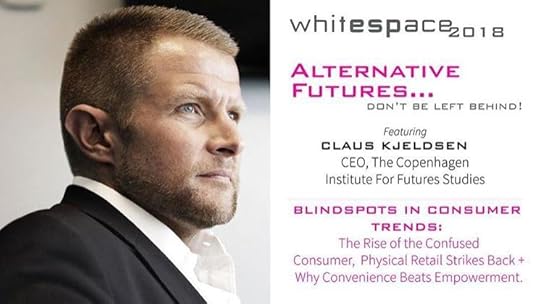
Conscious societies and mindful mavericks are asking questions about sustainability, consumption, health and well-being. These questions are hard to answer. Simplifying complexity does point us in the right direction. Christine Foden of D.Cipher FM and Sharon Graubard of Mint Moda distilled these complex trends into color and seasonal themes. Claus Kjeldsen CEO of Copenhagen Institute for Future Studies delivered insights into the liquid identity of the confused consumer in order to brand seamless and convenient choices.

Too Much Shit
Certainly, the constant pursuit of stuff has become as distracting as pop-up notifications, email alerts, flash sales and coupons via GPS. The desire of things throws people into a cycle of lack and acquisition, the frequency of which can become addicting and cause fatigue. Triggered by fear of missing out (FOMO), we become distracted from what we have, the moment we are in, ourselves and connection with others.

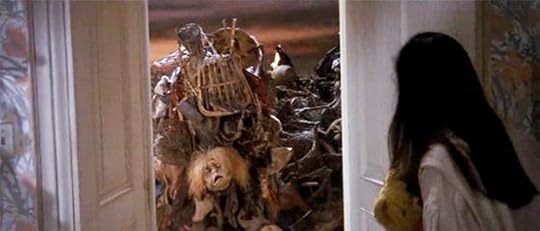
As a quintessential child of the 80’s, I am acutely aware of the sentiment we attach to things. We tend to keep sentimental but useless objects because they trigger memories. If we get rid of the object, does it diminish the memory? Keeping the object around would surely activate more experiences of the memory. Could keeping the thing diminish the present or future? Possibly. Foden talked about the trend of “Shit/Stuff,” citing how individuals are hanging on to the disposable components of packaging along with the unboxed object. Her analysis reminded me of the scene in the “Labyrinth” when Sarah encounters “The Junk Lady,” a hoarder who is buried under her things, and never leaves the perimeter of her possessions. Junk Lady temporarily convinces Sarah to stay with her childhood treasures, distracting Sarah from her quest toward what is truly important, getting her brother back. Likewise, things can derail us from our purpose, mission and personal journey. The comfort of things can empty the soul and inhibit personal growth.
Objects as Identity, Art and Meaning
Sure, stuff can be “Stuffocating” as Graubard quipped. She also shared a philosophy of her own, “Style is self, made visible.” We kind of are our stuff!
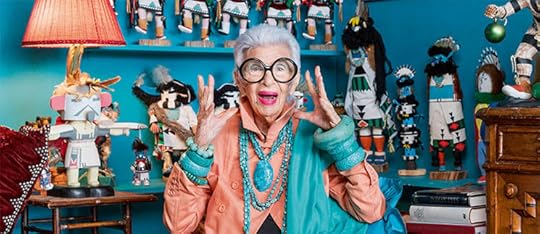
19th Century American philosopher and psychologist William James’s theory of self explains that our possessions become extensions of the self and they signal to others who we are, who we want to be, and where we belong. “A man is the sum total of all he can call his”- William James
John Lobell, Architect and Author of “Visionary Creativity: How New Worlds are Born” illustrates how this fact continues to add context into the digital age. “We are more than our bodies, minds and souls. We are also our memories, roles, relationships, friends, papers, photos, etc. Our identities began migrating outside of our skins as soon as we started making art…”
If making art is self-expression, so too can curating or collecting objects. Objects can also enrich our relationships and understanding of one another. If “style is the self-made visible,” than style is how we find our tribe. The ritual of gift giving grows relationships by recognizing our self in others and honoring another’s style with the gift of a selected or created object. Meaningful materialism, as Graubard, described means curating objects of significance. Sentimentality, aesthetic, function and style are all values for the collector to decipher. Can there be a fine line between hoarding and collecting?
Dis-ease of Stuffocation and Affluenza
Now that we have arrived at a crossroad with our unfulfilled “Self” and culture of enlightened responsibility, we have some problems that need solving. Anxiety and depression are at an all-time high in American culture and are linked to behaviors of hoarding and overeating. Suffice it to say, we are a binge and purge society. Trends in wellness are signals that people are looking for sustainable change. The emptiness we feel, and the cultural dis-ease Graubard identified as “Stuffocation” suggests that “Affluenza” is an illness caused by knowing many identities but finding little meaning.

Perhaps the afflictions Graubard described, has something to do with Claus Kjeldsen’s idea of “Liquid Identity” and the speed at which we are accelerating in the experience of our lives. Identity has become fluid from the physical, material, spiritual, on into the digital. New products are emerging every day with new technologies. Our lives are in constant flux as we grasp new concepts and change our minds and identities to keep up with the modern pace. Is it possible to become lost in the constant availability of becoming something new?
Future of Meaningful Materials & Human History
Some say the essence of a person lives on in what once was made or owned. Long after we’re gone, our things become our legacy. This may be especially true now that legislation has ruled that you can inherit a Facebook account. Implications of inheriting social media profiles the same as letters, books and diaries are interesting. Our memories and identities have become objects!
I quoted author and architect, John Lobell earlier and would add another quote from the same page, “The significance of Facebook is that of facilitating our migration from inside our skins out to the digital cloud, thus destroying the individual psychological Self.”
The extended self, our memories, and our connection to others are becoming objects to be referenced, curated or collected. Why are we so adamant about holding onto things, especially things that represent identities that are technically, gone? Because it is our history and we are figuring out who we are in all this Virtual Reality. The existentialist and poet, William Blake said, “You never know what is enough, until you know what is more than enough,” and “The Road of excess leads to the palace of wisdom.”
People have accumulated a lot of “shit/stuff” in the process of enlightenment. In all this liquid shifting of identity and stuff, we are now asking…What is it we truly need to have and to hold?
Mindful Consumption
As Claus Kjeldsen demonstrated, the consumer wants to do good and live a “Better Me” lifestyle but unhealthy and confusing options are conveniently everywhere. Kjeldsen points out that convenience tends to win over freedom of choice. Brands that meet the customer where they are and earn trust by making “Better Me” and “Doing Good” convenient will earn loyalty and market share.
What are we obliged to borrow? The rise of sharing economy and rental luxury enables consumers to enjoy experiences without being weighed down by accumulating objects. Having access over ownership can help people be more selective by prioritizing rather than accumulating.
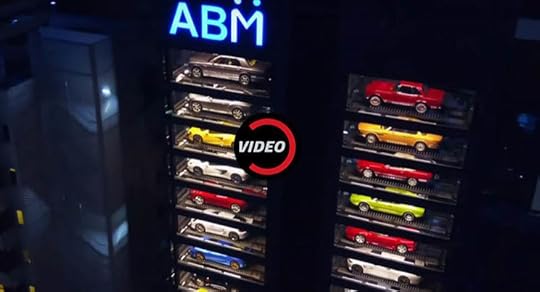
Some say the sharing/rental economy is the result of underemployment, high debt among millennials and escalating healthcare costs. Could sharing and rental lead to a future with little stability where individuals sacrifice the investment benefits of ownership for lower cost instant gratification?
Subscription services to basics commodities not only saves time and money but can keep consumers in line with their goals by eliminating the temptation of choosing unhealthy options in the first place. However, subscription commodities often arrive with excess packaging and are highly disposable and often, non-biodegradable. We are throwing away temporary objects that last a long time. Are we responsible for the things we throw away? What are the options if manufactures control the products?
Future of Mindful Manufacturing
What we throw away, also defines us.
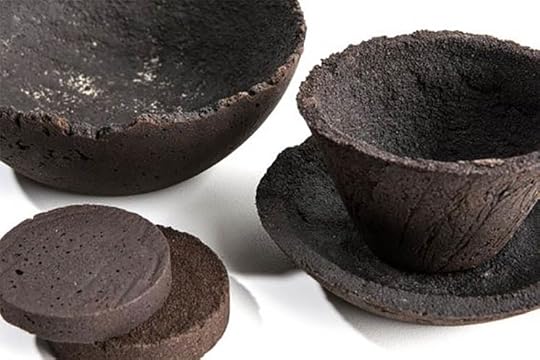
Science is informing product and package design with purpose and the “Better Me” consumer in mind. Bio-manufacturers are growing new materials with bacteria, algae and fungus in effort to make sustainable solutions for consumer products. Additionally, “Synthetic Naturalists” are harvesting waste and pollution to process into new materials. Graubard noted that technology becomes craft when surfaces gain tactile and aesthetic interest though innovation. Waste as a natural resource could close the loop and create meaningful objects from garbage.
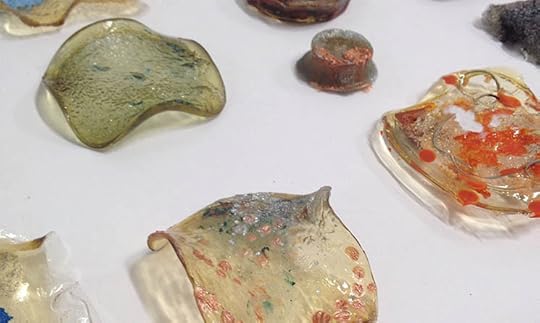
Is it possible that technology will ultimately stabilize and balance the “Shit/Suff” of our lives, open space and create meaning where we once were distracted, confused and sick? Sustainability not only means closing the loop of product and waste but financial stability as well. Look around, all that clutter used to be money.
“Have you noticed that other people’s stuff is shit and your shit is stuff?!”- George Carlin
For further exploration of “Shit” vs. “Stuff,” check out this poignant observation from the social scientist and sage of sarcasm, George Carlin.
The post Alternative Futures, Trends and Accumulating “Shit vs. Stuff” appeared first on Garrott Designs.


March 20, 2018
Moleskine Messages- Original Art by Mail
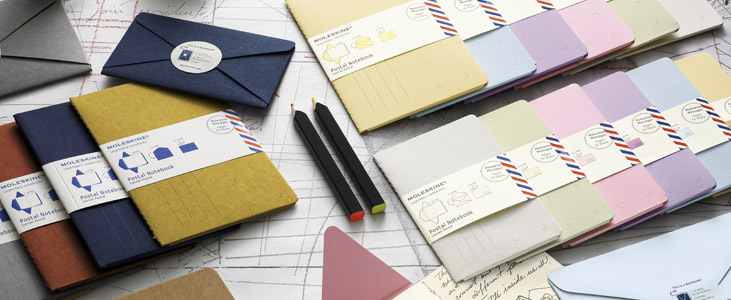
Moleskine Postal Notebook
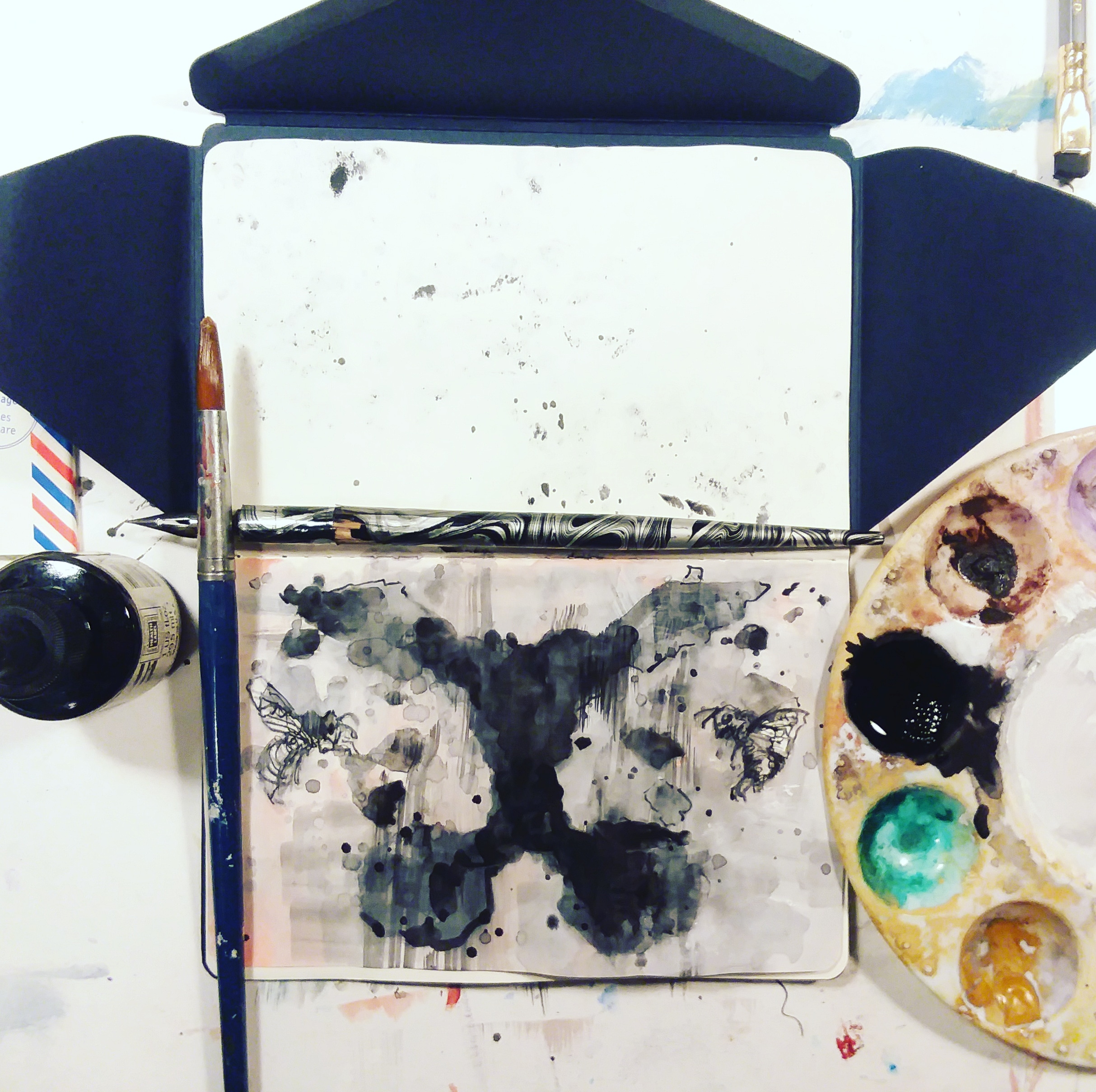
I recently got hold of these brilliant Moleskine Postal Notebooks samples from Moleskine and was thrilled with the possibilities. I could start a doodle conversation by mail with my nieces. I could fill the thing with original art and mail a surprise to a sketchy friend in Europe. Gifting a sketch among artists is one of the highest ways to appreciate one another and these little self sending notebooks are perfect for reconnecting. Sending something in the mail is such a romantic gesture these days. To stop, take time to write a note or doodle, fold it up in an envelope, mail it off and wait days for an unsuspecting recipient to respond. That’s how we REALLY say, “I was just thinking about you!”
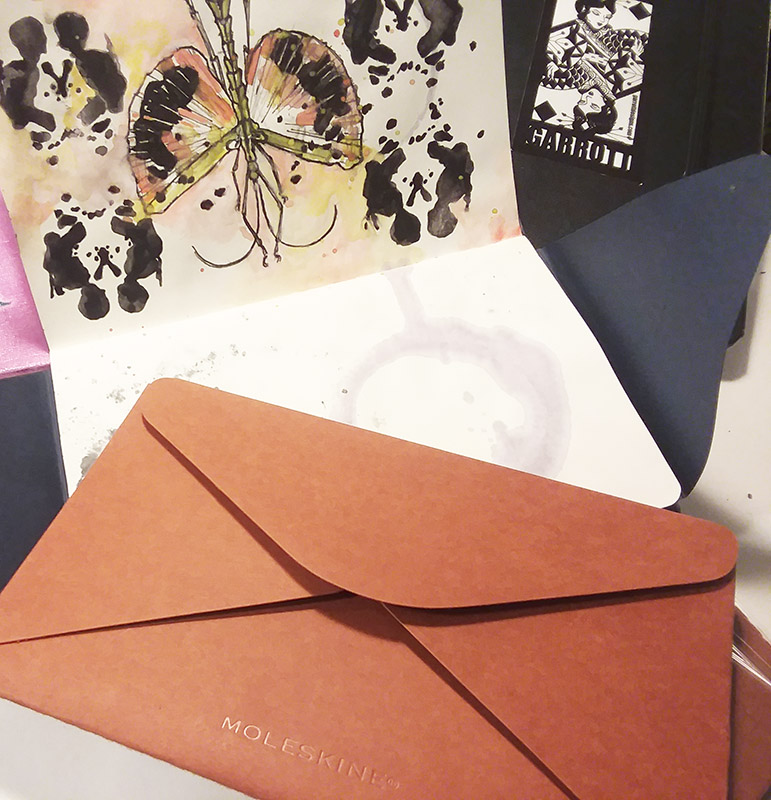
Original Art – Snail Mail
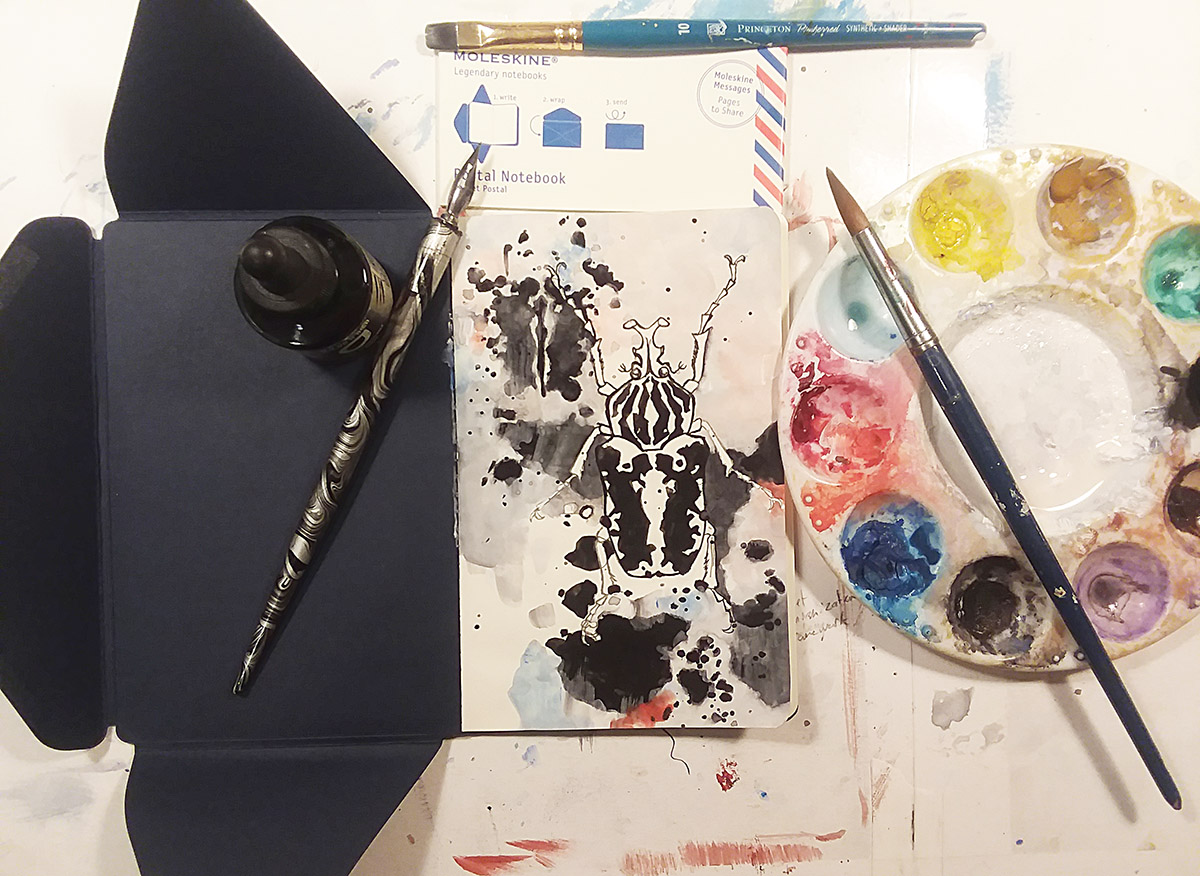
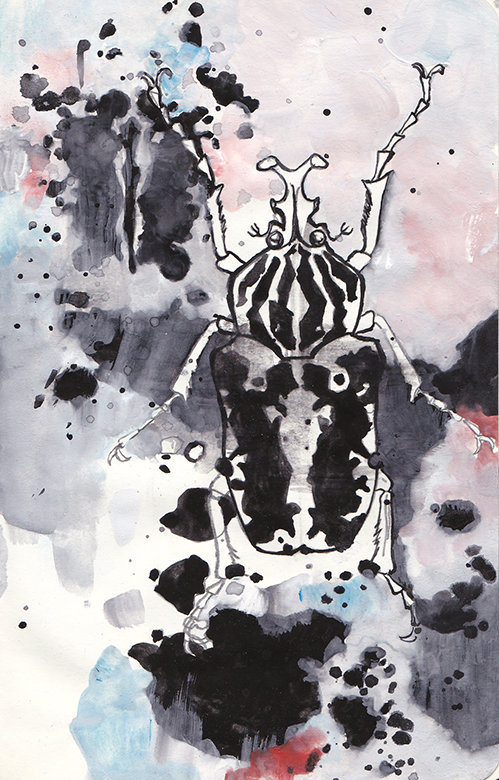
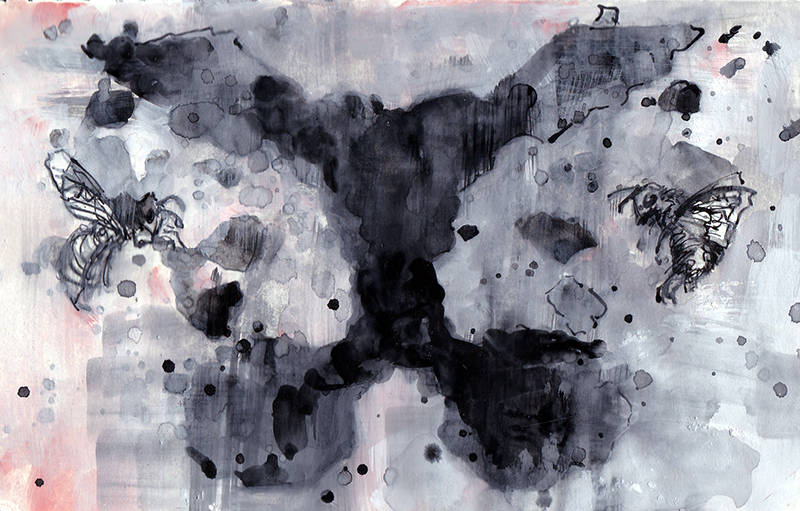
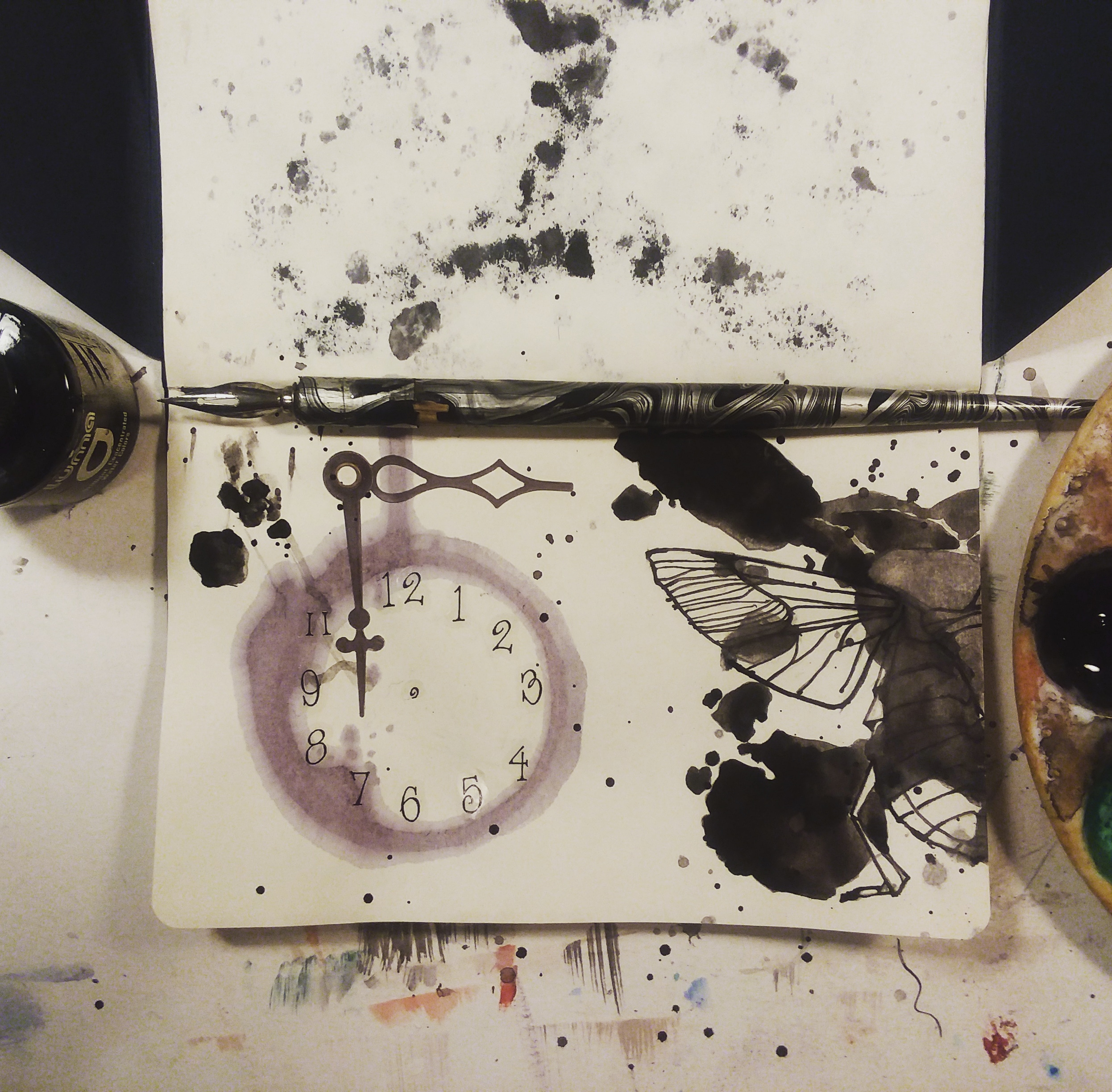
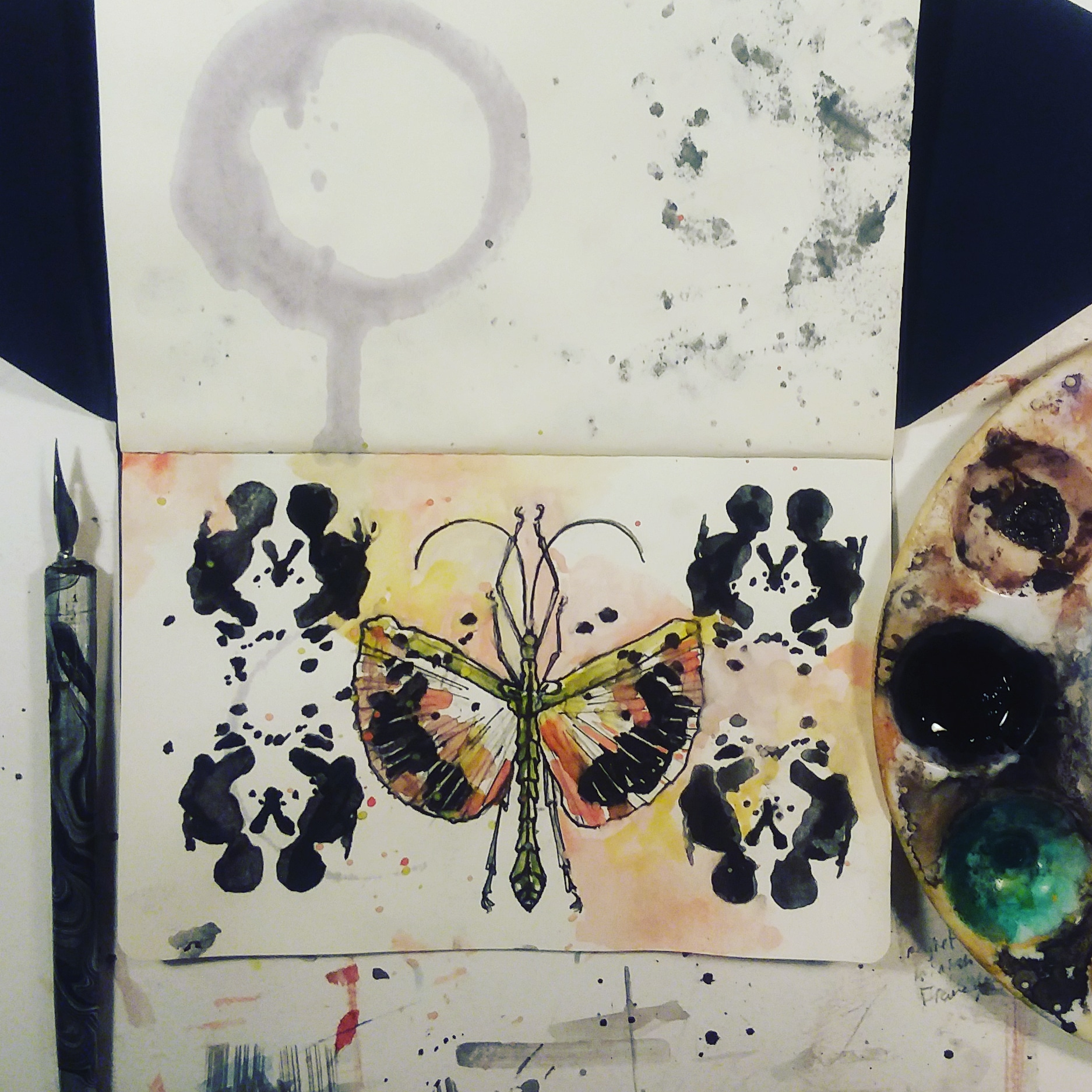
I’ve been sitting on these all-in-one envelopes until now. Friday night is Wine-O-Clock in the studio and I wanted to make some quick and rapid visual noise. Since I scan all sketches that become large paintings, I had a body of work to reduce and scale to tell one cohesive story on each page of the notebook. As you know, I’m in love with bugs and I recently finished a large Goliath Beetle painting titled “Rorschach“. Expanding on the idea for that painting, I used the four pages to explore the concept further. You can purchase the original art filled notebook in my store by following this link. A set of 4 Matte Canvas Prints are also available here. Stay tuned, I’ll be posting new ones as they emerge from the studio.


The post Moleskine Messages- Original Art by Mail appeared first on Garrott Designs.
March 14, 2018
Thryve in the Creative Lifestyle- Go with Your Gut
Thryve Inside
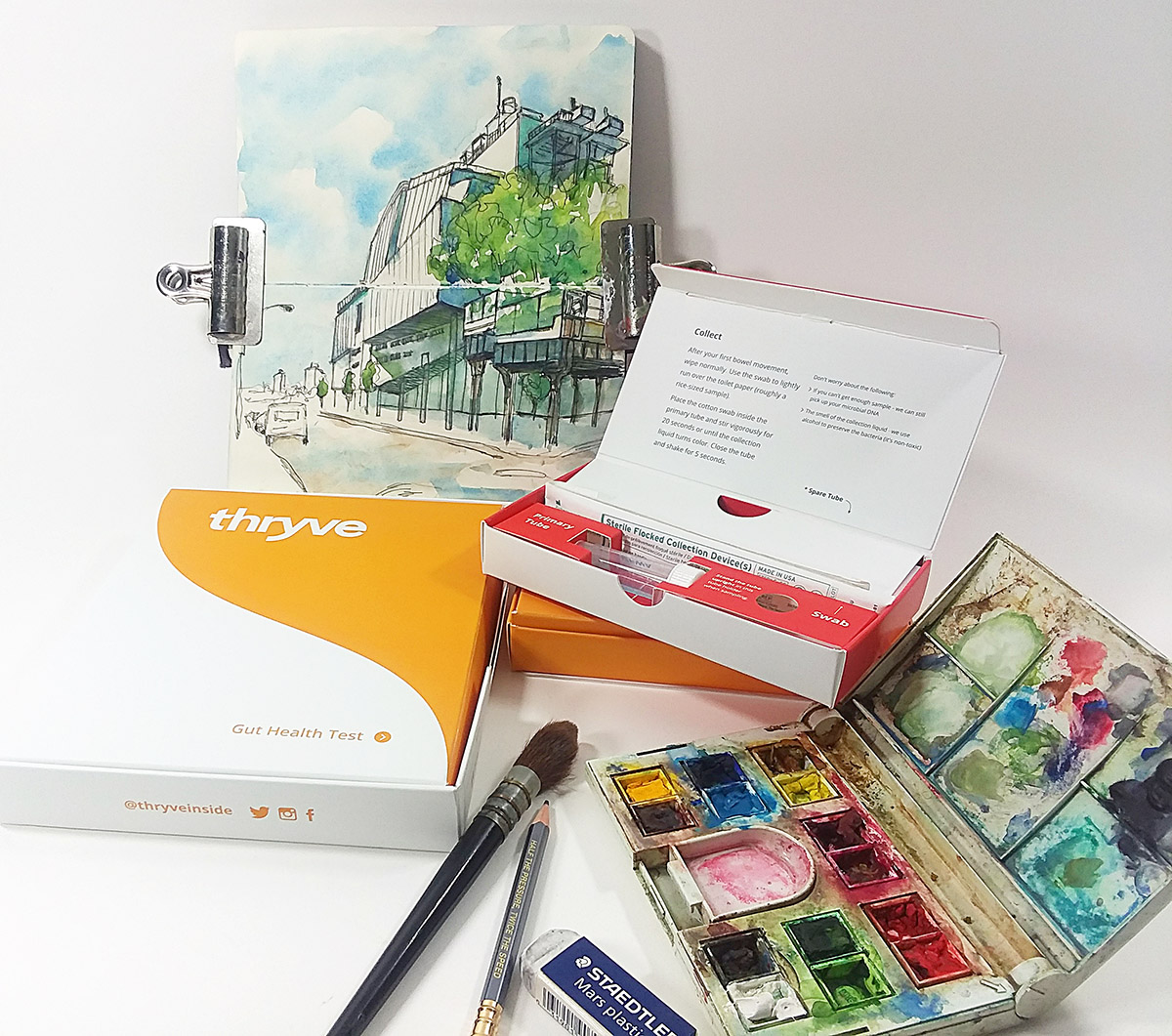
I’m excited to be partnering with Thryve, testing their personalized probiotic gut health system. Thryve, INC is a venture backed genomic and probiotic start-up company founded in 2016. They are the first to provide a personalized probiotic systems based on your own gut health needs. Follow the experience here on my blog by subscribing to my newsletter and find more stories by searching #gutheroes #thryveinside.
Creative Lifestyle
I believe in what Thryve is doing because, for the last year, I’ve been taking an essential oil vitamin pack as well as probiotics that have vastly increased my energy levels, concentration, and optimism as well as boosted my immune system. The results have directly improved my creativity and productivity. I’ve been so impressed with the addition of probiotics to my routine that I was excited to hear about Thryve having the ability to identify what my body needs and deliver it to my door. While there is still a lot we don’t know about our guts and the microbiome, Thryve is analyzing the data to learn more and innovate. I’m looking forward to feeling the difference and encourage you to try probiotics and essential oils to amplify your creative lifestyle.
How Thryve Works
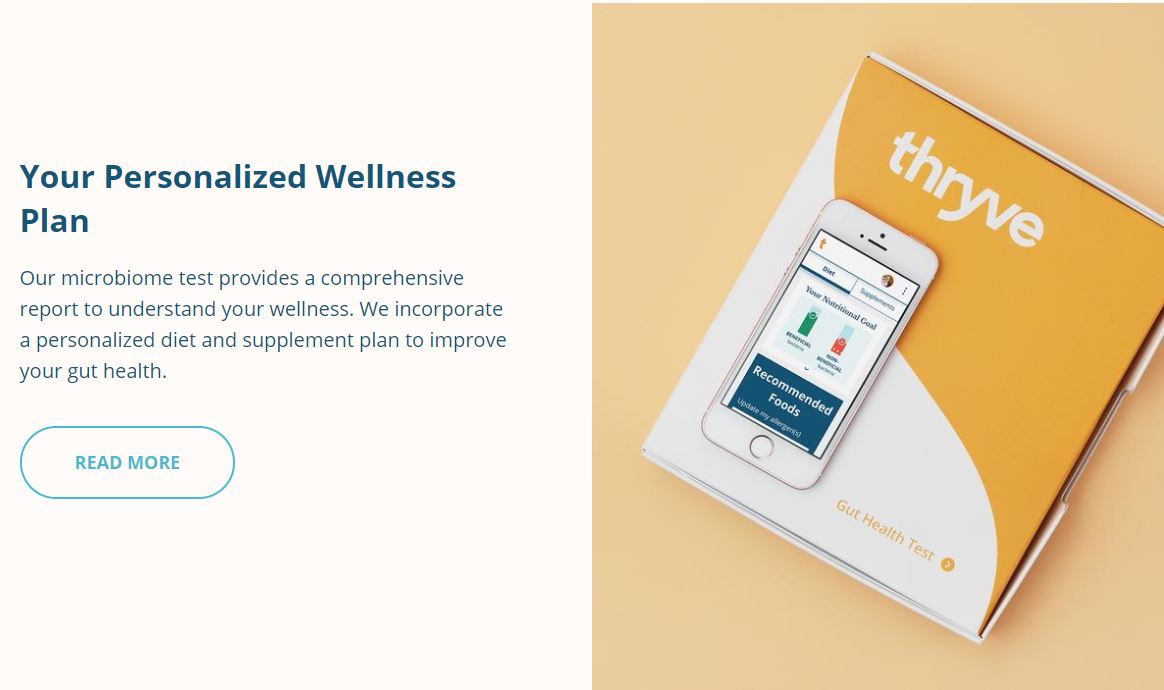
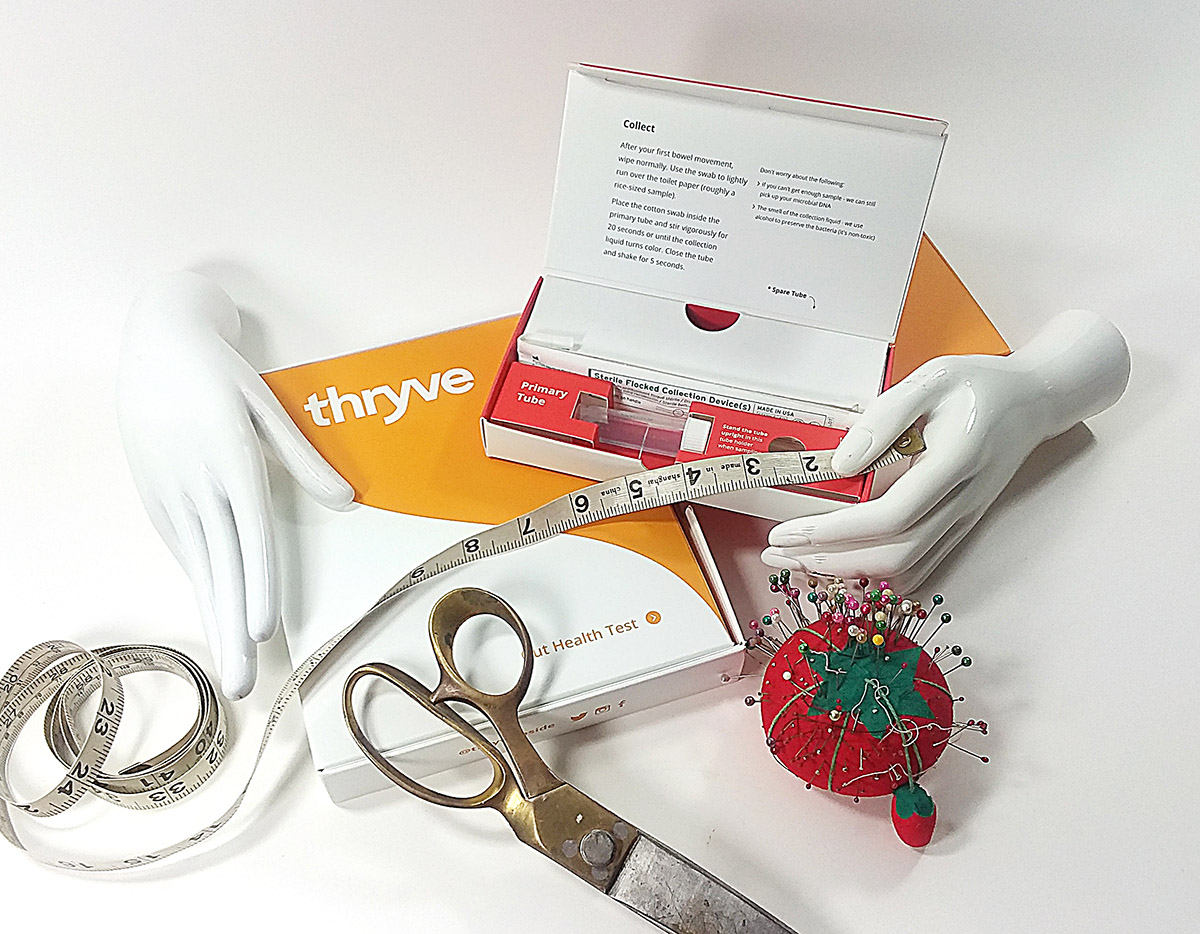
Thryve has created a simple and clean home test to collect your sample and ship in a postage paid pack to the lab. In two weeks you’ll get your results on specific bacteria strains in your body. You’ll receive dietary recommendations and a personalized formula to subscribe monthly and keep you running at optimal levels of awesome. It’s so much easier than going to a doctor, getting a prescription, having the test, getting another prescription, trying to find out if your insurance will cover it (it won’t) and then running to the pharmacist to get your “meds” like a sick person. Health insurance and pharmaceutical companies have their own agenda and it’s got nothing to do with nutrition.
Go with Your Gut
As a creative professional with my fingers in lots of industrial pies, I’ve found it absolutely necessary to keep my mind and my body running on all cylinders. This whole “starving artist” and the assumption that in order to be creative we need to live destructive lifestyles is so outdated. The people I work with are active, optimistic and industrious. I don’t know anyone who can take a bender, go off the rails and be back for the “Design Sprint” by noon. Depressed artists are so last century it’s not even trendy. Follow that thing you do with energy and enthusiasm, that’s how we roll.

To learn more about Thryve and what they can do for you, visit their website and blog. To save because you read this post use this link to purchase. If you’re curious but not ready to commit, subscribe to my newsletter and watch for updates about my experience with Thryve’s new system. I’ve sent off my test and will be getting my “bug” results back soon. I’m excited to share this experience with you. I hope you’ll take steps to being a happier, healthy creative who thrives from the inside out.
P.S. These statements are my own opinions and not currently supported by the FDA. I’m not a doctor, a nutritionist or a physician. I go with my gut.
#gowithyourgut #gutheroes
The post Thryve in the Creative Lifestyle- Go with Your Gut appeared first on Garrott Designs.
November 26, 2017
How Art Leads Innovation in Science, Technology & Business
Much of my time is spent connecting people and ideas to achieve brand vision through product development. I’ve written several posts on the role of art and design in every day experiences. Once in a while I find a Goodread that supports the hunches lurking in the back of my mind. One such book found it’s way to me at a Futures conference hosted by ESP TrendLab. John Lobell spoke about his new book “Visionary Creativity: How New Worlds are Born.” There are many layers to this book worth exploring. I’d like to focus on Lobell’s theory that art sets into motion new cultures and pulls us into the future. I am concentrating on this aspect in support of the democratization of art which began in the 60’s and now informs experiential design at retail, hospitality, the work place and even transportation centers.
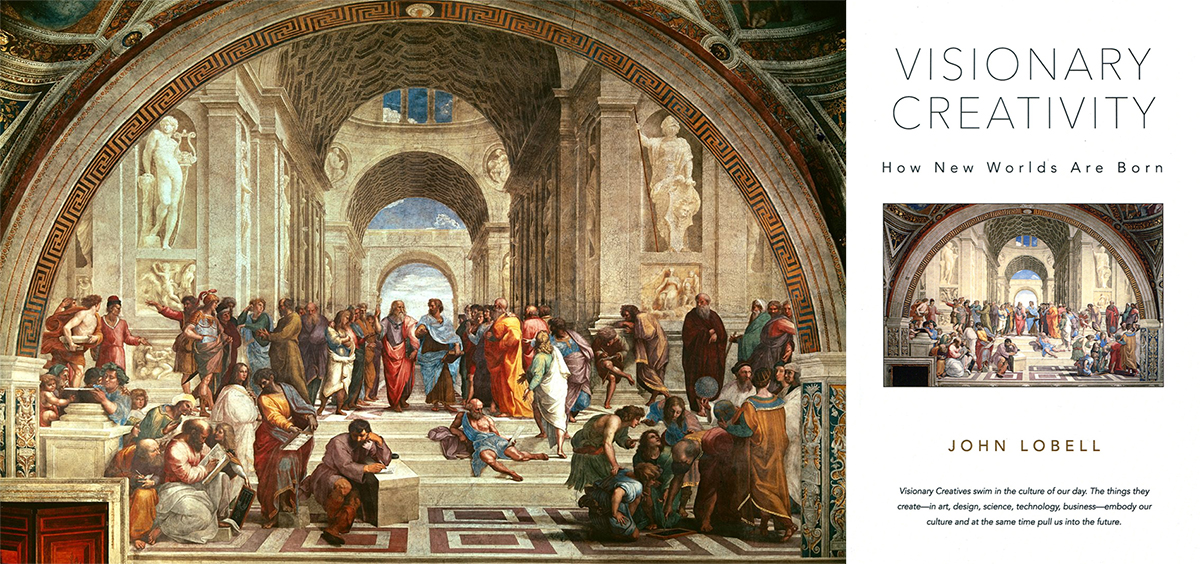
The Role of Art in Science, Technology and Business
Discontinuity is uncomfortable to most people, it is also the vehicle that drives business, innovation, new technologies and bridges cultural gaps. As Lobell points out in his book, there is one situation in which we are open to discontinuity: the art experience. It is through the encounter of art that we are willing to confront newness. Lobell sites Ray Kurzweil’s theory of hierarchical pattern recognition to suggest that art alters our structures of consciousness by bringing us to a place where we can imagine other possibilities. In doing so, we stretch preconceived assumptions and forge alternate cognitive paths enabling ourselves to create new destinations. Art stimulates the collective imagination of a culture and mobilizes the ability to create. By placing art in public spaces and in our daily lives, we democratize innovation by stimulating creativity and empowering a community to build the new.
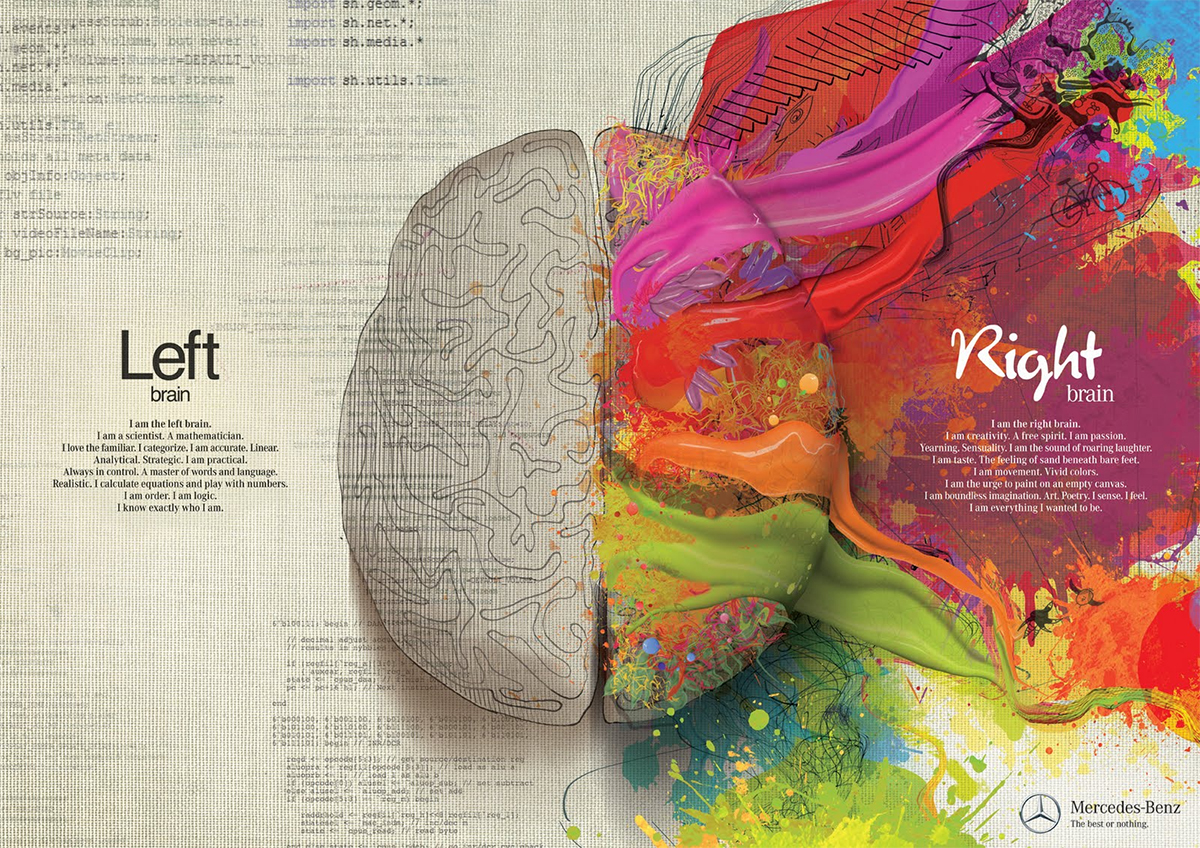
The Rise of the Creative Class
As Lobell points out, the most important ingredient in products today is not materials, or even assembly, but creativity. When we buy intangibles such as downloads, and immersive experiences, we are paying for the creativity of artists and designers. If creativity is central to our lives today, then our roles as artists and designers takes on new responsibilities as leaders and innovators. Creativity is demanded by our culture and therefore must inspire our environments.
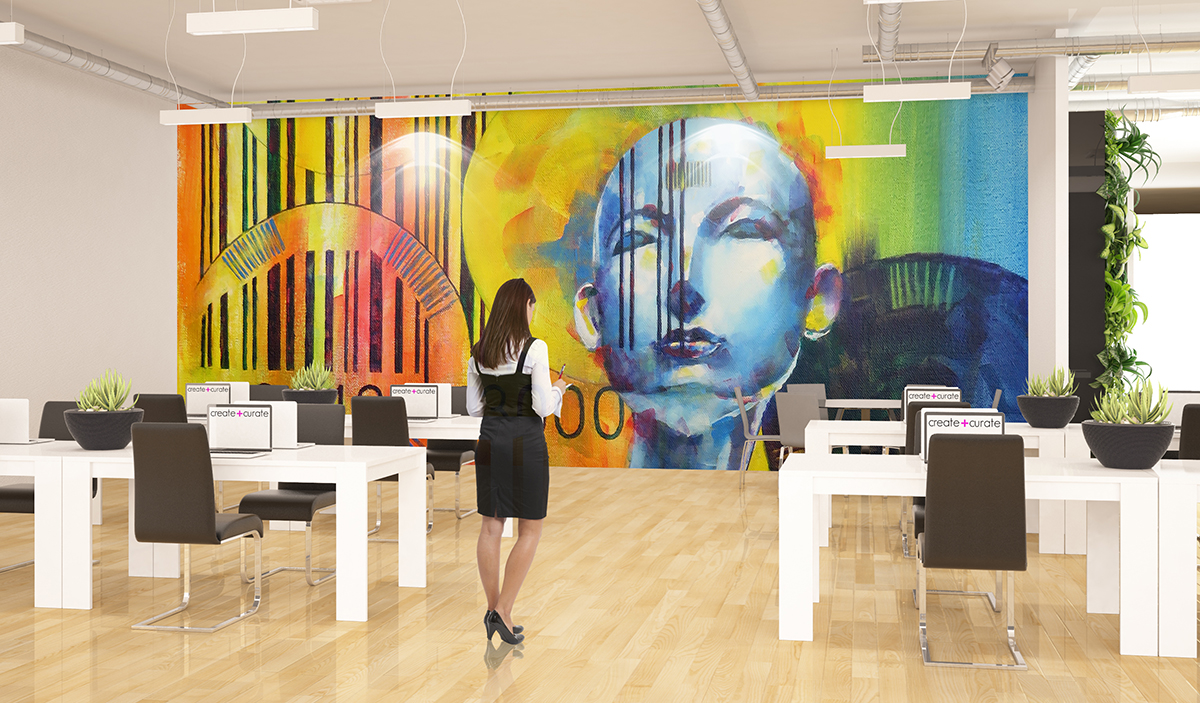
The Experience Economy
The look & feel of interface can influence the willingness to pay more, Apple and Microsoft are perfect examples. The visual arrangements of a hotel lobby or restaurant can influence our perceptions of the quality of food or service. An office space can dictate the culture and behavior of employees by its decor, color, and desk arrangements. By creating artful experiences digitally and physically, we can build the new and innovate the future.
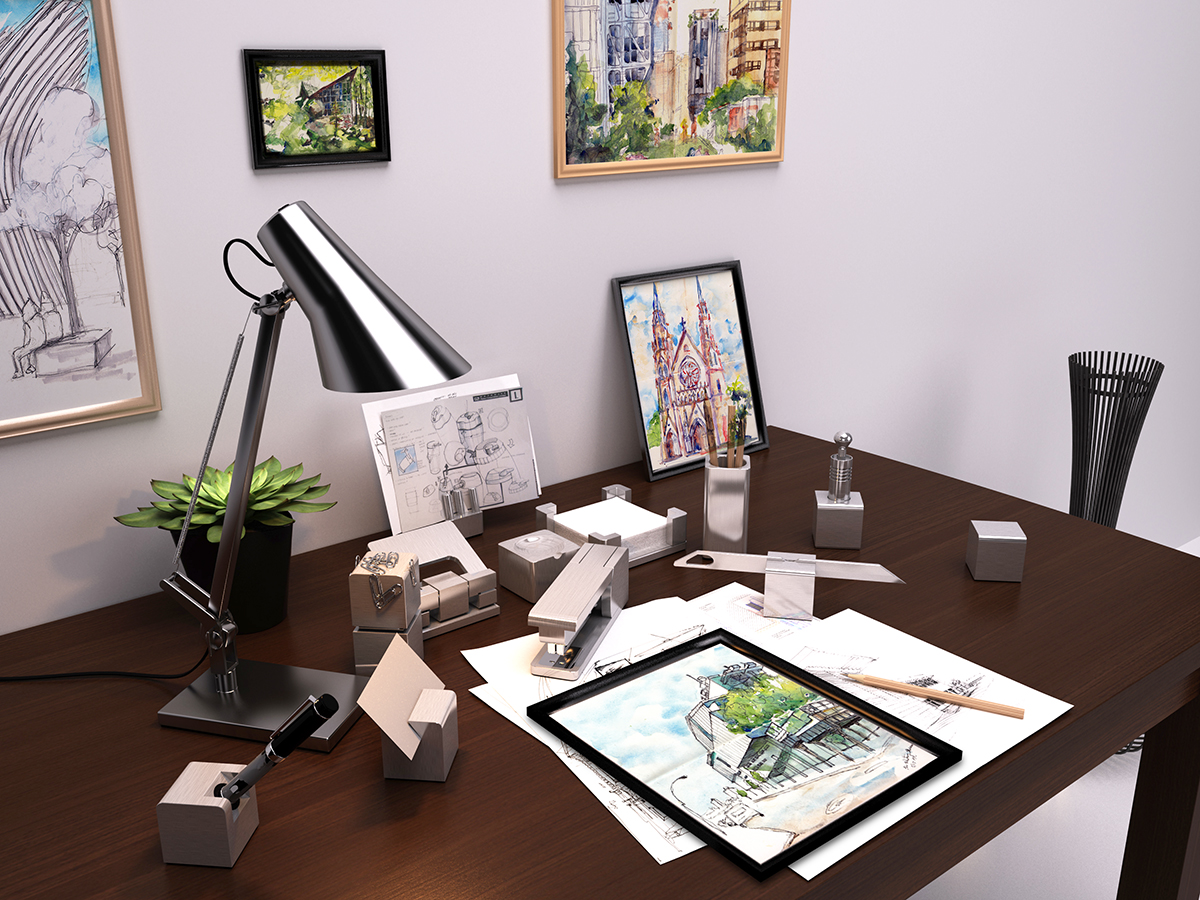
Creativity is our number one asset in this emerging age of intelligent machines. Fostering critical thinking and creative problem solving begins with our culture and environment. Bringing ideas to our physical environments while approaching newness with curiosity will be the building blocks to our future.
Design Yourself. Create Your Space.
The post How Art Leads Innovation in Science, Technology & Business appeared first on Garrott Designs.
August 26, 2017
Sketch Journal: Schooner Stephen Taber, Rockland Maine
I have a tragic history of letting summer go by without embracing the outdoors. This year I’ve been burning to spend time by the water. Opportunities came and went but timing fell short of booking a thing. I have a pool in my building but this country girl turned New Yorker needs the REAL thing. Over stimulated, synthesized and social networked to exhaustion, I wanted peace and quiet with green space for miles. Honestly, I wanted to be a passenger, for someone or something to carry me around to beautiful places while I took naps, ate, drank and sketched in my sketchbook, like Atreyu on a giant Luck Dragon or something.
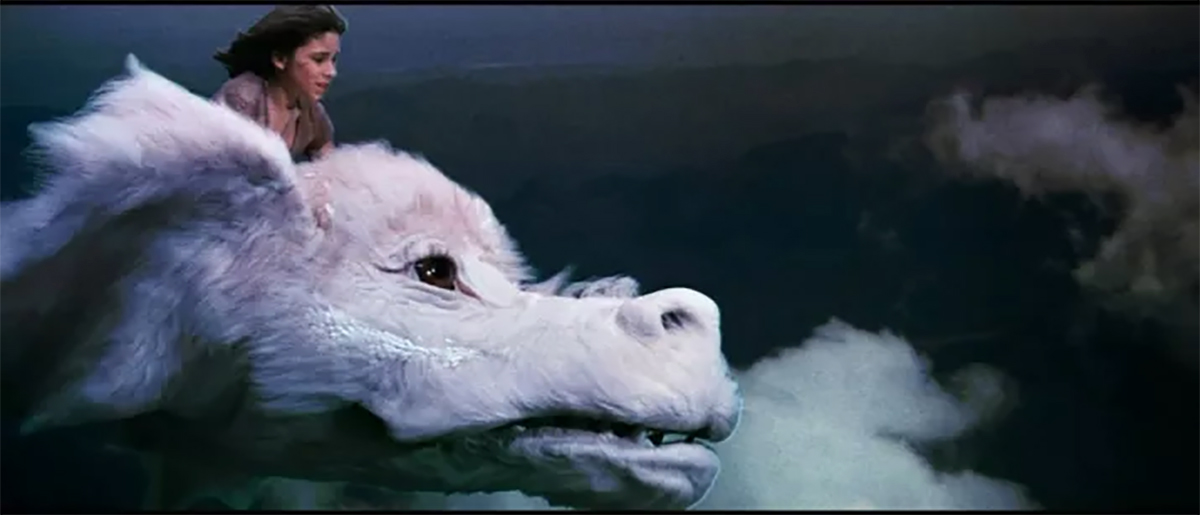
But where do I find a Luck Dragon this late in the season? That’s when a friend of mine told me about the Schooner Stephen Taber. He had just taken a 6 day cruise up the coast of Maine and loved every minute. After peeping their website and cruise schedule it didn’t take long before I was calling asking if there were any open spots on an August 3-4 Day cruise. Luckily, some poor bastard canceled and I was able to book 2 spots on a 3 day cruise for Mister and me.
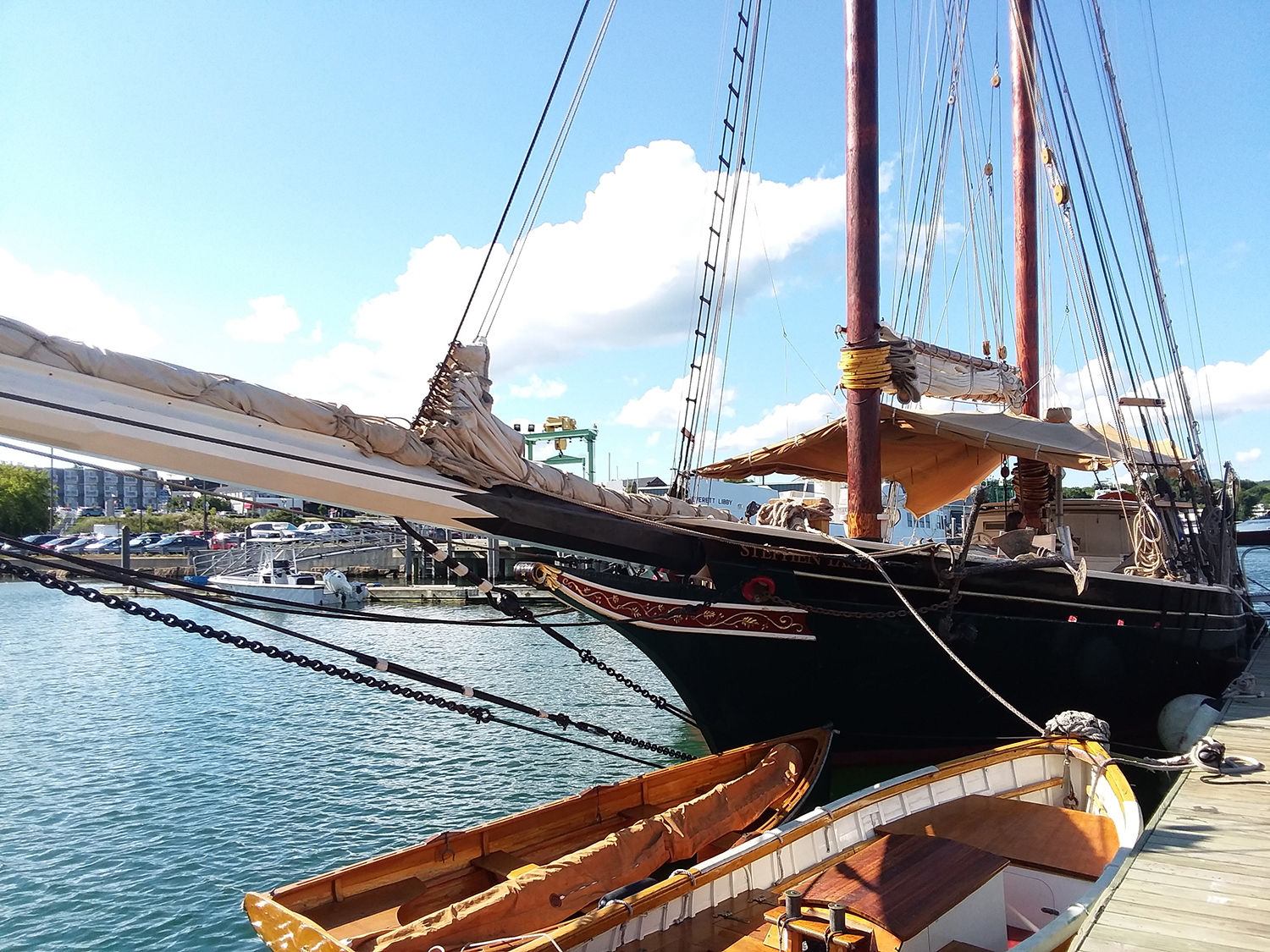
Schooner Stephen Taber
I’ll spare the details of how we got to Maine, stopping in Boston and all the fun we had in Cambridge because I want to tell you about this remarkable ship. The Taber really is a Luck Dragon, in fact, it’s called the “Good Luck Ship” of the Barnes family fleet. She is the oldest documented sailing vessel in continuous service in the US and a national landmark. She doesn’t have an inbound engine, just a yawl boat named Babe. The first day out, I stretched across a deckhouse for a nap in the sweet sunshine. The ship swayed and swelled, creaked and cracked as if a creature taking breath. I closed my eyes and breathed with each swell and sway. This ship is alive, Captain Noah will tell you the same.
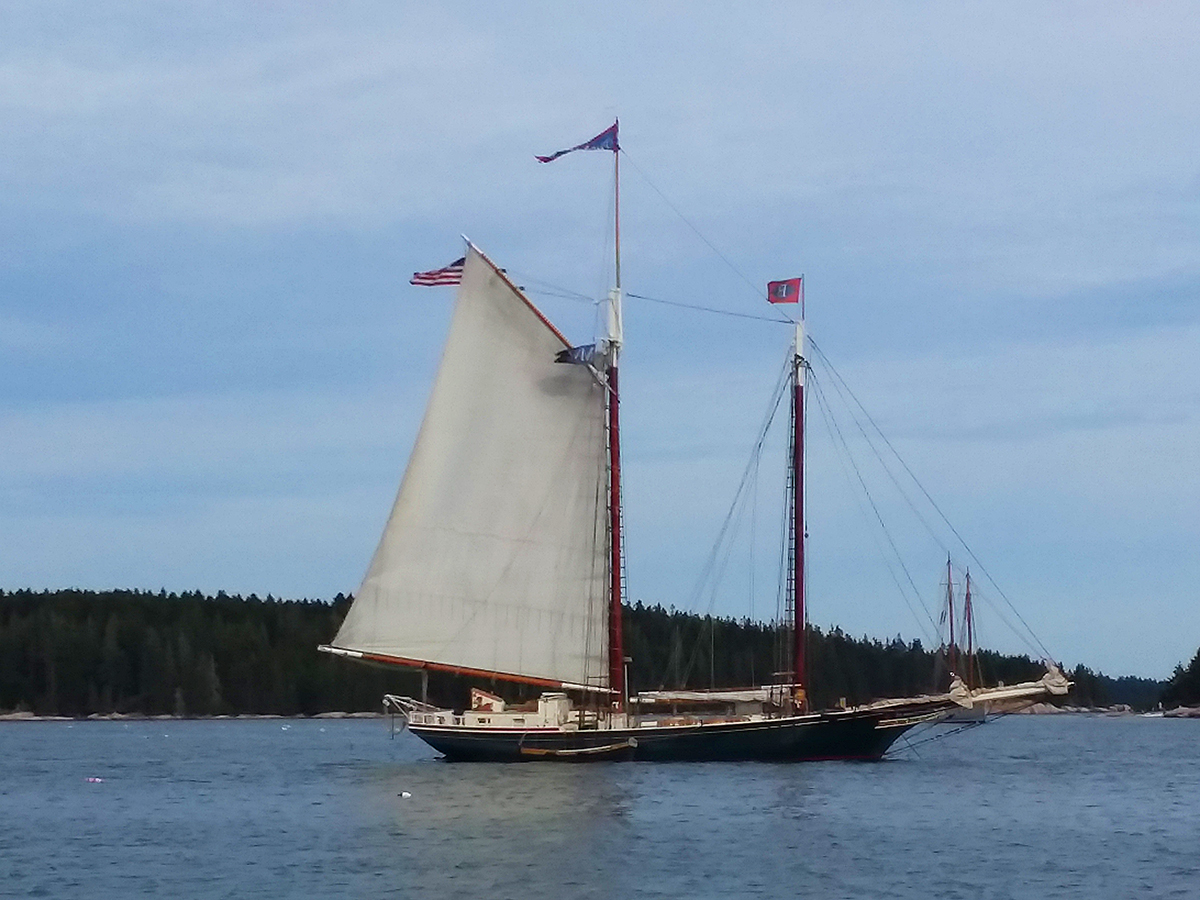
Artful Sailing
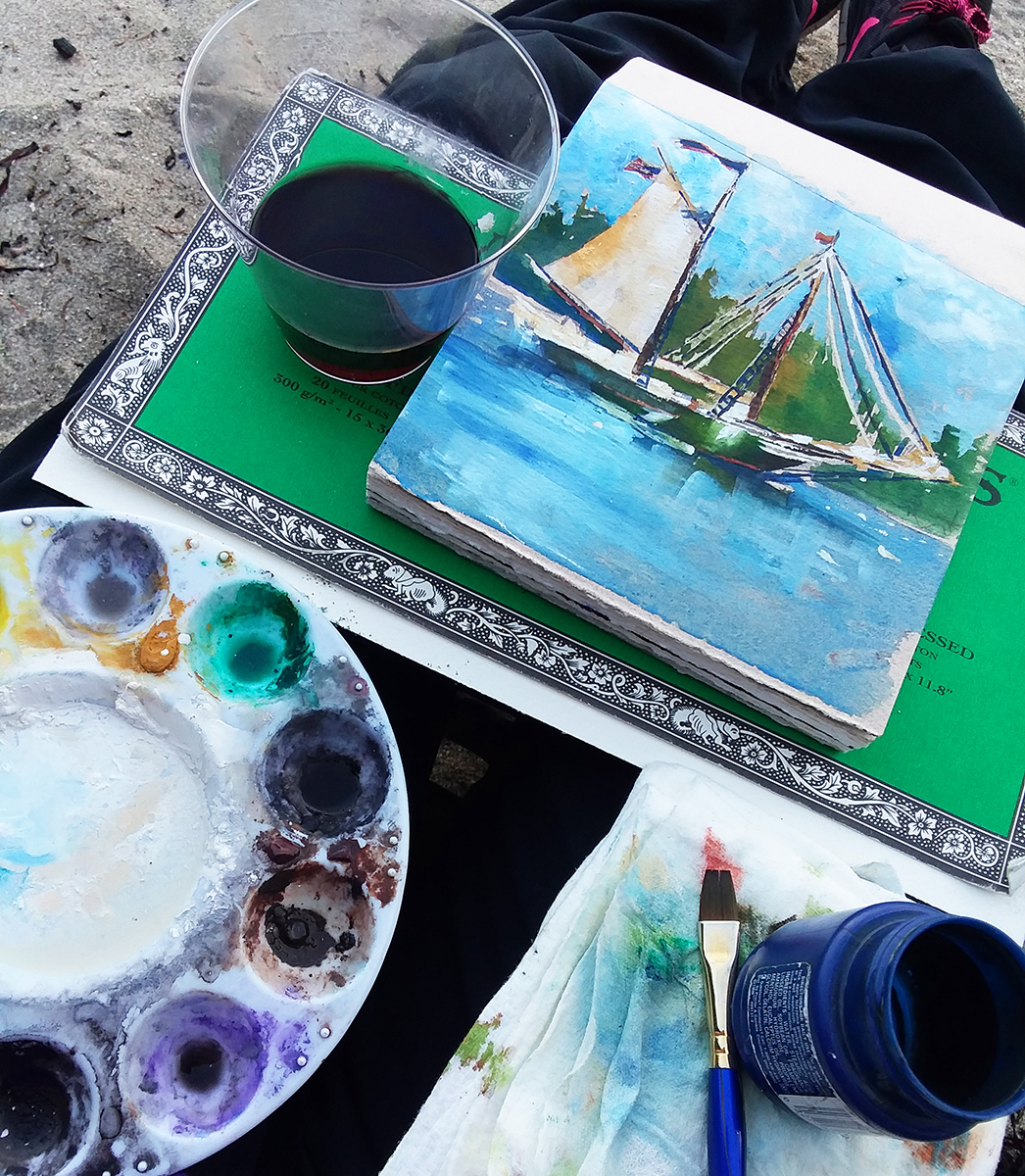
As we set sail, the Ledona sailed parallel to us, a perfect opportunity to do some warm up sketching. So I sat on deck and tinkered around on an Arches watercolor block, perfect for windward excursions because the paper is glued at the sides. It won’t buckle and it won’t blow away. (Artist tip #1 for sailing supplies)

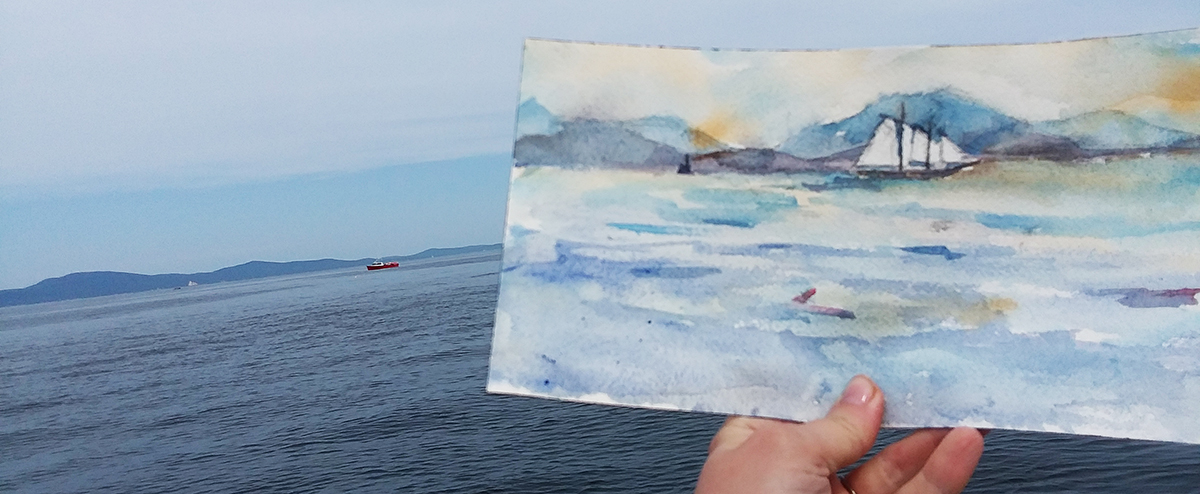
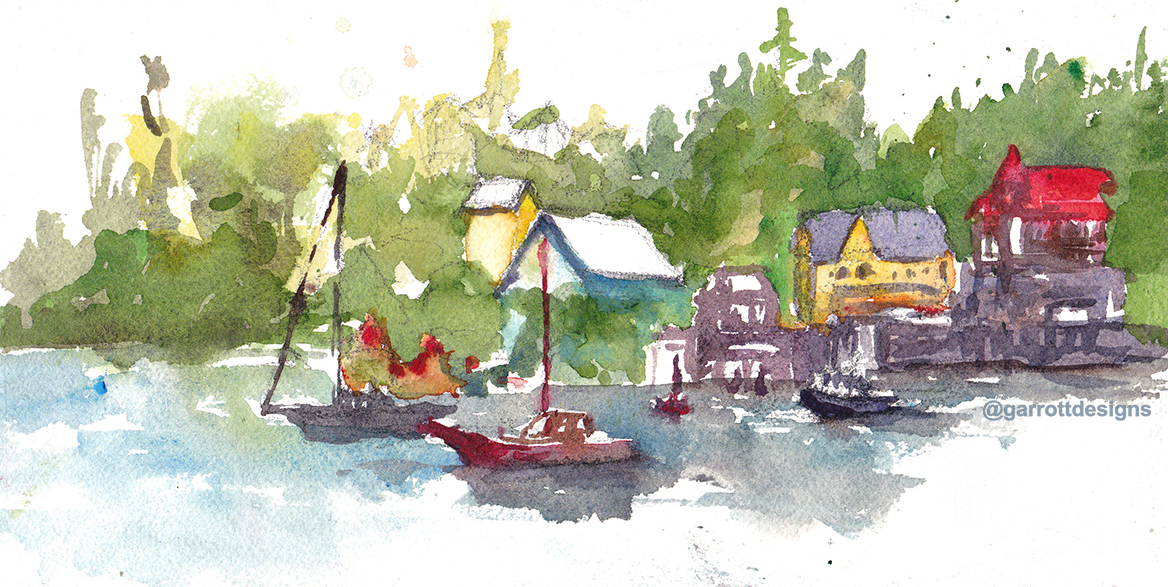
We passed several fishing villages as I hurried to capture a sense of the colorful buildings and boats in the sunshine. Proportions be damned, I got some fast draw washes down. Feeling as though I may well conquer the watercolor at sea challenge I wondered if some of the curious passengers expected a masterpiece. With questions like, “is this a hobby for you?” Much like a ship, one must stay the course and go with the wind. It’s not easy to fumble around, with a captive audience, trying to figure out if you and your brush are saying the same thing.
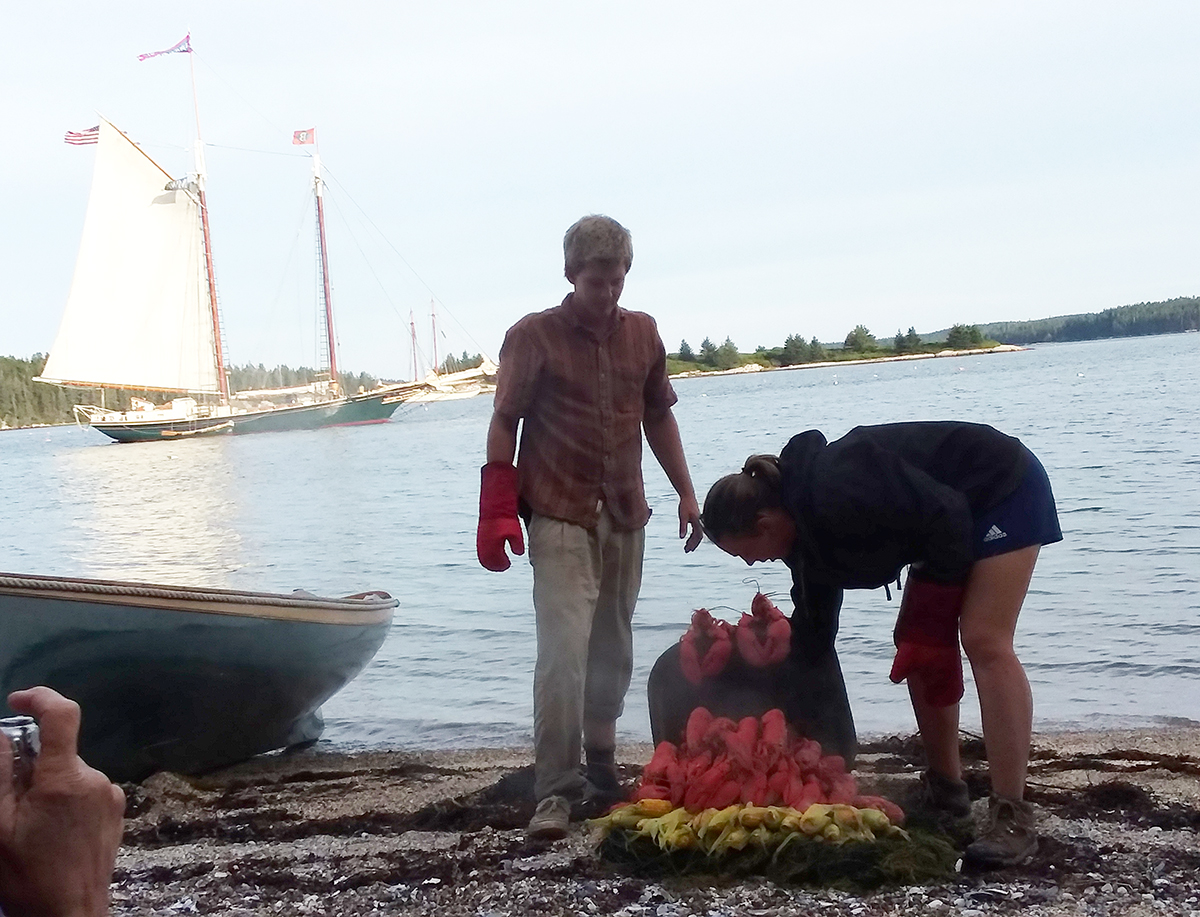
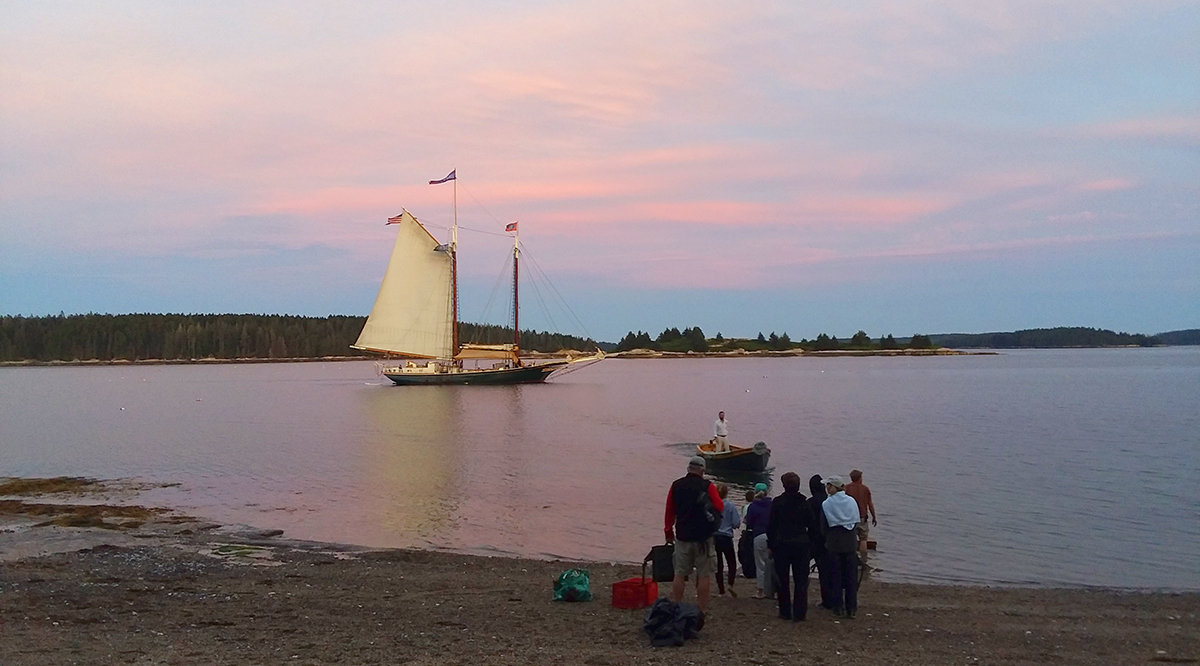
Just a few hours at sail and I was already in love with this ship. We dropped anchor at Russ Island for a hike, swim, some wine and a lobster bake. With the ship parked broadside to the island I took a seat on the shore to paint a watercolor portrait of the Schooner. I used a toned paper block because I wanted opaque white gouache to pop the colors of the sail and reflections in the water. Turns out love is the magic, with brush in hand, I nailed this one. Having conquered my palette and slightly buzzed on wine, I jumped in the water for a triumphant ice cold swim out to the boat and back. That was brisk.

Culinary Travels
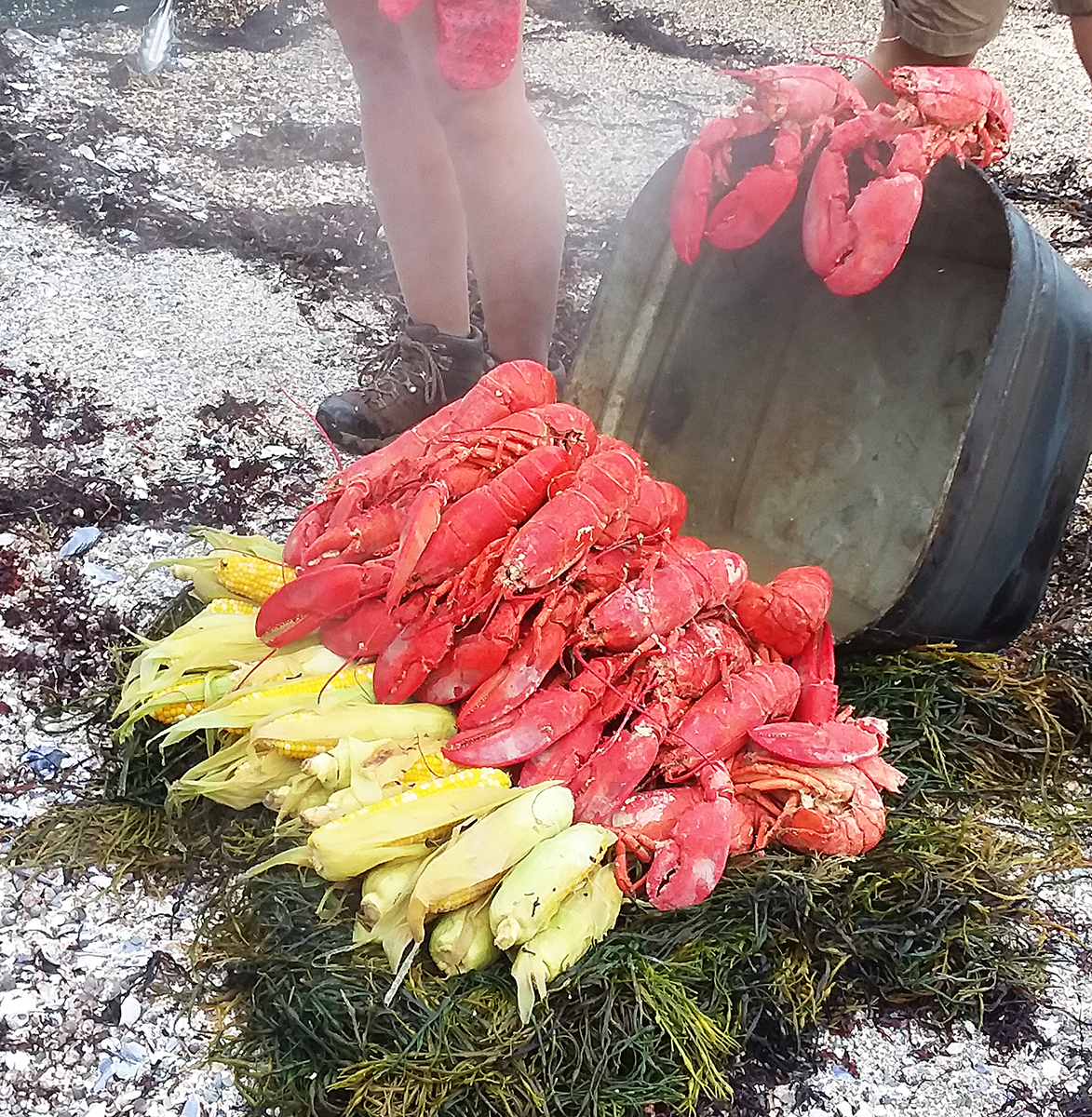
Besides the ship being a fantastical sea creature manifest, the shore side lobster feast was absolutely Biblical. Just in case 2 crustaceans each weren’t enough, handfuls of day long marinated tender bits of beef and chicken were delivered in frequent intervals as was wine and cheese. I considered for a moment they were trying to kill us but I resigned that this might not be a bad way to go if, indeed, that was to be our fate.
We loaded back on the ship around sunset, wine continued to flow as we visited with strangers, rapidly becoming new friends. The night sky was clear and bright with stars and a few meteors still passing through. I can’t tell you how awesome it was to fall asleep in the pure silence of a resting ship at sea. Around 3AM I crept on deck to see a low hanging half moon dangling just above the horizon, it’s light slithering across the water like Venetian glass. What a gift that was.
Fair Weather Friends
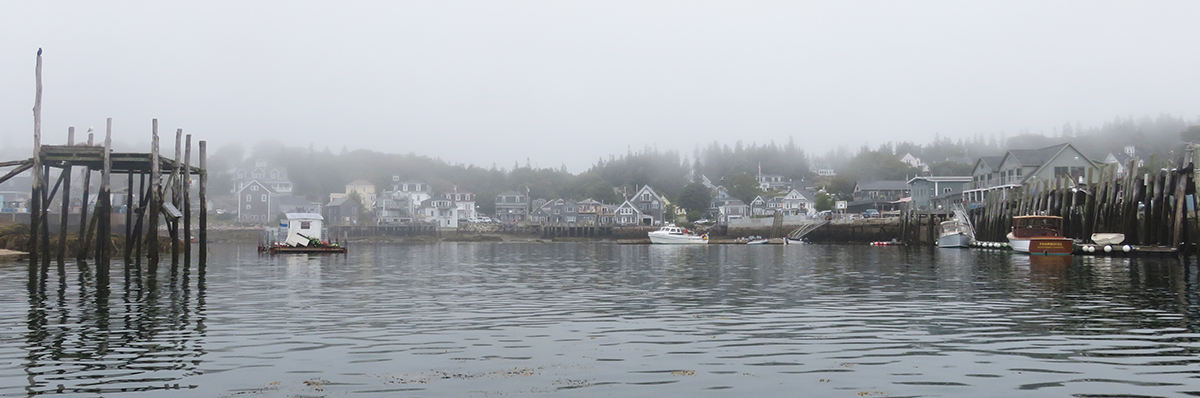
Next morning we woke to a dense fog, breakfast was steaming up from the galley as a damp chill cooled the air. Coffee poured while some guests started taking hot showers. Another guest and I got a bug to jump in for a swim first. So we did. It was cold and it was fantastic, I regret nothing.


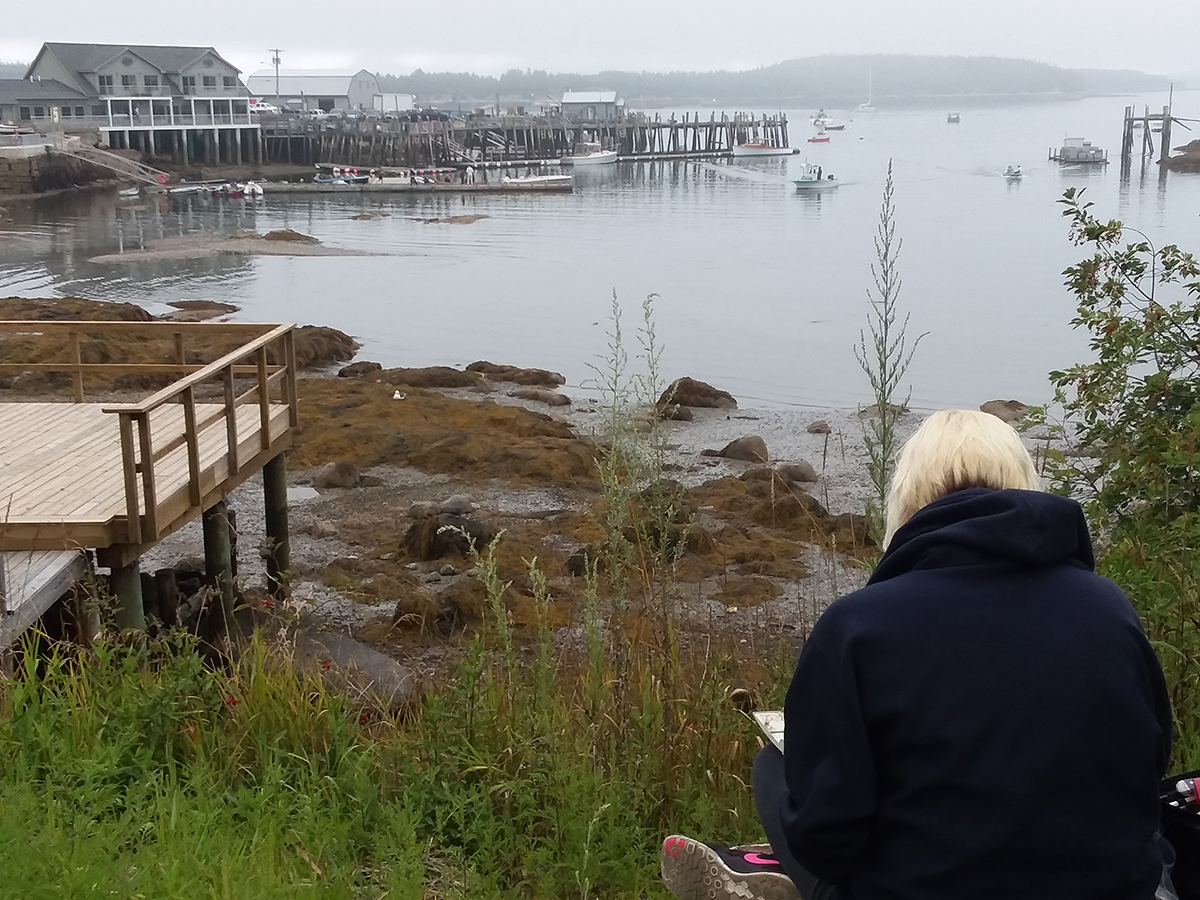
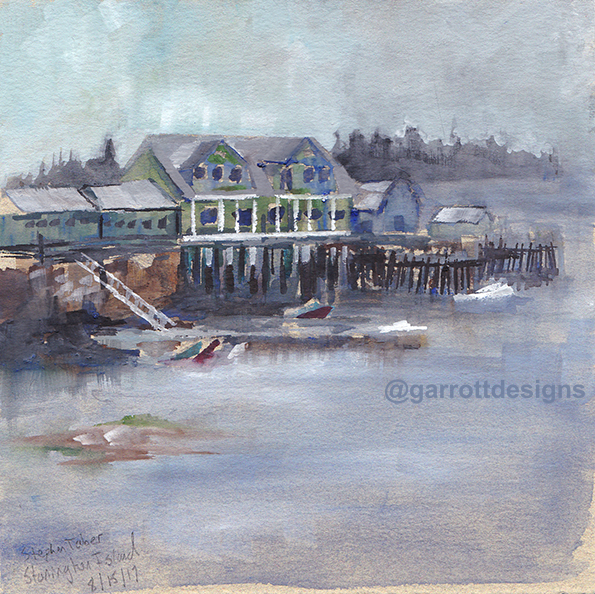
As the winds and the fog would have it, we landed in a little fishing village called Stonington. I Was eager to capture the fog before it lifted so we trolled up the roads, meandered in and out of merchant shops and settled on a view overlooking the dock we emerged from. The fog was kind enough to stick around for the duration.
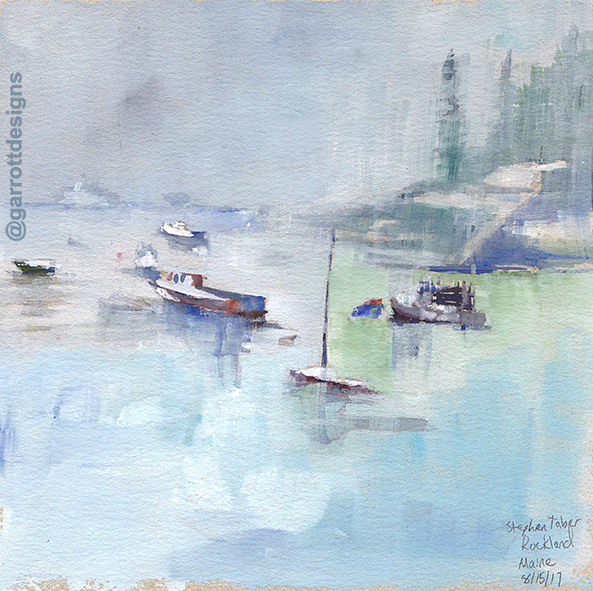
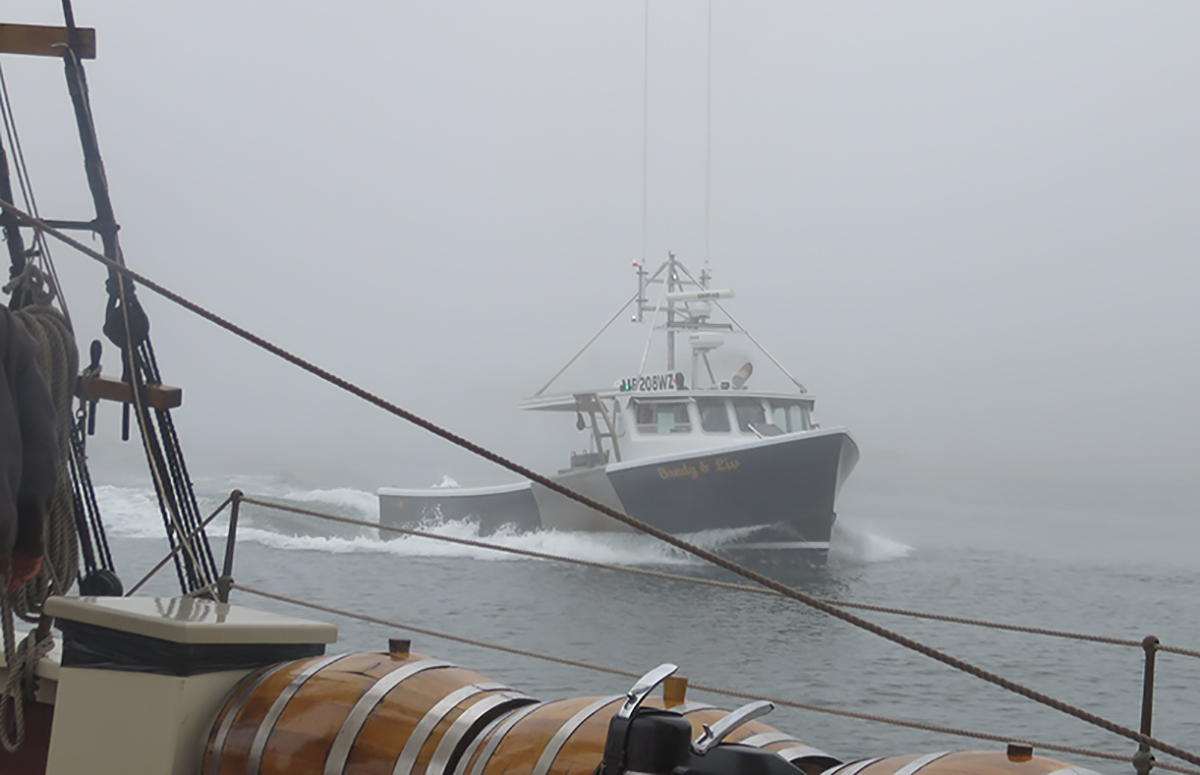
We departed for a 3 hour sail to another cove huddled someplace, I know not where. Fog following like an old friend, as we all visited on the quarterdeck or down below in the library. Captain Noah entertained us with anecdotes of his storied past and how he and his family came to sail the Taber.
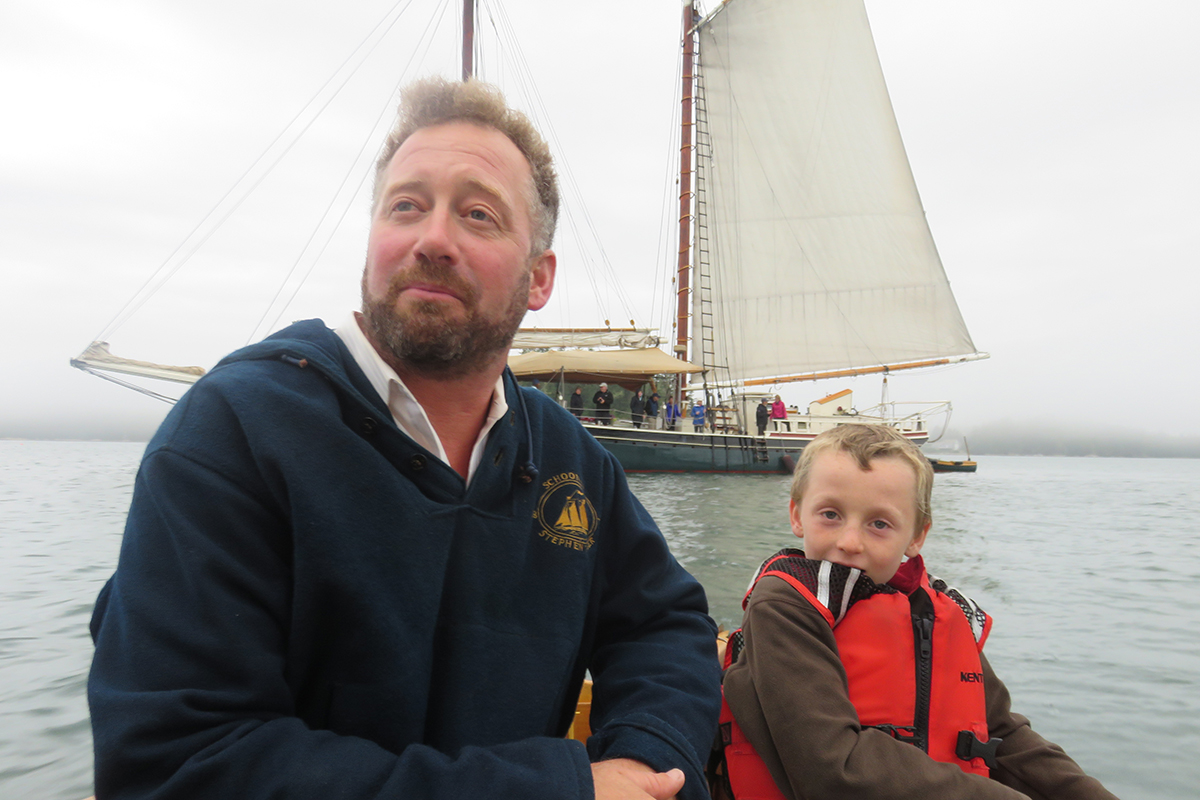 Captain Noah and a young Captain Oscar Barnes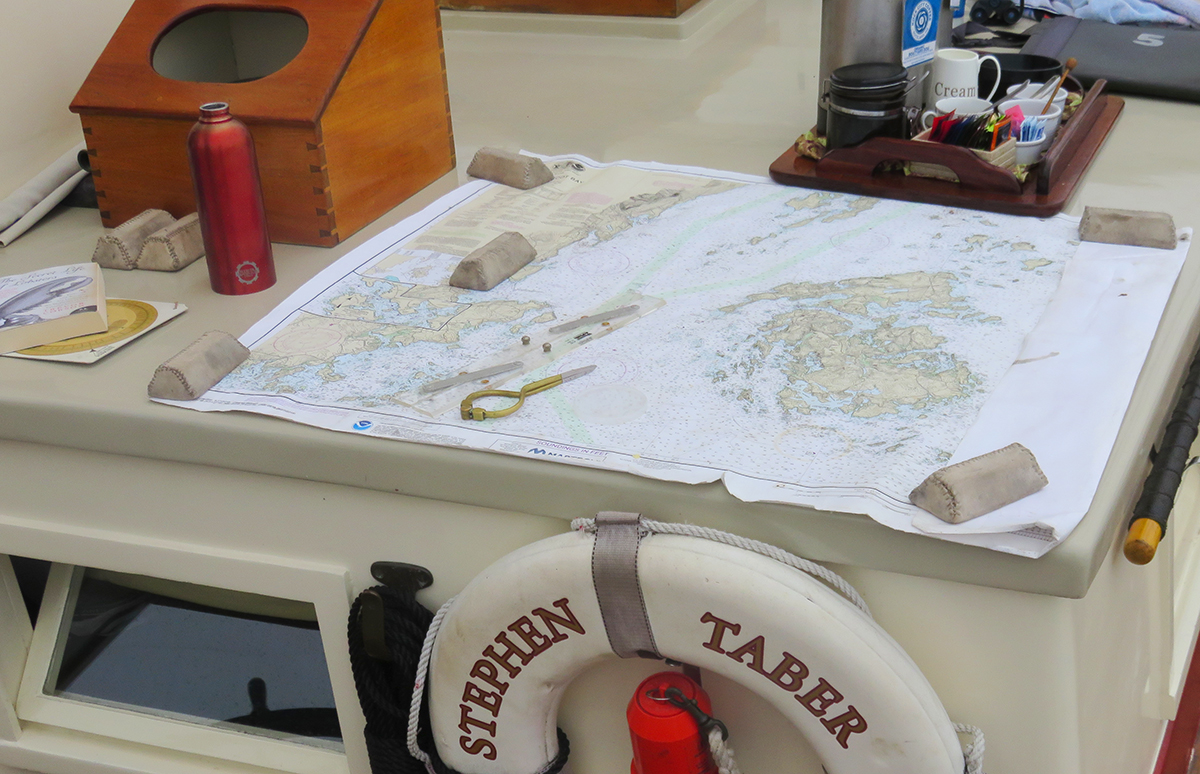
We anchored for our last night on the boat, poured our final glasses of wine and took the little yawl boat Babe for a spin.


Jocelyn, a member of the crew, set out on Babe just before dark. She had been recently engaged with another young sailor in the area. I painted her sailing off on her own musing about their future together.
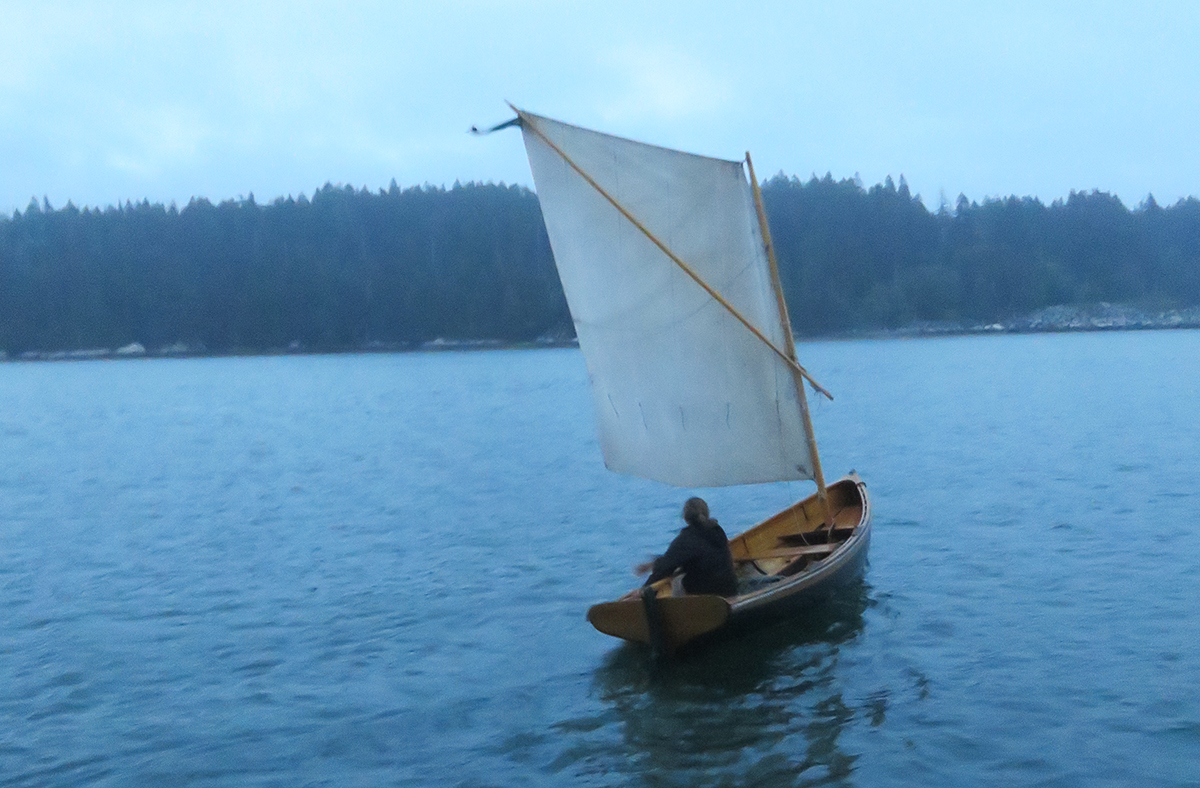
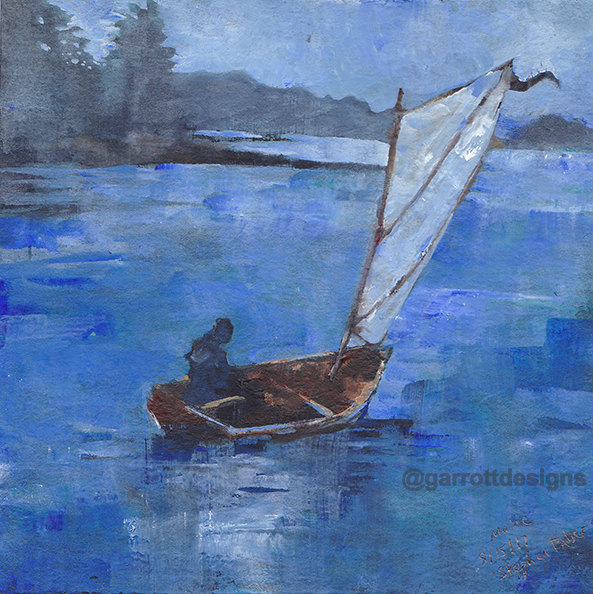
I can’t imagine how we could have packed more into a short 4 day vacation. This trip was a memorable escape and a remarkable experience. I got a ton of sketching in and had so much fun with a group of complete strangers, now friends. I highly recommend this excursion to the spirited, creative and adventurous.

Where can I buy Those Paintings?
I’m glad you asked, check out my store for available travel paintings and matte canvas prints. If you enjoyed this story, subscribe to the newsletter in the banner below to follow the journey.
More Stories:
The post Sketch Journal: Schooner Stephen Taber, Rockland Maine appeared first on Garrott Designs.
August 6, 2017
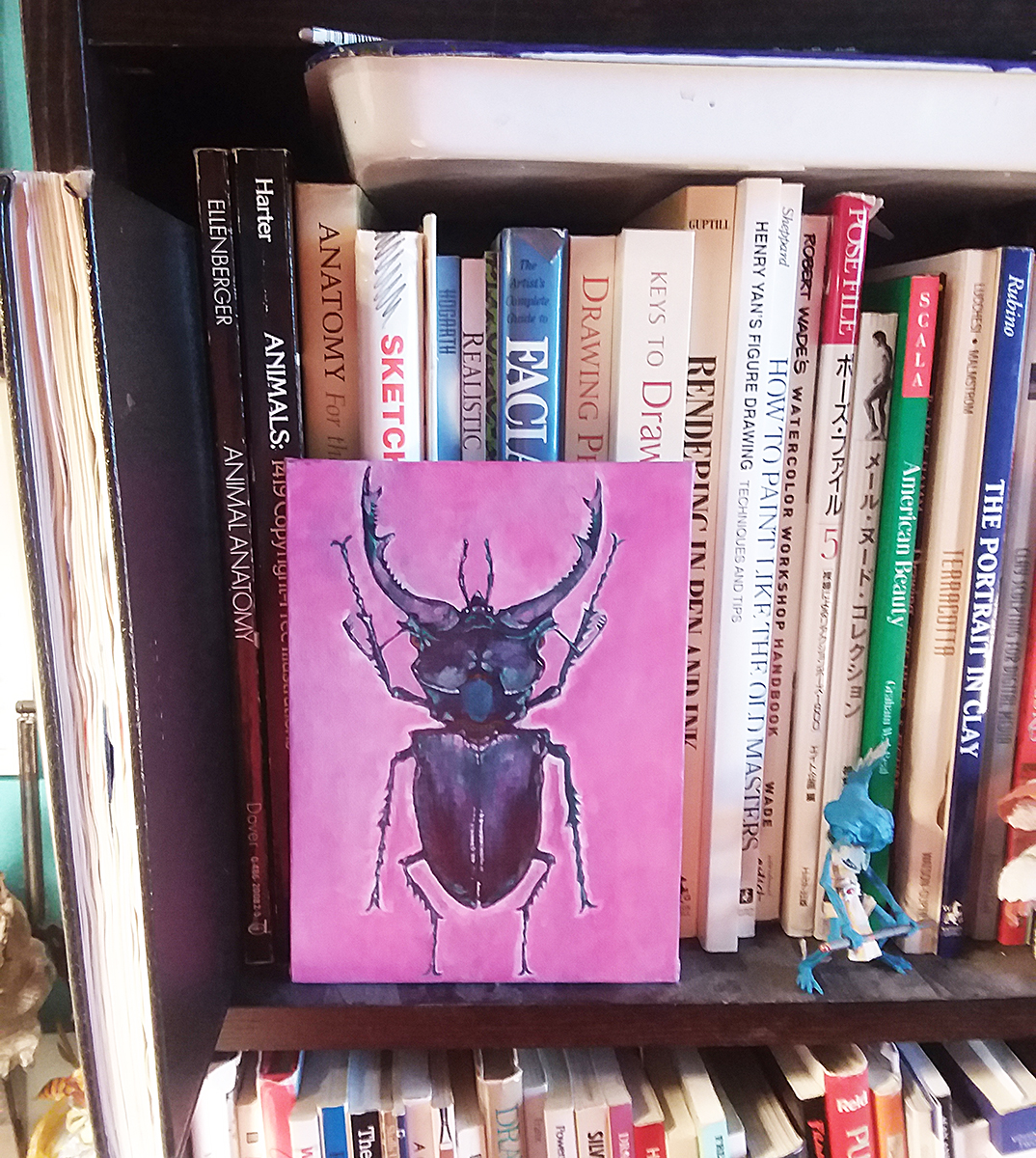
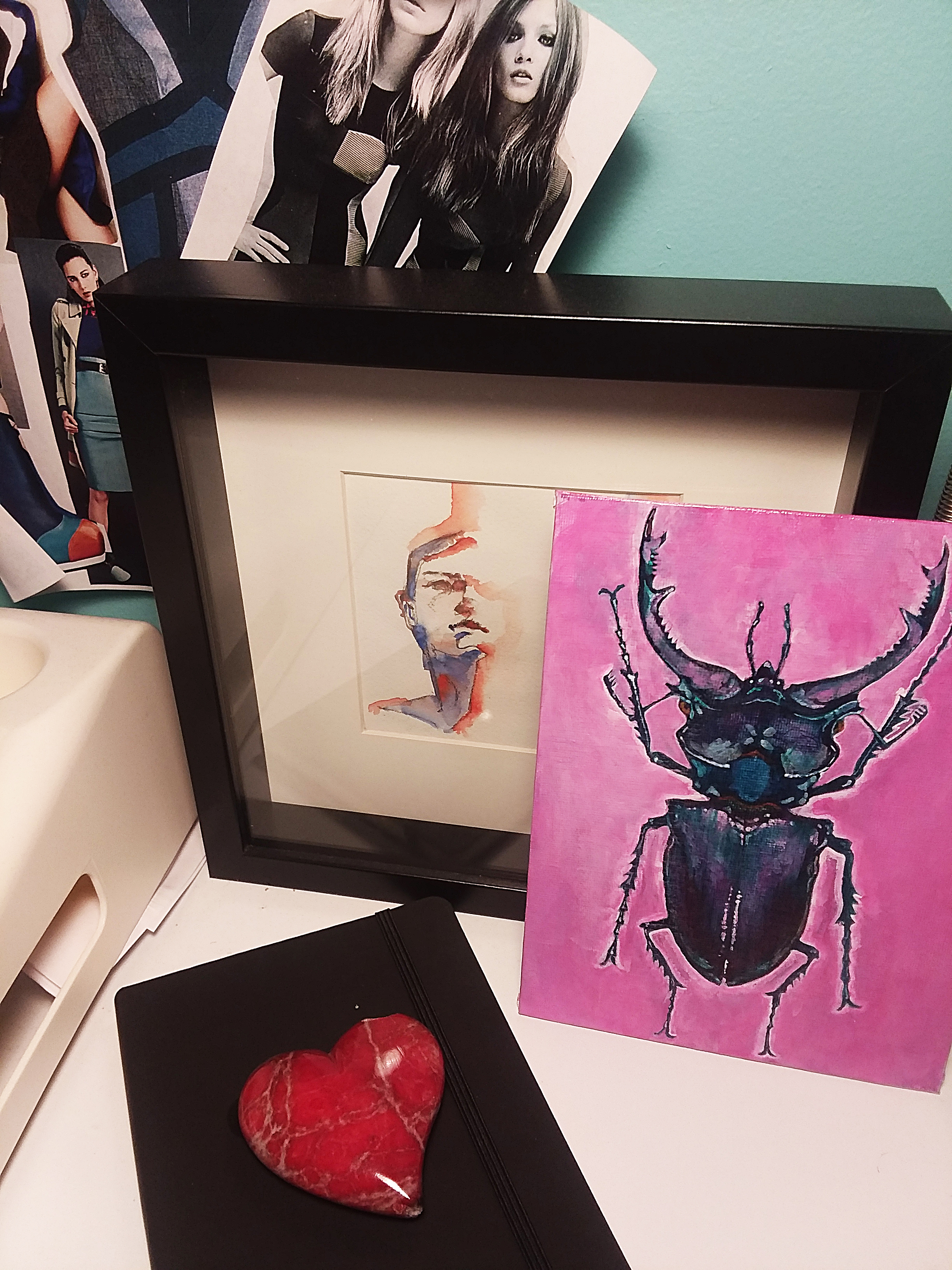
“Natural Selection” Interior Decor: Pink Stag Beetle
For those who follow my work, you know Natural science has been a strong source of inspiration. My “Natural Selection” series is a collection of insect specimens for people who would rather not collect actual insect specimens. Through the use of expressive brush strokes and wild color applications, I like to bring these fascinating creatures into the realm of art and interior design. Cafe Grumpy recently embraced the collection, see events here. Also, BFloral and I coordinated on an event installation combining art with floral design and I continue to look for celebratory collaborators and natural science conspirators.
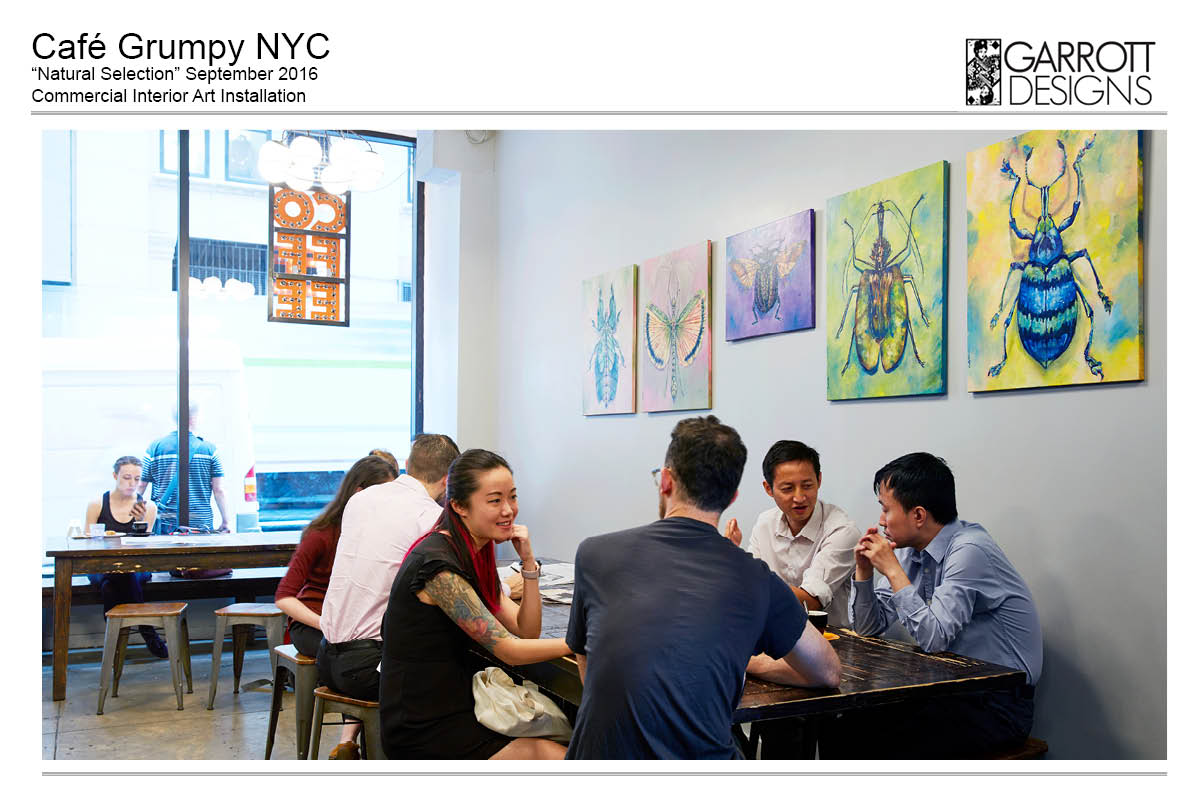

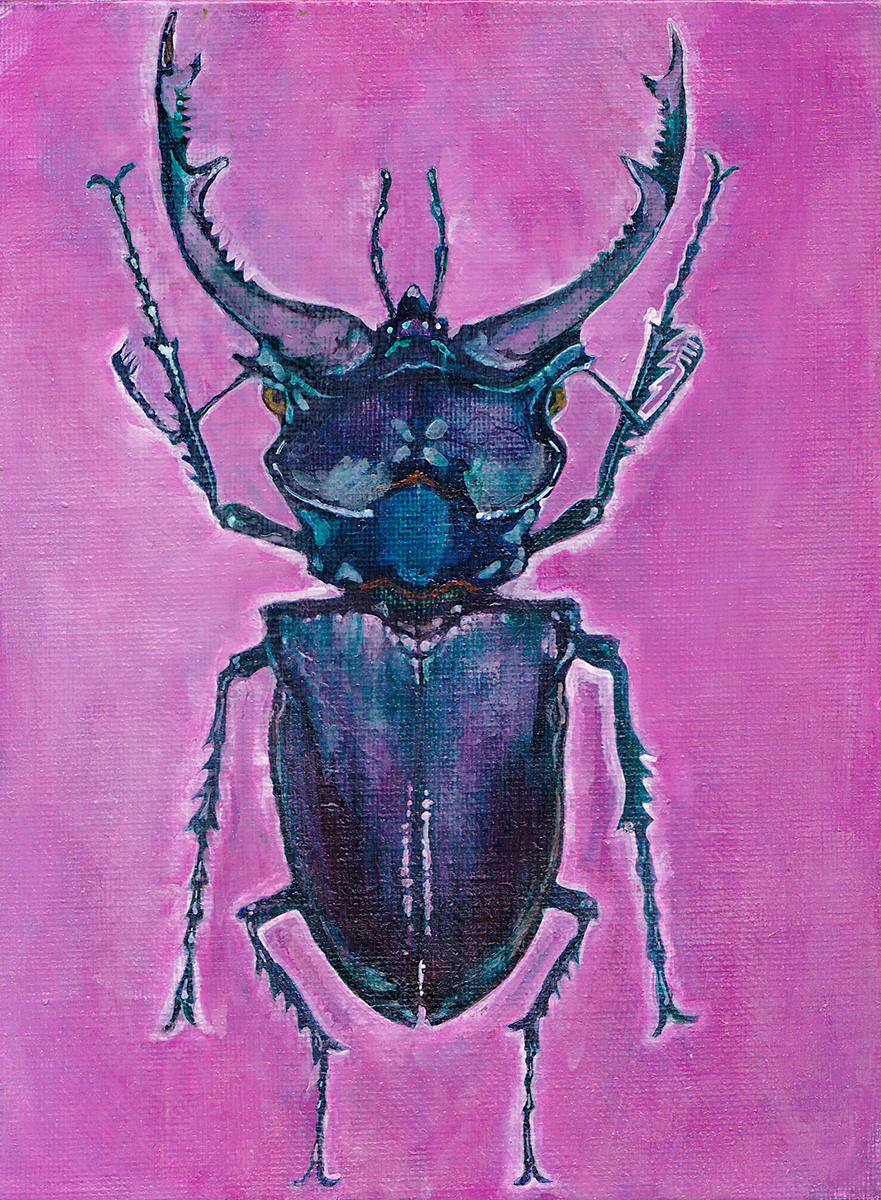
Pink Stag Beetle
I’d like to show a little bit about my process in creating these color infused, expressive paintings of specimen portraiture. The Stag Beetle is a dark and intense creature that exudes a colorful personality. I wanted to bounce as many colors into the “black” of it’s body as I could. With a little bit of color theory and penchant for play, I slapped down five different colors and never, ever, touched a tube of black. I used Phthalo Green, Deep Violet, Alizarine Crimson, Burnt Umber and Prussian Blue.
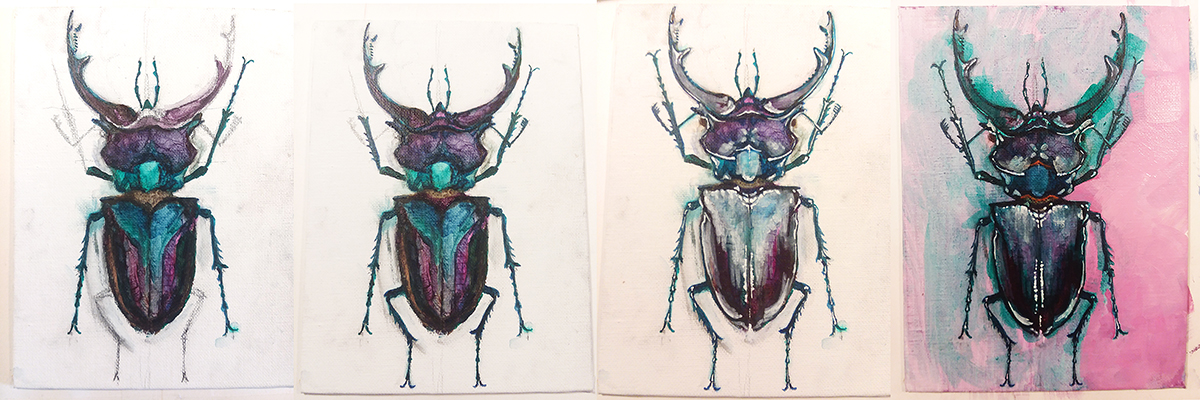
The key for getting expressive with the brush strokes is using as big a bush as possible. I personally love using flat brushes. I work the strokes as if I were sculpting the form of the body in paint. The background color went through a few stages until Magenta just made all the sense in the world.(my nieces texts confirmed this truth) I then created a white halo around the beetle because Egon Schiele was whispering in my ear that day.
How Can I Buy That?
You can find the “Pink Stag Beetle” original and matte canvas prints here. Have a look at some of the other insects available in the shop. You can also find an assortment of card-stock prints exclusively at Noir Arts and Oddities, contact Pamela with interest.
The post “Natural Selection” Interior Decor: Pink Stag Beetle appeared first on Garrott Designs.
July 16, 2017
Designing for the Future: Trends We Need to Consider Now
I am writing a series of posts exploring the topics of art, retail and hospitality trends influencing the design of Travel Centers as Culture Hubs. This post about trends affecting architectural design is a part of the Design Blogger Competition organized by CGTrader and a perfect opportunity to introduce key trends defining the future of design and curation of culture into transportation centers. Key themes include movements in Global Citizenship, Connectivity, Non-Place vs. Third Place, Retailtainment, Art & Culture, Health & Wellness and of course, the Unknown.
 Hamad International Airport Passenger Terminal Complex image courtesy of HOK
Global Citizenship
Global air travel has increased 6.5% from 2014 to 2015, despite a weak economy, travelers are benefiting from cheaper airfare with a growing appetite for travel. Asia- Pacific regions accounted for one third of the total annual increases according to this report. The statistics validate the growth of business travel while there is also an increased desire to travel for the global minded Millennial and Gen-Z generations. As a member of the forgotten/ignored Generation X (latchkey kids) I must also register that I’d rather travel than buy a house or make mini-me’s. Evolutionary proof that our global economy is accelerating while demographic data gives way to psychographic analysis.
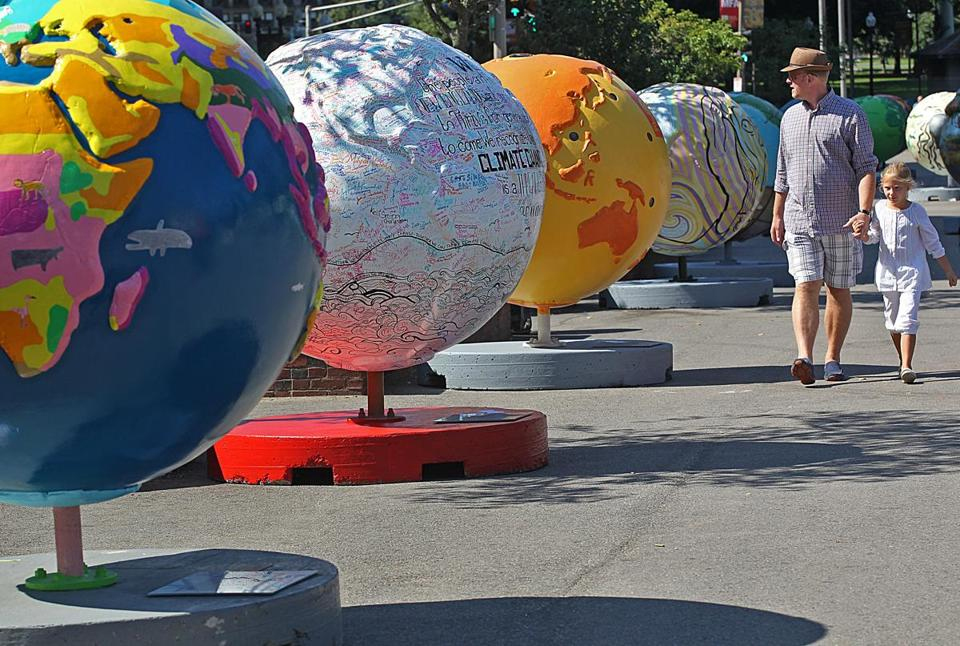 Boston Common “Cool Globes: Hot Ideas for a Cooler Planet” exhibit 2013
Connectivity- Home & Office
With flexible schedules counted in popularity among work benefits and advanced job positions requiring “on the ground” work, commuters are spending large amounts of time between home and office. Wi-Fi connectivity allows us to communicate from any hot-spot and transfer Hi-Fi information quicker than ever. We are free to move about in our workday lives so we need touch points in-between home and office. Naturally, amenities and creature comforts beyond the basics become a new foundation to design. We Work, Breather and LMHQ are co-working spaces building global networks to satisfy this growing need. In the next few years, we will likely see co-working spaces taking up real estate in transit hubs and airports.
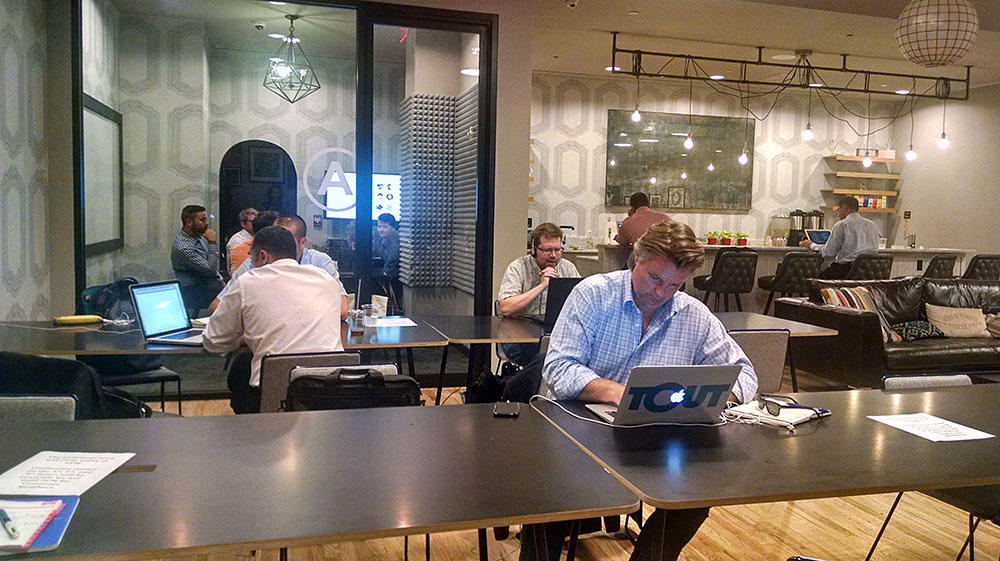 We Work Commons Area, Bryant Park NYC
“Non-Place” vs. “Third Place”
I first heard the notion of “Non-Place” at the Decoded Fashion Summit in 2015. AutoGrill’s Architecture Director Stefano Carmi presented a vision for the future. “From Non-Place to aerotropolis, the airport-come-city welcomes the fusion of luxury, art and technology at the service of travelers looking for leisure time during layovers.” I heard the term again June, 14th 2017 at an AIANY panel discussion when Robert Chicas SVP Global Director of Aviation and Transportation at HOK, so poetically illustrated the non-place. “…A passenger in a state of limbo on passage from one place to another… begin neither here nor there…this space is an opportunity for experiences… a welcome moment of pause.”
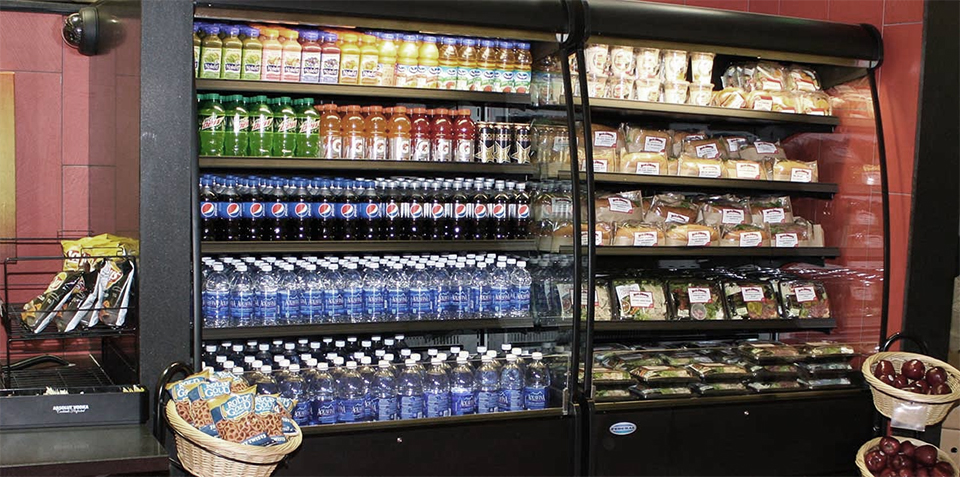
Sociologist, Ray Oldenberg refers to this type of space as the “Third Place” a social setting distinct from both home (the first place) and work (the second place). Historically, people flock to places of reprieve with a sense of community in the likes of coffee shops or pubs. The concept of third place isn’t new; but it’s new within travel centers.
David Zaccheo, Associate Principal and Studio Leader at Rockwell Group, discussed the implications of culture as a result of creating a well design social and public space within transportation centers. Like the beauty of a big city, this constant flow of activity and interaction creates it’s own broadly defined culture. David said this shift is only beginning with hospitality leading the charge in unique experiences surrounding food and beverage in the form of concept cafes.
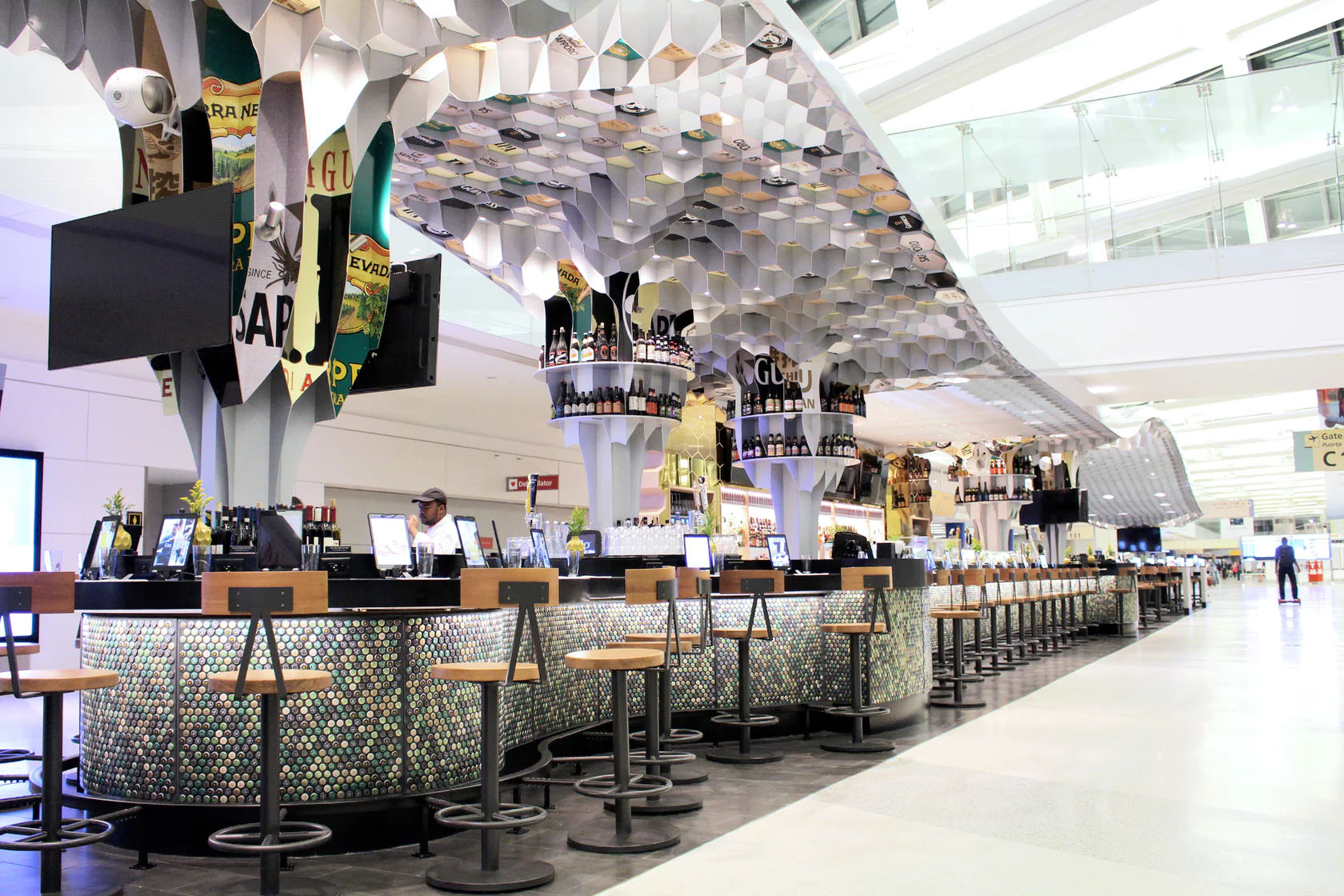 Caps Beer Garden, Newark Liberty Airport Design by Rockwell Group in collaboration with DCL
Retailtainment
As department stores and retail in general continue to struggle with attracting foot traffic, transportation hubs might well be the PB to retail’s sticky jelly sandwich. Architect Matt Honegger, discusses airports transformation to shopping malls in this 2013 article for Airport World Magazine. Part of retail’s problem, especially for department stores, is that the outdated layout still assumes the customer is in a browsing mindset. The modern consumer has done her research, only entering the store when she knows what she wants. The lion’s share of impulse purchases are revolving around experiential product displays. Airports are a perfect vessel for both browsing and discovery in addition to duty free shopping.
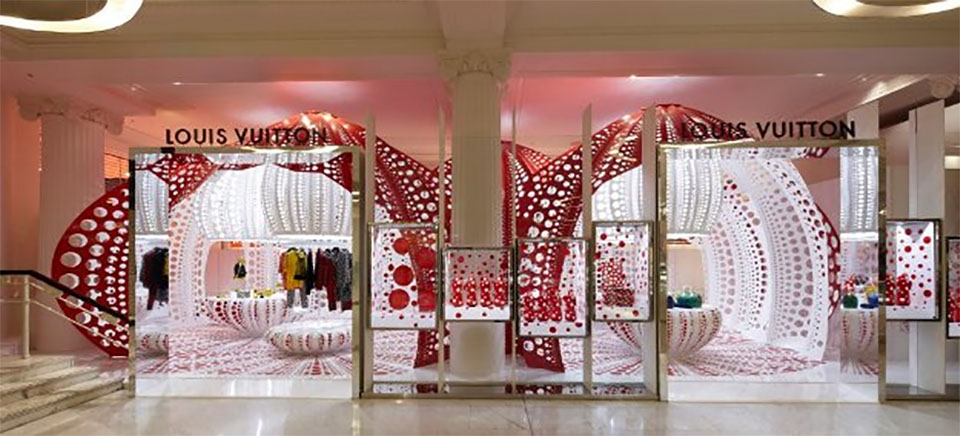 Yayoi Kusama Louis Vuitton Pop-up Shop Selfridges London 2013
Art & Culture
The democratization of art emerged from the 60’s as a movement to bring art into our every day experiences, empowering every person to judge for themselves it’s value and place in his/her lifestyle and culture. As artists embraced modern vehicles to distribute their work to broader audience, pop-culture and mass-media hijacked the art world from it’s academic gate keepers. Evidence of this trend can be seen in public spaces around the globe as installations by Jeff Koones became public events and Urs Fischer’s ‘Untitled Lamp Bear‘ became a permanent fixture that define its location.
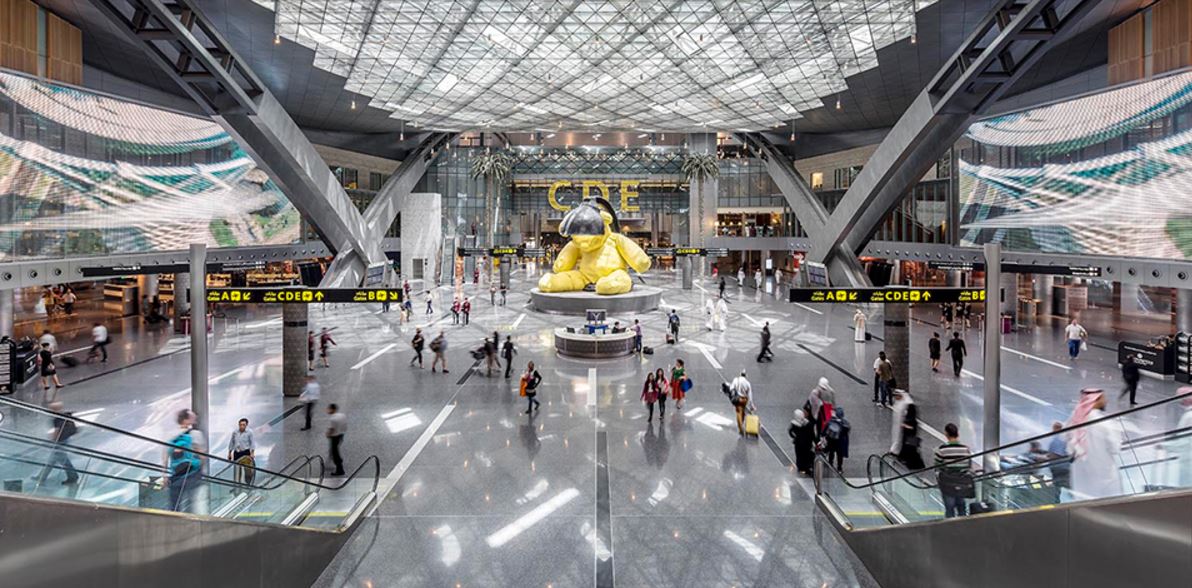 Hamad International Airport Passenger Terminal Complex HOK Design Art Installation
Academia is finally joining the party as curators are hired by organizations to assemble regular public installations. Kathy Greenwood, Director of the Art & Culture Program and Albany International Airport has gained national recognition for the quality and scope of its presentations. Kathy has been instrumental in curating exhibitions as well as overseeing the award winning retail enterprise Departures: The Shop of Capital Region Museums. Her contributions created a distinct culture to an airport that is now considered a destination in and of itself.
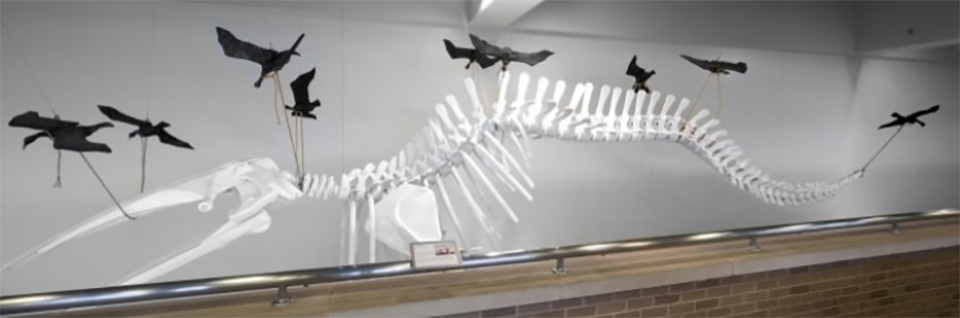 “Cormorants and the Whale” by Colin Boyd, Albany International Airport
Health and Wellness
Constant connection, going and doing fueled by our technology and ambition to make a better future leads to burn out. Constant demands for our attention, work/life balance and a nation wide obesity crisis are calling for a lifestyle redesign. A healthful and human centered design focus has become part of the conversation in many professional organizations including the AIA. We are often somewhere between home and office, self-care trends pivoted from home spa to localized oasis centers. Travel hubs are following suit as Chicago O’Hare International, San Francisco International and Heathrow in London include gyms and “quiet rooms” for meditation and yoga among their amenities. Phoenix Sky Harbor International offers a fitness trail with views overlooking mountains and parks. Transit hubs are even planting green spaces. Abu Dhabi International Airport has installed sleeping pods.
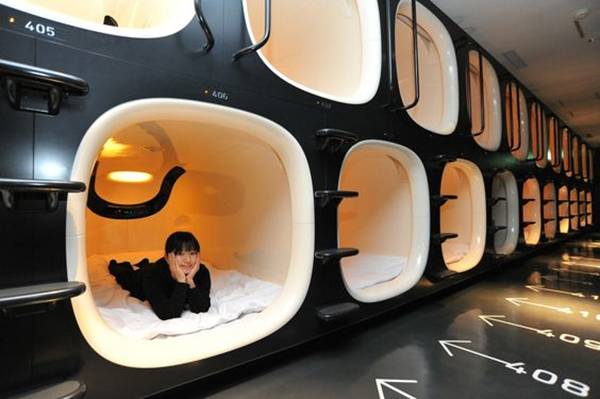 Nine Hour Capsule Hotel Kyoto, Japan
The Future Ain’t What it Used to Be
Robert Chicas at HOK offers predictions for the future in this interview while observing that the future is always changing. Speculation is our guide through the process we consider these concepts as we apply our skills to future design. Building culture and sense of place into travel hubs goes a long way toward bridging the gap of non-place. How can YOU advocate some of these concepts in your industry or field of study right now? I’d love to hear your perspective, join the conversation with #designingforfuture or leaving a comment below. Send a message garrott@garrottdesigns.com.
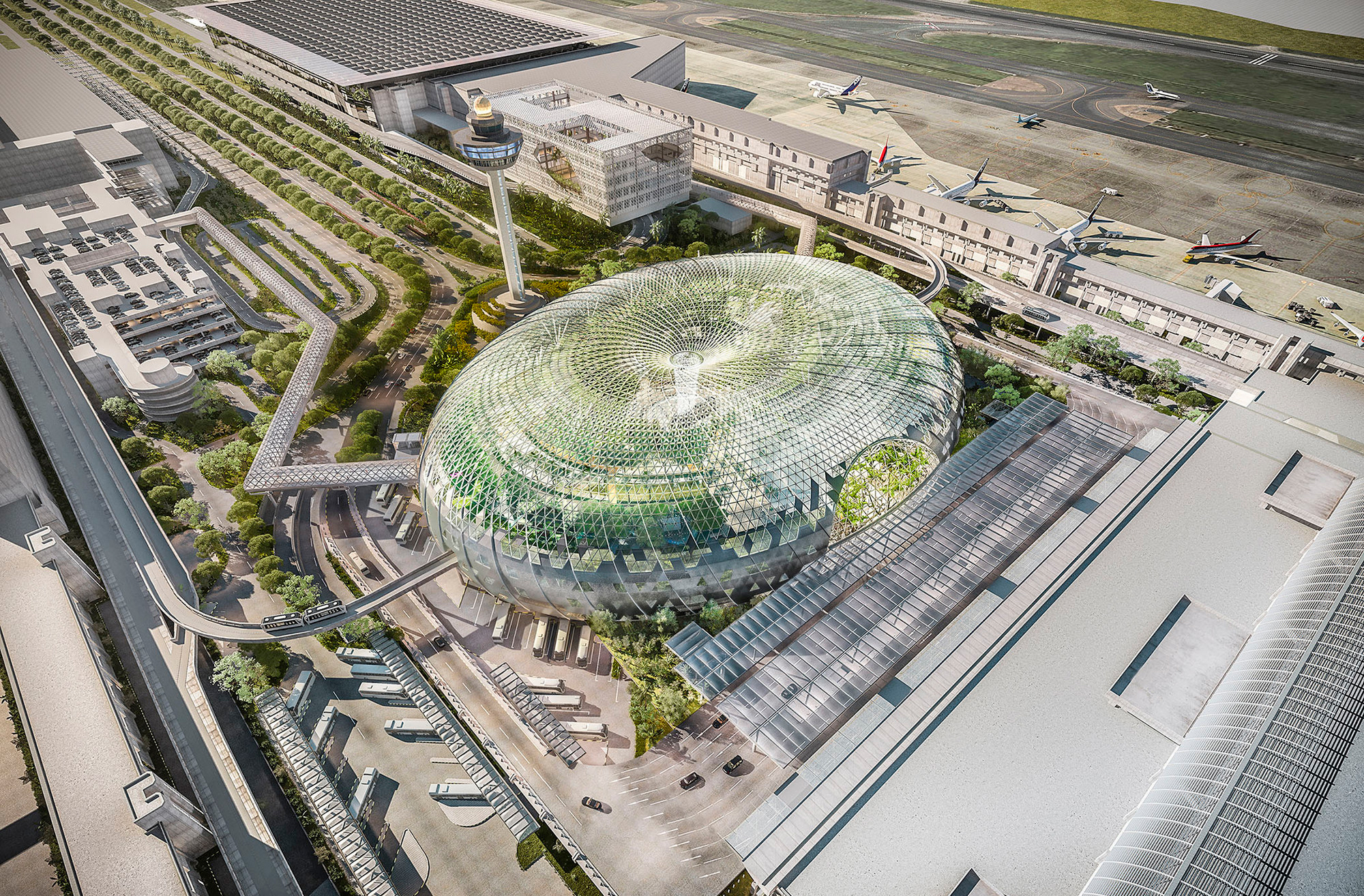 Jewel Changi Airport, Singapore
As mentioned, this blog post is part of the Design Blogger Competition organized by CGTrader. To share this post on social media, use #designingforfuture to join the conversation with a community of thought provoking designers.
The post Designing for the Future: Trends We Need to Consider Now appeared first on Garrott Designs.
June 3, 2017
Urban Architecture Sketching NYC: World Trade Center
For my third summer sketch location I went to Westfield World Trade Center. I’m a big fan of Santiago Calatrava especially for designing the Milwaukee Art Museum addition. I can’t always get back to Wisconsin when I like so this gorgeous little anomaly is my NYC fix. There is controversy about the significance, cost, value and function of Wesfield as a transit hub, shopping mall or even a monument. I can see the perspective of most of those arguments but from a purely experiential perspective, Calatrava did create a spectacle that provokes awe and wonder.
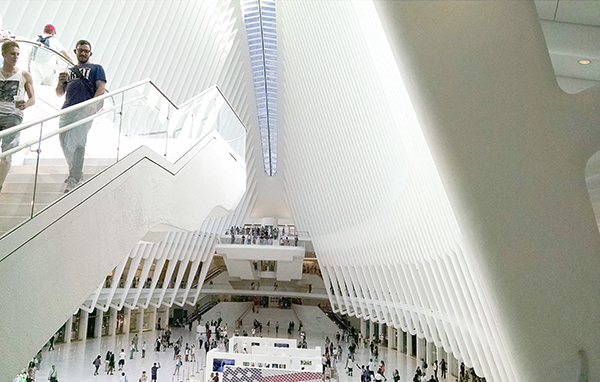
Urban Architecture Sketchers
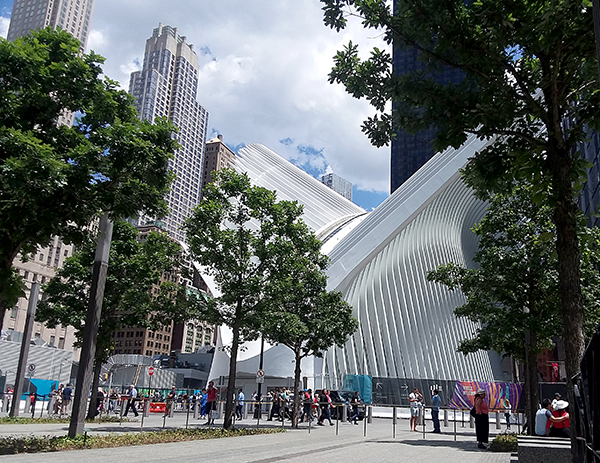
I looked for the best angle through flourished trees which ended up being on the ground tucked under a tree. I was surprised that was allowed, I’ve been told not to sit on the ground in densely trafficked areas before. Happily, I was out of the way and passers by enjoyed watching. Someone was playing bag pipes in the distance so I opted not to install my usual iPod playlist.
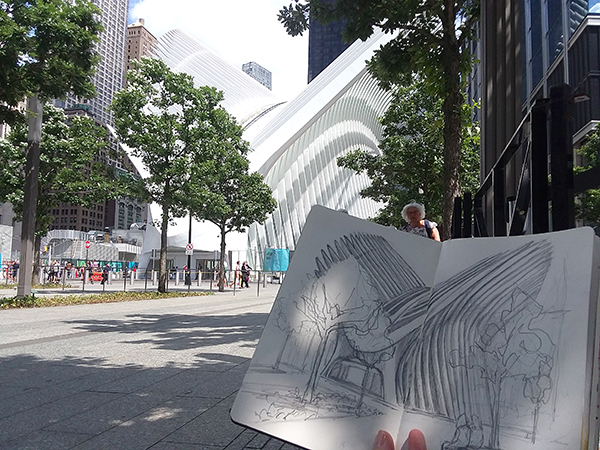
Pencil or Color?
I wanted to keep it about light, shadow and form so I didn’t use my usual watercolor set. Next time I will bring my gray scale markers. I think this would have been a great opportunity to pull them out and erase the pencil lines. Out in the wild I don’t always know what I’ll need so I plan with the most efficient tools and least baggage, a pencil and my travel watercolor set.
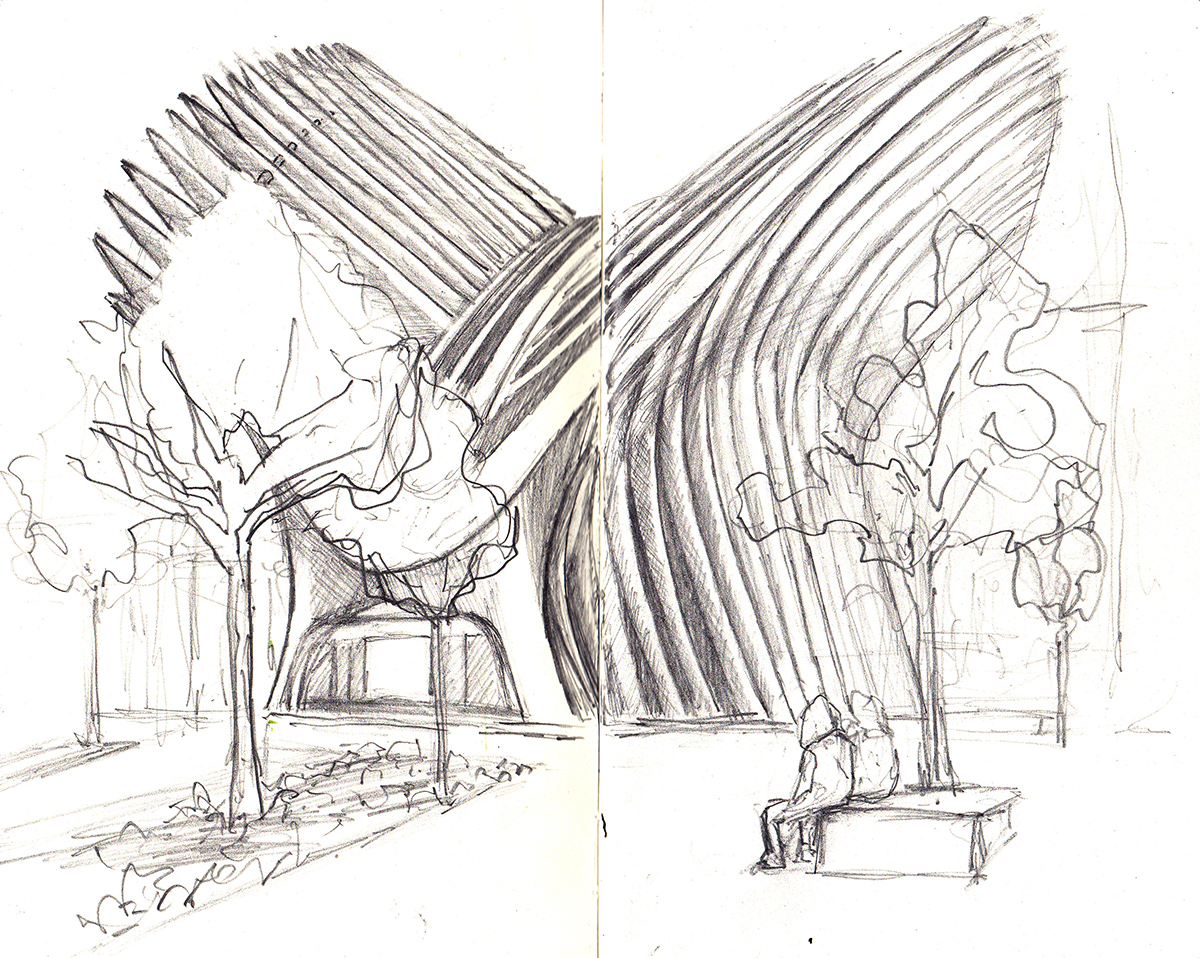
Studio Revisited
Back in the studio, I still wanted to try those markers and even throw down a little color.
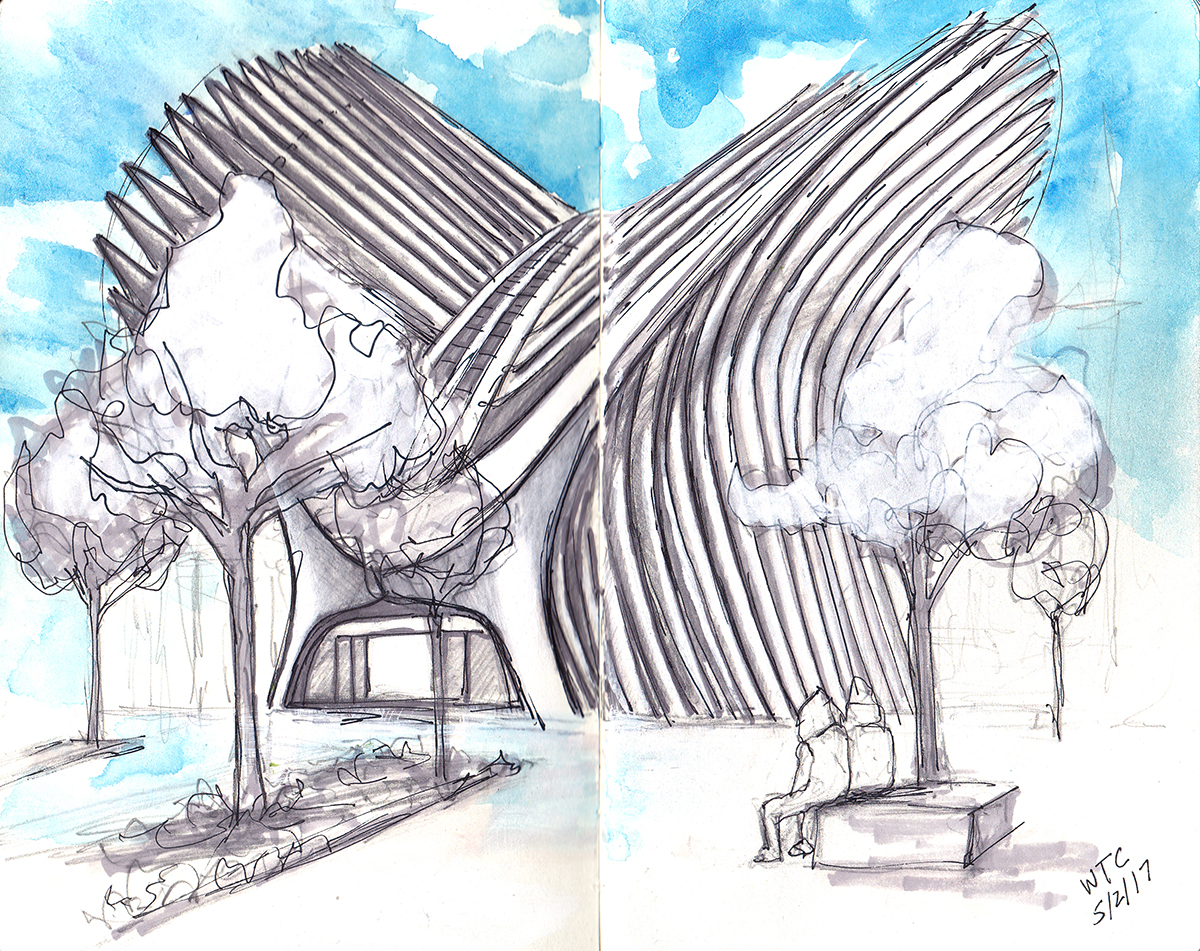
I went in 30%, 50% & 70% gray then brightened with white gouache and tossed in the sky. Combining materials after the fact is a fun way to think back around the process. I had fun in the sun and made in the shade.
The post Urban Architecture Sketching NYC: World Trade Center appeared first on Garrott Designs.
May 29, 2017
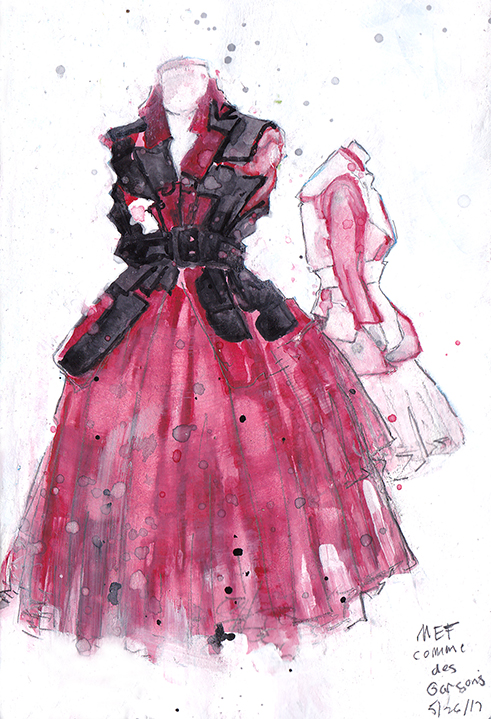
Comme des Garçons Art of the In-Between MET Sketches
Summer Fridays are here! This week, I sketched at the MET costume institute’s new exhibition, Rei Kawakubo/ Comme des Garçons “Art of the In-Between“. Fashion is a source of inspiration, especially when the construction and concept exceeds the expectation of function. When fashion elevates the idea of form and line into something more abstract, I get this tickle in my brain.
Into the Abstract:
” My clothes and the spaces they inhabit are inseparable – they are one and the same. They convey the same vision, the same message and the same sense of values.” -Rei Kawakubo
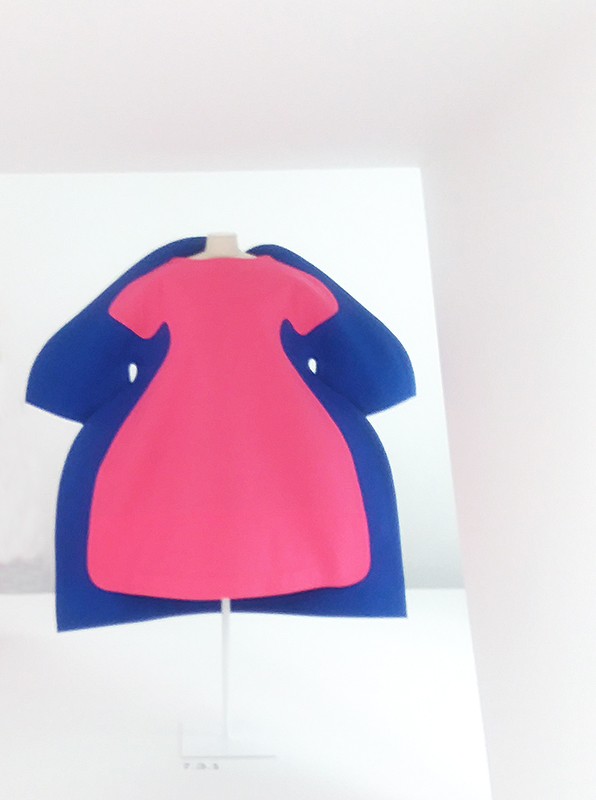
Design / Not Design:
Rie Kawakubo challenges fashion because she wasn’t taught to be a designer in the traditional sense. Her intuition led her to design before convention.
” I wasn’t limited to the confines of a pattern. Not being educated, not being taught how to design, I was able to visualize in a completely different context. And I still seem able to draw upon the unconventional.”
-Rei Kawakubo
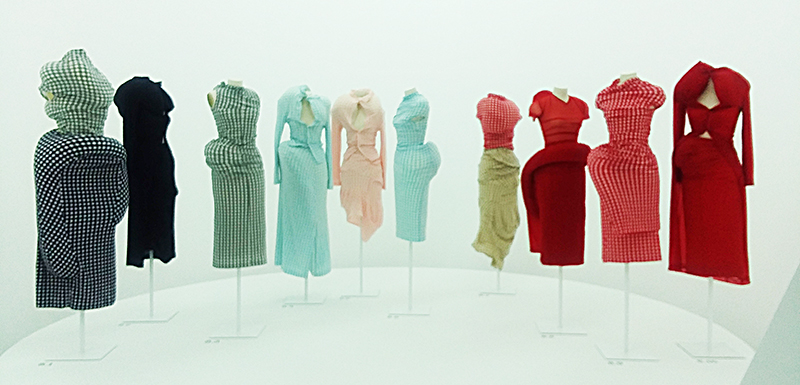
Fashion / Antifashion:
The conversation isn’t always about commercial or not commercial. At the heart of what we do, is design. Taking and pushing direction can coexist.
” I am not protesting against fashion. This is something else, another direction.” -Rei Kawakubo
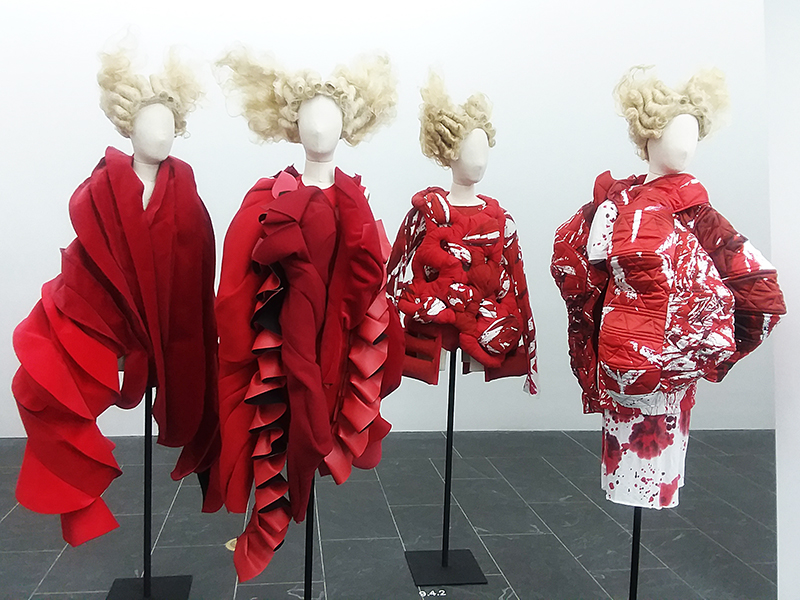
Model / Multiple:
Drawing on art and product is what I do every day as an artist and designer working in the industry. The Model and the Multiple resonates with me in many ways as I attempt to uncover the difference between observation and consumption. I sketch to understand. Sketching is both observation and consumption. Maybe fashion is also both, Rei Kawakubo is able to blur this distinction. For these sketches I used watercolor and gouache on Moleskin sketchbook paper.
” Fashion is not art. You sell art to one person. Fashion comes in a series and it is a more social phenomenon.” -Rei Kawakubo
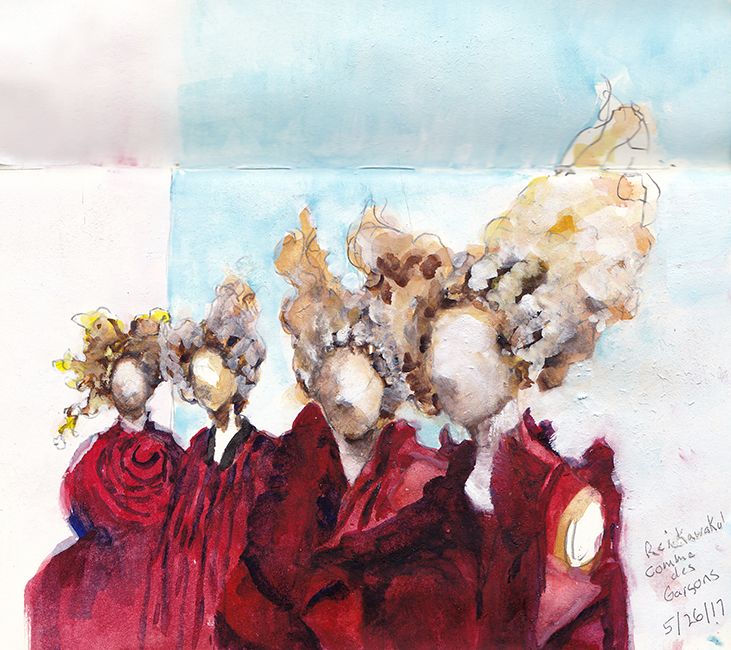
Object / Subject:
Are we wearing the dress or is the dress wearing us? Clothing has the ability to transform character. Just ask “Dress for Success”
“I want to rethink the body, so the body and the dress become one.” -Rei Kawakubo
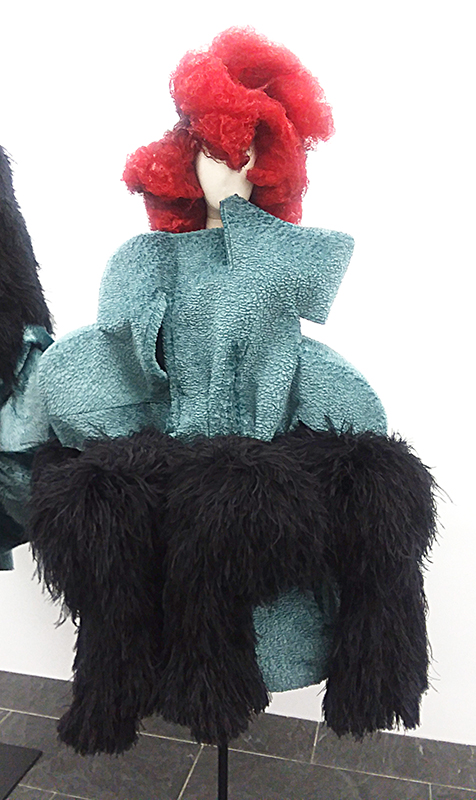
I sketched this one because I love how the proportions completely changes the character of the model in clothing.The figure remains recognizable but the story becomes about shape and color.
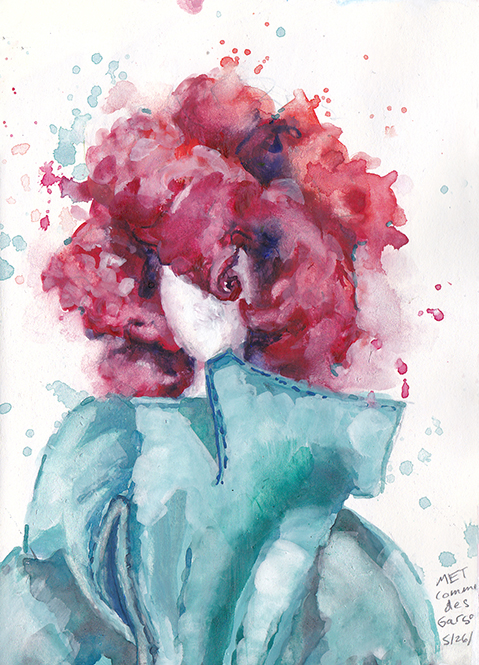
Form / Function:
“Personally, I don’t care about function at all… When I hear ‘where could you wear that?’ or ‘it’s not very wearable,’ or ‘who would wear that?’ to me it’s just a sign that someone missed the point.” -Rei Kawakubo
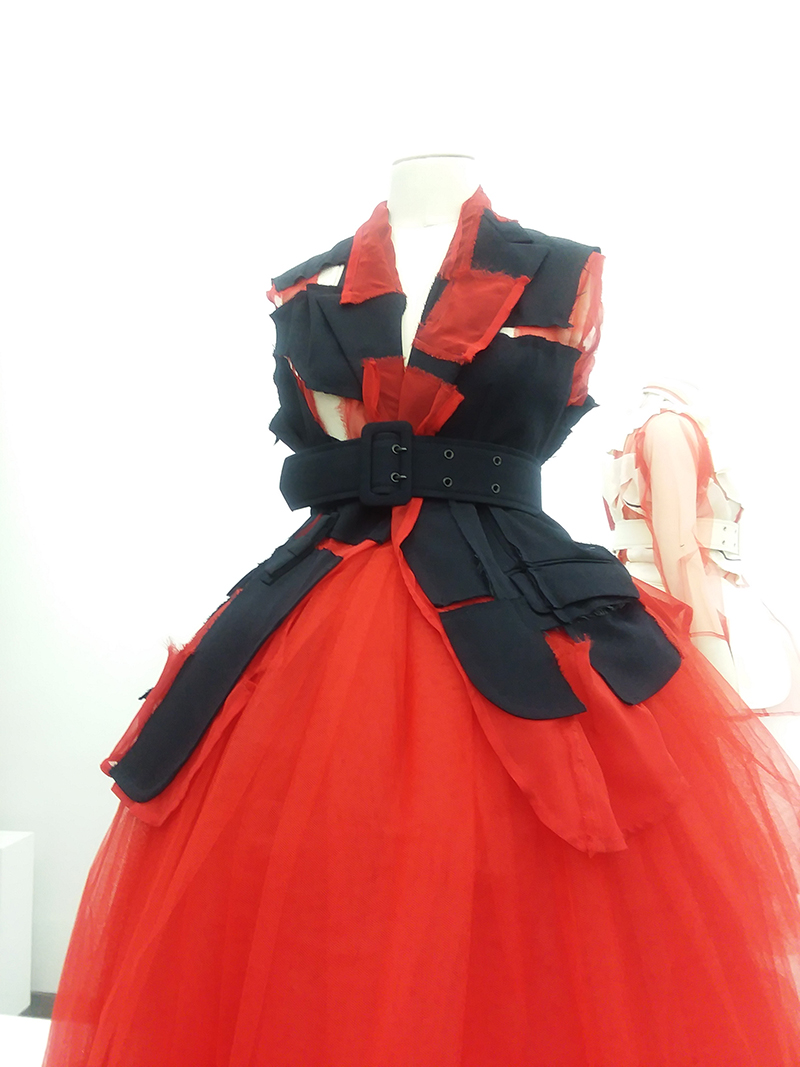
Clothes / Not Clothes:
“If we say ‘these are clothes,’ it’s all very usual, so we said ‘these are not clothes.’ It sounds like Zen dialogue, but it is very simple.” -Rei Kawakubo
Abstraction / Representation:
“Things that have never been seen before have a tendency to be somewhat abstract, but making art is not my intention at all. All my effort is oriented towards giving form to clothes that have never been seen before.” -Rei Kawakubo
The post Comme des Garçons Art of the In-Between MET Sketches appeared first on Garrott Designs.
May 28, 2017
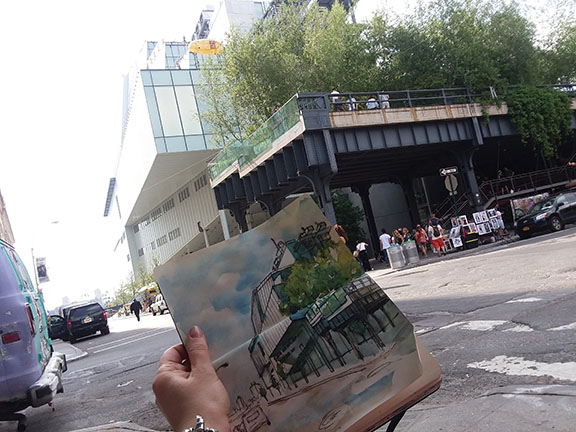
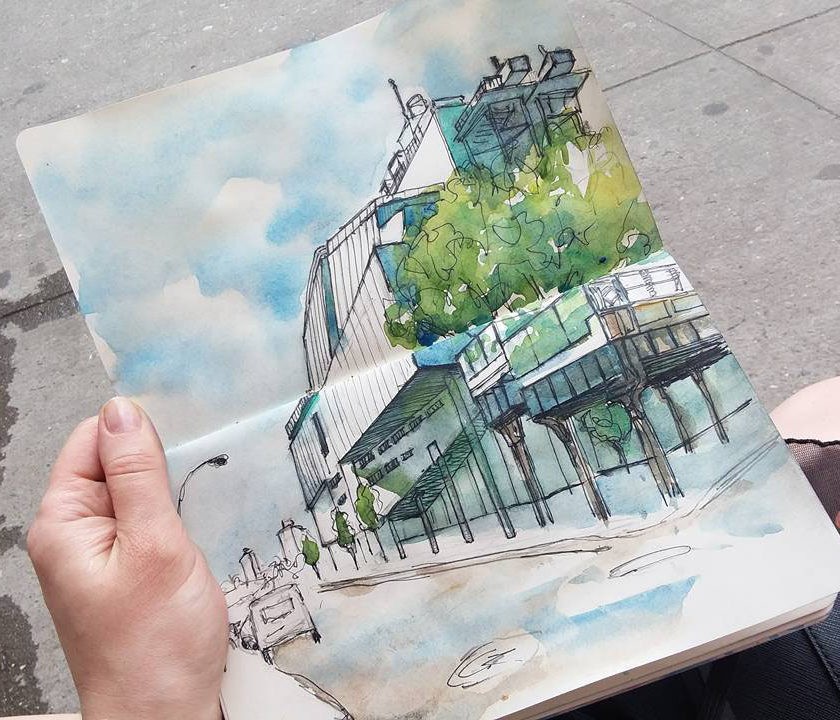
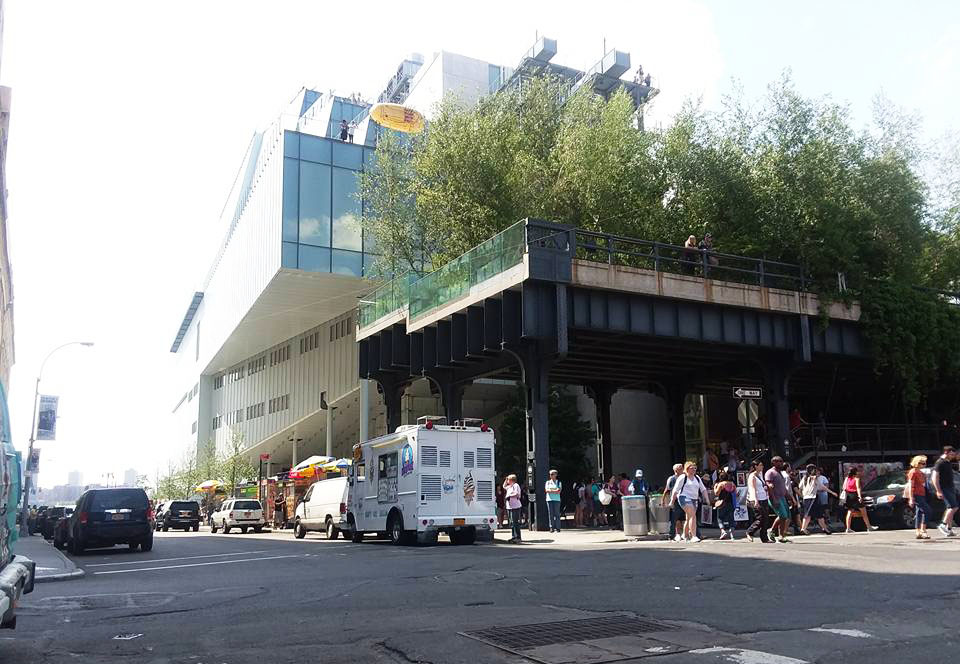
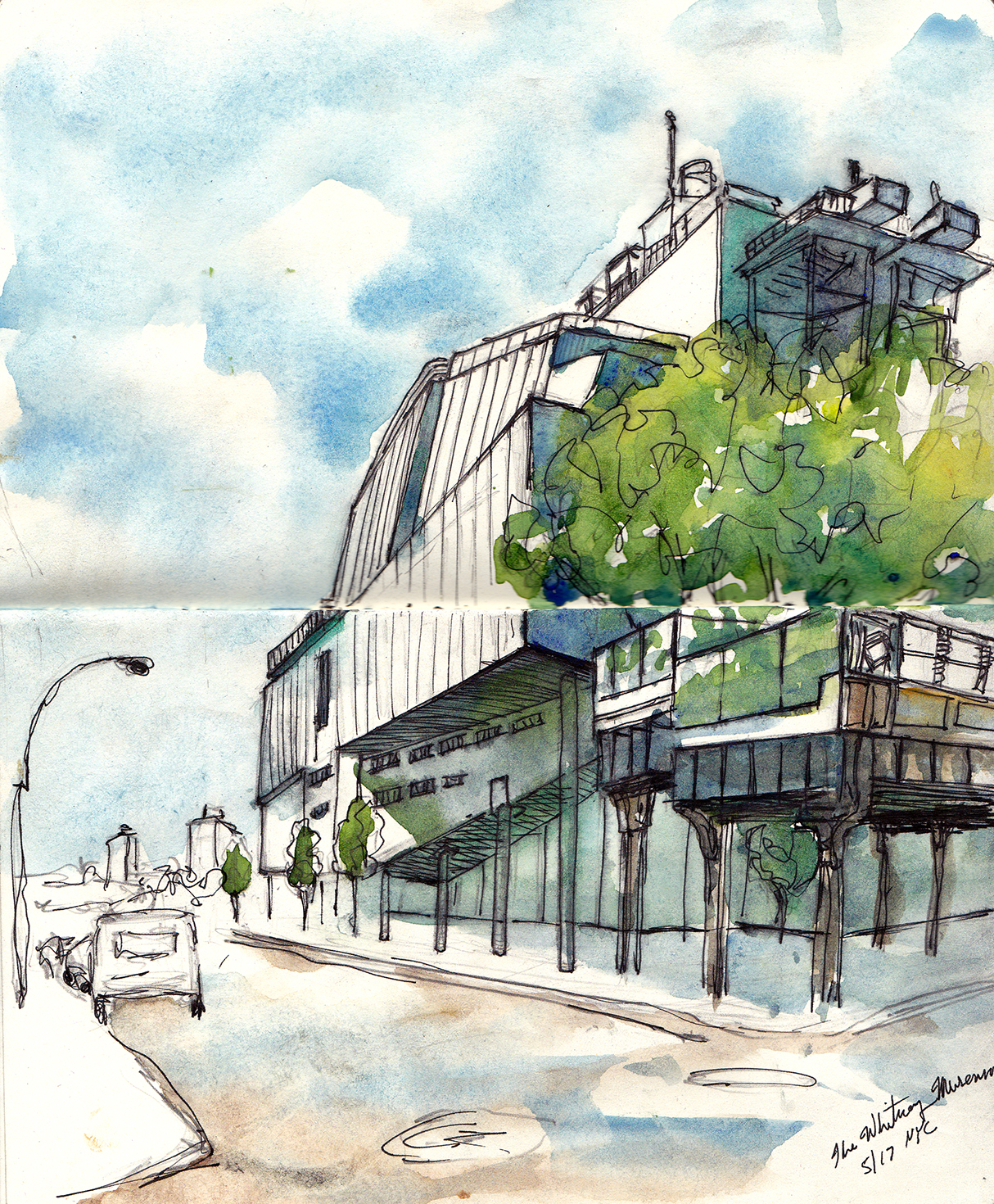
Urban Architecture Sketching NYC: Whitney Museum
I love sketching from life, be it figure drawing at Society of Illustrators or travel sketching. Summer is rapidly approaching. I plan to do more sketching of some of my favorite New York City locations. Here is the first sketch of summer, the Whitney Museum. If you’d like to receive updates, be sure to subscribe to my newsletter at the bottom of this page. If you’d like to join me on a sketch day email me at garrott@garrottdesigns.com to find out when and where.
The post Urban Architecture Sketching NYC: Whitney Museum appeared first on Garrott Designs.


