K.L. Tremaine's Blog, page 3
April 16, 2015
The Deck of Fate
A couple weeks ago (the last time I was at Source Comics & Games in Roseville, MN), I picked up The Deck of Fate, a card-based randomizer for the Fate role-playing game (which I reviewed back in August). The deck contains 15 cards that are pretty much “pretty/inspirational art for character building in the role-playing game,” which is totally awesome, but the bulk of the utility of the deck is the suit of dice, which is an 81-card deck that simulates the randomness of a 4dF roll.
This is an interesting way to play Fate. Presumably a player would draw a hand of five or seven cards, which would allow, then, a bit more strategy in the game while still permitting randomness to hold overall (the player can choose her failures strategically, rather than taking them as they come – a distinct positive when plotting a cinematic or literary, rather than strictly game-based, Fate game).
My “first run” idea for rules for using the Deck of Fate is thus:
“Random events” (the moon symbols on the tops of the cards) should be complications – they should not be used to negate (partially or fully) the effect of the card played.
Each player receives a hand of seven cards from the Deck of Fate at the start of play. At the start of any turn where the player has fewer than 7 cards they may draw at least 1 card; at the start of any turn where the player has fewer than 5 cards they may draw until their hand contains 5 cards.
Fate cards can be spent to refresh a player’s pool of Fate points, the spent fate card(s) will correspondingly lower the player’s maximum and minimum hand size, to a minimum of 4/2.
At the end of a scene, a player’s hand reverts to 7/5.
A player can spend a Fate point at any time to discard their hand and draw 7 new cards, additionally ending any hand size restriction.
Any suggestions for further Deck of Fate rules? Post in the comments!



April 9, 2015
AWP Day 1
I’ve gotten some swag including a new t-shirt (which was useful as an impromptu hat to keep the sudden April snow off) and some new ideas, including ideas involving sex scenes.
This morning I went to the most pointless and depressing panel I can remember going to in a long time – this was about getting a job with an MFA, which is something that understandably all MFA graduates want (having graduated with some degree of student debt in addition to their Master’s Degree). But it began with a 10-minute self-flagellation on the part of the first speaker (a college professor in an MFA program) about how college MFA programs are getting more expensive and the price of an MFA is a major bar to admission and blah de blah de tedious blah, your guilty conscience isn’t stopping you from teaching writing to grad students. The rest of the panel was about looking for work that’s not necessarily capital-W Writing, which is something that I think most graduate-level creative writing students do anyway.
The afternoon panel I attended, on the subject of sex scenes written by women, for women. This one was more interesting. Instead of talking about feeling guilty about teaching graduate-level English to adults who signed up for this panel. One of the best pieces of advice I got out of this panel: Unless you’re writing porn, don’t worry about whether the sex scene you’re writing is hot. The thing about a sex scene is what it reveals about the characters who are in it, and about the story world.
I spent a lot of time today in the bookfair, talking to publishers and booksellers, I bought a few books and a game, caught up with a few people, and spent a lot of time inquiring about submissions and other things of interest. And got a couple of interesting fiction prompts out of the deal.


April 4, 2015
Vox Day: Christians need to follow the lead of #GamerGate and the Spanish Inquisition to defeat seculars, Satan

Vox Day: At it again.
 Originally posted on we hunted the mammoth:
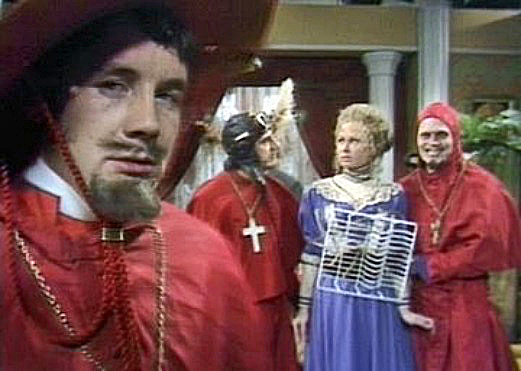 NOBODY expects the, well, you know.
Over on Vox Popoli, everyone’s favorite far-right fantasy author Vox Day (Theodore Beale) is pig-biting mad that pizza parlors in Indiana won’t be allowed to refuse service to gay people. And so he’s doing his best to rally the troops for a real-world Culture War Deathmatch, urging Christians — or at least the right kind of Christians — to “stop their cowardly cowering before the world” and start acting like “the apostles and martyrs and crusaders and inquisitors who preceded them.”
Oh, and like the dudes who’ve been having a giant public temper tantrum about video games and evil SJWs with dyed hair for the past 7 months:
View original 752 more words


March 30, 2015
White Pride, White Shame
 Originally posted on Kvasir Amongst the Gods:
 This one is going to be a serious one; buckle up. (I’ll try to be funnier next time)
There is a talking point that says being Anti-Racist is just a phrase to indicate that someone is, actually, Anti-White. The conceit hidden within that statement is that White Pride must obviously be this super healthy thing to have. It’s time we take this conceit head on, because there is a lot wrong with White Pride and how it functions in today’s society. Usually, this is where someone opens up the connections with the Ku Klux Klan, Neo-Nazis, and other White Supremacists groups. They talk about the evil, violence, and terrorism these groups have committed (and continue to commit) against others, and how these are bad things. They are of course, bad things, but that’s pretty well trodden ground; at this point, you’re either on board with how history has recorded these…
View original 1,122 more words


Where did the month go?
It feels like my projects – including writing short stories for this blog – have gotten derailed over the last month. Nothing but to get back on it!


March 19, 2015
5 facts about me
As far as I know. I expect a sibling or parent to correct me on this if it’s not true.
My last job was a grant-funded research project studying LGBTQ themes in popular fiction. It was by far my favorite job ever, and didn’t last anywhere NEAR long enough.
The hardest part of any manuscript for me to write – dramatic, fiction, or nonfiction – is the middle of the narrative.
My main hobbies are games (both electronic and paper-based), music, and roller derby (my favorite league is the Minnesota RollerGirls – and please don’t ask me to choose a favorite team!)
I live in an apartment with way, WAY too many books.
… HAHAHAHAHAHA
Just kidding. There’s no such thing as too many books.


March 8, 2015
Crossworlds Affair
The rough draft is written.
There’s at least two major plotlines that need to be added by the next draft, but I have a complete story.


February 25, 2015
State of the Kate: February 25, 2015
I’ve been quiet for the last week because I’ve been juggling four writing projects. But here’s the skinny:
My next LGBTQ column for Twin Cities Geek is going to be ready to submit by the end of this week. It’s about using speculative fiction as a way to discuss transgender experiences, inspired by a combination of Jupiter Ascending and Topside Press’s upcoming transgender author short speculative fiction anthology (which I will be submitting work to).
I’m working on pages for my screenplay project for my MFA, and another screenplay project that if I’m very very very very lucky might be done before CONvergence. I’m hoping to have a dry reading at Manticon – unedited dialogue, Nerf props and minimal set design – if we can get enough people.
I should have the Crossworlds rough draft story-complete by the 2nd of March (yes, that novel that I SAID was going to be coming out fall of last year… I’ll get around to changing that on my about page one of these days). I’m trying to have it ready for a friend to read when she goes out of town next week.
So that’s the State of the Kate – if you have questions, please leave them in the comment box and I’ll answer them as soon as I can!


February 15, 2015
Pathfinder Design Theory 1: The Shadowdancer
One of the things I’d really love to do in Pathfinder is fix the Shadow Dancer. Because it’s such a cool conceptual class concept – the rogue who has learned shadow magic while not sacrificing their rogue-ness – but it falls so badly flat; partly because it was originally designed in the early days of D&D 3.0 when even Wizards of the Coast didn’t really know what they were doing with the system.

Merisiel the iconic rogue as a shadowdancer. (c) 2015 filkearney.deviantart.com
The Shadowdancer has always had the problem that even though the prestige class is FULL of conceptual coolness, it’s let down by its early design – it was one of the first prestige classes designed for D&D 3rd Edition, and because of that its powers are a bit scattershot in nature, it’s a bit frontloaded, its entry requirements are onerous and it’s generally not as powerful as continuing to take those levels as a rogue.
My design goals for my Shadowdancer revamp, therefore, are:
Improve class entry: Pathfinder did a good job of this; class entry was reduced from 8th to 6th level in the Pathfinder revamp. The Perform (dance) skill is problematic for the class because it doesn’t convey any mechanical benefits; it’s a thematic choice but not a mechanically good one, and it eats skill points that could help the character in other tasks (this is a common problem with the Perform skills; from a min-max perspective unless you’re playing a Bard they’re wasted skill points). Combat Reflexes is again not a bad choice but not an optimal one; that feat slot might be better used in other ways. I want to keep the class entry requirements, overall, at two skills and three feats; this will encourage players to enter the prestige class around level 6-9.
Mechanically coherent theming: The major thematic tropes of this class are killing people from the shadows, sneaking in the shadows, and shadow magic. Note the word “shadow” in all of these, not coincidentally it’s also in the class name. Make sure that all the class-specific level-ups are about shadow manipulation.
Mechanically better: Both the 3.x and Pathfinder incarnations of the Shadow Dancer sound cool but tend to be pretty incoherent in play. This goes back to the coherent theming and mechanics.
So next week I’ll post a few design notes and my rough draft of the revised class entry requirements.
Thanks!


February 13, 2015
The Bildungsroman
I’m going to follow up my post yesterday praising the Wachowskis’ widely panned Jupiter Ascending by talking about the genre from which it comes – no, not space opera, I talk about that a lot more often. I’m talking about the Bildungsroman – the “coming of age story.”
The Bildungsroman is one of the most popular fictional story constructs in Western culture. In Robert A. Heinlein’s three (he claims) most basic story structures in the English language, it’s “boy becomes a man.” (or “girl becomes a woman” as it were).
The bildungsroman as a story construction is oversimplified by Western movies – we tend to assume that our characters are already competent adventurers, even if they just came out of a pretty normal lifestyle (or if, as in Jupiter Ascending, they actually came out of an underprivileged life of an assimilated-but-still-immigrant laborer who lives with her Russian extended family in Chicago and works in the homes of the very wealthy). Jupiter is not trained in any skill set that would help her in this adventure: She’s not a skilled warrior (the extent of her knowledge of fighting appears limited to bashing someone with a pipe or a wrench), nor a computer expert (not that being an excellent coder, a la Neo in The Matrix, would be of any help to her in a world where the basics of coding are literally millions of years more advanced than they are on Earth).
What Jupiter has going for her, uniquely, is that by being one of the Entitled in the galaxy – the elite who wield more money and power than a human being of our Earthly civilization can dream about – gives her power, but it’s a precarious form of power that also affords her no room for missteps or mistakes.
Her progress through the film is from acquiescence to agency; when she refuses Balem’s apparent victory, she becomes the heroine. Until that point, she’s the protagonist, but she’s also the Fool: A callow youth who may or may not become the hero.
If we think about Star Wars – the definitive male-oriented modern-day film bildungsroman – Luke Skywalker primarily relies on his allies until the moment that he chooses to stand with the Rebels flying into battle against the Death Star. Until then he is primarily following the lead of mentor figures – first Uncle Owen, then Ben Kenobi, and finally Han Solo. And like Jupiter, Luke spends act 2 growing tentatively into his own agency until he finally takes charge in act 3. The difference being that Luke shoots a blaster throughout act 2. Jupiter, well she’s got the bad luck to be in a position here gunplay would make her position substantially worse.