Steve Gannon's Blog, page 2
February 28, 2015
Inside Kindle Scout – Published!
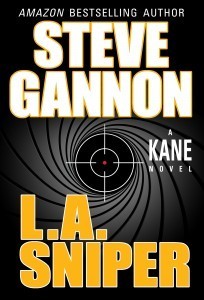
 L.A. Sniper has been published!
As one of the first authors to be selected in Amazon’s new Kindle Scout publishing program, I have been posting a series of articles describing my experience⎯writing in the hope that other authors who are considering submitting their own work to Kindle Scout can make an informed decision on the process. Previously having been published by a traditional publisher (A Song for the Asking, Bantam Books), I think I’m also in a position to compare fairly my various roads to publication.
We’ll get to that last part later. Right now, what’s been happening since I teamed up with Amazon? Well, not much at first, and then lately a whole lot, including several pleasant surprises.
After submitting my fourth “Kane Novel,” titled L.A. Sniper, to Kindle Scout in October and having my manuscript accepted for publication by Kindle Press in November, there followed a tedious period of filling out tax forms, setting up Amazon payment accounts, waiting for my advance to arrive, and the like. During this time I met online with a number of the other Kindle Scout “winners,” getting to know a diverse group of fine writers who were in the same Kindle Press publishing limbo as I. Daily, we traded emails filled with probing questions like “Have you heard anything yet?” and discouraging answers like “Nope.”
Published by Kindle Press
Then, in mid-December, the sun came out with a phone call from a real person at Amazon! Caroline identified herself as my new Kindle Press editor and informed me that Amazon was preparing to do a copy edit of my manuscript. This welcome news was totally unexpected, as Kindle Scout guidelines stipulate that all submissions must be “publication ready.” I had spent considerable time, effort, and money preparing a “clean” manuscript, but from experience I knew another professional edit could make my work even better. And it did.
In mid-February I received an edited version of L.A. Sniper for my approval. The revised version proved to be a thorough and comprehensive edit by Sherri Schultz, whom I highly recommend. Other Kindle Press authors with whom I have talked say they’ve had a similar editing experience with Kindle Press as well.
Which makes one wonder: will Kindle Press continue to provide high-quality editing to future Kindle Scout authors, or was this simply done for the Kindle Press inaugural-book launch? I don’t know the answer, but I’m glad I got in on the ground floor.
Another question: how about improvements to the covers? Nope, that wasn’t done on mine, or, to my knowledge, on any of the other selected books. If you’re going to submit, my advice would be to make certain your cover is professional quality. Along those lines, despite the possibility of additional Kindle Press editing, I would try to submit a clean a manuscript, too. Maybe Amazon will continue to provide editing, maybe not.
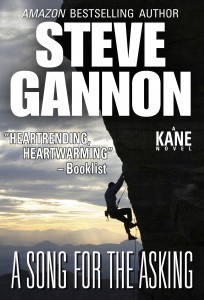
Published by Bantam Books
Okay, let’s get to the bottom line. How has my Amazon Kindle Press experience measured up to my Bantam Books experience? To date, with the exception of Amazon’s nominal advance, Kindle Press wins. Hands down.
For one, Kindle Press published my book (in eBook format) mere months from acceptance. Granted, Bantam published A Song for the Asking in hardcover, which is a bit more involved, but they took over a year to do so, and not much was happening for long periods of time. Second, the Amazon folks have responded quickly and professionally to all my communications, something that generally was not the case with my trad publisher. Last, teaming up with Amazon has already resulted in national print, online, and radio exposure for L.A. Sniper. Because Bantam was under the gun to make good on my six-figure advance, I received a fair amount of attention from their marketing department, but I’m hoping Amazon will do even better.
After all, the success of Kindle Scout is tied to the success of its books, and if a novel has potential, Amazon certainly has the clout to help it succeed.
But let’s get back to me. After all, this is my blog, right? And at the moment, for me the most important question remaining is this: how will Amazon promote its Kindle Press novels? And, in particular, what does the future hold for L.A. Sniper?
I can’t wait to find out . . .
Have you checked out the Kindle Scout site yet? Have any of your “nominations” been selected for publication? If you’re a writer, have you submitted a novel, and if so, what do you think? Please leave a comment (click here) and join the conversation!


December 7, 2014
Inside Kindle Scout – Under Contract!

Great news! My new novel, L.A. Sniper, has been selected for publication by Kindle Press! A big thanks to all those who hit that blue “Nominate” button. You should be receiving a free pre-release download of L.A. Sniper soon. I hope you enjoy the ride.
Speaking of which, as I’m one of the initial authors to be selected in Amazon’s new Kindle Scout publishing program, I thought I would post an occasional blog or two on the process. My hope is to give readers an inside look as things progress, as well as possibly providing some insight for writers who are considering submitting a novel to the Kindle Scout program.
Click to Preview
Here’s what has happened so far: I submitted my novel and cover, which (after a few tweaks) were quickly approved for promotion. My thirty-day nomination period started two weeks after that. I mostly stayed in the “Hot and Trending” slot, which I think is a critical aspect, as I consistently found myself checking books in that category. Good covers also caught my eye, and there were definitely a lot of great, imaginative covers.
An important point: I had trouble sticking with a book if I encountered misspellings and grammatical errors in the first few pages. My advice to authors who are considering a submission: Get professional editing first; Amazon won’t do it for you. Another thing – once the thirty-day promotion period starts, no changes can be made, so get it right before you submit.
When my promotion period ended, I was notified that L.A. Sniper was under consideration. Two days later I received a congratulatory email from Amazon informing me that L.A. Sniper would be published by Kindle Press.
Click for Kindle Scout
Since then I’ve filled out a lot of tax and royalty forms for countries in which Amazon markets books, and not much else. Tough for someone like me who likes total control, but on the upside, I’m looking forward to partnering with Amazon. By the way, I have been returning to the KS page to check out new books. It’s fun. If you haven’t already, give it a try.
So what’s next? Well, to date I’m delighted with the KS process and optimistic regarding the ultimate outcome for my novel.
I’ll update you as things develop.
Have you checked out the Kindle Scout site yet? If you’re a writer, have you submitted anything, and if so, what do you think? Please leave a comment (click here) and join the conversation!
November 20, 2014
Inside Kindle Scout – 5 Days Left
 I submitted my new novel, “L.A. Sniper,” to the Kindle Scout program a few weeks back. With five days remaining on my “promotion” period, I thought I’d post my initial impressions in the hopes they might prove helpful to other authors who are considering submitting a work, or to readers interested in getting an inside look at the process.
First, early on it was clear that Amazon had decided to tread cautiously and introduce Kindle Scout with a “soft launch” – no links on Amazon product pages, very little online advertising, and so on. Just a national press release and then silence. As a result, getting the word out to readers depended mostly on participating authors using their own social media connections (Twitter, FB, Google+, etc.) to rack up “nominations” for their novels. In time this may change, but at present those with the largest social media networks will undoubtedly rise to the “Hot and Trending” category, regardless of the quality of their writing. Of course Amazon editors will eventually weed out inferior works, but first you have to get noticed, and for now that mostly appears to be a popularity contest.
Second, in general I have been impressed by the professional quality of the covers submitted. Indie authors are definitely stepping up their game in that respect, with cover art rivaling that of trad publishing. Many of the stories look interesting as well. If there is a common weakness, it is in the editing. Grammar and spelling errors abound, even in the initial “teaser” paragraph you see when your cursor hovers over a cover. Most eBook readers will tolerate a few mistakes, but only up to a point. As Amazon has stated that no editorial services will be provided under the Scout program, authors who are considering submitting their work need to get professional editing first. In any case, in my opinion this is always a must.
Another observation: Amazon reserves the right to set the price of any eBooks published under the Scout program. When I queried Amazon on this, their response was: ” . . . while we know very well from experience that laying out a one-size-fits-all pricing plan or promotions plan for any book is not the best strategy for our authors, we are committed to ensuring any author that is published by Kindle Press earns at least $25,000 during their term with us.” Sounds reasonable to me.
Click to Preview
As for the number of Scout submissions to date, it seems that indie authors are holding back and waiting to see how things pan out. To date there have been just under 200 books submitted, which pales in comparison with the 10,000 novels submitted to Amazon’s “Breakout Novel Award” contest each year. Maybe the requirement for a professional-quality cover is keeping the numbers down; maybe the low ($1500) advance and the five-year contract is scaring people away. Or maybe it just takes time to get the ball rolling.
If nothing else, Kindle Scout has given me the opportunity to contact friends and get the word out about “L.A. Sniper.” Whether it’s picked up as a Kindle Scout publication or not, it’s been a fun ride, and either way “L.A. Sniper” will be available for purchase before Christmas. As for the Scout program itself, if nothing else it’s an interesting experiment in publishing. Will it last? I guess time will tell . . .
Have you checked out the Kindle Scout site yet? Find any authors you like? If you’re a writer, have you submitted anything, and if so, what do you think? Please leave a comment (click here) and join the conversation!
November 2, 2014
Inside Kindle Scout – eBook Royalties
There has been a lot of confusion about the author royalty percentage Amazon will pay to writers who receive a publishing contract under the new Kindle Scout program. I suppose that’s par for the course with any new program, but as money is important to starving authors (and the rest of us) who want to buy groceries and an occasional beer, I did some checking.
Here’s what I found out. In Amazon’s Submission and Publishing Agreement, the Author Royalty is stated as 50% of eBook sales (25% for audiobook, 20% eBook translation), net revenue. It’s the term “net revenue” that has been the source of confusion. In fact, I’ve read on numerous blogs recently that this “net revenue” clause will mean the royalty payment to an author will actually be in the 25% – 35% range, with Amazon doing the math.
When I queried Amazon on this issue, their response was as follows: “With regards to the 50% eBook royalty rate, the 50% is exactly the way KDP (Kindle Direct Publishing) calculates royalties. It’s 50% of sales price. The only things we deduct are electronic delivery costs, and any returns from customers or any bad transactions by customers (who use bad credit cards, etc.) – again the exact deductions KDP makes.”
So if you’re already publishing on KDP, the only Kindle Scout royalty difference will be that you will receive 50% vs. 70% of net revenue, as usual. Fair enough. No hidden pitfalls there.
Next question: Is being a Kindle Scout author worth it? Although I’m not advising anyone to enter his or her work in the Scout program, I’m figuring it is for me. With Amazon’s potential promotion behind an eBook, 50% of increased sales might work out well. I submitted my latest thriller, L.A. Sniper, to the Scout program a week ago. Since then L.A. Sniper has been in the “Hot and Trending” category, and although I’m not exactly sure what that means, I guess it’s better than being “new.”
Visit the site and see what you think. You might find a new author you like, and maybe get a free eBook as well.
Have you checked out the Kindle Scout site yet? Find any authors you like? If you’re a writer, have you submitted anything, and if so, what do you think? Please leave a comment (click here) and join the conversation!
October 17, 2014
Inside Kindle Scout – Good or Bad?
Amazon recently announced the launch of a new promotional program called “Kindle Scout,” describing it as “reader-powered publishing for new, never-before-published books.” In the program, readers get to decide whether a book will receive an Amazon publishing contract.
Click here to watch a short Amazon Promo Video (very cute)
In examining the merits of “Kindle Scout” and figuring out whom it will benefit, let’s first take a look at how it works.
For readers, it’s pretty simple. You go to the Amazon “Kindle Scout” site, browse books by reading samples, and nominate any you like (you can nominate up to three). If a novel you nominate receives an Amazon publishing contract, you get a thank-you email and a free download of the book. Upside: exploring new works by emerging and established writers, and maybe a free eBook. Downside: not much, except possibly wasting some time.
For authors, it’s a bit more complicated. In short, here’s how it works for them: An author submits a never-before-published manuscript, along with a blurb, log line, cover art, author photo, and bio. If the book receives enough “nominations” from readers during a 30-day campaign period (sort of like Kickstarter crowdfunding), and Amazon editors agree, you get a $1,500 advance and an eBook and audiobook publishing contract, along with various Amazon promotions (maybe).

Author upside: Exposure. Making your novel stand out from thousands of other available books is the biggest marketing challenge facing independent authors today. “Kindle Scout” potentially will do that by getting your work in front of a whole new audience. Plus, if you receive a contract, you (may) have Amazon’s amazing marketing machine promoting your book, and you retain all other rights to your work.
Author downside: The Amazon author’s eBook royalty is cut from 70% to 50%, although there is an advance of $1500. As opposed to the standard services of a traditional publisher, Amazon provides no editing, copyediting, cover design, or any additional advance for audiobooks or foreign rights distribution. In addition, Amazon’s five-year contract is nonnegotiable. If you submit, you automatically agree to Amazon’s terms, which include exclusive rights to eBook and audio formats. Last, Amazon can terminate the agreement at its sole discretion at any time, although there are various “outs” for the author as well.
Click here to read the Amazon “Kindle Scout” author agreement in full.
Bottom line, it appears that “Kindle Scout” will be a fun way for readers to explore new authors and new works, and maybe receive a free eBook as well. It also looks like “Kindle Scout” might be a good way for emerging authors to showcase their work and possibly partner with the biggest publisher in the world. As noted above, there is a downside, but best-case scenario, it could be worth it. At least I hope so. I’m in. I just submitted my latest book, L.A. Sniper. I’ll be in the first thirty-day promotion period when it debuts on October 27, so we’ll see what happens . . .
What do you think of the “Kindle Scout” program? Is it a good idea or just another promo scheme? If you’re a writer, would you submit a work yourself? As a reader, do you think “Kindle Scout” will be successful? Do you plan to check it out? Please leave a comment (click here) and join the conversation!
Kindle Scout – Good or Bad?
Amazon recently announced the launch of a new promotional program called “Kindle Scout,” describing it as “reader-powered publishing for new, never-before-published books.” In the program, readers get to decide whether a book will receive an Amazon publishing contract.
Click here to watch a short Amazon Promo Video (very cute)
In examining the merits of “Kindle Scout” and figuring out whom it will benefit, let’s first take a look at how it works.
For readers, it’s pretty simple. You go to the Amazon “Kindle Scout” site, browse books by reading samples, and nominate any you like (you can nominate up to three). If a novel you nominate receives an Amazon publishing contract, you get a thank-you email and a free download of the book. Upside: exploring new works by emerging and established writers, and maybe a free eBook. Downside: not much, except possibly wasting some time.
For authors, it’s a bit more complicated. In short, here’s how it works for them: An author submits a never-before-published manuscript, along with a blurb, log line, cover art, author photo, and bio. If the book receives enough “nominations” from readers during a 30-day campaign period (sort of like Kickstarter crowdfunding), and Amazon editors agree, you get a $1,500 advance and an eBook and audiobook publishing contract, along with various Amazon promotions (maybe).
Author upside: Exposure. Making your novel stand out from thousands of other available books is the biggest marketing challenge facing independent authors today. “Kindle Scout” potentially will do that by getting your work in front of a whole new audience. Plus, if you receive a contract, you (may) have Amazon’s amazing marketing machine promoting your book, and you retain all other rights to your work.
Author downside: The Amazon author’s eBook royalty is cut from 70% to 50%, although there is an advance of $1500. As opposed to the standard services of a traditional publisher, Amazon provides no editing, copyediting, cover design, or any additional advance for audiobooks or foreign rights distribution. In addition, Amazon’s five-year contract is nonnegotiable. If you submit, you automatically agree to Amazon’s terms, which include exclusive rights to eBook and audio formats. Last, Amazon can terminate the agreement at its sole discretion at any time, although there are various “outs” for the author as well.
Click here to read the Amazon “Kindle Scout” author agreement in full.
Bottom line, it appears that “Kindle Scout” will be a fun way for readers to explore new authors and new works, and maybe receive a free eBook as well. It also looks like “Kindle Scout” might be a good way for emerging authors to showcase their work and possibly partner with the biggest publisher in the world. As noted above, there is a downside, but best-case scenario, it could be worth it. At least I hope so. I’m in. I just submitted my latest book, L.A. Sniper. I’ll be in the first thirty-day promotion period when it debuts on October 27, so we’ll see what happens� . . .
What do you think of the “Kindle Scout” program? Is it a good idea or just another promo scheme? If you’re a writer, would you submit a work yourself? As a reader, do you think “Kindle Scout” will be successful? Do you plan to check it out? Please leave a comment (click here) and join the conversation!
September 3, 2014
Author Errors: 5 Common Mistakes
 Question: How do you feel when you skip your morning coffee? Answer: Depresso.
Okay—not much of joke, but I included it here to illustrate how writers can sometimes feel when finishing a project. I recently completed a first draft of my new novel, L.A. Sniper, and although I’m celebrating that milestone in what for me is a yearlong process, I’m also feeling a little depresso as well—along with maybe a bit of apprehension about sending my newborn out into the cold, cruel world. But I suppose that’s just part of the process.
The good/bad news is that there’s still plenty left to do before then. In today’s world of publishing, writing is just one part of the equation, and I decided to take a break from work to post an article on some of the pitfalls authors typically face on the way to publication.
Let’s imagine you just typed “The End” at the bottom of your brand-new manuscript. Now you want to get it out there as quickly as possible. Needless to say, you want to do it right.
So now what?
Formerly a traditional publisher did the heavy lifting required to get your book into the hands of readers—editing, copyedit, cover design, promotion, and printing. I’ve gone that route in the past, and I learned from my experience with Bantam Books that even with a trad publisher, you must get involved. And if you’re an indie author, it isn’t simply your involvement that’s required. Now it’s all up to you. You are responsible for everything previously done by a huge, professional publishing house, and you must do it well. A daunting task, but nobody ever said this writing thing was going to be easy.
There are five critical areas where things can go wrong. Although there are certainly others, in the following I’ll provide some suggestions that can help you avoid the five most common mistakes.
1. Over-Editing 
Solution: Cut Bait. The revision process can go on indefinitely, if you let it—literally taking on a life of its own. This is common in writing groups and with many insecure authors. At some point you simply have to “cut bait” and move on to the next step. Not to say that you don’t want your work to be the best it can be, but don’t get paralyzed by endless revision.
2. Technical Errors
Solution: “Vet” Your Manuscript. Carefully check all technical material in your work, and then have someone knowledgeable in the field vet your story—making certain you at least sound like you know what you’re talking about. For instance, cartridges or rounds (not bullets) are inserted into a rifle or a semi-automatic pistol via a magazine, not a clip—an error I made a few years back that garnered an avalanche of criticism from gun-enthusiasts, and rightly so. Consult with an expert and get your details straight.
3. Lack of Reader Input
Solution: Test Market. You don’t write in a vacuum. Once you have your manuscript (mostly) revised, vetted, and ready to go, preview your work with friends and readers whose opinions you trust. If they find typos along the way, fine—but what you really want is their candid comments on your story. Listen to what they say. Did your story move them? Were there plot holes? Unclear motivations? Murky character development? This evaluation is traditionally performed by a publishing-house editor, but in my opinion a “groupthink” approach is equally effective, possibly even more so. Of course writing isn’t a democratic process and you want to preserve your original vision, but you will be surprised at how often you can improve your work by opening yourself to reader suggestions and criticism.
4. Sloppy Writing
Solution: Professional Copyedit. Most readers will not tolerate sloppy writing, typos, punctuation mistakes, and grammatical errors from anyone. You need a clean manuscript, and for that you will have to PAY someone. Having a friend who’s “good at editing” won’t cut it. Find a professional and use his or her services. Period. After that you can do one final revision, making certain you don’t introduce new errors along the way. And then publish!
5. Poor Marketing  Solution: Social Media Marketing. Now that your book is out there, who knows about it besides your mom? Unless your name is Stephen King, hardly anyone, that’s who. Yours is one of tens of thousands of new books published each year. To find an audience, you must market your work. If you sit around waiting for your book to be discovered, you’re going to be sitting a long time. Step one in marketing is to have a professionally designed book cover, for which you will probably need to PAY for the services of a graphic artist. Step two is having a well designed website hub, along with various social media sites—Twitter, Facebook, YouTube, etc.—feeding into it. There is far too much in the social-marketing category to cover here, but there are many online sources (Jonathan Gunson’s bestsellerlabs.com or Joanna Penn’s TheCreativePen.com) that can point you in the right direction. To reiterate: Self-marketing is absolutely essential. Note that most successful authors devote around 70% of their average workday to writing and about 30% to marketing.
Oh, one last pitfall I forgot to mention: procrastination. Speaking of which, it’s time for me to grab some coffee, get over my first-draft depresso, and head back to work.
In your reading, have you encountered any sloppy writing lately? Does it irritate you? What are your pet peeves when reading? What are your main writing/publication problems? How do you get the word out about your work? Please leave a comment (click here) and join the conversation!
July 12, 2014
Joss Whedon: The Future of Cinema?
 There is a revolution coming in the world of filmmaking, and the first shots have already been fired. This coming revolution will transform the way feature films are financed, produced, and especially distributed—exerting as profound an influence on Hollywood as eBook publication has had on the world of publishing.
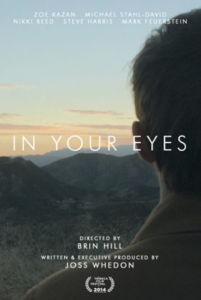
“In Your Eyes” Click to Watch Trailer
I just watched an example of cinematic things to come—Joss Whedon’s sci-fi love story, In Your Eyes. And I viewed it on Vimeo-on-Demand for five bucks.
In Your Eyes is a sweet romance wrapped in a paranormal dressing—delightfully acted by Zoe Kazan and Michael Stahl-David as telepathically-crossed lovers, and ably directed by Brin Hill. Check it out. It’s definitely worth a watch.
But what’s more important is the way in which In Your Eyes was distributed. Online. Worldwide. And direct to the consumer. But you can already watch plenty of videos on YouTube and Vimeo, right? So what’s the big deal?
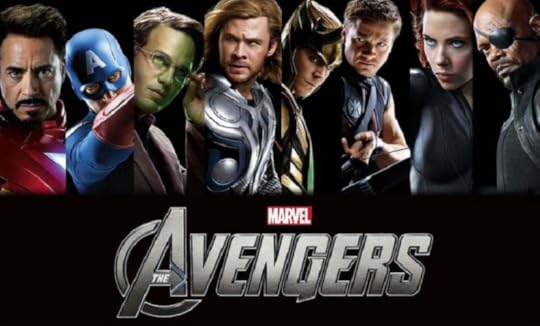
Just this: For those who don’t know, Joss Whedon is a heavyweight Hollywood screenwriter-producer-director best known for his 2012 film, The Avengers (third highest grossing movie of all time at $1.5 billion plus)—not to mention his numerous hit television productions including Buffy the Vampire Slayer, Firefly, Angel, Dollhouse, and more.
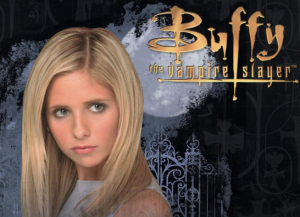
Buffy: Serious Vampire Hazard
The point is, Joss is a multitalented Hollywood player. Following a debut of In Your Eyes at the Tribeca Film Festival, Joss elected to distribute his new film online—making it available directly to the public worldwide. His words at the time were, “This is exciting for us because it means we get to explore yet another new form of distribution.” Damn right, Joss. It also means sidestepping traditional distribution and its huge associated costs, so you (and other future artists) keep a much bigger piece of the pie. Which is a good thing for filmmakers. And maybe for viewers like you and me as well.
Think of major publishing houses and traditional bookstores before the advent of eBooks, publish-on-demand, and Amazon. My first novel, A Song for the Asking, was traditionally published by Bantam Books. It took almost a year to grind through the process, and although the book was a critical and commercial success, publishing and distribution expenses ate up much of the profit. Today, as an indie author, my works are available in all formats almost immediately upon completion, and eBook publishing costs are nil. It’s a seminal change that has resulted in writers retaining more money from their writing, as well as making the future of mainstream publishing questionable.
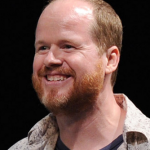
Joss Whedon
Now think of Hollywood studios, independent production houses, and nationwide theater chains—presently the accepted outlet for quality, first-run feature films. Don’t get me wrong: Major studios, independent production houses, and theater chains will always exist. But with the opportunity to view quality, first-run feature films online, which Joss Whedon has now made a reality, movie distribution will be transformed forever.
And that will change everything.
Have you watched any movies online lately? What’s your favorite? Any streaming issues? Please leave a comment and join the conversation!
June 13, 2014
Scorpions: Hazards of Writing in Italy
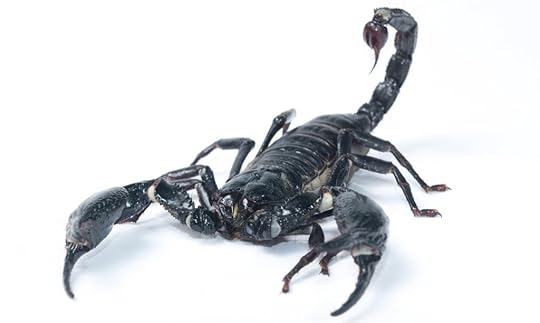
Euscorpius alpha Caporiacco in Attack Mode
At one time or another, most of us have probably dreamed of holing up in a cabin somewhere to finish a particularly troublesome project. For a writer like me, that would be the essay that’s taking forever, the manuscript that got sidetracked, the novel that keeps getting postponed by life’s day-to-day interruptions.
Even better than a cabin in the woods, how about an isolated, 800-year-old casa in Italy? No distractions there, right?
That’s what I thought before I learned about the scorpions.
Something they don’t tell you in the travel brochures: There are LOTS of scorpions in Italy! Fortunately they aren’t the kind that kill you. Of the approximately 1400 species of scorpion worldwide, only twenty-five are deadly, and Euscorpius alpha Caporiacco – the black, nocturnal species prevalent in Italy and southern Switzerland – isn’t among them. The sting of the Italian version has been likened to that of a wasp, fatal only to someone who happens to be allergic.
Nevertheless, it’s more than a little unnerving to pick up a houseplant or look under a cabinet and find one of them staring back at you. They are definitely . . . creepy. The good news is that travelers visiting Italy can avoid being stung by simply hanging up clothes (don’t leave anything on the floor), shaking out shoes, and never walking barefoot at night.

Pranzo on the Terrace
Unfortunately for me, scorpions aren’t the only distractions in bella Italia. For one, there is traffic noise at all hours, especially first thing in the morning. Nothing a chicken dinner wouldn’t fix, though.
Speaking of food, the produce here is great! Fresh vegetables, fruits, cheeses, pastas, pizzas, meats . . . did I mention chicken? I’ve been doing a lot of cooking over here. Hmmm. Maybe I can work something about that into my writing?
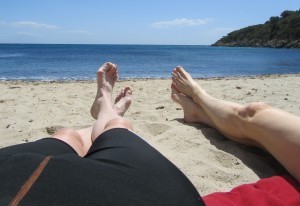
Sardinia
And then there’s the coast. Tourist season is coming up soon, so my wife Susan and I decided it would be much smarter, not to mention cost effective, to travel to the beach now rather than later. Here’s a picture of us on the sand of Sardinia.
We also visited the island of Elba, where I did some firsthand research on Napoleon that might come in handy . . .
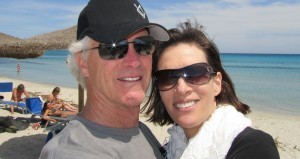
Elba selfie
Anyway, am I getting any writing done here in Italy? You bet. In fact, I’m just about to get back to work on my L.A. Sniper manuscript – the fourth in my “Kane Novel” series—right after I swat a couple scorpions, BBQ some chicken, and kick back for a while on the terrace.
What’s your worst insect encounter? Do bugs creep you out? What distracts you from your work? Please leave a comment and join the conversation!
May 25, 2014
Neologisms: Our Beautiful, Slippery Language
 A friend recently sent me the winning submissions to a contest The Washington Post ran some time back. In it readers were asked to suggest alternate meanings (neologisms) for common words. While reading the winning results below, I was struck by several observations:
First, of course, was the inventiveness of the answers. They are all complex, sophisticated, and extremely clever. What’s more, they’re funny! (My favorite is “Lymph.”) Not easy to do with what is essentially a one-word joke.
Second, because the humor involved depends on an intricate interweaving of language and culture, most of the neologisms listed would require a native speaker, or at least someone extremely fluent in English and well rooted in our society, to understand. Without a doubt, they are all ultimate examples of linguistic “in-jokes.”
Last, as a writer, I make use of words for a living. As such I was impressed and delighted by the ductile ability of our beautiful, slippery language to morph, to amuse, to reflect our lives, and to elucidate the inner workings of our minds. Enjoy!
1. Coffee (n.), the person upon whom one coughs.
2. Flabbergasted (adj.), appalled over how much weight you have gained.
3. Abdicate (v.), to give up all hope of ever having a flat stomach
4. Esplanade (v.), to attempt an explanation while drunk.
5. Willy-nilly (adj.), impotent.
6. Negligent (adj.), describes a condition in which you absentmindedly answer the door in your nightie.
7. Lymph (v.), to walk with a lisp.
8. Gargoyle (n.), olive-flavored mouthwash.
9. Flatulence (n.) emergency vehicle that picks you up after you are run over by a steamroller.
10. Balderdash (n.), a rapidly receding hairline.
11. Testicle (n.), a humorous question on an exam.
12. Rectitude (n.), the formal, dignified bearing adopted by proctologists.
13. Pokemon (n), a Rastafarian proctologist
14. Oyster (n.), a person who sprinkles his conversation with Yiddish isms.
15. Frisbeetarianism (n.), The belief that, when you die, your soul flies up onto the roof and stays there forever.
16. Circumvent (n.), an opening in the front of boxer shorts worn by Jewish men.
Which neologism was your favorite? Did any make you laugh out loud? Do you have one of your own to share? Please leave a comment and join the conversation!