J.B. Garner's Blog, page 57
October 13, 2014
Inspiration Point

A Writer’s Path puts these up regularly. They are all neat, but I like this one especially.
 Originally posted on A Writer's Path:




Looking at Character: Punching Out Cardboard Characters
In today’s Looking at Character, I thought it would be fun to think about how we writers handle minor and secondary characters. Even if you have a large troupe of main characters to work with, it is quite likely you’ll still have to include an assortment of minor characters to flesh out the world you are writing about. With so much already on a writer’s plate, it’s rather tempting to deal with all of these background characters as, well, background.
Now, here’s the thing: you can do this to some degree and it won’t hurt your writing. The truth is that, for the most part, people often only notice the majority of the masses around them as a general mass, only picking out general information about them. So, yes, in a large metropolis or crowded arena, you can get away with general brushstrokes about those background characters. The problem can come into play with a minor character when they are called to have more than a bit part in your story, especially when called into a ‘speaking role’, interacting with your main characters.
Obviously, you can’t make these secondary characters as featureless as your background characters. Unfortunately, quite commonly, the author simply ‘punches them out’ of the background and presents them in an equally flat manner: the archetypical Cardboard Character. Their personality, if it’s distinguishable at all, is usually a one note emotion or, often as not, their job or role, like ‘cop’ or ‘innkeeper’. These Cardboard cutouts are little more than semi-sentient tools to attempt to breathe life to the world outside of the main characters.
This usually goes wrong quickly, even faster if a Cardboard Character is more than a one-note or one-scene wonder. The reality is that such blatant lifeless stereotypes don’t exist in the real world. Real people, from the lowest beggar to the most powerful corporate executive, are complex creatures, with various needs, fears, and other personality traits. Do all of these need to come out with a minor character? No, of course not, but some of them should. Even a few little traits can add a lot of life to an otherwise Cardboard Character and also let you, the author, have some influence on how the reader looks at that minor character, making them more memorable than they would be.
Let’s not even consider the possibilities that fleshing out a few minor characters can have for your plot and main characterizations. Let’s face it: you can ‘show’ much more about your characters, your world, and your plot when your main characters can interact with characters that have depth, even if it’s not the full depth of a main character? It can open up wonders for your stories.
So remember, when you want to punch out some more Cardboard Characters for your plot, take some time to at least give them some extra dimensions and a fresh coat of paint. The deeper they are, the better your stories will be. If you have any comments, questions, or insights, feel free to add them below!


October 11, 2014
How Do You Take Criticism?
Criticism is vital to growing as an author. This sums up most of what I would have to say on the subject so why repeat what’s already been so well-stated?
Originally posted on A Writer's Path:

An author can’t get away from criticism, no matter the level of talent. How do you cope with it? And is there a way for it to be beneficial to you?
View original 1,041 more words


Yet another woman in gaming has been driven from her home by death threats
Long-time readers of this blog probably have a sense of my moral beliefs by now. I usually try to minimize my political thoughts and focus on writing, but things like this force reactions.
I whole-heartedly support all the women who have to fight against this kind of sexist assault every day.
 Originally posted on we hunted the mammoth:
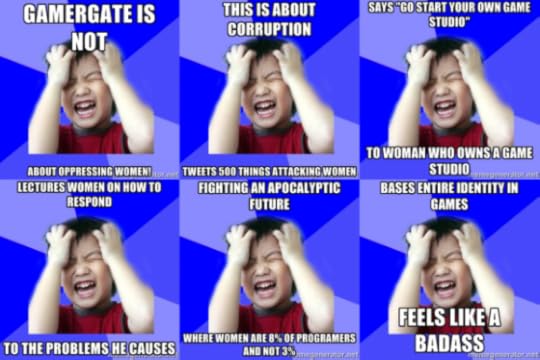
Post memes on Twitter making fun of #GamerGaters, get death threats.
The memes above? A fan of indie game developer Brianna Wu made them, using the text from some of Wu’s acerbic tweets about #GamerGaters. Wu thought the memes were funny, and posted them to Twitter.
View original 364 more words


Plot and Motivation: Keeping Pace
As you may have noticed, I’ve opened up a review section for indie authors like myself and completed my first review for that. It was during my read of Rule-Set that certain thoughts about the pacing of books came to me and, after a day or two of crystallization, it has become the topic of today’s Plot and Motivation article. The realization I came to, which I suppose I’ve always known, is that pacing is not necessarily tied to or proportional to the degree of action in a piece.
Certainly, it is easiest to grasp the idea of the pace of the novel being connected solely to the action within it. The rub is that not all conflict and not all dramatic tension is tied to the standard realm of physical action and danger. The most obvious way to see this in action is in any good mystery. A well-written mystery’s pacing isn’t driven by physical action so much as intellectual action. The dramatic tension isn’t caused by physical conflict; it’s caused by the conflict of investigator vs. criminal with one side trying to unravel the clues as the other tries to further obfuscate their trail.
So the rising action, climax, and denouement of a mystery shouldn’t be tracked by physical thrills, but by the progression of the mystery. Yes, physical action may be part of that, but it’s primarily that intellectual conflict that determines the pacing as tracked by the plot arc. Naturally, this principle can and should be applied to other non-action works. A romantic drama builds its arc on the emotional conflicts surrounding the romance. A political thriller may involve some action but, again, its story arc is built on the intellectual and political conflicts, not on raw physical conflict.
This, again, may seem obvious to some but it can get lost sometimes during writing. An action/adventure writer may become so focused on the physical action that he forgets he can keep his pacing on track with the occasional character-building emotional scene, for example. In fact, it could be argued that introducing plot-advancing elements outside of the ‘core’ conflict can greatly improve the pacing of your plots and provide much appreciated variety in a long work.
The important rule of thumb when plotting an arc and setting your pacing is that every scene be relevant. If a scene, no matter how well-written it is, doesn’t advance the plot or establish characterization (preferably both), it is a burden on the pace of your plot. The more of these filler scenes you add, the worse it becomes until it simply becomes unreadable. The reader will eventually be frustrated and give up after so many scenes where the plot doesn’t move.
So keep your scenes relevant and your mind open to every source of drama and conflict! If you have an insights, comments, or questions, leave them in the comments below.


October 10, 2014
Site Updates: Cleaned up and organized
Tomorrow we will be back to our regularly scheduled writing articles. For tonight, let me real quickly report that the site updates and clean-up is finished.
All articles should be properly tagged and categorized.
The My Kickstarter page is updated to reflect the conclusion of the Take 2 Kickstarter.
The My Books page is greatly improved, with book covers, blurbs, and direct links to the books.
The Starving Review Request page is up with submission info outlined.
If you see anything else that needs improvement or that you would like to see, let me know in the comments or an email. Thank you for reading!


October 9, 2014
Starving Review: Rule-Set: A Novel of a Quantum Future (volume 1)
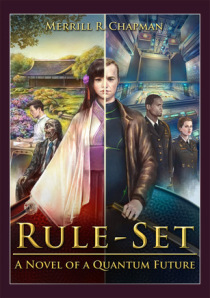
My first Starving Review is one that is done as a courtesy to the author, Merrill ‘Rick’ Chapman, who was the first person out there in the blogosphere to take a look at my firs book, Indomitable, and go ‘Hey, I’ll read that and tell you what I think’. Even that little bit of acceptance, even if he wound up hating it, was something that is rare out there in the wild world of indie books so this review of his own book is my way of saying thanks. Now only that, this entire concept of reviewing is a way of paying it forward, giving other authors the chance that Merrill and the other people brave enough to review my book gave me.
Now, on with the show!
I think I would do Rule-Set a great disservice by doing one of those bland ‘this happened, then this, and it was cool’ kind of reviews. First, any spoilers would ruin the book for any reader and would certainly ruin the future volumes. Second, that’s just now my style. Instead, let’s look at this in some broad conceptual strokes.
First, genre. Like most good literature, Rule-Set squirms under the attempt to tie it down too closely. In broad terms, it would be best to look at it through the lens of ‘hard science-fiction’. Rule-Set is not afraid to hit the reader with the science of it’s future Earth and, at the same time, isn’t afraid to pull intellectual punches in other arenas as well. This might be considered daunting to some, but the author never leaves the reader dangling. Everything is presented in context so that, while the narrative can be crunchy at times, it never hits a wall of terminology. A good reader won’t be lost as concepts are built on top of concepts to make a logical, integrated whole.
Second, about that ‘science fiction’ thing. This book was obviously extensively researched. The science is all logical extensions of current real world work, bringing a healthy dose of realism to the whole affair. Even through that, the author manages to capture a sense of mystery and wonder as the plot progresses outside of the normal bounds of the main character’s experience. There is a strong hint of something more, beyond the science, but it’s left shrouded in mystery, bidding the reader to continue to debate it in their minds as they are drawn deeper down the book’s rabbit-hole.
Third, pacing. This is an intellectual book, I won’t pull punches there. It is not an action tale. However, Rule-Set is not adverse to bringing tension and drama when it’s needed and more than a bit of full blown action in segments. What this means is that, save for a stretch in the first few chapters as the main character is established, the book retains an excellent dramatic pace. Even that slow first stretch is spiced up a bit by one of the best uses of prologues (chock full of action) I’ve seen in a while.
Oh, and of course, as Rule-Set squirms around genre definitions much like a real quantum particle dodges direct observation, the core of the story is, essentially, a mystery, a mystery that just the surface of what promises to be a nesting doll of other mysteries. It is that mystery that propelled me through the last half of the book in one evening and leaves me drumming my fingers for Volume 2.
There’s one major area I haven’t touched on. The big one … characterization. The author doesn’t drop the ball there, fortunately. It certainly had to be tempting to just not worry about developing character. After all, there’s a lot of world-building, tech-splaining, and mystery-hiding going on here already. Nope, no sir. Mr. Chapman wisely remembered that the core of ANY story is the characters. There’s no cut-and-dry stock characters here. The main character, especially, follows an interesting arc of swinging highs and lows, only to …. nope. No spoilers! Let’s just put it like this: the man has an arc, a well-realized one that is subtle to start with, but ends with a major hook.
So, let’s sum up.
Rule-Set is a hard sci-fi mystery intellectual drama with some bits of hardcore action. Oh, and possible romantic seeds are strewn. Maybe. MYSTERY DAMMIT! The point is that it’s an excellent book and like all excellent books, it’s many things. I’m a fast reader by nature, but I also have almost no time these days and I still slammed through it in three nights.
That being said, if you have an adverse reaction to hard sci-fi and the tech exposition that it requires as a genre, you may not like it. For anyone else, even if you aren’t big on tech stuff, you should love it.
FINAL VERDICT: ***** (5 stars, I’m full and I still want more!)


Please excuse the mess!
I am about to start the necessary blog adjustments to prepare for the start of my Starving Reviews, book reviews from one starving author to another. The first such review will be for Mark Chapman’s Rule-Set volume 1, as a thanks for the first person to give my book a chance for a review. Submission guidelines will be one of the first new site sections to come up so you too can ask for the opinion of a man with too many thoughts and not enough food in the pantry.


October 8, 2014
Book Reviews: Should I start them?
As quite a few people have been very open and welcoming in wanting to review my own books, I am contemplating starting a similar avenue for other authors to get their works out. Think of it as paying forward the good deeds done to me by reviewing others works.
So … do you think I should do it? If you do, comment or like this post. If not, tell me so. Though, to be fair, I am currently of the mind to do so. It just seems the fair thing to do.


October 7, 2014
Plot and Motivation: The C.A.B. – The Character Agency Bureau
Today’s Plot and Motivation was inspired by something I’ve noticed has been a major theme with many of my other articles: character agency. If it’s something that has been a part of a multitude of other writing articles, then it has to be important enough to address on it’s own. If you’re unfamiliar with the concept, character agency is the appearance that any particular character in a piece has control over his/her actions.
Now, on the surface, the very concept may seem odd. How can a fictional character have any control over anything? Obviously, yes, the author has ultimate control over and is responsible for the situations the characters find themselves in and their reactions to that. However, your readers shouldn’t view it that way. You should be able to create sufficient suspension of disbelief so that the readers don’t think ‘man, what is the author going to do with these folks next?’. Instead, they should be thinking ‘how will the hero figure a way out of this predicament the villain has placed her in?’. If you haven’t created that investment in the characters and generated that important appearance of character agency, you run the strong risk of loosing that suspension of disbelief.
Generating character agency requires attention on many levels of the story. First and foremost is good characterization. If the readers can’t relate to and understand the motivations of your characters, they will never believe them capable of making decisions in the first place. A character with no personality has no motivation to make a decision at all, cutting out agency before we’ve even begun.
Flowing from that, the plot and scenes you create need to allow for the expression of that agency. If every scene is railroaded from moment to moment, the characters have no agency because they can make no choices. Strangely, it is often a bad idea to allow the choices of the characters to control the entire plot. If they are never challenged, thwarted, or countermanded in their decisions at any point, you can break the suspension of disbelief in the other direction. No one makes it through life completely on their own decisions.
A final important point of character agency is that the characters should be able to take the initiative in decision making. This may seem a fine point to make, but if you take a character who mechanically moves through the plot only making the decisions put to him by other characters or forced upon him by the environment doesn’t show any real agency. He/she is simply reacting to the environment. A character with agency also acts upon his environment and is an active participant in your story.
The ultimate point is that even the most spineless or weak-willed person has beliefs and makes decisions, both reactive and independent. Even if they are thwarted in those decisions, the fact that they make them is important to creating fully realized characters your readers will be happy to invest in and follow through your stories.