Jonathan J. Den Hartog's Blog, page 2
May 25, 2016
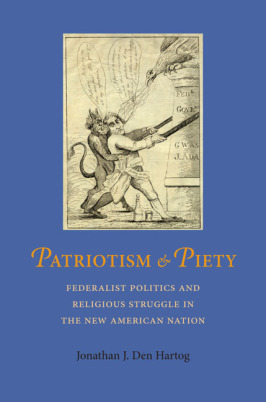
Patriotism and Piety on the Road this Summer
In the upcoming weeks, I’ll have some opportunities to take my Patriotism and Piety book on the road. I’ll be doing “Meet the Author” events at three Barnes and Noble locations. I’ll be signing books and will be happy to talk about the Federalists, Religion, and even what implications those categories have for today.
May 28, I’ll be at the B&N in Roseville, Minnesota, at the Harmar Mall, 2-4 PM.
June 11, I’ll be at the B&N in Des Moines, Iowa, at Jordan Creek Town Center, 2-4 PM.
June 12, I’ll be at the B&N in Cedar Rapids, Iowa, Northland Square, 1-3 PM.
So, if you’re a reader in the area, please come out and say “hello!”



April 6, 2016
Interviewing Daniel Williams on the Pro-Life Movement
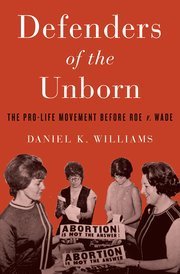
Today, at the Religion in American History blog, I had the chance to do a web-interview with Daniel K. Williams about his new book, Defenders of the Unborn: The Pro-Life Movement before Roe v. Wade.
I very much appreciated Dan’s first book, God’s Own Party, about the rise of the “religious right” in the Republican Party. I have even taught it to good effect.
After that book, Dan turned his attention to the pro-life movement, which has been part of the great moral and cultural debates of our times. Dan found a surprising back-story to opposition to elective abortion, which he chronicles in the book. The final chapter also makes sense of the shifts of abortion-related politics in the later 1970s and 1980s.
I highly commend both of Prof. Williams’s books.


March 31, 2016
Alexander Hamilton, After a Delay
I try to link (relatively) quickly to material elsewhere, but this one got away from me.
Early in March I posted a blog post on “Religion and Hamilton.” I contended that the smash Broadway hit Hamilton would be great for teaching, not only about the American Revolution in general but about religion in the American Revolution in particular.
Since I’ve published the piece, I’ve found several things:
1. The piece got mentioned on John Fea’s blog.
2. There are a lot of fans of the musical–and rightfully so!
3. The piece has resonated, which seems like a good thing for a piece about music.
So, in case you missed it, check the piece out!


March 14, 2016
Welcome, Jonathan Loopstra!
Earlier this academic year, the History Department at the University of Northwestern-St. Paul learned that our esteemed historian of Ancient History, Dr. Charles Aling, would be retiring in May. We will be celebrating Dr. Aling’s career next month.
Dr. Aling’s retirement, though, meant that Northwestern’s History Department needed a new historian of the Ancient World. After conducting a national (and even international) search, I am pleased to announce our new hire: Dr. Jonathan Loopstra.
Dr. Loopstra is an expert in the Church of the East, the Church that developed in the Middle East and stretched farther east. As a linguist, he has great capabilities with Syriac, the language which gave voice to the Church’s worship and culture. Dr. Loopstra will teach Ancient History classes at Northwestern. He also brings additional strengths. Having lived and even taught in the Middle East for several years, Professor Loopstra will be able to connect the Ancient Middle East and the Modern Middle East, a class he will be developing at Northwestern. Further, Dr. Loopstra will bring a developed specialty in Digital History and Humanities to share with our students. Finally, he will complement the department’s decided strength in the History of Christianity.
As an added bonus, Dr. Loopstra is a Northwestern alumnus. He has earned degrees from Trinity Evangelical Divinity School, Oxford University, and the Catholic University of America. Professor Loopstra joins our faculty after stints at the International Center for the Study of the Christian Orient (Grenada, Spain), Reformed Theological Seminary, the American University of Iraq-Sulaimani, and Capital University in Ohio.
Welcome, Jonathan!


February 23, 2016
We Have a Winner! (Wilsey Edition)
February has been a hectic month, with significant illness and significant responsibilities as chair of the History Department at Northwestern.
Nonetheless, I wanted to recognize that we have a winner for our comment contest. Congrats to Michael Brennen for his comment below.
I will be in touch with Michael to get him his copy of the book.


January 26, 2016
Book Give-away: Wilsey Edition
IVP Academic provided me with an additional copy of John D. Wilsey’s new book American Exceptionalism and Civil Religion: Reassessing the History of an Idea.
You may recall that I interviewed Wilsey a few weeks back about the book.
If that piqued your interest, here’s an opportunity to get a copy.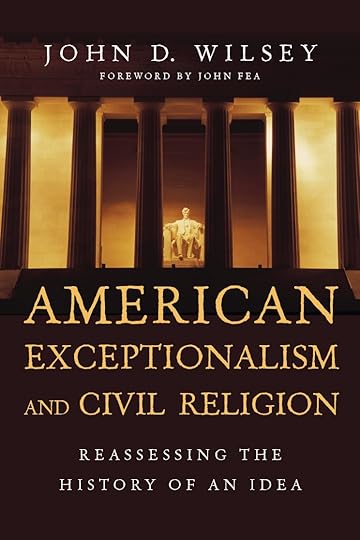
In the comments below, leave a comment about how you would use or define the concept of American exceptionalism.
The best definition will get a copy of the book.
Comments will be open until February 1.
Define away!


January 19, 2016
Journal of American History Review
I recently opened up my newly-arrived Journal of American History (December 2015 issue) and scanned the table of contents. I was quite pleasantly surprised to see a review of Patriotism and Piety!
John Compton of Chapman University provided the review. He offered a clear summary of the book’s argument and content. I most appreciated his introductory and concluding paragraphs.
He opened with:
In Patriotism and Piety Jonathan J. Den Hartog casts the familiar story of the Federalist struggle against Jeffersonian “infidelity” in a new light. He shows that leading Federalists, so often depicted as supporters of established religion and theological orthodoxy, staked out a range of positions on the question of religion’s role in public life. Moreover, he demonstrates that Federalist views on the church-state relationship evolved over time and in directions that would continue to shape American politics long after the last of the New England religious establishments had crumbled.
I’m always happy to place things “in a new light.”
Moreover, Compton saw at least one “original insight” in the book:
Den Hartog’s most original insight concerns the voluntarist phase of Federalist religious thought. He ends his study with the provocative claim that the out-of-power Federalists laid much of the groundwork for the Second Great Awakening. Instead of retreating “into an energetic pietism,” Federalist luminaries, including Jay and Boudinot, accepted leadership positions in the American Bible Society and other voluntary associations, thus “direct[ing] religious energy outward, into the world” (p. 204). In the process, they constructed an ecumenical infrastructure that would infuse the nation’s public life with a deeply religious sensibility for generations to come.
I’m appreciative of Compton’s close attention to the book’s claims and figures.
The entire review is available (although perhaps not for long) here.


January 6, 2016
Interview with John D. Wilsey
Today at the Religion in American History blog, I posted an interview I did with John D. Wilsey. John is a scholar that I have gotten to know over the past two years, and I consider him a friend.
John has recently published the book American Exceptionalism and Civil Religion: Reassessing the History of an Idea.
Readers of this blog would do well to pick it up. I highly recommend the book. For a taste of Wilsey’s concerns, check out the interview!


November 30, 2015
Northwestern is Hiring!
In my role as Chair of the History Department at the University of Northwestern-St. Paul, I am pleased to announce that our department is hiring. We are looking for an historian of the Ancient World.
Here is the official announcement:
The Department of History at the University of Northwestern-St. Paul, Minnesota seeks to make a full-time, permanent appointment at the assistant or associate level in the field of Ancient History. Any area or era of the Near East and Mediterranean world (including late antiquity) will be considered, but the successful candidate should demonstrate the ability to connect his or her knowledge with the world of the Bible and with the field of archaeology. The ideal candidate will also demonstrate the ability to teach an outside field on some region of non-western modern world history (such as the History of the Middle East). The appointee will teach upper-level undergraduate classes in Ancient History, as well as support the department and university by teaching the introductory History of Western Civilization course. In rotation, the faculty member may support the department in teaching classes on historical methods or the senior-level history seminar.
Ph.D. required by time of appointment. ABD applicants will be considered.
For full consideration, applications (including cover letter, curriculum vitae, graduate school transcripts, and the institution-specific form, including supplemental questions) should be submitted by December 18. Position is open until filled.
To view the job description and begin the application process, go to https://jobs.unwsp.edu/postings/1396.
We are looking for great candidates. We invite applications, and I would encourage readers to forward this announcement to those who might be interested.


October 8, 2015
Puritans with Sympathy?
When most Americans think about the Puritans–when they think about them at all–it’s usually to dismiss them as stern, hard-hearted folks–the kind of people who enjoyed plastering Hester Prynne with a “Scarlet Letter.”
One of the burdens of my US History classes is to chip away at this stigma. The Puritans took things seriously–it’s true–because life is serious business. But that didn’t keep them from loving whole-heartedly and feeling deeply.
We have more evidence of this in a recent book by Abram Van Engen called Sympathetic Puritans. Van Engen’s book is all about how Puritans valued sympathy, understood as care and even imaginative identification with others.
I wrote a longer review of the book in my monthly piece for the Religion in American History Blog.