Sarah Alisabeth Fox's Blog, page 2
January 6, 2018
Teaching Downwind
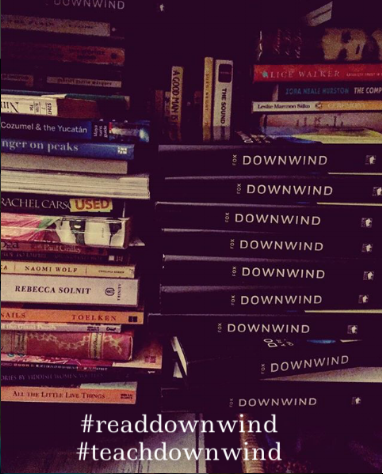
#readdownwind #teachdownwind
After the release of Downwind in 2014, I spent a year and a half touring the book and speaking to as many audiences as I could arrange to meet. My friends held a community fundraiser, university professors cobbled together honorariums, and humanities organizations lent their support. I was still waitressing full time, with a young family, and I was still conducting oral history interviews with downwinders. The juggling act was not sustainable, and I worried I wasn't doing enough to launch the book and its stories out into the world.
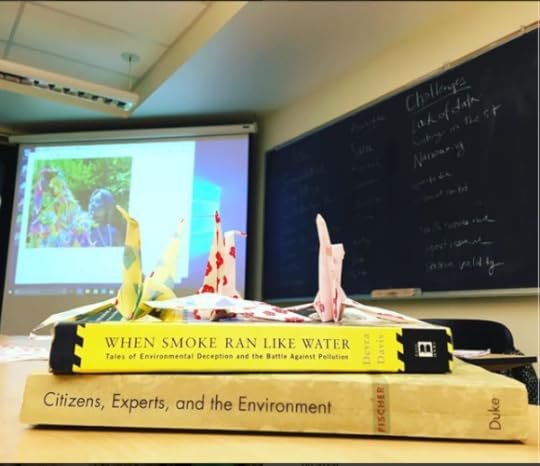
A new opportunity arose. Friend and colleague Rachel DeMotts, Mellon Assistant Professor of Global Environmental Politics at University of Puget Sound, invited me to develop an upper-division environmental studies course based on my research. "Nuclear Narratives of the American West" is the course that emerged, and I've now had the privilege of teaching it three times to students in the Environmental Policy and Decision Making program at UPS. These students don't just read Downwind; they study oral histories from uranium workers and downwinders, historic AEC documents, popular media, scientific studies, poems, legal briefs, and epidemiological reports. They discuss research by scientists, sociologists, historians, and folklorists, poetry by Simon Ortiz, Sherman Alexie, Kathleen Flenniken and Michael McLane. They view original art by Ed Singer, take in documentary film, and pore over nuclear-impacted regions using google map technology. Some of them even folded paper cranes.
From the syllabus:
This course will examine the history of Cold War era nuclear testing and uranium extraction in the American West, in order to understand the environmental, cultural, political, and health ramifications of these activities. Using nuclear history as a case study, we will explore interdisciplinary methodologies for gathering and studying narratives about human relationships with the environment.
For nearly five decades, the American West served as the primary staging ground of United States nuclear weapons production. Vast swaths of land were appropriated by the military, the federal government, and the uranium industry, and massive amounts of toxins were released into the environment. Severe contamination persists in many regions, and citizen populations have been struggling to make sense of the impact of this contamination for generations. How do we as scholars of environmental studies assess this chain of events? We must critically assess multiple narratives, including federal documents, small town newspaper coverage, oral citizen narratives, and peer-reviewed scientific studies. What analytical tools are most useful for sifting through this array of accounts? How have industry and government experts exerted their power to shape research, reportage, and public perceptions related to nuclearism? How have the residents of affected areas come to understand the impact of nuclear industries in their regions, and how can we as scholars best analyze this local knowledge? More broadly, how can the information we draw from place-based environmental histories and the methodologies we employ in doing so inform our approach to other global environmental issues?
The sixty students who have made their way through this class have produced remarkable reports on nuclear sites around the world. They have produced original art, economic analyses, and legal critiques. Students have come to this class from fields as varied as health sciences, business administration, politics and government, music, biology, geology, sociology. Each of them has applied their major disciplinary tools to the complex research and ethical questions nuclearism poses, and I have learned from every single one of them. I hope to feature some of the remarkable work they have produced here in the future. In the meantime, I'll to leave you with some of the final reflections from students who took the course in the Fall of 2017. (See below). Their work gives me something different than hope. It gives me faith. (Thank you Rachel DeMotts for putting this into words!) Faith that they will keep these stories alive, think more critically, ask more questions about knowledge and power, and reach across disciplines to find more data, faith that they will bring this knowledge into their work as professionals and as citizens and as members of communities.
It's been an honor to teach this class the past few years and I look forward to doing it again soon. With gratitude... Sarah
# # #
"History has never been something I've had interest in; however, this course captivated me and kept me engaged throughout the entire 16 weeks. One thing that's stayed on my mind... is the role of scientists in society. I have always thought of science as meaningful work for public safety and awareness; but, as we've seen, science can also be used to manipulate citizens into thinking what other may want them to think. As a future environmental scientist, this has made me think about how I can ensure that this manipulation does not continue, and how I can work with others to present truthful, and impactful science for the general public.
This idea of science also carries over to another important topic I learned: how we value people's narratives based on their background. I really appreciated the discussion we had regarding how people believe scientists because of their education, more than they do downwinders. To be quite honest, I feel as though this might have also been my mindset coming into the class as well. But after reading Downwind, I understand now that even stories that may not be scientifically corroborated can still be meaningful. These narratives can still provide insight into information that we cannot find in a scientific paper or report, such as local demographics, history, and culture. I cannot go into environmental studies in the future without considering the position of those who may not have a white-collar job. Although I picked up a lot of information in the class (and a slight distrust of the government now), these two points have impacted me the most, and have given me a lot to think about for the future. Seeing how nuclear testing may be resurrected soon, what I've learned will certainly be applicable in the next coming years. I am so thankful to have taken this class."
"I plan to become a scientific researcher, so it was very eye-opening to see the ways in which science was biased and suppressed during the nuclear era when findings conflicted with government interests. I think that learning about this will make me more critical of studies conducted by the government, pharmaceutical companies, etc. when there are obvious conflicts of interest. I think it will also make me more cognizant in general of what types of research are being conducted, and who is deciding to fund this research. This course has also given me a more nuanced picture of the costs and benefits of nuclear energy. Before taking the class, I thought that nuclear power sounded like a great alternative to fossil fuels, and avoided a lot of the problems of scale and efficiency that come with renewable sources of energy. However, this class has shown me how dangerous nuclear energy can be, not only in terms of accidental meltdowns, which are rare but may increase in frequency as the rates of natural disasters increase, but also in terms of the radioactive waste produced. As of now, it seems that there are no good, long-term solutions for dealing with radioactive waste, and instead this waste often ends up being ineffectively stored near poor and marginalized communities."
"Undoubtedly one of the biggest takeaways from this class is an entirely new understanding and perspective about the Cold War, and the realization of my previous ignorance regarding it. So often we get caught up learning the narratives provided for us by major news sources, textbooks, and others who have very specific knowledge and understandings. This course has taught me to search elsewhere, to seek out the stories of those who may have a harder sharing them. Additionally, the further exposure to the overwhelming environmental racism in this world is detrimental and has pushed me in a different direction in my studies here than I had expected, but am grateful for, and plan to focus on and work towards helping in different ways for the rest of my life."
"I absolutely loved taking this course, I really appreciated how I was able to apply a broad range of my own interests to it which is unfortunately rare. One of the biggest takeaways that I am getting is my own research on the Marshall Islands. I had never put much thought into this area of the world but have become captivated in it through my research. It is one of the first cases studies that I feel like really taps into many of my academic and extra curricular interests. I’m not sure right now if I will continue this research in an academic setting, but I plan on carrying a notebook with me after college that is on this topic and just seeing how full it ends up getting. The second biggest take away from this course is the research skills that I gained. I feel like the paper reviews were very beneficial and really got me in the habit of researching the people who where writing the sources I was looking at. I hope to take this into future work that I do."
"From this class, I will take away how governments can designate certain people (usually minorities or people from lower socieoeconomic classes) expendable. I think it is easy to oftentimes look at disasters or events that negatively affected people from a numbers perspective and see that “only x amount of people died, it must not have been too bad” but this class helped me approach these events from a more human side, one that looks at the stories the individuals have to tell. I knew very little about the nuclear testing that had gone on in the United States before this class and to learn about the atrocities that our government inflicted on its own citizens for the 'greater good' was horrifying for me. This class has helped me understand that there are many events in our history that are not taught in most classes or talked about by most people and so many people can grow up with no understanding of many of the atrocities that have occurred. I think that this class will help me dig a little deeper when looking at current events, especially those with environmental impacts to be able to see the full story about its impacts."
"This course has actually taught me so much, that narrowing it down to 2 or 3 learning points is quite difficult. But, the biggest takeaway I got from this class was my passion for environmental justice. I honestly learned so much more about the injustice that takes place in our world, apart from other issues, and I am excited to share my knowledge with the people around me. I want to make this environmental crisis into a social issue so more people are aware of the corruption our current policy holds. I had also thought that I had a pretty good critical eye when it came to scientific research prior to this class, but I have now been able to develop the skills to actually dissect the rhetoric reports use, where the funds are coming from, and able to find alternative responses to reports conclusions. Finally, this class has really solidified my affinity for the research world."
"I valued learning about an event that took place within the 'middle' part of the U.S. So many of my courses talk about decisions of large governments or political organizations, of if they discuss events occurring to people, those people are located in large cities, or other centers of people and money. I enjoyed taking a course that actively worked to center the experiences of people who are not near money or power--both in the U.S., and in some cases, outside of the country as well."
"I can say with confidence that I learned something new every week. I am so so excited to be taking your community environmental research course next semester to gain even more understanding of the world of environmental justice. You have been one of the best professors I have had at this school because you are able to teach students basic understanding of the society we live in, while not having students feel discouraged because they don't know much about a topic."
"Some of the most important things I’ve learned from this course is that the American government does not care for the safety and health of its citizens when national security is in question. The government will also try and hide its mistakes rather than share information that may save people. Also, this class has taught me that there is much more radiation left in the environment than the US government would like us to believe, and that Native Americans have especially had to deal with more radioactive waste than almost any other minority group. I have also learned how important it is to consider all types of sources when researching a subject, and that anecdotal sources are just as important as scientific sources in understanding a situation like nuclear testing."
"Most all of my classes have focused on quantitative research and with the introduction to your book and the other material I enjoyed learning about ethnographic focused research and its accompanying characteristics. I found that it was intensely personal and in this case heavily reliant on peoples relationship with their government, land, and bodies. In thinking more about this another important takeaway was that relationship I described earlier. Before I had read any of the material I had no clue about the nuclear legacy of the American west. A nuclear legacy that seemed to take place right in my backyard around where I grew up. This has shown me that I cannot stand by idly and take my situation for what it is. It has taught me to look deeper into my home and surrounding area, wherever that may be, seeing that the nuclear legacy is not only specific to the American west but also the Pacific Northwest."
"Downwinders took note of things such as settler colonialism and environmental racism which a lot of books I’ve been assigned in college don’t. I also really appreciated the pieces by Sherman Alexie. He is an author I really like a lot and it was really interesting to see the way he incorporated his nuclear past in his work. I also really appreciated all the poetry we read. Its so interesting to read poems that have such personal and political meaning."
"This class has left me with several valuable takeaways. One is distinguishing between the advantages and disadvantages of narrative as a way to justify a perceived environmental justice vs. scientific method/data as a way of justification. Another is understanding information flows and how media and certain power dynamics can manipulate stories/events so as to play along (or not play along) with governmental influence. Lastly, I have been left with a greater understanding of how corrupt government agendas negatively affect culture--particularly the cultural aspects of land and food--and especially how they negatively affect people of color."
"Before this course, I had never talked about in a course before was the way in which it is possible to critically evaluate oral histories of people within academic contexts. Most of the other classes I have either held oral histories as either unworthy of acknowledgement as unauthoritative knowledge, or otherwise, framed as infallible sources of radical information. I appreciated this course's more practical approach, particularly the way in which we discussed how to consider inaccuracies in information as further opportunities to study events. I also appreciated the interdisciplinary nature of the class, because the opportunity to compare formal documents, oral histories, artistic narratives, etc, helped me to understand a fuller and more accurate picture of what happened to folks living in Downwind regions of the world."
"What impacted me the most was hearing personal testimonies from people who had either experienced cancer themselves or had watched loved ones slowly die as a result of radiation exposure. It was heartbreaking to hear these difficult stories, and made me angry that our own government had caused this. I also thought it was very interesting to investigate the way in which women played a large role in the efforts to stop nuclear testing, and how they were faced with so many double standards - they couldn't be emotional or they were dismissed, but they couldn't be stoic because then they would be labeled as unloving and cold. The most influential aspect of this class was writing my research paper because it allowed me to dig really deep into a specific site. The case of the Marshall Islands, my chosen site, is both very interesting and very tragic. Learning about the forced (multiple) exiles of the Marshallese people, the sheer magnitude of the nuclear testing, and the way in which the US government used and promptly forgot about the native people was an eye-opening experience. Overall, I simply cannot believe how few people know the true story of US nuclear testing, and it makes me want to inform myself and everyone I know. This is so important!!!"
"Learning about the hierarchy of risk of the Soviet Union reminded me a lot about the hierarchy of risk of the AEC. How the AEC covered up the sheep death to avoid embarrassment is exactly the way the leaders of the Chernobyl nuclear power plant tried to cover up the Chernobyl Nuclear disaster. It clicked in my head that governments don’t pursue what is in each citizens interest when they pursue nuclear weapons or nuclear energy. In the United States, the government chose marginalized people to expose to environmental hazards... I usually believe that people are doing the best they can and that sinister behavior is just rumor and that this extends to officials in power. This class has taught me that those officials in power are only doing the best for their constituency, the people that keep them in power, not all people, not the people negatively affected by their decisions."
"Coming into this class, I knew pretty much nothing about nuclear activities or narratives, aside from the two bombs dropped on Nagasaki and Hiroshima. I did not know anything about Downwinders or their testimonies, nor did I know about the U.S. government testing nuclear bombs in the American West."
"I personally have learned a great deal about radioactivity and elements that should not be played with unless taking appropriate safety measures to handle. Elements consisting of Plutonium and Uranium. I have learned that I should pay more attention to nuclear talks on the news hour, because their outcomes can decide the fate of millions of people. It was very informational to learn about the four major accidents that have happened at nuclear plants, like Fukushima, Chernobyl, Three Mile Island and the other one. Before this class I had heard of Fukushima because it happened in 2011, but I did not understand the extent of damage that had actually taken place. This class has definitely taught me to be more suspicious of U.S. government documents and the idea of “national security.” I had a lot of fun learning about NASA, Cassini, and the Department of Energy’s role in creating the nuclear site on Saturn. It is scary to think that their have been nuclear accidents hidden from the public because they were not reported in the media. When I was researching media headlines for the Chernobyl accident, in my head I though I would find tons of headlines, much like there were for 9/11. But, instead I barely found any reporting at the time of the accident, which also taught me a lot about the media. Overall, this class was mostly depressing to learn about all of the sad Downwinder stories, and all of the wrongs the U.S. government has done, especially against indigenous peoples. But it also had a lot of very important information that needed to get out to public ears."
"I think it is really important to offer a class that teaches this subject material to future generations, because eventually... there will be no one who knows this history to stop the U.S. government from performing these tests and exposing people to radiation again. This class can help to prevent that from ever happening by getting the information the government does not share, out to the public."


January 27, 2016
Day of Remembrance for Downwinders: the 65th Anniversary of the Inception of Nuclear Testing in Nevada
January 27, 2016 marks the 65th anniversary of the inception of nuclear testing at the Nevada Test Site. The test, a 1 kiloton bomb code named Able, went off at Frenchman Flat at 5:45 am local time.
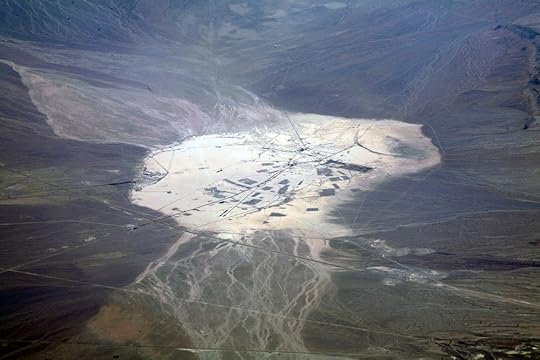
Frenchman's Flat, Nevada Test Site
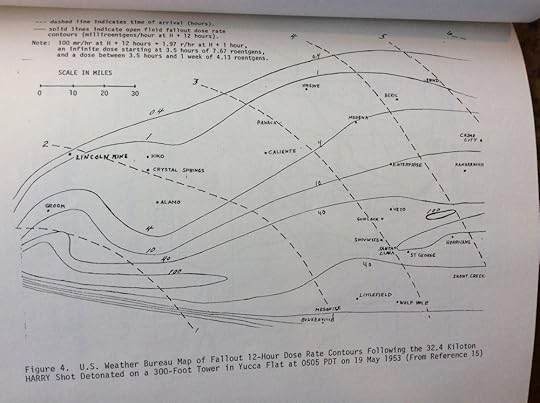
Within eight days it was followed by four additional nuclear tests. In the forty years that followed, those first five tests, known as the Ranger series, were followed by another 923 nuclear detonations in Nevada. Massive amounts of toxic radiological pollution entered the downwind environment, contaminating the air, food, and water that local citizens relied on, and creating a legacy of health problems that will continue to ripple forward for generations. At 1 kt, Able was a comparatively small test, (if you consider 1000 tons of TNT small). Subsequent tests in Nevada were frequently upwards of 50 kt, sometimes even surpassing 100 kt. Atomic Energy Commission policy dictated that tests go forward only when the wind blew east, over the communities of southern Nevada, southern Utah, northern Arizona, and often northern Nevada, northern Utah and southern Idaho. Testing from 1951 to 1962 took place atmospherically, or in the open air, dumping massive amounts of radiological pollution into the winds to be carried across the country.
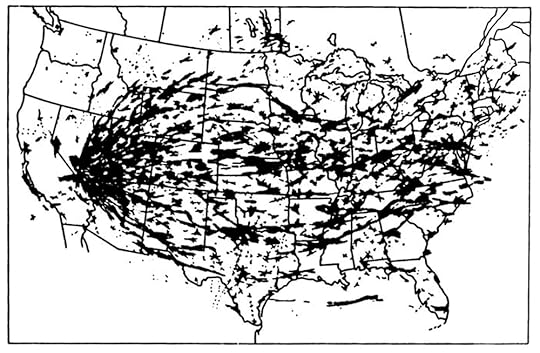
Areas of the United States crossed by two or more clouds from atmospheric nuclear tests, 1951-1962. Underground testing from 1962-1992 also created airborne contamination. Map assembled by Richard Miller.
Testing in Nevada was only part of the problem. Massive amounts of uranium were mined, milled, transported, and processed to fuel the bombs (225 million tons between 1950 and 1989, some of that destined for the nuclear power industry), a process that left its own legacy of catastrophic pollution and health problems across the American West.
In memory of those who have been lost to radiation-related illness, downwinders in Salt Lake City and Emmett, Idaho are holding memorial gatherings today. The 5th annual SLC "Day of Remembrance for Downwinders," will take place from 7-8 pm at South Valley Unitarian Church in Cottonwood Heights.
The Emmett, Idaho downwinders group will be holding their event at 4:00 pm at the Frontier Cinema, where the official release of the documentary Downwinders will take place. To view a clip of the documentary, click here.
A contribution to HEAL Utah is a great way to help keep nuclear testing in Nevada a thing of the past, and a wonderful way to honor the memory of those who have been lost to radiation-related illness.
In memory of those who are too many to name.
November 5, 2015
Bringing Downwind to Idaho: October Book Tour midpoint
During the early years of my research into the impact of nuclear testing in Nevada, I operated under a common misconception: that Southern Utah had borne the brunt of the contamination from the Nevada tests. During the atmospheric testing era in Nevada (1951-1962) the Atomic Energy Commission tested only when the wind blew east, away from densely populated Las Vegas and California, and over the more sparsely populated regions of the American West. While this meant that Southern Utah did receive more than its fair share of fallout, as it was sited directly east of the Nevada Test Site, the wind didn't always follow the same course. Contamination was frequently carried south, into Arizona and beyond, and north, into northern Utah, southern Idaho, and the states that lay beyond to the east. In 1997 the National Cancer Institute released a study on fallout-related thyroid cancer,
providing a sobering look at all the far flung places the wind travelled to.

The NCI study concerned itself with only one of many radioactive isotope produced by the nuclear tests: Iodine 131. I-131 has a relatively short half-life of only eight days, but it remains very dangerous during that time. It began to make its way into the food chain as it drifted down on grazing lands and alfalfa crops which were subsequently consumed by cattle. The contamination bioaccumulated, which means it increased in concentration as it moved up the food chain. When humans consumed that I-131 contaminated cows milk, they received doses of radiation to their thyroids, particuarly dangerous in the developing bodies of children.

The NCI study revealed the extent to which contamination had reached areas beyond southern Utah, and Idahoans struggling to make sense of alarming cancer clusters in their communities found the data particularly enlightening. They've been fighting for years to expand the Radiation Exposure Compensation Act to cover those counties in Idaho that we know were severely affected by radiological contamination from atmopsheric testing in Nevada. During a gap in my Utah book tour events, I was able to dash up to Idaho to visit two community libraries to speak about these topics.
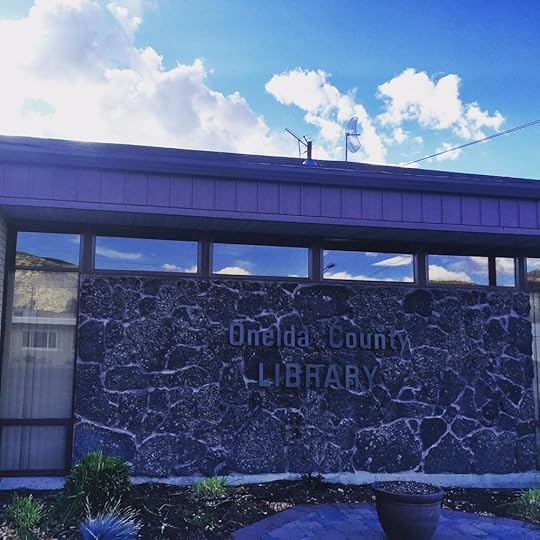
I spoke to a lovely audience at the library in Malad City, Idaho. A copy of Downwind has been donated to the Oneida County Library.

Sunrise behind a wind farm. Early morning drive across Idaho from Malad City to Emmett.
In Emmett I had the honor of sitting down with four different residents who grew up in Gem County and interviewing them as a group about their memories of farm childhoods, early mentions of nuclear testing, and patterns of health problems in their community.
[image error]
The stack of cards in this photograph represent one year of medical appointments for Emmett downwinder Billy Reynolds. He has mylofibrosis, which his doctor believes could only have been caused by radiation exposure. He lived in Emmett on a farm from 1951-1961, during the bulk of atmospheric nuclear testing to the south. Emmett is located in Gem County, which ranks in the top five counties in the United States for fallout from atmospheric nuclear testing. "It seems like death is just a part of life here in Emmett. My mother lived to be the oldest of her five siblings. She died at 47. Three of her siblings had brain cancer." Billy's father and brother have also died of cancer. I first met Billy two years ago. At the time he was receiving regular blood transfusions to stay alive. Today he's on a new experimental medication that's improved his quality of life a great deal. It was dear to see him in Emmett. A copy of Downwind has been donated to the Emmett library.

Emmett downwinder organizer Tona Henderson has copies of Downwind for sale at her bakery, the Rumor Mill.
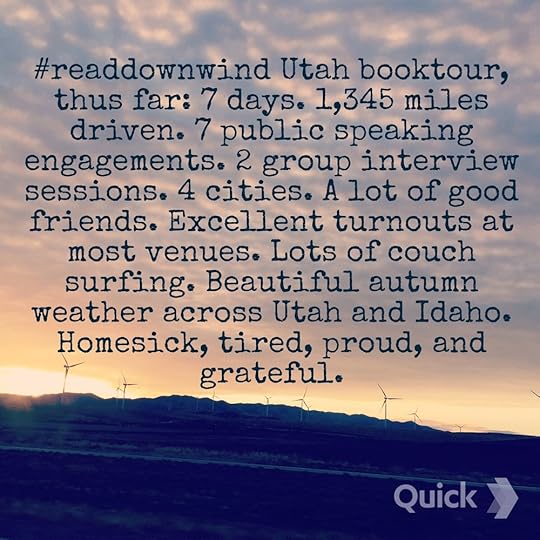
Snapshot of the tour midpoint.
October 22, 2015
Bringing DOWNWIND to the City of Salt
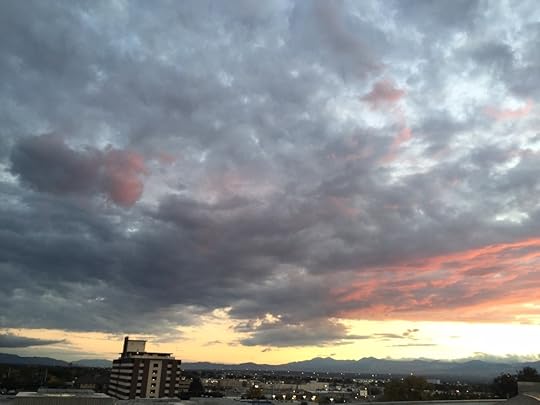
Sunset from the roof of the Salt Lake City Public Library, Tuesday October 20
In the past three days I've been able to present Downwind: A People's History in three different and really special Salt Lake City venues. Tuesday night I visited the beautiful downtown library in SL and had a conversation with downwinder activist, playwright, KUED Director of Services, and all around force of nature, Mary Dickson. It was a great format. Attendees sat in a semicircle of chairs and we sat in the center, sharing stories and fielding some fantastic questions.
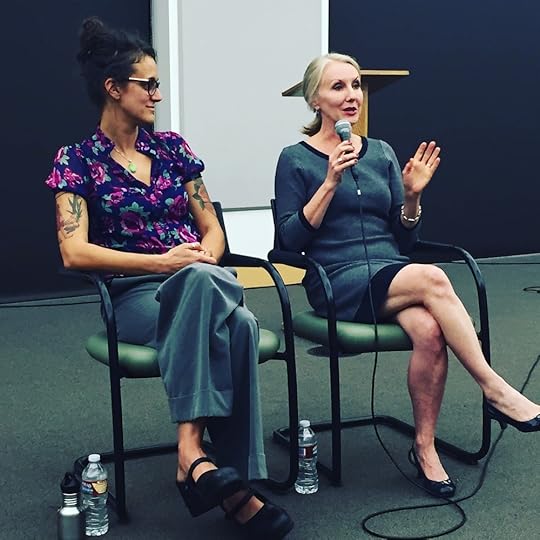
Mary and myself speaking to a lovely audience at the SL Library. Thanks to Christina McWhinnie for this and all other photos from this event.
I met Mary over ten years ago, when I was first begining my research on these issues. I'd gone to hear writer and downwinder Terry Tempest Williams speak at USU in November of 2004. After her talk I waited in line to meet her and I told her that I was thinking about writing my master's thesis on the downwinders. She clasped my hands, gave me her best wishes, and told me I'd better call Mary, whose number she scribbled down on the margin of a program. Mary immediately agreed to let me interview her, but she quickly became more than an informant for my project. She took me out to eat, she took me to the movies, she shared everything she knew. We spent one long night sitting up eating Girl Scout cookies and making postcards to send to elected officials in protest of the planned Divine Strake test. Several years later Mary wrote a remarkable play, Exposed, about her journey to awareness as a downwinder, which was performed in SL and around the state to critical aclaim. It was an honor and a pleasure to be reunited at this event to talk about our respective journeys and our work. This event (and in fact, most of my Utah tour) wouldn't have been possible without the help of several key folks. Rob DeBirk (who happens to be Mary's nephew) who worked for many years with HEAL, connected me to Michael McLane of Utah Humanities. Michael set up this and most of my other Utah tour events, lending his passion for the subject and his extensive connections around the state.
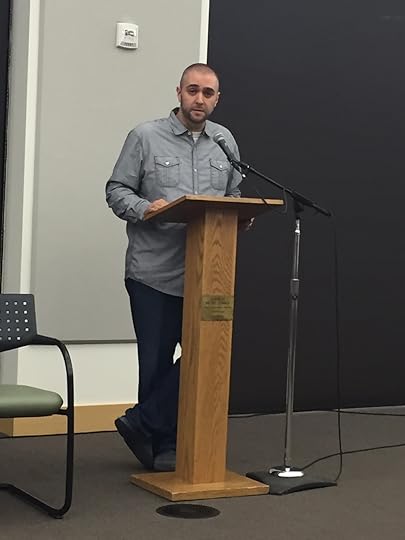
Michael McLane, the organizer of the Utah Book Festival and most of the Downwind Utah tour. Michael is an exceptionally talented writer and a particularly kind human being, to boot.
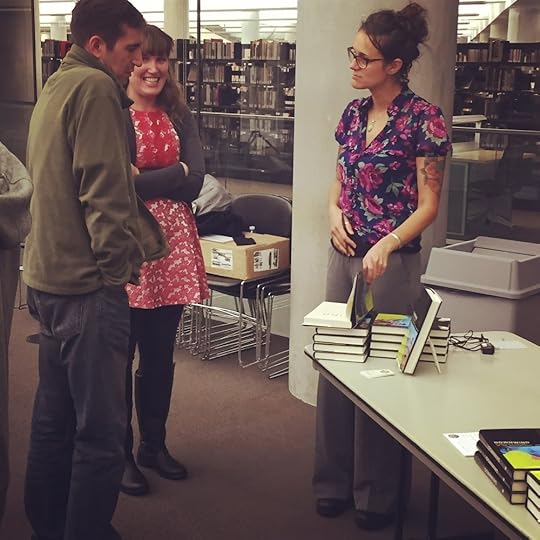
The SLC Public library audience was full of really lovely people. I so appreciated each of their questions, comments, and stories, and their willingness to come out and participate in this event. Also, big thanks to SLC's Weller Book Works, who sold books at this and my Utah Archives Event. They have signed copies available in their store.
On Wednesday I visited the Utah State Archives as a guest of Archives Month, where I spoke to a great crowd of archivists and community members about some of the archival documents that informed Downwind. (A link to a video of my talk can be found in the caption of the slide image below). Prior to my talk, Justin Sorenson and Heidi Brett of the University of Utah Downwinders Archive offered a short presentation about the remarkable work they are doing to preserve and share Downwinder oral histories, documents, and data.
Click here to access a video of my presentation at the Archives.
After my talk, archivist Jim Kichas gave me a fantastic tour of the facilities. People, there are SO MANY BOOKS in this room waiting to be written. Get yourself to an archive and ask a brilliant archivist like Jim what's good. Its pretty magical when they set down that box on the table and you get to pull out those folders and see the literal pieces of history tucked inside.
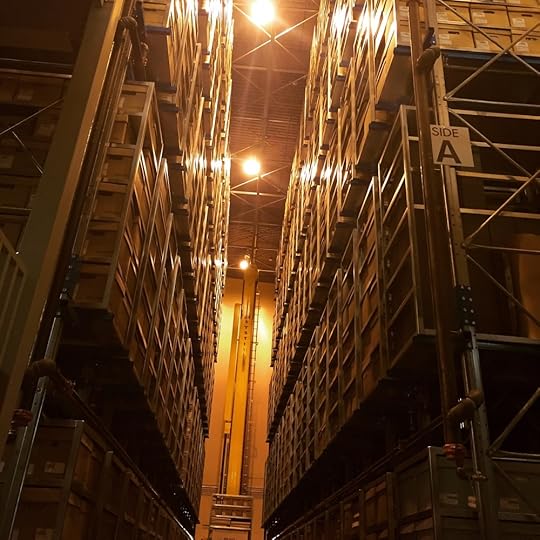
Behind the scenes at the Utah State Archives.
Thursday I joined staff and several very special supporters of HEAL Utah for a luncheon to discuss Downwind and the work of building awareness and action around these stories. Whenever I feel overwhelmed by the enormity of the work to be done on this issue, I take great comfort from clicking over to HEAL's website to be reminded of the incredible work they are are doing every day to advocate for the environment and the people of Utah. It was amazing to meet them in person, and to hand over my small, heartfelt donation from the first year of Downwind's royalties. Keep up the good work, you amazing people.
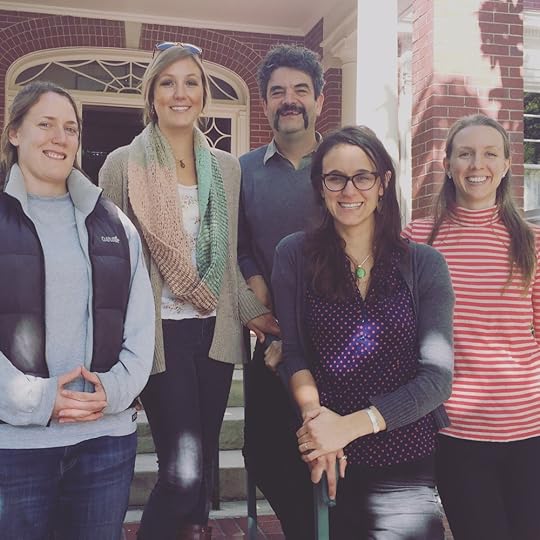
with the fantastic staff of HEAL Utah: Laura, Ashley, Matt, and Sophia. (Their official titles with HEAL are in caption below).
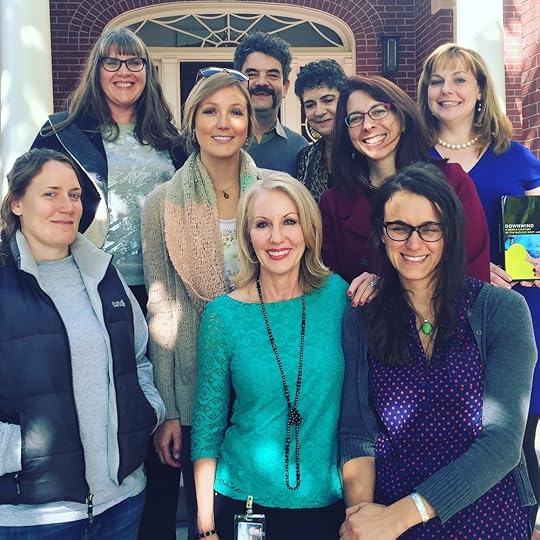
HEAL staff and some of the remarkable people who support HEAL's work through their own extraordinary activism, scholarship, civic engagement, and political work. Back row: Professor Danielle Endres of U of U, Matt Pacenza, Executive Dir of HEAL, downwinder activist Eve Mary Verde, former Utah State Representative Jennifer Seeling. Middle row: Ashley Soltysiak, HEAL Senior Policy Associate, Jean Welch-Hill of the Catholic Campaign for Human Development. Front row, Laura Schmidt, HEAL Outreach Coordinator, Mary Dickson, downwinder activist and KUED Dir of Services, and me. Not pictured because she was taking the picture: HEAL Associate Director Sophia Nicholas.
I've had the great pleasure of staying with dear friends in SLC... thanks Christina and Sadiki! Now its on to events in Malad, Idaho and Emmett, Idaho this weekend.
October 21, 2015
Historical Treasures and an Unexpected Interview
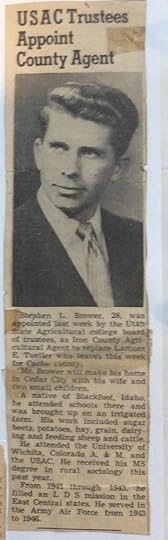
Tuesday morning I had the unexpected pleasure of sitting down with Bruce Brower and Jan Arnell, children of Stephen Brower, who readers of Downwind will remember from Chapter 3 "Home on the Range," which discusses the Cedar City sheep die off of 1953. Jan graciously allowed me to look through her father's papers about the incident, which span several decades and have been assiduously preserved and organized, thanks to Jan.
They document the career and efforts of a principled and earnest individual who spent years advocating for the ranchers of Iron County.
I was thrilled to look through his papers, which included ample correspondence between Brower and AEC officials, public health officials, elected officials, private contractors brought in by the AEC to help assess the afflicted livestock, and later, Governor Scott Matheson of Utah, who also advocated strongly for the people of his state who had been affected by radiation. Brower saved his copies of meeting minutes with the livestockmen and the AEC, reports on the sheep deaths, and newspaper clippings documenting years worth of controversy around the sheep case. He even corresponded with former Secretary of the Interior Stewart Udall about Udall's efforts to organize Downwinder plaintiffs and "embarass the government into acting."
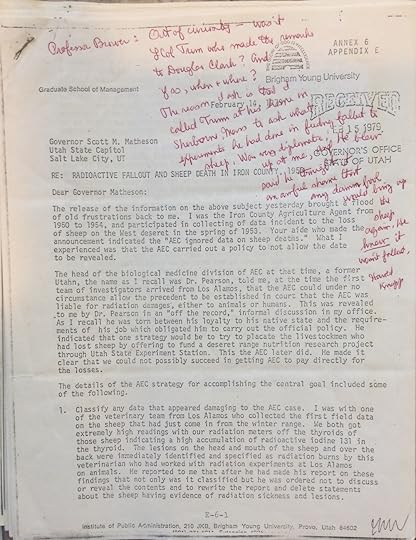
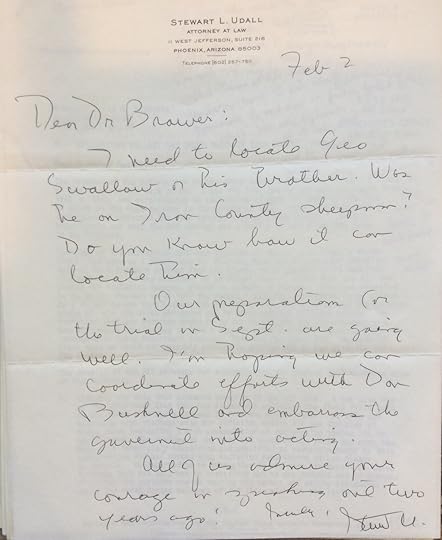
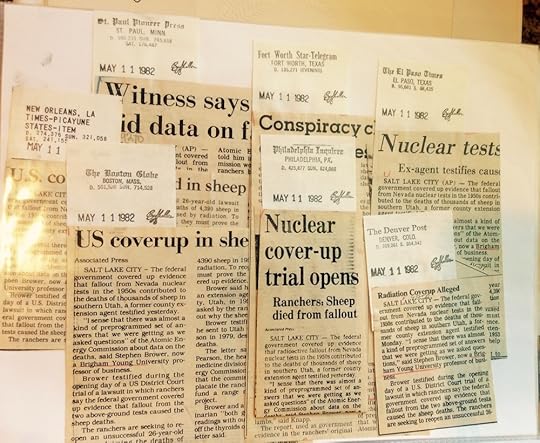
Press clippings from around the nation Brower saved in his files.
It was an unexpected pleasure to get to interview Jan and Bruce about their father. Here's hoping some day I get a chance to do another edition of Downwind that includes some of the fascinating data from his personal papers.
October 20, 2015
Return to Logan
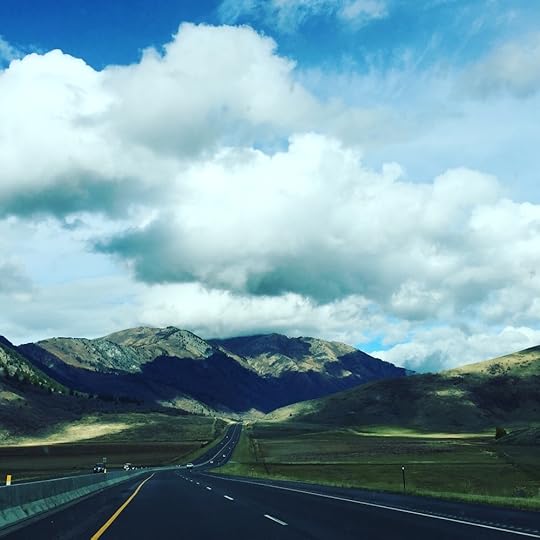
Returning to Logan
It felt fitting to kick off the Utah tour for Downwind in Logan, the town where my journey with these stories began. I first arrived in Logan to attend grad school in history at USU in 2004. Yesterday I had the honor of speaking about my research in the same building where I defended my master 's thesis all those years ago, and the pleasure of chatting with Utah Public Radio's Tom Williams on the Access Utah Program. I've had the chance to catch up with dear friends (thank you Jess and Ryan for your incredible hospitality), see old grad school buddies (what a great suprise, Sarah!), and reconnect with some amazing faculty mentors. And of course, I got to swing by my old apartment, revisit Logan Canyon, and stop by the offices of the WHQ, where I served as an editorial fellow during grad school. From here its on to Salt Lake, where I will speak with Mary Dickson at the SLC Public Library on Tuesday, the State Archives on Wednesday, and staff and supporters of HEAL Utah on Thursday.
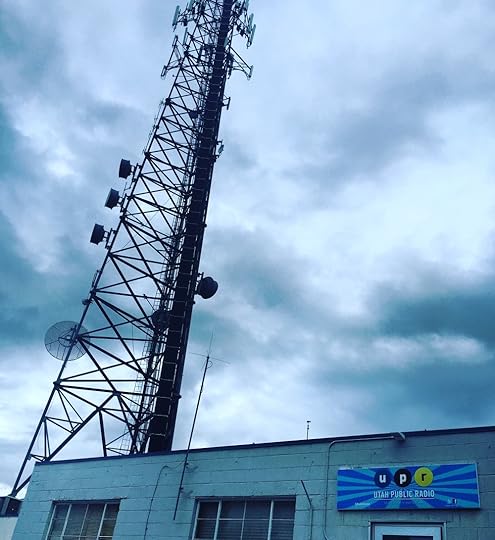
Visiting UPR to discuss Downwind with Access Utah's Tom Williams.
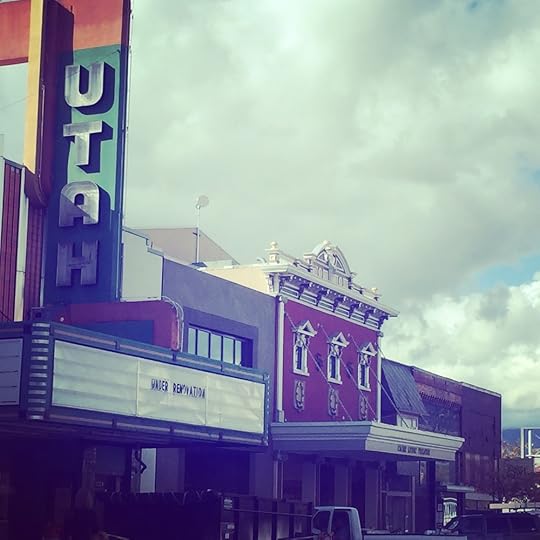
The Utah theater in downtown Logan
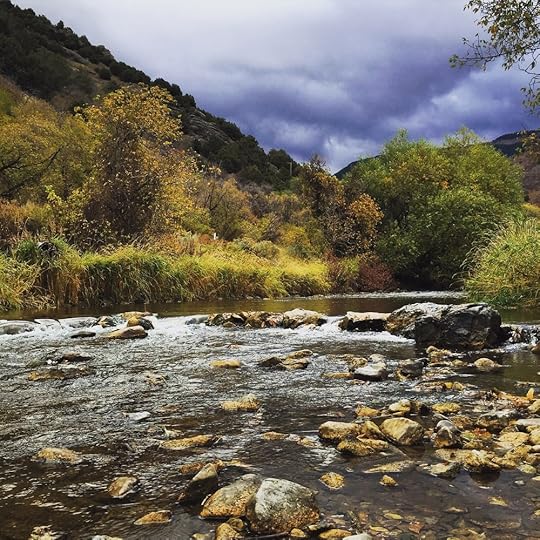
Beautiful Logan Canyon
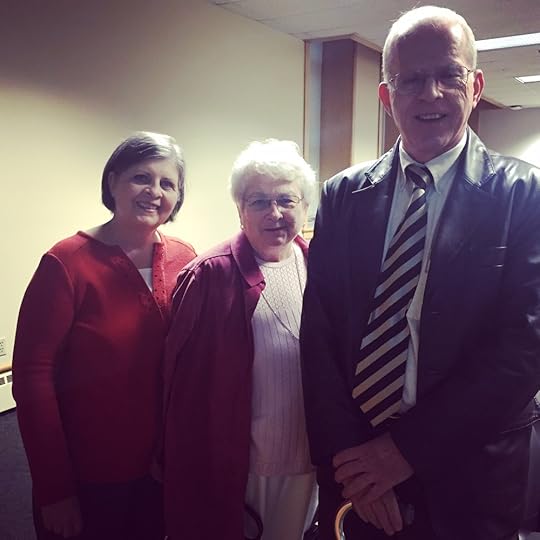
Surprise guests at my talk: Jan, Karen, and Bruce Brower, children of Stephen Brower, one of the heroes of Downwind: A People's History.
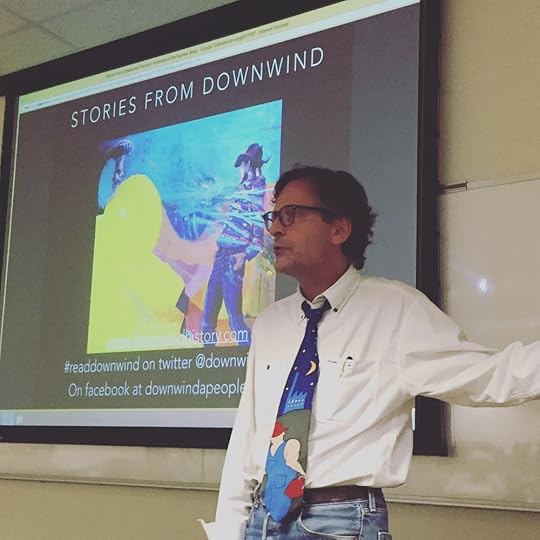
It was an honor to be introduced by Dr. David Rich Lewis, my longtime mentor.
October 16, 2015
DOWNWIND: A People's History Utah tour set to begin soon (with special appearences in Idaho!)
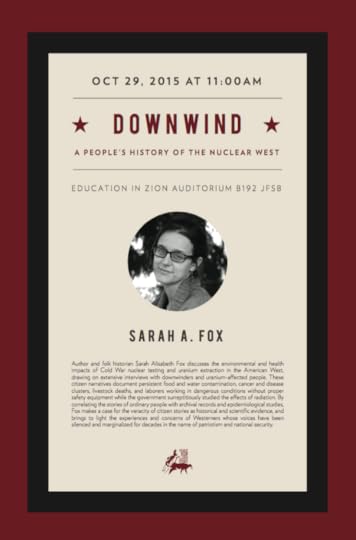
This week, Downwind: A People's History of the Nuclear West author Sarah Fox will be returning to the region where her book research began ten years ago, to speak at libraries and universities across Utah (with a side trip to two communities in Southern Idaho) during the Utah Book Festival. Her visit is made possible by the generous support of Utah Humanities, the Charles Redd Center for Western American Studies, and the libraries and institutions that will host her on this trip. Fox will be available to record oral history interviews for residents who are interested in sharing their memories of the Cold War in three different locations (noted below). Learn more about how to sign up for an oral history session here.
Highlights of Fox's tour include:
Utah State University, Logan, Monday October 19, at 3:30 pm.
Salt Lake City Library, conversation with Mary Dickson, Salt Lake City, Tuesday October 20, at 7 pm.
Utah State Archives, Salt Lake City, Wednesday October 21, at 12:00 pm (Courtyard Meeting Room, 346 South Rio Grande (450 West), Salt Lake City, UT).
HEAL UTAH visit, Salt Lake City, Thursday October 22.
Oneida County Library, Malad Idaho, Friday October 23, 5 pm.
Emmett Library, Emmett, Idaho, Saturday October 24, 12:00 pm.
Oral History Gathering Session, Emmett Library, October 24, 1:30-4:00 pm. (email the author at downwindhistory@gmail.com to sign up for a time.)
Washington Branch Library, Washington City, Monday October 26, 7 pm.
Southern Utah University, Cedar City, Tuesday October 27, 7 pm.
Oral History Gathering Session, SUU Library, Tuesday October 27, 1-4 pm. (email the author at downwindhistory@gmail.com to sign up for a time.)
Enterprise Library, Enterprise, Wednesday October 28, 7 pm.
Oral History Gathering Session, Enterprise Library, 5-6:30 pm. (email the author at downwindhistory@gmail.com to sign up for a time.)
Charles Redd Center for Western American Studies, BYU, Provo, 11:00 am.
October 15, 2015
Downwind author Sarah Fox's Radio West interview with KUER's Doug Fabrizio
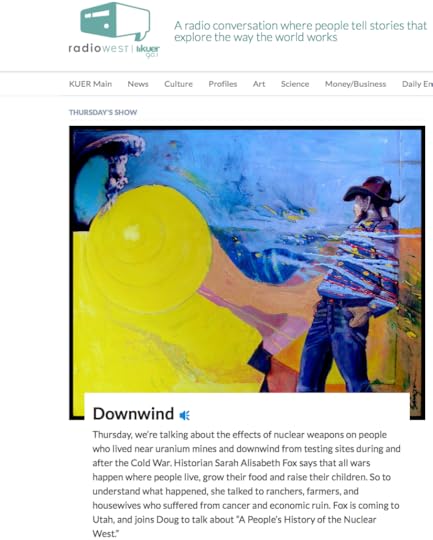
On October 15 Downwind author Sarah Fox sat down at Seattle's KUOW studios to chat with KUER Radio West's Doug Fabrizio about some of the stories in Downwind: A People's History. Listen to the program here.
Would you like to share your story of life downwind?
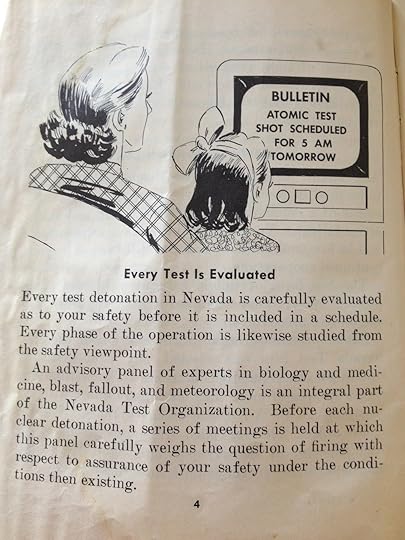
Author Sarah Fox will be available on three dates during her upcoming tour to record oral history interviews with residents who are interested in sharing their memories of the Cold War. Digital recordings of these interviews will be donated to the University of Utah Downwinders Archive and the SUU archive.
Oral History Gathering Sessions will take place on the following dates:
Emmett Library, Emmett, Idaho, Saturday, October 24, 1:30-4:00 pm.
Southern Utah University Library, Cedar City, Utah, Tuesday October 27, 1-4 pm.
Enterprise Library, Enterprise, Utah, Wednesday October 28, 5-6:30 pm.
If you or someone you know is interested in sharing a story, please email the author at downwindhistory@gmail.com to sign up for a time at one of these sessions. If you aren't able to make it to an oral history gathering session, but would still like to share your story, you can submit a written history to Fox for donation to the archives (email downwindhistory@gmail.com to learn more), or you can contact the Utah Downwinders Archive directly to see about having your story preserved.
Your stories matter. They are helping to change the historical record of the Cold War as it played out in the American West. They are helping to bring awareness to the health problems, environmental contamination, and family tragedies that are still playing out across the downwind and uranium-affected regions. Thank you for telling them, and keeping this history alive.
July 24, 2015
Downwind reviewed in Environmental History
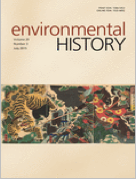
It was an honor to read Leisl Carr Childers' review of Downwind (excerpted below) in the July 2015 issue of Environmental History, a preeminent interdisciplinary journal published by Oxford University Press. A former assistant director of the Nevada Test Site Oral History Project at the University of Nevada, Las Vegas, Childers is intimately familiar with the stories associated with this period in history. She's a well-respected scholar of the American West at the University of Northern Iowa and author of the upcoming book The Size of the Risk: Histories of Multiple Use in the Great Basin, due out this fall. You can read her full review of Downwind online if you subscribe to Environmental History, or access it online at a public or university library.
Excerpts from Review of Downwind by Leisl Carr Childers, Environmental History (July 2015), pp 527-8.
"In this riveting narrative about the experiences of those who suffered in the shadow of atmospheric nuclear testing and uranium mining, Sarah Alisabeth Fox offers readers a glimpse into what it meant to be part of 'all those little communities' in the American West downwind of military test sites and big corporate mines. For Fox, downwind is at once a concept, a state of being, and a geographic location. During the latter half of the twentieth century, downwind meant hazardous exposure to radiation; to be downwind meant to be rural, pastoral, Native or Mormon; to live downwind meant abiding in an undesirable place, proximate to dangerous activities, with no refuge or recourse. Given these parameters, Fox argues that Downwinders, those who share in this concept, state of being, and place, represent the human cost of national security during the Cold War."
"Navajo artist Edward Singer's 2008 painting Dear Downwinder on the cover captures the essence of her study---the problematic intersection of bodies and radioactive contamination."
"Written in an accessible literary style rarely seen in works that employ rigorous theoretical analysis, Downwind offers students and scholars of the Cold War a new perspective on the resilience of Downwinders despite efforts to obfuscate the effects of radiation exposure."
"Current works on the same topic... offer similar insights but do not interrogate the meaning of downwind. Combining the intricacies of the official record with the complicated narratives of the individuals she interviewed, Fox provides texture and insight into becoming and being downwind within the framework of both nuclear testing and uranium mining."