Stacy DeKeyser's Blog: Reading, Writing, and Chocolate, page 2
April 24, 2018
Hiding in Plain Sight: Real-life References in The Rhino in Right Field
The Rhino in Right Field is a made-up story. Of course it is! Climbing into animal pens at the zoo? A parade of zoo animals? An escape? None of that stuff could happen in real life. Could it?
You might be surprised.
Here (in alphabetical order) is a roundup of the very real people, places, and events that found their way into The Rhino in Right Field. I’ll be adding links and photos a little at a time, so check back often.
Advertising: The ads sprinkled throughout the book are authentic to the time and place. Doerflinger's Artificial Limb Company was located at 2525 W Fond du Lac Avenue in Milwaukee. King's Motors ("Your source for genuine Packard parts!") was real, too, and its phone number was HOpkins 5800. A popular magazine ad of the era boasted that "More doctors smoke Camels than any other cigarette!"
The batboy contest: Penny’s rejection—just because she was a girl—is based on a true event. While he was owner of the Cleveland Indians, Bill Veeck sponsored a citywide batboy contest. According to Paul Dickson’s book, Bill Veeck: Baseball’s Greatest Maverick, Veeck sent out a call inviting boys ages 12–16 to submit an essay explaining why they should be the Indians batboy. Dickson writes, “Thousands of boys entered the contest, as did one girl… to whom Veeck sent a regretful letter explaining why she was not eligible.”
The brewery on State Street: The Miller brewery has been located at, or near, the same location on State Street in Milwaukee since 1855.
The Caravan of Animals from the zoo to the ballpark recalls two significant events in Milwaukee history. The first is Milwaukee’s Great Circus Parade. Sporadically from 1963 to 2009, brightly painted circus wagons carrying giraffes, lions, camels, and other exotic animals paraded through the streets of downtown Milwaukee to commemorate the arrival of the circus. On a smaller scale, the Washington Park Zoo sponsored a traveling zoo wagon in the 1950s. A Parks Department truck fitted with cages trundled around the city during the summer, so that kids who couldn’t get to the zoo could still see live tortoises, rabbits, and other small zoo creatures.
The second event occurred in 1943, when Karonga the rhino was purchased from the Brookfield Zoo in Chicago. Karonga was part of a caravan of animals that also included two hippos and a wildebeeste. Karonga’s truck was the fourth of five vehicles trundling up the highway from Chicago to Milwaukee. Behind it was a car carrying a zookeeper with an elephant gun. Just in case.
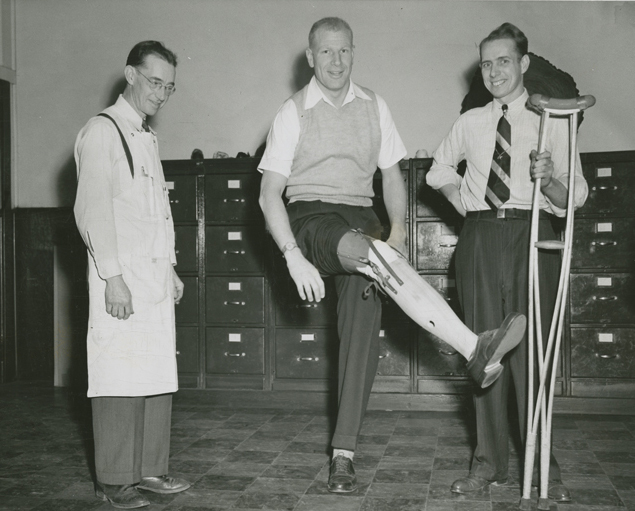
Joe Daggett’s character was inspired by Bill Veeck, who owned the minor league Milwaukee Brewers from 1941-1945. Veeck had a wooden leg as a result of injuries received in the Pacific during World War II. (He even carved a hole in the hollow leg so he could use it as an ashtray.) Veeck owned five different pro baseball teams during his long career, and his influence reverberates to this day. He is credited with introducing fan giveaways, names on players’ jerseys, and even with planting the ivy on the outfield wall at Wrigley Field. And just like Joe Daggett, Bill Veeck's door was always open.
Joe Daggett’s one-sided telephone conversations are a nod to the comedy routines of Bob Newhart.
Dandelions: My Greek grandmother really did pick dandelion leaves from the yard and cook them for dinner. They are a good source of potassium and vitamins A and C (though dandelions in your yard may have been treated with fertilizer, weed killer, or pest killer). Buy them from a market, and wash them well before cooking.
The escaped rhino: A rhinoceros never escaped its wagon during a parade, but something similar almost did happen. In 1943, a rhino named Karonga was tranported to Milwaukee by truck from the Brookfield Zoo in Chicago. He was accompanied by a caravan
that included a police escort and zookeepers with elephant guns. According to a written account, “When the procession moved Karonga was quiet. But at every stop … he renewed bombardment of the front of his crate. So terrific were his onslaughts that everyone in the parade feared he would gain freedom.”
The fence: Nick’s description of the “chest high chain link fence” that separated Tank from the Scramble field really did exist at Washington Park Zoo, exactly as described in the book--except the fence actually contained American bison, which is arguably more intimidating than a rhino, considering those horns. A short chain link fence sits atop a shallow retaining wall built of stone. The retaining wall provides a convenient step for anyone wanting to climb in (or out). Want to try it for yourself? Go for it! The wall and fence are still there.
Frederick Street: Vliet Street in Milwaukee (rhymes with “Fleet Street”).
Frozen custard is a favorite in Milwaukee. It looks like soft-serve ice cream, but is called custard because it’s made with eggs. Traditional flavors are chocolate and vanilla, but most local custard stands create their own “flavor of the day” menus. Some popular local custard stands are Gilles, Kopp’s, Leon’s, Robert’s, and Culver’s. Every true Milwaukeean swears loyalty to their favorite custard stand.
Mrs. Garble is a complete figment of my imagination. But the Camel cigarette ad she quotes in the book really did exist.
Mrs. Gibbs is modeled after Ione Quinby Griggs, known simply as “Mrs. Griggs” to several generations of Milwaukeeans. Her daily advice column ran in the Milwaukee Journal’s Green Sheet from 1934–1985.
The Green Sheet was the daily entertainment section of the evening Milwaukee Journal from 1934–1994. It was a 4-page broadside, printed on green paper, containing the comics, radio and TV listings, movie showtimes, and Mrs. Griggs’ famous local advice column.
The Kenosha Comets were a team in the All-American Girls’ Professional Baseball League (AAGPBL). The league had between 5 and 11 teams, and played from 1943 until 1954. Players’ uniforms included short skirts (with bloomers underneath). League rules also stated that “lipstick should always be on,” and “at no time may a player…wear slacks or shorts in public.” Players were allowed to pitch overhand beginning in 1948.
Monkey Island has been a favorite attraction at Milwaukee zoos since 1925. Generations of kids have watched the monkeys (macaques) swimming in the moat, but never climbing out and escaping to freedom. The monkeys can wade in on the island side, but the moat gets deeper toward the outer wall. Since the monkeys can’t touch the bottom, they have no way of jumping out. And the wall is too smooth to climb. But in 1948, you could almost reach out and touch them!
Mountain Goat Mountain, where Barbary sheep roamed, was another favorite exhibit at the Washington Park Zoo. Anonymous sources claim that it was also a perfect venue for playing Cops and Robbers, or for shagging fly balls.
The Mudpuppies are inspired by the minor league Milwaukee Brewers (1902–1952). I changed the team’s name to avoid confusion with the present-day, major-league Brewers, and to pay homage to the tradition of quirky names for minor league clubs, such as the Mud Hens, Yard Goats, and Riverdogs.
Newspapers: The morning Milwaukee Sentinel was published from 1837–1995, when it merged with the evening Milwaukee Journal to become the Milwaukee Journal-Sentinel.
Orchard Field is modeled after Borchert Field, home to professional baseball in Milwaukee from 1888 until 1952. Nicknamed “Borchert’s Orchard” or “The Ol’ Orchard,” the rectangular ballpark took up one full city block in the middle of a residential neighborhood, at 8th and Chambers streets (“8th and Chalmers” in the book.) Borchert Field’s phone number was COncord 3180 (dial 2 and 6, the numbers corresponding with the letters C and O on the dial, and then 3180—a six-digit phone number).
Radio announcers: Bob & Ray (Bob Elliott and Ray Goulding) were a nationally famous comedy team on radio and TV from 1946 until 1984. Their routines often consisted of fictional play-by-play and news commentary. You can listen to some samples here. More locally, broadcasters Earl Gillespie and Gordon Hinkley were fixtures on Milwaukee radio and television for over 40 years. And then of course, there’s Bob Uecker, the radio voice of the Milwaukee Brewers since 1971. Without the Uek, Milwaukee baseball wouldn’t be anywhere near as much fun as it has been all these years.
Tank the rhino: Tank’s real name was Karonga, and he was the Washington Park Zoo’s resident rhino from 1943–1957. In his prime, he weighed 2,580 pounds and sported a 17-inch horn.
WTRJ radio: A sideways homage to WTMJ radio, broadcasting in Milwaukee since 1927.
The zoo: The Washington Park Zoo was a true city zoo. Occupying the southwest corner of Washington Park from 1892 until 1958, it housed more than 800 animals, including polar bears, giraffes, lions, and a rhinoceros. Since it was in the park, the zoo had no gates or fences around it, and no admission charge. It gained a national reputation as a progressive zoo, building large, realistic enclosures for many of its animals, with few obvious barriers between the animals and their human visitors. Close interaction was officially forbidden. Of course.
In 1958 the zoo was relocated to the western city limits and renamed the Milwaukee County Zoo, where it is still located.


My blog has moved
Stacy DeKeyser's blog
Thanks! Hope to see you there.
--Stacy
Bibliography for The Rhino in Right Field
Here's a list of the major source materials I used while researching and writing The Rhino in Right Field:
Printed material:
Buege, Bob. Borchert Field: Stories from Milwaukee’s Legendary Ballpark. Madison, WI: The Wisconsin Historical Society, 2017.
Dickson, Paul. Bill Veeck: Baseball’s Greatest Maverick. New York: Bloomsbury, 2012.
Gurda, John. New World Odyssey: Annunciation Greek Orthodox Church and Frank Lloyd Wright. Milwaukee: The Milwaukee Hellenic Community, 1986.
Gurda, John. The Making of Milwaukee. Milwaukee: The Milwaukee County Historical Society, 1999.
Saloutos, Theodore. “The Greeks of Milwaukee.” Wisconsin Magazine of History, Spring 1970.
Wesley, Charles I. “Story of Milwaukee’s Zoo and its Sponsor, the Washington Park Zoological Society,” The Washington Park Zoological Society, 1947.
Winter, Darlene, Elizabeth Frank, and Mary Kazmierczak. Images of America: Milwaukee County Zoo.Charleston, SC: Arcadia Publishing, 2014.
Veeck, Bill, and Ed Linn. Veeck—As in Wreck. Chicago: The University of Chicago Press, 2001.
Online:
Michaels, Chance. Borchert Field (blog).
Milwaukee County Historical Society website.
Milwaukee Journal historical archives.
Milwaukee Sentinel historical archives.
In person:
Milwaukee County Zoo Library and Archive
10001 W. Bluemound Rd.
Milwaukee, WI 53226
1859 N. 40th Street
Milwaukee, WI 53208
April 23, 2018
Blog Archive
April 7, 2018
Bibliography for THE RHINO IN RIGHT FIELD
Printed material:
Veeck, Bill, and Ed Linn. Veeck—As in Wreck. Chicago: The University of Chicago Press, 2001.
Buege, Bob. Borchert Field: Stories from Milwaukee’s Legendary Ballpark. Madison, WI: The Wisconsin Historical Society, 2017.
Winter, Darlene, Elizabeth Frank, and Mary Kazmierczak. Images of America: Milwaukee County Zoo.Charleston, SC: Arcadia Publishing, 2014.
Dickson, Paul. Bill Veeck: Baseball’s Greatest Maverick. New York: Bloomsbury, 2012.
Gurda, John. New World Odyssey: Annunciation Greek Orthodox Church and Frank Lloyd Wright.Milwaukee: The Milwaukee Hellenic Community, 1986.
Gurda, John. The Making of Milwaukee. Milwaukee: The Milwaukee County Historical Society, 1999.
Saloutos, Theodore. “The Greeks of Milwaukee.” Wisconsin Magazine of History, Spring 1970.
Wesley, Charles I. “Story of Milwaukee’s Zoo and its Sponsor, the Washington Park Zoological Society,” The Washington Park Zoological Society, 1947.
Online:
Michaels, Chance. Borchert Field(blog). http://www.borchertfield.com/.
Milwaukee County Historical Society website. https://milwaukeehistory.net/.
Milwaukee Journalhistorical archives. https://news.google.com/newspapers?ni....
Milwaukee Sentinelhistorical archives. https://news.google.com/newspapers?ni....
In person:
Milwaukee County Zoo Library and Archive. Milwaukee County Zoo, 10001 W. Bluemound Rd., Milwaukee, WI 53226.
Washington Park. 1859 N. 40thStreet, Milwaukee, WI 53208.
February 2, 2018
The Rhino in Right Field

Coming July 10, 2018
Margaret K. McElderry Books/Simon & Schuster
No one ever hits the ball to right field.
Except, of course, when they do. A boy who loves baseball must get past his hard-working immigrant parents—and the rhino in the outfield—to become a batboy in this laugh-out-loud middle grade novel in the tradition of The Sandlot.Nick wants to change his life. For twelve whole years, he’s done what his hard-working, immigrant parents want him to do. Now he’s looking for his own American dream and he thinks he’s found it. The local baseball team is having a batboy contest. Nick’s goal—to be a Mudpuppy for a day!
But the contest is on a Saturday—the day Nick has to work in his father’s shop. There’s one other tiny—well, not so tiny—problem. A 2,000-pound rhinoceros named Tank. Nick and his friends play ball right in the city zoo—and Tank lives just beyond the right field fence. Nick’s experience getting the ball out of Tank’s pen has left him frozen with fear whenever a fly ball comes his way. How’s a lousy fielder going to win the contest?
One thing Nick knows how to do is work hard, and he practices every day with his best friend, Ace, and a new girl named Penny, who has an impressive throwing arm! But that’s not enough—to get to the contest, Nick resorts to a plan that has him lying to his parents and blackmailing his uncle. All while dodging the school bully, who’s determined to win even by playing dirty.
Nick will need to keep his eye on the ball and find the courage to face his fears—oh yeah, and stay one step ahead of Tank—in this fast, funny story about a game that can throw you some curveballs—just like life!
Preorder now!
from IndieBound
from Amazon
from Barnes & Noble
February 8, 2017
Summer 2018
My next novel has a tentative publication date!
It's a middle-grade novel about a kid (who very closely resembles my dad) growing up in a city that very closely resembles Milwaukee in the late 1940s.
As part of my research, I've been collecting images over at Pinterest, if you want to take a look.
And I'll be posting details of the publication schedule over on my calendar page.
Check back occasionally to see what's new.
October 21, 2016
Handout from Wisconsin SCBWI Conference, October 2016
If you attended my conference workshop, "The Connect-the-Dots Novel Outline" (or even if you didn't), here is the link to the PowerPoint presentation and handout.
Connect-the-Dots handout
Feel free to copy it for your personal use.
Happy writing!
May 20, 2016
Turning Points
A few weeks ago, I talked about turning points at the New England SCBWI spring conference.
The main point was this: As you write (especially a first draft), you may not know everything about how your story will unfold, but you DO know some things.
For example, you may know:
Who your protagonist is
What he/she wants
Who the main antagonist is
What obstacles will get thrown in the way...
Maybe you know the initial premise, and how your story will end. (When I started my first draft of Jump the Cracks , that's all I knew.)
But the thing is, you don't have to know your whole story to start writing. You only have to know ONE thing about your story, and you can write your way to that point. Or write THAT scene: the one you KNOW will have to happen at some point in your story.
Then, fill in the blanks as you go. Because once you write SOMETHING, other things will become apparent to you, and then you can write THOSE things.
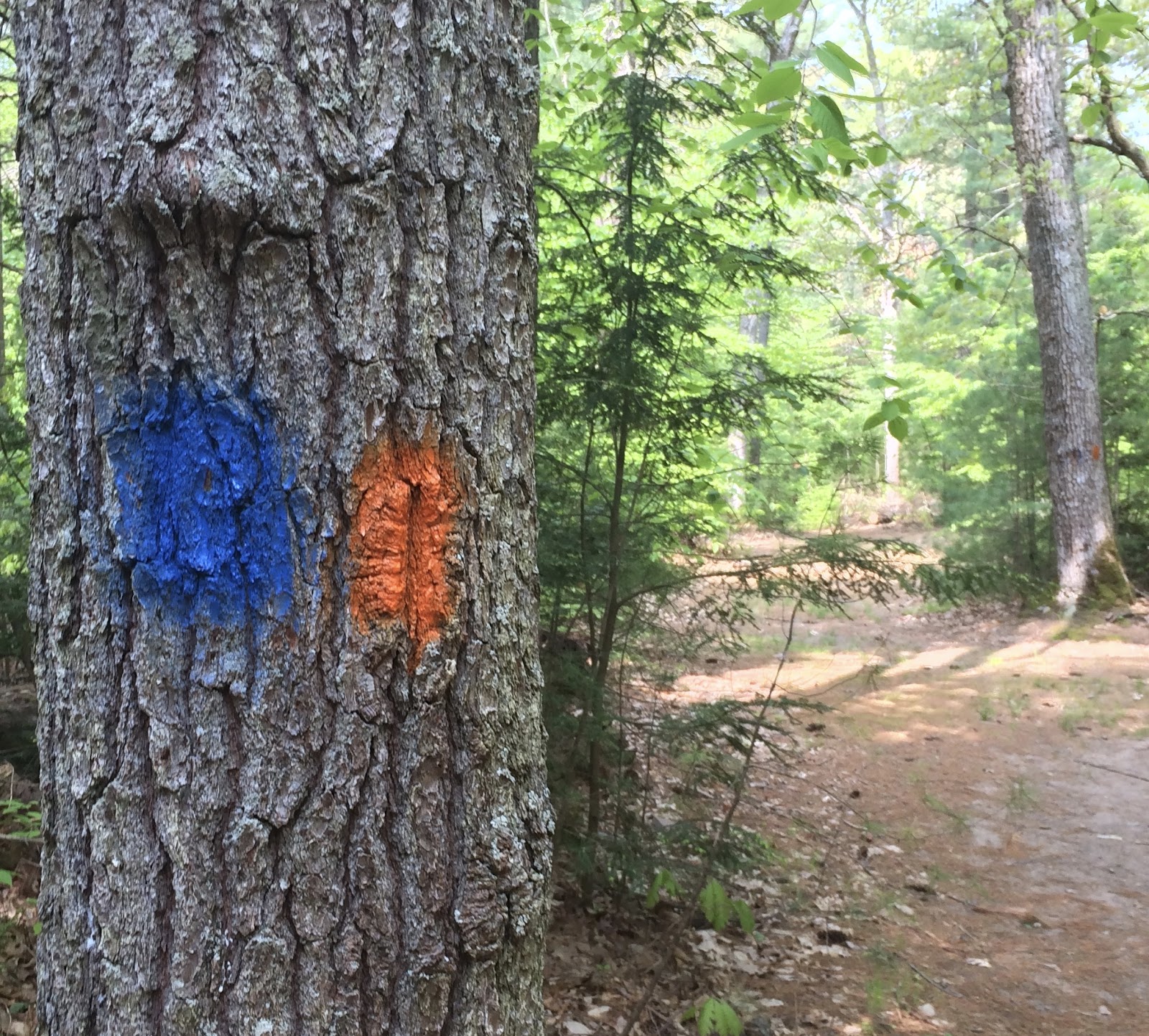
It's a lot like walking through the woods. There may be several possible paths, but once you decide you are hiking the blue trail and not the orange trail, that's a start. You walk along, watching for the next blue blaze. And when you get there, you know you have to look for the NEXT blue blaze.
Writing is so similar. Write a scene--ANY scene--that you KNOW has to happen in your book. Then think about another thing that will HAVE to happen as a result...and write that. Repeat.
Look for the blazes. You can write a whole book that way, or at least a good underlying structure.
Happy trails!
June 3, 2015
Mapping a Reader's Life
xo