
Ingela Bohm's Blog, page 44
April 23, 2016
Wreck Of Maidenhood (a Rival Poet extra)

If you ever wondered about Will’s romantic past, and my view of his sexuality. Deleted scenes from Rival Poet. 1581.
He first saw her in a graveyard. Among the headstones and the rain-blackened trees, on the darkest day of September, he saw her. On a day when his ink was running dry and his words were turning to dust in his mouth, that’s when she appeared.
Like the angel he hadn’t known he needed.
It was a Sunday, the one day of the week when he was able to breathe. Four years had passed since he first began toiling in the odorous trade of Dick Field’s father, and most of that time he’d spent shackled to the tannery, acquiring skills he didn’t want. But once a week, he had a few precious hours of freedom, and the graveyard was as good a place as any to spend them. There…
View original post 12,716 more words



Death of Kings (a Rival Poet extra)
Deleted scene from Rival Poet. 1576.
“I’m serious, Mary. I can’t keep this up!”
Will glanced up. It was father’s voice, coming from the garden. There was a hissing sound, and then silence. Will peered through the half open shutters and saw mother filling pitchers with beer, handing them to her husband in terse, angry movements.
“On one side, there’s family,” father said. “On the other, the Queen’s favourite! I need to work twice as hard as everyone else to keep up appearances.”
“Isn’t that your job?” Mother’s voice was tense. Will glanced at his brother and sister, but Gilbert just continued stretching skins and Annie bent her head over her needlework, as if trying to shut out what couldn’t be ignored.
Will sighed and took a new skin, unrolled it and started pulling at it. Father was having all the aldermen over to the house for an evening…
View original post 12,978 more words


Did Shakespeare love his wife?
Of course, we can never know. We don’t know much about the man at all, except that he was born, he married, his wife had three children, he moved to London and acted in plays, dodged a few tax collectors, and died.
So why am I posing the question? Because Anne – or Agnes, as she was christened – tends to be shoved aside when we gather to adore her husband. Many interpret their marriage as solely motivated by her being pregnant (the ‘bed trick’), and Shakespeare’s subsequent move to London as proof that he wanted to get away from her.
Basic misogyny.
I have another take on it, but don’t read on if you don’t want your Rival Poet ruined by the complexity that is real life (or if you haven’t read it yet and don’t want ***spoilers***!).
So you’re reading on? Okay. Well, in my view, Shakespeare was bi, and possibly poly. Rival Poet, being a m/m romance, focuses on the biggest love of his life, Marlowe, but there’s a whole scrapped background from an unpublished bio novel that complicates the picture. My Shakespeare’s most prominent trait, apart from his phenomenal memory for words, is his ability to see things from several points of view. That was the first thing I decided when I started plotting his story: he should be both intellectual and materialistic, undecided when it came to religion, bisexual, equally at home in Stratford and London, and torn between wanting to be a poet and wanting to be an actor.
So yes, in my book (no pun intended… okay, yes, pun intended), Shakespeare did love his wife. In fact, he was besotted, but had a hard time convincing her that marrying a stripling like him was in any way sensible. She was pregnant with someone else’s child (I warned you about the spoilers!), and he jumped at the chance to save her from life as a social pariah. In the unpublished story about their marriage, he has to work really hard to get close to her, and the reward, in the end, came in the form of a pair of twins with Will’s DNA.
 That doesn’t negate his all-consuming love affair with Kit. That’s the most important thing in his life, after all. It’s what kickstarts his career after Agnes has persuaded him to go to London to try his luck among the publishing houses, and it’s also what spawns the great tragedies. Kit is his biggest passion, no doubt about it, because theirs is a ‘marriage of true minds’. Their love of words and their almost telepathic communication makes the attraction instantaneous and irrestistible.
But a life is a life, and not a romance. Will had a life before Kit, and parallel with Kit. If you don’t mind women in your fiction (and you really shouldn’t), here’s the beginning of the story of Agnes and Will.


April 22, 2016
I don’t get the toilet thing!
Aren’t half of all public restrooms gender neutral anyway? And what do the anti toilet loonies expect people to do in there? In my experience, you go in, you do your stuff, and you leave. That’s sort of how we do it where I live, but apparently, that procedure is highly unusual in other parts of the world. Apparently, public restrooms are a breeding ground for all sorts of fishy behaviour.
I mean, if at least this was something that would make life worse for cis people, but it’s not. I would welcome not having to trek halfway across a stadium to reach the ladies’, only to be met with a mile long queue*. What a relief to go to the gents’ (which would no longer be the gents’, of course), which is invariably closer to my seat at the concert.
I’m sorry if this comes across as flippant or something, but I just don’t get it. I keep thinking I must be missing something, since people are up in arms about a sign on a door.
But then they tend to get up in arms about who votes for who in the Eurovision Song Contest too, so I guess I shouldn’t be surprised.
* One single time in my life, the ladies’ queue was shorter. In fact, it was non-existent. I thought the loos were out of order or something, and then I remembered I was at a Rush concert. It remains a happy memory, for several reasons.


April 21, 2016
Wedding naughtiness (deleted scene, Pax II)
Yup, I’ve got my revising hat on again, and good thing I have. There are some definite snarls in this book, just waiting to be smoothed out. This is one thing that got the axe.
***
The first dance was done. Jamie released Sapphire and turned to scan the room. He’d seen Michael slip away earlier, but there hadn’t been a moment of peace when he could go in search for him. Please God, don’t let him have gone home! I need him here.
His lips still burned from the memory of Michael’s mouth – so small, so hot, so sweet. So startled beneath his gentle assault, but so willing. He’d let him in, like he always let Jamie do everything. He hadn’t made a peep of protest even when Jamie entered him with his tongue in front of everyone.
Oh, baby…
Hunting through the crowded rooms, Jamie dodged laughing and drinking guests, pushing them aside like mere glittery obstacles on his way to Michael. He finally found the stairs and zoned in on them with sudden certainty. Michael was up there somewhere, in darkness and solitude. He just knew it. Heart hammering, Jamie tiptoed up the steps just in time to see a quick shadow scramble out of sight inside an open closet. He hesitated. Michael didn’t want to see him? He was hiding, not from the others, but from him?
No. Not possible. Even if he was shocked, he wouldn’t avoid him. Right?
Jamie inched forward until he could look past the screen door. Michael was staring up at him from the darkest corner like an angered owl. Weak with long-battled affection, Jamie leaned against the door. “I guess I should apologise…”
Michael shrugged. Swallowing, Jamie stepped inside, closed the door and sat down. Michael frowned down at his shoes, his hair concealing any emotion as he spoke, voice all level and low. “I just want to know one thing.”
Jamie swallowed again. “Yeah?”
A pause. “Did you know it was me?”
“Of course!”
Michael nodded. Seemed to relax the tiniest bit. He got to his knees and crawled closer, a lopsided crawl with only one hand on the floor. Suddenly his face was just inches from Jamie’s. And then hot lips were pressing wetly against his. Jamie almost fell backwards. Somewhere in the middle of soaring above the rainbow, he found the sanity needed to throw up his hands and push at Michael’s shoulders. Somehow he failed to muster the necessary force, because now Michael’s tongue was snaking inside Jamie’s mouth, and even though his brain kept telling it to close, it fell completely open, giving up the codes to his innermost treasures without a fight.
He didn’t know how long they kissed, but he finally found the strength to break away. “What are you doing?” He’d meant to sound angry, but it came out whispered, breathless.
Michael’s reply was hushed but calm. “What do you think?”
“But not… not here!”
Michael exhaled sharply. “You didn’t care before. I don’t care now.”
Jamie knew he should be appalled, but instead he felt the pull of disorienting desire. Michael’s hair nestled into his as he leaned close again and licked a moist path across Jamie’s parted lips. The touch was nothing, the mere ghost of a touch, and yet it tickled and burned as if Michael was lapping at the head of his cock. “Oh… God…” He felt himself be kissed down onto the floor, kissed into submission. Writhing underneath his captor, he whimpered an unconvincing “But–” that was quickly smothered by Michael’s hot tongue. When he felt Michael’s weak left hand sneak up between his legs, he jumped and tried to wrench free. His good hand immediately came down on his chest and held him in place. Jamie tensed. If he had both his hands he could really hold me down, he thought, and the feeling that thought evoked in him was as uncivilised as it got.
Perhaps sensing his confusion, Michael stopped kissing him. Time stood still for a moment. All that could be heard was their laboured breathing in the blackness. “Are you really sure you want to say no?” Michael’s dark voice came to him, caressing his ears like crushed velvet. He stroked moist lips across Jamie’s throat without actually kissing him. Then he reached down again to cradle Jamie’s swollen cock through the expensive fabric of his trousers.
“My clothes,” Jamie whispered weakly, unable to find a better argument. “They’ll stain…”
There was a pause, no longer than a heartbeat. “I’ll swallow.”
The words hit Jamie like an arrow and all will to struggle left him in one shuddering breath. His legs fell open and his whole body relaxed. Given permission at last, Michael lowered the zipper and quickly dug him out. Jamie chest was rising and falling quickly, but his heart screeched to a sudden stop when he felt the silken heat envelop him from root to tip. The first few licks were rough, clumsy in the cramped space, but then Michael stumbled into a delicious rhythm that had Jamie unravelling in seconds. Ignoring his stifled cries of protest, Michael sucked him down into himself, burning him like some jasmine-smelling acid. It was all pain, and all beauty – like the ruby gleam of a bloodied blade.
It only took a minute.
When the last drops were licked off his pulsing skin, Jamie saw the blurry form of Michael stand up. Brushing the dust off his pants, he just walked past Jamie’s wrecked body and left him there without a word.


April 19, 2016
The motivational value of giving up
So many gurus tell you to persevere, to stay positive, to go-go-go. But is that always the best way? Barbara Ehrenreich has talked excellently about the toxic nature of over-positivity, so I’m not going to reiterate that here. I’m going to talk about the very concrete way negativity and giving up can be good, even productive.
Last week, our house was invaded by carpenters and electricians on a mission to make us a flight of stairs. We’d hired them, so this part wasn’t a surprise – but the suddenness with which they turned up was. When the weekend came and we were not only exhausted but fully booked with social engagements, we also had the added task of painting a whole room – because come Monday, the floor would be, well, gone, and so would our chance to make the walls of the stairwell less hideous.
So when we’d done everything else we had scheduled, and rested enough to not get dizzy and fall off the stepladder, we got to work. The mood soon became a bit heated, because let’s face it: paint a room in five hours, with only two small buckets of paint and two okayish brushes (shops were closed), and the paint was of the slow-drying kind. Ten hours to be exact. And we needed at least three layers of paint to cover the horrid wallpaper underneath.
So we basically had to paint at supersonic speed and add new layers some nine hours before the bucket said we could. Late at night. With bad lighting. On stepladders.
Yup, we yelled at each other for a bit.
And then suddenly, M said, “Look, this is impossible.”
I paused and looked at the uneven, runny colour that had dripped onto the floor and spattered on the ceiling because we were so stressed-out, and I agreed. It was impossible. We were killing ourselves over a task that couldn’t be finished both on time and well done.
So we gave up.
And from then on, there was no yelling. We just worked in silence, calmly, knowing in our hearts that the room would end up looking like shit. Which meant that the semi-shit we managed actually looked a lot better than the nightmare we’d imagined.
Moral of the story: when we turn ourselves inside out to manage the impossible, it can have a negative effect on the result. Sometimes the best thing is to just settle for less. Because even if you’re superwoman, you can’t make paint dry quicker.
(Well, maybe you can, if you really are superwoman, but you know…)
And yet again and again, we fall into the trap of thinking that we can, because our circumstances aren’t always as tangible as the instructions on that bucket. Sometimes we can convince ourselves that if we were only better, stronger or faster, we could do the thing perfectly. Even when it’s impossible.
So give up. Just try it. What if it works? It was when I gave up on the PhD that I found the resolve to finish it. It was when I dragged a whole novel to the rubbish bin that I realised that I hadn’t tried that one thing that saved the whole plot. When you let go of your perfect vision, it can have a chance of becoming, if not what you dreamed of, at least… something.
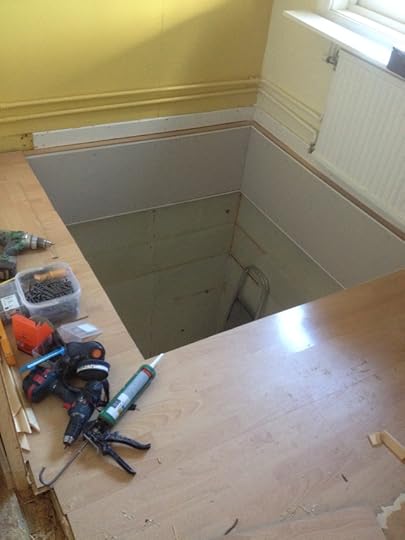 The hole[image error]

April 15, 2016
Writing room makeover
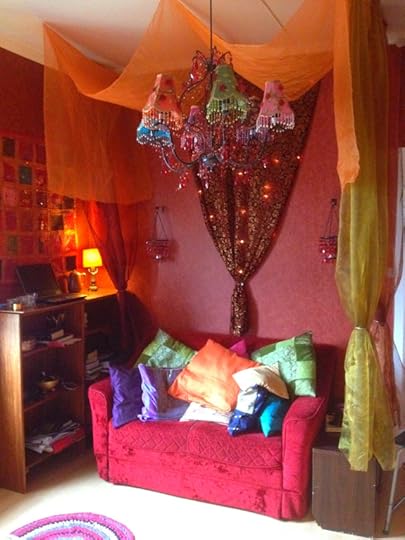
I just had to snap a picture of it mid-project. It’s slowly turning into the kind of room I want, but I’m not very talented when it comes to interior design, so it takes me AGES to get it right.


April 14, 2016
Doctoral resolve, yay!
I had a good supervision meeting yesterday! Meaning they gave me carte blanche to calm the fuck down about analyzing every single deictic and subject/predicate switch in my massive amounts of data. And they gave me a reason I could accept. Because that’s the trouble with me, I reach for perfection and completion, and almost nothing anyone says can make me settle for less, but this time… they succeeded.
So today I’m going to clean the house like a boss and listen to my transcriptions and dictate some analysis on a more general level, and then I’m going to transcribe the relevant parts (because transcribing is like the monster under my bed).
For those who have no idea what the hell I’m on about, I’m on my last year as a doctoral student and struggling to even get up in the morning. The defense is in December, so I sort of have to get a move on with this fourth article, but it’s such a fucking lonely job I’m tearing my hair out. I’ve rekindled an ounce of interest in the subject, but it’s just me and the screen, me and the screen every day, which can really wear you down, especially if you know that whatever you do, someone will think it’s rubbish*.
But today it’ll be me and the dust bunnies, which is a welcome change! Heh. As I see it written down, it actually looks like a good summary of what the PhD student’s life is like.
Anyway, I think better when I’m walking around, so I’m (re)trying that today. I almost know the sound files by heart after listening to them for five years, but hey, maybe today will be the day when I hear something new.
*This is not a plea for reassurance. It’s God’s own truth. It’s the fundament of academia: hating other people’s work because they think a category is a theme or vice versa.


April 13, 2016
Can you say ‘asshole’?
The other day, a really sweet lady at work called a colleague ‘stupid’, and I was really thrown. She didn’t say it to their face, but at a small meeting where the other person wasn’t present. Also, she meant it in the sense of ‘so socially inept that they didn’t realise they were hurting me’, but the word stayed with me, and I’ve been mulling over it for days.
The thing is, I’ve encountered a lot of advice about how to refer to people you think are stupid in the traditional, intellectual sense. You should avoid words like ‘moron’ and ‘idiot’ because of their history as institutionalised oppression of certain people, and you should use cumbersome formulations like ‘he doesn’t know all the facts of the matter’ instead. (I don’t.)
And yet it seems perfectly okay to call someone an ‘asshole’.
Now, I believe in the theory of multiple intelligences and in the MBTI. This means that in my view, some people are born with a preference for certain functions, such as creating harmony in a group, analysing how an engine works, or running fast. Inherent in these theories is the assumption that some people are good socially, and others are less so. In the case of my colleague, the offending person had handled a delicate matter quite badly, so I understand why she was upset, but the word ‘stupid’ still made me jump. I don’t know why, really, since I use the word myself – although I do tend to tone it down at work, and I’m not sure I’d be comfortable calling a close colleague ‘stupid’ in a group of other colleagues.
And I wonder: if she’d meant the word as an assessment of the offender’s cognitive abilities, would more people than me have reacted? Or does the fact that she was referring to what we can loosely call emotional intelligence make it better? Maybe one reason why it seems okay is that emotionally stupid people hurt other people’s feelings, while intellectually stupid people ‘only’ hurt others’ heads.
So maybe the consensus is that a lack of emotional intelligence is okay to deride in a way that intellectual problems aren’t. That it’s okay to call someone an ‘asshole’, but not a ‘moron’. But what if the asshole has a diagnosis that involves social ineptitude? Does that make the trait magically acceptable? Sometimes I think it does. But those categories are manmade, and don’t actually exist. They’re just a way of speaking about something we view as a problem. An arbitrary line we draw between those who can’t help themselves and those who can; between those who have a disability, and those who are just assholes*.
I have no doubt that the future will see more diagnoses. Maybe the person who’s an asshole today will be a tragically misunderstood X in a few years. But I mean, aren’t they already? The way we act is a result of nature and nurture, for everyone. I believe there are reasons for everything, even the really evil stuff.
So where does free will come in, you ask. As philosophical a question as they come, but it is relevant: how much can we counteract a bad hand dealt to us by life? How caring and sensitive to other people’s needs can we become if we aren’t born with that special knack, and no one taught us how to do it?
Deep sigh.
As usual, I’m just rambling and not really coming to a conclusion. I don’t have an answer to any of this, I just wanted to set it down in words to rid my brain of questions.
*Not everyone subscribes to this particular get out of jail free card, I know, but many do.


April 12, 2016
Revamped vampires and non-obscene wall colours

So today was a day for covers. My old Last Communion cover was a bit dull, so I reworked it. When I say dull, I mean too little colour. I may dress almost exclusively in black, but I want my surroundings to be vibrant.
When people come to our house, they tend to go, “Oh… this is colourful.” And then silence. As in, “What’s fucking wrong with you? The only non-obscene wall colour is white!”
Which, you know… After a bit of that, you tend to despise people with white walls. Which is rational as hell.
So anyway, something else I discovered is that I love texture. I’ve been studying covers that I love, and the things they have in common are the colours and the texture. When you just slap a title on a photo, it can look a bit flat.
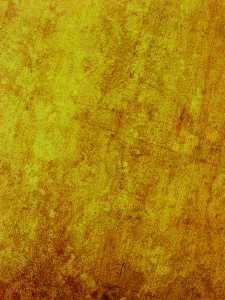 My favourite texture
It doesn’t always, but one way to avoid flatness is to put a textured image as your bottom layer, and then work with layer properties as outlined in this post to make the main photo and thus the cover look a bit more alive.
Especially important when said cover sports a vampire, wouldn’t you agree?
Of course, everyone won’t love textures and colours. In fact, my bestselling short story is very sort of mild and just has a few shades of purple on it. I don’t know if it’s the cover or the blurb that does it, but it seems to draw attention. Personally, I’m not sure I would give it a second look, but there you have it. We’re all different.


Ingela Bohm's Blog

- Ingela Bohm's profile
- 19 followers

