
 Sign in with Facebook
Fei Xiaotong’s Followers (22)


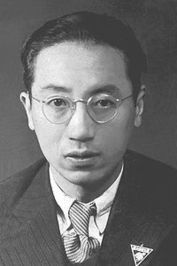
Fei Xiaotong
Born
in Wujiang, Jiangsu Province, China
November 02, 1910
Died
April 24, 2005


|
From the Soil: The Foundations of Chinese Society
by
—
published
1992
—
73 editions
|
|

|
生育制度
|
|

|
江村经济:中国农民的生活(博雅双语名家名作)(英汉对照)
—
published
1980
—
11 editions
|
|

|
Peasant Life in China
—
published
2006
—
4 editions
|
|

|
民主•宪法•人权
|
|

|
美国人的性格
|
|

|
乡土中国、江村经济套装
|
|

|
中国士绅:城乡关系论集(博雅双语名家名作)(英汉对照)
—
published
2011
|
|

|
Earthbound China: A Study of Rural Economy in Yunnan
by |
|

|
皇权与绅权(增补本)
|
|
“American children hear no stories about ghosts. They spend a dime at the drugstore to buy a Superman comic book...Superman represents actual capabilities or future potential, while ghosts symbolize belief in and reverence for the accumulated past...How could ghosts gain a foothold in American cities? People move about like the tide, unable to form permanent ties with places, still less with other people...In a world without ghosts, life is free and easy. American eyes can gaze straight ahead. But still I think they lack something and I do not envy their life.”
―
―
“I also seemed to realize that a beautiful scene, once it had existed, would always be. The present loss was just a matter of separation in time, and this separation I felt could be overcome. An inextinguishable revelation had struck; the universe showed a different structure. In this structure our lives do not just pass through time in such a way that a moment in time or a station in life once past is lost. Life in its creativity changes the absolute nature of time: it makes past into present, no, it melds past, present, and future into one inextinguishable, multilayered scene, a three-dimensional body. This is what ghosts are, and not only did I not fear them, I even began to yearn for them.”
―
―
“Ritual is obviously different from law and even from what we normally call morality. Law restrains people by setting external limits to action. The penalty for breaking a law is imposed on the individual by a designated power. People may break the law but escape being detected, and they may even feel proud of themselves or complacent if they succeed. Morality is sustained by public opinion. If you do something immoral or scandalous, people will ostracize you, and you will be shamed. Ritual is even more exacting than morality. If you act in violation of rituals, your action is not only immoral but incorrect, and it will not bring about a desired result. Rituals are sustained by personal habits. It is as if there were ten eyes watching you and ten fingers pointing at you all the time. You cannot help but follow the ritual, even if you are all by yourself. Following rituals is the right way to act. Actually, it is a habit formed in the process of cultivating oneself. One learns to conform to tradition on one’s own initiative. On the surface, “a rule of rituals” seems like a self-generated form of social order in which people’s actions are unrestrained by laws. Actually, “self-generated” is the wrong word here, because a rule of rituals implies that one uses one’s own initiative to follow conventional rules. Confucius often used the words restrain (ke) and bind (yue) to describe the process of ritual cultivation. These words suggest that “a rule of rituals” does not occur in the absence of society, does not stem from natural human instincts, and does not depend on directions from heaven.”
― From the Soil: The Foundations of Chinese Society
― From the Soil: The Foundations of Chinese Society