
Laura Christensen's Blog, page 4
December 21, 2017
Gods, Witches, Space & Stars (+bonus short story)
Back in 2011 when I started this blog, I named it “Gods, Witches, Space & Stars” as an encapsulating summary of the type of stories I was working on at the time: switching back and forth between what I called my “Gods & Witches” secondary fantasy world and some science fiction.
I first created my “Gods & Witches” world in 2009 for Brandon Sanderson’s SF&F writing class. As part of that class, we were to begin a whole new writing project rather than continue working on any pet projects. So, I began a Rapunzel-inspired story set in a secondary world of–you guessed it–gods and witches, where “gods” had creation magic and “witches” had destruction magic. The repercussions for using their magic were inspiring awe, reverence, and a compulsion to worship or follow (gods) or inspiring intense fear and hatred in anyone in the vicinity to the point of their wanting to kill you (witches). There’s a bit more to it than that, but my idea was to take folkloric trends and human tendencies and press down on them, exaggerate them, or make them a bit more concrete and a bit less abstract.
I ended up writing something like 76k of the first book of my planned duology (The Witch’s Tower (Rapunzel retelling) / God’s Arrows (Cupid & Psyche retelling)) before running into several problems I was unequipped to solve at the time.
One, The Witch’s Tower was far bleaker and more tragic a story than I actually wanted to write. And although I retooled the ending and overall arc several times to make it lighter or more hopeful, I kept running into the fact that although I mentally wanted to write something more uplifting, I emotionally couldn’t. Frankly, I was carrying too much emotional baggage from my own life that I needed to confront, work through, and heal in order to be able to write anything else. Writers write from our hearts and our subconscious as well as our minds, after all.
Two, even though I’d been writing collaboratively with friends for over a decade by this point, I had comparatively little experience crafting plots solo. The 76k I’d written barely scratched the surface of the story I wanted to tell, and I was frustrated by its lack of substance. I wasn’t sure at the time if this was due to my intense love of long-story formats or if I simply didn’t know what I was doing. I suspected it was more the latter, (although frankly it’s probably both).
It was really hard for me to reach the decision to set the world and these stories aside, however I don’t regret it. I spent the next several years experimenting with and learning from short fiction, from 1k one-offs to my 44k novella. I won’t say that I’m a master of plotting now, but I’m increasing my ability to tell if my pace is a plot problem that needs solving or if I simply need to go ahead and indulge my love of wandering through character and worlds.
Then in 2014, my friends at World Weaver Press did a #SFFLunch Twitter chat on my birthday and I jokingly suggested they create a dragon anthology for me. Aaaand they agreed! Haha, I’m still highly entertained and pleased by this.
After looking at the worlds and stories I had to hand to see where I might craft a dragon story to submit, I eyed my Gods & Witches world and characters and realized that allowing the mentor-figure of The Witch’s Tower to encounter a dragon in her backstory would set her on a much less lonely, wearying, tragic path. It would also unravel a good deal of the resulting situation and plot I’d written out in that 76k, and sort of create a “what if something else had happened” alternate direction.
In other words, if I wrote a dragon-and-girl friendship romance story with this character in this world, I could not only practice my plotting, but I’d create much more light and hope and a greater potential for happiness within my own inner worlds. It felt like a much more suitable way to say goodbye.
I took up the challenge; I wrote the story. I saved it a couple years to submit to the anthology, but unfortunately due to a few things the anthology never got off the ground.
However, I’ve also sought help and feedback on the story sporadically over the years, and I’ve learned a lot from my experiences revising. From cutting a scene on one reader’s feedback, to putting it back in with a different approach on the very next reader’s feedback, revising this story has given me a lot to think about concerning what’s right or wrong in regards to storytelling and the relationship between a writer’s intent and readers’ expectations. Especially since, in my quest to write a lighter story (despite the protagonist’s difficult past), I originally undercut the protagonist’s emotional arc and made her a bit colorless and the ending weak or difficult to understand. I’ve definitely grappled a lot with the balance of dark and light in this story. We will see what impact my revisions have made.
Now it’s time to share it with the world and move on to the next big adventure: another world, another novel that’s now well over 100k and pleasing me much more.
I should probably change the name of my blog to something more suitable to what I’m writing currently, but first, my announcement!
I’m giving away this story, “The Dragon’s Gift, Once Given” for free to start off my new fiction-writing and releases newsletter. The story clocks in at roughly 12k, right between short and long, haha. I’m still happy with how I wrote their relationship. A dragon with a sense of humor? Check!
Enjoy! 


May 16, 2017
100k & WIP Thoughts
I recently hit 100k on my current novel WIP and also passed the 2 year mark for how long I’ve been working on it, so I thought now would be as good a time as any to talk a bit about it. (As I write this, I’m really tired/worn out, so be prepared for a somewhat dry entry, but here goes?)
Before I talk about the novel WIP, I should say – if you’re curious about when Persinette‘s sequel Fairer will be ready, I’ve been holding off on touching its second draft until this novel’s rough draft is done. Whether or not that’s entirely a smart idea I’m not sure, but I’d really really like to finish the rest of this novel draft in one go then use Fairer‘s second draft as a break between novel revisions. The two stories also complement each other thematically in a way that pleases me, so if I can release them more or less together, that’d be cool.
Okay, now to talk about this novel WIP journey.
2015 was a rough year for me, so starting a new novel in January, beginning its draft in April for Camp NaNoWriMo and completing its first chapter (among other things) was super comforting. I kept moving forward in the story over the course of that summer but eventually had to come to terms with the fact that I didn’t know the protagonists nearly well enough yet to feel comfortable continuing. At the point I stopped, I think I’d written something like 5 or 6 chapters (I write long chapters, so between 50-60k?) before I realized I’d taken the story on a path that just…did not feel right at all and I didn’t have the equipment to fix it. (Generally when I work well in a story, it’s because I’ve known the characters for longer than a few months.) So I wrote a few more side/prequel short stories, exploring the characters, the world, and the…flavor–for a lack of a better way to put it–in more depth.
I was more or less successful with these? The short stories took a lot longer to “get right” than I’d been expecting, and I sought a lot of help with one of the stories in particular. I have no idea how effective or appealing they are as short stories since I’ve gone over them a bajillion times, but writing them accomplished what I set out to do, at least. I know the characters a lot better now than I did at the start.
Midway through 2016, I paused in my efforts on figuring things out to move States. I also took a break from frustrating short stories/novel to translate a few folktales, finish the translation rough draft of Fairer and dabble in a paranormal murder mystery for a while before I eventually got stuck on that too (haha >.>).
But! Getting stuck again forced me to reevaluate my priorities. I decided that I really really wanted to see what I could accomplish with this novel project, if I could pull it off, etc, now that I knew the characters better. So, after reevaluating, I ditched almost half of what I’d previously written and restarted there from scratch.
I’m now in the midst of drafting a whole new section of the story, carving a path through barely-charted territory. I just used this year’s April Camp NaNoWriMo to help me add another 10k to the draft even through the midst of some really difficult personal-life things. Ironically, this most recent chapter went the wrong direction again, but I caught it early! So I ditched what I had, let the problem simmer, spent a day picking apart what went wrong and brainstorming fixes, and I’m about to dive in to start its replacement.
I’m not going to predict how long it will take me to finish this novel’s rough draft. I don’t want to set anyone’s expectations, especially my own, especially since working on it isn’t my top priority in my day-to-day life. My healing journey comes first, and this is just an appendage to that. But the cool thing is that even though I’m slow enough to be writing only about 150k or so in two years at this pace, it took me four years to complete my 44k novella, so this is a vast improvement in my story-construction pace and really encouraging to me. It’s not nearly the speed I wish I could go, but it’s still encouraging.
The one prediction I feel I can make at this juncture, however, is that even though 100k is a traditional novel’s length or longer–um. Well. I have a feeling this story is going to be at least ~200k. I’m currently rereading the Touchstone trilogy by Andrea K. Höst which is nominally three books but in my head is one book just split into three convenient parts, especially since I bought them lumped together in an omnibus. (350k in total? Something like that). And I adored reading 400k-a-pop monstrosities as a teen. I love detail and exploration and character and sinking my teeth into story. Sooooo, yes. We’ll see what this draft produces. >.>
I do intend on coming back to the paranormal murder mystery eventually. That one I predict will be much shorter than this WIP, too, and might make for a conveniently-sized palate cleanser or dessert.
If you want to stay informed with my (albeit very sporadic) updates, feel free to subscribe to my blog posts on the upper right side of this page. I’ll have a proper newsletter for my fiction up and ready later this year or early next, but meanwhile that’s probably the best way to stay informed. Or, if you’re here to learn about my fairy tale translation e-book releases, there’s a newsletter just for that, as well.
Updates will remain sporadic for the foreseeable future. But rest assured that my silence means I’m focusing my creative efforts on becoming healthy and crafting good stories. I haven’t disappeared.
January 13, 2017
#1lineWed
This is a writing blog, but I haven’t done much talking about my writing lately. So I thought I’d share some writing-related snippets from my Twitter account, whether that be a super short story:
Traveled through light, awoke in time. #6wordstories #6words https://t.co/4SAjaFvfIc
— Laura Christensen (@titetraductrice) July 14, 2016
Or community-themed lines from my current work-in-progress:
#1linewed She looked at the mage w/his serious green eyes & how he sat, crinkling the parchment beneath him with a certain, silly delight.
— Laura Christensen (@titetraductrice) August 31, 2016
(You can tell I was trying to take advantage of the 140 character limit, because all of these quotes are about the same sentence structure, haha. )
Inside was a wonder. A marvel of vaulted ceilings graced by chandeliers lit with blue & green salt-fire that cast a wavering light #1linewed
— Laura Christensen (@titetraductrice) September 21, 2016
(Oh look, a snippet from the prequel:)
The star sprites that should have been twinkling beyond her window, floating lazily about the garden, were gone. #1linewed
— Laura Christensen (@titetraductrice) December 7, 2016
I keep surprising myself by how often I associate the #1lineWed theme word with a rather gruesome subject. Check out my use of “fresh”:
The ondine’s hair was ichor-gold—not wheat or flaxen or the color of honey, but the true, pale, wet glisten of ichor freshly spilt #1linewed
— Laura Christensen (@titetraductrice) January 4, 2017
Otherwise, I’m continuing my trend of not discussing my projects in any detail until they’re done. This mitigates the pressure somewhat. But I do occasionally share sideways snippets about what’s happening with it. Whatever I feel comfortable sharing usually ends up on Twitter:
A poem spontaneously appeared in my wip, how did that get there. #amwriting
— Laura Christensen (@titetraductrice) December 2, 2016
Till next time!
December 30, 2016
2016 in review
2016 has been all about changing focuses and swapping priorities around.
Outside of resting and trying to take care of myself physically, I used to put writing/translation as my top priority of things to do when I had enough energy or I didn’t feel too much like crap to do something. That’s why this blog got started in 2011, actually, as a way to express this priority and its relationship in and around my health challenges.
But for this year, I decided to change that. Enough was enough. I’d reached a health plateau (before being a full-time caretaker in 2014 and the major post-caretaking health crash) and I wasn’t progressing in my recovery the way I wished to. That plateau was really comfortable, though. I could live the rest of my life like that and still have a good life, still write the stories I want to write (if in slow motion), still have good relationships and so on.
But it’s not the life I want. I want to be expand these limitations, be free to live the life I want with full recovery of my health. So towards the end of 2015 I did some reevaluating. From then on, and throughout 2016, I would put healthwork first before any writing or translating or social life or fun with friends or family connections or any of the rest of effort-inducing, spoons-depleting things. I set aside multiple days a week and specific times of day and I swapped my priorities so that if I was going to reach for something to do, if I had the energy to do something more rigorous, it would be to seek full recovery so I could have more power to do the rest of what I wanted. It’s not that health-seeking hadn’t been a priority before nor that I hadn’t worked on it before, just as it’s not like I’ve given up writing/translating completely now in order to make this happen, but my focus is completely different, what I put first is different.
And you know what? It’s paying off. I found the path I need to take to full recovery. I’m on it, and I’m making actual progress. Miracles are happening. My health is recovering. My life is changing. I picked up writing again a few months ago and my ability to write and how I’m writing and what I’m capable of writing about is changing. That’s all I’ll say for here and now. I’m a bit superstitious and don’t want to jinx it, true, but also it’s a private, vulnerable topic, and I’d rather discuss it more in detail when I’m through and can look back on the other side. So don’t ask. I’ll talk about it when I’m ready.
Life is definitely a journey, full of discoveries along the way. I’m interested to see what 2017 brings. Where I’ll be, where I’ll go, and what I’ll do.
Thanks for supporting me along the way.
❤ Cheers.
Other things accomplished in 2016:
Moved out of state
Finished wrestling with the government
Got health insurance again
Rewrote/revised a lot of what I wrote in 2015
Translated a few folktales
Finished the rough draft of “Fairer,” which will become the e-book sequel to Persinette
Alpha/beta-read 2 or 3 pieces
Started a fairy garden


November 1, 2016
Beta-reading Services
So, let’s say you’ve given your manuscript to all your alpha-readers already. They pointed out trouble-areas and you fixed those then gave your manuscript to your beta-readers. They pointed out more major structural changes and you put your nose to the grindstone and made more changes. Unfortunately, now you’ve run through all your regular readers and you want a fresh set of eyes.
Or let’s say that for one reason or another, you don’t think your regular alpha/beta-readers will appreciate your new manuscript. It’s not to their preferred taste and you’re looking for someone outside your normal sphere of feedback for this one-off project.
Or maybe you’ve just had no luck at all getting feedback and need a reader who will take your work seriously, who will actually get back to you when they say they will, or who will speak bluntly about their reading experience.
In all of these cases and more, I offer my services as a beta-reader. This is not to be confused with the job of an editor or copy-editor. I will be reading your work using these principles. Preferably, I will not be the first set of eyes to look at your manuscript, but if that’s what you need, then I am willing to be an alpha-reader, as well.
Normally, yes, you don’t pay your alpha/beta-readers but swap services with them instead. “I’ll read your manuscript if you read mine,” and so on. However, good feedback is sometimes hard to find, especially a fresh set of eyes when you’re in a pinch. I’ve had to do a lot of scaling back on alpha/beta-reading these past several years. I don’t like saying no, but my time and energy are limited. So this is the solution I’ve hit on, to fill a specific need. Finances are also rocky at the moment, I still have health challenges, I need some additional income, et voilà. Necessity is the mother of invention.
October 18, 2016
Why I’m a Feminist
(I wrote this back at the beginning of the year. I was waiting to post it until I’d written its Feminism & Fairy Tales follow-up post but haven’t been able to get to it, for health reasons. We’ll see if I pull it off later. Meanwhile, I should actually post this before the year’s up….)
So, the topic came up and so I decided to write it all out, as that’s easier for me than trying to come up with sound-byte style pithy spoken statements to address all the concerns about feminism, what it is, and whether or not feminists are manhaters.
The short answer is no, feminists as a whole haven’t hated men (they’re evil, don’t marry them, don’t sleep with them, etc.) since the feminist wave in the 60s, but you have to remember what the 60s feminists were reacting to and pushing up against. But I’m not going to go into the history of feminism and feminists here. The only thing I can really speak to are my own experiences. So. The shorter answer is no, I don’t hate men.
Now for the longer answer: how I became a feminist.
Stage 1: “I believe in the power of women but I’m not a feminist.”
I grew up really privileged to have a father who is kind, thoughtful, reflective, humble–but also compassionate, patient, intuitive, and empathetic. Even though the chores around the house and yard were mostly split along traditional gender-role lines, my father not only embodies a lot of personality traits that society has delegated to women, but he was always open to watching things like chick flicks, reading the female-led books I practically shoved in his hands growing up, and whenever I expressed opinions about the world he listened and responded to me as an equal. I also saw how my mom was allowed to pursue her goals, to become a professional on her own terms and timing.
I thought the whole world must be like this. And, if the whole world is like this, where traditionally feminine things are given equal value to traditional male ones, then the world clearly had no need for Feminism and Feminists. One of the things I have always disliked is when people complain about their blessings, or complain just to complain, irregardless of whether or not the thing actually needs improvement, and that’s what I thought feminists did.
That’s not to say that the world I actually lived in was perfect. But it does mean that I ignored all the imperfections, just “letting boys be boys” or “men be men,” because it was easier to deal with a lot of the ways I was treated or the misogynist things I experienced by not dealing with them or confronting them at all. Plus, I was told over and over that feminists are only really adamant about things like “equal pay for equal work,” but I didn’t know anyone who’d ever earned less than a man. But more on this later.
Stage 2: Too many dramatic, eye-opening experiences.
This attitude of mine continued for many years, even through many unpleasant experiences, until finally in 2009-2010 I reached saturation point. I finally had enough. I could no longer deny my own experiences and observations.
In 2009 I started living and volunteering in Armenia. Now, Armenia is a place where bride-kidnapping is an accepted cultural norm, (though not necessarily a wanted one). To demonstrate, let me give you a few slices of life.
-From my first week or so there, I got to deal with an insistent man/stalker trying to follow us home. Luckily I’m tall and can be very intimidating, but it was the first in a long series of varied incidents over the year+ I lived there. Leering drunks, stalkers, unwanted propositions and proposals, kidnapping threats, harassment at home, etc., etc. And I had it so much easier than most of the other female volunteers because I’m tall, curve-less, not super blonde, and I cut my hair boyishly short.
-The words we heard used for “kidnap” and the word for “elope” are the same word in Armenian. The excuse I heard was that getting married requires an “expensive” license, though I never found out how much it actually costed and whether or not it was expensive because it wasn’t free.
But this concept of kidnapping and eloping meaning the same thing meant that once, when we’d heard a girl had had this done to her, we had to track her down to figure out whether or not it was voluntary–it was. She felt that it was her only way to get married, and so she took being kidnapped as a compliment.
But I remember clearly the day I innocently asked a young mother at a dinner I’d been invited to how she and her husband had met/married, and she told me the story point-blank that “He asked me to marry him, I said ‘no,’ he asked me again, I said ‘no,’ so he kidnapped me.” And since once you were married you become touched, spoiled goods culturally and can never marry again, she’d resigned herself to it like so many women before her.
To add to this underlying horror, I met a man who bragged about the women he’d chloroformed and helped kidnap for his friends. And on television, soap operas often portrayed women being kidnapped–but with the happy ending of being rescued by their fathers and brothers.
However, the woman I know of who was rescued by her father from kidnapping is now culturally shunned because even though she wasn’t raped yet no one would believe her word on that.
-Changing to a less dramatic example, in Armenia women are not allowed/encouraged to drive. Female drivers are… extremely extremely rare. And few women sit up front/ride shotgun.
-Extended families often live together, and these dynamics can be… really eye-opening, as well. Daughters-in-law are the lowest in rank and treated like servants doing the housework for everyone while the matron sits back, her reward for doing her duty to her own mother-in-law when she was young. The men laze about as well, going off to drink and play games with their friends, minus the single father-figure who provides for the family. However, it wasn’t just the work-sharing dynamics that felt off. We also encountered too many men who beat their women, including sons beating their mothers–I even knew young, five year old sons beating on their mothers who were allowed to get away with it, as if it were “expected.”
This isn’t to say that everyone in Armenia was like this, because they’re not. I met good men in Armenia and good women and functioning families with tender relationships. I mean no disrespect towards these good men and women living like candles in a much darker world, nor to all the families who live surrounded by these things and are strong enough not to participate in them.
But my point here is that I was also exposed to a lot of extreme, dramatic examples of this dysfunctional relationship between men and women on a cultural whole, and I can’t deny that.
(And you know what? It doesn’t matter that the people who made me hit my saturation point and opened my eyes were Armenian. There are sectors of every culture and society where the disparity is frankly rather obvious.)
Stage 3: Once I saw and acknowledged the dramatic examples, I began to see the subtle.
After living surrounded by men not respecting women in dramatic, rotten ways, my whole perspective changed. I began to pick up on the subtler trends I’d encountered all my life that I’d previously ignored. For example,
-how I learned quickly in elementary school that boys would flip my skirt to see my underwear unless I wore shorts beneath.
-anything girly or feminine was “stupid” or “boring” or “silly” unless a boy liked it too (pink was only cool because Michael proudly/defiantly loved hot pink)
-I began to hide my love of ballet and instead talk more of jazz and tap to my friends.
-I eventually gave up skirts and became a rough-housing tomboy because those aspects of myself were far more acceptable than my more feminine half.
-I loved and could identify with books/films with male protagonists but none of my guy friends ever gave girl-led books the time of day, and though this made me feel sad and often lonely, I dismissed the feeling every time: they were boys, they didn’t have to like the stuff I liked, even if I liked their stuff.
-Once I hit high school and started working at Sears, I was often sexually harassed. My body and its sexiness–or lack thereof–was often put on display, talked about, and ridiculed by my coworkers and the store’s patrons, both male and female. Then, whenever I worked in the hardware section, I dealt with customers often disrespecting my knowledge of the tools we sold, where they were, what they did, what they were called. These things hurt me, but I dismissed them all as “expected.”
-Then I hit college and that opened a whole new can of worms. The most awful was how when I would tell people “no” or “stop” they wouldn’t. My no’s meant nothing. “No that hurts me” became a phrase to laugh at or mock or dismiss, not take seriously. I realized I was just a body, a receptacle, an object, a bystander. My feelings and wants meant less than a man’s, no matter the situation–I won’t go into them here. You will just have to take my word for it. Can you?
-I counted and realized that 10+ of my female friends had been raped by people they knew, including family members. I counted the number up several years ago, and since then I’ve met more.
-While in college I had fellow students (both men and women) tell me that 1) women are terrible writers they should stop writing books, 2) women could never learn to be fluent in another language they should just stop trying so hard, 3) women aren’t as smart as men. And yes, THIS IS THE TWENTY-FIRST CENTURY. I also had a professor mock women who make money off their hobbies as part of our class discussion, to enthusiastic agreement, specifically mocking mothers who write books while raising children. I stood up to him and called him out on it, and he later ended up hiring me, but still. Too many incidents.
-My grandpa often tried to correct my driving. Not in the “oops you made a mistake” way but in the “you can’t possibly know how to drive well, you’re a young woman, so I’d better tell you everything you need to do” way.
-All the anti-woman jokes. As an example, an uncle once made a “let’s us men sit in the front and keep women in their backseat place” joke that I let him know was not funny. Y’know, considering all the men I’d encountered who fully believe that, not just 50% believe it. Because if no part of him believed it, the joke never would have occurred to him.
-All the times I’ve participated in a discussion and my opinions are dismissed (by a man), and then the only topic they want to know about/from me is whether or not I have a boyfriend.
-All the entertainment about women we take for granted and that persists in popularity. Like Shakespeare’s Much Ado About Nothing that was turned into a popular Joss Whedon movie in 2012. Watch that, but picture every dynamic about the female leads being real, because it was, and still in the world that is.
-I got a bunch of 1950s comedies for us to watch when I was taking care of Grandma. 1950s are supposed to be the golden age of clean, wholesome entertainment. But what I saw instead, with all these experiences behind me, was the stand-up comedian joking non-stop about inane women and women’s work and women’s lives; the comedy duo arguing about who gets the gorgeous, personality-less girl who cleans up after them, makes them food, cleans their clothes, and does their housework; Annie Get Your Gun that changed history to an ending where she gives up her career so that a man doesn’t have to compare himself to her anymore. Needless to say we only watched a few before I had to put it all away for both our sakes.
So, What is Feminism?
Feminism is not about man-hating. It’s recognizing the trend that on the whole, women are still treated like they’re a step beneath men, that feminine is valued less than masculine, that a woman’s word is valued less than a man’s, that women are still objectified, that women’s voices and stories are given less representation, and so on.
As an example of women being treated as less than men, think of the disparity between women reading books and watching films with lead male protagonists written by male writers vs. men reading books and films by women with female protagonists. Why is there a disparity? How are male characters seen as universal or a default but female characters are seen as specific and niche or deliberate? Why do boys see “girly” stories as “beneath them” or uninteresting? We’re just as interesting and just as human as boys. But the inequality is at the subconscious, cultural level.
As an example of how culturally “feminine” things are seen as a taint to be avoided at all costs, look at the trend of naming. When girls are given boys names it feels like a step up, like they have something to prove to those above, that they’re being edgy and cool. But then once that “boy” name is given to a girl, it can’t be used for a boy anymore. It’s tainted, it’s girly and gross and the boy will be mocked forevermore if he’s given a girl name. This is proof that women are treated like something less. If women were valued and honored, then having a girl’s name would be a blessing for a boy, not a curse. It would be cool and edgy and unique, too.
As an example of how culturally women’s word is valued less than a man’s, look at the story of Cassandra–the prophetess who spoke the truth but wasn’t believed–versus the story of The Boy Who Cried Wolf, the boy who lied again and again but was continually believed despite proof from the beginning he was a liar. These two stories keep replaying themselves in life. I keep encountering stories in the news about women who are raped but how their rapist is given the benefit of the doubt, not them. She isn’t believed, and if she was drunk then she was “inviting” it. Being devalued is just expected. A man’s reputation is by default protected over the woman’s.
As an example of how women are objectified culturally, let’s take a brief look at how we teach modesty in conservative communities. We’re taught that women need to cover up to protect men from seeing things that might give them lusty thoughts. In other words, it’s the woman’s job to protect a man from himself, and that whatever she’s wearing is at fault, that a piece of clothing or lack thereof is a provocation. But arousal is more complicated than that. Sight-based arousal is as much about what you’re used to seeing as what you’re not used to seeing, so what arouses a man will vary from community to community and from man to man, thereby making it impossible for a woman to protect all men from themselves. I’ve also learned that wearing “too much” clothing is as “provoking” as wearing too little, to further add to the impossible job of man-protecting. I’ve been propositioned, cat-called and wolf-whistled and shouted advice at in all kinds of clothes and situations and cultures. But the point is, it all comes down to being taught that my body is not my own but belongs to the eyes of the beholder, specifically to male eyes. And people wonder why there is such a huge problem with pornography addictions in conservative communities…. Mental boundaries are not taught about anything except respecting the bodies of your sister, your mother, your daughter. (And even then….)
As an example of how women’s voices are given less representation culturally, I’ll briefly mention the 70/30 principle. The principle states that when we “feel that women and men are given equal representation, that in fact it’s not a 50/50 split but a 70 male/30 female percentage split, and when it’s actually a 50/50 split then we feel like women are dominating or taking everything over.” Andrea K. Höst recently counted up all the male and female characters in a book she wrote that she thought she’d skewed to lean female as an experiment. You can see the interesting results here. Related to that, the Washington Post just published an article studying male/female ratios of dialogue and dialogue content in Disney princess movies. The results might surprise you.
Though I’m trying to stay away from statistics, since numbers can be easily gathered then twisted to say whatever you want them to, I think both of these links provide good examples of the trend. One prominent female character generally “needs” to be balanced out by a lot of men in order for us to feel comfortable.
thedatingfeminist said on Tumblr: “Feminism didn’t teach me to hate men, but it did teach me to stop prioritizing them over women. And it turns out a lot of men think that’s the same thing as hatred.”
Why is Feminism important for everyone, not just women?
Assigning traits like compassion and intuition, colors like pink and purple, occupations like child-carer, careers like fashion or elementary school teacher, and interests like self-care and health to women and then simultaneously valuing them as “less” hurts and limits everyone. It puts people in boxes and devalues anyone, male or female, who is compassionate, who likes pink, who stays at home to raise kids, who wants to teach children, who is interested in living healthily, and so on. It also builds resentment and adds to the burden, if your partner simultaneously devalues housework as “women’s work” and also as “too hard” and “not my problem.”
I have heard young men complain over and over again about women being “too hard to understand”or “too hard to date” who don’t read books written by women with female protagonists. I can promise you that once you start seeing women as people, with stories of equal value and interest, the quality of your relationships with women will go up.
I have also heard lots of men complain about women’s tendency to be passive aggressive. But…they rarely ever stop to think how women, as a whole, got that way. If nothing you say is listened to, believed, or matters, then you’ll find ways to express yourself in a backhanded, backwards, upside-down manner. If all the women in your life can’t speak to you directly, then maybe you should ask yourself if you’re the problem. Trust me, I hate it when I’m blocked into being passive aggressive about my thoughts and wishes, too.
There’s another angle to passive aggressive-ness that I should mention, and that is that women are often forced to use it as a defense mechanism. Women can find themselves stuck in situations where denying a man can either lead to a dangerous repercussion (such as being kidnapped or killed) or on the more day-to-day level, disagreeing with a man can lead to his rage, offense, or hurt. He may see it as his authority being questioned, his opinion being set down, his self-esteem belittled because this woman-creature beneath him dared to disagree or hold her own inconvenient opinion as his equal. When you have to protect someone else’s ego in order to survive from day-to-day, it’s really hard to consistently say what you think to whoever holds the power.
As for how feminism is needed in religious communities, think about the traits you say are “divinely delegated to women” and which are “divinely delegated to men” and then ask yourself if your very masculine, father-figure God is kind, merciful, compassionate, nurturing, loving, intuitive, empathetic, and emotional. If you’re a man who believes that you’re incapable of nurturing–or that it’s somehow beneath you–because that trait wasn’t given to you but to women then think again. Please. For all our sake. (You will note that even though women are taught that we are emotional nurturers from birth, that we still often seek to develop stereotypically/”divine” masculine traits like courage, strength, foresight, intelligence, knowledge, wisdom, leadership, stoicism, fortitude).
And last but not least, to the men in my life who are compassionate, intuitive, patient, understanding, thoughtful and considerate but find themselves walked over, made fun of, or verbally and emotionally abused by women or men for possessing these “weaker” aka “feminine” traits, then feminism is definitely for you. Because, at its core, it is about respecting all of human nature, and finding value in all of its goodness.
The Political and Corporate Side to Feminism.
Feminism is an ethical and social-consciousness battle rather than a political battle, first and foremost. So I’m not going to spend very much time on corporate or political topics such as equal pay or equal work and the legislative battles there. However, I should say that, due to the efforts of feminists, laws allowing women’s right to vote and laws against domestic abuse exist. Legally, the definition of rape and sexual abuse didn’t include abuse within marriage until the 70s/80s. It was not legally possibly in the United States to sexually abuse someone if you were married to them, before.
I think it’s easy to get caught up in arguments about whether or not women are paid less or whether or not companies pass over women when hiring, and use those arguments to oversimplify and then dismiss everything feminism is asking for. But you should always remember: if someone tells you about their own personal experiences, you should give them the benefit of the doubt and listen to them. Being skeptical and wanting to wait for more evidence is allowed, but never dismiss someone’s experiences out of hand.
All this is to say —
Feminism is about seeing the trends of inequality between men and women and about how this trend hurts all of us, both men and women. It’s not about subjugating or hating on men. Observing and pointing out trends is not hatred. Asking to be treated with respect and equal value is not suppression of male voices. (Though I do agree with the insight that the men who are afraid of being oppressed or losing their current male privileges and unquestioned voice are generally afraid of being treated like women already are).
An Apology to my Friends.
I want to formally apologize to my girl-friends who tried to convince me of the need for feminism before I finally hit saturation point for myself. There was a lot I didn’t see because of my home-life, and a lot I didn’t see because I didn’t want to. I also want to apologize to my friends who confided in me how little their husbands respect their opinions/words/experiences and how I blew you off, too, choosing to take your husband’s side automatically and instinctively. I still cringe whenever I think about how I treated you. I didn’t think. I’m sorry.
Next up: Feminism and Fairy Tales.
(I delayed posting this because I wanted to write a follow-up blog entry about feminist expression within fairy tales, but this year has been hard health-wise so I’m not sure when/if it will get done.)


June 23, 2016
Persinette’s 1st year, Bk2 Update
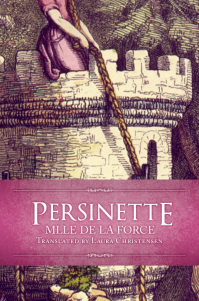 Just dropping in to talk briefly about how Persinette did in its first year (pre-order in March; April 2015- May 2016). For a bit of background, the only paid advertising I did was at the very beginning. Occasionally I dropped the book into free promotional opportunities, but nothing regular. I sought out its first review, but none of the others. The only passive advertising I’ve got going is its book page on Goodreads and the link on my Twitter profile.
I could be missing numbers because I tallied things up really quickly for curiosity’s sake. Canada looks low, for example, but the rough percentages are right:
Sold: 136 copies
Amazon: 116 (US), 9 (UK), 1 (France), 2 (Canada), 6 (Australia)
Kobo: 1
B&N: 1
Total free copies given away during promotion: 113
KU1 borrows, while enrolled the first 3 months: 10
Price point: $0.99
Earning roughly $0.30/book
Royalties: ~ $45
Goodreads: 14 ratings, 4 reviews – 4.14 starred average
Based off this, it’s not worth it to go wide-release with Book 2, considering KU1 gave me 10 borrows while I was enrolled and there’s been no traction at all at the other retailers. So my plan right now is to leave Persinette in wide-release but release all subsequent books as KDP Select/Amazon-exclusive and see where that puts me.
If you happen to be reading this and you’re a Kobo/iBooks/B&N fan, feel free to buy a copy and leave a review on one of the other retailers and change my mind.
May 25, 2016
Obscure French Folklore in Out-of-Print Collections (Review)
Well, this post is going to be a bit different, since I’ll essentially be presenting and reviewing two out-of-print French books, but stick with me.
Two Christmases ago I received several collections of Alsatian/Lorraine and Breton/Gallo folklore to feed my obsession. Among them were Alsatian-centric Dragons, fantômes, et trésors cachés : légendes, traditions et contes d’Alsace, with text by Guy Trendel and illustrations by Thierry Christmann (1988) and Contes populaires et légendes d’Alsace. Translating to: Dragons, ghosts, and hidden treasures: legends, traditions, and folktales of Alsace, and Folktales and legends of Alsace.
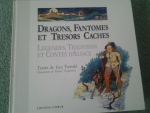
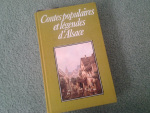
I’d gone into the request for more books of folklore hoping that, since folktales belong to the people, that the folklorists would be presenting their tales as-told-by the people, maybe with some light editing for readability. I know of collections that are essentially dictations of oral recordings, with names and ages stated of the individuals telling the tales. Adolphe Orain, for example, is a 19th century Breton-Gallo folklorist who did just that.
However, while researching a few of the tales in Contes populaires, I looked into the resources quoted in the bibliography, tracked down and compared the present telling to the original recording and discovered that it had been significantly pared down and adapted. I was then presented with the conundrum–does the folktale still count as belonging to the people in the past, does it still count as being “public domain” and open to translation, if the tale has been adapted and altered so much? If the folklorist has added so much of their own touch? What is the nature of folklore, as it’s being passed down?
If you’ve been following my folktale and fairy tale translations on little translator, you know I’ve been sticking to–or trying my best to stick to–tales that are freely available. But I didn’t realize when I started how many grey areas there would be to try and avoid.
Last year I translated the tale “Le chasseur vert” or “The Green Hunter” from the collection Contes populaires and offered it to my Patreon supporters while I was in the midst of trying to figure all this out. Since I’ve come to the conclusion that it would be better to stick to only translating folklore from their original publications in the 19th century and earlier and, unfortunately, avoid any modern folklore collections, I’m going to make a change.
There is something I can do with these more modern-day folktale collections, however, and that is to show you how awesome they are, present you with their bibliographies in case any of you encountering this post also wish to read original French folklore or do similar research as me, aaaaand give you a token translation as part of this review. I won’t make a habit of it, but I do still want to do all this cultural heritage justice. It’s really hard to do research across borders, and I want to make it easier.
So, without further ado, “The Green Hunter” from page 182.
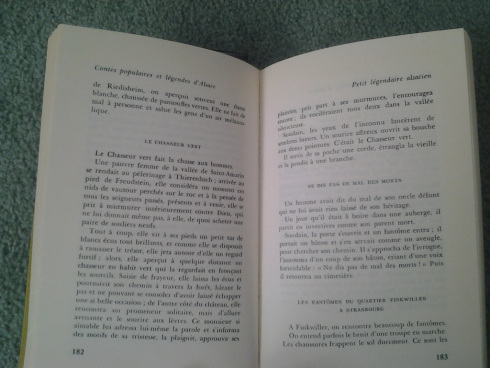
“The Green Hunter”
The Green Hunter hunts men.
A poor woman from Saint-Amarin valley went on pilgrimage to Thierenbach. Once arrived at the foot of the Freundstein castle ruins, she considered for a moment the vulture nests perched atop the rocks and, at the thought of every lord past, present, and future, she began to murmur inwardly against God who would not give her even enough to buy a new pair of shoes.
All at once, she saw a small pile of écu blanc coins shining at her feet. As she bent to collect the treasure she cast a furtive glance around her; consequently, she perceived at some distance away a hunter clothed in green who was watching her beneath furrowed brows. Seized with fright, she left the coins behind and continued on her way through the forest, quickening her pace and regretting the loss of such a great fortune. On the other side of the castle ruins, she met a man walking alone, though he had a certain air of charm and grace and a smile on his lips. This affable gentleman condescended to address her and inquired after the reason for her sadness, sympathized with her, approved her complaints, took part in her grousing, and even encouraged her: together they broke the valley’s silence with their ranting.
Suddenly, the stranger’s eyes gleamed darkly. A terrible smile split open his mouth, revealing pointed teeth. It was the Green Hunter.
He took a cord from his pocket, strangled the old woman, and hung her from a branch.
One of the great things about taking a survey of folklore collections’ table of contents is that you can start to see a pattern.
For example, there are many familiar themes: Catholic saints and miracles are as important as tales of ghosts in the cities and faeries in the woods. “Une nuit dans les bois” features a man who gets lost in the woods and what he discovers. “La chasse maudite” is yet another tale of a sort of Wild Hunt. “Le guerrier dormant” is about a mysterious sleeping warrior–a historical figure who might awake when needed to save them?
But there are also repeating, specific tales: “Le pont des fées” or “The Faeries’ Bridge” has been told in so many different versions for this region that I included it in my growing collection of translations. “La légende de l’horloge” or “The Legend of the Clock” also is a local favorite. Likewise, “The Silver Rose” which features in “Petit légendaire alsacien,” and “The Legend of Hans-Trapp,” a sort of bogeyman to scare children into being good. Not to mention, a whole slew of legends about the Strasbourg cathedral.
The repeating themes and tales are what I look for when trying to find something representative to translate.
Another use for surveying tables of content is you can see a pattern of everyone’s favorite go-to folklorists for the region, which you can then use in your own research. Names such as Auguste Stoeber (who wrote in German), Prosper Baur, and Abbé Charles Braun figure repeatedly.
As for the book’s collection itself, I think it’s really well curated. Especially in the “Petit légendaire alsacien” chapter which has a whole slew of bite-sized tales that paint a fantastic magical realism picture, from the countryside to the city streets. I think it has something for everyone and something for everywhere.
So, here is the table of contents and the bibliography. Go ahead and skip over them if you don’t speak French or German.
February 19, 2016
Where are the asexual protagonists?
It’s Valentine’s Day when I’m starting this post, for context. I’ve always had mixed feelings about Valentine’s Day. On the one hand, fun candy and cupcakes and valentines when you’re in elementary school. On the other hand…. Actually, let’s not discuss the other hand. Instead, I’m going to talk a bit about love and sex and characters in stories. So, fasten your seat belts.
Growing up as a teenager in a conservative culture, I was greatly bothered by all the adults telling me a series of things about love and sex, but most of them boiled down to:
When you’re a child, you’re only capable of puppy love. Look how cute that is. But once you hit puberty, then you start being capable of “real love” and so you should watch out and take care whom you date, whom you get attached to, how fast you let things progress, &c. &c.
The belief I encountered over and over was that a) children are not capable of “real” aka romantic love, and b) puberty aka “increased sex drive” is when love actually starts being possible.
I knew this was messed up at the time. After all, my friends were more than capable of developing “crushes”, no matter that we were five, ten, or fifteen. Sure, the feelings of the fifteen year olds were probably rated on a more intense scale than the five year olds, but the drama level wasn’t all that different between the age groups, nor was the complete sincerity of the moment. To have the adults tell me over and over again that what we felt wasn’t “real” and that only when we were adults like them would real affection be possible was insulting, condescending, and seemed to me to be very short-sighted. Had the adults all forgotten what it was to be young? Or were they just in some form of extreme denial? Did they honestly think that children and adults were separate creatures? I wondered. Probably.
But today, as I was considering all the stories I sought but couldn’t find as a teenager, it hit me that it’s much, much worse than that. The adults telling me that love only starts at puberty sincerely believed, at a subconscious level, that “real” love and sex are equated, inseparable, and…ugh. Ughgghghghg.
Take a look at this horrifying sentence: if you love me, then prove it by having sex with me.
Love, you see, only happens, at worst, when sex is involved, at best, when an activated sex drive is involved.
That’s messed up. Messed. Up. Messed up. Messed up. Messed up.
This is me being squicked out. But now we know where that creepy “request” snuck into our world from.
~~~
So, how does this relate to my request for more asexual and/or aromantic protagonists.
((Sidenote: For those of you unfamiliar with the terms asexual or aromantic, you might be more familiar with the other most-often quoted labels tossed around when discussing sexuality: LGBTQ – lesbian, gay, bisexual, transsexual, queer. Asexual is often added to the list as a label for those who are not attracted to anyone or anything on a sexual level, ever. Though it’s also broadened occasionally to a spectrum of people who are simply disinterested in sexual relationships–for now or for all time, that doesn’t matter and doesn’t need disputing. Aromantics, on the other hand, are those who rarely–if ever–experience romantic attraction. For this discussion, I’m not going to stick within any rigid labeling systems or go into a debate on who is allowed to be called what but instead open up the spectrum of possibility. ))
When I was a teenager, the storyline I wanted most to read involved a female protagonist who was disinterested in romance or sex. I wanted to see someone more like me who was more interested in doing her own thing, creating, exploring, having adventures, or saving the world (without squeezing a love triangle in). Oh yes, and developing lots of friendships with all sorts of cool, interesting people.
See, I loved reading, but the problem with reading a lot of books when all of them decide that teenagers are hotblooded young things is that my reading experience all felt the same, uniform, and so it all felt both unrealistic and, frankly, like an overdose. Sure, I had hotblooded young thing friends who jumped from love to love, who got into indecisive or shy love triangles, who had secret crushes that then spilled over into tentative dating, who kissed passionately and lived on the wild edge of desire, or felt the need to find a partner to “complete” them at seventeen. But were all of my friends like that? No. Were they like that all the time? No. So, reading began to feel like eating a steady diet of chocolate. Sure, there were different flavors of chocolate: milky and light, dark and lush, adventurous and spicy, waxy and fake, drinkable or eatable. But what I really wanted, what I really craved was something–anything else. Vanilla, maybe. Strawberry, cherry’s jubilee, mango delight. Something that felt closer to home, for once. Something that expanded possibilities.
Something that also didn’t do the bait and switch of “she’s disinterested in dating guys–but only because she’s lesbian! woohoo!” Nothing against lesbians, but when I was hoping to finally get an aro/ace storyline, it’d jerk my chain. x.x
Sure, you can read books by men, they often don’t write romance, you might say. But think again. Most of the time when I’ve read a story without any romance at all written by a guy it’s when the cast is all male. And if you add a female, suddenly her one goal in life is to pair up with someone. And, um, those aren’t really very satisfying underlying assumptions.
Here, let’s change tacks. This might demonstrate better.
Imagine Harry Potter where Harry, Hermione, and Ron don’t fall in love with each other but instead treat each other like lifelong friends and might-as-well-be siblings. Funnily enough, just like the actors became. Emma Watson said it felt weird kissing the other actors because it felt like kissing her brothers. No kidding.
Imagine Legend of Korra where instead of putting together a hasty bisexual/romantic ending that implies that one way or another romance is always needed for a happy ever after, the gang is allowed to end with: making the world a better place and friendship is enough.
Imagine Star Wars where the “two guys & a girl” scenario doesn’t end up in her falling for one or the other–or both–of them. I don’t know. If Earth blew up, I think I’d be too busy grieving and fighting back to be flirting, and if some scoundrel tried to get handsy I’d tell him to grow a heart, but hey that’s just me. ((And yes, I know there’s a whole chunk of the Internet who really wants Finn at the center of this new triangle, but to them I say: whyyyyyyyy does it always have to be about romance whyyyyy. *whine* ))
Imagine a Frozen that doesn’t feel obligated to end with a kiss, thereby uprooting the point of the whole story up till that moment.
Imagine an Agent Carter that is less about how many men hate her or fall in love with her or want up her skirt and more about her awesome platonic friendship and dynamic with Jarvis.
Actually, let’s just imagine for a moment a world in which spending time with someone (of any gender) doesn’t become a contractual obligation that you have to consider dating them. And saying a polite “no thanks” to their interest isn’t an insult. It’s like the Romance/Hook-up Story-line of Life has the right-of-way or something. If someone is romantically interested it’s like you’re obligated to either indulge or tip-toe around their fancies or else you’re some sort of unnatural monster.
Which is one of the many reasons why I think asexual and aromantic protagonists are so important. We are what we eat. Our expectations of the world and life are shaped by the stories we read and watch and are told.
And even if you wouldn’t label yourself “fully” asexual or aromantic I really hope you have multiple asexual and aromantic relationships in your life. I hope your S.O. or partner isn’t your only relationship outside of your immediate family. I hope, if sex disappeared tomorrow, you’d still be able to love and appreciate your partner. And if you’re searching for a partner, I hope you treat everyone you meet with respect and kindness rather than a “oh, they’re not for me, TOSS!” or a “they won’t give me the time of day, TOSS!” attitude.
((Sidenote: Sometimes it feels like the conservative Christian cultural ideal of Heaven is divided into male and female sections and the only people allowed to cross over and talk to each other are spouses and siblings. x.x))
~~~~
Here are a few asexual/aromantic spectrum character ideas to start the writing world brainstorming:
-a child character who travels to another world, becomes its ruler, and realizes that in this world everything and anything is possible–which means they don’t have to return home from Narnia and become a child again in order to avoid the complications of getting married there
-a teenage girl who is more interested in filming murder mysteries in a graveyard with her friends (some of whom may be ghosts) than going to the prom
-a teenage guy who isn’t interested in masturbation and/or porn, not because he thinks it’s evil but because he thinks it’s pointless, boring, or unfulfilling. (But this trait isn’t just to show how “wonderful” he is as a future romantic lead, please.)
-a teenager called on to save the kingdom/world who doesn’t automatically fall in love with the only opposite-gender member of their party. They’re too busy saving the day to experience more than passing glimmers of attraction and respect, let alone worry about feelings or romance.
-a cross-dresser who finds everyone attractive and interesting but is completely disinterested in sex or romance
-a character who was sexually abused in their backstory, who can no longer feel sexual attraction but who lives whole and healthy and happy in their asexual relationship of choice with their S.O.
-a chronically ill character who still has a ticking clock for a uterus but has no desire to “do anything about it” with anyone, but desires only to fill the time and energy they have to spend with other interests and pursuits instead. Plots and subplots ensue.
-a character who finds stargazing more engrossing than attractive-people-gazing
-a character who shows up at the scene of a crime and doesn’t automatically start narrating about how hot someone is while everyone’s standing over the dead body, and in fact doesn’t notice hotness at all because someone they knew just died. Or else the mystery presented is more intriguing than the spectators or the colleagues, though this doesn’t mean they’re a jerk about it.
-an expert flirt who never goes past flirting. The flirting’s the fun part.
-a courtesan who’s just doing their job. The political maneuvering and the intrigue are the real perks.
– a character who lost their beloved spouse but then doesn’t turn around and fall in love with the next character you pair them up to adventure with during the course of your story. Instead, they find a comfortable friendship.
-a pair of friends who grew up together who then (surprisingly *cough*) remain still just friends by story’s end
-an extrovert who loves people and whom everyone loves to be around, who is charismatic and charming, but who isn’t interested in dating “just yet.” (They’ve been saying that for years–if not decades–at this point).
-a Regency spinster who thinks she got the best end of the deal
-a eunuch who doesn’t mope a lot about how he no longer has “real man parts”. He’s probably too busy being besties with one of the ladies in the harem and making sure all the other eunuchs stop having dramas long enough to remember their duties–and solving the king’s murder. Or maybe it’s the queen’s murder. ‘Cause, y’know. Just add murder mystery.
-an old, young-looking vampire who–after centuries of watching them be born, grow old, and die–has developed the boundaries necessary to not actually fall in love with mortals, but enjoys their friendship and their company. (You might think this is impossible, that all it would take is the “right mortal” to woo him back to romance, but then I ask you how people generally don’t fall romantically in love with their siblings or, now, with their first cousins :p) I would love love love to read a paranormal friendship romance sometime.
-a character who finds themselves completely disinterested in sex with their current partner, and finds this baffling despite their romantic attachment, …to be dealt with amidst high-stakes car chases, or something equally crazy but generally sexualized.
-a religious celibate who doesn’t make a morose martyr out of themself or pull a holier-than-thou or actually need to “suppress” or “fight” anything but enjoys their singledom with a sense of simplicity and true, relaxed enjoyment.
-a tender-hearted (rather than tough/stoic) knight, who loves deeply, who swears loyalty and protection, but who is uninterested in relationships beyond brother, sister, friend, liege. Extra points if it’s a ladyknight, since everyone is constantly trying to pair those up with someone. :p
—
Later I might recommend some stories, but I think this post is long enough. -.-
What about you? Favorite asexual or aromantic/non-romantic/platonic stories or characters? What about character wishlists or scenario wishlists? Let’s brainstorm together, wooooo~.


December 31, 2015
2015 in Review
As predicted, this has been a year of all sorts of personal life disruptive changes. However, it hasn’t been without its successes.
This year I
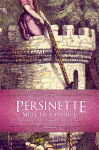 -published Persinette (on Patreon, Amazon, eBooksAreForever, Barnes & Noble, iBooks, Kobo, Smashwords, Scribd, and Payhip).
-am pleased to see Persinette‘s received a great collection of ratings and reviews at Goodreads for such a niche book.
-wrote two short stories, one dark and one light, while trying out various methods of writing/typing on my tablet when I had no computer access. I wrote both of them with anthology submissions as prompts, but even though I completely was not expecting anything out of it, they were both short-listed. o.o
-got a new laptop after months of our trying to fix the old one. The old one I landed up turning into an internet-less, mostly program-less writing machine, aka The Glorified Typewriter.
-started a new novel project, which is still continuing. Alas, I’d hoped to have it done by now, but I’ve been making better progress on it than I did with Queen, my last longer-fiction project. It took me about four years to write 44k on Queen, but I’ve managed to write 40k on this novel. However, I’m going to have to rewrite a lot of that, since one of the main characters wasn’t working.
-wrote a prequel story to my novel project, then rewrote it based on one reader’s feedback and will rewrite it again based on another reader’s feedback. I don’t mind though (much), because each time I work on it I learn more about the main character who was giving me troubles and I learn more about plotting short stories that are attached to other stories–which I’ve so far been unsuccessful at.
-received more support at my Patreon towards covering web-hosting costs for my translations.
 -put my Bibliography back up, since I have something to actually fill it with now, haha. XD
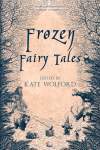
And last but not least, the light short story, “What She Saw by Lantern Light,” was published in the anthology I wrote it for, Frozen Fairy Tales.


Laura Christensen's Blog

- Laura Christensen's profile
- 21 followers

