
Janelle Diller's Blog, page 17
March 14, 2014
A Quick Tour of Austria
It’s hard to choose my favorite gem in Austria.
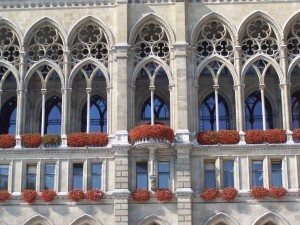 I love Vienna. Its narrow, winding streets in the city center are a history book at every turn. Mozart lived here. Johann Strauss and Franz Schubert were born here. Everyone who was anyone in the music world in the late 1700s to early 1800s paid their dues in Vienna, which explains why the music tradition continues today. On our last trip, we splurged on an elegant dinner in a former manor house and followed it with a concert. The elaborate crystal chandeliers above us and the meticulously manicured gardens just beyond our dinner table set the tone for the evening. The concert, held in an ornate but intimate music hall, transported us back hundreds of years to a time when patrons valued the arts enough to support those who created so many timeless pieces of music.
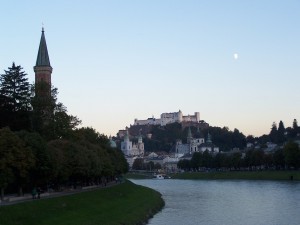 Salzburg in my mind is Vienna with a fraction of the population. The Salzach River winds along the old part of the city and makes a perfect afternoon stroll. The city center has its own grand buildings and large plaza where live music is a frequent treat. The music tradition—Mozart, Beethoven, Brahms, and Haydn were all born here—is even richer than Vienna’s. It’s hard to imagine a city anywhere else in the world then or now that produced as many amazing musicians in such a short period, especially because Salzburg’s population was only about 16,000. I have to admit, though, we skipped the prolific concert scene. Instead, we joined a Sound of Music tour. We spent the afternoon meandering through the Austrian countryside singing “Edelweiss” and “Do-Re-Mi,” stopping for Apfelstrudel and coffee, and even dancing in the gazebo where 16- going on 17-year-old Liesel von Trapp foolishly gave her heart to Rolf Gruber. Later we feasted on smoked ham hocks with all the fixings from one of the many food stands in the cellar of the Augustiner Bräu Kloster Mülln, a former convent turned brewery.
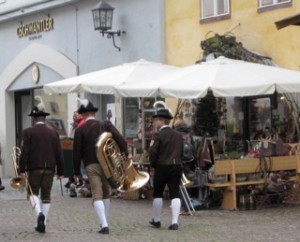 Kitzbühel, the picturesque location of the Austria Pack-n-Go Girls series, is postcard perfect. The village center, with its cobblestone streets and colorful flowers cascading from every window box, is full of upscale shopping and the clatter of horse drawn carriages. Even if your budget isn’t geared toward Louis Vuitton or Helmut Eder, you can still enjoy a decadent Sacher torte and espresso at one of the many sidewalk cafes. Four churches cluster together in the city center and reflect the long local history from the Romanesque period through the Renaissance to World War II. In true European pattern, the largest cathedral sits at the highest point in town, the crown jewel. If you’re lucky, you can catch an organ or brass quintet concert there and be enveloped in music. The cemetery spreads out around the cathedral and up the hill. Even in the winter, each family plot is a multihued, lovingly tended garden. Though the town’s main revenue is from tourism—world-class skiing in the winter and hiking and biking the other three seasons—the storeowners keep a leisurely work mindset. Most close from noon on Saturday till Monday morning. No après ski shopping on a Saturday. The slower pace makes it a perfect weekend getaway.
You really can’t go wrong with Austria. I hope we run into each other the next time I’m there. ~Janelle


February 27, 2014
Mystery of the Ballerina Ghost Trailer Premier
Today we are premiering our first book trailer for Mystery of the Ballerina Ghost!
You can check it out on YouTube or on our Pack-n-Go Girls website.

We pulled some pictures from our book launch, and we tapped into the music of Mozart’s Symphony No. 40 as part of our goal to continue to educate girls about the cultures of the countries we are writing about. Since the works of Wolfgang Amadeus Mozart and classical music in general have such a rich history in Austria, we thought that would be most appropriate for our Austrian series.
We would love to know what you think!
-Lisa
February 14, 2014
Check out the Second Austrian Travel Adventure from Pack-n-Go Girls!
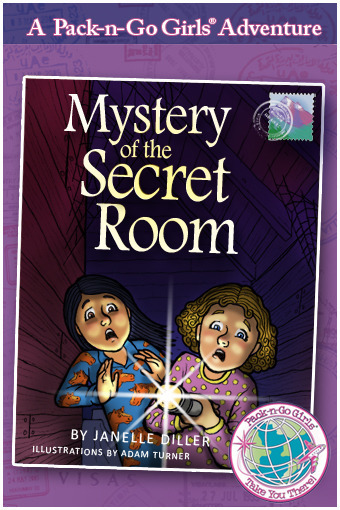
Join Brooke and Eva for their next adventure!
We’re excited to announce Mystery of the Secret Room is now available on Amazon. In this second Austria adventure, Brooke and Eva are still in Austria at Schloss Mueller, the spooky old castle where Eva’s family has lived for over 400 years. It turns out the schloss still holds a few secrets. Here’s a bit more about the book:
It’s raining so Brooke and Eva have nothing to do buy play hide and seek in the castle’s attic. It’s just an ordinary game on an ordinary rainy afternoon. But then Brooke stumbles into a room everyone has forgotten for decades. A beautiful porcelain doll sits at a table set for tea for two.
It’s as if she’s been waiting for Brooke and Eva to arrive.
Join us on the adventure!
February 6, 2014
The World at Your Kitchen Table
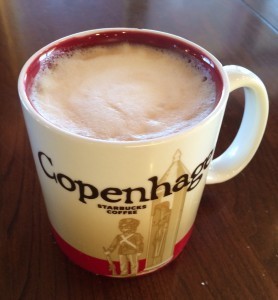
Cappuccino “in” Copenhagen
One of our missions at Pack-n-Go Girls is to open up our children’s eyes to the world around them. It’s so easy to get caught up in the day-to-day hustle and bustle of school, homework, sports, arts, or simply putting food on the table that we can go weeks, months, years without stepping outside our own personal bubbles. How are you helping your kids learn about the world around them?
The editor of National Geographic Traveler recently shared a great geography game we can all play at our kitchen tables. Each person names a place starting with the letter of the of the last letter of the place last said. For example: If I start with PariS, my son, Will, might say SpaiN, and my daughter, Sarah, might say New Mexico.
While maybe more well suited for the couch or car, two other great games to help your kids learn more about our country and our world are Stack the States and Stack the Countries. You can learn state and country capitals, landmarks, flags, relative size, geographic locations, and more. And the best part is stacking them. If you aren’t careful, your states/countries will fall off the stack!
Games are good, but so are conversations. Talking with your kids about the world can help them discover old and new civilizations, understand the impacts of ecological and economic systems, learn how cultures are born and shaped (including how we came to be who we are), explore ways we can contribute to our interconnected world, and appreciate the diversity that each person brings.
Luckily, my kids have a grandmother who is a World History teacher, so we have had quite a few conversations about the Greek and Roman Empires at the kitchen table. Of course, she is not here all the time to share. So, at our house, we sometimes simply discuss Starbucks coffee mugs. Yup, you heard me. I am lucky enough to get a few national and international trips in for business here and there. When I do, I try to visit local coffee shops wherever I am, as well as, dare I say, a “local” Starbucks to purchase a souvenir mug. My son often inquires via Skype whether or not I’ve been able to scope out said Starbucks and acquire said coffee mug so he knows whether or not to “make room” for one more on the shelf. Each mug has a unique picture and makes for an interesting discussion with my kids about a different state or country. And each morning at home, we ask, “Where are we are going today?” This morning I had cappuccino “in” Copenhagen and went to Denmark. At the kitchen table, we discussed how Maersk is based in Denmark, and my son informed me that they just launched the largest container ship in the world, the Maersk Triple E, and oh by the way, that Lego has released its namesake as well.
What conversations about the world are you having at the kitchen table?
-Lisa
January 31, 2014
¿Habla usted español?
 I have a confession to make: my Spanish is atrocious. Never mind that since late 2006 I’ve spent half of every year living in Mexico.
I have lots of excuses, my favorite being that so many Mexicans speak English better than I speak Spanish that we always default to the easier language. Besides, they’re more eager to practice their English than I’m willing to make mistakes in Spanish. Of course, that explanation only works around the marina, which is filled with English speaking boaters. (Even the Mexican boaters speak English instead of Spanish.) Venture outside of the tourist areas a kilometer or two, and the Mexicans struggle with English like I struggle with Spanish.
It’s not that I haven’t tried to learn. I’ve studied Spanish over the years, but my brain is no longer in the sponge mode of my youth. It’s more like brick mode. Some of it trickles in, but only where there are predetermined holes. I get cognates.
 Maybe a better metaphor is of a glass filling with water. The glass only holds so much, though. If water pours in, water also has to pour out. I can learn future tense, but there goes past tense. And conditional tense? Whoa. Say goodbye to prepositions. I’ve gone through periods where I’ve tried to learn ten new words a day. And I do. I just can’t remember the ten words I learned on Thursday. Of course, if I want to retain the ten words I learned today, I also need to write my combination lock number on my hand.
Unfortunately, learning a language is not like riding a bike. It falls more into the use-it-or-lose-it skill type. In 1999, my husband and I took our kids out of school for four and a half months and traveled in Central America. We started our trip with three weeks of intensive language study in Guatemala. We each had five hours daily of one-on-one language instruction and lived with different non-English speaking families. After such a short time, I have to admit I was in awe of what I could say and understand. From Guatemala, we slowly made our way to Utila, an English speaking island off the coast of Honduras. Three short months later we returned to Guatemala to fly back home—and I realized my Spanish had atrophied. I couldn’t even confirm our cab to the airport for the next morning. (And I know this because the cab never arrived.)
In spite of my fumbling, though, Mexicans are incredibly tolerant of my lousy Spanish. They’re courteous. They’re patient. They don’t get irritated that I’m not fluent or even very conversational. It’s one of the many things I appreciate about this country. I’m reminded that I want to be like that when I’m back in the US.
And this, after all, might be my most important learning about language. -Janelle
January 28, 2014
Mystery of the Secret Room
January 22, 2014
The spooky city of Prague
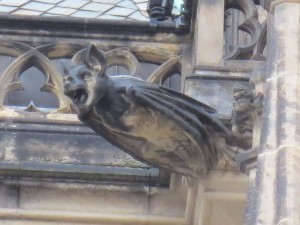
A spooky bat guarding the streets of Prague
Dark, narrow cobble-stoned alleys with marionette puppets glaring at you from behind smoky windows…gargoyles and bats hovering over you from the sides of old buildings shaded black with age…underground passages with bars on windows and lanterns eerily lit leading to secret waterways…an old astronomical clock that chimes every hour with a skeleton pulling the cord…what can be more spooky than this? On my recent trip to Prague, the capital of the Czech Republic, I was constantly looking over my shoulder expecting to see gargoyles chasing me down the street.
The last time I visited Prague – about 20 years ago – it was spooky for another reason: it was still under communist control. We exchanged money in a bus on the side of the road with a sketchy man who jumped on the bus, exchanged our money, and then promptly raced away. Our passports were taken to be “safely held” at the hotel. Our rooms were bugged. Armed guards patrolled the streets. We were served water, bread, and a few slices of meat for breakfast. Then we dined elegantly at a state-sponsored dinner in the evening. We were told not to go outside alone after dark. The nerves nagging at me overshadowed the gargoyles staring at me.
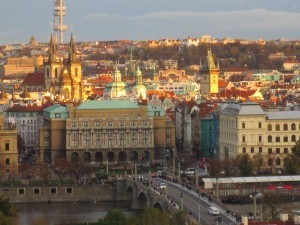
A view from Prague Castle (Prazsky Hrad)
Prague, with its stunning Gothic architecture and dark history, may be branded spooky in my memories, but I also see its great beauty. It is a city of contrasts. It is intriguing and glorious. It is mysterious and friendly. It is dark and light. It is magical and modern. With a vibrant economy, Prague is a welcoming Eastern European destination. Experience the stunning architecture of Prague Castle with the awe-inspiring Cathedral of St Vitus and the picturesque Golden Lane with its tiny cottages (now the home of many cute gift shops). Walk across the Charles Bridge bustling with tourists and vendors and take in the amazing sculptures from the late 1600′s and early 1700′s. Stop and listen to the street musicians while sampling Trdelnik hot sugar-sprinkled pastries. Stroll through Staromestke Namesti (Old Town Square) at night and take in the Disneyesque-lit spires of Church of Our Lady of Tyn. Visit Czech Tradition and Manufaktura for traditional Czech gifts made by skilled Czech artisans, shop for Czech crystal and, if you dare, bring home a spooky marionette. – Lisa
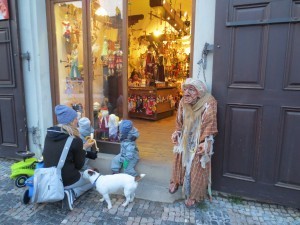
A marionette shop along one of the back alleys of Prague
January 9, 2014
We are what we read
I ran across an interesting article about reading and the lingering effect on brains. Emory University researchers used functional magnetic resonance imaging (fMRI) scanners to determine neural changes days after the subjects read a novel. Five days later, traces remained of heightened connectivity in the left temporal cortex and the central sulcus, parts of the brain associated with receptivity for language and sensory motor. In other words, as the lead author of the study says, “Reading can transport you into the body of the protagonist.”
Apparently in ways we never realized.
Those of us who love to read (and if you’re reading this, you’re one) won’t be the least bit surprised by the study’s findings. We’ve all been transported to other places and time while reading. We’ve identified with characters we’d never meet or understand otherwise. The surprising thing for me is that this isn’t just about making memories; reading actually creates neural changes that stay with us. Our mothers were right: We are what we read.
Years ago I used William Goldman’s The Princess Bride in a high school freshman English class I taught. We had quite a spirited discussion about what happens when you identify with and root for a character whose value system is different from yours. My angst centered on the fencing master Inigo Montoya, who lived only for the revenge of the six-fingered man, his father’s murderer. I hated the evil six-fingered man and loved Inigo. As a reader, I wanted nothing more than for him to finally destroy his foe even though my real-life value system was 180—or at least 90—degrees from this. Did reading the book change my neural patterns? Or did my neural patterns grow because I examined my value system and sorted through the contrast of what I read and what I believed.
Either way, it’s no small thing to be deliberate about what I read.
Janelle
December 20, 2013
Christmas Contrasts
 Last week I had the unexpected pleasure of wandering through two different Christmas markets. The contrast couldn’t have been greater between the two or where I’ll spend the holidays this year.
The Kitzbuhel market, set in the snow-frosted cobblestone streets of the village, is a single lane of wooden booths filled with Christmas ornaments, decorated gingerbread hearts, and chewy soft pretzels. Small groups of friends cluster around tables and let the sweet, spicy gluehwein warm their insides and their conversations. On a balcony high above the strings of Christmas lights, a brass quartet plays something beautiful and bright. I don’t know the piece, but it feeds my holiday spirit and makes me feel this is a tradition I’ve known forever. It’s magical.
A few days later, I’m traveling through Chicago on my way from Austria to our winter home in Mexico. I have the luxury of spending an evening with family as part of my layover. It happens that we meet at the German Holiday Market on Washington Street. I come up from the subway to a crush of people and lines snaking around as people wait for their souvenir mug of gluehwein or their turn in one of the many temporary stores filled to the temporary rafters with Christmas ornaments, nativity sets, and wooden nutcrackers. All around me, people laugh and share the festive moment with friends and family. The market space is maybe twice the size of the Kitzbuhel one but has 100 times—although it feels like 1000 times—the number of people. This evening, it’s a roaring commercial success.
It’s cold, so we linger only long enough to get some gluehwein and for the others to buy their annual ornaments. Living in the sparse space of a boat six months of the year keeps me from collecting much of anything these days except experiences, and I’m perfectly happy with that.
 Right now, I’m sitting in the cockpit of our boat and watching the setting sun paint the Western sky. It’s lovely and warm and I’m happy to be here. But I’ll be honest. It’s so different from my childhood Christmases of crisp air and the sharp scent of pine from our Christmas tree. I’ll never get used to hearing Jingle Bells and seeing palm trees. So I’m extra lucky to have the Christmas markets to tuck away in my memory.
December 8, 2013
Pack-n-Go Girls in Austria
 After a hectic book launch, what do you do? Well, if you’re Janelle, you get on a plane to Mexico for a day or so, and then hop on another plane to Austria. And then when you land, you go to the Christmas Market in Kitzbuhel, listen to a beautiful brass quartet while enjoying the spirit of Christmas in Austria, and meet a Pack-n-Go Girl! Meet Hannah, our first Austrian Pack-n-Go Girl!


