
 Sign in with Facebook
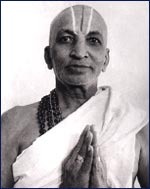


Tirumalai Krishnamacharya
Born
in Muchukundapuram, India
November 18, 1888
Died
February 28, 1989
Website
Genre


|
Yoga Makaranda
by
—
published
1934
—
3 editions
|
|

|
Il nettare dello Yoga
|
|

|
Yoganjalisaram
by
—
published
2013
—
2 editions
|
|

|
Yogarahasya de Sri Nathamuni
by
—
published
1996
|
|
|
|
Yogasanagalu
—
published
1941
|
|

|
Dhyanamalika
|
|

|
Mantra Mala
|
|

|
Yoga Makaranda
|
|

|
Yogasutras of Patanjali - Prayers to Patanjali (Notations in Sanskrit and Roman Transliteration
|
|
|
|
Dhyanamalika
|
|
“Who built this tree of universe that has not stopped changing from the very minute (atomic) times undergoing many beautiful and wonderful changes; Who must eat fruits bearing from this tree? Why is that all are not eating these fruits equally without differences? What is the reason? Could someone like us plant another tree like that? Why not? The eternal that does not dry up but continues to give required fruits to the souls. This creator, is he in front of us or not? If not how does this work? Without doubt we all realize that work does not happen without a reason. Therefore, one who is giving us this variety of unlimited fruits without end in this tree of universe must be immensely powerful, with unlimited knowledge, unfathomable, have infinite empathy and having many other amazing qualities. His existence is documented in all vedas and puranas. Although he exists, the reason we are not able to witness, we have to admit is our deficiency in body, faculty and mind. Our ancestors called and praised him as “Paramatma and Sarveshvara.” We have to resolve that we will practice sadhana to be able to see Paramatma and offer to Sarveshvara with great devotion our spiritual practices, without desire for any benefits. This is called Ishwarapranidhana.”
―
―
“Why do we need money beyond a point? If we are free of ill health, enmity, and debt, is that not enough? Too much money only leads to less peace.”
―
―
“The following are fit practitioners or potential persons suitable for undertaking the practice of Yoga: a person who has an aptitude for learning, who is morally and spiritually sound, who has conquered his senses (Jitendriya), who has a peaceful mind (Śānta-citta), who speaks the truth (Satya-vādin), who takes delight in serving the teacher, who serves his father and mother, who is pure and clean in [thought and action], who acts according to the scriptures, who has faith in and loves pilgrimage (yātrā), who bathes in the [holy river] Gaṅgā and other holy rivers, who has faith in his prescribed responsibilities (svajāti-dharma), who is humble, who loves his motherland (Deśa-abhimānin) and who has fondness for his family (Kula-”
― Yoga Makaranda: The Nectar of Yoga
― Yoga Makaranda: The Nectar of Yoga
