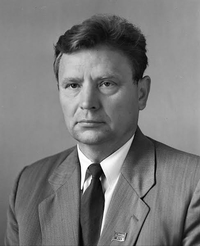
Maksim Tank (Belarusian: Максiм Танк, Russian: Максим Танк, real name Jaŭhien Skurko) was a Belarusian Soviet journalist, poet and translator.
After the annexation of West Belarus by the Soviet Union, Skurko worked as a culture journalist and as an education administrator in Vilejka.
After the beginning of the war, Skurko was evacuated to Saratov and then returned to the Bryansk Front to work as a reporter for several Soviet publications.
In 1945 – 1948, Skurko worked as editor at the satirical magazine Vozhyk. From 1948 to 1966, he was editor in chief of the major Belarusian literature magazine Polymia.
Since the late 1940s, Skurko held various senior positions in the Belarusian Soviet legislative system. In 1947–1971 he was member of the SuprMaksim Tank (Belarusian: Максiм Танк, Russian: Максим Танк, real name Jaŭhien Skurko) was a Belarusian Soviet journalist, poet and translator.
After the annexation of West Belarus by the Soviet Union, Skurko worked as a culture journalist and as an education administrator in Vilejka.
After the beginning of the war, Skurko was evacuated to Saratov and then returned to the Bryansk Front to work as a reporter for several Soviet publications.
In 1945 – 1948, Skurko worked as editor at the satirical magazine Vozhyk. From 1948 to 1966, he was editor in chief of the major Belarusian literature magazine Polymia.
Since the late 1940s, Skurko held various senior positions in the Belarusian Soviet legislative system. In 1947–1971 he was member of the Supreme Soviet of Belarus; of which he was chairman in 1963–1971.[2] In 1969 – 1989 he was member of the Supreme Soviet of the USSR.
After Belarus regained independence, Maksim Tank admitted being supporter of the Belarusian White, Red and White flag and opposed the controversial referendum to change the national symbols of Belarus organized by president Alexander Lukashenko....more

 Sign in with Facebook