Jay Cardam's Blog, page 4
March 17, 2017
one of the most remarkable revolts in world history
[image error]
— from The Rise of Rome by Anthony Everitt. In 494 BCE, the people of Rome staged one of the most remarkable and imaginative protests in world history. Though this protest brought some reform, it underscored the seemingly never-ending struggle of the plebs against the major landowners and ruling elite:
“It was the strangest spectacle seen since the foundation of Rome. A long stream of families could be observed leaving the city in what looked like a general evacuation. They walked southward and climbed a sparsely populated hill, the Aventine, which stands across a valley from the Palatine, the site of Romulus’s first settlement. They were, broadly speaking, the poor and the disadvantaged — artisans and farmers, peasants and urban workers. They carried with them a few days’ worth of food. On arrival they set up camp, building a stockade and a trench. There they stayed quietly, like a weaponless army, offering no provocation or violence. They waited, doing nothing.
Read more at:
Source: one of the most remarkable revolts in world history — 3/16/17
Buy Everitt’s book, The Rise of Rome at Amazon



March 15, 2017
Writers learning from Writers
[image error]
Novelists Leonardo Wild and George Wier having a conversation during the writer’s conference in Cuenca Ecuador
This week I’m attending the Cuenca Internation Writers Conference in Cuenca Ecuador! It’s always incredible to me how much I learn from other writers, sometimes when I least expect it. Wandered into a session on Horror Fiction today, a genre I rarely consider reading let alone have any urge to write…and yet the presenter, Ricardo Segreda, blew me away talking about Greek Tragedy and the elements of which are moved into the writing of Horror…He went far beyond my rather parochial idea of what Horror is about and gave me a new appreciation of what good horror is about. I’m not fighting an urge to try my hand at it, but I certainly came away with a different view of it.
Top of the list is George Wier, author of the Bill Travis series. Wier writes more than mysteries, and I have taken a particular interest in his work Neptune’s Forge which takes place in the late 19th century (There’s my historicals love again) He also writes sci fi and even steampunk. Check out his blog. It has been a treat to be able to chat with this warm, helpful, and down to earth writer. Meeting George Wier alone would have been worth attending the conference, but there has been so much more and still two days to go!


March 11, 2017
What is it about Historicals?
[image error]
I have loved Historicals since reading The Calico Captive (Elizabeth George Speare) in the third grade. What was your first?
I love sinking into a past world lovingly created around a good story…the ancient world, Rennaisance, Elizabethan, Victorian, Edwardian…all can take me into hours of otherworldly delight.
Old favorites: Mary Renault, Georgette Hyer, Robert Graves, Marguertie Youcenar, Lawrence Schoonover
New favorites: Stephen Saylor, Charles Finch, Robert Harris, Lindsey Davis
My biggest surprise: Norman Mailer’s Ancient Evenings. Not a fan of the man or his work, but I fell in love with this book.
Historicals are magical transport into the past.
What are your favorites? Why do you read Historicals?


January 16, 2017
One Down, One in Progress, One on the Back Burner!
[image error]
I have been very noticeably absent of late. I have, however been very busy. Finally finished the second Numerius Meridius Pulcher novel and am currently trying to get the final editing done. Any Beta Readers out there that care to help? Shoot me an email. It took a while for me to get this one down, had to go back and rewrite it more than once.
[image error]
Currently I am working on the first installment of a new series: Dime a Dozen: A Denys and Dixie Delacroix Mystery of Old New Orleans. The first mystery takes place in 1913. It was the time of Storyville, Emma Johnson, Countess Willie, Tom Anderson and Jazz. Camel cigarettes had just introduced the first 20 pack of pre-mades; it became the industry standard.
On the back burner: the next Numerius adventure, tentatively call Numerius Meridius Pulcher and the case of the Prodigious Prefect. This romp will take Numerius back on a retreat to his Pompeii home and his good friend Julia Felix. It will take place in 62-63 CE.


December 5, 2016
Geometric Mosaics of Ancient Rome — Timeless Italy
I have to say I love Roman Mosaics. This is a nice little introductory blog I found on wordpress. (See below for more info.)
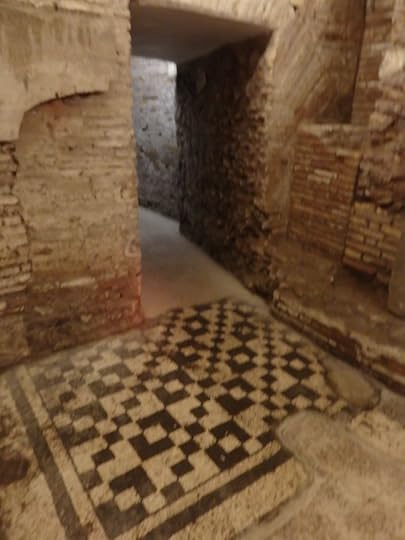
One of my Italian passions is the study of the ancient Romans. I especially love the artwork, like the excavated wall frescoes in Pompeii and Ostia, sculptures from the Roman forum, and mosaics, which were used as decor in public buildings and the homes of the wealthy. While much is now in museums, many of […]
via Geometric Mosaics of Ancient Rome — Timeless Italy


December 4, 2016
Have to use this!
 I
I
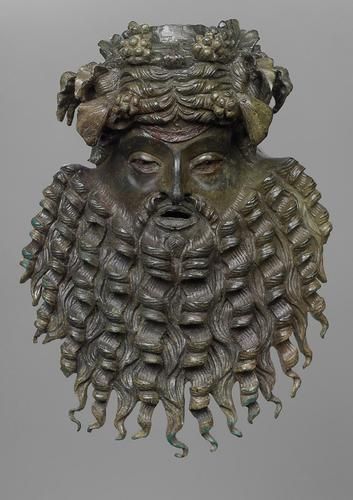
Bronze Bacchic Mask- First Century (CE)
I keep a Pininterest file on art works that I might use in My NMP series as well as a separate art collection for an upcoming series and character costume and setting images for various potential works.
When I saw this mask I knew it was one I would use. Can’t wait to get to the Case it will be in!


April 11, 2016
Coming in August—No—January!
Okay….so, I slipped back into a comfort zone…teaching. This retirement thing isn’t easy for me to get a handle on. But after these months of teaching English to Ecuadorians I think I’m ready to try again. Round two of retirement and full time writing. (12/4/16)
Finally have a projected date for the coming out of the second Numerius mystery!
NUMERIUS MERIDIUS PULCHER AND THE CASE OF THE SYRIAN SLAVE AND THE SLIPPERY SLOPES OF SELF-INDULGENCE
 Coming in August –No–January 2017. In final editing now and all systems seem go. This one has taken a while what with life and all that stuff. But now that I’m retiring from my teaching career things should move a bit faster on the writing scene.


Coming in August!
Finally have a projected date for the coming out of the second Numerius mystery!
NUMERIUS MERIDIUS PULCHER AND THE CASE OF THE SYRIAN SLAVE AND THE SLIPPERY SLOPES OF SELF-INDULGENCE
Coming in August 2016. In final editing now and all systems seem go. This one has taken a while what with life and all that stuff. But now that I’m retiring from my teaching career things should move a bit faster on the writing scene.
May 15, 2014
Ancient Slavery
In the book I’m currently working on, Numerius Meridius Pulcher And The Case Of The Syrian Slave Dealer, I’m having to deal with the morality of slave buying and selling even within a society that knew nothing else. Numerius, having started as a young sex slave for the old degenerate Tiberius has seen the ugliness of slavery up close and personal and yet, now free, continues to buy slaves for his own household. What does that do to a caring and thinking person? To buy or not to buy? Roman literature has examples of freed slaves who seem to have no compunctions in this, who , in fact seem to be worse slave owners than their own were; men and women who simply took the attitude of “Now it’s my turn.” Fortunately for me, Numerius is not that guy. The new book has led to exploring much deeper that part of Numerius that continues to support slavery and why he makes the decisions he does. It has led to more readings about ancient slavery and to consider how thinking men justified such a stance.



March 15, 2014
Camping It Up in Ancient Rome: A Queer Take on Catullus 16
From the Huffington Post…Article by Michael Broder
Once upon a time, I was sitting around a Fordham University seminar table in a graduate class on the Roman satirist Juvenal, who lived and wrote in the second century A.D. The professor, an adorable grandfatherly man named Harry Evans, was trying to pin some slackers like me down to an oral presentation on one of Juvenal’s 16 satires. Only a few of the poems were not already spoken for by other students, and we had not yet read them all, so Prof. Evans ran through his little stack of index cards, telling us what was left: Satire 15, about cannibalism in Egypt (okay, not bad). Satire 8, about noble pedigrees (retch).
And then he said, “Satire 9, about a male prostitute who has sex with his patron and his patron’s wife and fathers their two children.”
“Stop!” I called out. “That’s the one. I’m doing my report on Satire 9.”
That oral presentation led to a term paper, which led to my dissertation and to my obsession with an idea that has proved very controversial in academia: the ancient Romans, it turns out, invented camp.
Surprised? Well, the Romans gave us aqueducts and concrete. Why not acid wit, incongruous humor, over-the-top theatricality, and drag queens?
In this post, I’m not going to give you my whole spiel on Juvenal 9, a 150-line poem that spawned a 350-page dissertation. Perhaps another day. Instead, I want to talk about a 14-line poem by Catullus, a Roman poet who lived in the first century B.C. (Hmm, could the Romans have invented the sonnet, too? Stay tuned.)
Catullus’ poems have numbers, not names. This one is called “Poem 16,” and it goes something like this (the translation is by me):
I will butt-fuck you and skull-fuck you,
Aurelius, you pussy-boy, and Furius, you cocksucker!
Both of you think I’m not man enough
because my little poems are a little soft.
But while a decent poet should be manly,
his bits of verse need not be manly at all.
In fact, poems are witty and charming
if they’re a little soft and a bit shameful,
and can get a rise, well, not out of boys perhaps,
but these hairy men who can barely get it up.
Because you read about my “many thousands of kisses,”
you think I’m not a real man?
I will butt-fuck you and skull-fuck you!
The technical literary term for this torrent of ridicule and verbal abuse is “invective,” but I prefer to call it a shady day in Rome and the library is wide open!
Now, since I started arguing for the Roman invention of camp at academic conferences in 2009, I’ve received some support, but more pushback. A generation of classics scholars staked their careers on the idea that this sort of ridicule was deadly serious and was all the proof we needed that every homophobic bone in our modern social body could be traced back to ancient Rome. These folks don’t take kindly to my claim that Catullus, more than simply being ironic, is a kind of proto-queer figure. Others insist that I cannot use the 20th-century term “camp” to describe a type of poetry and a social milieu found in ancient Rome. Like so many gay voices today, my critics claim, I’m just hell-bent on “seeing us in them,” of finding evidence for gayness wherever I look in history. Both of these sins fall under the general charge of “presentism,” applying modern categories inappropriately to the past. But now I’m on The Huffington Post, not at an academic conference. You make the rules around here. So read on and tell me what you think.
Camp has been defined in various ways, but my favorite definition is the one suggested by sociologist Esther Newton in her 1972 book Mother Camp, a study of female impersonators in America. Newton argues that camp is a kind of performance, whether onstage or in everyday life, that embraces the stigma of homosexual identity by calling attention to incongruous juxtapositions in a way that is both theatrical and humorous. By incongruous juxtapositions, she means any pairing of things that don’t seem to go together: a beauty in love with a beast, an old woman living in a shoe, or a man wearing a dress. She argues that by fully embracing the stigmatized identity, camp can “neutralize the sting and make it laughable.” She continues:
Not all references to the stigma are campy, however. Only if it is pointed out as a joke is it camp, although there is no requirement that the jokes be gentle or friendly. A lot of camping is extremely hostile; it is almost always sarcastic. But its intent is humorous as well.
Hostile, sarcastic humor about men acting like women is precisely what Catullus’ Poem 16 is all about. In the poem, Catullus is pissed off at his friends, Aurelius and Furius, because they say his sissy poems prove that he’s a sissy. Catullus does not mention a specific lover here, but any Roman reader would know that Catullus pleads for “many thousands of kisses” from both his girlfriend Lesbia (in Poems 5 and 7) and from his boyfriend Juventius (in Poem 48). Moreover, in Poem 99, Catullus “steals” a single kiss from Juventius, who proceeds to wash his lips clean, a gesture that Catullus interprets as a devastating rejection.
You may wonder what is so “unmanly” about asking your girlfriend or boyfriend for kisses, even for thousands of them. Keep in mind that manliness for the Romans meant dominance — sexual dominance above all. The Romans were fine with a man having sex with another man, as long as he stayed on top. In modern terms (which of course I’m not supposed to use when talking about ancient Rome), being a gay male top was fine, but being a gay male bottom was not. In contemporary grindr-ese: masc for masc, no fems, no btms (sorry, nothing personal, just a cultural imperative).
Wow, things have really changed a lot in 2000 years, haven’t they?
The way I read this poem, Catullus is making fun of exactly that kind of hypermasculine Roman sexual morality. His friends say he’s a sissy because he writes sissy poems. To prove them wrong, he’s going to skull-fuck them and butt-fuck them. On the one hand, Catullus is challenging the traditional Roman assumption that submission is unmanly: he can assume a submissive role or a dominant role as he pleases — his manliness is independent of his society’s rigid sex and gender roles. On the other hand, he’s reminding us that masculinity is only skin-deep: even if he skull-fucks and butt-fucks Aurelius and Furius, he’s still the same Catullus who begged Lesbia and Juventius for kisses. It’s the same type of camp irony we see these days on grindr, where guys sprinkle their profiles with quips like, “Tell me how masculine you are while my dick is in your mouth.”
There’s another way in which Poem 16 is camp: the way Catullus pretends to buy into moral standards that he actually rejects. In defending himself against the charges of being effeminate, he does not go all “We’re here, we’re queer, get used to it” on us. Instead, he deflects. He says he can be manly while still writing unmanly poems, and that unmanly poems are witty and charming. He’s no sissy, he’s just pretending to be one for the entertainment value. Wink wink. Does Catullus really accept traditional Roman standards of masculinity? Which is the “real” Catullus, the manly Catullus who only writes mushy love poems to give hard-ons to hairy old men, or the sissy Catullus who begs Lesbia and Juventius for kisses? The fact is, we don’t know for sure which is real and which is pretend, and that’s precisely how camp works. Camp is all about insider audiences and outsider audiences. In the 1960s, drag queens were called “female impersonators” to make straight audiences feel more comfortable. They could believe that once the man in the dress went home, he was a “normal man,” just like them. Meanwhile, the camp audience members knew that after the show, the drag queen was going to the nearest gay bar to cruise some trade. Catullus is wielding that same kind of double-edged sword.
For years, gay readers have been told that we should despise this kind of poetry because it devalues us and has historically contributed to our stigmatization and marginalization. And yet, much of this poetry can be great fun if we approach it as camp frivolity rather than earnest homophobic ridicule. What’s more, reading these poems in this spirit makes a lot of sense: how morally serious do we really think Catullus can be when he goes around threatening to sexually assault friends who question his manhood? If gay readers approach this poetry as camp, we are reclaiming it for ourselves, making it a part of our history, and re-inscribing ourselves into a part of the Western literary tradition from which we have long been excluded.
Note: A very different version of this essay previously appeared in the Gay & Lesbian Review Worldwide.