
Ray Stone's Blog: A blog for everyone, page 12
June 5, 2015
Glimmer Train
 I am currently entered into two competitions for Glimmer Train, one of the best short story publishers in magazine/journals.
This is one journal all short story and serial writers should submit their work to. Google them and read more. I highly recommend them.
Dear Ray,
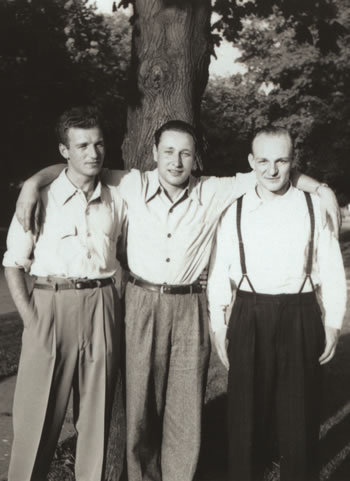
Walter Schmaus, Jacob Fuld, Henry Burmeister after WWII, 1946 (more)
Upcoming deadline:
Fiction Open: 1st place $2,500 and publication. Deadline: 6/30.
(NOTE: The grace period for the New Writer Award has been extended to 6/10 since there was a technical hangup a few days ago, for which we apologize!)

Open to all writers, all subjects, all themes. (But we’re happy to report that the last 1st-place Fiction Open winner was that author’s very first publication.)
The 1st-place winner will be published in Issue 97 and will receive 20 copies of that issue. Second- and 3rd-places will win, respectively, $1,000 and $600 (or if published $700). Writing Guidelines
Winners and finalists will be announced in the September 1 bulletin, and contacted directly the previous week.
Most Fiction Open submissions run 2,000 – 8,000 words, but can be as long as 20,000. Please, no more than four submissions per person.
Essays in this bulletin:

Jennifer Tseng: When I was a child my father trained me to imagine my hands were on fire, so if I was ever caught in a snowstorm I could stay alive. (An immigrant who had crossed many oceans, he was obsessed with survival.) (read more)

Clare Thompson-Ostrander: I simply imagine the gadget in my brain and my writer’s conscience gets a jolt. I collect hundreds of ideas each day, I pay more attention to my surroundings, always seeking details for later use, and I avoid shortcuts around campus to catch the color of grass. (read more)

Lisa Gornick: Indeed, a person embarking on writing a personal essay and a person embarking on a psychotherapy share many aims: a desire to tell a story, to penetrate the surface to reach a liberating meaning beneath, to feel enlarged by experience… (read more)
Results of the March Family Matters Contest
Winners and finalists have been notified, the Top 25 list is posted, and here are the Honorable Mentions. Our thanks to all of you for letting us read your stories!
1st place goes to Clare Thompson-Ostrander for “The Manual for Waitresses Everywhere.” Publishes in Issue #97. This will be her first national publication.
2nd place goes to Wendy Rasmussen for “Mesopotamian Nights.”
3rd place goes to Paula Tang for “Little China House.”
Feel free to forward this bulletin to your writer friends. As you know, the bulletin is free and meant to inform and to promote writers. (We never share your info.) People can sign up for bulletins themselves here. Missed a bulletin? They’re all archived here.
Looking forward,

Sisters and Editors

Glimmer Train has been discovering, publishing, and paying emerging writers since 1990.
One of the most respected short-story journals in print, Glimmer Train is represented in recent editions of the Pushcart Prize: Best of the Small Presses, New Stories from the Midwest, The PEN/O. Henry Prize Stories, New Stories from the South, Best American Mystery Stories, Best of the West, and Best American Short Stories
Every story published in Glimmer Train is unsolicited. And every year, we pay out over $50,000 to fiction writers.

You are subscribed as ray@raystoneauthor.com
Please note that we never share your contact information.
CHANGE YOUR EMAIL ADDRESS: send us your old address and the new. Thanks!
Don’t want to get our bulletins and reminders? UNSUBSCRIBE here.
Questions? Please check our straightforward FAQs; if the answer isn’t there: editors@glimmertrain.org.


Serials Galore
 I have a habit of cruising through the serials every so often. Not just the current ones but the early ones too. Every time I find one or two serials that catch my eye and I turn to the beginning and read them through. What normally tweaks my interest is a writer who is a regular contributor. To read how far they have come when I read a later serial they have written a chapter for is astounding.
One piece of advice that all agents and publishers advise writers to do is put a piece of work away for a couple of months and then read it again and find all the little creative differences and typos you want to correct or change. With serial writing an author cannot do this. It really is a great testament to not only the Style Guide but also the authors writing skills which improve each time they submit a chapter.
There are now 40 serials of which 15 are complete, 8 are being booked and 7 are on the go live. The completed serials alone amount to 82,500 words – the length of a good novel.
I have spent some time over the last year looking for similar sites and have yet to find one so diverse in genre and quality of material. We are unique in as much as offering serials to readers, written by ten authors at a time. In the last year we have attracted a wider audience and more writers, some of whom are also posting work on Writers Pad.
The result that all the serial participants gain from this is not some publishing contract or enquiry from an agent – although it has happened to three out of at least six Story Mint authors who are published – but the great satisfaction each one feels when their work is good enough to be published.
On Tuesday 1st Nov 2011 we published the start of our very first serial – The Third Shadow. By the time the serial was complete both Suraya and I began to see that having ten authors and trying to keep them all in sync with regard genre and storyline was going to require a little stricter discipline. It was a little embarrassing to read the serial, not that any writer was particularly bad. We just went off in different directions and from a serious start to a thriller ended up with robots and green blood.
I am glad we have left the serial intact and out there for all to read. Compared to the serials that followed one can see how we progressed and improved. We need to push forward now that we have an increasing number of wonderful writers. With the advent of electronic publishing the opportunity to publish is greater now than ever before and my wish is to see the Story Mint start publishing collections of quality serials.
There are seven serials being booked. I urge you to join us, book a chapter, and enjoy writing.
Ray Stone
Publishing Manager
The Story Mint
May 30, 2015
A week that was on Cyprus
Well it’s raining today and we have cloud right down to the road here. I drove down into town this morning and imagined a scene from the X files as I drove through the mist expecting to see strange craft on the road ahead ready to abduct me. No such luck. Everything has turned green and the grape vines are growing inches by the day. I guess the swimming pool will remain still but then this afternoon I will be glued to the TV. The FA Cup is on and I want Aston Villa to win against Arsenal. Should be a good match. Nice to have a little of the old country visit me now and again. Of course I am never far away from the old country…Tea and Toast
News Feed

Raymond Stone
May 27 at 4:04pm ·
A strange experience today. Very windy but very hot. I was going to have a dip but decided to wait until tomorrow. Instead it was nice to sit outside and relax with a cup of tea and watch the trees and tall bushes sway in the wind and listen as they whispered to each other. Swallows swooped in tight formation, some skimming the pool before soaring up into the sky. It can be so quiet here sometimes you can hear nothing but nature’s voice. What a joy that is.
Raymond Stone
May 26 at 11:02pm ·
Today my orange tree is a month old and I have a few small green oranges about an eighth of an inch in diameter. I’m not sure if they will turn orange and grow but I’m watering every day. My hopes are still high. Rest tomorrow before a drive to Nicosia next week to pick up a machine for me and a trip to the hospital to get the wife under the knife. (Op on the neck) At least three days on my own. What will I do with all that spare time, Pimms by the pool I think and some Scotch in the evening. Mind there will still be tea at 4.00 with cucumber sandwiches. We Colonials need to keep the Crown Colonies civilized don’t you know. (Must remember to raise my little finger with each sip) Toodle pip old things.
News Feed
Raymond Stone
May 23 at 5:25pm ·
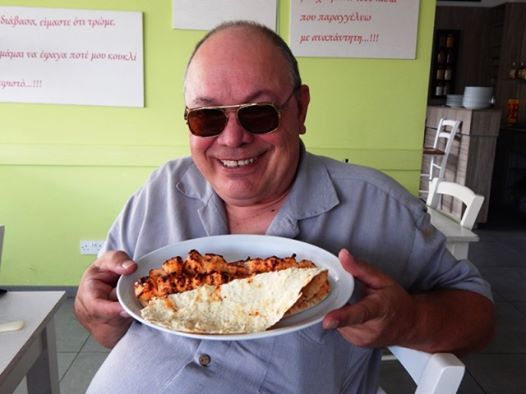
Don’t let the glasses fool you. Hidden behind them is a man with an amazing mind, good taste, charisma, suave personality, and a great taste for tea. Please send tea bags to Kathikas, Paphos, Cyprus the coffee is awful.
You updated your cover photo.
May 23 at 5:20pm ·
Writing an Outline by Glen C. Strathy
In 8 Easy Steps
By Glen C. Strathy*
How would you like to create a plot outline for your novel in less than an hour that is emotionally compelling and dramatically sound? It’s easier than you think.
The secret is to incorporate the 8 Basic Plot Elements. Starting with your story idea, you only need to make eight choices to ensure the plot of your future novel hangs together in a meaningful way.
Sound intriguing? Then let’s get started.
I’ll describe each of the eight elements in turn. If you already have an idea for a novel you’re working on, open your file or get a pad of paper or your writer’s notebook. As you read through the rest of this page, jot down ideas for how each element might work in your story. At the end, I’ll show you how to use your choices to create a brief, well-rounded plot outline for your novel. If you don’t have an idea for a novel yet, just grab one from your imagination. It doesn’t have to be good. It’s just an exercise after all.
On the other hand, if you already have a draft for a novel, that you’re looking to revise, then ask yourself, as we go through these elements, whether you have included them in your story. Create a plot outline for your novel in the way suggested below. You may find you can strengthen your novel plot considerably by incorporating any plot element you neglected before.
1. Story Goal

The first element to include in your plot outline is the Story Goal, which we covered in detail in the previous article, The Key to a Solid Plot: Choosing a Story Goal. To summarize, the plot of any story is a sequence of events that revolve around an attempt to solve a problem or attain a goal. The Story Goal is, generally speaking, what your protagonist wants to achieve or the problem he/she wants to resolve. It is also the goal/problem that involves or affects most, if not all the other characters in the story. It is “what the story is all about.”
For instance, let’s say we want to write a story about a 38-year-old female executive who has always put off having a family for the sake of her career and now finds herself lonely and regretting her choices. In this case, we might choose to make the Story Goal for her to find true love before it’s too late.
There are many ways we could involve other characters in this goal. For instance, we could give our protagonist …
… a mother who wants her to be happier.
… friends and colleagues at her company who are also unmarried and lonely (so that her success might inspire them).
… a jealous ex-boyfriend who tries to sabotage her love life.
… an elderly, lonely spinster of an aunt who doesn’t want the protagonist to make the same mistake she did.
… a happy young family who give her an example of what she has missed.
… a friend who married and divorced, and is now down on marriage. (Forcing the protagonist to work out whether her friend’s experience really applies to her – or whether it was just a case of choosing the wrong partner, or bad luck.)
We could even make the company where the protagonist works in danger of failing because it doesn’t appreciate the importance of family. It could be losing good employees to other companies that do.
In other words, after we have chosen a Story Goal, we will build a world around our protagonist that includes many perspectives on the problem and makes the goal important to everyone in that world. That’s why choosing the Story Goal is the most important first step in building a plot outline.
If you haven’t chosen a goal for your novel yet, do so now. Make a list of potential goals that fits the idea you are working on. Then choose choose one goal to base your plot outline on.
2. Consequence
Once you have decided on a Story Goal, your next step is to ask yourself, “What disaster will happen if the goal is not achieved? What is my protagonist afraid will happen if he/she doesn’t achieve the goal or solve the problem?”
The answer to these questions is the Consequence of the story. The Consequence is the negative situation or event that will result if the Goal is not achieved. Avoiding the Consequence justifies the effort required in pursuing the Story Goal, both to the characters in your novel and the reader, and that makes it an important part of your plot outline.
The combination of goal and consequence creates the main dramatic tension in your plot. It’s a carrot and stick approach that makes the plot meaningful.
In some stories, the protagonist may begin by deciding to resolve a problem or pursue a goal. Later, that goal becomes more meaningful when he discovers that a terrible consequence will occur if he fails. Other times, the protagonist may start off threatened by a terrible event, which thus motivates him/her to find way to avoid it.
As Melanie Anne Phillips points out, in some stories the consequence seems to be in effect when the story opens. Perhaps the evil despot is already on the throne and the Story Goal is to depose him. In that case, the consequence, if the protagonist fails, is that things will stay the way they are.
In our novel plot about the female executive, we’ve already come up with one possible Consequence – that she could end up like her spinster aunt. We could make the Consequence worse (perhaps the aunt dies of starvation because she is feeble and has no immediate family looking after her). Or we could create a different Consequence. Her employer may go bankrupt unless it becomes more family-friendly.
Write a list of possible Consequences you could have in your plot outline. Then choose one to be the counterpoint to your chosen Story Goal.
3. Requirements
The third element of your plot outline, Requirements, describes what must be accomplished in order to achieve the goal. You can think of this as a checklist of one or more events. As the Requirements are met in the course of the novel, the reader will feel the characters are getting closer to the attainment of the goal.
Requirements create a state of excited anticipation in the reader’s mind, as he looks forward to the protagonist’s success.
What could the Requirements be in our executive story? Well, if the goal is for our protagonist to find true love, perhaps she will need to join a singles club or dating service so she can meet single men. Perhaps she will need to take a holiday or leave of absence from her job.
Ask yourself what event(s) might need to happen for the goal in your novel to be achieved. List as many possibilities as you can think of. To keep things simple for the moment, just choose one requirement for now to include in your plot outline.
4. Forewarnings
Forewarnings are the counterpart to requirements. While requirements show that the story is progressing towards the achievement of the goal, forewarnings are events that show the consequence is getting closer. Forewarnings make the reader anxious that the consequence will occur before the protagonist can succeed.
In the plot outline for our story, events that could constitute Forewarnings might be…
the company loses one of its key employees to another firm that was more family-friendly.
the protagonist has a series of bad dates that make it seem like she will never find the right guy.
the protagonist meets a woman at a singles club who tells her that at their age all the good men are already married.
one of the protagonist’s friends goes through a messy divorce, showing that marriage may not be the source of happiness it’s purported to be.
While the Story Goal and Consequences create dramatic tension, Requirements and Forewarnings take the reader through an emotional roller coaster that oscillates between hope and fear. There will be places in the plot where it seems the protagonist is making progress, and others where it seems that everything is going wrong. Structure these well, and you will keep your reader turning pages non-stop.
For example, here’s how our plot outline might look so far …
“A female executive in her late 30s has been married to her job. But she has a wake-up call when her elderly, spinster aunt dies alone and neglected (consequence). The executive decides that she needs to have a family before she suffers the same fate (goal). In order to do this, she hires a dating service and arranges to go on several dates (requirements). But each date ends in disaster (forewarnings).”
As you can see, using just these four elements, a story plot is starting to emerge that will take the reader on a series of emotional twists and turns. And we’re only halfway through our 8 plot elements! (Of course, we started with the four most important ones.)
Notice too that these elements come in pairs that balance each other. This is an important secret for creating tension and momentum in your plot.
Before moving on to the remaining elements, list some possible events that could serve as Forewarnings in your story. For now, just choose one. See if you can create a brief plot outline like the example above using just the first four elements.
5. Costs
Generally speaking, good plots are about problems that mean a lot to the characters. If a problem is trivial, then neither the protagonist nor the reader has a reason to get worked up about it. You want your readers to get worked up about your novel. So you must give your protagonist a goal that matters.
One sign that a problem or goal matters to the protagonist is that he/she is willing to make sacrifices or suffer pain in order to achieve it. Such sacrifices are called Costs.
Classic examples of Costs include the hard-boiled detective who gets beaten up at some point in his investigation, or the heroic tales in which the hero must suffer pain or injury or give up a cherished possession to reach his goal. However, Costs can come in many other ways. Protagonists can be asked to give up their pride, self-respect, money, security, an attitude, an idealized memory, the life of a friend, or anything else they hold dear. If you make the costs steep and illustrate how hard the sacrifice is for the protagonist, the reader will feel that the protagonist deserves to achieve the goal.
In the case of our female executive, perhaps she must give up a promotion she has worked hard for because it would require her to travel so much that she would have no chance of settling down and raising a family.
Make a list of possible Costs your protagonist might be forced to endure in order to achieve the Story Goal. Again, just choose one idea to include in your plot outline for now.
6. Dividends
The element that balances Costs in your plot outline is Dividends. Dividends are rewards that characters receive along the journey towards the Story Goal. Unlike Requirements, Dividends are not necessary for the goal to be achieved. They may be unrelated to the goal entirely. But they are something that would never have occurred if the characters hadn’t made the effort to achieve the goal.
In the case of our executive, perhaps her efforts to meet men give her an idea for creating a business of her own – a kind of executive dating service, for instance, that will lead her to a happier career. Or perhaps the quest for love and family forces her to become more compassionate towards her co-workers when their family responsibilities interfere with work.
List possible ways to reward your characters and choose one that feels appropriate for your plot outline. Then move on to our final pair of elements.
7. Prerequisites
Prerequisites are events that must happen in order for the Requirements to happen. They are an added layer of challenges to your plot outline. Like Requirements, as Prerequisites are met, the reader feels progress is being made towards the goal. For instance, in order to free the Princess, the hero must recovery the key from its hiding place, but first (Prerequisite) he must defeat the dragon guarding it. In order to win the maiden’s hand, the gallant suitor must show he would not risk losing her for anything. But before he has a chance to do that, he must show he is willing to risk everything to win her (Shakespeare’s The Merchant of Venice).
If the Requirement for our novel about the executive is that she must go out on several dates, perhaps the Prerequisite is that she must sign up at a dating service, buy a new wardrobe, or get a make-over.
Take a look at your chosen Requirement and make a list of possible Prerequisites that must be accomplished before the requirement can be met. Choose one.
8. Preconditions
The last element to balance your plot outline, Preconditions, is a junior version of Forewarnings. Preconditions are small impediments in the plot. They are stipulations laid down by certain characters that make it more difficult for the Story Goal to be achieved.
A classic example is Pride and Prejudice in which Elizabeth’s quest for happiness is made more difficult by the terms of her grandfather’s will, which state that the family property can only be inherited by males. This means that, upon her father’s death, Elizabeth and her sisters will be penniless unless they find good husbands first.
However there are many other ways characters can impose conditions that impede the attainment of the Story Goal. They can make their help conditional on favours, insist on arduous rules, or negotiate tough terms.
For instance, perhaps the company where our female executive works has a rule that executives must attend meetings very early in the day – say 6AM on Saturdays. This rule makes it very hard for her to go on Friday night dates and be alert in the meetings. Or perhaps the singles club she joins has some seemingly unfair rules that cause her problems.
You know what to do by now. List possible Preconditions your characters might encounter, and choose one you like.
Organizing Your Plot Outline
Once you have chosen your eight elements, the next step is to arrange them into a brief plot summary. It doesn’t matter what order you put them in, so long as all eight are included. In fact, most of the elements can be repeated or included in more than one way.
For example, here’s how we might put together all eight elements for our executive story together into a one-paragraph plot outline…
“A female executive in her late 30s has been married to her job. But she has a wake-up call when her elderly, spinster aunt dies alone and neglected (consequence). The executive decides that she needs to have a family before she suffers the same fate (goal). So she buys a new wardrobe and signs on with a dating service (prerequisites). Her boss offers her a promotion that would involve a lot of travel, but she turns it down, so that she will have time to meet some men (cost). She goes on several dates (requirements). But each one ends in disaster (forewarnings). On top of that, because the agency arranges all her dates for Friday nights, she ends up arriving tired and late for the company’s mandatory 6AM Saturday morning meetings (preconditions). Along the way, however, she starts to realize how the company’s policies are very unfair to people with families or social lives outside work, and she begins to develop compassion for some of her co-workers that leads to improved relationships in the office (dividend).”
May 27, 2015
Instant Grammar Checker
More Punctuation Rules:PeriodsCommasSemicolonsColonsQuestion MarksParentheses and BracketsApostrophesHyphensDashesEllipsesQuotation MarksExclamation Points
Do you know how to use an apostrophe. If we did all proof readers would be out of a job.
Rule 1a. Use the apostrophe to show possession. To show possession with a singular noun, add an apostrophe plus the letter s.
Examples:
a woman’s hat
the boss’s wife
Mrs. Chang’s house
Rule 1b. Many common nouns end in the letter s (lens, cactus, bus, etc.). So do a lot of proper nouns (Mr. Jones, Texas, Christmas). There are conflicting policies and theories about how to show possession when writing such nouns. There is no right answer; the best advice is to choose a formula and stay consistent.
Rule 1c. Some writers and editors add only an apostrophe to all nouns ending in s. And some add an apostrophe + s to every proper noun, be it Hastings’s or Jones’s.
One method, common in newspapers and magazines, is to add an apostrophe + s (‘s) to common nouns ending in s, but only a stand-alone apostrophe to proper nouns ending in s.
Examples:
the class’s hours
Mr. Jones’ golf clubs
the canvas’s size
Texas’ weather
Care must be taken to place the apostrophe outside the word in question. For instance, if talking about a pen belonging to Mr. Hastings, many people would wrongly write Mr. Hasting’s pen (his name is not Mr. Hasting).
Correct: Mr. Hastings’ pen
Another widely used technique is to write the word as we would speak it. For example, since most people saying, “Mr. Hastings’ pen” would not pronounce an added s, we would write Mr. Hastings’ pen with no added s. But most people would pronounce an added s in “Jones’s,” so we’d write it as we say it: Mr. Jones’s golf clubs. This method explains the punctuation of for goodness’ sake.
Rule 2a. Regular nouns are nouns that form their plurals by adding either the letter s or -es(guy, guys; letter, letters; actress, actresses; etc.). To show plural possession, simply put an apostrophe after the s.
Correct: guys’ night out (guy + s + apostrophe)
Incorrect: guy’s night out (implies only one guy)
Correct: two actresses’ roles (actress + es + apostrophe)
Incorrect: two actress’s roles
Rule 2b. Do not use an apostrophe + s to make a regular noun plural.
Incorrect: Apostrophe’s are confusing.
Correct: Apostrophes are confusing.
Incorrect: We’ve had many happy Christmas’s.
Correct: We’ve had many happy Christmases.
In special cases, such as when forming a plural of a word that is not normally a noun, some writers add an apostrophe for clarity.
Example: Here are some do’s and don’ts.
In that sentence, the verb do is used as a plural noun, and the apostrophe was added because the writer felt that dos was confusing. Not all writers agree; some see no problem with dos and don’ts.
Rule 2c. English also has many irregular nouns (child, nucleus, tooth, etc.). These nouns become plural by changing their spelling, sometimes becoming quite different words. You may find it helpful to write out the entire irregular plural noun before adding an apostrophe or an apostrophe + s.
Incorrect: two childrens’ hats
The plural is children, not childrens.
Correct: two children’s hats (children + apostrophe + s)
Incorrect: the teeths’ roots
Correct: the teeth’s roots
Rule 2d. Things can get really confusing with the possessive plurals of proper names ending in s, such as Hastings and Jones.
If you’re the guest of the Ford family—the Fords—you’re the Fords’ guest (Ford + s + apostrophe). But what if it’s the Hastings family?
Most would call them the “Hastings.” But that would refer to a family named “Hasting.” If someone’s name ends in s, we must add -es for the plural. The plural of Hastings isHastingses. The members of the Jones family are the Joneses.
To show possession, add an apostrophe.
Incorrect: the Hastings’ dog
Correct: the Hastingses’ dog (Hastings + es + apostrophe)
Incorrect: the Jones’ car
Correct: the Joneses’ car
In serious writing, this rule must be followed no matter how strange or awkward the results.
Rule 2e. Never use an apostrophe to make a name plural.
Incorrect: The Wilson’s are here.
Correct: The Wilsons are here.
Incorrect: We visited the Sanchez’s.
Correct: We visited the Sanchezes.
Rule 3. With a singular compound noun (for example, mother-in-law), show possession with an apostrophe + s at the end of the word.
Example: my mother-in-law’s hat
If the compound noun (e.g., brother-in-law) is to be made plural, form the plural first (brothers-in-law), and then use the apostrophe + s.
Example: my two brothers-in-law’s hats
Rule 4. If two people possess the same item, put the apostrophe + s after the second name only.
Example: Cesar and Maribel’s home is constructed of redwood.
However, if one of the joint owners is written as a pronoun, use the possessive form for both.
Incorrect: Maribel and my home
Correct: Maribel’s and my home
Incorrect: he and Maribel’s home
Incorrect: him and Maribel’s home
Correct: his and Maribel’s home
In cases of separate rather than joint possession, use the possessive form for both.
Examples:
Cesar’s and Maribel’s homes are both lovely.
They don’t own the homes jointly.
Cesar and Maribel’s homes are both lovely.
The homes belong to both of them.
Rule 5. Use an apostrophe with contractions. The apostrophe is placed where a letter or letters have been removed.
Examples: doesn’t, wouldn’t, it’s, can’t, you’ve, etc.
Incorrect: does’nt
Rule 6. There are various approaches to plurals for initials, capital letters, and numbers used as nouns.
Examples:
She consulted with three M.D.s.
She consulted with three M.D.’s.
Some write M.D.’s to give the s separation from the second period.
Many writers and editors prefer an apostrophe after single capital letters only:
Examples:
I made straight A’s.
He learned his ABCs.
There are different schools of thought about years and decades. The following examples are all in widespread use:
Examples:
the 1990s
the 1990’s
the ’90s
the 90’s
Awkward: the ’90’s
Rule 7. Amounts of time or money are sometimes used as possessive adjectives that require apostrophes.
Incorrect: three days leave
Correct: three days’ leave
Incorrect: my two cents worth
Correct: my two cents’ worth
Rule 8. The personal pronouns hers, ours, yours, theirs, its, whose, and oneself never take an apostrophe.
Example: Feed a horse grain. It’s better for its health.
Rule 9. When an apostrophe comes before a word or number, take care that it’s truly an apostrophe (’) rather than a single quotation mark (‘).
Incorrect: ‘Twas the night before Christmas.
Correct: ’Twas the night before Christmas.
Incorrect: I voted in ‘08.
Correct: I voted in ’08.
NOTE
Serious writers avoid the word ‘til as an alternative to until. The correct word is till, which is many centuries older than until.
Rule 10. Beware of false possessives, which often occur with nouns ending in s. Don’t add apostrophes to noun-derived adjectives ending in s. Close analysis is the best guide.
Incorrect: We enjoyed the New Orleans’ cuisine.
In the preceding sentence, the word the makes no sense unless New Orleans is being used as an adjective to describe cuisine. In English, nouns frequently become adjectives. Adjectives rarely if ever take apostrophes.
Incorrect: I like that Beatles’ song.
Correct: I like that Beatles song.
Again, Beatles is an adjective, modifying song.
Incorrect: He’s a United States’ citizen.
Correct: He’s a United States citizen.
Rule 11. Beware of nouns ending in y; do not show possession by changing the y to -ies.
Correct: the company’s policy
Incorrect: the companies policy
Correct: three companies’ policies
May 26, 2015
An Inspirational Blog

By Annaliese Morgan

 Richard “RB” Botto
Today’s guest blog comes from Stage 32 member Annaliese Morgan, an author in Halifax, United Kingdom. After a 20 year career in veterinary nursing, Annaliese began a career writing true stories, as she believes people’s journeys are the glue of this world. To date, she has published 6 books.
In this entry, Annaliese exposes her own true story – a remarkable tale of how one split-second accident changed her whole life. Rather than letting the accident destroy her, she used it to push herself mentally and physically farther than she ever thought possible. What most would have considered a negative, Annaliese turned into a positive and crafted a whole new outlook on life for herself. If you’re looking for some inspiration, you’re definitely in the right place.
I thank Annaliese for her contribution to the Stage 32 Blog.
Cheers,
RB.
I’m at the traffic lights, sat on the back of (my then) boyfriend’s sports motorbike.
“One more blast round, or go home?” he said.
My silent voice inside instantly urging me to say, turn right, lets go home.
“Turn left”, I said thinking he would prefer another 20 minutes out in the early evening sun.

It was Sunday evening, August 9th. Five minutes later a red car hurtling up our side of the road at 70 mph came into view. In a nano-second I shift into paralyzing terror. The car isn’t supposed to be on our side, I thought. Surely it’ll pull back over – as I see it gaining size and its distance from us becoming shorter. The loudest coldest sound I’ve ever heard followed…the explosion of impact of both human body and metal machines.
The right side of my body took the impact with enough power to then catapult me into a brick wall, smashing the left side of my body.
I eventually stopped rolling down the road. My lower limbs in multiple pieces, bone ends ripped through my skin and trousers, ribs broken puncturing my lungs causing one to collapse. I hear the car engine chugging in the background, it’s sat there, just looking at us…at obscene speed the car driver drove off and left.

I had returned from London two days earlier after completing a stint for my advanced veterinary surgical examinations. I wished I didn’t work in the field I did, as my skills were giving me the inside information I didn’t want, and I knew I didn’t have long.
I hear my former boyfriend screaming my name but I can’t respond. I can barely breathe. Fortunately, a passerby finds us and rings the ambulance. Sympathetic, concerned doctors, surgeons and nurses fought to save me all night. I didn’t know if I would live or even keep my legs.
The next three months in hospital equated to a freakish nightmare.

Enduring multiple operations, failing treatments and surgery, pain at a level I didn’t think was possible, to be destroyed once more when I find out weeks later I can’t walk. Shouting hysterically at the doctor, “WHY ME, when will my legs work again?” The staff, friends and family tried to be positive. I, wanted it all to go away.
The days and weeks tick by. Finally I’m allowed home in my wheelchair – my home adapted to accommodate it, and me. It felt like this perceived nightmare was seeping into everything I’d built and had. Every day for months and months the local transport ambulance collected me and drove me to my grueling physiotherapy regime. I’d naturally decided long ago this wasn’t how it was going to be, this wasn’t my life.
I put in the hours, I practiced and practiced, I crafted, perfected exercises and assisted swimming work. I got over the degrading feelings which would often sweep over me.
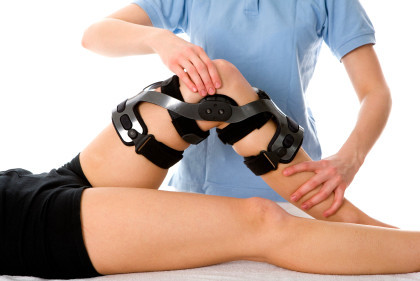
Then the day came, the day I’d waited for. I was to walk the boards of the gym floor unaided for the first time. I was terrified, markedly vulnerable, yet absolutely clear of my task. My physiotherapist stood by my side. “When you’re ready” he said, “and I’m going to come with every bit of the way”.
This was the same physiotherapist I had thrown my walker at weeks earlier out of pure resentment and frustration (which by the way, was a dumb thing to do, as I promptly fell on the floor and couldn’t stand back up on my own). Others at the far end of the gym floor began cheering and calling my name, waving their arms in the air. My eyes and heart did not move from those people once, not once.
I knew as soon as I swung my leg forward, that was it, no looking back, no self doubt. Step by step by step I put the distance between me and the side of the gym I considered the past, and continued until I fell into the arms of those cheering people, sobbing like the biggest yet happiest baby on earth.

Surrounded by all the smiles, delight and tears rolling from their eyes too, it was this moment, when years later my “why me” question all made sense.
Let me continue if I may –
What this particular adventure taught me was, the perceived nightmare is actually a smokescreen to a beautiful dream. I have achieved way beyond what I thought I could and certainly what was expected of me on many levels, and I give a lot of the credit to the accident.
I listen to my intuition like it’s my best pal. I don’t mind what you call it or where you think it comes from but that baby is 100% on the money, every time. Whether a warning or the gorgeous butterfly feeling, follow it and trust.
The amount of focus, self-belief and knowing you need to learn a skill we consider easy like walking, is nothing short of massive. I see so many trying to learn and teach the power of focus and directing your mind and I think – hot damn I had this zapped into me years ago! I learnt the importance of the company you keep – had my team and those people at the other end of the boards been yelling you can’t do that, it’s not how its done, you’re not the right fit, I would never have done it and would have continued living a life I didn’t want.
I understand making a decision isn’t deciding you would like to do something, it’s deciding there is No Other Option, but the one you wish and the right choice (however illogical) is led by inspiration, not pushed by your ego. There is a big difference, and I have come to find anything we are trying to gain by ego and pushing will fail you, or it will eventually, because that’s its job to keep us where we are.
Lastly, for a long time I would become upset over my less than pretty looking legs. As a woman not being able to wear short dresses and heels is a tricky one. I give the term killer heels a whole new meaning. You see, all those scars, the limp and odd shapes are my proof, my evidence that I, me (the girl who thought for her entire life she was useless and a hindrance, not an asset) I was stronger than IT was. If I have to face another operation (I’ve done 12 so far!) a phone call, project or something I find fearful, I no longer have to look very far to find my courage. Plus, I never did like short dresses and heels anyway.
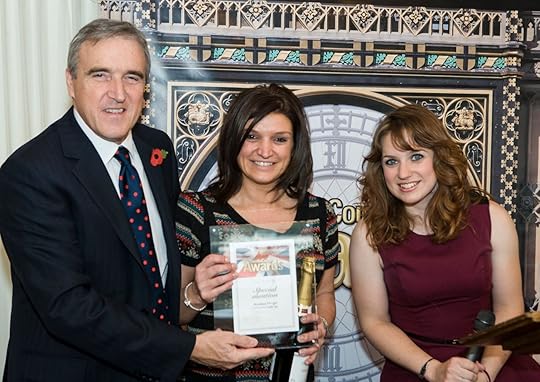
In 2012 I was awarded a special award created specifically for me for my inspiration and innovation, presented to me at the House of Lords in London by double gold Paralympian Natasha Baker (awesome woman who I loved). Unaware this had been arranged, I was attending an awards ceremony there due to been nominated for a different one and was stunned when normal proceedings were halted to present this. It was a most magical day I will never forget.
Whether you’re a fellow writer, producer, director, actor or any other genius I hope my words and the lessons I learned help you along on your path.
When I hear somebody tell me “That’s impossible”, “It’s not normally done,” “They won’t like it,” “You’re not good enough”, etc., I smile because I know different. I know, I just heard my cue.
…and this is your cue; to check in, harness what you have, and go walk those God damn boards.
May 5, 2015
Keep Believing: The Power of Positive Thinking

By Rosalind Winton

 Richard “RB” Botto
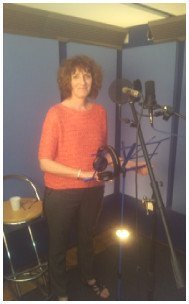
Today’s blog comes from editor and Stage 32 member, Rosalind Winton, from Bushey, United Kingdom. Rosalind is the owner of One Voice Literary Agency, a company that assists writers in developing and proofreading their manuscripts. While she specializes in editorial work, Rosalind is also a narrator for ACX, the audio subsidiary for Amazon that turns their publications into audio books, and is looking to further her career in voice over work.
In this entry, Rosalind speaks to her creative journey and discusses how she overcame doubt and fear of the unknown by doing the one thing many of us tend to forget to do: think positively.
I thank Rosalind for her contribution to the Stage 32 Blog.
Enjoy!
I’ve only been with Stage 32 for a few weeks, but I’ve already connected with a lot of great people. This is an amazing site with that leads to great opportunities in the industry. I absolutely love it here and I would like to thank Andre Corrales for inviting me to write this blog.
I left school at 16 and went straight into the workplace. I didn’t want to go further into education, because I had been relentlessly bullied my whole school life and I couldn’t face studying any longer. At school, I had been made to feel worthless. I felt like a nobody.

But once I found myself in a world where people were kind and respectful, I knew that’s where I wanted to be.
My first job was a six-month temporary position as a receptionist for a children’s fashion company in the West End of London. When the six months was up, I found a job in a public relations company and from there, I worked in a variety of companies. I worked my way up in the secretarial field and in 1987, I landed a position at the International Institute For Strategic Studies, also in the West End of London.
The company dealt with worldwide military strategies and also produced their own books. I was Personal Assistant to a Colonel and ran an office of five military personnel, but I also took on the job of editing and proof reading their main publication, “The Military Balance”, which listed all the armaments of the world’s armed forces. I found I had a flair for editing and I really loved and enjoyed the work tremendously.
I also worked with interns who wrote research papers for the Institute. Some of them came from other countries and needed help writing in English, so I learned how to respect the author and the content of their papers, while at the same time knowing what was best for the work.
In 1989 I got married and in 1995 I left the Institute to have my first daughter. I had my second daughter two years later and I was now a full time mum.
In 2007, I was asked by a friend if I would edit the novel she was writing. I couldn’t pass up the opportunity and it was while working on this that I came into contact with other authors who needed help with their manuscripts. I was in my element and having such a great time, that it was then that I began to think about starting my own business. It was a daunting prospect but with the encouragement of friends and family, I decided to see if I could do it.
It took a long while to decide how I was going to do this and what I was going to call the company, but in time I decided to name the business after my favorite song of all time. “One Voice” by Barry Manilow. I have been a fan of Barry’s for many years and the words to the song describe exactly how I saw my company, that “one voice” really can bring people together and make a difference.
I began building the company up and eventually found myself with a clientele of extremely talented writers. I felt honored and privileged to be working with all of them. One of my clients who had written a beautiful short story asked me if I would like to narrate the story and make it into an audio book. My instant reaction was “no”, because the thought of performing filled me with dread.
For many years, I have been writing lyrics and songs (the story behind this would take another blog), but when I’m in the studio overseeing the production of my songs, I like to stay on the recording engineer’s side of the room.
I never would have imagined myself in the recording booth actually recording anything. My client however, had more faith in me than I had in myself and in the end, I agreed to give it a try.
The recording was a complete success and I enjoyed the process so much that I recently signed up to ACX, the audio subsidiary for Amazon. I hope to be employed by authors to narrate their books for them.
I always tell everyone I come into contact with that they are capable of anything, but I think we are all guilty of being great at giving other people
advice, while being terrible at taking our own advice. Sometimes, it does take other people’s encouragement and belief in you to make you see that
anything is possible. When I think back to the quiet, shy, unassuming person I was in school; someone who couldn’t stand up for herself; someone
who wouldn’t speak up, someone who was scared of the world… that person was now running her own business and finding herself doing things she
never even dreamed of.
I have learned that there is always a way out, always hope, always the possibility of becoming the person you always wanted to be.
The point I am trying to make is that you can do anything if you put your mind to it. You can think about doing something, and you can wish you could
do something, but you’ve got to take action towards making it happen.
I’m a great believer in the power of positive thought. Life is scary, but sometimes the thought of doing something turns out to be more frightening than
when you actually do it. And once you’ve taken those first steps, you can be well on your way to achieving your goals and that feeling of accomplishment
is truly amazing.

I am right now working towards seeing my client’s work published. Everyone I work with is a genius writer and I feel so honoured and privileged
to be working with them. It is something I am extremely grateful for. I have spoken with tons of authors and have even seen posts here on Stage 32
where people get disheartened and feel like giving up.
Finding publishers and producers is a really difficult thing, but it really is a case of taking every opportunity and every chance that taps you on the shoulder.
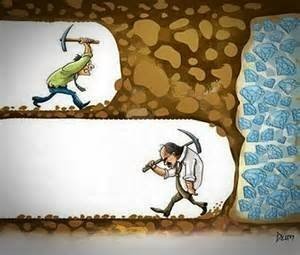
It’s like the story of the man digging through the tunnel to find the treasure. It took months and months of really hard work.
In the end, he felt so discouraged that he didn’t see the point in carrying on, so he turned around, went home and gave up,
not realising that the treasure was only a few inches away from where he stopped digging.
The very next door you knock on could be the one that will open for you a world of new opportunities. The very next connection you make might be the one
that breaks you into the industry.
It’s all about staying positive and telling yourself you can do anything.
I believe that writing in any genre is 10% inspiration, 90% rewrites. I’ve seen a lot of posts here asking about editing, but to be honest, there is no right
or wrong way. Take 100 writers, give them the same topic and they will work 100 different ways. You have to do what is comfortable and right for you.
Some people edit as they go, some wait until they’ve written a couple of chapters, some can only write in complete silence, some like to have background
music or the TV on when they write. The important thing is to just keep writing, finish the book and get all your ideas from your head onto the page.
Any first draft is never going to be the finished product, but I believe you have to have fun when you write. It has to be a joy. It’s your creation.
Ideas come from ideas and inspiration comes from everywhere and anywhere.
People-watch. Observe the things that people say and do. Be aware of your own thoughts. Look for signs on advertising marquees (names of companies can
sometimes give you an idea for something great). Research as much as you can.
I know this is the biggest cliché on the planet, but your own life really is a story. Always put the very best of yourself into your work.

There is so much more I would love to talk about, but this blog would end up being a novel in itself, so I’ll finish by saying “keep believing.”
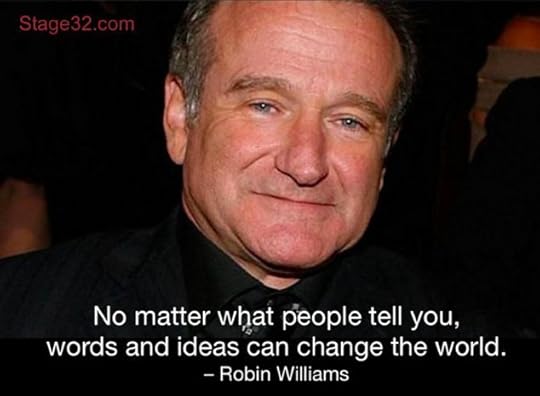
And, finally, in the words of the great Robin Williams:
May 4, 2015
Love the Critic
I have a love hate relationship with critics and like all authors, appreciate a pat on the head but loathe the occasional kick in the pants. Below are two examples of reviews on one of my novels. A review should be helpful to the writer. Criticism is not always welcomed by some writers but if well intended and accompanied by a helpful suggested remedy for the criticism, the writer should at least show respect to the reviewer for taking the time to read the work. I love good criticism because that is one way I learn to improve my work. At least I have a choice in storing good advice or discarding it because I don’t agree with it. We all know, deep down, when reading reviews, whether the reader has got it right and hit a nerve. Never be afraid to admit to yourself that the reader has a good point. Then remember that the next time you are dealing with a similar issue in your writing. What I hate are the reviewers who hide behind a pseudo name and take great delight in insulting one’s intelligence with badly written reviews that let the writer know what they have done wrong (according to them) but without any helpful hints on how the problems they point out can be resolved (according to them). We should look on good criticism as a tool. I cut and paste some of mine onto a file and believe it or not that is a great way to remember the points without having to refer back to them. They get stored in your memory banks as you write them or paste them. So what is a good review and what is bad. Below I give you the Good, the Bad and the Ugly. It is bad practice to answer a critic whether good or bad. One should quietly thank them or quietly curse them. However, as you will see from the example below, I was tempted to answer this one. The last example here is what I call a really useful review – not the best one I ever had but one of the most useful. Remember, there is a difference between good and useful.
2.0 out of 5 stars Free but stupid 2 April 2015
By GLENNIS-WILDDOG1
Format:Kindle Edition|Verified Purchase
downloaded as a freebie. Bad research regarding Biggin Hill airport and the ability to just jump out whilst taxying and escaping through fencing, no………..I worked there for 14 years………………. and Piper aircraft???Piper with a canopy??
no! not outside of a one/two seat crop duster! and then this canopied craft apparently takes 4 passengers… all small Piper aircraft have doors, not canopies. Even the registration is stupid, British registered is all letters starting with G….
not G and numbers.
Whole plot and characters unbelievable, especially what they supposedly achieve. sorry author, but get research correct or don’t write about it, and think about just how far someone like a journalist can go, certainly not as far as this guy was supposed to.
Just silly and as previously stated, badly researched in certain parts.
Last edited by the author on 5 Apr 2015 22:51:06 BDT
Ray Stone says:
Fiction contains a certain amount of ‘suspended disbelief’ I wonder how this reviewer would get on with all the totally unbelievable plots in James Bond. This book has many good reviews from USA so readers are obviously enjoying it. Sorry reviewer but you need to get with the plot. Over 3000 sold so far and in top 20 for two months and still there. Go figure. Incidentally, the plane was hired from a German air taxi firm in Germany. It would not have Brit reg. Also, why cant a plane stop at the end of a runway and two people jump out and escape. And has the reviewer seen the latest exploits of journalists from the London tabloids. Sorry, reviewer but you really ought to brush up on your research. Criticism is always welcome but should be properly written in a non offensive manner. Perhaps this reviewer might keep that in mind and actually read the next book and not ‘skim read’ it.
4 Spy Thriller
ByRoses are Amberon December 7, 2014
Format: Kindle Edition
Twisted wire is a complex spy thriller. The prologue introduces us to Nigel Silsbury, a spy who is searching for the mole in MI6, a man known as Krane. Enda Osin is a political reporter for the Herald newspaper, he returns from holiday to a strange message on his phone. He follows up the lead and finds himself involved with industrial espionage and the theft of material about a high-speed experimental air craft.
The storyline involves the Americans, Russians, the EU and the British secret service in a plot line with plenty of twists and turns as spies are exposed, sabotage planned and deals are double crossed. Enda Osin, his wife Jessica and a handy right hand man called Fish sniff out a story and try to help justice win. Determined to be able to get a story for the paper Enda goes to great lengths and takes huge risks as he follows a trail to Germany and Europe.
A good storyline, a little of the dialogue didn’t flow on occasions as much as I would have hoped and I did struggle with the amount of characters and all the names, however a good ending which I didn’t see coming and had me checking back to the beginning of the book to re-read the prologue.
This review is based on a free copy of the book given to me by the author.
Do you see the difference? The second review was written by a professional blogger I have a lot of respect for. She has read the book cover to cover – that’s obvious. She is making a couple of criticisms but notice her diplomatic way of telling me. This is well intended advice and I choose to ignore the criticism about too many characters because that’s the way I like to plot with many characters. However, her point about the dialogue is something I am mindful of and will remember it each time I write dialogue. Of the first review…well I think I have said it all in my comment.
Do not discard criticism – embrace it and learn from it and become a better writer and a better person.
Unforgotten
Written by: Jasmine Groves
Huang Fu looked at me blankly “That’s what her text said, got it this morning” he pulled his cell out and flipped it open “See?”
My eyes darted around the night market, I had lost time, and the man in the chequered shirt was quickly pushing his way through the crowd. I couldn’t make out his face, his cap was pulled low covering his eyes, and he had a smattering of unshaven hair on his chin.
One thing I could tell, it emanates from him….. He meant me menace, he was on the hunt.
I glanced one last time at Huang Fu and then bolted in the opposite direction, crashing into shoulders, hand bags and limbs as I tried to navigate the market. I struggled to find my bearings in the dimming night. My legs felt weak and my breath wanted to explode. My husband is dead. Dead!
But maybe I could save Voila?
No time for contemplation. A stand was being dragged off site just to my right behind a red pickup. I made my way towards it, hunching over trying to lose myself in the crowd. I pulled my coat off and discarded it on the ground, hoping the change would confuse my pursuer.
I dived behind the moving trailer that was being pulled. Progress wasn’t fast but it blocked me from view for anyone in the square. I kept pace; waiting… there is an alley.
Changing direction, I ran into it. It was narrow and dank and I couldn’t make out how long it is. I tripped. There was nothing I could do at the speed I was going. One knee went down and then the other. Jeans torn open as the concrete ripped skin from my knee, blood trickling down.
Glass cut into the flesh of my hand and once again I could smell the scent of death. Alongside the alley wall I could see the decomposing carcass of an animal.
A sob escaped me. I leant towards the wall. I needed to get up. I needed to move. My body trembled violently from fear, exhaustion, the bike ride and the chase, the breath choking out of me with each step. Blood continued to ooze from my knee as I staggered one foot after the other into the darkness ahead.
Where is the end of this alley? What will I do when I get there…? Honestly Claudia, think! Use that febrile imagination of yours.
Thoughts ceased, as a noise from the dark made my senses become heightened. I couldn’t make him out, but I could feel the menace focused right at me. I whimpered and tried to turn, turning blindly back the way I came.
One step, two, everything echoed in my head with fear. A hand reached from the dark, violently grabbed my hair. I was propelled backwards. “Viola”, my last thought as the abyss came to claim me and I lost consciousness.
Improve your Writing
Another easy one to sort out.
Their is the possessive form indicating belonging to them. You should only use this when you are indicating possession to a group. Look at the examples below.
The children all ate their sandwiches.
The soldiers polished their rifles.
The Greek people are justifiably proud of their beautiful country.
The passengers complained that the airline had lost their luggage.
There is the place, i.e. not here.
It is also used when saying ‘there is’ and ‘there are’.
Put those books over there please.
I found the old shoes in there.
There are thousands of stars visible from Earth.
There is soot all over the new carpet.
They’re is the contracted form of “they are”. Remember that abbreviations like this should not be used in essays and other formal writing. They are fine in reported speech.
‘They’re all going to the cinema this evening,’ said Paul’s mum.
‘I can’t see where they’re coming from!’ he yelled.
‘They’re waiting for you in the interview room.’
‘Do you know where they’re going to be this afternoon?’
A blog for everyone

- Ray Stone's profile
- 17 followers

