Ingrid Hall's Blog, page 34
January 28, 2014
Book Review: The Face in the Mirror: a transhuman identity crisis by T.R. Brown
TR Brown is a forty-something writer who hales from Salt Lake City, Utah and a cancer survivor. He has a background in biology and writing research and technical documents. His fiction includes the two volumes of the ‘Reflections’ series, of which The Face in the Mirror is the first, with more planned for the future.
The Face in the Mirror: a transhuman identity crisis by T.R. Brown
 Todd Herschel is a cybernetics expert involved in a human/cyborg transplant program. Following a near fatal car crash he awakes from a coma to discover that his brain has been transplanted into the body of a genetically engineered human cat hybrid. Not only that, but his replacement body is female. The story follows Todd’s physical and psychological recovery and acceptance of his new body and his new ambiguous legal status. It also forces him to reevaluate the way human’s treat genetically modified life-forms – Neo’s- who were created to do the jobs human’s didn’t want to – and consider how his unique status might be used to help emancipate the Neo’s and save humankind from itself.
I was not sure what to expect from this book, having looked at the cover I thought it might be a bit of a cheesy B Movie style sci-fi gender shocker and nothing more, how wrong I was! It would be impossible to explore every issue that this book covers. Initially it is a very through exploration of the psychological trauma faced by many amputees/trauma survivors and the familial fall out – the reaction of friends and family; it then delves into what precisely makes an individual personality – is it your brain, your appearance, muscle memory? Can parts of the donor personality remain in the body?
Gender identity is a strong theme in the book as Todd must learn to live with his confused sexual identity – the human male part of his identity being attracted to human females while his female Felis body was attracted to male Tom’s – sexual and species confusion! The slow burning love triangle – square (?) between Todd, Goliath, Spitfire and Dr Shimanda is a very interesting exploration of a poly amorous relationship.
As if these were not big enough issues to tackle, Todd must then come to terms with the terrifying world of his dreams where Shade the dead felis donor of his body stalks him and gives him a mission to save her cubs and his. This mission leads him to explore the possibilities of what makes up the soul and to ask: do Neo’s have souls? They are after all part human as well as part animal. Some very interesting theological ideas crop up and the reader (and Todd) are left wondering if Shade is simply a vestigial memory or a ghost, perhaps even a messenger from God?
Brown sets this story in a futuristic America where the states have been through a second civil war and are now at war with the Caliphate. Neo’s were genetically engineered to fight the war and do the dirty jobs for the human citizens. With no legal rights, the issue of emancipation becomes a dominant theme and parallels are drawn with America’s first civil war and the emancipation of black slaves. The depiction of a future world where genetically engineered creatures do the work of humans is not too far-fetched in a world where we already have spider-goats and cloned sheep. What this novel does, is ask the question, if humans’ play god are they toying with their own destruction? Will they, Frankenstein-like refuse to take responsibility for their creation? Emancipation of a new slave class and human fear and prejudice against genetically modified hybrid’s are ethical and scientific issues that in the future may not be restricted to the pages of science fiction.
All together this is a very detailed, thorough and well constructed story. The arguments are both compelling and thought-provoking. The future world plausible if not imminent. Todd’s journey from denial to acceptance feels genuine and heart-felt. My only caveat is that at times it is almost as though Brown’s research/technical knowledge sometimes takes over at the expense of drama or action – there is a lot of detailed discussion of psychology, ethics and philosophy, a lot of existential angst. The bulk of the novel takes place during Todd’s recovery in the hospital. I would have liked a bit more about the Neo Rights movement earlier on, perhaps a more active role for Todd in the movement. Towards the end, once Todd leaves the hospital, there was action and drama a plenty but some readers may find the story slow at times. As the author has a background in science and the medical world, perhaps he was being too realistic about the time it would take for a person to physically recover and psychologically and spiritually accept their new identity – as I read the book I did keep wondering when he would get out and start sharpening his claws for Neo Rights…..but perhaps I was just being impatient.
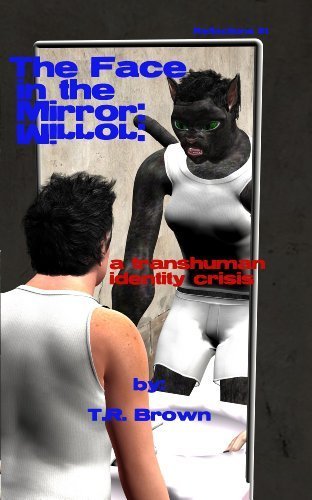
My only other issue with the book is the cover. This is way too thoughtful and intelligent piece of writing to have such an ‘obvious’ cover. It sounds shallow, but covers do attract readers and the current cover does not do justice to the huge themes this novel deals with.
Despite these caveats, this is a good read, and leaves you wanting to continue following the story of Todd, Dr Shimanda, Goliath and Spitfire – and Shade of course.
The Face in the Mirror: a transhuman identity crisis by TR Brown is available on Amazon:
The Face in the Mirror: a transhuman identity crisis (Reflections)


Book Review: The Face in the Mirror: a transhuman identity crisis by TR Brown
TR Brown is a forty-something writer who hales from Salt Lake City, Utah and a cancer survivor. He has a background in biology and writing research and technical documents. His fiction includes the two volumes of the ‘Reflections’ series, of which The Face in the Mirror is the first, with more planned for the future.
The Face in the Mirror: a transhuman identity crisis by TR Brown
Todd Herschel is a cybernetics expert involved in a human/cyborg transplant program. Following a near fatal car crash he awakes from a coma to discover that his brain has been transplanted into the body of a genetically engineered human cat hybrid. Not only that, but his replacement body is female. The story follows Todd’s physical and psychological recovery and acceptance of his new body and his new ambiguous legal status. It also forces him to reevaluate the way human’s treat genetically modified life-forms – Neo’s- who were created to do the jobs human’s didn’t want to – and consider how his unique status might be used to help emancipate the Neo’s and save humankind from itself.
I was not sure what to expect from this book, having looked at the cover I thought it might be a bit of a cheesy B Movie style sci-fi gender shocker and nothing more, how wrong I was! It would be impossible to explore every issue that this book covers. Initially it is a very through exploration of the psychological trauma faced by many amputees/trauma survivors and the familial fall out – the reaction of friends and family; it then delves into what precisely makes an individual personality – is it your brain, your appearance, muscle memory? Can parts of the donor personality remain in the body?
Gender identity is a strong theme in the book as Todd must learn to live with his confused sexual identity – the human male part of his identity being attracted to human females while his female Felis body was attracted to male Tom’s – sexual and species confusion! The slow burning love triangle – square (?) between Todd, Goliath, Spitfire and Dr Shimanda is a very interesting exploration of a poly amorous relationship.
As if these were not big enough issues to tackle, Todd must then come to terms with the terrifying world of his dreams where Shade the dead felis donor of his body stalks him and gives him a mission to save her cubs and his. This mission leads him to explore the possibilities of what makes up the soul and to ask: do Neo’s have souls? They are after all part human as well as part animal. Some very interesting theological ideas crop up and the reader (and Todd) are left wondering if Shade is simply a vestigial memory or a ghost, perhaps even a messenger from God?
Brown sets this story in a futuristic America where the states have been through a second civil war and are now at war with the Caliphate. Neo’s were genetically engineered to fight the war and do the dirty jobs for the human citizens. With no legal rights, the issue of emancipation becomes a dominant theme and parallels are drawn with America’s first civil war and the emancipation of black slaves. The depiction of a future world were genetically engineered creatures do the work of humans is not to far-fetched in a world where we already have spider-goats and cloned sheep. What this novel does, is ask the question, if humans’ play god are they toying with their own destruction? Will they, Frankenstein-like refuse to take responsibility for their creation? Emancipation of a new slave class and human fear and prejudice against genetically modified hybrid’s are ethical and scientific issues that in the future may not be restricted to the pages of science fiction.
All together this is a very detailed, thorough and well constructed story. The arguments are both compelling and thought-provoking. The future world plausible if not imminent. Todd’s journey from denial to acceptance feels genuine and heart-felt. My only caveat is that at times it is almost as though Brown’s research/technical knowledge sometimes takes over at the expense of drama or action – there is a lot of detailed discussion of psychology, ethics and philosophy, a lot of existential angst. The bulk of the novel takes place during Todd’s recovery in the hospital. I would have liked a bit more about the Neo Rights movement earlier on, perhaps a more active role for Todd in the movement. Towards the end, once Todd leaves the hospital, there was action and drama a plenty but some readers may find the story slow at times. As the author has a background in science and the medical world, perhaps he was being too realistic about the time it would take for a person to physically recover and psychologically and spiritually accept their new identity – as I read the book I did keep wondering when he would get out and start sharpening his claws for Neo Rights…..but perhaps I was just being impatient.
My only other issue with the book is the cover. This is way too thoughtful and intelligent piece of writing to have such an ‘obvious’ cover. It sounds shallow, but covers do attract readers and the current cover does not do justice to the huge themes this novel deals with.
Despite these caveats, this is a good read, and leaves you wanting to continue following the story of Todd, Dr Shimanda, Goliath and Spitfire – and Shade of course.
The Face in the Mirror: a transhuman identity crisis by TR Brown is available on Amazon:
The Face in the Mirror: a transhuman identity crisis (Reflections)
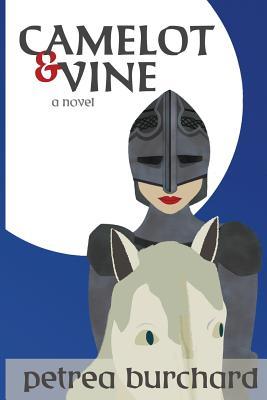
Review of Camelot and Vine by Petrea Burchard
Petrea Burchard started as an actress. She began her acting career in Chicago at The Second City and Victory Gardens Theaters, later moving to Los Angeles to work in television, film, and voice-over. Auditions, jobs and the people she met (famous and infamous) became fodder for her popular “Act As If” humor column at NowCasting.com.
Petrea drew on her acting experience to write her first novel. During a summer Shakespeare acting course at Oxford, she fell in love with the English countryside, and the idea for “Camelot & Vine” began to take shape.
Casey Clemens is having a bad day. A television actress, she has just been axed from her role as Mrs Gone…She has also discovered that her married lover is a lot “closer” to his wife than he had led her to believe…To make matters even worse it also just happens to be the day before her fortieth birthday! So what does Casey do? She jumps on a plane to London of course and takes herself off to Wiltshire. No sooner has she arrived in a sleepy little village near Stonehenge, then she she is hiring a horse for a therapeutic, solitary ride in the beautiful Arthurian countryside. A dangerous mistake, because a close encounter with a fast moving car then sends her hurtling back in time and into the arms of King Arthur…Although, she doesn’t know it is him at the time!
I have to say that the time slip elements of this book are seamless, I loved the way the author handles the transition from contemporary to ancient history. I also liked the fact that rather than flicking backwards and forwards between past and present like some authors have a habit of doing, Burchard chose to stay with Arthurian Britain almost until the very end of the book. I loved Casey as a flawed, contemporary heroine but I loved her even more when out of her time.
Camelot and Vine is spellbinding in it’s innocence. Beautifully told, the reader knows right from the offset that for all Casey is chained and dragged through the beautiful countryside by Lancelot and his men she is never going to come to any real harm. It is definitely not for those expecting a bodice ripping, ravishing romp through the Arthurian court, for even the affair between Lancelot and Guinevere is handled very delicately and Casey, for all she is painted as a husband stealer at the very beginning of the book never gets more than the chastest of kisses. (Even that is implied and only at the very end!) If I am honest, I would have liked her to have at least some romantic action, whether that be a tumble in the hay with King Arthur, or anyone really! I am not quite sure who the target audience for this book is. It certainly appeals to adults, I loved it simply for the escapism element. It would also have appealed to me as a young adult. So while the books aimed at young adults today often have a more explicit content, if the author were to target geeky kids, then I am sure she would have a receptive audience.
All of the characters are extremely well written and life like. The book is vibrant and descriptive, the two standout legendary characters for me being King Arthur and Merlin (Myrddin). The relationship that Casey has with both of these is exquisitely written.
I was also pleased that the author didn’t fall into the trap of trotting out the standard legend. She very cleverly changed the names of a lot of the well known figures, Myrddin (Merlin) etc. The implication being that the correct versions had been lost/altered over the over the years, as is often the case with legend…
All in all Camelot and Vine is a deliciously entertaining read and once I had got past the first chapter I simply couldn’t put it down.
You can find out more at:


January 27, 2014
Meet the Daddy of Time Travel…Mr Dennis Higgins!

Afternoon folks!
It’s Indie and Proud time again…Have you ever wondered what it would be like to travel backwards or forwards in time? Are you one of the many fans (old or new) of Dr Who? Well, hop on over to the wonderful Jamie Marchant’s blog today and you will be in for a real treat, because not only is Dennis Higgins giving away 3 E copies of his amazing book Parallel Roads (Lost on Route 66) BUT he is is also exploring the many different modes of time travel from different points of view and authors.
What are you waiting for? Check out my review by clicking the link above and then hop over to:
http://jamie-marchant.blogspot.com/
If you haven’t already done so please like our Facebook Page:
https://www.facebook.com/indieandproud



January 26, 2014
Book Review: A Certain Kind of Freedom compiled and edited by Beryl Belsky
A review by Lenora
Beryl Belsky is an academic editor and writer who runs The Writer’s Drawer website. The Writer’s Drawer aims to promote writers from all backgrounds, abilities and cultures. Beryl Belsky is also taking part in the year-long Indie and Proud campaign.
A Certain Kind of Freedom, Stories and Poems from The Writer’s Drawer compiled and edited by Beryl Belsky
 This compact collection brings together 30 or so new writers of all ages and abilities from all over the world. The book is divided into short fiction, essays and poetry, and the common link is the writer’s drawer website rather than subject matter. Belsky’s stated aim is to present not only stories of literary merit, but also those that provide cultural insight into the writer’s own countries.
I was lucky enough to be given a paperback copy of this collection to review. Initially I dipped into it, beginning with a few of the poems. I was immediately impressed by the poetry of Jane Tarlo, ‘Debris’ and ‘It’ were both haunting and perceptive poems that stayed with me long after I had read them.
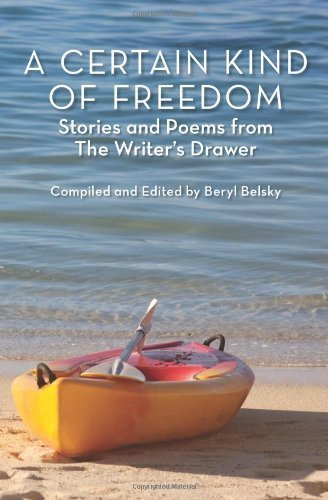
From there I began at the beginning and found it very hard to put the book down. Almost all of the stories, essays and poems are of a high standard, clearly some stood out more than others. The title story ‘A Certain Kind of Freedom’ by Susan Rodgers was a stand out piece of writing. A young couple embark on a kayaking trip on a beautiful, and yet cursed, coastline. The landscape perhaps reflecting Kate and Ryan’s passionate but ultimately doomed relationship, while an impending sense of tragedy quickly unfolds.
‘The Villager Who Dared the Spirits’ by D. Othniel Forte, the tale of a lazy and foolish villager who mocked the woodland spirits and paid the price for his pride was told in a charming folk-lore style. While the ‘Cry of the Fish Eagle’ by Leandre Grobler presented the tragic clash between ancient indigenous/aboriginal culture and modern ‘civilization’ when the last remaining Khoisan couple find refuge in an Eden-like valley only to be pursued by well-meaning but misguided academics. Perhaps the bigger lesson in this story is that modern ‘civilized’ society cannot be forgiven for its disregard of more ancient ways of life. Of the other stories, I enjoyed the Noire-ish and conspiracy theorist tale ‘Nuked’ by Robert Walton and the time travel fantasy ‘Immortal Beloved’ by Tyger Schonholzer.
In the essays section, I loved ‘All the Cats in the World’ by Mina Sephri, writing of her and her family’s love of cats set against the backdrop of revolutionary Iran. There is a bittersweet poignancy in the final message of this story. Aside from some very poignant and touching writing the collection also contains some very pithy personal essays – I found myself wholeheartedly agreeing with Vincent Quek in his essay ‘Punctuality is the Politeness of Kings’. My other favourite in this section was ‘The Smoke Bird’ by Bryan Clark, a beautiful story about an aboriginal mystic and how the dead can still watch over the living.
All in all, barring a couple of pieces that jarred with the overall quality of this collection, Beryl Belsky has selected an engaging and at times highly moving collection of writing. Credit must be given to her undoubted skills as an editor, despite the challenges of editing works from writers of all nationalities and who may not have English as a first language, Belsky’s collection is extremely polished and eminently readable. I would recommend this book both as a cover to cover read, and for dipping into. I certainly won’t be giving Ingrid my copy back (sorry Ingrid) as I will definitely be re-reading many of these works. Beryl Belsky has expressed the hope that this will be the first in a collection of books based on works from The Writer’s Drawer and I certainly hope she achieves this aim.
A Certain Kind of Freedom compiled and edited by Beryl Belsky is available on Amazon:

January 25, 2014
Update on The Tunnel Betwixt…

Woo Hoo!
I have submitted The Tunnel Betwixt… to Amazon and it is now pending review. Once I get the all clear from them, I will simply need to order my proof copy to make sure I am one hundred percent happy with it, before hitting that publish button!
Once it goes live on Amazon I will also be publishing The Tunnel Betwixt…as well as Granny Irene’s Guide to the Afterlife Revenge Part 1 on ITunes, Smashwords and hopefully Kobo. I am also going to be looking at integrating a PayPal button into my blog so that you can order signed copies directly from me. I have checked out Barnes and Noble and their procedure seems cumbersome, so I will probably skip them for now! If anyone has had a positive experience with B&N please let me know!
Love
Ingrid xxx


January 23, 2014
Review of Connie by Sarah Pliton

Hi,
Luna has been very quiet for the past couple of weeks, however check out her latest review of Connie, an erotic lesbian romance by Sarah Pliton over at:
http://lunaballantyne.wordpress.com
Love
Ingrid xxx


January 22, 2014
Digital Rights Management…With Daniel J Weber

For today’s stop on the Indie and Proud campaign, I am pleased to hand over to Daniel J Weber…
Daniel J Weber is a writer who generally writes whatever comes to mind, although mainly chooses to focus on things of a fantastic nature. He likes to write about topics and themes concerning self-discovery, self-esteem, and how the world around us effects who we were, are, and will become. He is part of INDIE AND PROUD and lives in Northern Ontario, Canada.
Who owns the keys?
Dystopian fiction, it’s in us all. Whether you are a book reader, TV watcher, or gamer – whatever type of media you favour – you have entered into the dystopian world that is on a rise in popularity. Everything from nuclear fallout to the zombie apocalypse has been covered over and over again, bringing to life this end-of-the-world obsession that is so prevalent in the media (and our minds) to date.
For the sake of argument, and perhaps to add a fictitious flavour to this non-fiction article, let us put on our thinking caps and enter into a dystopian age together. Image, the world is falling apart. Social fall-out is on the rise. Paranoia is no longer cured by drugs, but in fact is encouraged. Doors are always locked against the criers in the streets. No one can trust their neighbours, friends family… even themselves.
Where do we turn in such a society? Who holds the keys to the world? In desperation, we reach out to the government who promises to keep our families, lives, and all that matters safe. In order to do this, we give them the means to our survival, in hopes of turning this dystopia into a utopia. We give them the keys.
Screams of terror turn to shouts of joy. This new security is uplifting, exciting, throwing loads off of hearts from one sea to the next. We are safe, protected against all who might threaten what matters most, but one question still remains. Who holds the keys?
Now, let us step out of those fiction shoes, throw the hats of imagination away, but keep this final question and the message that struggles free. Who holds the keys?
As authors, or artists of any kind, we can be greatly concerned about thievery. Art is what spurs us on. It is the source of our lives, the blood that flows within our veins, and, sometimes, the only thing that gets us up in the morning or causes our minds ease when night comes with its whispering cries. If we lock our doors against such thieves, would it not prove equally logical (nigh-on insane to do otherwise) to lock up our art, only allowing those to whom we sell it the taste of our life’s work? Shout Amen! Sing Hallelujah! If only this were the case…
Digital Rights Management (DRM) is essentially a system that proposes such freedom. It offers the opportunity to only allow legitimate customers access to our art, thus abolishing thievery (turning dystopia into utopia). The question is, who hold the keys?
I count it no fault of an author for putting DRM on their book(s). Most times it is done for legitimate reasons. The most common thing that I hear authors say when I query them on why they chose to have their works DRM-locked is this. “I want to protect against piracy.” This is, unfortunately, the lie that many of us have bought into. The lie is fed to us from the very top, and it is this: DRM prevents piracy (just like locking your door, in theory, prevents thievery). Yes, regardless of locks, sometimes thieves break in and steal. I will not comment on the effectiveness of DRM as a piracy protection method in length, except to simply say that DRM offer little to no protection. The bigger question, as authors, we should be concerned with is: who hold the keys?
DRM does not allow books to only be accessed by legitimate customers, but instead limits legal and sane use of our art, thus, in effect, limiting and causing disgruntlement in our audience. Whether it be Adobe DRM, Amazon specific DRM, or any other type, the keys function the same. If readers buy a DRM-locked book at the distributor, they can only read it on devices licensed by that distributor. More specifically, this means that if you buy an e-book from Amazon that has DRM, it will only be readable on Amazon licensed devices (Kindle apps and/or devices). Here in-lies the problem. The distributor (not the author) owns the keys to the book(s). If the reader owns a Kobo e-reader or Nook device and purchases a DRM-locked book from Amazon, they cannot read it. Without DRM, such books (regardless of where purchased) can be converted and side-loaded onto any device. With DRM, the only way for this to be possible is by breaking the law, cracking the DRM, and then side-loading the product. This, then, leaves the reader with two options: break the law just to read a legitimately purchased book, or go out and buy a Kindle.
Because the distributor had all the rights to the keys, breaking the DRM does not hurt the author, but instead hurts the distributor. It is, in essence, a marketing scam wearing the mask of helping authors fight piracy. Most people don’t want to break the law, but it is quite nonsensical to be forced into purchasing a device from the distributor in order to read a single book you purchased. True, kindle offers free apps for phones, computers, tablets, etc. But if you already have a reading device that has all of your books, why be forced to switch to a different device for certain books? This would be like only having the right to bring home 50% of the books you purchased from the store. The others you have to read in-store because the manager (not the author) has decided that by bringing the book(s) home (even though you bought it) you are breaking the law. The best analogy I have heard concerning this was penned by Cory Doctorow who said: “This (DRM) is as if Indigo can print their books with special ink that would only be readable under Indigo’s light-bulbs. Indigo might have lovely stores, they might be very stylish, their CEO might come out in a turtle-neck twice a year and show you their awesome products, and their light-bulbs might be very reasonably priced, but I think most of us can still agree that Indigo… nobody should own the exclusive lights under which our books can be read.” (As seen at Writer’s Festival 2009).
If I buy a book, I want to be able to do with it what I would do with a regular paper book (take it on a trip, loan it to a friend, throw it in a lake… wait, I don’t throw books into lakes! How absurd!) DRM essentially takes the power out of my hands and I can no longer choose to do what I want to do with a legally purchased product. If Amazon was a book-lenders service (like a library) that would make sense. Libraries have certain rules about the dos and don’ts of the books you borrow (like don’t throw them into lakes…) and I respect that because I don’t own the book. If I buy a book I should then own it and thus be aloud to do what I want with it.
We all want to live in a utopia, a place where everyone gets along, where there is nothing to be afraid of (even the thievery of our books). The reality is that thievery happens, and handing over our keys to the book distributors, giving them full rights to abuse our rights as authors (and thus restrict our readership) does not help prevent piracy. Instead, it helps the distributors sell their products (e-readers). So, which is better when the zombie apocalypse comes: leaving your door unlocked, or locking it and giving your key away so that when the zombies are chasing you, and you need to get inside, you can’t because you didn’t buy your shoes from the correct store (distributor)?
To connect with the author visit:
If you are not already doing so please like our Facebook Page:
https://www.facebook.com/indieandproud
Jamie Marchant will be hosting Dennis Higgins on Monday 27th January:
http://jamie-marchant.blogspot.com/
Daniel J. Weber


January 21, 2014
Review of Raving Violet by Valerie Gilbert
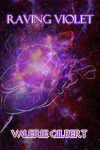
Valerie Gilbert is a native New Yorker, passionate mystic, and introspective seeker of expansive and explosive fun. She believes that the spirit world and physical world dovetail perfectly…
Raving Violet has at various different points been on Lenora’s list, my list, Lenora’s list and finally back to my list and is one of the many books that have been waiting several months to be reviewed. It was well worth the wait and I am glad that I was the one to eventually review it!
The book is a series of succinct and extremely well written essays, covering many areas of the author’s life, in particular her spiritual and metaphysical leanings. Her effervescent personality quite literally jumps straight off the page at you and while sometimes I found her energy a little overpowering, I always found myself willingly going back for more! The fact that it is in essay form, means that you can pick up and put down the book at will, my only caveat with that is that because each essay feels like a short story in it’s own right, then it took me over a week to read the book, which is way longer than the 2-3 days that I prefer to spend reading a book. (I would never read more than a couple of short stories at any one time)
I could maybe have done without the Foreword by Bridgett Walther, Author and the “KUDOS for Raving Violet” by Debbie Christiana at the very beginning of the book as this REALLY grated on me. The way I see it, if I have picked up a book and I am going to read it, then I really don’t want some random person telling me how fabulous it is. That said, I do like to see promotions for future works by the same author at the end…
As with any book of this nature, some chapters/essays are always going to appeal more than others and while there were a couple that I felt were a little laboured (the ones with Francois and his “gypsy gal” I love the notion of spirits being bubbles and absolutely adored Chapter 18 in which the author discusses the concept of your alternate futures shifting accordingly depending upon what is going on in your life. As someone who has visited a lot of mediums in her time, then this statement also resonated with me “Two mediums can present very different versions of the same message from the same spirit.”
I was fascinated by the author’s accounts of the various metaphysical classes and seminars that she attended and as a direct result of reading this book, I will also when time allows, definitely be exploring the work of Lynn Andrews as I am eager to find out more about her Native American teachers, Agnes Whistling Elk and Ruby Plenty Chiefs.
Overall, Raving Violet was a really enjoyable, roller-coaster ride through the spiritual and social life of the author. I would have no hesitation in recommending it to anyone with an interest in the world of spirit, or the afterlife.
You can find Valerie at:
http://ravingvioletvalerie.blogspot.com/


Short Story Competition!!!

Morning everyone, and what a chilly one it is today!
I am pleased to announce that Indie and Proud have teamed up with The Writer’s Drawer to bring you a brand new SHORT STORY COMPETITION with some fabulous prizes, including publication in the Writer’s Drawer’s next Anthology.
Maximum length of entries is 3000 words and the closing date for submissions is 31st March 2014.
For full details please visit:
http://www.thewritersdrawer.net/short-story-competition.html
If you haven’t already done so, then please like our Facebook page
https://www.facebook.com/indieandproud
Don’t forget that I am currently also running a Poetry Competition. (Click for details)
Good luck!
Ingrid xxx