Mary Jo Robertiello's Blog, page 3
June 23, 2023
The Titan/Titanic adventure
New York Mysteries. com
Are you as fascinated by the Titan/Titanic adventure as I am? I’ve copied this marine illustration of the ocean’s depth from CNN. There are also facts and figures about sea adventures.
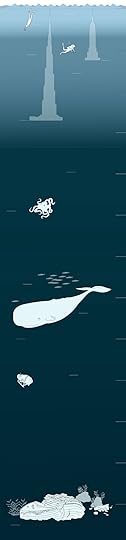
Sea level
(0 feet)
Sunlight zone
130ft
Sunlight entering the water can reach down to 660ft.
Scuba diving
The recommended maximum depth for scuba diving.
393ft
Free dive record
One of the deepest dives with a single breath of air ever, recorded by Arnaud Jerald in 2022.
660ft
Twilight zone
Only a small amount of light can penetrate the water at this depth.
1,000ft
1,090ft
Scuba dive record
1,250ft
Ahmed Gabr set the record in 2014, training for years beforehand.
Empire State Building
1,575ft
Deepest underwater rescue
Two men were trapped in a submersible off the coast of Ireland for 76 hours and rescued on Aug. 29, 1973.
2,000ft
2,717ft
Tallest building in the world
Burj Khalifa, United Arab Emirates
3,000ft
3,300ft
Midnight zone
Nearly 90% of the ocean is in this range. It is entirely dark and near freezing.
3,953ft
Arctic Ocean
4,000ft
(average depth)
4,900ft
Giant Pacific octopus
5,000ft
The maximum depth of one of the ocean’s biggest octopuses.
6,000ft
6,683ft
Blue Ridge Mountains
(maximum height)
7,000ft
7,381ft
Sperm whale
(maximum depth)
8,000ft
8,000ft
Grand Canyon
(maximum height)
8,981ft
Golden Gate Bridge
9,000ft
The total distance that the bridge would stretch vertically.
Titan
Owned by OceanGate, the Titan was a human-operated submersible designed to take five people down to 13,123ft.
10,000ft
11,000ft
12,000ft
12,500ft
RMS Titanic
The wreck of the Titanic sits nearly 2.4 miles down on the ocean floor.
Sources: CNN, National Oceanic and Atmospheric Administration; Dive Magazine; Empire State Building (esbnyc.com); Burj Khalifa (burjkhalifa.ae); Monterey Bay Aquarium; US Department of the Interior; UC San Diego; Golden Gate Bridge (goldengate.org); Guinness World Records; Vertical Blue. Graphic: Amy O’Kruk and Annette Choi, CNN[image error]

New York Mysteries. com
June 23, 2023
Are you as fascinated by the Titan/Titanic adventure as I am? I’ve copied this marine illustration of the ocean’s depth from CNN. There are also facts and figures about sea adventures.
[image error]Sea level
(0 feet)
Sunlight zone
130ft
Sunlight entering the water can reach down to 660ft.
Scuba diving
The recommended maximum depth for scuba diving.
393ft
Free dive record
One of the deepest dives with a single breath of air ever, recorded by Arnaud Jerald in 2022.
660ft
Twilight zone
Only a small amount of light can penetrate the water at this depth.
1,000ft
1,090ft
Scuba dive record
1,250ft
Ahmed Gabr set the record in 2014, training for years beforehand.
Empire State Building
1,575ft
Deepest underwater rescue
Two men were trapped in a submersible off the coast of Ireland for 76 hours and rescued on Aug. 29, 1973.
2,000ft
2,717ft
Tallest building in the world
Burj Khalifa, United Arab Emirates
3,000ft
3,300ft
Midnight zone
Nearly 90% of the ocean is in this range. It is entirely dark and near freezing.
3,953ft
Arctic Ocean
4,000ft
(average depth)
4,900ft
Giant Pacific octopus
5,000ft
The maximum depth of one of the ocean’s biggest octopuses.
6,000ft
6,683ft
Blue Ridge Mountains
(maximum height)
7,000ft
7,381ft
Sperm whale
(maximum depth)
8,000ft
8,000ft
Grand Canyon
(maximum height)
8,981ft
Golden Gate Bridge
9,000ft
The total distance that the bridge would stretch vertically.
Titan
Owned by OceanGate, the Titan was a human-operated submersible designed to take five people down to 13,123ft.
10,000ft
11,000ft
12,000ft
12,500ft
RMS Titanic
The wreck of the Titanic sits nearly 2.4 miles down on the ocean floor.
Sources: CNN, National Oceanic and Atmospheric Administration; Dive Magazine; Empire State Building (esbnyc.com); Burj Khalifa (burjkhalifa.ae); Monterey Bay Aquarium; US Department of the Interior; UC San Diego; Golden Gate Bridge (goldengate.org); Guinness World Records; Vertical Blue. Graphic: Amy O’Kruk and Annette Choi, CNNJune 17, 2023
New York Mysteries.com
One of my dearest friends, a psychologist, emailed me this article.
A professor was accused of antisemitism. The controversy has exploded into a bigger, messier debate about the future of psychology itself
by J Oliver Conroy
(Carlos Bernate/The Guardian)
Fri 16 Jun 2023 06.00 EDT
Is Lara Sheehi, a psychoanalytic therapist and psychology professor from Lebanon, a charismatic, caring and deeply ethical mental health professional, according to her friends and allies, or part of something “toxic, aggressive and narcissistically delusional”, in the words of an email sent not long ago to more than a thousand colleagues.
Sheehi has never made a secret of her political commitments. Her influences include Che Guevara and the psychiatrist and anti-colonialist Frantz Fanon, and she sometimes sports a black-and-white keffiyeh, the checkered scarf associated with Palestinian resistance. Yet neither Sheehi nor her most caustic critics probably could have predicted the chain of events that followed a graduate psychology class she taught in October at George Washington University, in Washington DC.
The course was normally held in person, but that day unusual, nearly gale-force winds were blowing near her home, so Sheehi decided to do class virtually. She was unaware that some Jewish students were distraught about a recent extracurricular event she had organized, where a Palestinian law professor had sharply chastised Israel, and had been waiting to raise their concerns. In a heated, tearful conversation, the students accused the law professor, and by implication Sheehi, of antisemitism; Sheehi rejected the accusation and suggested that the students were the ones suffering from unexamined racism.
The saga that began in that one-and-a-half-hour seminar has torn the insular world of psychoanalysis into bitter factions; sparked legal petitions, counter-petitions, investigations, ethics complaints, disinvitations, resignations, death threats and accusations of libel; and led the president of the United States’ preeminent psychoanalytic association to step down, in April, in what he calls a “human sacrifice”.
At every step, psychoanalysis – the intense school of clinical psychology, founded by Sigmund Freud, that studies our unconscious urges and conflicts – seems to have failed its practitioners. The two main camps accuse each other of bigotry, stifling free expression, condoning violence and betraying the creeds of their profession. Each side views itself as psychoanalysis’s moral conscience: a superego battling an ugly id.
“The lines have been drawn,” Sheehi said from her home, whose location she asked to keep private because of threats she says she has received since the controversy began. “I don’t think people really get what the fallout has been.”
From an argument about Israel and Palestine, the Sheehi case has become a larger debate about psychology itself. Are psychoanalysts neutral interlocutors, healing one mind at a time, or activists, diagnosing society’s pathologies and fighting injustice? Can someone be a nuanced and empathetic clinician, and also take to Twitter to issue thundering political judgments?
The trouble has rippled outward, in open letters and listserv skirmishes and furtive back-channel emails. There are murmurs of purges, schisms, vanguards, coups. Analysts and therapists from a number of countries have weighed in, weaponizing the vocabularies of Freud, Jung and Lacan against each other.
Some worried insiders get the sense that psychoanalysis is analyzing itself – and not very well. “There is nothing about this that feels like healing, or meets any of the ideals of our own work,” one practitioner told me; a “collective regression” has seized the profession, with respected mental health professionals “becoming babies”.
Psychoanalysis was popularized in the US by Jewish refugees from Nazi-era Europe, and its practitioners today are often older, white and Jewish – a demographic that tends to be liberal on most issues except Israel. If that is the archetype, then Sheehi breaks the mold: she is 38, Arab and queer; a professional biography says she “works on race and white supremacy, decolonial struggles [and] power configurations in class and gender”, and practices “from a trans-inclusive feminist and liberation theory model”.
In an interview last year, she put it more bluntly: “Join the motherfucking struggle.”
Sheehi doesn’t spend patient sessions “talking constantly about capitalism”, she told me. “What is pertinent is that it’s always a backdrop. It drives suffering.”
Sheehi, whose childhood and early adulthood in Lebanon was punctuated by destructive Israeli military operations, has described herself as both traumatized and resentful of the way her trauma might become fodder for “racist fantasies” that perceive her as a victim. Last year, she and her husband, Stephen Sheehi, a professor of Arabic and Middle East studies at the College of William & Mary, published Psychoanalysis Under Occupation: Practicing Resistance in Palestine, a study examining clinical psychology in the context of Israeli occupation.
Psychoanalysis, historically, was deeply influential on the fields of psychology and psychiatry, though its clout waned in the late 20th century as more accessible treatments, such as cognitive behavioral therapy, came into favor. In the last few years, however, there has been a revival of interest: the New York Times recently speculated that analysis is enjoying a “moment”, and a leftwing magazine of analytic ideas, Parapraxis, launched last year.
“There’s definitely a new wave in psychoanalysis, with more radical politics, including on Israel,” a practitioner told me – one of several, of the dozen I interviewed, who insisted on anonymity because of the acrimony aroused by the Sheehi controversy. “That shift has been in the air for a while, and there’s a feeling that the shift is happening faster than some people are comfortable with.”
The tidal change might be said to mirror similar revolutions in the media and progressive non-profit sectors in recent years: a sometimes rapid march through the institutions by younger professionals eager to diversify predominantly white industries and call into question what they view as hoary notions about objectivity.
A new model of psychoanalysis has arisen, another psychoanalyst said, focused less on sifting the individual unconscious and “more on the notion that because of the society we live in we’re constantly influenced by various forms of systemic racism, and that the goal of analysis is a calling-out of prejudices and almost a kind of re-education”. In 2020 the American Psychoanalytic Association (APsA) established the Holmes Commission, an investigation into racism in its field.
GW’s department of clinical psychology hired Sheehi in 2014 as an instructor for required courses intended to teach trainee psychologists greater sensitivity to racial, sexual, and other identities. Sheehi also became known as a vocal member of the American Psychological Association’s analysis division, Division 39 (which is distinct from APsA). She resigned from its listserv several years ago, following fighting with members she feels were bigoted, but was popular enough that in 2021 she was elected Division 39’s president for 2023.
“I have been collegial my whole life,” Sheehi told me. “That’s how I was able to be elected as president of a very large division. It’s not like I walk into a room and punch somebody in the face, which is how they make it seem.”
In September, at GW, Sheehi helped organize a “brown-bag lunch” with Nadera Shalhoub-Kevorkian, a Palestinian law professor at the Hebrew University of Jerusalem, on the topic “Global Mental Health ‘Expertise’, ‘Therapeutic’ Military Occupation and Its Deadly Exchange”. Shalhoub-Kevorkian’s talk argued that Israel uses global mental- health programs as a “cunning” way to prop up its military occupation, and called for psychologists to beware of co-optation by state projects.
George Washington University. Photograph: The Washington Post/Getty Images
The talk was held on a Friday. Thirty or 40 people attended, in Shalhoub-Kevorkian’s recollection, and others watched by livestream. She was surprised that the talk was recalled as controversial. The students “were very engaged”, she told me. “It was very pleasant. The questions were very good.” She noted that she has lectured on similar topics at the Hebrew University, often to students who are Israeli soldiers, and has rarely encountered the same blowback. “I think that American academia is becoming too neurotic.”
Yet some Jewish students felt unsettled, according to a legal complaint later filed by the pro-Israel group StandWithUs, and decided to raise the topic in Sheehi’s class the following Monday. According to the complaint, they said that Shalhoub-Kevorkian’s talk had been a “two-hour diatribe” against Israel that “felt like [an] excuse to bash Jews” and left students feeling “vulnerable and unsafe”. A student said that the talk “seemed to have little to do with being a stronger clinician”. (The complaint also alleged that Sheehi, earlier in the semester, had told a Jewish Israeli student: “It’s not your fault you were born in Israel,” implying her nationality to be shameful; Sheehi told me: “That is not something I would ever say,” and called the complaint a “farce”.)
The class was tense. According to both the legal complaint and Sheehi’s account, she responded by arguing that anti-Zionism is not synonymous with antisemitism, and framing the discussion as an opportunity to reconsider assumptions and learn from each other. The students argued that Sheehi was minimizing the threats faced by Jewish Israelis and denying Jews the right to define their identity in a way that other groups are granted.
“I go out of my way to never ‘shut down’ disruptive or uncomfortable topics,” Sheehi wrote in the leftwing magazine CounterPunch. In her account, the students “categorically refused to engage in genuine discussion”; they implied that Shalhoub-Kevorkian was a “terrorist” who “advocated violence against Jews” and argued that the brown-bag lunch was akin to GW hosting “a talk that would discuss how black men commit crimes”.
Shalhoub-Kevorkian, Sheehi recalled one student saying, “would readily dance on the grave of my seven-year-old niece”.
Sheehi disputes that she ever denied that antisemitism is a real phenomenon and says that she will be vindicated if a clandestine recording she believes one of the students took is made public. (She has also noted that the lunch event was optional, and held in a different building so that students wouldn’t feel obliged to attend.)
The situation deteriorated: the students complained to the psychology department; StandWithUs filed a complaint with the US Department of Education alleging that Jewish students at GW were being harassed; the university opened an administrative inquiry and hired a law firm to conduct an outside investigation; and the American-Arab Anti-Discrimination Committee (ADC) announced that it would represent Sheehi, accusing GW of enabling a “hostile environment” for Arabs and Muslims and “setting a chilling precedent regarding academic freedom”.
As news of Sheehi’s situation reverberated through the psychoanalysis world, quite a few colleagues, including many who are Jewish, leaped to defend her. The GW case, they believe, is a cynical attempt to clamp down on legitimate criticism of Zionism. As an organization, StandWithUs seems like an ideological “ambulance-chaser”, a Jewish psychologist told me; another person views the group as a “proto-fascist” surrogate for Israel’s increasingly far-right government.
(StandWithUs disputes these characterizations. StandWithUs “is a nonpartisan educational organization” that fights “misinformation and hate”, its co-founder and CEO, the former family therapist Roz Rothstein, said through a representative. “While we often partner with like-minded groups on educational initiatives, we operate entirely independently of any other entity, governmental or otherwise.”)
Lara Sheehi with her recent book Psychoanalysis Under Occupation. Photograph: Carlos Bernate/The Guardian
“The playbook is pretty consistent,” Dylan Saba, an attorney with the non-profit Palestine Legal, which recently filed a complaint alleging that GW discriminates against Palestinians, told me. (Sheehi is represented by the ADC, a different organization.) “Attacking critics of Israel on the substance doesn’t quite work in the way that it maybe once did, so the move from these organizations has been to try and silence that criticism altogether.” He added that accusations of antisemitism may be particularly damaging to untenured professors, such as Sheehi, or students entering the job market.
GW’s investigators later cleared the university, and Sheehi, of wrongdoing. (The complaint with the Department of Education is still pending.) But the psychoanalytic world was already roiling with scandal. People sympathetic to Sheehi, alarmed to hear that she’d been getting hate-mail and threats of violence, accused their colleagues of failing to stick up for her.
A listserv hurricane gathered. Soon a deluge of messages was pouring in. Roula Hajjar, a therapist in training in New York, believes the controversy proved so inflammatory because the psychoanalytic field is Zionist to an unusual extent. When discussing other issues, such as anti-black racism, “the window is widening”, she said. “When you say ‘Palestine,’ the appetite plummets right to zero.”
But others had reservations, particularly when old posts from Sheehi’s private Twitter page, BlackFlagHag, circulated. In her tweets – which Sheehi says were decontextualized expressions of anger about Palestinian and Lebanese suffering – she called Israeli soldiers “genocidal fucks”; urged Palestinians to “throw rocks”; retweeted a picture of a Molotov cocktail; wrote, “Israelis are so fucking racist” and “FUCK ZIONISM, ZIONISTS, AND SETTLER COLONIALISM”; and urged those who disagreed to “Fucking learn something”.
On the page, later deleted, Sheehi seemed to suggest that some humans are beyond redemption: “If you … STILL entertain for even a split second that Hamas is the terrorist entity, there is literally zero hope for you, your soul, or your general existence as an ethical human being in this world.”
People began taking sides.
Although the United States’ two most important psychoanalytic professional organizations, Division 39 and APsA, are hardly unaccustomed to debate – the question of how to treat children who identify as transgender has been particularly divisive – the Sheehi case punctured some final gossamer of collegiality. The resulting listserv correspondence, when printed, forms a heavy sheaf of paper; the messages, all trailed by professional signatures, depict an unhappy marriage collapsing into despair and rage.
“[O]ur division is being ripped apart, while its president-elect” – Sheehi – “watches passively to the bloodshed,” Michael Singer, a psychologist in New York, wrote. “This is turning out to be a pathetic end to a once-vibrant organization. Dr Sheehi, we owe you our final breath as the life drips out of Division 39.”
The debate has hinged on competing understandings of identity and victimhood, but also on something more amorphous than Israel and Palestine: that generational division between a new guard that sees resistance to reform as born of structural, and often unconscious, bigotry and an old guard fighting what it sees as a radical activist vanguard.
Sheehi disputes aspects of this framing. “There’s a way in which this generational argument is made as an escape hatch, and a rallying cry. If you say to people, in a profession that feels it’s dying, that new folks are trying to come in and dismantle everything, it activates … annihilation anxiety.”
Jon Mills, a Canadian psychoanalyst who has vehemently criticized Sheehi, told me by video call from rural Ontario that he sees himself as combating an unchecked leftward drift in psychology. “Paranoid and schizoid” mentalities have gripped his profession, he said, with a cadre of authoritarians exploiting the vacuum to “castrate” the leaderships of psychological organizations.
In February, a moderator banned Mills from the Division 39 listserv on the grounds that his posts defamed Sheehi. (Mills disputes that characterization, and shared with me a 1,500-word letter he wrote in protest, with an appendix of evidence organized in the style of court exhibits.) It did little to quell the conflict.
Thomas Greenspon, a retired therapist in Minneapolis, tried to play diplomat: “Div 39, as a gathering place for psychoanalytic thought, may be one of the few places where progress might be made on new approaches to this struggle. What threatens such progress is calling each other names and asserting diagnoses.”
“Clearly, this is a political battle,” Singer replied, “not a psychoanalytic battle.” One side attacks the other “as reactionary and elitist, while simultaneously claiming a kind of warped victimhood for themselves as the misunderstood vanguard of the enlightened future. […] One would think [Sheehi] would have had the decency to call off her attack dogs when she saw them devouring the Division.”
Carter J Carter, an outspoken supporter of Sheehi’s, wrote: “‘Dogs,’ dude?”
“Wow! Are you for real, dude?” Karim Dajani, a psychologist in San Francisco, wrote, also in reply to Singer. “This is a psychoanalytic forum not a forum for your racist diatribes.”
“How dare you call us attack dogs, Michael,” Kritika Dwivedi, a therapist in Denver, wrote. “Would you type the same vitriolic, disgusting and racist sentiments if you knew your patients could read this?”
Singer used the term again. Carter wrote: “So we’re doubling down on the ‘dogs’ thing huh?”
A therapist in New York, Alaa Hijazi, wrote: “I can say with confidence that the most hatred that I have ever personally or directly witnessed has been on this listserv.”
Alan Hack, also in New York, agreed that the term “attack dog” was inflammatory but asked why anti-Zionists were describing Israel as “settler-colonialist” when some Jews had objected. “Please do not invalidate my claim to how sad and triggering this is to me.”
Referring to a characterization of Mills as a “bomb-thrower”, Molly Merson, a Bay Area therapist, accused Mills, Singer and their allies of wreaking psychic violence, splattering the listserv with “fragments of blood and bone and body parts. The ‘bomb dropper’ can silently slip out the back, soaking in the pleasure of the blood they have spilled.”
Singer says he was irritated at the other side for lobbying accusations of racism that left “very little room for disagreement”. To “use that as your tactic doesn’t really promote the kind of conversation that psychoanalysis is known for, which is a self-aware, introspective, mulling-over”, he told me. Psychoanalysis has slipped into irrelevance, he said. “I’m very reluctant to have us make our re-entry to the world stage as this kind of virulent political action committee.”
But the old guard is also political, and has its own form of identity politics, Carter J Carter argued when I reached him at his farm in Massachusetts. A group “of us [have] been bringing a critique to our field that is more critical of white supremacy, of capitalism, of the ways in which our profession conducts itself”, he said. Their opponents think that “if they can just establish that we’re the ‘real bigots,’ we’re just gonna go back under the rock that we came from”.
Soon the controversy’s center of gravity began to shift from Division 39, where Sheehi had been elected president, to APsA. Unlike Division 39, which is functionally open to anyone with an interest in psychoanalysis, APsA has historically been more exclusionary: the organization only began admitting non-psychiatrists in 1988, after a legal battle, and gay analysts in 1991.
In recent years, the new guard had gained a significant foothold in APsA’s program committee, which organizes panels and conferences for the association. Observers were impressed by the committee’s programming and its commitment to diversity, though “there were issues with the way that they ran things,” someone familiar told me. “It was somewhat despotic.”
In February, APsA’s program committee decided to invite Sheehi, who was also a member of the committee, to speak at a panel on “Psychotherapy Under Wartime Conditions” this June. The invitation was overruled by Kerry Sulkowicz, APsA’s president, and the organization’s executive committee.
“We were told that we were prohibited from inviting her,” a former member of the program committee, Avgi Saketopoulou, told me, speaking crisply in a faint Greek accent. “Now, you have to understand that this is unprecedented … an extreme measure.”
In a letter to members, Sulkowicz argued that the invitation was “not in the best interests of APsA at this time”, and said some members “felt uncomfortable with having a presenter who has been on record as making what some believe are statements that may constitute hate speech”.
Kerry Sulkowicz at a Physicians For Human Rights gala, New York, 2016. Photograph: Thos Robinson/Getty Images
Sheehi resigned from APsA: it is “not hate speech to advocate for the rights of an oppressed and colonized people”, she wrote in a reply-all email, nor “to call an apartheid state what it is.” APsA is a “white supremacist institution” whose “false and defamatory categorization [stokes] actual hate speech against me, threats of forced deportation, rape and bodily harm to me and my family”.
She added, with the phrase bolded and underlined: “I will not be complicit in this violence.”
The executive committee, led by Sulkowicz and Dan Prezant, APsA’s president-elect, refused to bend. They also disbanded the program committee, which they characterized as secretive and nepotistic.
The former program committee responded with a letter casting its disbanding as a “sudden and reactionary” purge by forces “working, knowingly or not, to preserve the reign of whiteness within psychoanalysis”. Many of the committee’s members had already quit in protest, and people began calling for Sulkowicz’s resignation as president. The American-Arab Anti-Discrimination Committee also sent a letter demanding APsA preserve any records related to Sheehi’s disinvitation as “relevant to upcoming litigation”.
In late March, after GW’s investigation had exonerated Sheehi, APsA’s executive committee retreated: it contacted Sheehi to offer what she and her allies view as a “faux apology”, and said that she could do the panel after all. She pointedly declined.
In early April, Sulkowicz stepped down. His resignation letter argued that an “illiberal, extreme left” had seized control of APsA – putschists who chill debate “with reflexive accusations of unconscious or systemic bias at the first hint of questioning” and “seem to want to transform APsA from a professional organization into a primarily political” one.
He also suggested a patricidal impulse, with the new guard requiring “a scapegoat, ideally a white male representing authority and privilege”.
Sulkowicz struck a slightly different tone when I caught him by telephone in Vancouver, where he was attending a Ted Talk conference. An analytically-trained business consultant, Sulkowicz is one of psychoanalysis’s more visible personalities. (He is also the father of Emma Sulkowicz, the former activist and artist known as “mattress girl” for her public protest against Columbia University’s handling of a rape allegation she made against a fellow student.)
“It felt like resigning was the right thing to do, just to try to give them a sense that they had won and there’s a bit of human sacrifice involved,” he said. “But it really hasn’t helped that much. I mean, it’s helped me – I’m hugely relieved to be out of that role.”
During Division 39’s spring conference, in Manhattan in late April, a truck paid for by Alums for Campus Fairness, a pro-Israel group, circled the venue with an electronic billboard with giant portraits of Lara and Stephen Sheehi and the question: “WHY IS THE AMERICAN PSYCHOLOGICAL ASSOCIATION HOSTING ANTISEMITES?”
Inside, the conference proceeded unperturbed. Sheehi gave a well-received presidential address; her husband was a keynote speaker. People there described the conference as energetic, diverse, and, because Sheehi’s supporters came and critics stayed home, wholly dominated by the new guard.
Sheehi is by most accounts a commendable teacher and clinician, though “an activist, first and foremost”, a psychoanalyst told me. And “while I’m sure this has been horrible for Lara, I think that there’s a way that the scandal and the form that it has taken has served some purpose aligned with her politics. It feels both like she’s the victim of something, and that she’s playing out a narrative that she has some agency in.”
Lara Sheehi at home earlier this month. Photograph: Carlos Bernate/The Guardian
Sheehi rejects the activist-clinician distinction. Psychologists must move past the idea “that the material world doesn’t exist in intimate relationship with psyches and with people suffering”, she insists. “And I think that there are a lot more people unwilling to bend that reality any more.”
No one seems sure what will happen next. There is talk of forming a new, social-justice-oriented psychoanalytic organization – to be built from a clean slate and unapologetic in its activist stance. There are also rumors that the old guard might start its own. Michael Singer suspects the controversy will “die away at this point, because I think Dr Sheehi and her supporters have sort of won the day”.
Sheehi, already president of Division 39, was recently nominated to be president of its parent organization, the APA, which has 146,000 members and is America’s most important and powerful psychology organization. She withdrew from consideration, she told me, for fear of further harassment. She has been teaching her latest course remotely, due to security concerns, and says that pro-Israel protesters have been tracking her location.
Almost everyone I interviewed despaired at their profession’s inability to cope with the kind of conflict that mental health professionals are charged with alleviating. The saga feels like a surrender “to the kind of rhetoric and brokenness that’s represented all around us, in the world, that we’re supposedly trying to help people fix,” an analyst I spoke to said.
Another analyst argued that clinicians are entitled to opinions – “It’s not fair for someone to have to be a clinical psychologist 24/7, in all contexts” – but added, “Personally, I would die before any of my patients had direct access to my political views.”
I asked the analyst to diagnose their industry. Laughter that sounded like sobbing came from the telephone. “Instinctively, I want to say psychotic?”
June 2, 2023
NEW YORK MYSTERIES.COM
NYMYSTERIES:
ONE BRAVE WOMAN AND MANY COWARDLY BOARD OF TRUSTEES MEMBERS
[image error]Fatima Mohammed, a Yemeni-American student, is being unfairly attacked for her graduation speech at CUNY Law School.
On May 12, 2023, Students for Justice in Palestine (SJP) activist Fatima Mousa Mohammed delivered a commencement speech at CUNY School of Law. In her speech, she said that American law is a “manifestation of white supremacy” and that she chose CUNY School of Law because it equips its students with the tools to protect “organizers” that are working to “confront the systems of oppression that wreak violence on them, systems of oppression, created to feed an empire with a ravenous appetite for destruction and violence.” She celebrated the fact that the school endorsed BDS and enabled its students to fight “Israeli settler colonialism.” She also said that Israel “continues to indiscriminately rain bullets and bombs on worshippers, murdering the old, the young, attacking even funerals and graveyards, as it encourages lynch mobs to target Palestinian homes and businesses.” In addition, Mohammed also referred to the Holyland Five, five U.S. citizens affiliated with the Holyland Foundation who are imprisoned for having funneled millions of dollars to Hamas, as “political prisoners.” She wished that the joy and rage that fills the auditorium will be “the fuel for the fight against capitalism, racism, imperialism, and Zionism around the world.” Mohammed concluded: “No longer are we going to capitulate to the oppressors, no longer are we going to put our hope in their depraved consciousness… Greater empires of destruction have fallen before, and so will these.”
From MEMRI June 2, 2023
[image error]Here comes a mixture of phony liberalism, fear of the truth, and genteel bias against a Yemeni-
American student’s nerve and courage.
May 28, 2023
NYMYSTERIES.COM
MARY OLIVER’S “SOMETIMES”:
“Instructions for living a life:
Pay attention.
Be astonished.
Tell about it.”
May 20, 2023
NYMYSTERIES.COM
The Stuyvesant Flea Market
Look forward to seeing you on June 3. If you’ve never been to Stuyvesant Town, you’re in for a treat. It’s beautifully green with lovely walks. It begins at Ave. A and !4 Street. At the center of the complex is the Oval which encircles a charming fountain and comfortable benches. It will be lots of fun that Saturday with 500 of us residents selling everything we want to get rid of. Plus spending your money at the neighboring bakeries and restaurants food stands.
COMMUNITY EVENTS Postponed: Flea Market, Taste of StuyTown, & Recycling Day Now Saturday, June 3rd | 10am-4pm | Around the OvalDue to expected inclement weather tomorrow, the Flea Market and Taste of StuyTown have been rescheduled to Saturday, June 3rd.
Over 500 residents will be selling items new and old. Walk around the Oval to find tables with knick-knacks, toys, books, vinyl records, and much more.
The Taste of StuyTown returns again, featuring local eateries Brooklyn Dumpling, Bread Story, Baked by Luigi, Brindle Room, Hane, Haile Bistro, Rosemary’s, Lenz’s, Pure Grit, Matto Espresso, Veeray de Dhaba, Tortazo, and The Royal Sifting Company. A portion of proceeds will go to The Good Neighbor Collective & Henry Street Settlement.
It will also be Community Recycling Day: • The Shred-It Truck returns on the 1st Ave Loop from 11am-3pm (or until the truck is full), for residents only. • Visit the Textile Recycling table near Playground 12. • Bring your unwanted electronics to Playground 12 for E-recycling.
While it’s disappointing to postpone this highly anticipated event, we are excited to hold it on a day that will hopefully bring better weather. We look forward to seeing you there!
May 13, 2023
Nakba = Catastrophe
The 75th anniversary of the Palestinian Nakba, which means “catastrophe,” is on May 15th. These two organizations believe that recognizing the Nakba is recognizing each other’s humanity.
If America Knew Team:
The 1948 founding of Israel was preceded and accompanied by a massive ethnic cleansing operation to remove as many of the Muslim and Christian inhabitants as possible.
During Israel’s “war of independence,” over 750,000 Palestinians were driven from their homes, never to be allowed to return. Hundreds of towns were razed; villagers were massacred. Their very existence on the land was nearly wiped from history as Israel built new towns over the ruins.
This devastating humanitarian disaster is given almost no attention in American history books or by the mainstream news media even though it is essential in understanding the ongoing violence in Israel-Palestine and the Middle East in general.
Palestinian refugees and their descendants living in the West Bank and Gaza continue to live under an Israeli military occupation funded by American taxpayers at over $10 million a day.
Israeli forces continue to violate human rights on a regular basis, with multiple cases of assault, abduction (in some cases, of children), andinvasion taking place in the past two months.
It is essential that we educate our communities and demand an end to the use of our tax dollars for killing and destruction.
Here are some things you can do:
• Share our short summary “How Palestine Became Israel” article with people who are new to the issue.
Watch and share Occupation 101, an award-winning documentary film on the root causes of the Israeli-Palestinian conflict.
• Post about the Nakba on Facebook and Twitter.
• Check to see what your local newspaper wrote about this tragedy, and write a letter to the editor with the facts they omitted.
• Learn about the Boycott, Divestment, and Sanctions movement and get involved with a local chapter.
• Call your Congressperson and give them your opinion about this issue.
American Friend of Combatants for Peace:
As Combatants for Peace has been planning the upcoming Joint Nakba Ceremony, division is being stirred in the U.S. regarding the commemoration of this important day.
This week, Speaker of the House Kevin McCarthy attempted to block a Nakba commemoration event sponsored by Rep. Rashida Tlaib. He claimed that it was “wrong for members of Congress to traffic in antisemitic tropes about Israel.” Citing concerns about the Nakba event led by Rep. Tlaib, Jonathan Greenblatt, the national director of the ADL, wrote to McCarthyand asked him to ensure that spaces controlled by Congress “are not being used to espouse discriminatory and hateful rhetoric.”
The Nakba commemoration event did take place in the Capitol building on Wednesday and Congresswoman Tlaib shared that true peace can only be built on truth and justice.
Recently, some AFCFP supporters have reached out to better understand the significance of CfP’s Joint Nakba Ceremony. As a community of Palestinian, Israeli, and international activists, our solidarity and unequivocal commitment to one another invites us to let go of our defenses and to draw near to one another’s stories. Solidarity invites us to bravely safeguard the dignity of all. The Combatants for Peace movement helps us to resist the urge of false dichotomies. As we build a future collectively, we are showing the world that there is a third path, rooted in justice and peace, that we can all walk together.
May 6, 2023
Dogs! Dogs! Dogs!
A friend adopted two delightful dogs three years go. I journeyed to the Bronx to see her wonderful new apartment and to meet Pepper and her sister dog whose name might be Chloe. My friend lives in a beautiful, gigantic, grand apartment building probably built in the early twentieth century (Just guessing!)
Molly being admired by Pepper and ChloeI was raised with collies. Old Lyme, Ct. was a combination of village and country. Your animals wandered around the countryside. Other neighbors’ animals wandered into your yard. There was a casual freedom the way dogs and cats were treated. They ate left overs and came and went through a small opening built in the screen door. By the way, I know where Lyme disease gets its name.
April 29, 2023
The oldest tree in Manhattan
New York Mysteries April 29, 2023
A friend has a 1950s copy of a Russian film, War and Peace. It’s wonderful. When I was young I sort of read War and Peace, concentrating on the lavish parties and skipping the battles. In the film, the battles are amazing. Russian and French soldiers in natty uniforms on well trained horses raced over green fields and lakes in pursuit of each other.
The Russian spring’s birch, cherry and oak trees reminded me of the oldest living tree in Manhattan, planted in New York/ New Amsterdam in 1679.
It’s referred to as “the hanging tree” because of executions that supposedly took place. Although there are no public records confirming this, there was a nearby prison. Perhaps some of the inmates met their fate at the hanging tree.
The tree was on private land that was bought by the city and added to Washington Square in 1827. You can visit it at Washington Square Park’s northwest corner.
[image error]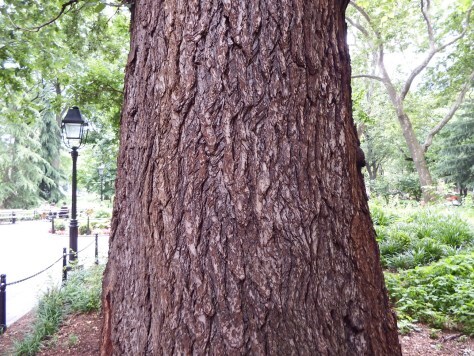
April 22, 2023
Alone
Years ago there was a motion to stop the MTA 8 Bus. Its route is east to west on eighth and ninth streets. The reasons given were fewer passengers. The east and west neighborhoods spoke up. Many were parents who used the bus to transport their kids back and forth from schools. It worked.
Several days ago I was on the MTA 8 Bus going west.It was about 4:30 pm, the time extra curricular activities wind down. Seated at the front of the bus across from me was a good looking man, slightly disheveled after a day’s work: rolled up white sleeves, loosened tie. Maybe 38ish? He sat with his head in his hands. On either side of him were two young boys. To the right was a six year old. To the left was a nine year old. Of course, I’m assuming these ages. The older child banged an empty plastic bottle relentlessly against the seat, keeping time by screaming. The younger child fluttered a green object and kept grabbing his father who unwound the boy from his embraces. The child made loud, guttural sounds incessantly. The father made futile attempts to calm the kids. Mostly, he sat with his head buried in his hands.
For me their anguish and suffering fenced them in. Like me, the other passengers said nothing. What was there to say? The kids were driving us nuts but we all held on to our annoyance. When they got off the bus I was relieved. What about them? Where was their relief? What’s the mother like? What’s home life like?
What would you have done?