Matthew C. Mitchell's Blog, page 45
August 4, 2019
“Expecting Fruit” [Matt's Messages]
 “Expecting Fruit”
Following Jesus - The Gospel of Matthew
August 4, 2019 :: Matthew 21:18-46
We have reached what we called last time Jesus’ Crucial Week. Also called Passion Week or Holy Week. This is the week in the Gospel of Matthew where Jesus has entered into Jerusalem on Sunday and will be crucified by Friday.
It’s the most Crucial Week of Jesus’ life and ministry.
Last time, we got through Sunday and Monday.
On Sunday, the crowds were shouting “Hosanna!” because the Son of David came riding into town on a donkey.
On Monday, the Son of David was tossing tables in the temple.
He was angrily protesting the profiteering going on in His Father’s house.
And then when the dust settled, he was healing the blind and the lame who came to Him for help in the temple and the children were still shouting, “Hosanna to the Son of David!”
In verse 17, it says that Jesus went out of the city to the village of Bethany where He spent the night.
So today’s stories apparently take place on Tuesday of Jesus’ Crucial Week.
Now, before we get into our text for today, I need to prepare you for something you’re probably going to notice and feel as we get further into this Crucial Week.
It’s almost a change that’s going come.
Jesus is going to start talking a lot about judgment.
It’s not the first time that He’s done that. We’ve seen it sprinkled here and there throughout the Gospel of Matthew.
This isn’t a different Jesus. But that side of Jesus is going to be much more prominent as Jesus teaches during His Crucial Week.
It’s not just that He is involved in controversy with the Jewish Religious Leaders.
But He has a message of coming judgment that sounds and feels and truly is heavy, weighty, serious, grave.
Obviously, Jesus just was wreaking havoc on the tables and benches of the moneychangers yesterday! There is more of that kind of judgment to come.
In fact, the story begins on Tuesday morning with Jesus cursing a fig tree.
I’ll read the first two verses. Matthew 21:18 and 29.
“Early in the morning, as he was on his way back to the city, he was hungry. Seeing a fig tree by the road, he went up to it but found nothing on it except leaves. Then he said to it, ‘May you never bear fruit again!’ Immediately the tree withered.”
Do you see what I mean?
This is a side to Jesus that we don’t always hear about or think about, but it’s Who He is.
First off, notice that Jesus was hungry.
That shows us how human Jesus was. Fully human.
And He wanted some breakfast from this fig tree (by the way, if you compare notes with the Gospel of Mark, you find out that this happened over two days, probably Monday and Tuesday of Jesus’ Crucial Week. Matthew puts all of the details together in his story and doesn’t chronology).
But Jesus wants some fruit from this fig tree, and it doesn’t have any fruit.
It doesn’t “give a fig.”
It looked like it was going to have fruit (at least the early fruit that doesn’t take good but can fill a hungry tummy). The leaves are there.
But it’s false advertising! It’s deceptive.
And what I understand from my study this week is that if it has leaves but no fruit at this time of the year then it will not have fruit for the rest of the year.
It’s just a hypocritical liar of a tree acting like it’s bearing fruit but actually doing no such thing.
Got it?
So instead of this being Jesus just throwing a fit because He’s “hangry” (insight from Pastor Kerry Doyal), I suspect that Jesus is making a point, using this tree as an illustration.
“May you never bear fruit again!” And the tree withers.
Now, that is harsh. We don’t usually see Jesus doing miracles of destruction!
Thankfully!
Thankfully, most of His miracles are miracles of restoration and health and peace and life.
But Jesus is capable of miracles of death and destruction, as well.
And when He does a miracle like that, it’s a picture of judgment.
Here’s our sermon title for today.
“Expecting Fruit.”
Jesus is expecting fruit, and when and where He does NOT find that expected fruit, there will be consequences.
I came up with some alternate titles for this message.
One was, “Where’s the Fruit?” But it was probably too 1980's for most people to get.
I had another on “Show Me the Fruit!” but that’s also probably dated by now as a cultural reference.
And neither of those titles reflect the gravity of what is going on here.
Jesus is expecting fruit, and when and where He does NOT find that expected fruit, there are serious consequences.
But before we get to the serious consequences, Jesus takes this story in an unexpected direction.
The fruit tree withers, and Jesus uses that, first off, as an illustration of the power of prayer. V.20
“When the disciples saw this, they were amazed. ‘How did the fig tree wither so quickly?’ they asked. Jesus replied, ‘I tell you the truth, if you have faith and do not doubt, not only can you do what was done to the fig tree, but also you can say to this mountain, 'Go, throw yourself into the sea,' and it will be done. If you believe, you will receive whatever you ask for in prayer.’”
I have three points of application this morning.
#1. PRAY IN FAITH.
Which would, of course, be exhibiting fruit!
If you pray in faith, that’s an example of the kind of fruit Jesus expects.
Now, I have a love/hate relationship with passages like this one.
I love that Jesus promises big answers to prayer.
I hate that I’m not always sure how literally to take them.
If you remember, Jesus said something similar back in chapter 17, and we decided that He didn’t mean that literally this mountain would up and get tossed into the sea.
Jesus never did a miracle like that, and the apostles never did either in the Book of Acts.
He’s probably using a figure of speech.
But that word “whatever” in verse 22 sure sounds like “anything.” Like a blank check.
But we know from the rest of the Bible that God doesn’t just do whatever we ask in our prayers. We have to pray according to His will.
And Paul gets told, “No.”
And Peter gets told, “No.”
And even Jesus got told, “No.” to some of His prayer requests.
So this isn’t a blank check. And it’s a magic lamp.
And God is not our genie in a bottle.
BUT!!!
This is a big promise!
Jesus is telling the disciples that they will do bigger things than pronounce judgment.
And Jesus is saying that His Father will be answering big prayer requests.
We need to not fall into the ditch of explaining away these unblushing promises.
We need to stay out of the ditch of presumption, but we also need to stay out of the ditch of unbelief.
And we need to pray in faith.
What are you praying for these days?
Are you praying for big things?
I don’t mean are you praying for a flashy new car or a cushy new job.
I mean are you praying for reconciliation with a personal enemy?
Are you praying for healing in our nation?
Are you praying for salvation for the lost?
That’s a miracle right there.
If you pray for a lost person and they get saved, that’s a bigger miracle than the fig tree withering on the spot.
I have a hymn posted above my desk that I look at every week. It’s by John Newton who also wrote “Amazing Grace.”
This one is called "Come, my soul, thy suit prepare" or Thou Art Coming to a King.”
Verse 2 says:
Thou art coming to a King,
large petitions with thee bring,
for his grace and pow'r are such,
none can ever ask too much.
So we pray in faith.
Believing in God’s reality, God’s power, God’s goodness, and God’s wisdom.
And whenever we bring these big prayer requests, we say like the Savior, “Not my will, but Your will be done.”
What are you praying for?
Let’s pray big!
I’m ashamed of all of the times when I’ve not trusted God’s reality, power, wisdom, and goodness enough to go big with my prayers.
“If you believe you will receive whatever you ask for in prayer.”
Now, the chief priest and elders are not happy with how this week is going.
They were really frustrated with Jesus yesterday when everybody was shouting praise at Him and when He was disrupting the commerce in the temple.
And here He is again today back at the temple and teaching without a license!
So they try to put a stop to it. V.23
“Jesus entered the temple courts, and, while he was teaching, the chief priests and the elders of the people came to him. ‘By what authority are you doing these things?’ they asked. ‘And who gave you this authority?’”
What is the question behind that question?
Keep your eye on the ball. Remember, this is the Gospel of Matthew.
Keep your eye on the ball. What is the ball?
“Who is Jesus?”
Their question in other words is, “Who do you think you are? Huh?!”
“Who do you think you are to come in here and do these things and say these things?”
“By what authority and who gave this authority?”
Now, that’s a good question, but they didn’t really want the answer.
They wanted Jesus to be embarrassed or trapped by the question.
But Jesus is neither embarrassed or trapped by the question! In fact, He turns it around and aims it right back at them. V.24
“Jesus replied, ‘I will also ask you one question. If you answer me, I will tell you by what authority I am doing these things. [Ready?] John's baptism–where did it come from? Was it from heaven, or from men?’”
That’s a masterful reply, isn’t it?
Because it contains the answer, doesn’t it?
I mean He’s asking about John the Baptist. What did John the Baptist mean by His baptism?
What did John the Baptist preach when He was baptizing?
“Repent! For the kingdom of heaven is near.”
“Produce fruit in keeping with repentance!” Remember that one?
And what did John the Baptist say about Jesus?
“I baptize you with water for repentance. But after me will come one who is more powerful than I, whose sandals I am not fit to carry. He will baptize you with the Holy Spirit and with fire. His winnowing fork is in his hand, and he will clear his threshing floor, gathering his wheat into the barn and burning up the chaff with unquenchable fire” (Matthew 3:11-12).
And the next thing He does is baptize Jesus and all Heaven breaks loose!
“So, guys, John's baptism–where did it come from? Was it from heaven, or from men?”
And so their team huddles up and decides how to answer that one.
But they don’t like either of the options. V.25
“They discussed it among themselves and said, ‘If we say, 'From heaven,' he will ask, 'Then why didn't you believe him?' But if we say, 'From men'–we are afraid of the people, for they all hold that John was a prophet.’ [Don’t want to get into trouble with them. Fraidy cats.] So they answered Jesus, ‘We don't know.’ Then he said, ‘Neither will I tell you by what authority I am doing these things.”
Which is another masterful answer.
Because He has basically already told them, but He’s still in the driver’s seat.
So if we’re keeping track at home today, this is Jesus 1, the leaders 0.
“Neither will I tell you by what authority I am doing these things.”
But Jesus will tell them 3 parables that all answer the question from another direction.
Today, we’ll get through the first two parables. V.28
“‘What do you think? There was a man who had two sons. He went to the first and said, 'Son, go and work today in the vineyard.' ‘'I will not,' he answered, but later he changed his mind and went. ‘Then the father went to the other son and said the same thing. He answered, 'I will, sir,' but he did not go. ‘Which of the two did what his father wanted?’”
Stop there for a second.
Jesus is back to storytelling. Parables are stories with a shove.
He’s got 3 shoves that He’s going to give these guys.
They all really pack a punch.
In this first story, the man with two sons is basically God with two kinds of putative disciples. Supposed disciples.
The first son is the shocking son.
Think about that in this culture.
“There was a man who had two sons. He went to the first and said, 'Son, go and work today in the vineyard.' ‘'I will not,' he answered...”
That is shocking!
That is completely dishonoring and disrespecting.
That son is in trouble.
He’s like the prodigal son, isn’t he?
He has just insult his father.
But later he REPENTS. He has a change of mind and actually does go and do the work.
The second son looks good on paper, right?
He sounds great.
“He answered, 'I will, sir!”
You can count on me.
I’ll get right to that.
I’m your man.
But then he never shows up!
What’s he like?
He’s like that fig tree, right?
He’s got the leaves but not the figs.
He’s got the look but not the fruit.
And Jesus expects the fruit.
“Which of the two did what his father wanted?”
Well, I’m sure he wanted to be told that he would do what he was asked to do.
Yes.
But which one actually did what the father asked? V.31
“‘The first,’ they answered. Jesus said to them, ‘I tell you the truth, the tax collectors and the prostitutes are entering the kingdom of God ahead of you. For John [the Baptist we were just talking about] came to you to show you the way of righteousness, and you did not believe him, but the tax collectors and the prostitutes did. And even after you saw this, you did not repent and believe him.”
#2. REPENT AND BELIEVE.
For real.
Not just for show.
The Pharisee and the Sadducees and the Chief Priests and the elders and the scribes all put on a good show.
They said that they were for real.
But there was no fruit.
They were all leaves and no figs.
But the prostitutes and the tax collectors and the meth heads and the child abusers.
They heard what John was saying and repented.
They turned around. They did the 180.
And they believed what John said about Jesus and they began to follow Him, and their lives were genuinely changed.
Church folk like you and me should be worried periodically.
We should be worried that we are “good” because we think we are “good.”
There is a real danger in “clean living.”
There is a real danger in being religious.
We have to ask ourselves on a regular basis if we are for real.
Paul says, “Examine yourselves to see whether you are in the faith; test yourselves” (2 Corinthians 13:5).
And the test is, “Have I repented and believed?” Or “Am I repenting and believing?”
Am on the “way of righteousness” from verse 32?
That’s the same “way” as we saw in Psalm 1 and Psalm 92 the last two weeks.
Am I on that road?
Is there fruit...or only leaves?
Am I the first son or the second one?
Be the first son.
Repent and believe.
Sadly, the leaders were being the second son.
And Jesus says that they are in trouble because He is expecting fruit. V.33
“‘Listen to another parable: There was a landowner who planted a vineyard. [Not figs now but grapes.] He put a wall around it, dug a winepress in it and built a watchtower. Then he rented the vineyard to some farmers and went away on a journey. [You can see where this is going, especially if you know that the Old Testament likened Israel to a vineyard. V.34]
When the harvest time approached, he sent his servants to the tenants to collect his fruit.
[He expects fruit. He it is rightful expectation for them to produce fruit for Him from this vineyard. So far, this story makes sense. But not it turns bizarre. V.35] The tenants seized his servants; they beat one, killed another, and stoned a third. Then he sent other servants to them, more than the first time, and the tenants treated them the same way. [What is going on?!!]
Last of all, he sent his son to them. 'They will respect my son,' he said. ‘But when the tenants saw the son, they said to each other, 'This is the heir. Come, let's kill him and take his inheritance.' So they took him and threw him out of the vineyard and killed him.
‘Therefore, when the owner of the vineyard comes, what will he do to those tenants?’
‘He will bring those wretches to a wretched end,’ they replied, ‘and he will rent the vineyard to other tenants, who will give him his share of the crop at harvest time.’”
They got into that story, didn’t they?
They got carried along and they didn’t even stop to think about who this story was about!
Who is this story about?
Roughly speaking (as most parables are only roughly speaking) the landowner is God the Father.
And the vineyard is the kingdom. And the fruit is the expected obedience that would come from faith in God.
Who are all of these fruit collectors, the servants?
They are probably the Old Testament prophets, right?
This is the story of the Old Testament.
And look how patient God is!
The listeners can’t believe how patient He is to keep sending these servants.
And then He sends His son!
And these murderous tenants get it into their foolish brains that if they kill the son, they can keep the produce for themselves.
(That’s not how it works.)
But they do it anyway.
The kill the son.
Says...the Son. Standing the temple on Tuesday of that Crucial Week.
All of a sudden, it doesn’t seem to harsh for the fig tree to wither.
Because it stands for the justice of God in rightfully expecting fruit and finding none.
“What will he do to those tenants?”
“‘He will bring those wretches to a wretched end,’ they replied, ‘and he will rent the vineyard to other tenants, who will give him his share of the crop at harvest time.’” v.42
“Jesus said to them, [Uh huh.] ‘Have you never read in the Scriptures: ‘'The stone the builders rejected has become the capstone; the Lord has done this, and it is marvelous in our eyes'? [Psalm 118? Have you never read that? Don’t you think that applies here?] ‘Therefore I tell you that the kingdom of God will be taken away from you and given to a people who will [what?] produce its fruit. He who falls on this stone will be broken to pieces, but he on whom it falls will be crushed.’ When the chief priests and the Pharisees heard Jesus' parables, they knew he was talking about them. They looked for a way [to fulfill this parable and] to arrest him, but they were afraid of the crowd because the people held that he was a prophet.”
It won’t last.
By the end of the week, this prophetic parable will be enacted.
And they will throw the Son out and kill Him.
Keep your eye on the ball.
Who is Jesus?
He is the Son in the parable.
He is also the stone.
The stone rejected by the builders but turns out to be capstone.
And the stone that though once rejected comes to reject them.
If you fall on this stone in unbelief, you will be broken to pieces.
And if this stone falls on you in judgment, you will be crushed.
Because the Lord Jesus expects fruit.
#3. BEAR FRUIT.
That means to submit Jesus’ authority and to live like He says to.
This is the answer to their question.
“By what authority are you doing these things? And who gave you this authority?”
By God’s authority.
By My own authority!
The Father gave me this authority.
So you and I should submit.
Jesus is Lord.
Now, this is not to say that Jesus expect perfection out of us or we aren’t real.
He knows what we are.
He knows what we will continue to struggle with.
But He does require us to be real.
To trust Him and obey Him.
To repent and to believe.
And to change!
Jesus expects us to be different from the world and different from how we used to be.
And He doesn’t appreciate it when we ignore Him and His commands.
Especially when we claim to believe and follow Him and then don’t show up.
In what areas of your life do you need to bear fruit?
Remember, you can only bear fruit by faith, by being vitally connected to the vine.
You can’t bear fruit on your own.
With Jesus we can do nothing.
We need to abide in the Vine.
But we need to abide in the Vine and bear much fruit.
Love, joy, peace, patience, kindness, goodness, faithfulness, gentleness and self-control.
Is that you?
This is Jesus once more calling us to live out the Sermon on the Mount.
Upside-down and inside-out.
Not like the world.
And bearing fruit out our faith.
In what areas of your life do you need to bear fruit?
Jesus is expecting it.
***
Previous Messages in This Series: 01. The Genealogy of Jesus
02. The Birth of Jesus Christ
03. The Search for Jesus Christ
04. The Baptism of Jesus
05. The Temptation of Jesus
06. Following Jesus
07. Jesus' Sermon on the Mount
08. The Good Life (Part One)
09. The Good Life (Part Two)
10. You Are The...
11. Jesus and the First 2/3 of the Bible
12. But I Tell You
13. But I Tell You (2)
14. But I Tell You (3)
15. In Secret
16. Choose Wisely
17. Seek First His Kingdom
18. Generous
19. These Words of Mine
20. When He Saw the Crowds
21. When He Came Down from the Mountainside
22. Follow Me
23. Our Greatest Problem
24. Who Does He Think He Is?
25. Special Agents
26. Sheep Among Wolves
27. What To Expect On Your Mission
28. Are You the One?
29. Come to Me
30. The King of Rest
31. So Thankful!
32. Overflow
33. This Wicked Generation
34. Get It?
35. What Is Really Going On Here?
36. Baptizing the Disciples
37. The Treasure of the Kingdom
38. Living the Last Beatitude
39. Five Loaves, Two Fish, and Jesus
40. It Is I.
41. Worthless Worship
42. Great Faith in a Great God
43. The Pharisees and Sadducees
44. The Question and the Promise
45. Take Up His Cross
46. Like the Sun
47. Seed-Sized Faith
48. These Little Ones
49. If Your Brother Sins Against You
50. The Lord of Marriage
51. Drop Everything
52. First and Last
53. The Suffering Serving Son of Man
54. Shouting for the Son of David


August 3, 2019
"Radically Different" by Champ Thornton
 Just got my hands on the brand new resource from Champ Thornton,
Radically Different: A Student's Guide to Community
and its matching parent/leader guide.
Just got my hands on the brand new resource from Champ Thornton,
Radically Different: A Student's Guide to Community
and its matching parent/leader guide.These books officially come out on Monday, but I got to read some advanced versions and offer this unqualified endorsement:
Raise your hand if you want the middle-schoolers in your life to understand the world and their place in it. Good news! Champ Thornton has crafted a terrific new resource to help students make sense of...well, everything, especially the tangled world of relationships. Utilizing the #GoodBadNew biblical storyline worldview lens, "Radically Different: A Guide to Community" gives readers simple yet profound hooks on which to hang all of the complicated relational aspects of their young lives. By investing a just little time in this creative Bible study, teens will gain great clarity in how to relate to their parents, friends, family, church, and God. If you raised your hand, you will want to give this clever book out to all of those beloved middle-schoolers and maybe grab a leader's guide for yourself.I'm a big fan of Champ's previous books The Radical Book for Kids and Pass It On, and this one is no less good. I'm scheming up ways to use it in youth ministry this Fall.
July 28, 2019
“Psalm 92, A Psalm. A Song. For the Sabbath Day.” [Matt's Messages]
 “Psalm 92, A Psalm. A Song. For the Sabbath Day.”
Family Bible Week: The Songbook in Your Bible
July 28, 2019 :: Psalm 92
Well, we have had a great Family Bible Week, and we’ve learned a lot.
There’s been a lot of “vroom vroom” this week, and I am very grateful.
I invite you to turn in your Bibles with me to Psalm 92.
Because all week our adult class has been learning about the Songbook in the middle of our Bibles.
If you open your Bible to the very center, you’ll find a book of 150 poems which turn out to be 150 songs most of which are also prayers of some sort.
We said this week that the Psalms are in the center of our Bibles, to express the center of ourselves–our hearts, and are directed at the Center of the Universe–our God, the LORD.
Last week, we looked at the first Psalm.
Today, I want us to look at the 92nd Psalm.
And this is the title:
 Or translated into English: “A Psalm. A Song. For the Sabbath Day.”
Interestingly, this is the only Psalm of 150 Psalms that is designated “for the Sabbath Day.”
In fact, it’s the only time that the word “Sabbath” is mentioned in the book of Psalms.
Apparently, this Psalm, Psalm 92, is particularly appropriate and was written for use on the Day of Rest.
The Jews were to take off one day a week from their work and trust God to provide for them.
And to set aside that day to enjoy one another, to enjoy rest, and to enjoy their God.
And, apparently, also to sing.
It’s interesting because the word for “psalm” there in the title (mizmor) basically means “to make music and sing praise” and then the second word of the title (shir) means “a song.”
So it’s like a repetition.
This is a songy song.
This is a musical song.
This is a praise song that is meant to be sung.
On the Sabbath day.
I’d like to read it to you all the way through before we study it in parts.
But before I do, I want to remind the adult class of some of the things we learned together this week.
First, because they are songs, we have to interpret the psalms as songs.
We don’t expect to read a song the same way we read other kinds of literature.
You don’t take the phone book to the beach with you and say, “I think I’ll work my way down through the W’s today. They are just so interesting.” No, you take a novel with you to the beach. But you don’t use a novel to fix your Honda either even if there is a Honda in the story.
You interpret various kinds of literature according to their own rules and their own forms.
So we learned a little about Hebrew poetry this week.
The Hebrews loved to what? Repeat themselves.
The Hebrews loved to what? Repeat themselves.
The Hebrews loved to what? Repeat themselves.
We call it Hebrew parralelism.
Listen for the psalmist (we don’t know his name) to repeat ideas one right after another. Sometimes with a twist in the second or third line.
Hebrew poetry also features imagery.
Imagery is when you say a word and an image pops up in your mind.
And the image is supposed to speak to a reality beyond the image.
The LORD isn’t a shepherd in the sense that He’s smelly and rough and works with literal sheep.
We are the sheep, and we need a strong and loving caretaker. So the LORD is our shepherd. That’s imagery.
Listen for the powerful images that jump out of this song as we read it.
Hebrew poetry is deeply emotional.
It’s terse. It uses a few power-packed words to get across its point. There’s a lot of white space on the page.
But the words are emotive and passionate and arouse the affections.
We love the Psalms because they are expressive of our hearts.
And yet, at the same time, they are not about us. They are about the LORD and how awesome He is.
The Psalms paint a picture of God as God is, and they draw us into worship.
The Psalms are great because they connect us intimately with God’s majesty.
Listen for that.
One more thing to listen for, though I could say more, this week our adult class learned to classify the Psalms into 7 basic categories.
The Celebratory Hymn
The Heartfelt Lament
The Thanksgiving Song
The Psalm of Remembrance
The Psalm of Confidence
The Wisdom Psalm
The Royal or Kingship Psalms.
Those are the seven main types.
But we also said that some Psalms exhibit features of more than one of those types.
I think there are at least 3 of those types exhibited in these 15 short verses.
So, let’s play “Name that Tune” as we read them and listen for which types of Psalms this one has.
Psalm 92 (NIV 1984):
1 A psalm. A song. For the Sabbath day. It is good to praise the LORD and make music to your name, O Most High,Psalm 92 has a lot in common with the Psalm we looked at last week, Psalm 1.
2 to proclaim your love in the morning and your faithfulness at night,
3 to the music of the ten-stringed lyre and the melody of the harp.
4 For you make me glad by your deeds, O LORD; I sing for joy at the works of your hands.
5 How great are your works, O LORD, how profound your thoughts!
6 The senseless man does not know, fools do not understand,
7 that though the wicked spring up like grass and all evildoers flourish, they will be forever destroyed.
8 But you, O LORD, are exalted forever.
9 For surely your enemies, O LORD, surely your enemies will perish; all evildoers will be scattered.
10 You have exalted my horn like that of a wild ox; fine oils have been poured upon me.
11 My eyes have seen the defeat of my adversaries; my ears have heard the rout of my wicked foes.
12 The righteous will flourish like a palm tree, they will grow like a cedar of Lebanon;
13 planted in the house of the LORD, they will flourish in the courts of our God.
14 They will still bear fruit in old age, they will stay fresh and green,
15 proclaiming, "The LORD is upright; he is my Rock, and there is no wickedness in him."
Last week, we talked about choosing the path, the track, of righteousness instead of the path, the track, of wickedness.
We kept saying, “Turn to the right.”
“Turn to the right.”
“Turn to the right.”
I’d like to cast this Psalm as four more right turns.
Four more turns in the right and righteous direction.
Here’s the first one:
#1. TURN UP YOUR PRAISE!
You can just feel the warmth and joy that rises off of the first three verses.
“It is good to praise the LORD and make music to your name, O Most High, to proclaim your love in the morning and your faithfulness at night, to the music of the ten-stringed lyre and the melody of the harp.”
The word “good” there in Hebrew is, “tov.” It’s the same word God used when He made everything at creation, and He said that it was good.
It is “tov” to praise the LORD and make music to His name.
It is good and right for us to be here today.
It is good and right for us to raise God’s praise!
It’s good and right for us to sing the way we have this morning!
We were made for this!
And notice the psalmist is already praying.
It’s not just good to praise the LORD. It’s good to make music to YOUR name, O Most High. (That’s quite a title, isn’t it?!)
“...to proclaim your love in the morning and your faithfulness at night,”
Does that mean that in the morning we’re supposed to praise God for His love and then in the evening, we’re supposed to praise God for His faithfulness?
No, that’s Hebrew parallelism and that’s the figure of speech called “merism,” isn’t it?
Any remember what merism is?
It’s when you mention one of the spectrum and the other end of the spectrum to mean everything in between.
The A line says that we should proclaim God’s faithful love in the morning and the B line says that we should proclaim His faithfulness at night.
And that means all day long. We say, “24/7.”
It is good to praise God all day long!
Especially on a Sabbath Day.
Which our Sundays are kind of like.
They aren’t the exact same thing, but they are kind of like the Sabbath for Christians.
And it’s appropriate. It’s fitting. It’s good. It’s tov, to proclaim God’s love and faithfulness all day long.
Class, what kind of Psalm is this so far?
It’s a hymn, right? One of those celebratory hymns of joy.
Turn up your praise!
And set your praise to music.
“to the music of the ten-stringed lyre and the melody of the harp.”
David’s own instrument.
The Psalmist says that God’s praise deserves some good instrumentation.
“To the music of the ten-stringed lyre and the melody of the harp.”
To the electronic keyboard and the 6 string guitars.
To the drumset.
To the brass band.
To the orchestra.
Turn up your praise!
Why?
Verse 4.
“For you make me glad by your deeds, O LORD; I sing for joy at the works of your hands. How great are your works, O LORD, how profound your thoughts!”
Our praise is not just based on feelings.
Our feelings come from facts.
The facts of Who God is and what God has done.
The Psalmist full of joy when He thinks about God. God’s love and faithfulness.
God’s deeds. God’s actions in the world.
“I sing for joy at the works of your hands.”
What is that?
That’s creation, right?
That’s marveling at everything God has made.
And more than that, it’s not just creation. It’s redemption, too.
The Red Sea Rescue!
God’s salvation of His people from their enemies.
“How great are your works, O LORD, [B-line] how profound your thoughts!”
God’s great works come out of God’s great thoughts.
Just contemplate for a minute the depth of God’s thoughts.
What does it take to run a universe?
How wise do you have to be?
I mean, Misty has done a fabulous job coordinating our Family Bible Week, and that was a lot of details.
Now, imagine if you were in charge of the universe. How deep would your thoughts have to be?
Now, imagine not just running the universe, but running the universe with justice. Where everything works out the way it ought to be.
But don’t stop there. Imagine not just running the universe, and not just running the universe with justice, but also running the universe with love and GRACE for your special people?
So that the end in the end all things work for the good of those who love God and are called according to His purposes.
“How great are your works, O LORD, how profound your thoughts!”
Turn up your praise.
This week, we looked at a number of the sadder psalms. The Psalms of Lament. We need those songs, too, because our world is broken, and we feel the pain of it.
But this morning, I wanted to look at one of the joyful songs because that’s where this book ends up. It ends up in praise.
The title of the book is “Song of Praise.”
The songbook in the middle of your Bible is a book of Praise Songs.
Turn up your praise!
But not everybody does.
In fact, most people take the wrong path.
We saw this last week. They turn the wrong way.
They take the road wickedness.
And Psalm 92 says that that is senseless, foolish, and just plain dumb. V. 6
“The senseless man does not know, fools do not understand, that though the wicked spring up like grass and all evildoers flourish, they will be forever destroyed.”
#2. TURN AWAY FROM WICKEDNESS.
Wickedness is very shortsighted.
The Psalmist calls it senseless.
It seems like the wicked flourish. They spring up like grass, and for a while it seems like they are going to win.
If you take the shortcut, it’s going to look like you’re in the lead.
But God says that taking that wicked short cut will cut short your life. Forever.
“They will be forever destroyed.”
What did Psalm 1 call them? “Chaff.”
Their success is momentary, temporary, and fleeting.
I know it doesn’t seem like it. That’s why we need to sing this song for ourselves!
“It’s stupid to choose wickedness.
Because the good times never last!”
I know. I’ll stick to my day job.
The psalmist says, verse 8, “But you, O LORD, are exalted forever. For surely your enemies, O LORD, surely your enemies will perish; all evildoers will be scattered.”
They are like chaff. And the LORD is like a mountain!
He is exalted forever.
He is supreme. He is majestic. He towers over all. He towers over time. He towers over rulers. He towers over creation. He towers over everything and never will fall!
He is exalted forever!
Not so the wicked.
Notice the “surely” in verse 9. Not a person. “Surely” as in “certainly” “inescapably” “unavoidably.”
“For surely your enemies, O LORD, surely your enemies will perish; all evildoers will be scattered.”
Justice is on the way.
We saw this again and again this week in our class, as well.
The promise of restoration and justice.
The promise that God will make all things right, and His enemies will lose forever.
That day is on the way.
And we need to get ready for it.
Because, we are by nature, God’s enemies.
We are born hurtling down the wrong path.
And we need to turn away.
The word for that is “repentance.”
We turn away from the path of wickedness and choose the path of faith.
Faith in God’s promises.
And faith in God’s promised Savior. The Lord Jesus Christ. Have you turned onto His track yet?
The point is not to become “nice” and become “good.”
The point is to receive Jesus as your Savior and Lord, your Rescuer and King and begin to follow Him on His path.
To chase after Him on His track.
Jesus perished like one of God’s enemies so that we could become God’s friends.
Turn away from wickedness and trust in the Savior Jesus Christ.
Because wickedness is so shortsighted.
I know it seems like the wicked are winning in this world.
That’s the point of Psalm 73, by the way.
But that’s what is happening.
Sin promises a pay-off, but it’s all pleasure in the short-run.
Sin always fails to deliver in the long run.
Turn away from wickedness.
The Psalmist did. And over and over again, He experienced the blessing of God. V.10
“You have exalted my horn like that of a wild ox; fine oils have been poured upon me. My eyes have seen the defeat of my adversaries; my ears have heard the rout of my wicked foes.”
#3. TURN ON YOUR THANKSGIVING.
By the way, what kind of Psalm was verses 6 through 9?
It sounded like a Wisdom Psalm didn’t it?
The two paths. Righteousness and wickedness contrasted. Take the right path.
Sounds like Proverbs. Sounds like wisdom.
Well, what do these verses sound like, class? Verses 10 and 11.
The Psalm of Thanksgiving right?
That’s the Psalm of personal testimony.
“You have exalted my horn like that of a wild ox; fine oils have been poured upon me. My eyes have seen the defeat of my adversaries; my ears have heard the rout of my wicked foes.”
Again and again the Psalmist gives thanks for God’s blessing on his life.
And he doesn’t take credit for any of it. This is all from God.
And the psalmist is thankful.
Now, I’m not sure what it means that God has exalted his horn like that of a wild ox.
I know that a horn is a symbol of strength.
So God has blessed him with some strength, maybe some power.
The wild ox, the “auroch” was a powerful animal, a predecessor to our cattle known for its strength.
Funny story. The Greek translators of the Old Testament used the word “one-horned” “monkeros” to loosely translate this word from the Hebrew so that the older English versions ended up translating it “unicorn.”
You might have the old King James, and it says “unicorn” in verse 10.
That’s not the mythical beast and national animal of Scotland.
This is a wild oxen known for its power.
That’s an image, by the way.
The psalmist has been given strength and power in some way like an exalted horn of a wild ox. Not that he’s superhuman now. It’s an image.
And so is the B-line. “Fine oils have been poured upon me.”
I suppose he might have literally had fine oils poured on him, but I think it’s poetic language to say that he’s been consecrated and refreshed.
This sounds like Psalm 23, right?
You prepare a table before me in the presence of my enemies. You anoint my head with oil; my cup overflows.”
In other words, “I’ve been treated like an honored guest.”
And he’s been blessed with success and justice.
And he knows it! “My eyes have seen the defeat of my adversaries; my ears have heard the rout of my wicked foes.”
This guy knows that he has been blessed, and he’s singing about it.
Turn on your thanksgiving.
When was the last time you listed your praises out to God for His many blessings to you?
I’m giving thanks this week that it’s been four years since my major abdominal surgery. And I’m thankful for four years of health and fruitfulness since then.
When was the last time you listed your praises out to God for His many blessings to you?
Verse 11 might sound like gloating.
But we learned this week that the psalmists prayed against their enemies because they were also God’s enemies.
If they would turn and be converted and come over to the Lord’s side, I’m sure that they would have also be happy to forgive and receive and love them.
But if their enemies persisted in hate of God and rebellion against God, then the psalmists were going to stay opposed to them.
And it’s right to praise God when their evils schemes fail.
To pray for justice and to praise God when justice is done.
Last one.
#3. TURN INTO BLESSING! V.12
“The righteous will flourish like a palm tree, they will grow like a cedar of Lebanon; planted in the house of the LORD, they will flourish in the courts of our God. They will still bear fruit in old age, they will stay fresh and green, proclaiming, ‘The LORD is upright; he is my Rock, and there is no wickedness in him.’”
I almost said for this last point, “Turn into a evergreen tree,” but I didn’t want it to sound like I was saying “Crash your race car into a tree.”
I mean “turn into” as in “transform into” a flourishing tree.
This is another image, isn’t it?
And it’s like the image from Psalm 1.
Here’s Heather’s painting of Psalm 1 again. V.12

“[A-line] The righteous will flourish like a palm tree, [B-line] they will grow like a cedar of Lebanon; [C-line] planted in the house of the LORD, [D-line] they will flourish in the courts of our God.”
I love that word “flourish” because it’s what I want for me, for my family, and for my church family.
I want us to experience that kind of blessing. Of vibrancy and vitality and fruit-bearing and flourishing and life!
Both the Palm Tree and the Cedar are symbols of stateliness and grace and dignity and prosperity and strength.
And they were both in Solomon’s temple.
Solomon used cedar from Lebanon (where they are famous for their cedar) and palm trees were part of the decorations. They were embroidered into the design of the temple.
Psalm 92 says that WE are the trees.
And it pictures us not just used in the design of the temple but transplanted into the temple.
I think the idea is that we will flourish if we are near God.
And part of our flourishing is nearness to God!
Not just a tree, but a tree in the temple.
And the temple, by the way, was as shadow of heaven.
A reminder of the Garden and a foretaste of what is to come!
Eternal flourishing!
How about that?!
V.14 “They [the righteous, the trees] will still bear fruit in old age, they will stay fresh and green...”
Evergreen.
I heard of a church named “Evergreen” once.
I love that. That would be such a good name for church.
Evergreen.
That’s what God promises to the righteous as they follow Him by faith.
Endless vitality.
Not physically. Not in this age.
“...outwardly we are wasting away, yet inwardly we are being renewed day by day” (2 Corinthians 4:16)!
Endless spiritual vitality.
And what do they do with that flourishing?
They praise God with it and for it! V.15
“...they will stay fresh and green, proclaiming [same word as verse 2], ‘The LORD is upright; he is my Rock, and there is no wickedness in him.’”
Praise the Lord!
How about that image?
God is our Rock.
Just what we need when our world is crumbling and giving way and floating down stream.
We need a rock.
And a rock that doesn’t move. A rock that has no fault in it. No wickedness, no shadow of turning in Him.
“The LORD is upright; he is my Rock, and there is no wickedness in him.’”
That’s the song of the righteous.
That’s what it looks like to flourish.
To all the time be able to sing and proclaim that God is our Rock.
That’s what it means to win this race that we’ve been learning about all week.
You know Who did this really well?
You know Who sang this song to its fullest?
The Lord Jesus Christ.
Jesus sang all 150 psalms.
I’m sure He sang this one and nobody sang it better.
He turned up the praise of His Father.
He turned away from wickedness (perfectly).
He always turned on His thanksgiving.
And He was ever green.
He was the very model of human flourishing.
He sang this song with His life.
And with His death.
And with His resurrection.
And He invites us to sing it with Him now.
A psalm. A song. For the Sabbath day.
July 21, 2019
"Winning In The Race of Life" [Matt's Messages]
 “Winning in the Race of Life”
Family Bible Week 2019
July 21, 2019 :: Psalm 1
I invite you to turn in your Bibles with me to the first Psalm. Psalm 1. You can find that on Pew Bible page #532. Pew Bible page #532. Psalm 1.
We’re going to take a short break from the Gospel of Matthew for Family Bible Week. This Sunday and next Sunday.
In case you can’t tell, this is Family Bible Week, and we’ve transformed our campus into a race track and a pit-stop garage because our theme this year is “Drive! Pressing on for the Prize.”
Family Bible Week officially starts tomorrow night at 6, but this morning, I wanted to tune up our engines to get us ready for the race set before us this week.
So we’re going to start with that racing theme this morning.
And we’re going to get a taste of what the adult class will be studying each evening.
And that is the “Songbook In Your Bibles.”
Right in the middle of your Bible, if you open it halfway, you’ll find 150 songs embedded right smack dab in the center of the Scriptures.
They are called the Psalms, and they are there for you and me to connect with God from the middle of us, right from the smack dab center of our hearts.
Each evening when we gather, our adult class will be learning how to study the Psalms (because they’re different from other kinds of writings in the Bible) and how to apply them directly to our lives today.
Most of you know that I have made 2019 a year of Psalms for me personally.
I’ve been reading and praying and singing from the Psalms each morning this year.
And it’s been really wonderful for me, stimulating for my mind and strengthening for my heart.
If you’ve been around me at all this year, the Psalms have been pouring out onto you. The Elders and Facilities Team started the year with a devotion on Psalm 1 with me. The guys I disciple regularly have found themselves being taken back to the Psalms again and again. I’ve preached 7 funerals, and I’ve read the Psalms at all of them.
On Sunday mornings, when we haven’t been in the Gospel of Matthew, we’ve been in the Psalms in 2019. I’ve preached Psalm 15, Psalm 41, Psalm 62, and Psalm 103.
Last week, I made reference to Psalm 118 in Matthew 21.
The Psalms are in the center of our Bibles, and they are linked to every other part of our Bibles, and they are eminently applicable to our lives today.
This morning, I want us to look at the first one.
The first psalm. Psalm one.
And we’re going to see that the psalmist lays out a major choice.
He lays out a major decision before his readers and requires them to choose.
I once preached Psalm One with the title, “Either/Or.”
It’s either this or it’s that.
Like all good wisdom literature in your Bible.
Psalm 1 says that there are basically two paths and two destinations in life.
Look at the last verse. Verse 6. “The LORD watches over the way of the righteous, but the way of the wicked will perish.”
That word “way” there means a path. A road. A direction. A track.
He says that, fundamentally, there are 2 ways to go in life. And they are not BOTH/AND; they are “EITHER/OR.”
You and I are faced with a choice (or a series of choices). Will we go the way of the righteous or will we go the way of the wicked?
And each way (the way of the righteous or the way of the wicked) has a final destination. Each path points to certain destination.
If you get on Route 80 and you head East, and don’t stop, you will end up in Teaneck New Jersey.
If you get on Route 80 and you head West, and don’t stop, you will end up in San Francisco.
Each way has a certain destination.
And the beautiful thing about Psalm 1 is that those two destinations are painted in stark and vivid colors. You know where you will end up if you get on that path!
Now this is helpful because often in life the paths are not so clearly marked. Sometimes, it seems like the way of wickedness prospers. For example, that was Asaph’s problem in Psalm 73. “Why do the wicked prosper?”
But Psalm 1 makes it crystal clear where each path eventually and ultimately and most assuredly leads.
It’s either prospering or perishing.
It’s either flourishing or dying.
Or to carry on the racing metaphor of this week:
It’s either winning or losing in the race of life.
That’s what’s at stake in Psalm 1.
The stakes are very high. Much higher than the Indy 500.
Do you see why I use the word “winning?”
It’s because of that first word in verse 1, “Blessed.”
Does that word sound familiar?
Remember the Beatitudes?
The Hebrew word behind this word is ashre and it’s the equivalent of the makarios word group in Greek that is the word behind “blessed” in the Sermon on the Mount.
This is another of the connections between The Gospel of Matthew and the Psalms.
“Blessed.”
Remember our contemporary word to try to get at the idea?
“Flourishing.”
Full of life. To be congratulated. To be in state which is worthy of congratulations.
If you are blessed, you are winning.
Not that at the expense of others, just on your own.
You are winning.
The person on this path is being recognized (by GOD!) as being in a place worthy of celebration.
How would you like God to open up the heavens right now, look down on you, and say, “Way to go! You are in the right spot now! Congratulations on your recent choices! Good job!”
That’s what this verse does. “Blessed is the man [or woman or child]” who is on this path...].
You are winning.
Wow!
How do you get to be that person?
I picked up at least three things in this Psalm.
And they are themes that run through the rest of the Psalms, and they also fit with what we learning about Jesus in the Gospel of Matthew.
Here’s number one. I’ve put them in racing terms.
(Keep in mind I don’t know a thing about racing. So if I get that wrong, you can let me know afterwards. I don’t think I’ve got the Psalm wrong.)
#1. STAY OUT OF THE WRONG PACK.
Listen to the whole of verse 1.
“Blessed is the man who does not walk in the counsel of the wicked or stand in the way of sinners or sit in the seat of mockers.”
Do you see how this guy avoids associating with the wrong crowd?
He doesn’t just run with the pack. He runs out of the pack.
I’ve heard that it’s easy to race with NASCAR, you just start going forward then you make a bunch of left turns.
I almost titled this message, “Keep Turning Right.”
If the world goes left, then we go right.
 Photo by snoopy-alien.com from PexelsOf course, that means that there will be some danger, doesn’t it?
I mean look at this picture, I wouldn’t want to be in any of those cars with this one going the opposite direction. (And yes, I know it’s not NASCAR.)
But the point is to not just go with the flow.
Don’t just go where the world goes.
Notice the progression: walking, standing, sitting. It’s a downward spiral of giving in to the crowd. Walking in the counsel of the wicked means listening to the advice of the world. What the world says about what matters: money, sex, possessions, success, popularity, power, external beauty, and so on. The blessed person does not listen to that counsel and just believe it. They learn to tune it out.
We don’t just think what the world thinks.
We don’t get our cues from social media. Or what is popular.
Not standing in the way of sinners means not choosing to go along with the crowd and do the self-seeking sinful things that our unbelieving friends and family want us to do. The NIV here ind of makes it sound like we’re stopping sinners by standing in their way, but it really means that we won’t go with them in their direction. We won’t identify with them or what they want us to do. We are not on their path, their way.
Did you know that peer pressure is not a teenage thing? It’s a human thing. It is a sinner thing. It affects all ages. The way of blessing says no to peer pressure for sin.
The godly man or woman does not stand in the path that sinners stand in.
Let me ask you:
Do you stand out amongst your friends because you don’t do all of the things that they do?
Refusing to sit in the seat of mockers means valuing godly things instead of scorning and ridiculing them. It’s an attitude thing. In our culture today, there is a cynicism and disdain for spiritual things.
And high value on snark.
Mocking is cool right now.
But the road of blessing does not go through that town! It maintains reverence and respect for God and the things of God.
Are you running with the crowd? Are you just going with the flow? The way of blessing says no to the press of the crowd and goes it own way.
Stay out of the wrong pack.
Number Two. And this is really important.
#2. STAY FUELED UP WITH GOD’S WORD. Look at v.2.
“But his delight is in the law of the LORD, and on his law he meditates day and night.”
The one who lives a winning life not only doesn’t go with the pack, but he slows down and drinks up the word of God.
To use the racing metaphor, he regularly heads in for a pit-stop.
And the pit-stop is focused on filling yourself God’s word.
It says here the “law of LORD.” What is that?
It’s more than just the commandments.
It’s the “Torah” or the “teaching.”
How much of God’s Word did King David have?
Well, we know for certain that he had the first five book of the Bible.
Genesis, Exodus, Leviticus, Numbers, Deuteronomy.
Also called “The Pentateuch.”
And also called “The Law,” “The Torah,” “The Teaching.”
The King was supposed to write out freehand his own copy of the law.
And David did that, and he loved it.
And the psalmist says that the blessed man will fill himself up with the Law of the LORD and meditate on it day and night.
This is why we have Family Bible Week.
Because we want “winners.”
The blessed man or woman loves the Bible.
Loves. V.2 “His DELIGHT is in the law of the LORD.” ‘
Delight! Not just that he reads the Scriptures. Not just that he is disciplined in reading the his devotional book. The blessed person delights in the Scriptures because they bring him close to God.
Now, get that. This is not describing someone who loves Bible Trivia but not the Author of the Bible. This is someone who realizes that God has spoken and feeds off of His words. Eats’em up.
Jeremiah 15:16 says, “Your words came, I ate them. They were my joy and my delight. For I bear your name or LORD God Almighty.”
This is the person that says, “What did God say? O, I want to know! I want to know! Tell me. Tell me what God says!”
And when he gets that information he doesn’t let it go. V.2 again.
“On his law [on God’s Word] he meditates day and night.”
The word “meditates” here means to mutter, to mumble, to repeat. It means to chew on a word like a cow chews its cud. Over and over again, the words of God are rehearsed and turned over on the tongue.
Day and night. That means all the time, focusing on the Word of God. Thinking about, chewing on, soaking in God’s Word.
That’s the key to the blessed life according to Psalm 1. Not giving in to the pressure of the sinful crowd but making your own way through loving the word of God.
If you love the word of God, you will not choose to walk, stand, or sit with the world.
The Word of God re-adjusts your priorities and your values. It becomes the lens through which you view the world, the grid that you make all your choices through, the yardstick that you measure the worth of everything by.
Does this describe you?
Many years ago, I was sitting in chapel at Moody Bible Institute, and the guest preacher that day was D.A. Carson of Trinity Evangelical Divinity School. And Dr. Carson spoke on the blessedness of this path in Psalm 1. And that day, I wrote in my Bible (it’s still there today), “Father, Give me a hunger for the meat of your word. Make me a Psalm 1 man.”
And I believe that God has been answering that prayer.
I want this blessing.
This is what I’ve been pursuing as a “Bible guy” all of these years.
And I want this blessing for you, too. I want it for all of the families attached to our church. I want this blessing for Family Bible Week.
This is the gas that fuels our engines and keeps us on the road to blessedness.
Let me ask you:
What kind of time do you spend in the pit getting fueled up by the Word of God?
I’m amazed at Christians who say they want to live the Christian life, but they want to do it on fumes.
Are you becoming a Psalm 1 man or a Psalm 1 woman, a Psalm 1 teen, a Psalm 1 boy, a Psalm 1 girl–enthralled by, delighted in, enraptured by the words of God? That is the road to blessing.
That’s how to be winning in the race of life.
The Psalmist describes that blessing in v.3. I love the imagery here.
It’s garden imagery. Not racetrack. V.3
“[This blessed man] is like a tree planted by streams of water, which yields its fruit in season and whose leaf does not wither. Whatever he does prospers.”
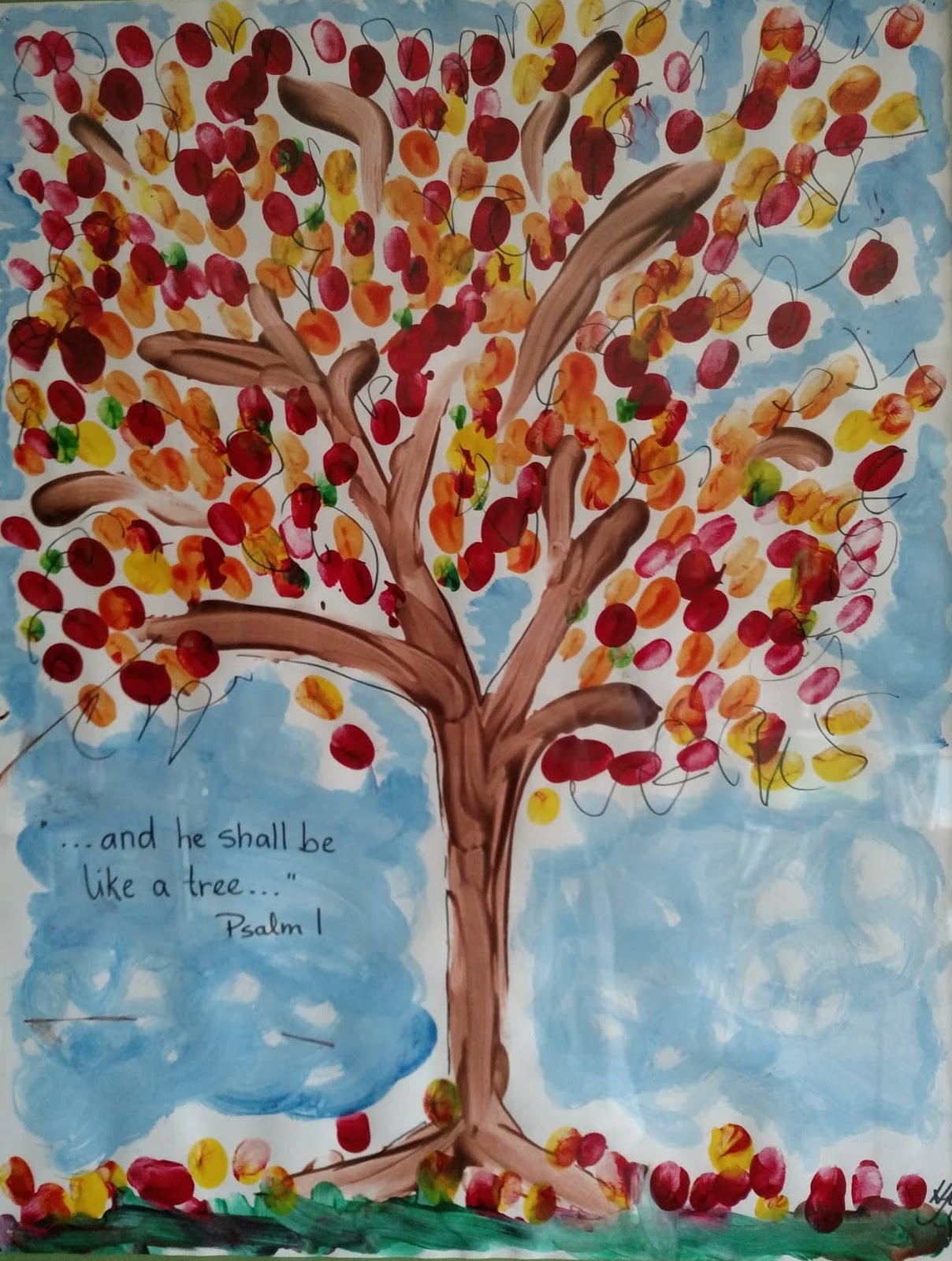 "Like a Tree" by Heather Joy MitchellLet’s take down the picture of the car, and put up a picture of a tree.
Anybody whose been in my office has seen this painting by my wife. For many years it hung in our boys’ room, and now it hangs in my office.
The idea is a strong tree.
A vibrant tree.
A flourishing tree standing tall and firm against the elements.
The picture here is of a stable life. A life that does not fall when the wind of adversity blows. A tree planted by streams of water doesn’t run out of nourishment because the words of God are more satisfying than bread or honey from the comb.
A tree which yields its fruit in season is a life that is productive and effective in the Lord’s service. A tree whose leaf does not wither is a person who does not fall apart when the hard times come.
Now, this phrase, “whatever he does prospers” could lead somebody to think that the God-blessed life is one where there are no problems.
There is a grave error out in the world called “The Prosperity Gospel” and many have fallen for it.
But this isn’t teaching the prosperity gospel of health, wealth, and constant happiness.
This is talking about the power of an unshakable life.
This is talking about vibrancy and joy in the midst of sorrow and pain.
This is talking about hope even in hopeless times.
This is talking about fruit bearing even when there is no rain.
Eventually and ultimately, God works everything for the prosperity and good of those who love Him and love His words like this!
I want to be this tree.
And I want you to be this tree, as well.
And I want the kids who come to our church this week to be this tree.
Flourishing, prospering, growing, bearing fruit.
Because of our love for God’s word.
Because the opposite is also true. Verse 4.
“Not so the wicked! They are like chaff that the wind blows away. Therefore the wicked will not stand in the judgment, nor sinners in the assembly of the righteous.”
The wicked are those who do not love the words of God. The wicked are those who go with the flow of the crowd. Listening to their counsel. Choosing their sinful paths. Mocking the holiness of God. And ignoring the word of God.
Vv.4 and 5 are a warning sign at the head of track, cautioning us to stay far from it. Because at the end of this road is destruction.
The Psalmist says, “Not so the wicked!” No blessing here. There may be a temporary prosperity for those who thumb their noses at God. But not for long. God’s justice will triumph. And they will be destroyed.
If the blessed righteous are like sturdy trees, the wicked (according to Psalm 1) are like chaff that the wind drives away.
You know what chaff is, right?
“Chaff is the leftover dust and plant refuse that comes with the harvest. In modern farming...the chaff would be all of the junk that spits out the back end of the combine as it makes its way through the fields. It is the chopped up parts of the plant that are no good to anybody.
In ancient farming...there were no machines for separating the good grain from the chaff. What would happen at harvest is that the heads of grain would all be gathered and then left to dry. The good seeds of wheat and barley would be all mixed together with the husks and shells and stems.
And so, the farmer–in order to clean his crop–would have to thresh. On a windy day he would...take his dried heads of grain and toss them up into the air, over and over again. As he did this the heavier, valuable seeds of grain would fall back to the ground around his feet while the lighter, worthless pieces of chaff would be caught by the wind and carried away....
The life of the wicked, the Psalmist is saying, is like that chaff. The literal reality this image is picturing for us is a life of instability as the wicked float from one whim to the next. ... ‘All they are is dust in the wind.’ [Russell J. Muilenburg, “The Costs of Living a Life Without God” morning sermon, January 9, 2000].
What do you want to be: a mighty tree or chaff in the wind?
V.5 says more. “Therefore the wicked will not stand in the judgment, nor sinners in the assembly of the righteous.”
Judgment day is coming; and those who have not come into a life-changing relationship with Jesus Christ by feasting on the words of God in the Scriptures will not live through the judgment. When the “church of the firstborn” joins in heaven to sing the praises of Christ our Savior, these people will not be present.
Like chaff from grain, there will be a separation of the righteous and the wicked. Those that love God’s words and those who do not.
The two paths will diverge and their destinations will be very different. V.6 makes this plain. It is either/or.
“For the LORD watches over the way of the righteous, but the way of the wicked will perish.”
#3. STAY ON THE RIGHT TRACK.
Stay on the right path.
Choose the path, the way of the righteous.
Because it’s either/or.
It’s either flourishing or dying.
It’s either prospering or perishing.
It’s either winning or losing.
It often doesn’t seem like it!
The world will lie to you about the path you are on.
But God’s Word makes it clear.
The wicked will die in the judgment. If you choose that path, it ends in perishing.
But the other path, the path of delight in God through His Word, ends in being “watched over,” guided, directed by God Himself in personal relationship.
“The LORD watches over the way of the righteous.”
Never out of His sight. Never out of His watch-care.
God doesn’t rest in caring for the travelers of the righteous road.
So stay on that track.
And you do that by faith.
This is not saying, “Stay a good little boy. Or stay a good little girl. Keep your nose clean.”
This is saying trust in the Lord with all your heart and lean not on your own understanding, in all of your ways know Him, and He will make straight your paths.
Let me ask you.
Which track are you on?
Have you trusted in Jesus Christ as your Savior and your Lord and are following Him by faith?
That’s another way of talking about the way of the righteous.
Is that the road you’re on?
That’s the road to winning. That’s the road to the good life.
That’s the road to blessing.
Or maybe you’ve been walking the path of the wicked.
Or flirting with it.
Listening the world, standing with the world, mocking with the world.
If so, today, I want to challenge you to take a detour. To repent.
That’s what repent means–to take a detour, to change direction, to jump paths.
To pull a U-turn in the middle of the road!
I challenge you to turn off of the way of the wicked and place your trust in Jesus Christ and what He did on the Cross. Because on the Cross, He took the punishment for sin and He paid the penalty that sin had accrued.
Catch this: Jesus took the penalty for the way of the wicked. And He perished!
But death could not hold Him down.
He came back to life in victory!
And He gives us the power of His righteousness.
Jesus lived Psalm 1 perfectly.
Nobody avoided compromise with the crowd like Jesus.
Nobody delighted in the Law of the LORD like Jesus did.
Nobody was embodied that tree of verse 3 like Jesus did!
Everything He does prospers.
And He gives us His perfect record, His fulfilling Psalm 1 with His perfect life when we trust in Him.
And then He helps us to stay on that right track.
To keep turning right on the way of the righteous.
Until we come to the finish line, victory in Jesus, our savior forever!
***
[Readers with simply amazing memories might recognize that this message incorporates many words from "What's At Stake At Family Bible Week?" a sermon on Psalm One preached 13 years ago (which was also dependent on an even earlier message "Either/Or" preached long before blogging was a thing).]
July 14, 2019
"Shouting for the Son of David" [Matt's Messages]
 “Shouting for the Son of David”
Following Jesus - The Gospel of Matthew
July 14, 2019 :: Matthew 20:29-21:17
Our series in the Gospel of Matthew is called “Following Jesus,” and this is our 54th message in this series. We’ve been studying Matthew since December of 2017. Of course, we’ve taken a number of breaks along the way. But we’ve been carefully studying this theological biography of the most extraordinary and compelling Person Who has ever lived.
Matthew tells us and shows us Who Jesus really is.
And that compels us to follow Him.
We are nearing the end of the book. There’s quite a bit left (8 big chapters), but we’ve reached the extended last section of Matthew that is often called the “Passion Narrative” or “The Story of Holy Week.”
This is something Christians often emphasize in the Spring to go along with the church holidays (Palm Sunday, Resurrection Sunday, Easter). But we can study it any time because it’s always applicable and always relevant.
So for the next few months, we’re going to be studying together Jesus’ crucial week.
Quite literally. Because He was crucified that week.
Today’s passage has a lot of shouting in it.
In the three short stories about Jesus that we’re about to read, several groups shout at Jesus. In fact, they’re shouting for Jesus.
They are not mad at Him.
They want something from Him or they are proclaiming who He is.
They are excited enough to shout.
When was the last time you shouted, and why was it?
Maybe a ball game?
Shouting from the stands or shouting at your TV?
Or maybe you were shouting at someone who was in danger. Afraid for a child who was heading out into the road.
Or maybe you wanted to get someone’s attention who was far away, across the street or across the yard, or across the lake.
When was the last time you shouted?
In all three of these short stories, the shouters use a particular name for Jesus, one His many appropriate titles.
Last week, Jesus was using His favorite title for Himself.
What was it? “The Son of Man.”
That mysterious, powerful figure from the Old Testament that will come and reign and rule in glory.
But Jesus said that He was actually a Suffering and Serving Son of Man which almost nobody was expecting.
Son of Man.
Soon, the title at the center of the discussion in Matthew will be “Son of God.” When we get to chapters 26 and 27, that’s the title that gets bandied back and forth there.
But this week, right here, the title being emphasized is “Son of David.”
These people are: “Shouting for the Son of David.”
What does it mean that Jesus is the Son of David?
By the way, this has been a major theme running through the Gospel of Matthew.
What is the very first thing that Matthew says in chapter 1, verse 1?
“A record of the genealogy of Jesus Christ [what?] the son of David...”
Matthew 1:1, Matthew 1:20, Matthew 9:27, Matthew 15:2
This title keeps coming up again and again.
What does it mean?
Well, it literally means that Jesus is a descendant of King David.
He is Great David’s Greater Son.
That’s going to be contested during this Crucial Week.
Wait til you see in chapter 22, how Jesus fights with the Pharisees about Psalm 110!
Jesus is Great David’s Greater Son, a direct descendant of King David.
But that title means more than just that He’s in the family.
It means that He is the heir of the throne and the great King Who was promised to Israel.
Jesus is the Messiah.
Not just the Son of Man, but the Son of David and the heir of all of the promises that were made to David and His royal dynasty.
That’s a big title. Those are big shoes to fill. Son of David.
Let’s see how Jesus fills them.
Because, as you might expect by now, Jesus likes to do the unexpected!
He is the Son of David, but not necessarily a Son of David like anyone ever thought there would be.
v.29 “As Jesus and his disciples were leaving Jericho, a large crowd followed him. Two blind men were sitting by the roadside, and when they heard that Jesus was going by, they shouted, ‘Lord, Son of David, have mercy on us!’ The crowd rebuked them and told them to be quiet, but they shouted all the louder, ‘Lord, Son of David, have mercy on us!’”
He’s almost to Jerusalem.
New Jericho (built near old one where Jesus’ ancestor Rahab had once lived, New Jericho) is about 15 miles from Jerusalem.
It’s at the bottom of the hill. To get to Jerusalem, you start climbing up 3,500 feet.
Up, up, up towards Jerusalem.
Towards His fatal week.
Matthew had just told us that Jesus expects to give His life as a ransom for many.
His disciples didn’t understand what that means, but we do looking back on it.
He certainly knew.
And He’s still going. Up, up, up towards Jerusalem.
And He’s got big crowd following Him.
That doesn’t mean that they are His followers.
They follow, but they don’t follow, if you follow me...
Crowds are fickle. But there are a lot of witnesses for what happens next.
Two blind guys (Mark tells us that one of them was named Bartimaeus) are sitting by the roadside.
Now what do they see coming down the road?
That’s a trick question. They don’t see anything.
And yet, they do. They see with their hearts that Jesus is the Son of David.
“Lord! Son of David! Have mercy on us!”
There are plenty of people who see Jesus with their own eyes and miss Who He really is. The Pharisees are like that. In chapter 23, Jesus is going to call them “blind guides” which is a really sick burn.
But these guys who are blind could be guides to the identity of Jesus.
“Lord! [Meaning King] Son of David! [Meaning Messiah] Have mercy on us!”
And look at that crowd. The crowd rebukes the blind men. I guess they were a nuisance. They were getting in the way, slowing things down.
But I love what these guys do. It says they “shouted all the louder.”
I almost titled this message, “All the Louder!”
“Lord! Son of David! Have mercy on us!”
What a great prayer.
That’s something you can pray any day.
It’s a prayer for help. It’s prayer for aid. It’s prayer for salvation and rescue. It’s pray for healing.
And it’s directed to the right Person.
Look what Jesus does. V.32
“Jesus stopped and called them. ‘What do you want me to do for you?’ he asked. [I love that. I’m sure He already knows. But He wants them to say it. They don’t want money. They Him to be the Son of David. They want Him to be the Messiah for them. To do what Isaiah 35:5 said the Messiah would do. He would heal the eyes of the blind.] ‘Lord,’ they answered, ‘we want our sight.’ [And now see this. Verse 34.] Jesus had compassion on them and touched their eyes. Immediately they received their sight and followed him.”
And they really followed Him.
They weren’t just part of the crowd. They were disciples.
Here’s what’s worth shouting about:
#1. THE SON OF DAVID IS FULL OF MERCY.
They cry out for mercy, and what do they get?
They get mercy!
Verse 34 says that Jesus had compassion.
Matthew has told us this about Jesus again and again.
Matthew 9:35, Matthew 14:14, Matthew 15:32.
Remember that word for compassion comes for the word for “guts?”
That Jesus hurt in His guts over their plight.
He had his guts wrenched in pity and sympathy.
And because He is the Son of David, He had the power to do something about it!
He touched their eyes. Imagine what that felt like.
And then, they could see.
Because He is the Son of David.
Jesus keeps doing this again and again the Gospel of Matthew.
Matthew 9:27. Matthew 11:5, Matthew 12:22, Matthew 15:30, and soon Matthew 21:14. He gives sight to the blind. Guess what that means?
Jesus is the Son of David.
I think that’s worth shouting about.
And He’s full of mercy and compassion.
And that’s good news for our prayer lives, right?
These guys are a model for us of persistent prayer.
They know Who Jesus is and they ask Him to do Messiah things in their lives.
Now, there’s no promise that He will answer every single prayer with a “Yes” or at least not right away.
But He’s full of mercy. He’s full of compassion.
You don’t have to manipulate Him into mercy.
You just have to ask in faith.
And that’s especially true for spiritual eyesight.
If you call out to Jesus to have your spiritual eyes opened, you will find that He is rich with mercy.
“Lord! Son of David! Have mercy on us!”
Now, the last time Jesus healed two blind guys in the Gospel of Matthew, the next thing He did was tell them to keep it a secret.
“Don’t tell anyone.”
But we’ve reached that Crucial Week when the secret is now out.
Jesus is no longer clandestine.
Jesus now reveals Himself.
“It’s Messiah time!”
Jesus goes public.
In the most public way. Chapter 21, verse 1.
“As they approached Jerusalem and came to Bethphage on the Mount of Olives, Jesus sent two disciples, saying to them, ‘Go to the village ahead of you, and at once you will find a donkey tied there, with her colt by her. Untie them and bring them to me. If anyone says anything to you, tell him that the Lord needs them, and he will send them right away.’”
Clearly, Jesus has a plan.
I don’t know if this is supernatural foreknowledge or if He’s secretly arranged this in advance in more natural ways, but Jesus is clearly in charge, and He’s ready to carry the title, “Lord.” “Tell him that Lord needs them. He’s requisitioning these animals.”
Because Jesus is going to ride into town.
This is the big reveal!
Here comes the Son of David.
Riding on a mighty warhorse!
Wait, what? He’s going to ride into town on what?
The symbol of peace?
Couldn’t He have found a big and more impressive ride?
A little donkey colt?
With its Momma?
That’s Airforce One?
Matthew knows why He did it. Because of Matthew’s favorite word, “fulfill.” v.4
“This took place to fulfill what was spoken through the prophet [Zechariah 9:9]: ‘Say to the Daughter of Zion, 'See, your king comes to you, gentle and riding on a donkey, on a colt, the foal of a donkey.'’”
Yes, He’s the Son of David. But He’s a Son of David like nobody was expecting, but they should have been.
He comes in meek. That’s what that word “gentle” means in verse 5.
He comes in lowly and humble and taking the second place.
Everything we’ve been talking about the last 3 messages.
The First and the Last Theology.
Jesus is taking the Last.
He’s taking the lower.
He’s coming in like the Suffering Servant of Isaiah 53.
Not like the Glorious Son of Man in Daniel 7.
He is both, but right here, He comes in, not just full of mercy, but full of meekness.
And that’s worth shouting about.
Verse 6.
“The disciples went and did as Jesus had instructed them. They brought the donkey and the colt, placed their cloaks on them, and Jesus sat on them [the cloaks]. A very large crowd spread their cloaks on the road, while others cut branches from the trees and spread them on the road. The crowds that went ahead of him and those that followed shouted, ‘Hosanna to the Son of David!’ ‘Blessed is he who comes in the name of the Lord!’ ‘Hosanna in the highest!’”
How many people do think lived in Jerusalem at that time?
Scholars believe it was about 70,000 people.
But what happens to State College on a Game Day?
What happens to Jerusalem at Passover?
Historians believe that Jerusalem swelled to about 250,000 people at Passover.
A very large crowd is laying down their cloaks and spreading out palm branches.
This is Sunday, by the way. We call it Palm Sunday or the Triumphal Entry.
They are rolling out the Red Carpet, or the Green Carpet, actually.
And they are shouting.
“Save Us!” “Hosanna!” “[He will] Save Us!” Which is another way of saying, Praise Him! Praise this One!
“‘Hosanna to the Son of David!' ‘Blessed is he who comes in the name of the Lord!' ‘Hosanna in the highest!'"
They’re quoting from Psalm 118: We looked at that more closely back on Palm Sunday 2018.
They don’t care that He’s on a baby donkey.
They care that He’s the Son of David.
#2. THE SON OF DAVID IS THE ARRIVING KING.
Here’s what’s amazing:
Jesus doesn’t stop them.
Think about it.
Jesus just accepts this adulation.
Jesus just receives everything they are shouting at Him.
He doesn’t shut them down.
He doesn’t redirect.
He doesn’t point to someone else.
Jesus rides in and receives all of these shouted praises!
He is the Son of David!
These praises are not over the top.
They are not inappropriate.
They are appropriate!
“‘Hosanna to the Son of David!' ‘Blessed is he who comes in the name of the Lord!' ‘Hosanna in the highest!'"
What’s the application of that?
For our lives today?
Jesus is Lord.
We should be bowing down to Him.
We should be laying out the Green Carpet for Him.
So many of our personal problems would be solved simply by submitting to Jesus as Lord.
I see a lot of people who say they are followers of Christ, but they don’t live like He is their King.
If we really believe that Jesus is the arriving King, then we will organize our lives around Him.
We will cry out to Him for mercy.
We will follow His example in meekness.
And we will recognize His lordship over every single area of our lives.
We’ll hand over very every single of our lives just like those donkeys. "The Lord needs them.”
He’s the King.
What area of your life is dangling out there un-submitted to Jesus’ lordship?
He can have all of this, but I don’t really want Him telling me what to do with this.
Jesus is the Son of David.
And He is the arriving king.
He’s coming back.
And next time, it won’t be on a donkey.
Submit yourself to Him.
Yoke yourself to Him.
He’s gentle and meek. He gives rest to your soul.
But He calls the shots.
The Son of David is the Arriving King.
And that’s worth shouting about.
Because not everybody has gotten the message. V.10
“When Jesus entered Jerusalem, the whole city was stirred and asked, ‘Who is this?’ The crowds answered, ‘This is Jesus, the prophet from Nazareth in Galilee.’”
Some people have not yet gotten the memo.
Notice how Matthew has brought us back to the identity of Jesus once again.
Matthew says, “Keep your eye on the ball.”
There’s 250,000 people in town asking around, “Who is this?”
And He’s popular at this point, but all they’re sure of is that He’s a prophet.
Well, that’s right, but He’s so much more. And He’s going to show them. Verse 12.
By the way, most scholars believe that verse 12 happens on Monday of Jesus’ Crucial Week. V.12
“Jesus entered the temple area and drove out all who were buying and selling there. He overturned the tables of the money changers and the benches of those selling doves. ‘It is written,’ he said to them, ‘'My house will be called a house of prayer,' but you are making it a 'den of robbers.'’”
It doesn’t say it, but I think Jesus was shouting there.
This is the second time He’s done this sort of thing. The first time was early in His ministry according to the Gospel of John.
Now here He is again flipping over tables.
Imagine if I just went over here and flipped over this table.
Jesus is not just merciful.
He’s not just meek.
He’s also mad.
He is righteously angry about what these people are doing in His temple.
These folks had set up a market in the Court of Gentiles. It wasn’t supposed to be there.
This was a place of prayer for the nations, but they had turned into to a shopping center.
They were probably also cheating people, right there, in the temple.
By the way, Jesus is going to spend a lot of time in the temple this Crucial Week.
Here He is protesting their profiteering crowding out the place of prayer.
Jesus quotes Isaiah 56:7 and Jeremiah 7:11 as He does it.
This is both a cleansing and cursing. (Language borrowed from Grant Osborne.)
He is cleansing the temple of its corruption.
But He is also predicting the overthrow of the temple in the judgment to come.
He’s got more to say about that which we will read as the week unfolds.
Here’s what’s worth shouting about.
#3. THE SON OF DAVID DESERVES PURE WORSHIP.
Where is the temple now?
We are the temple now, right?
The question now is what is going on in our hearts?
Our hearts should be a house of prayer.
What have we made them into?
I have never noticed in my life what happened next. Matthew 21:14 blew me away this week when I studied it. Look at verse 14.
“The blind and the lame came to him at the temple, and he healed them.”
Did you ever see that before?
This is what a house of prayer should look like!
Jesus is not out of control. He’s flipping tables, but He’s not flipping out.
“The blind and the lame came to him at the temple, and he healed them.”
That’s the sequel to the cleansing of the temple.
Jesus doesn’t get thrown out, Jesus starts healing people and acting like the Son of David should!
And a children’s choir sprouts up.
The kids see what Jesus is doing, and they start shouting the same thing that they heard everybody shouting out on the road on Sunday.
“Hosanna to the Son of David!”
They know what’s up!
And the chief priests and teachers of the Law hate it. V.15
“But when the chief priests and the teachers of the law saw the wonderful things he did and the children shouting in the temple area, ‘Hosanna to the Son of David,’ they were indignant. ‘Do you hear what these children are saying?’ they asked him.”
Notice what they are the most upset about.
Are they mad about the tables and the trade? Probably.
Are they mad about the healing of the blind and the lame in the temple.
Were those sorts of people supposed to be in there?
They are so indignant that Jesus is getting praised as the Son of David.
Keep your eye on the ball.
“Do you hear what these children are saying?’ they asked [Jesus].” v.16
“‘Yes,’ replied Jesus, ‘have you never read, [Psalm 8, verse 2] ‘'From the lips of children and infants you have ordained praise'?’ [Mic drop.] And he left them and went out of the city to Bethany, where he spent the night.”
That’s quite a statement, Jesus made there.
He’s saying that the children are right.
That the Old Testament said that they should do that.
The Old Testament said that they should praise God.
That they are right to shout like that.
But notice what that means about Who Jesus is.
Who are the children supposed to praise in Psalm 8?
God.
And Who is Jesus applying that to in Matthew 21?
Himself.
Jesus is claiming to be God.
He’s not just the Son of David.
He is the Son of God.
It is right for the children to praise Him like this.
And if it’s right for the children, how much more for everybody else?!
The Son of David deserves pure worship!
Not just admiration.
Not just respect.
But worship.
Pure worship.
We need to repent of anything in our hearts that doesn’t belong, like a cash register in the Court of Gentiles.
And we need to give Jesus our whole hearts.
Because He is the Son of David.
Full of Mercy.
Arriving as King.
Deserving of Pure Worship.
I think that’s worth shouting about.
***
Previous Messages in This Series:
01. The Genealogy of Jesus
02. The Birth of Jesus Christ
03. The Search for Jesus Christ
04. The Baptism of Jesus
05. The Temptation of Jesus
06. Following Jesus
07. Jesus' Sermon on the Mount
08. The Good Life (Part One)
09. The Good Life (Part Two)
10. You Are The...
11. Jesus and the First 2/3 of the Bible
12. But I Tell You
13. But I Tell You (2)
14. But I Tell You (3)
15. In Secret
16. Choose Wisely
17. Seek First His Kingdom
18. Generous
19. These Words of Mine
20. When He Saw the Crowds
21. When He Came Down from the Mountainside
22. Follow Me
23. Our Greatest Problem
24. Who Does He Think He Is?
25. Special Agents
26. Sheep Among Wolves
27. What To Expect On Your Mission
28. Are You the One?
29. Come to Me
30. The King of Rest
31. So Thankful!
32. Overflow
33. This Wicked Generation
34. Get It?
35. What Is Really Going On Here?
36. Baptizing the Disciples
37. The Treasure of the Kingdom
38. Living the Last Beatitude
39. Five Loaves, Two Fish, and Jesus
40. It Is I.
41. Worthless Worship
42. Great Faith in a Great God
43. The Pharisees and Sadducees
44. The Question and the Promise
45. Take Up His Cross
46. Like the Sun
47. Seed-Sized Faith
48. These Little Ones
49. If Your Brother Sins Against You
50. The Lord of Marriage
51. Drop Everything
52. First and Last53. The Suffering Serving Son of Man
July 7, 2019
“The Suffering Serving Son of Man” [Matt's Messages]
 “The Suffering Serving Son of Man”
Following Jesus - The Gospel of Matthew
July 7, 2019 :: Matthew 20:17-28
We’ve been learning together that the Gospel of Matthew is a theological biography of the most compelling Person Whoever walked the face of the Earth.
We’ve been learning that the Gospel of Matthew tells us, teaches us, shows us Who Jesus really is.
We keep saying, “Keep your eye on the ball.”
“Keep your eye on the ball.” And “the ball” in Matthew is the identity of Jesus.
Our passage for today is no different.
It’s, at the center, about the identity Jesus.
In this passage (Matthew 20, verses 17 through 28), Jesus uses His favorite title for Himself to teach us about Himself.
What was Jesus’ favorite appellation for Himself? His favorite title for Himself?
“The Son of...Man.”
You might have guessed “The Son of God” which He surely was. But that’s what others call Him.
He likes to use this phrase, “The Son of Man.”
I think He liked it for various reasons.
One was its ambiguity.
It could just mean someone was a human.
A son of man is himself a man.
But there’s obviously more to it.
In the Old Testament, that phrase is used again and again, especially in the book of Ezekiel, and in the book of Daniel.
Israelite believers who had read their Old Testament prophecies would have interpreted this title, “Son of Man,” as a name for the coming Messiah.
What was the Messiah supposed to be like?
Well, listen to Daniel chapter 7, verses 13 and 14.
Daniels says, “In my vision at night I looked, and there before me was one like a son of man, coming with the clouds of heaven. He approached the Ancient of Days and was led into his presence. He was given authority, glory and sovereign power; all peoples, nations and men of every language worshiped him. His dominion is an everlasting dominion that will not pass away, and his kingdom is one that will never be destroyed.”
Wow! That’s the Son of Man!
And Jesus, in the immediately preceding chapter, had said something similar.
Chapter 19, verse 28 and 29.
“Jesus said to them, ‘I tell you the truth, at the renewal of all things, when the Son of Man sits on his glorious throne, you who have followed me will also sit on twelve thrones, judging the twelve tribes of Israel. And everyone who has left houses or brothers or sisters or father or mother or children or fields for my sake will receive a hundred times as much and will inherit eternal life.”
The Son of Man coming in glory and sitting on His glorious throne and giving away glorious gifts!
But.
That’s not all that the Son of Man is.
That’s not all that the Son of Man is going to do.
It turns out that the Son of Man is going to be very different than many people expected.
Jesus is often different than we expect, is He not?
You could never predict Jesus.
The more you get to know Him and become like Him, the more He makes sense to you, but He’s definitely counter-intuitive and counter-cultural.
We’ve seen that again and again, haven’t we?
When He describes His kingdom?
Upside-down and inside-out.
The opposite of what we’d ever predict.
In fact, what does Jesus say in verse 30? Right after that prediction of the glorious coming, the glorious throne, the glorious kingdom?
“But many who are first will be last, and many who are last will be first.”
It’s not just an upside-down kingdom.
It’s a back-to-front kingdom.
It’s a last-to-first kingdom.
Last week, we listened to Jesus teach some more of his “first and last theology.”
He told the story of the eccentric employer who was perfectly just but also amazingly gracious. And He told us that we just need to deal with it, to deal with just how gracious He is.
Because in His kingdom, the last will be first and the first will be last.
Well, Jesus has some more of that “first and last theology” for us today.
But He kicks it up a notch by showing how He Himself will live out this first and last theology.
The Son of Man will not just come in glory.
He will come in suffering service.
Here’s our title for today.
Who is Jesus?
He is: “The Suffering Serving Son of Man.”
And if that doesn’t blow your mind, you are either completely sanctified already or you aren’t paying enough attention.
I only have two points this morning, and they are both in the title.
#1. THE SON OF MAN CAME TO SUFFER.
I know that we’re used to that idea, but the disciples sure weren’t.
The Son of Man comes in glory.
He doesn’t come to suffer?!
But that’s exactly what Jesus predicts.
Isn’t it amazing that Jesus knows what is going to happen to Him?
This is the third time so far in the Gospel of Matthew where Jesus clearly predicts his passion. Each time He adds a little information that He didn’t before.
Jesus is on His way up to Jerusalem. He’s almost there!
And He knows what is going to happen there.
“Now as Jesus was going up to Jerusalem, he took the twelve disciples aside and said to them, ‘We are going up to Jerusalem, and the Son of Man will be betrayed to the chief priests and the teachers of the law. They will condemn him to death and will turn him over to the Gentiles to be mocked and flogged and crucified.”
Listen to those verbs.
Be betrayed.
Condemned to death.
Turned over the Pilate and the Romans.
Mocked.
Flogged.
Crucified.
Mocked. Flogged. Crucified.
Mocked. Flogged. Crucified.
Mocked. Flogged. Crucified.
Jesus knew what was coming.
In fact, He chose it!
Praise the Lord for verse 19, and “On the third day he will be raised to life!”
Jesus knew that, too.
He knew that suffering was the true path to glory.
He knew about His resurrection.
That the last will be first.
But He also knew about the Cross.
Mocked. Flogged. Crucified.
He took the last place to get the first place.
Mocked. Flogged. Crucified.
When we got to the table today. Just think of those 3 words from Jesus’ lips.
What He knew was coming.
Mocked. Flogged. Crucified.
What’s really sad about verse 20 is that they clearly weren’t listening.
I know because of what James and John do.
They bring their Mom to Jesus to try get to be first in the kingdom.
They are clearly not paying attention. Verse 20.
“Then the mother of Zebedee's sons came to Jesus with her sons and, kneeling down, asked a favor of him. [This ought to be good.] ‘What is it you want?’ he asked. She said, ‘Grant that one of these two sons of mine may sit at your right and the other at your left in your kingdom.’”
What do you think of that request?
Well, it’s great that she and they believe in the kingdom.
Many people then did not believe that Jesus was the coming king.
And many people today still do not believe that Jesus is the coming king.
They got that right.
They believed what He said in chapter 19, verse 28.
“By the way, you mentioned twelve thrones. I was just wondering if my two sons could be on the thrones immediately to your right and to your left. What do you say?”
[By the way, it’s possible that James and John were actually cousins of Jesus and this woman named Salome was Jesus’ aunt. It’s not at all for sure as the Bible never comes out and says it but if you follow the names and relationships in the gospels, it’s definitely possible. So this could be Jesus’ aunt trying to get some special favors in.]
So what do you say, Jesus? I mean everybody’s got to have a right hand man!
V.22. Truer words were never spoken.
“‘You don't know what you are asking,’ Jesus said to them. ‘Can you drink the cup I am going to drink?’”
Stop there for a second.
These folks have no clue.
Jesus just said that He was going to be mocked, flogged, crucified.
And they’re like, “Yeah, whatever, sure. But can we be glorified? We want to be first in the kingdom!”
And Jesus says, “Can you drink the cup I am going to drink?”
What do you think is in that cup?
I believe they think that cup is the cup of victory.
“Can you drink from the cup of glory that I drink from?”
“Sure! Hand it over.” v.22
“‘We can,’ they answered.”
But it’s not the cup of glory. It’s not the cup of victory.
It’s the cup of death.
It’s the cup of God’s wrath.
It’s the cup of suffering.
When we get to chapter 26, Jesus will ask His Father if there is any way that this cup could be taken away from Him (v.39)!
And they say that the could drink it with Him.
“You don’t know what you’re asking.”
This cup is the cup of be mocked, flogged, and crucified.
And even more, bearing the just wrath of God.
That’s what the Son of Man is going to do.
The Son of Man Came to Suffer.
So we shouldn’t be surprised if we have to follow in footsteps. V.23
“Jesus said to them, ‘You will indeed drink from my cup, but to sit at my right or left is not for me to grant. These places belong to those for whom they have been prepared by my Father.’”
That’s another surprise.
Jesus says that they will drink, to some small degree, from His cup.
They too will suffer.
Not exactly like He did.
But kind of like He did.
The Sons of Zebedee?
James will be killed by Herod in Acts chapter 12. Killed by a sword.
John will be exiled to the island of Patmos.
The Sons of Zebedee will suffer for Jesus’ sake.
And we, too, should not be surprised when are called to suffer for Him, as well.
Because that’s the path that Jesus took.
Suffering is the path to glory.
Why would we think that we would get there without any pain?
But they all did.
All of the disciples thought this way. V.24
“When the ten heard about this, they were indignant with the two brothers. [They weren’t more godly, they were jealous. “Hey, you’re trying to take our place! We want to be first.] Jesus called them together and said, [No way, guys.]‘You know that the rulers of the Gentiles lord it over them, and their high officials exercise authority over them. Not so with you. Instead, whoever wants to become great among you must be your servant, and whoever wants to be first must be your slave–just as the Son of Man did not come to be served, but to serve, and to give his life as a ransom for many.”
#2. THE SON OF MAN CAME TO SERVE.
They all want to be first.
And Jesus says, “No, no, no. You want to be last.
Don’t be like the world. The pagans want to be lords and authorities and little potentates.
But my kingdom is upside-down.
If you want to be great, you must be a servant.,
If you want to be first, you must be last. You must be a slave.”
Jesus says, “Don’t be like them. Be like Me!”
How counter-cultural.
How counter-intuitive.
Nothing has changed. The world still clamors to be first.
Nobody runs to the back of the line.
Nobody lives to die to self and deny themselves.
Everybody loves to live for their selves.
Think about it. What is the number one thing the world tells you today:
“Be yourself.”
“Trust yourself.”
“Love yourself.”
Jesus says, “Die to self.”
And serve others.
Now, of course, this doesn’t mean that someone who is in authority no longer exercises authority.
Jesus has all authority and exercises it.
But He does so as a servant.
He is the prime example of serving others, putting them before Himself.
And His Crosswork is the prime example of His Servanthood.
His suffering was His way of serving.
Verse 28 is so wonderful!
Serve others, “just as the Son of Man did not come to be served, but to serve, and to give his life as a ransom for many.”
I’ll say it this way:
The Son of Man from Daniel 7 is also the Suffering Servant of Isaiah 53.
He is worthy of the crown because He drank from the cup. [Pastor Kerry Doyal says, “Cups precede crowns.”]
He gave His life as a ransom FOR many.
That means “in place of” many.
A ransom is a price paid for someone’s freedom.
On the Cross, Jesus was paying the price of freedom from sin and guilt and shame.
Isaiah 53 says that the Suffering Servant will be rewarded “because he poured out his life unto death, and was numbered with the transgressors. For he bore the sin of many, and made intercession for the transgressors.”
Jesus is riffing on that language.
He’s alluding to Isaiah 53 and saying that He will fulfill it.
The Son of Man Came to Serve.
And so, we who follow Him, should choose to serve, as well.
Are you a servant?
Would that appellation be appropriate for you?
Would that fit on your social media bio? And nobody would laugh?
“Matt Mitchell, servant.” I want it to.
When was the last time you put somebody ahead of yourself, and you didn’t do it to manipulate them?
When was the last time you took the last place because you were following Jesus?
The Son of Man deserved to be served, but instead He served.
How much more should we serve the people around us?
How could you quietly up your servant quotient today, this week?
At work?
At home?
In the neighborhood?
At church?
How are you going to apply this teaching to yourself?
“Not so with you...whoever wants to become great among you must be your servant, and whoever wants to be first must be your slave–just [like the Son of Man” did.
***
Previous Messages in This Series:
01. The Genealogy of Jesus
02. The Birth of Jesus Christ
03. The Search for Jesus Christ
04. The Baptism of Jesus
05. The Temptation of Jesus
06. Following Jesus
07. Jesus' Sermon on the Mount
08. The Good Life (Part One)
09. The Good Life (Part Two)
10. You Are The...
11. Jesus and the First 2/3 of the Bible
12. But I Tell You
13. But I Tell You (2)
14. But I Tell You (3)
15. In Secret
16. Choose Wisely
17. Seek First His Kingdom
18. Generous
19. These Words of Mine
20. When He Saw the Crowds
21. When He Came Down from the Mountainside
22. Follow Me
23. Our Greatest Problem
24. Who Does He Think He Is?
25. Special Agents
26. Sheep Among Wolves
27. What To Expect On Your Mission
28. Are You the One?
29. Come to Me
30. The King of Rest
31. So Thankful!
32. Overflow
33. This Wicked Generation
34. Get It?
35. What Is Really Going On Here?
36. Baptizing the Disciples
37. The Treasure of the Kingdom
38. Living the Last Beatitude
39. Five Loaves, Two Fish, and Jesus
40. It Is I.
41. Worthless Worship
42. Great Faith in a Great God
43. The Pharisees and Sadducees
44. The Question and the Promise
45. Take Up His Cross
46. Like the Sun
47. Seed-Sized Faith
48. These Little Ones
49. If Your Brother Sins Against You
50. The Lord of Marriage
51. Drop Everything
52. First and Last
July 5, 2019
Learning about Love from Paul Miller
I am profoundly indebted to Paul Miller.
Paul wrote the best book I've ever read on the subject of prayer, A Praying Life , which has deeply affected how I think of and practice prayer.
And Paul also wrote the best short book I've ever read on the subject of love, Love Walked Among Us. I appreciated this book so much I wrote a small group discussion guide for it.
 Paul was a good friend of one of my mentors, David Powlison, and their likemindedness shows in their respective work.
I think it's quite a feat to write two of the best books I've ever read on two different topics!
Paul has a new book out this month called The J-Curve: Dying and Rising with Jesus in Everyday Life which I just started reading yesterday. I can't wait to find out what I'll learn from Paul Miller next.
This beautifully made video from Crossway gives a window in Paul, his life, and his thoughts. It's worth the time to watch. The theme is how love is not efficient.
Paul Miller's Story of Learning to Love from Crossway on Vimeo.
You can guess, by the way, how encouraging it was to learn that Paul had read my book and added his endorsement.
Paul wrote the best book I've ever read on the subject of prayer, A Praying Life , which has deeply affected how I think of and practice prayer.
And Paul also wrote the best short book I've ever read on the subject of love, Love Walked Among Us. I appreciated this book so much I wrote a small group discussion guide for it.
 Paul was a good friend of one of my mentors, David Powlison, and their likemindedness shows in their respective work.
I think it's quite a feat to write two of the best books I've ever read on two different topics!
Paul has a new book out this month called The J-Curve: Dying and Rising with Jesus in Everyday Life which I just started reading yesterday. I can't wait to find out what I'll learn from Paul Miller next.
This beautifully made video from Crossway gives a window in Paul, his life, and his thoughts. It's worth the time to watch. The theme is how love is not efficient.
Paul Miller's Story of Learning to Love from Crossway on Vimeo.
You can guess, by the way, how encouraging it was to learn that Paul had read my book and added his endorsement.
June 30, 2019
"First and Last" [Matt's Messages]
 “First and Last”
Following Jesus - The Gospel of Matthew
June 29, 2019 :: Matthew 20:1-16
When we were together last in the Gospel of Matthew, the Lord Jesus was putting His hands on some children and blessing them, and He was also interacting with a rich young man who loved his wealth too much.
Jesus told the young man that he needed to drop everything and follow Him.
But the young man went away sad because he loved his stuff too much.
Sop then Jesus said that it was hard for a rich man to enter into the kingdom.
And the disciples were scandalized by that. They figured if anybody could get into the kingdom, it would be the rich.
But Jesus said, “No.” “[M]any who are first will be last, and many who are last will be first.”
Counter-intuitively, the little children and those humble like them get into the kingdom, but the rich young men who can’t let go of their stuff don’t get into the kingdom.
If you are first, you must lay that all aside and humble yourself and become last.
But those that are last in the world, will be moved to the front of the line.
Matthew 19:30. “Many who are first will be last, and many who are last will be first.”
And then Jesus tells a story to illustrate His point.
We didn’t get that far last time. But it’s what chapter 20 begins with, and He basically ends His story with an inversion of that same line about the first and the last.
We often call it “The Parable of the Workers in the Vineyard.”
Or you might call it, “The Story of the Eccentric Employer.”
I wanted to title today’s message, “The Great Switcheroo,” but in the end, I opted to just go with “First and Last.”
Jesus was a master storyteller.
We’ve already seen in the Gospel of Matthew how Jesus uses parables to teach about the Kingdom. Remember chapter 13? There was a bunch there.
And there are so more parables to come in the next few chapters.
Jesus parables are stories with a shove.
Jesus tells a story, often with a twisty ending, a kicker at the end to show us ourselves and teach us spiritual truth.
You’re listening to His very interesting story, following along, often with a question-mark on your face as Jesus tells a story you with characters and elements and a plot you wouldn’t expect, and then all of sudden, you realize that the story is all about you!
Well, here He does it again. And the point of the story is that in the Kingdom of heaven (which is already here in part but not yet here in its fullness, in the Kingdom of heaven) the last will be first and the first will be last.
And you and I need to deal with it.
Let’s listen to the story.
Matthew chapter 20, verse 1.
“For the kingdom of heaven is like [the following story] a landowner who went out early in the morning to hire men to work in his vineyard. He agreed to pay them a denarius for the day and sent them into his vineyard.”
Simple story so far, right?
Two characters so far.
A powerful rich landowner and a set of workers that he has hired to work in his vineyard for one day.
How much has he promised to pay? This is important.
One denarius. And that’s apparently the going rate for a day’s labor.
How much do you make per day?
These guys got one.
[By the way, this parable is not about economics. There is economics in it, but this is not teaching us how much to pay people or how economics is supposed to work.]
By the way, the Jews divided up the work day into about 12 hours. So at harvest time, which is probably what this is, the day started early like around 6am, which is what they’d call the 1st hour. V.3
“About the third hour [so around 9am] he went out and saw others standing in the marketplace doing nothing. He told them, 'You also go and work in my vineyard, and I will pay you whatever is right.' So they went.”
Stop there for a second.
Obviously, this guy thinks he needs some more workers. Maybe it was a big job, and he wanted to get it done in one day.
Maybe he’s really feeling generous today, and he doesn’t need all of those workers so much, but he wants to give people the dignity of work.
Or maybe there was bad weather coming, and they needed to hurry.
Jesus doesn’t say why he hires so many people.
He doesn’t have to have a reason! This is just a story with a shove.
This landowner doesn’t have to make a lot of sense!
Because look! V.5
“He went out again about the sixth hour [noon] and the ninth hour [3] and did the same thing.”
I’m sure that by this time, every person listening to the story has raised eyebrows.
“He did what?”
He actually goes back to the city square 5 times to find more workers. And the last time there is only about a hour of daylight left on the clock. V.9
“About the eleventh hour [5 o’clock] he went out and found still others standing around. He asked them, 'Why have you been standing here all day long doing nothing?' ‘'Because no one has hired us,' they answered. [“Nobody wanted us.” Remember that. That’s important.] ‘He said to them, 'You also go and work in my vineyard.'”
I’m sure that by now everybody is wondering how this story is going to end.
Because this employer is doing stuff that no other employer normally does.
Well, it’s the end of the day and time to pay off the day workers. V.8
“When evening came, the owner of the vineyard said to his foreman, 'Call the workers and pay them their wages, beginning with the last ones hired and going on to the first.']
Notice those last few words!
Aha. Here comes the punchline. But first, the twist at the end. V.9
“The workers who were hired about the eleventh hour [5 o’clock almost at quitting time] came and each received a denarius. [How much were they promised. Just something fair. But they received what the first people had been promised! Aha. V.10]So when those came who were hired first, they expected to receive more [Everybody’s paying attention!]. But each one of them also received a denarius. [That’s a surprise!]
When they received it, they began to grumble against the landowner. [Isn’t that interesting?]
'These men who were hired last worked only one hour,' they said, 'and you have made them equal to us who have borne the burden of the work and the heat of the day.'”
“Now, I ask you, is that right?”
So much for “equal pay for equal work.”
[But remember, this isn’t about economics.]
They grumble.
They are very unhappy and they certainly let the owner know it.
Now, I think it’s obvious that the landowner symbolizes what God is like.
The King of the Kingdom of Heaven.
And the landowner, in verses 13 through 15, asks the unhappy first workers 3 rhetorical questions.
And, the point of those rhetorical questions make the point of the whole parable. V.13
“But he answered one of them, 'Friend, I am not being unfair to you. [Question #1] Didn't you agree to work for a denarius? Take your pay and go. I want to give the man who was hired last the same as I gave you. [Question #2] Don't I have the right to do what I want with my own money? [Question #3] Or are you envious because I am generous?' So the last will be first, and the first will be last.”
I think there are two main points here that we can take home from this parable of the first and the last.
#1. THE LORD IS PERFECTLY JUST.
I love how direct the landowner is to the grumbling worker. V.13 again.
'Friend, I am not being unfair to you. Didn't you agree to work for a denarius?”
“So how much did you get?
You got a denarius, right?”
God is not unfair.
God is not unjust.
Just like the landowner here, God keeps every single one of His promises.
So we have nothing to grumble about.
Friends, you and I have absolutely no legitimate beefs with the Lord.
He is perfectly just.
He keeps every single one of His deals.
He will never renege on any of His debts.
He is never in the wrong.
He never does wrong.
He is never unfair.
The Lord is perfectly just.
And if that’s all that He was, He would deserve all of our worship.
But He is more.
#2. THE LORD IS AMAZINGLY GRACIOUS.
Not only is this landowner not cheating anyone out of their just wages, he wants to do more than he needed to. V.14 again.
“Take your pay and go. I want to give the man who was hired last the same as I gave you.”
“I want to be generous.”
“Don't I have the right to do what I want with my own money?”
I guess so, when you put it that way.
“Or are you envious [literally, “Do you have the evil eye?] because I am generous?'”
“I am amazingly gracious.
I want to give these people more than they deserve.
Isn’t that okay?
You got a problem with that?”
That’s the kicker right there, right?
That’s what you didn’t expect to come at the end of the story.
Jesus says, “You got a problem with how gracious I am?”
“You got a problem with how amazingly gracious the kingdom of heaven is?”
“Well, if so, you need to deal with it.”
Did you ever see somebody walk into church, and you thought, “What are they doing here?”
“I never thought I’d see somebody like them here.”
If you’ve never thought that way, good for you!
If your heart is joyful about everybody that you’ve ever seen come into the kingdom, I’m glad. That’s the way our hearts are supposed to be.
But for most of us, there is a Pharisee that lives in our hearts.
Like the older brother in the parable of the Prodigal Son, we can find ourselves rip-roaring mad that the Father is generous to those who certainly don’t deserve it. Who haven’t been here from the first, working hard for the Lord and keeping our noses clean.
And here they are getting off easy.
Meth-heads.
Child-abusers.
Prostitutes.
Abortionists.
Illegal immigrants.
What if those folks came into our church?
What if they began to follow Jesus?
Fill in the blank here with the kinds of people whom you might feel superior to.
People who don’t deserve God’s grace.
People who came late.
People whom nobody wanted.
And probably for some good reasons.
Well, okay, it’s alright for God to show them grace if He wants, I guess, but shouldn’t He give us more if we’ve been good little boys and girls?
Doctor Jesus didn’t come to treat the healthy but the sick.
Of course, what we need to realize is that we are all really really sick.
If you don’t realize how sick you are, then you think you should be first.
But the first shall be last.
It’s the sick that get the doctor.
The last will be first.
The Lord is amazingly gracious, and you and I need to deal with it.
How are we treating those whom nobody else wants?
We should be the most gracious people ourselves, right?
If our Lord is amazingly gracious, how much more should we be?!
I’m not saying that we don’t call sin “sin,” but what do we do next?
I hope, next, we love the sinners!
How about these people with their deathbed conversions?
How about these people with their prison conversions?
How about these people on death row who begin to follow Jesus at the very end of their despicable lives?
And they don’t spend years and years doing the hard work of following Jesus.
Peter just said, “We have left everything to follow you! What then will there be for us?”
And Jesus said, “Following me is more than worth it. A hundred times worth it!”
“But don’t begrudge my grace to those that are last to come in.”
Like the thief on the cross.
He gets the same denarius.
“Today, you will be with me in Paradise.”
Yes, we must continue to call sinners to repentance.
And many sinners do not want to hear that call.
I know that I often don’t!
But we should be the least judgmental of all people.
Christians should be the least judgmental of all people.
Are we known for being the least judgmental of all people?
Is the church known for being the most gracious group of people in the community?
The Lord has shown us so much amazing grace.
And when someone repents of their sin, even if they have been really late to the party, we should rejoice and be glad for every ounce of grace they receive.
Even if it seems like they get more grace than we do!
Because that’s just Who our God is.
Don’t despise the undeserving latecomers to the kingdom.
Because the last will be first, and the first will be last.
That’s just how the Kingdom works.
And Jesus says that you and I need to deal with it.
***
Previous Messages in This Series:
01. The Genealogy of Jesus
02. The Birth of Jesus Christ
03. The Search for Jesus Christ
04. The Baptism of Jesus
05. The Temptation of Jesus
06. Following Jesus
07. Jesus' Sermon on the Mount
08. The Good Life (Part One)
09. The Good Life (Part Two)
10. You Are The...
11. Jesus and the First 2/3 of the Bible
12. But I Tell You
13. But I Tell You (2)
14. But I Tell You (3)
15. In Secret
16. Choose Wisely
17. Seek First His Kingdom
18. Generous
19. These Words of Mine
20. When He Saw the Crowds
21. When He Came Down from the Mountainside
22. Follow Me
23. Our Greatest Problem
24. Who Does He Think He Is?
25. Special Agents
26. Sheep Among Wolves
27. What To Expect On Your Mission
28. Are You the One?
29. Come to Me
30. The King of Rest
31. So Thankful!
32. Overflow
33. This Wicked Generation
34. Get It?
35. What Is Really Going On Here?
36. Baptizing the Disciples
37. The Treasure of the Kingdom
38. Living the Last Beatitude
39. Five Loaves, Two Fish, and Jesus
40. It Is I.
41. Worthless Worship
42. Great Faith in a Great God
43. The Pharisees and Sadducees
44. The Question and the Promise
45. Take Up His Cross
46. Like the Sun
47. Seed-Sized Faith
48. These Little Ones
49. If Your Brother Sins Against You
50. The Lord of Marriage
51. Drop Everything
June 29, 2019
Wonderful Week Away
Last week, Heather and I had a wonderful time at both the EFCA One conference and our weekend getaway in Chicago to celebrate our 25th wedding anniversary.
Flat Tire on the Interstate
We almost didn’t make it to either! We hadn’t gotten out of Pennsylvania before we encountered a flat tire. The Lord was gracious, however, and we discovered it at a rest area where the attendant had both an air compressor and directions to a nearby repair shop run by Christians who got our valve stem replaced and us back on the road in about a half an hour!
EFCA One
Our biennial conference of our association of churches was held at Compass Church in Naperville, Illinois, and we got attend it with our friends and fellow LEFC leaders Curtis and Stephanie Quick.
 The conference was one of the best I’ve ever attended (and the biggest since the first one Heather and I went to back in 1998!), and there were so many highlights I don’t know where to start.
My friends, Michael Wallenmeyer and Greg Strand, have both written excellent spot-on summaries:
At the center of the conference was the big decision we were making together about changing one word in our doctrinal statement. After a long process of discussion (begun, really, about 15 years ago) and deliberation, the conference made the change with about 4/5 of the delegates voting for it. I had the privilege of “calling the question” to end the debate phase and move into the vote. I am very encouraged by the result.
The conference was about so much more than just that decision, however. The focus was on multiplying disciplemakers, and I felt like there was much momentum building towards our shared mission.
By the way, one thing that Greg does not mention in his write-up is that Trinity International University, our EFCA partner school conferred an honorary doctorate on Greg and also on President Kevin Kompelien at a special banquet at the conference. This honor is well deserved and very appropriate in that exact setting.
It was also wonderful to catch up with everyone. EFCA One is like a big family reunion for a national-level family! Our Allegheny District was especially well represented with a bunch of our churches sending delegates. We are so blessed to belong to this association of churches!
Silver Anniversary at the Drake
Then on the weekend, Heather and I got to celebrate our silver anniversary by staying downtown in Chicago and revisiting our old haunts.
 When we were students, we often dreamed about staying at the Drake Hotel which has a beautiful view of Lake Shore Drive and Lake Michigan. For our big anniversary, we got to stay there!
We also visited with some of our friends from back in those Moody and Trinity days, view the campuses of our old schools, tool around the Art Institute and eat some Chicago-style pizza.
It was an idyllic time of giving thanks to the Lord for the blessing of being “us” for all of these years.
 We’ve been back in the saddle now almost a full week, and the week has been very full. I came back to a funeral, a wedding (Congratulations are due this afternoon to Mr. and Mrs. Isaac and Meili Finney!!!), two prayer meetings, a missions meeting, a lot of phone calls and catching up with people, and also getting heavily involved in the search for our next Allegheny District Superintendent).
But I’m glad we could get away last week amid the hustle and bustle of conference and fun in the big Windy City to get some wider-lens-perspective on ministry, life, and love.
 Praise the Lord!
Flat Tire on the Interstate
We almost didn’t make it to either! We hadn’t gotten out of Pennsylvania before we encountered a flat tire. The Lord was gracious, however, and we discovered it at a rest area where the attendant had both an air compressor and directions to a nearby repair shop run by Christians who got our valve stem replaced and us back on the road in about a half an hour!
EFCA One
Our biennial conference of our association of churches was held at Compass Church in Naperville, Illinois, and we got attend it with our friends and fellow LEFC leaders Curtis and Stephanie Quick.
The conference was one of the best I’ve ever attended (and the biggest since the first one Heather and I went to back in 1998!), and there were so many highlights I don’t know where to start.My friends, Michael Wallenmeyer and Greg Strand, have both written excellent spot-on summaries:
Main Takeaways from EFCA One - Michael Wallenmeyer
One Lord, One Faith, One EFCA - Greg StrandI was especially encouraged by how many conference participants were not pastors, and how diverse and young the group was. This is the future of the EFCA and not just our past.
At the center of the conference was the big decision we were making together about changing one word in our doctrinal statement. After a long process of discussion (begun, really, about 15 years ago) and deliberation, the conference made the change with about 4/5 of the delegates voting for it. I had the privilege of “calling the question” to end the debate phase and move into the vote. I am very encouraged by the result.
The conference was about so much more than just that decision, however. The focus was on multiplying disciplemakers, and I felt like there was much momentum building towards our shared mission.
By the way, one thing that Greg does not mention in his write-up is that Trinity International University, our EFCA partner school conferred an honorary doctorate on Greg and also on President Kevin Kompelien at a special banquet at the conference. This honor is well deserved and very appropriate in that exact setting.
It was also wonderful to catch up with everyone. EFCA One is like a big family reunion for a national-level family! Our Allegheny District was especially well represented with a bunch of our churches sending delegates. We are so blessed to belong to this association of churches!
Silver Anniversary at the Drake
Then on the weekend, Heather and I got to celebrate our silver anniversary by staying downtown in Chicago and revisiting our old haunts.
 When we were students, we often dreamed about staying at the Drake Hotel which has a beautiful view of Lake Shore Drive and Lake Michigan. For our big anniversary, we got to stay there!
We also visited with some of our friends from back in those Moody and Trinity days, view the campuses of our old schools, tool around the Art Institute and eat some Chicago-style pizza.
It was an idyllic time of giving thanks to the Lord for the blessing of being “us” for all of these years.
 We’ve been back in the saddle now almost a full week, and the week has been very full. I came back to a funeral, a wedding (Congratulations are due this afternoon to Mr. and Mrs. Isaac and Meili Finney!!!), two prayer meetings, a missions meeting, a lot of phone calls and catching up with people, and also getting heavily involved in the search for our next Allegheny District Superintendent).
But I’m glad we could get away last week amid the hustle and bustle of conference and fun in the big Windy City to get some wider-lens-perspective on ministry, life, and love.
 Praise the Lord!
June 28, 2019
Unexpected
 Katie Faris (whose new blog I mentioned yesterday) has a new article up today at "Her View from Home" about what she wasn't expecting when she was expecting and what she found instead.
Read: Motherhood By Faith