Matthew C. Mitchell's Blog, page 34
September 17, 2020
Celebration Sunday 2020 Invitation
Super excited for this!


September 13, 2020
“The LORD On High Is Mighty” [Matt's Messages]
 “The LORD On High Is Mighty”Lanse Evangelical Free ChurchSeptember 13, 2020 :: Psalm 93
On Tuesday night at our Elders’ meeting, we studied Psalm 93 together as an Elders Team, and I was just so encouraged that I came home saying, “I’ve got to preach on that this Sunday!”
I want to read to you all of Psalm 93 straight through, and as I read it, I want you to really hear and feel the poetry.
The Psalms are songs, poetic worship songs, songs with a message about God.
And this one, Psalm 93, is very short and very beautiful and very powerful.
And it achieves its short, beautiful, powerfulness mainly by concise repetition.
In just a few short verses, Psalm 93 repeats itself again and again.In just a few short verses, Psalm 93 repeats itself again and again.
And it repeats itself to emphasize.It repeats itself to emphasize.It repeats itself to emphasize its glorious message.
[You see what I did there? I thought so.]
The psalmist [we don’t know which one it was, the song writer] wants to emphasize the fortifying truth that the LORD (capital L-O-R-D, Yahweh, the Creator and Covenant God of Israel, the LORD) Who reigns on high is mighty.
He says it verse 4: “The LORD on High Is Mighty”
Psalm 93 is a kingship psalm.
It’s a song about how the LORD is the king of everything.
There are a number of kingship psalms, and a bunch of them are right here in the fourth book of the psalter, from Psalm 93 through Psalm 100.
The Hebrews loved to sing about the royal magnificence of their God.
We sometimes don’t understand or immediately feel these songs because we don’t have a monarchy here in the U.S. We aren’t used to kings and royalty. So sometimes we have to meditate a little while on the images to really receive them.
And yet we do all understand magnificence and have a instinctive sense of greatness and glory. We all long for (even when we don’t realize it, we all long for) transcendence and majesty.
Psalm 93 is like Psalm 8 and Psalm 90 that we’ve studied the last 2 weeks in that it is full of Big God Theology.
But there is one noticeable difference. In Psalm 8 and Psalm 90, we got a picture of a Big God and little old us.
In Psalm 8, God was majestic over creation yet mindful His image-bearers.
In Psalm 90, God was eternal and safe, while our lives were short and brutal and yet also able to be graced.
But here’s what’s different in Psalm 93:
We aren’t in Psalm 93.
Psalm 93 isn’t about you and me at all. It’s just about God Himself.
The only place we have in it is singing it ourselves.
Psalm 93 is about the LORD Himself, and that’s a great thing.
Because He is the greatest thing, the greatest being.
Did you hear the repetition?
Majesty, majesty.Established, established.Lifted up, lifted up, lifted up.Mightier, Mightier, Mighty.
This is a great worship song with a truly great message!
“The LORD on high is mighty.”
I think the psalm divides nicely into 3 parts. The first part is verses 1 and 2 which we might summarize by saying:
#1. THE LORD’S ROYAL REIGN IS UNSHAKABLE.
The psalmist says it so much better (v.1): “The LORD reigns, he is robed in majesty; the LORD is robed in majesty and is armed with strength.”
Yahweh, the Creator and Covenant God, is the king over everything.
He reigns. He is sovereign. He rules.
And as the sovereign ruler, He is utterly majestic.
The song says that He is robed in majesty. That’s a metaphor to gesture at His glory. He is dressed for the part. He is the King over all, and it shows.
And on his sword belt is His own strength. God doesn’t need another weapon. God’s own strength is all the weapon He needs.
The LORD reigns. The LORD is king, and no one else is. The LORD is king over all, and that is good news.
That means that there is a ruler at the helm of this world.
And this praise song names Him; Psalm 93 says that the King of the World is Yahweh.
Yahweh reigns.
And so how firm is that reign? How established is Yahweh’s throne?
It is unshakable.
Yahweh made the world, and is not going anywhere. V.1 again.
“The world is firmly established; it cannot be moved.”
That’s not talking about geo-centrism, that the Earth does not move on its axis or around the sun. It means that the world God made is stable. It is measured and regulated and reliable. It is firm and secure.
There are stable laws that govern the world because it was made by this Lawgiver.
The only way that this world will go somewhere is if the Lord says that it should go somewhere.
In other words, the world is not out of God’s control.
The world is established because the Lord’s throne is established. V.2
“Your throne was established long ago; you are from all eternity.”
Sounds like Psalm 90, doesn’t it?
God is eternal. And His throne is eternal.
God is the eternal ruler of all.
God has always been the king. Always.
And this means that the Lord’s royal rule is unshakable.
Isn’t that good news?
This throne will not budge.
We have a hard time conceiving of eternity because we live in time. But if you can wrap your mind around a God who is eternal, wrap your mind around a throne that is just as eternal.
A throne that has always been and always will be.
A throne that will not budge.
I think we need to hear this message. This throne will not budge.
Never.
Sometimes it seems like our world is falling apart and flying apart.
9/11COVIDForest FiresWarsRacismRioting
None of those things will budge this throne. Joel said at our elders’ meeting on Tuesday that the world will end some day but none of these things will end the world. Only God will end the world.
The world is not out of God’s control. Amen?
Now, I’m beginning to pick up from my social media and from some yard-signs that there is apparently an election of some kind coming up? Has anybody else noticed this that we are in an election year?
(It seems like it’s always an election year these days.)
And it is important to educate yourself about the various candidates and their platforms and if a candidate or a platform earns your vote, to be a good citizen and in our great democratic system cast your vote for the candidates and the platforms you think would be the best for our country.
But, however, the position of King of the Universe is not up for vote this year or any year!
Whoever might end up being the President of the United States, Yahweh is King.
The LORD reigns.
And nothing will stop Him. This throne will not budge.
That doesn’t mean that evil will not try.
The rule of God is contested.
I know that this talk about God’s sovereignty raises questions about bad things happening.
If God is sovereign over, all why are there bad things?
And that’s a real question that the Bible gives great and nuanced and complex and sometimes surprising answers for. We’ll hit it a number of times in the Psalms this Fall.
Because clearly bad things happen.
They truly exist.
And Psalm 93 doesn’t pretend that they don’t.
It’s no secret. Psalm 93 isn’t hiding anything just like Psalm 90 didn’t hide anything last week.
The bad things are here, unleashed in the world.
But the message of Psalm 93 is that those bad things will never win.
And it’s not even close.
The LORD’s royal reign is unshakable.
Because (Part #2):
#2. THE LORD’S ROYAL MIGHT IS UNSURPASSABLE.
Listen again to verse 3. Listen to the repetition.
“The seas have lifted up, O LORD, the seas have lifted up their voice; the seas have lifted up their pounding waves.”
It sounds like the seashore doesn’t it?
The crashing, crashing relentless fury of the waves pounding the shore.
How did the Hebrews feel about the seas?
Are there any stories in the Bible about happy trips of the ancient Hebrew mariners?
No. They were not a seafaring people.
Think about Jonah. He went to sea, and look what happened to him. He was just about buried at sea.
The seas often (if not always) represented chaos and evil symbolically to Israel.
These seas with their growing growing thundering roar represent turmoil and tumult and trouble.
Anybody having a hard year?
2020! Turns out nobody had 2020 vision.
And it feels like we’re getting pounded by the chaos.
“The seas have lifted up, O LORD, the seas have lifted up their voice; the seas have lifted up their pounding waves.”
But!
This throne don’t budge. V.4
“Mightier than the thunder of the great waters, mightier than the breakers of the sea–the LORD on high is mighty.”
Bob said on Tuesday night that when he was in the US Navy, he was on a ship in the North Sea that was going up and down and up and down, and water coming over the front of the ship. I can’t imagine how scary that would be!
Have you ever felt like that is happening in your life?
“Mightier than the thunder of the great waters, mightier than the breakers of the sea–the LORD on high is mighty.”
His royal might is unsurpassable.
Do you need to hear that today? I know I do.
Keith pointed out on Tuesday that this God on this throne is our Father.
If you belong to Jesus Christ, if you have put your faith in God the Son and what He did for you on the Cross, then this God on this throne is your Father! So no matter if the seas lift up their voices on you, your God is mightier than the thunders of the great waters, mightier than the breakers of the sea.
The LORD on high is mighty.
So much so that when the LORD on high makes a rule, or sets a standard, or gives a directive, that statute stands firm, as well.
It’s not just the world that stands firm, it’s God’s Word that stands firm, too. V.5
“Your statutes stand firm; holiness adorns your house for endless days, O LORD.”
Part #3 of Psalm 93:
#3. THE LORD’S ROYAL HOLINESS IS UNENDING.
“Your statutes stand firm.” Your Law is not wishy-washy.
The Scripture is not broken or even breakable.
Cody pointed out on Tuesday night that if God’s throne is so established, then His word is completely trustworthy.
His word does not budge. And therefore, we should not fudge. (Cody didn’t say that part. I did.)
If the LORD is on high like this, exalted above everything, then what He says should carry the ultimate weight with us.
And we should live a holy life.
Because that’s the only thing that’s appropriate around this God.
“Holiness adorns your house (the temple and heaven) for endless days, O LORD.”
That phrase, “endless days” in Hebrew is the very same words that end Psalm 23 which I’m planning to preach next Sunday, Lord-willing. “Surely goodness and love will follow me all the days of my life, and I will dwell in the [holy] house of the LORD ‘for endless days.’”
So if we want to live in that house, we need to be holy, too.
So this psalm gets scary if you are not holy.
That’s why we need to be in Jesus.
That’s why we need what Jesus did for us on the Cross.
Paying for our sins and giving us His righteous holiness.
And why we need to make that holiness ours more and more each day.
Because without holiness noone will see the Lord (Hebrews 12:14).
Because the LORD is holy forever and ever.
He has always been eternal, always been mighty, and always been holy, holy, holy.
So, what is the application of this psalm to our lives today in 2020?
Because, remember, we’re not in this Psalm. This Psalm is not about us. It’s about God.
So what is the application for us?
I have just one word.
If the LORD is king like this (and He is), then we should:
BOW.
We should bow:
We should bow before this King in reverent worship and awe.
We should sing this song with our lives.
“The LORD reigns, he is robed in majesty; the LORD is robed in majesty and armed with strength.”
Bow!
And we should bow before this King in faithful obedience and submission.
We should find out what God’s Word says and do it.
Repent wherever needed and be holy. Do not fudge.
Bow!
And we should bow before this King in resting trust and expectant hope.
Because His throne won’t budge. It cannot be moved.
He has always been king, is king, and always will be king.
And He is our Father.
Mightier than any relentless roaring wave of chaos that might threaten to take us under.
It turns out that the LORD is not just our Father.
The LORD is also Jesus.
This King is Jesus.
And remember what Jesus did to the waves of the sea?
“The LORD on High is Mighty!”
***
Fortifying Truth - Fall 2020
01. Majestic and Mindful - Psalm 802. All Our Days - Psalm 90
September 6, 2020
“All Our Days” [Matt's Messages]
 “All Our Days”Lanse Evangelical Free ChurchSeptember 6, 2020 :: Psalm 90
The superscription of Psalm 90 tells us that it was written by “Moses, the man of God.” Psalm 90 is the only psalm that we know that Moses wrote, and it’s a richly profound psalm.
In some ways, it’s like last week’s psalm by King David, Psalm 8, because it juxtaposes God’s greatness and our not-so-greatness.
Psalm 90 gives us more of that much needed (God/Us) perspective. But Moses, the man of God, takes his psalm in some different directions than David did in Psalm 8.
At first, I looked at Psalm 90 for this Sunday because it was Labor Day weekend, and I love to pray the prayer of verse 17 over our church family every Labor Day weekend. The Psalm ends, “Establish the work of our hands for us–yes, establish the work of our hands.”
But how Moses gets to that prayer request might surprise you. I was surprised again as I studied it this week, because it’s almost the last thing you might expect to ask for at the end of this particular psalm. The poetic logic is wild!
I was also surprised at how appropriate Psalm 90 would be for us as we consider the anniversary this week of the deadly terrorist attacks of September 11th.
Moses is reflecting on human frailty and mortality.
I looked back through my notes, and realized that I had preached on Psalm 90 once before. It was actually September 2, 2001. Just over a week before 9/11. I didn’t know what was going to come. Nearly 3,000 Americans died in one day.
And of course, now we are living in the era of COVID-19, a world-wide pandemic that also reminds us of our frailty and mortality.
26.7 million reported cases world-wide and more than 876,000 deaths attributed to this new virus in less than a year. [John Hopkins University, accessed 9/5/20]
And, of course, Psalm 90 is always appropriate, no matter what era you are living in.
Because it’s been true ever since Moses wrote it. The human mortality rate is 100%.
Moses knew about frailty and mortality.
Remember Moses led the people of Israel out of the land of Egypt and through the wilderness of Sinai to the very brink of the Promised Land.
But they did not enter the Promised Land with Moses because of their unbelieving disobedience and hardness of heart. Instead, God disciplined them in His wrath and that entire generation died over a 40 year period.
Scholars estimate conservatively (using the most conservative numbers) that Moses must have seen at least 41 adult deaths per day among the wandering people of Israel for each of those 40 years.
That’s a lot of funerals.
And some time in the middle of those depressing days, Moses sat down and wrote out this prayer song, Psalm 90.
Psalm 90 gives us the straight stuff. The way things really are. How to think about these days we are living in, and how to pray during these days we are living in.
Do you want some new ways to pray? The second half of this psalm has some wonderfully fresh things to pray to the God it tells us about in the first half of the Psalm.
How do you pray when you realize how brief and hard and painful life truly is? Psalm 90 gives us some great direction.
I’ve taken the sermon title from a little phrase that Moses repeats a couple times in Psalm 90. He talks about “All Our Days” both how hard all our days are and how good God is in them.
Look with me at Psalm 90, verse 1.
“A prayer of Moses the man of God. Lord, you have been our dwelling place throughout all generations. Before the mountains were born or you brought forth the earth and the world, from everlasting to everlasting you are God.”
What glorious words!
Moses opens his song with a big boast about the Lord to the Lord.
He sings it right to God, His majestic heavenly King:
“Lord, you have been our dwelling place throughout all generations.”
That’s a song of faith. That’s a hymnic declaration of the goodness of God all our days.
I want to summarize Psalm 90 in three steps, and here’s number one.
#1. GOD IS ETERNAL AND SAFE.
Safe. I love that word “dwelling place” there in verse 1.
It means what is sounds like. It means a home. A shelter, a refuge, a place of security, a place of protection, a place of sanctuary, a place you can lay down your head and you feel safe.
At least you should be able to.
This is my dwelling place. This is where I come back to and when I’m away, the place I long to be at. We had just cleared the land for it to break ground for this dwelling place when I preached Psalm 90 back in 2001. Now we’ve lived there almost 19 years.
Moses and the Israelites didn’t have permanent homes at point. They were living in tents and wandering around the desert for forty years. But Moses said that they had a home in God. And they always had.
“Lord, you have been our dwelling place throughout all generations.”
All our days! We have been safe in You.
Notice, he doesn’t say, “You have dwelt with us throughout all generations.” That would be true, too. But he says that God has actually been their dwelling place.
If they are in Him, they are safe.If they are in Him, nothing can separate them from the love of God.
If we live in God, there is a refuge, a place of safety, and abode of shelter from the awful ravages of the universe.
Do you see why I picked this one? Do you feel it?
I think right now, most of us feel attacked in some way.
We always have enemies–the world, the flesh, and the devil–but in this particular season right now, we are all feeling it in strong ways.
And Psalms tell us and show us and sing for us what to do and where to go when we’re feeling attacked.
We go home...if our home is God.
“Lord, you have been our dwelling place throughout all generations.”
Can you say that for yourself?
Are you home safe in God? Only those who are trusting in Jesus Christ as their Savior and King are truly safe in God because, as we’ll see in just a minute, if you are outside of Him, then God is anything but safe to you.
God is a safe and secure dwelling place for those who belong to Jesus.
As Isaac Watts said so beautifully: God is “our shelter from the stormy blast and our eternal home.”
Emphasis on “eternal.”
Verse 1 is from our perspective. “All generations,” all our days.Verse 2 is from God’s perspective. “From everlasting to everlasting.”
God is eternal. He is over time.
“Before the mountains were born [there’s an image!] or you brought forth the earth and the world, from everlasting to everlasting you are God.”
I’m so thankful that God is not God for just a short amount of time, aren’t you?
How terrible it would be if God were finite and timebound and mortal Himself.
He is unchanging, immortal, eternal, infinite.
What did we say today in our Worship in Unity from the New City Catechism?
“God is the creator and sustainer of everyone and everything. He is eternal, infinite, and unchangeable in his power and perfection, goodness and glory, wisdom, justice, and truth.”
That’s a God that deserves our worship, all our days!He is eternal, but we, in this life, certainly are not. Look verse 3.
“You turn men back to dust, saying, ‘Return to dust, O sons of men.’ [Or “sons of Adam.” He’s singing about Genesis 3, isn’t he? David sung last week about Genesis 1. Moses is singing about Genesis 3:17, ‘for dust you are and to dust you will return.’ When God says you go back to dust, you go back to dust. Because He’s eternal. V.4] For a thousand years in your sight are like a day that has just gone by, or like a watch in the night.”
Do you feel small again?
It’s not bad to feel small when you’re comparing yourself to God.
God is eternal!
And that means He’s not going anywhere. You can count on Him.
But you and I are going somewhere. We are going to our graves. V.5
“You sweep men away in the sleep of death; they are like the new grass of the morning–6 though in the morning it springs up new, by evening it is dry and withered. We are consumed by your anger and terrified by your indignation. You have set our iniquities before you, our secret sins in the light of your presence. All our days pass away under your wrath; we finish our years with a moan.”
Wow. Do you feel that?
Here’s the second step in our study of Psalm 90.
#1. God is eternal and safe.
But conversely:
#2. OUR LIVES ARE SHORT AND BRUTAL.
“All our days.” Did you hear that in verse 9?
“All our days pass away under your wrath; we finish our years with a moan.” It was true of Israel as the bodies fell in the wilderness, and it is true for all of us living in this day, as well.
The world is cursed by God.
Death is here, and it is coming for every one of us.
(Except for the generation alive when Jesus returns! And that might be us, but we don’t know. What we do know is that our lives are short and brutal.)
By "brutal," I don’t mean that they are all as bad as they could be.
But they all have plenty of bad in them. Look at verse 10.
“The length of our days is seventy years–or eighty, if we have the strength; yet their span is but trouble and sorrow, for they quickly pass, and we fly away.”
Seventy or eighty feels like a lot until you’re getting up there [CALL OUT]. But they sure feel short compared to “everlasting to everlasting.” “They quickly pass.”
And what are they like?
“Trouble and sorrow”
Moses sounds like Ecclesiastes, doesn’t he? Or maybe like Job.
This is really honest. Moses is really honest here. Really raw and honest.
Life is hard.
There is no getting around that.
We don’t like it, but it’s the way it is.
Life is really hard.
And then you die.
And it’s like this, because of our sin. The world is broken because we broke it.
And the world is not the way it’s supposed to be because we are not the way we are supposed to be. Look at verse 8 again.
“You have set our iniquities before you, our secret sins in the light of your presence.”
I love the “light of [his] presence,” but it doesn’t love my sin. And none of it is hidden from him. Look at verse 11.
“Who knows the power of your anger? For your wrath is as great as the fear that is due you.”
God is mad at sin, and that is why there is death in the world.
Sin was why the Israelites were dropping like flies.
And sin is why anybody dies in the first place.
And why life is so brutally hard.
A lot of people in our church family are hurting right now. You know who you are, and you know what you’re going through. And this Psalm says that your suffering is real. This is not the way things ought to be, but it is the way things are. Life is hard and then you die.
It’s okay to hate it. It’s okay to be honest and raw about how brutal it is. There are lots of Psalms that teach us how to lament and grieve the way the world is. All our days. Trouble and sorrow. Because of sin in the world.
Which makes the last move that Moses takes in Psalm 90 such a surprise!
Because Moses puts the frailty and brutality and mortality of all our days TOGETHER with the eternality and safety and goodness of God, and spins out these beautiful prayer requests!
I would have never come up with this.
1. God is eternal and safe.2. Our lives are short and brutal.
Therefore:
#3. WE ASK FOR WISDOM AND GRACE.
All our days.
Moses looks at the eternality of God and the mortality of man, and says (v.12):
“Teach us to number our days aright, that we may gain a heart of wisdom.”
What a great prayer request!
Help us to count our days, Lord, so that all of our days really count for You.
If you have a smartphone in your pocket, I invite you to pull it out and do a Google search right now.
Put this into your phone, “How many days since _______?” And then say your birthday. Mine is May 4, 1973.
Google says that from May 4, 1973 to September 6, 2020 there have been 17,292 days.
I don’t know what yours says. But I do know that if you ask Google how many days you have left, it won’t be able to tell you. But Psalm 90 says that it will pass quickly.
And so you better make it count.
That’s what a “heart of wisdom” means. It means a heart that knows the right way to live. The right way to make the most of the days you have left, however many they are.
We pray for wisdom. And we pray for grace.
Because it’s totally amazing where Moses goes next. Verse 13.
“Relent, O LORD! How long will it be? Have compassion on your servants.”
Moses asks for grace. For mercy. For compassion when they don’t deserve it.
Moses asks God to undo what He has been doing, to relent and give them a reprieve and relief.
How can he ask that of God?
Well, Moses knows what God is like. He knows that God is gracious. He knows that God is his dwelling place, his safety, his refuge, his home.
I think Moses actually expects God to answer many of these prayers with a “Yes!”
Look at what he asks in verse 14!
“Satisfy us in the morning with your unfailing love, that we may sing for joy and be glad all our days.”
There it is! “All our days!”
My wife, Heather, prays verse 14 over me just about every night.
We pray together last thing before sleep every night, and this is her go-to-verse when she prays for me.
“Satisfy us in the morning with your unfailing love, that we may sing for joy and be glad all our days.”
Do we deserve that? No, we do not!
But we know Who God is! And we know what He has done in Jesus at the Cross and the Empty Tomb!
We know about His unfailing love. In Hebrew that’s “hesed.” Steadfast love. Loyal love. Unfailing love.
Which is so satisfying that we can sing about it and rejoice all our days.
All of our brutal, painful, death-filled days!
And Moses doesn’t stop there. He doesn’t just ask for joy and gladness, he asks for double joy and gladness. V.15
“Make us glad for as many days as you have afflicted us, for as many years as we have seen trouble.”
We deserve all of the affliction and the trouble, but God you don’t have to just give us that. You can grace us with double joy and double gladness!
He knows what God’s like!
He knows that what God is up to.
And we know it even more. We know that “our light and momentary troubles [as heavy and long as they may seem!] are achieving for us an eternal glory that far outweighs them all” (2 Cor 4:17).
Jesus’ resurrection takes the sting out of the curse and even out of death.
So that our short and brutal lives–for those who are in Christ–issue into everlasting and blessed life with God in eternity. So Moses prays that we would see God do it. Verse 16.
“May your deeds be shown to your servants, your splendor to their children.”
Show up, Lord! Do it! Do it! We don't deserve it, but do it anyway for your glory! And can you see how crazy it is that he prays verse 17?
“May the favor [the beautiful grace] of the Lord our God rest upon us; establish the work of our hands for us–yes, establish the work of our hands.”
Use us in all of our days, all of our short and brutal days, to do something eternal and blessed!
Make our days count, Lord. Make our days count for the kingdom, for eternity.
Yes, Eternal God, help us to count all our days, and by your grace, to make all our days count for eternity.
“...yes, establish the work of our hands.”
Amen.
August 30, 2020
"Majestic & Mindful" [Matt's Messages]
 “Majestic and Mindful”Lanse Evangelical Free ChurchAugust 30, 2020 :: Psalm 8:1-9
One of the things that I love about Psalm 8 is how it puts me in my place in all the right ways.
Psalm 8 is about God. It’s an amazing song about our amazing God.
It starts and ends with magnificent praise to God’ and the middle is full of worship, too.
And while King David is leading us in worshipful praise of our magnificent God, he is also, at the same time, masterfully putting us in our place in all the right ways.
I don’t know about you, but I often need to be to put in my place.
I need to be told where I belong, where I fit in the grand scheme of things. So that I don’t get to big for my britches. (Or too small for them either.)
Psalm 8, while praising God, puts us in our place in all the right ways.
Let me show you what I mean.
Psalm 8, verse 1. “For the director of music. According to gittith. A psalm of David.
O LORD, our Lord, how majestic is your name in all the earth! You have set your glory above the heavens.”
Here’s my place:
#1. LOOKING UP AT OUR LORD’S MAJESTY.
King David wrote this song “according to gittith.” We don’t know what that means. Maybe it’s a song for people from Gath or maybe a “gittith” is a musical instrument or musical style. We don’t know. But David wrote it and gave it to the director of music for the temple for God’s people to sing their hearts out.
“O LORD, our Lord, how majestic is your name in all the earth! You have set your glory above the heavens.”
You can just feel the praise pulsing through the psalm!
David is joyfully overwhelmed with the glory of God.
He names God here. He uses God’s covenant name: YHWH.
Whenever you see that capital L-O-R-D in your English Bible, the covenant name for God revealed most gloriously at the burning bush is standing behind it.
Yahweh
“O YHWH, our Lord,” our sovereign.
King David is singing about His Heavenly King and claiming Him as his.
You see that little word “our;” that’s a relationship word, isn’t it?
He isn’t just saying, “God you are majestic.”
He is saying, “Our God is majestic.”
The one we belong to. The one we are in relationship with.
"O Yahweh, our Lord, how majestic is your name in all the earth!”
Do you feel it?
That word “majestic” means “awesome, magnificent, splendid, beautiful, grand, exalted.”
King David is enthralled by how dazzling, awe-inspiring, sensational, and glorious God is!
His name (His reputation, His glory, His name) is majestic, not just here but everywhere, “in all the earth.”
Wherever you go, God’s glory fills the earth.
And above! “You have set your glory above the heavens.”
All creation (in heaven and earth) is a testimony to the glory of God.
All things point to the majesty of the name of the LORD.
God is transcendent over all.
That puts us in our place, doesn’t it?
Looking up at the majesty of our God.
He is worthy of our worship.
That’s one reason why we need to set aside time every day and especially every week just to worship.
We come together whether at home or as a congregation to worship, to declare the majesty of the name of Yahweh.
His name deserves our praise. His name deserves our singing!
He is transcendent and glorious over all. Amen?
And then verse 2 is a real surprise to me.
It calls for praise, but the people praising are a surprise. Verse 2.
“From the lips of children and infants you have ordained praise because of your enemies, to silence the foe and the avenger.”
Perhaps I shouldn’t be surprised, but I never see those kids coming in this psalm.
The Lord’s name is majestic over everything, and He has ordained praise from the lips of children and infants.
From the smallest and weakest.
I guess he’s putting us in our place. He doesn’t start with the great and the strong. He starts with the humble and weak. When the humble and the weak praise God, there is strength.
That word for “praise” there in verse 2 is literally, “strength.” Strength of praise is the general idea, I think.
And when the weakest lift up the name of the LORD, they shame the supposedly strong. They silence the foe and the avenger, the enemies of God.
Remember when Jesus quoted this verse? We saw it about a year ago in the Gospel of Matthew. On the Palm Sunday when Jesus came into town riding on a donkey, the little children praised Him. And it enraged the Pharisees, but Jesus said, in a mic-drop moment, “Haven’t you read Psalm 8? That’s what the little kids are supposed to do.”
God loves to humble the proud by using the praises of the humble.
Because He deserves it.
“O LORD, our Lord, how majestic is your name in all the earth!”
How are you doing at looking up at the majesty of our God?
Are you worshiping the Lord every day? Are you seeing how majestic He is in all of the earth? Not just on Sundays when we’re singing, but on Mondays when you’re slogging it out at work?
It helps to get out into creation.
A month ago, Heather and I were in Cook Forest, and we did a lot of sitting by the river and watching it go by. And we saw bald eagles and hawks in the sky and fish jumping and ducks and geese floating by.
And at night time, stars.
I’ve said it before, and I’ll say it again. I love to lay in the field up at Ridge Camp in Cook Forest and marvel at the Milky Way. So many stars.
I think that David probably wrote this song at nighttime reflecting on sleepless nights on guard duty as a shepherd on the hillside looking up at the night sky filled with stars and thinking, “My God made those.”
Which is very humbling, but also very exhilarating, isn’t it?
“O LORD, our Lord, how majestic is your name in all the earth!”
And then verse 3 is surprising, too.
In fact, even David is surprised by it! Look at verse 3.
“When I consider your heavens [YOUR heavens], the work of your fingers [handiwork, like my wife’s knitting], the moon and the stars [it’s nighttime], which you have set in place, what is man that you are mindful of him, the son of man that you care for him?”
Do you see David’s question?
The Lord is not just majestic. He is mindful!
He is mindful of David and other human beings. That’s what “son of man” means here, it means humanity, humankind, probably represented by the first man, Adam.
When I look up at the Milky Way, I think, how is it that that majestic God would even have one thought about me? Little old me.
Do you feel the amazement? Do you get a sense of the wonder that David is singing about?
This song really puts us in our place.
It humbles us, but in a thrilling way.
And then it humbles us again by telling us that we are not just insignificant.
Yes, we are small, but we are not insignificant.
You would think that we are less than a speck.
When you think about God and Who God is in all of His majesty and splendor and beauty and glory and magnificence.
And then you think about who you are...
And then you think, God thinks about who I am?
I’m in God’s mind? God cares for me?
What dignity! What significance! What meaning that gives to our lives!
The world will not tell you this.
The world will either tell you that you are the greatest, you are a good, you deserve all of your wildest dreams to come true.
Or the world will tell you that you are worthless, a nothing, a meaningless speck, a cog in the machine, here today and gone tomorrow.
Neither are true, because of Who God is.
God is majestic over all creation, and God is mindful of His special creation, humankind.
And even more mindful, if you can say it that way, of His own children, those belong to Jesus Christ.
Remember when Jesus said, “Are not two sparrows sold for a penny? Yet not one of them will fall to the ground apart from the will of your Father. And even the very hairs of your head are all numbered. So don't be afraid; you are worth more than many sparrows” (Matthew 10:29-31).
This majestic God is mindful of you.
Do you need to hear that today?
God’s mind is on you.He sees you.He knows you.He knows what’s on your mind.He knows what’s on your plate.He knows what’s coming this week.
And you matter to Him.
Not because you’re so grand. He’s so grand!
But because you’re His.
And because He made you to represent Him.
That’s where David goes next in verse 5. He goes back to the creation account in Genesis 1 and sings about that. Verse 5.
“You made him [Adam, the Son of Man] a little lower than the heavenly beings [or literally, “a little lower than God”] and crowned him with glory and honor.”
The majestic and mindful King of the World made us...little kings of the world.
Remember what God said in Genesis 1?
“Let us make man in our image, in our likeness, and let them rule over the fish of the sea and the birds of the air, over the livestock, over all the earth, and over all the creatures that move along the ground. [Rule.] So God created man in his own image, in the image of God he created him; male and female he created them. God blessed them and said to them, ‘Be fruitful and increase in number; fill the earth and subdue it. Rule over the fish of the sea and the birds of the air and over every living creature that moves on the ground.”
Image and rulership go hand in hand.
God made us to represent Him and rule the world as His image-bearers.He put a crown on our heads!
How’s that for putting us in our place?
The shepherd boy who became a king knew that He was tiny and made out of dust and yet was also made to wear a crown and rule the world for God!
Did you know that you were made to wear a crown?
Verse 6.
“You made him a little lower than the heavenly beings and crowned him with glory and honor. You made him ruler over the works of your hands; you put everything under his feet: all flocks and herds, and the beasts of the field, the birds of the air, and the fish of the sea, all that swim the paths of the seas.”
We were made to rule all of that.
Just think about everything in those categories.
Here’s your place: Looking Up at Our Majestic God.
But also:
#2. LOOKING OVER THE REST OF CREATION.
As one of our God’s faithful representative rulers.
Humans were meant to be a kind of royalty.
If you’ve ever read the Chronicles of Narnia, C.S. Lewis was a master at creatively communicating that truth. King Peter, Queen Susan, King Edmund, and Queen Lucy learn of their royalty that comes as a gift of the Christ-mirroring Aslan and the Emperor Over the Sea.
And they learn to rule as representatives.
How are you doing at representing God in this world?You may not rule over very much right now.
I have a little 5 acres and 3 vehicles and a little family that has gotten really big with kids that will soon all no longer be under my authority.
I don’t rule over very much.
But how am I doing at representing the God in whose image I am supposed to rule?
What do you rule over?
I was over this week to visit the Long family. Bill and Shasta and 10 Year Old Carter and Princess Jocelyn and the ever-grinning Chance. The first time I’ve seen them all in person since March! What a joy to be with them again!
10 Year Old Carter showed me his pet turtle Poseidon. He obviously takes good care of Poseidon.
I’m not exactly sure how you can tell, but I know he’s a happy turtle.
What do you rule over?
And how are you doing at representing God there?
Maybe in a workplace?Maybe in a household?Maybe in a community?
What’s your dominion?
We were made to look up to the majesty of God, and (amazingly) in the mindfulness of God, we are also made to look over the rest of creation and represent our Lord to it as responsible rulers.
And of course, as an entire race, we are not doing a very good job it.
The image of God has been defaced and marred and broken and cracked, and our rule over the world God made has been despotic and disappointing and disastrous.
That’s why we have wars and violence and rioting and racial injustice and even hurricanes and raging forest fires and raging pandemics.
Because as the human race we have dropped the ball.
Only one human has ever lived up to promise of Psalm 8.
And it sure wasn’t David.
He could see it, and he could sing it, but he couldn’t live out it the way it should be.
Do you know where this Psalm gets sung again in the New Testament?
It’s the book of Hebrews chapter 2. Listen to this:
“But there is a place where someone has testified: ‘What is man that you are mindful of him, the son of man that you care for him? You made him a little lower than the angels; you crowned him with glory and honor and put everything under his feet.’ In putting everything under him, God left nothing that is not subject to him. Yet at present we do not see everything subject to him. [Things are not the way they are supposed to be.] But we see Jesus, who was made a little lower than the angels, now crowned with glory and honor because he suffered death, so that by the grace of God he might taste death for everyone” (6-9, NIV84).
Psalm 8 puts us in our place. Here’s our place:
#3. LOOKING FORWARD TO JESUS.
Looking forward to Jesus, because of His death and resurrection, putting everything back to the way it was always supposed to be.
“We see Jesus...now crowned with glory and honor.”
Fulfilling Psalm 8, being everything we were always supposed to be.
And one day making everything new.
Majestic, Mindful, Messiah.
No wonder, David returns in the last line to the first:
“O LORD, our Lord, how majestic is your name in all the earth!”
***
My favorite rendition of Psalm 8 set to music (I must have listened to this 125x preparing for this sermon) is by Poor Bishop Hooper:
August 23, 2020
“Greet All the Saints in Christ Jesus” [Matt's Messages]
 “Greet All the Saints in Christ Jesus”Lanse Evangelical Free ChurchAugust 23, 2020 :: Philippians 4:21-23
The Letter to the Philippians has been a wonderful gift to our church family in 2020.
Paul’s joyful missionary letter to his joy and his crown, his beloved church friends at Philippi has been one of God’s great blessings to us during this tumultuous time of COVID-19.
What a joy it has been! I have loved studying Philippians and doling it out in little doses each weekend to speak to our hearts, orient our minds, and order our steps. I’m going to miss it!
I have preached through Philippians 3 times now in my 22 years here, and I still can’t get enough of this short little joyful gospel-packed letter.
This is our last sermon in this series, and it’s on the last 3 verses in the letter where Paul is basically signing off.
We’ve got to the “goodbyes,” and it’s easy to overlook the spiritual depth and riches here.
But Paul never throws away his words. He’s always thoughtful and intentional with what he says, and these words are inspired by the Holy Spirit, so we should slow down and not just run our eyes over them.
And what Paul focuses on in these last fleeting words of this missionary letter from 2000 years ago, can be summed up with the first sentence in verse 21 which I have taken as the title of this message: “Greet all the saints in Christ Jesus.”
“Greet all the saints in Christ Jesus.”
You can see how that might get overlooked and missed along the way.
When my eyes hit those words, they are already bouncing over to Colossians.
But Paul ends all of his letters with this sort thing. He believes that greetings are very important. And they are!
“Greet all the saints in Christ Jesus.”
I want to teach this passage under 3 major headings which are 3 G’s.
So, I don’t know anything about cellular technology, but this is a 3G powered message.
1. The Power of Greetings in Christ Jesus 2. The Power of the Gospel of Christ Jesus 3. The Power of the Grace of Jesus Christ
Greetings, Gospel, and Grace in Jesus Christ.
Let’s begin with G1: Greetings.
Paul says to the Philippians, “Greet all the saints in Christ Jesus.”
Now, let’s start with the hard word in verse 21, and that is “saints.” Paul is not talking about super-Christians from the Middle Ages. Paul is not talking about the New Orleans football team.
Paul is talking about all of the genuine Christians at Philippi. “Saints” or literally “holy-ones” is Paul’s favorite name to describe all genuine Christians. If you are a follower of Jesus Christ, you are a saint. You have been made holy by the blood of Jesus Christ.
You are what Paul calls, “in Christ,” and Christ is holy, so you if you are in Christ, you are holy. You are a holy one. And that means that you and I should live as holy ones.
“Saint” is name that both describes us and gives us something to shoot for.
So that when the song says that “the saints go marching in,” it’s talking about when we enter the kingdom. How I want to be in that number!
You and I are the saints if we are in Christ Jesus.
Are you in Christ Jesus?
You and I are the saints if we are in Christ Jesus.
So that the 2011 version of the NIV actually translates this as “Greet all God’s people.”
Paul is sending his personal greetings to all of God’s people at Philippi.
He wants them to pass his greetings on to every single Christian in the church.
Don’t miss that important little word “all.” “Greet ALL the saints in Christ Jesus.”
The English Standard Version makes it clear by translating it “every.” “Greet every saint in Christ Jesus.” Don’t miss a one of them.
Isn’t that interesting?
Paul doesn’t want any Christian to go un-greeted at Philippi.
He loves every single one of them and wants them all to know it.
I don’t think we realize what an important thing greetings are [Some of the following insights are drawn from the teaching of John Piper in "Why Do Greetings Matter" at DesiringGod].
Greetings say, “I see you. I know you. I’m glad you are there. You matter.”
They are a tiny little way of saying, in effect, “I love you.”
“Hey there.”“Welcome!”“Hello!”“Hi!”“I know you.”“Good morning.”“Good night.”“See you later.”“You matter.”“I see you there.”“I’m glad you’re here.”
That’s why the greeting ministry in a local church is so important.
When we went back to on-campus in-person ministry here, one of the first things we knew we had to get in place was a greeting ministry.
And even if we can’t shake hands or hand out hugs at the doors, we can still smile in through a mask, and call people by name and welcome and greet them in Christ Jesus.
We’re looking for more people to join the greeting team, because it is an incredibly important ministry on Sunday mornings. And we have 3 worship times that need folks to serve!
Nobody should come church and not be greeted.
Church should not be impersonal where you just slide in and listen and then slide out.
Church is relational.
It’s hard to do right now. Greetings are hard in a COVID world.
But it was hard for Paul. He was separated by hundreds of miles and by prison bars.
And yet he sends his personal greetings in this letter.
“Greet all the saints in Christ Jesus.”
Now, I’m not sure if Paul means all of the saints who are in Christ Jesus as in, “Greet all of the Christians” or if he means to greet them in the name of Christ Jesus so
“Greet all of the Christians with a Christian greeting.”
It amounts to the same thing, but do not miss the words “in Christ Jesus.”
Because Paul is all about Christ Jesus.This letter is all about Christ Jesus.And the saints, the people of God, are all about Christ Jesus.
Every single one of them.
I think that one of the reasons why Paul emphasizes “all” here is because, as we’ve seen, the Philippians were struggling with one another. Remember Euodia and Synteche in chapter 4? Remember Paul’s instructions in chapter 2 about how to put others ahead of yourself the same attitude as Christ Jesus?
Paul doesn’t greet just one side of the church.Paul greets all of the saints in Christ Jesus.
And he wants us to, as well.
Paul is trying to avoid division and show no favoritism.
Greeting is a ministry of unity.
Is there somebody you don’t like to greet on Sunday mornings?
Do you only greet your friends and your tribe?
The word of God says, “Greet all the saints in Christ Jesus.”
It’s not just something that official greeters do, though that helps a lot.
It’s something we all are called to do. The whole church is supposed to greet the whole church. “Greet all the saints in Christ Jesus.”
Greetings are small but powerful things.
I was talking to a friend on Friday who said that her old boss if you passed him in the hallway, would pretend you weren’t there. And just go by. Not even a nod.
Why was the TV show “Cheers” so popular?
“Sometimes you want to go where everybody knows your name and they’re all glad you came.”
That’s the bar being like what the church is supposed to be.
“Greet all the saints in Christ Jesus.”
Of course you can fake this, and that’s not good.
It’s not just about being friendly or nicey-nice.
It’s “Greet all the saints in Christ Jesus.” With genuine Christian love.
But it’s also not an option. It’s a command. This is what Christians do. Christians greet one another. They send each other their love in hospitable recognition.
“Greetings!”
Paul obviously practiced what he preached. If you read the end of Colossians or Romans, there are whole chapters where he greets everybody that he can think of by name.
And here he tells the Philippians who all are greeting them in this letter. Look at verse 21 again.
“Greet all the saints in Christ Jesus. The brothers who are with me send greetings.”
That would include Timothy like we saw back in chapter 2. It would include Ephaphroditus, but he’s probably delivering the letter and giving his greetings in person. I love how this shows these were REAL people in the real world! V.22
“All the saints send you greetings, especially those who belong to Caesar's household.”
That’s interesting, huh?
“All of the saints send you greetings,” and you should greet all of the saints.
That’s everybody. Nobody left out. Nobody left behind. Nobody left un-greeted, un-loved, un-included.
And look at this “especially” clause in verse 22.
“especially those who belong to Caesar's household.”
Now, this is the second G for this morning.
G1 was the power of greetings in Christ Jesus.G2 is the power of the gospel of Christ Jesus.
“...especially those who belong to Caesar's household?”
Paul says that there are Christians in Caesar’s household!
That doesn’t necessarily mean Caesar’s royal family. The household is the system of the whole palace. The whole business of Caesar’s palatial system.
That would include the staff, the servants, the court, the workers, even I think the prison guards in what Paul called in chapter 1, “the whole palace guard.”
But pick up what Paul is laying down!
He says that the gospel has taken root in Caesar’s household.
Just a little hint, but Paul is saying that the gospel is powerful.
He might be chained up for preaching the gospel, but the gospel is unchained.
Back in March, on the very first Sunday that we didn’t meet in person, I stood in front of these doors and recorded a video message on Philippians chapter 1 called “I Always Pray with Joy.”
And we saw there that Paul thought of the gospel, the good news of Jesus Christ, as an unstoppable force.
“...that he who began a good work in you will carry it on to completion until the day of Christ Jesus” (Philippians 1:6).
COVID-19 will not stop the gospel.
In fact, I’m sure that God will use COVID-19 to further the gospel.
Paul was in chains in Caesar’s household.
Now, members of Caasar’s household are sending their Christian greetings to the church in Philippi!
People they’ve never met are greeting them as brothers and sisters in Christ Jesus.
Because of the power of the gospel of Christ Jesus.
I don’t know about you, but I need that reminder again that nothing is going to stop the progress of the gospel.
Which should not only encourage us but inspire us to share the gospel with those who need to hear it.
The gospel is the power of God for the salvation of all who believe.
And we need to believe in that power and then unleash it.
Whom do you need to share the gospel with this week?
There are certain people whom I tend to think of as “tough nuts to crack,” and I shy away from sharing with them.
But if there was ever a tough nut to crack, it was Paul himself. He used to kill Christians for kicks.
But look at him now! In prison and preaching the gospel so that people in Caesar’s own household are sending their Christian greetings to the Philippians.
What’s our excuse?
Here’s what it takes, the last G.
(1) The power of greetings, (2) the power of the gospel, and (#3) the power of grace. V.23
“The grace of the Lord Jesus Christ be with your spirit. Amen.”
That’s how Paul always signs off his letters, praying that his readers would experience the grace of Jesus Christ.
And here he says, “with your spirit.” Not just externally, but internally.
Paul prays that the Philippians would be fortified from the inside at their very core with the unearned favor of God which comes from what Jesus Christ did for us on the Cross.
The grace of the Lord Jesus Christ.
It’s all about Him.
This whole letter has been all about Him.
Preaching the Gospel of Jesus (chapter 1).Loving like Jesus loved us (chapter 2).Knowing Jesus, there is no greater thing (chapter 3).And Rejoicing in Jesus (chapter 4) no matter what.
Rejoice in the Lord, always. I’ll say it again: “Rejoice!”
“The grace of the Lord Jesus Christ be with your spirit. Amen.”
***
Previous Messages in This Series:
01. "I Always Pray with Joy"
02. "Because Of This I Will Rejoice"
03. "I Will Continue To Rejoice"
04. "Whatever Happens"
05. "Make My Joy Complete"
06. "Your Attitude"
07. "I Am Glad and Rejoice With All Of You"
08. "With Great Joy"
09. "Rejoice in the Lord!"
10. "I Want To Know Christ"
11. "I Press On"
12. "My Joy and Crown"
13. "I Will Say It Again: Rejoice!"
14. "The Peace of God"
15. "The God of Peace"
16. "I Rejoice Greatly In the Lord"
17. "Giving and Receiving"
August 16, 2020
"Giving and Receiving" [Matt's Messages]
 “Giving and Receiving”Lanse Evangelical Free ChurchAugust 16, 2020 :: Philippians 4:14-20
I always feel a little funny teaching you on the topic of Christian giving, giving to the work of the gospel, especially encouraging you to be generous.
I feel a little funny because I am often on the receiving end of the “giving and receiving” relationship.
You’re often giving, and (as a vocational gospel worker) I’m often receiving.
It’s not hard for me to say "thank you" for your giving. I am very grateful, and like Paul said last week in verse 10, “I rejoice greatly in the Lord” for your generosity. I know that’s from God, and as a frequent recipient, I am very thankful.
But it’s much more...awkward to encourage you to keep giving, to grow in your Christian generosity. It’s harder to encourage you to give and to give more.
Well, I think that the Apostle Paul was feeling much the same awkwardness as he wrote the end of this missionary letter to his joy and his crown, his beloved church friends at Phillipi.
Paul wants to thank them for their gift, and he wants them to keep on giving to the work of the gospel.
But he wants them to do it for the right reasons and from the right heart.
And he doesn’t want them to think he’s just angling for another gift for him personally.
And I think that, under the inspiration of the Holy Spirit, Paul handles it all deftly, incredibly well.
So that when you’ve read verses 14 through 20, you both feel like giving more to the work of the gospel [and for all of the right reasons!] and you feel confident that the Lord will take good care of you as you give.
It’s a beautiful, sublime piece of writing.
I took the title of this message from verse 15 where Paul references the matter of “giving and receiving” by which he’s talking about a financial relationship between to two parties.
A system of debits and credits. Philippians is full of that kind of economic, accounting language, debits and credits. Remember that from chapter 3?
Paul and the Philippians had a kind of financial relationship where they were doing the giving and he was doing the receiving because they were supporting him in his gospel work.
But Paul is quick to point out in this passage that he was not only one who should expect to receive something. The Philippians, even as they were giving, would also be receiving. “Giving and Receiving.”
Last time, we studied verses 10 through 13 where Paul rejoiced that the Philippians’ gift of support had reached him through the life-risking ministry of Epaphroditus.
And Paul was quick to make it clear that he wasn’t angling for another gift. He was “good” whether he got their gift or not. He knows the secret of contentment.
Remember what the secret was?
It’s Jesus.If you have Jesus, you have everything even if you have nothing else.If you have Jesus, you can do anything including lose everything.
Because Jesus Himself enough. That’s the secret.
But that doesn’t mean Paul isn’t thankful that their gift has gotten to him. He is! Look at verse 14.
“Yet it was good of you to share in my troubles.”
Giving is good! Remember, Paul is in prison for the sake of the gospel of Jesus Christ. And their gift will help meet his needs while he’s stuck there.
“Yet it was good of you to share in my troubles.”
In fact, Paul says, we’ve had a long history of this kind of thing, haven’t we? Verse 15.
“Moreover, as you Philippians know, in the early days of your acquaintance with the gospel, when I set out from Macedonia, not one church shared with me in the matter of giving and receiving, except you only; for even when I was in Thessalonica, you sent me aid again and again when I was in need.”
They have been at this together for a long time.
Just like you guys have been supporting me now for twenty two and a half years. We have a long history of giving and receiving.
Paul is talking about his second missionary journey. You can read about it the book of Acts, especially chapters 16 and 17.
Paul says that back then the Philippian Church was the only one that supported him. Even soon after he left them and went to Thessalonica, that’s about 95 miles away, they sent him help (notice this!) “again and again when I was in need.”
Remember. There is no Western Union. There is no Paypal or Venmo. There are no blue USPS box on the corner to drop that support check into and expect it to arrive the next day 95 miles away. For the Philippians to have supported Paul again and again, they would have had to send one of them 95 miles each way again and again to help him with his needs.
There’s a word for that: Sacrifice.
There’s another word for that: Partnership.
Did you catch that Paul uses the word “share” in verse 14 and in verse 15? Both of those in the Greek are variations on the word “koinonia” or “fellowship” that we learned about back in chapter 1.
Do you remember that first sermon I did on video on the first Sunday that we didn’t meet in person back in March? I said that this word is hard to translate because to us “fellowship” means coffee and donuts and chit-chat.
And “partnership” is better, but it’s a colder word.
This word is about a deep connection between people as they share the most important things including the very mission of the gospel.
I suggested “in-it-togetherness.” Paul and the Philippians were in-it-together, and they had been for a long time. That kind of deep connection is a great reason to give to the work of the gospel.
When you give your time and talents and treasure to a missionary or to a pastor or to another gospel worker, you get connected to them on a deeper level. You become a blessing to them and you share in what they go through, including the hard things.
On top of our own giving to our local church, Heather and I have a number of missionaries that we support in our gospel giving. We love getting their prayer letters and hearing about their lives and ministries, both the joys and the sorrows, the triumphs and the trials.
That’s one of the great things that has happened this year with our Zoom meetings. They have brought us closer to all of our missionary partners, so we know what we are up to in-it-together.
You can tell just how thankful Paul is for the Philippians. He just loves them! And with good reason; they have faithfully loved him.
So Paul is worried that all of this talk about their giving will make them think that he’s angling for another gift.
He does want them to give more! But not for himself. He’s actually concerned for them.
Because when you give, you receive. Verse 17.
“Not that I am looking for a gift, but I am looking for what may be credited to your account.”
Again, don’t get me wrong. I’m not looking out for me here. I’m looking out for you.
Because when you give to the Lord’s work, you receive from the Lord.
Remember chapter 2, “Each of you should look not only to your own interests, but also to the interests of others.”
Well, you’ve been looking out for me. I’m looking out for you. I want you to give so that you will receive.
Now, this “what may be credited to your account” is also hard to translate. It’s literally, “the fruit that increases to your account.”
So that might be money in your bank account that the Lord drops in there when you give.
Some versions actually have the word “profit” in there or in the footnotes.
I think he’s probably talking about spiritual fruit. When you sacrifice, when you give out of a generous heart, you grow spiritually.
You receive grace and sanctification.When you bless others, you are blessed yourself.When you make an investment in the kingdom by faith, your faith grows!
My guess is that he’s talking about that kind of fruit.
Paul wants them to give more, so they grow more.
And I want that for you.
I know that’s worked for me. When Heather and I were first married, I wasn’t too excited about giving to the work of the gospel. I thought that when we had enough, then we could start giving. But when you are just starting out, you don’t have very much.
I mean I was a lowly youth pastor who was going to seminary.
But Heather insisted that we give off of the top of every paycheck no matter how small.
And, let me tell you, that was stretching of my faith. So that as we gave by faith, I grew in faith.
It was not just an investment in the kingdom, it was an investment that yielded spiritual dividends in my own heart.
Are you giving to the work of the gospel?Are you giving enough to the work of the gospel?Is, perhaps, the Lord calling you give more?
I’m not asking for myself. You have taken great care of me. I said that last week, and I say it again today.
I’m not looking for a gift, but I am looking for what may be credited to your account.
King Jesus said, “Do not store up for yourselves treasures on earth, where moth and rust destroy, and where thieves break in and steal. But store up for yourselves treasures in heaven, where moth and rust do not destroy, and where thieves do not break in and steal. For where your treasure is, there your heart will be also.”
Where’s your heart?Where’s your treasure?
Again, Paul says in verse 18 that he doesn’t personally need another gift. V.18
“I have received full payment and even more; I am amply supplied, now that I have received from Epaphroditus the gifts you sent. They are a fragrant offering, an acceptable sacrifice, pleasing to God.”
He just took it up a notch, didn’t he?
Paul is saying that when we give, it’s not just fellowship, it’s worship.
It’s not just giving to the work of the gospel, it is giving our hearts to the Lord in worship.
Paul uses Old Testament sacrificial system language here. “Fragrant offering, acceptable sacrifice, pleasing to God.” Our gifts put a smile on God’s face (so to speak).
We don’t kill bulls and goats lambs and then burn them up on the altar any longer.
But we do sacrifice. We take out of our hard earned money, our limited funds, and we give to the work of the gospel.
And when we do, we are worshiping.
Whether we put it in an offering plate, or we use the bank’s P2P system, we are worshiping.
If we do it in faith, of course. This is only true for those who are in Christ and are giving out of their faith in Christ.
It’s not automatic. It’s not legalistic. It’s not mechanical.
Give your money and turn God’s frown upside down.
No. God accepts us in Christ and Christ alone.
In chapter 3, Paul said we don’t have a righteousness of our own “that comes from the law, but that which is through faith in Christ–the righteousness that comes from God and is by faith” (v.9). And it’s out of that righteousness and out of that faith in Christ that we give, and when we do it. is. worship.
God-pleasing worship.
That’s a reason to give, isn’t it?
So let me ask again.
Are you giving to the work of the gospel?Are you giving enough to the work of the gospel?Is, perhaps, the Lord calling you give more?
Out of heart of worship.
You might be worried that if you give, you will run out.
I know I was back when we were first married.
The math didn’t seem to work for me.
And the Philippians might have been worried, too, about the exact same thing.
So Paul drops on them verse 19, and it’s a glorious promise. V.19
“And my God will meet all your needs according to his glorious riches in Christ Jesus.”
Notice that that promise is for givers.
Those who give to the needs of gospel workers can expect that their own needs will also be met.
Those who give will receive.
And you can’t out-give God!
“And my God will meet all your needs according to his glorious riches in Christ Jesus.”
Paul’s own God.
I love that. “My God.” The one Paul keeps talking about.
He will personally see to it that all of the Philippians needs are cared for.
Not all of their wants, of course.And not all of the things they think they need.
But every single genuine need, God will meet.
And He won’t do it (notice this) FROM His glorious riches, but ACCORDING TO.
Not just a little bit that he can spare but in accordance with, in correspondence with, in proportion to his glorious riches.
In other words, God can afford to take care of you. And to take care of you in His style. In a fashion that befits Him.
Both now and ESPECIALLY forever.
You can’t out-give God.
God will not be in your debt.
He gave it to you in the first place, and He will repay it all with compounding interest forever.
He is debtor to none.
He is actually never receiving. He is always giving. Even when He’s giving through you to others or back to you. God is never in debt.
So that He can be, not only the God of peace like we saw back in July, but the God of provision like we saw last week and today.
“And my God will meet all your needs according to his glorious riches in Christ Jesus.”
So don’t be afraid to give.
And to give some more.
A few of you may need to be encouraged to give less. To save more. To be prudent with your funds. That’s between you and the Lord.
But my guess is that the vast majority of us need the other challenge. We need to be challenged to sacrificially give more to the work of the gospel so that we grow and that we worship and the kingdom grows and the Lord is pleased.
And so that we receive. So that we don’t have to worry.
That’s what I found out back when were first married. The Lord kept providing and providing and providing. Even if my math didn’t work, the Lord’s math did. And it still does!
I know that God used the gifts of others for that to happen. But I also know that God was ultimately behind it all providing and providing and providing for all of my needs according to His glorious[!] riches in Christ Jesus.
And I know who should get the ultimate glory. Verse 20.
“To our God and Father be glory for ever and ever. Amen.”
No awkwardness there!
May we be increasingly giving to the work of the gospel, and expectantly receiving God’s provision, and may God get the glory for ever and ever. Amen.
***
Previous Messages in This Series:
01. "I Always Pray with Joy"
02. "Because Of This I Will Rejoice"
03. "I Will Continue To Rejoice"
04. "Whatever Happens"
05. "Make My Joy Complete"
06. "Your Attitude"
07. "I Am Glad and Rejoice With All Of You"
08. "With Great Joy"
09. "Rejoice in the Lord!"
10. "I Want To Know Christ"
11. "I Press On"
12. "My Joy and Crown"
13. "I Will Say It Again: Rejoice!"
14. "The Peace of God"
15. "The God of Peace"16. "I Rejoice Greatly In the Lord"
August 9, 2020
“I Rejoice Greatly In the Lord” [Matt's Messages]
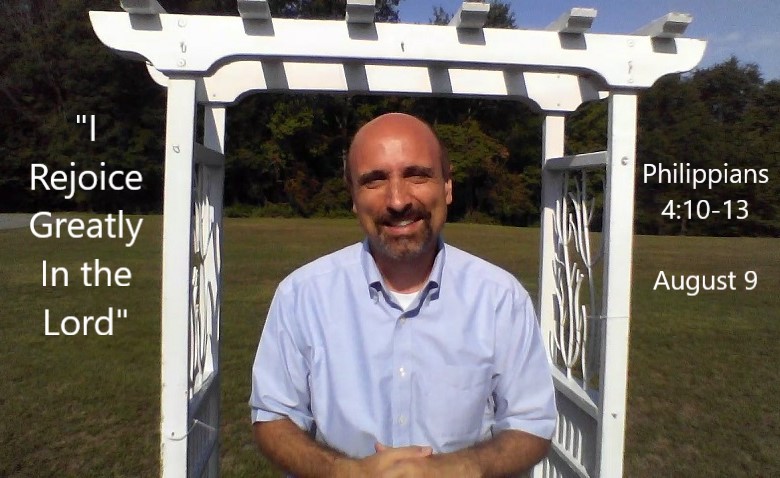 “I Rejoice Greatly In the Lord”Lanse Evangelical Free ChurchAugust 9, 2020 :: Philippians 4:10-13
We are rounding out the last section of Paul’s missionary letter to his joy and his crown, his beloved church friends back in Philippi. And by now, we should not be surprised that as Paul winds down his letter, he returns yet again to the theme of joy. Rejoicing.
Philippians has been full of rejoicing. How many times have we see him say it?
And then say it again?
Rejoice in the Lord always.Rejoice in the Lord always.Rejoice in the Lord always.
I’ll say it again: Rejoice!
Well, thankfully, the broken record Apostle Paul personally practices what he preaches. Verse 10 begins with the words, “I Rejoice Greatly in the Lord.” He’s told us to do it and told us again, and he says that he does it, too.
“I rejoice greatly in the Lord.”
But you might be surprised to find out why Paul is rejoicing so greatly in the Lord.
It actually has to do with money.
This is a missionary letter. How many times have I said that in the last 16 messages? Paul was a kind of traveling evangelist and church planting missionary, and the Philippians were kind of like one of his supporting churches.
And often when you get a letter from a missionary, they talk a little bit about their support. There is normally a thank-you involved and also a statement about their current needs.
The best missionary letters sound a lot like this one. Paul has given us a model.
It seems that when Ephaphroditus (remember him from chapter 2?) risked his life to come be a messenger from the Philippians, he brought along a gift from them, probably a monetary gift. Which was really important because prisoners like Paul were not cared for by the prison authorities. They had to supply for themselves. So Ephaphroditus brought a gift from the Philippians to help support Paul.
And one of the reasons that Paul was writing was to thank them for their gift.
It’s really interesting how he does it and how he teaches us how to live as Christians through how he does it.
We’re going to break up this section into two messages. This one is just going to focus on verses 10 through 13, and then next week, Lord-willing, we’ll look at verses 14 through 20. But they are all one section about this gift.
I have two points of application that I want to draw out from verses 10 through 13.
Here’s the first one:
#1. REJOICE GREATLY IN THE LORD WHEN OTHERS SHOW LOVE TO YOU.
Look at verse 10.
“I rejoice greatly in the Lord that at last you have renewed your concern for me. Indeed, you have been concerned, but you had no opportunity to show it.”
Interesting, huh?
Paul rejoices greatly in the Lord that he has received their gift.
“...at last you have renewed your concern for me”
And he doesn’t want them to get the wrong idea. He doesn’t mean, “Finally you guys got with the program. Where have you been with my money? At last.”
He knows that they have been concerned for him all along, but they didn’t know where he was, or what he needed, or how to get the money to him!
Imagine a world with no telephones. Imagine a world with no email.Imagine a world with no postal system or FedEx or UPS.Imagine a world with no GPS.
Letters go back and forth, but they are personally delivered by personal emissaries.
Good intel is going to be very slow. They were concerned, but they had no way to show it. But now they have. They have heard that Paul is in prison, and they have sent Ephaphroditus with a gift.
And Paul rejoices greatly in the Lord!
Now, what I want you to notice is what a great way that is to say “Thank you.”
He could just say, “Thank you.” And that would be fine. I’m all for “Thank you.” And he means that.
But Paul also recognizes that the Lord is behind their gift to him.
So Paul rejoices greatly IN THE LORD for their gift.
He knows that they had the money to give because the Lord provided it to them.He knows that they cared about him enough to send the money because the Lord put that care in their hearts.He knows that the money made it across the continent safely to him because the Lord provided safe passage for Ephaphroditus who was risking his neck and almost died.
No wonder Paul rejoices greatly in the Lord over this gift!
God is behind every good gift.
Including the gifts that others give to us in concern and love.
So, here’s a great way to say thank you:
Say,“I rejoice greatly in the Lord for this gift you have given me.”
It honors the giver and it glorifies the ultimate Giver.
I say that today to the Lanse Free Church as your pastor. Last week, Heather and I enjoyed a week away at Cook Forest for our vacation.
Thank you for the time off. It was much needed and much appreciated. We came back rested and refreshed. I rejoice greatly in the Lord for that gift from you of time off.
We are well-supplied and well-supported financially by this church family. I rejoice greatly in the Lord for your giving. I praise Him that during COVID-19 even as we’ve been scattered into our homes and slowly making our way back onto campus, your giving has stayed strong.
That’s from you, and I thank you. And that’s ultimately from the Lord, I praise Him for it!
Now, Paul really doesn’t want them to get the wrong idea from this. He doesn’t want them to think that he’s angling for another gift.
Sometimes people give a thank-you that makes it clear that their greedy little hand is out for another.
“Thank so much; how about some more?” That’s why Paul says verse 11.
“I am not saying this because I am in need, for I have learned to be content whatever the circumstances.”
Well, that sounds good, doesn’t it? I want some of that. V.12
“I know what it is to be in need, and I know what it is to have plenty. I have learned the secret of being content in any and every situation, whether well fed or hungry, whether living in plenty or in want. I can do everything through him who gives me strength.”
That last verse, verse 13, is a most famous verse.
One time I asked a bunch of Christian athletes what their favorite verse was, and just about every one said Philippians 4:13.
“I can do everything through him who gives me strength.”
Amen! But the context here shows us what Paul means by that might be different than what we might think.
Here’s point #2. We should:
#2. BE STRENGTHENED GREATLY IN THE LORD TO DO ANYTHING AND EVERYTHING HE CALLS YOU TO DO.
Paul is not angling for another gift. He’s good.
Even if he doesn’t have enough, he’s good.
Did you catch that?
He isn’t saying that he has all of his needs and wants supplied right now.
He’s saying that he is content. Contentment is a rare jewel.
One of the old Puritans, Jeremiah Burroughs liked to say that. He called it “The Rare Jewel of Christian Contentment.” Do you know people that are content? Happy not matter what? Not fazed? Not concerned? Not anxious about money? Not dependent upon their circumstances?
What’s the secret?
Do you see how Paul says that he has found out the secret? Look at verse 12 again.
“I know what it is to be in need [been there, done that, bought the t-shirt], and I know what it is to have plenty. I have learned the secret of being content in any and every situation, whether well fed or hungry, whether living in plenty or in want.”
Isn’t it interesting that you can be discontent living in plenty?
You can be discontent while being well-fed and while being prosperous.
We see that all of the time in our affluent culture, don’t we?
Who of us here has recently missed a meal?Who of us here is wondering if we are going to be homeless tomorrow?And yet, are we content?
There’s a secret.
This weekend, Zach and Haylee got married on our church campus, and they promised to love and cherish each other, “for better for worse, for richer for poorer, in sickness and in health.”
How do you do that?
What’s the secret?
I used to think that Paul didn’t tell us the secret. I used to think that he was saying you had to live some in plenty and live some in want to really “get it.”
But the secret is out! Paul gives the secret in verse 13:
“I can do everything through him who gives me strength.”
The everything there is anything and everything God calls you to do.
Even the hard stuff.
The “everything” is not winning at everything.The “everything” is everything including losing everything.
I can do “everything” through him who gives me strength.
I can be content even if I go hungry.I can be content even if I don’t have a home.I can be content even if I come down with cancer or COVID-19.
I can be content even if I die.
Remember, Paul thinks he might be executed soon for preaching the gospel of Jesus Christ.
He is in prison for preaching the gospel, and he might die for it.
And he says, “I rejoice greatly in the Lord. I can do everything through him who gives me strength.”
Last time, we saw that God is the God of peace.
As we are anxious about nothing and pray about everything, we get the peace of God from the God of peace.
Well, here we see that God is also the God of provision.
He provides us with those things we need. We’ll see that more next week.
But He also provides us with the strength to carry on even when we don’t have those things we need.
Be strengthened greatly in the Lord to do anything and everything (no matter how hard, no matter how difficult, no matter how uncomfortable, no matter how painful, anything and everything the Lord) calls you to do.
Put your faith in Him.Place your dependence upon Him.Rest on Him.Lean on Him.Trust Him.
Here's the secret:
Jesus is the secret to contentment.
If you have Jesus, then you have everything. Even if you have nothing else, if you have Jesus, you have everything.
Do you have Jesus?
If you have never trusted Jesus as your Savior and King, then I invite now to turn and place your faith in Him.
He died on the Cross to pay for our sins, and He came back to life to give us life forever with Him.
And there is no greater thing than knowing Him.
If you have Jesus, then you have everything. If you have Jesus, you can do anything and everything He calls you to do no matter how hard.
Rejoice greatly IN THE LORD!
***
Previous Messages in This Series:
01. "I Always Pray with Joy"
02. "Because Of This I Will Rejoice"
03. "I Will Continue To Rejoice"
04. "Whatever Happens"
05. "Make My Joy Complete"
06. "Your Attitude"
07. "I Am Glad and Rejoice With All Of You"
08. "With Great Joy"
09. "Rejoice in the Lord!"
10. "I Want To Know Christ"
11. "I Press On"
12. "My Joy and Crown"
13. "I Will Say It Again: Rejoice!"
14. "The Peace of God"15. "The God of Peace"
August 5, 2020
August 2, 2020
"Since You Are His, Live Like It!" by Pastor Kerry Doyal [LEFC Sermon Notes]
 Since You are His, Live Like it!Identifying, Unifying Attitudes from Eph. 4:1-6Kerry Doyal, Allegheny District Superintendent
Ephesians 4:1-6 is pretty straightforward. The hard part is applying it. But, live it we must - so much is at stake. A simple summary: “In light of all God has done for us, and made us in Christ, we are live worthy of His grace, and love. This is to show itself in our personal attitudes, and our relationships with one another.” See? Not hard to understand, but essential to do.
After three rich chapters filled with what God has done for us in Christ, Paul exhorts the Ephesian believers – and us – to live worthy of our high calling. By grace, God has made us His own people. Now, we are to live up to it! Hear and heed prisoner-Paul’s admonition in Ephesians 4:1-6.
4:1 “Therefore I, the prisoner in the Lord, urge you to live worthy of the calling you have received, 2 with all humility and gentleness, with patience, bearing with one another in love, 3 making every effort to keep the unity of the Spirit through the bond of peace. 4 There is one body and one Spirit—just as you were called to one hope at your calling— 5 one Lord, one faith, one baptism, 6 one God and Father of all, who is above all and through all and in all.” (CSB)
In Light of our High, Holy Calling, Let’s Live Worthy of It / Him
“I beg you—I, a prisoner here in jail for serving the Lord—to live and act in a way worthy of those who have been chosen for such wonderful blessings as these. Be humble and gentle. Be patient with each other, making allowance for each other’s faults because of your love. Try always to be led along together by the Holy Spirit and so be at peace with one another.
“We are all parts of one body, we have the same Spirit, and we have all been called to the same glorious future. For us there is only one Lord, one faith, one baptism, and we all have the same God and Father who is over us all and in us all, and living through every part of us.” (The Living Bible)
His Calling that We’ve Received: (Ephesians 1-3!) · Learn who we are in Him, because of His grace· Notice Paul’s prayer for us to be able to know this (3:14-22)
Our Responsibility in this Calling: Walk Worthy! (Eph. 4-6)
1. Lives that fit our Identity; we’re HIS, Live Like it! (vs. 1)· He graciously called us to Himself (Eph. 1-3; Rom. 8:28, 12:1, 2)· He calls us to live suitably, appropriately to Whose we are · We bear the family name: “Christ-ones” (Acts 11:26) · Disciples are not just learners, but imitators! (cf. Phil. 1:27; Col. 1:10; 2:6; 1 Thess. 2:12; 1 John 2:6)
2. Attitudes that Lead to Unity, Display Oneness (vs. 2-6)Notice the First Applications, Areas Dealt with:
· Humility – who we are is of HIM - no bragging! Have “lowliness of mind” (cf. 2:8-10; Acts 20:19; Phil. 2:1-11; Col. 3:12; 1 Pet. 3:8; 5:5). From the NET: “having a humble opinion of one's self; a deep sense of one's (moral) littleness; modesty”. Pride divides, it is of the devil
· Gentleness – quiet behavior, meekness (cf. Col. 4:5, 6)“The word is often used in Hellenistic Greek of the merciful execution of justice on behalf of those who have no voice by those who are in a position of authority” (Matt 11:29; 21:5 – from NET)
· Patience – longsuffering, “taking whatever comes” (Gal. 5:22-25) God was patient with us, soooo… (cf. Romans 5:3-5; James 1:1-12)
· Bearing with one another in love: “putting up with one another” Not sin, but differences, idiosyncratic differences (cf. Romans 14; 1 Cor. 12-14)
· “Making every effort to keep the unity of the Spirit through the bond of peace. (3-6) Pursuing one-ness in Christ’s body (cf. John 17; Colossians 3:14). “making every effort to keep” (NET) “being diligent to preserve” (NASB) “Taking care to keep the harmony of the Spirit in the yoke of peace.” (BBE) “eager to maintain the unity of the Spirit in the bond of peace.” (ESV)
Because: “There is one body and one Spirit—just as you were called to the one hope that belongs to your call— one Lord, one faith, one baptism, one God and Father of all, who is over all and through all and in all.” (Eph. 4:4-6 - ESV)
ü Is your life Congruent to your Calling: fitting, or at odds?
ü Do you need to learn your calling? From Ephesians 1-3, make a list of all He has done for us. Take your time, it is a lot! ü Ever known someone who wasn’t acting like themselves? Maybe they had a fever, emotional strain, or worst of all, an outburst of sinful, willful disobedience? Don’t let it be said of us – in light of who we are – that we don’t sound like Jesus. Let it be that, as we walk together, people can say, “Yep, they’re Jesus’”
ü Are you passive or proactive in keeping peace in His Body? See Acts 20; 1 Peter 5
ü With His help, work on which least describes you. “Always be humble and gentle. Be patient with each other, making allowance for each other’s faults because of your love.” (NLT)
July 26, 2020
"The God of Peace" [Matt's Messages]
 “The God of Peace”
Lanse Evangelical Free Church
July 26, 2020 :: Philippians 4:8-9
The Apostle Paul was no dummy.
Even before he came to Christ, Paul was an extremely intelligent and well-educated man. And so when he said something, when he wrote something, he meant it.
Paul wrote carefully crafted letters under the inspiration of the Holy Spirit. Every word counts.
The previous time, which was the previous verse (v.7), we considered this amazing phrase from Paul, “The Peace of God.” Remember that?
Instead of being anxious, we pray and present our requests to God, and this piece of the peace of God which transcends our finite human understanding will guard our hearts and our minds in Christ Jesus. That’s what we need! The peace of God.
Well, at the end of verse 9, just two verses later, Paul flips that phrase around and goes even deeper into what we need.
He says, “And the God of peace will be with you.”
That’s on purpose. Paul did that on purpose.
The Apostle Paul was no dummy. He knew what the Philippians needed. He knew what we really need.
We don’t just need the peace of God. We need the God of peace.
We don’t just need the peace of God. We need the presence of God.
We don’t just need to have our hearts and minds guarded. We need them visited.
And we need them visited by the God of peace.
Because remember: God is at peace. He is not shaken. He is not disturbed. He is not troubled. He is not anxious. He is not fretful. He is not jolted. He is not vexed. He is not worried. God is not worried. God is at peace.
He is the God of peace.
And the Bible promises here that He will be with us.
Now, before we get to that precious promise, Paul has some more commands for the Philippians, and, therefore, for us.
In fact, there are two more commands here to go on top of the ones he’s been doling out ever since reaching this last major section of his letter.
For the last three weeks, we’ve seen Paul give out important commands that are really good for us but not as easy as they might sound.
Agree with each other in the Lord.
Rejoice in the Lord always: I’ll say it again: Rejoice!
Let your gentleness be evident to all.
Do not be anxious about anything.
Pray about everything.
And now, two more:
#1. FOCUS ON EXCELLENT THINGS.
#2. FOLLOW AN EXCELLENT EXAMPLE.
And then “...the God of peace will be with you.”
Now, we’re not supposed to think that we somehow will earn the presence of God by doing these commands.
That’s not how the gospel works. We saw that in the previous chapter. Chapter 3.
We are not justified by works of Law, by works of the flesh.
We get our right standing with God from our faith in Christ and Christ alone.
Everything else is street trash compared to knowing Him.
So, we are not supposed to think that if we keep these two commands that we will somehow earn the presence of the God of peace. No way!
And yet they are connected. We will experience the presence of the God of peace in a deeper and more real way if we are obeying these commands from the God of peace.
They do go hand in hand.
But it’s because God of peace is behind and before.
Remember last time, the command to not be anxious follows behind, “The Lord is near.” And then at the end, “The God of peace will be with you.”
The promise of His presence precedes these commands, and our obedience proceeds from it and results in experiencing it.
“The God of peace will be with you.”
I want that for me. And I want it for you.
Let’s see what our part is. Verse 8.
“Finally, brothers, whatever is true, whatever is noble, whatever is right, whatever is pure, whatever is lovely, whatever is admirable–if anything is excellent or praiseworthy–think about such things.”
That’s a beautiful sentence as it is. Just thinking about that sentence can be a way of obeying it!
Paul says:
#1. FOCUS ON EXCELLENT THINGS.
Fill up your mind with these sorts of items.
Focus your attention on this quality of things.
Dwell upon, meditate upon, excellent things.
Yes, Paul is telling us what to think about.
He is urging us to practice mind control; that is, over our own minds.
It is true that thoughts enter our minds over which we have no control. But it is also true that we have a great deal of control over what thoughts we entertain. What thoughts we dwell upon. What thoughts we allow real estate in our minds.
Have you ever had a thought that you knew you had let take up residence in your brain and you needed to evict? We all have.
Some thoughts leave without a struggle. Other thoughts need to be tossed out on their ear, and they keeping back for more.
Especially those anxious thoughts, right? Remember the context? V.6
Paul is still telling the Philippians how to counter anxious thoughts.
You don’t just toss them out.
You don’t just pray about them!
You replace those thoughts...with better thoughts.
“Finally, brothers, whatever is true, whatever is noble, whatever is right, whatever is pure, whatever is lovely, whatever is admirable–if anything is excellent or praiseworthy–think about such things.”
That calls for discernment, doesn’t it?
Paul tells us that we have to discern between the worst kind of things and the best kind of things.
And really between the kinda good kind of things and the best things.
True, noble, right, pure, lovely, admirable, excellent, praiseworthy.
Those are the best things. Think about them.
Now, again, Paul is not saying that we should pretend that the worst things don’t exist. This is not the power of positive thinking.
And it is not fake-it-till-you-make-it. Just pretend like the opposite stuff doesn’t even exist.
The false, the ignoble, the wrong, the dirty, the ugly, the detestable, the worst, the unspeakable.
Those things exist, and Paul is not saying that we should pretend they don’t.
In fact, Paul is not saying that there is never a time to think about them. Or to talk about them. Paul talks about those things in his letters. He has talked about them in this letter.
Paul does not have an Instagram filter over his reality where everything is sepia-toned and fuzzy and bright and happy and perfect.
Remember where Paul is and what Paul expects to happen to him.
And yet, what does it really matter? Paul is in Christ, and the Lord is near. And even if he dies, He goes to be with Christ which is better by far.
The gospel is true, so there are better things to dwell upon.
That’s what he’s talking about. He’s talking about the focus of your mind.
He’s talking about what you dwell upon, what you end up thinking about, where your mind goes, where your mind rests.
Focus on excellent things.
Now, that takes some effort, and it takes some imagination.
Let’s play a game.
I’ll say a word, and I want you to think about something that embodies it.
Kind of like a spiritual Rorschach test.
Okay. Ready?
Think about something true. _____________
Think about something noble. _____________
Think about something right. _____________
Think about something pure. _____________
Think about something lovely. ____________
Think about something admirable. _____________
Think about something excellent and/or praiseworthy. _____________
How’d you do?
It’s not automatic, is it?
I think we all love this verse as a meme or a poster or a plaque that we put up on our wall.
But we don’t always give it that much effort.
Let’s try again:
Think about something true. “I am the way, the truth, and the life.” I think the seven “I AM __________” statements we looked at that during Family Bible Week this week would fit in there really well.
Think about something noble. I think about someone standing up for what they believe in.
Think about something right. Or “just.” Think about justice. We often say, “That ain’t right.” But think about what is. What would justice look like in this situation? Don’t just think about injustice. There’s plenty of that! But think about justice. “What is right?”
Think about something pure. Pure love. Pure devotion. Pure joy.
Think about something lovely. What might that be? What is beautiful to consider? Think a beautiful thought. Some beautiful music comes to my mind.
Think about something admirable. Something commendable. Something when you see that you say, “Oh! That’s wonderful.” Maybe a good deed somebody did?
Think about something excellent and/or praiseworthy.
Do you see how this requires some effort and some imagination?
Sometimes when it requires effort or imagination, we just bail on it, right?
I think we need to seriously consider repenting our disobedience of verse 8. Repenting of the times when we decided to dwell on all of the worst things.
I think this should inform our entertainment choices. What we watch. What we listen to. What we read. I think it definitely should inform our social media choices. What we say out there, but especially what we follow.
I don’t know about you, but I have had to unfollow a whole lot of people on social media who were bringing me down mentally.
I don’t mean people who were telling me things I needed to hear but didn’t want to hear. I mean people who I was allowing to tell me things I didn’t need to hear and I didn’t need to keep dwelling upon.
I always say that the greatest thing about Facebook is you know what people are thinking and feeling. And the worst thing about Facebook is that you know what people are thinking and feeling!
Is it helping you to think about “whatever is true, whatever is noble, whatever is right, whatever is pure, whatever is lovely, whatever is admirable–if anything is excellent or praiseworthy” to“think about such things?”
Don’t just shrug.
This is God’s word to us. And remember, God knows your very thoughts. He knows what you are thinking about.
And as you think, so you will be. What you focus on will determine your steps.
I just about walked into a sign yesterday. I was working on this sermon while walking home for supper, and I had my print out of the text, and I was studying it, and I just about walked into a road sign!
Your focus will determine your steps.
What are you focusing on? Is it excellent?
What do you need to change to be where you need to be mentally?
Remember, this doesn’t mean that we never think about bad things. But in proportion, we focus on the best things.
We focus on Christ!
Paul has one more “whatever” in this section. V.9
“Whatever you have learned or received or heard from me, or seen in me–put it into practice. And the God of peace will be with you.”
Think about excellent things.
#2. FOLLOW AN EXCELLENT EXAMPLE.
And here the example is Paul himself.
“Whatever you have learned or received or heard from me, or seen in me–put it into practice.”
He was saying something like this in the previous chapter.
Paul intends to be a good example.
Everybody is following somebody, Paul says, “Follow me.”
“Do it this way.”
I love how he says it 4 ways! “Whatever you have learned or received or heard [from me [that’s talk], or seen in me [that’s walk]–put it into practice.”
Including what I think about, right?
Paul is saying that he does verse 8, so you and I can do it, too.
I think it’s pretty audacious thing to say. “Whatever you’ve seen me do, you do it, too.”
Pretty audacious. But so is the promise that follows it. “And the God of peace will be with you.”
Well, I want that! So, I probably ought to check out Paul’s excellent example and start following. We have 13 letters by Paul to see what he taught and the book of Acts to see what he did. And we can start right here in Philippians. He’s showing us how it’s done.
Paul has given us an excellent example. Are you living like Paul?
Paul was no dummy! Are you living like Paul?
“And the God of peace will be with you.”
Not just the peace of God, but the God of peace.
God Himself in all of His perfect tranquility, His simple wholeness.
His simple truth, nobility, justice, purity, loveliness, admirableness, excellence, and praiseworthiness will be with you.
Think about that!
***
Previous Messages in This Series:
01. "I Always Pray with Joy"
02. "Because Of This I Will Rejoice"
03. "I Will Continue To Rejoice"
04. "Whatever Happens"
05. "Make My Joy Complete"
06. "Your Attitude"
07. "I Am Glad and Rejoice With All Of You"
08. "With Great Joy"
09. "Rejoice in the Lord!"
10. "I Want To Know Christ"
11. "I Press On"
12. "My Joy and Crown"
13. "I Will Say It Again: Rejoice!"
14. "The Peace of God"