Rusty Williamson's Blog, page 4
August 8, 2013
Traveling across the universe without falling off the edge!
Hi!
The universe is a strange place. It is a space-time structure, which, because of gravity, may fold back upon itself. We can only see a portion of it called the Observable Universe, which has a radius of about 47 billion miles. And, it is universally agreed that it is much larger than that and most scientists believe that it is in fact infinite! Hmm…wait a minute…the latest estimates I’m aware of place it’s age at 13.7 billion years old so how could we have a visible diameter of 94 billion? As I said, a strange place. Obviously, although matter cannot accelerate past the speed of light, the universe can expand faster than the speed of light. As for how can we see objects 47 billion light years away--this is because the universe was expanding while that light was traveling toward us (I know…but you’ll need Google to get further explanations on this one).New discoveries indicate that the universe may not be infinite but finite and in my four part sci-fi series, The Spiral Slayers, it is finite. So could we ever reach the universe’s edge and, if we could, what would it look like and what would be beyond it?
Both in reality (if it is finite) and in the Spiral Slayers’ universe, the answer to these questions are both ‘no’ and ‘maybe’. The ‘no’ part of this is that space-time, as I have already pointed out, folds back upon itself because of gravity and, we are part of space time and simply can’t remove ourselves from it. Long before we came anywhere close to the universe’s edge, space time would bend both our view and path away from it and we could never reach it.
 The maybe part is that perhaps we can see the edge of the universe or at least a portion of it every time we look at a black hole. This edge might be the event horizon or it may be the singularity itself. In my story it’s the latter. As for what we'd find beyond the universe, we don't know and, in my story and probably in reality as well, anything outside the universe is unknowable. However, if a singularity is the edge then we can see the effects from outside and those indicate that a unistate (AKA a singularity) exists beyond the edge. Here is a very interesting documentary on this subject—it’s a bit long but really worth watching!In the next post we’ll talk about probably one of the more controversially elements of my story; traveling between galactic super clusters and across the Observably Universe while observing light’s speed limit. Rusty Williamson
The universe is a strange place. It is a space-time structure, which, because of gravity, may fold back upon itself. We can only see a portion of it called the Observable Universe, which has a radius of about 47 billion miles. And, it is universally agreed that it is much larger than that and most scientists believe that it is in fact infinite! Hmm…wait a minute…the latest estimates I’m aware of place it’s age at 13.7 billion years old so how could we have a visible diameter of 94 billion? As I said, a strange place. Obviously, although matter cannot accelerate past the speed of light, the universe can expand faster than the speed of light. As for how can we see objects 47 billion light years away--this is because the universe was expanding while that light was traveling toward us (I know…but you’ll need Google to get further explanations on this one).New discoveries indicate that the universe may not be infinite but finite and in my four part sci-fi series, The Spiral Slayers, it is finite. So could we ever reach the universe’s edge and, if we could, what would it look like and what would be beyond it?
Both in reality (if it is finite) and in the Spiral Slayers’ universe, the answer to these questions are both ‘no’ and ‘maybe’. The ‘no’ part of this is that space-time, as I have already pointed out, folds back upon itself because of gravity and, we are part of space time and simply can’t remove ourselves from it. Long before we came anywhere close to the universe’s edge, space time would bend both our view and path away from it and we could never reach it.
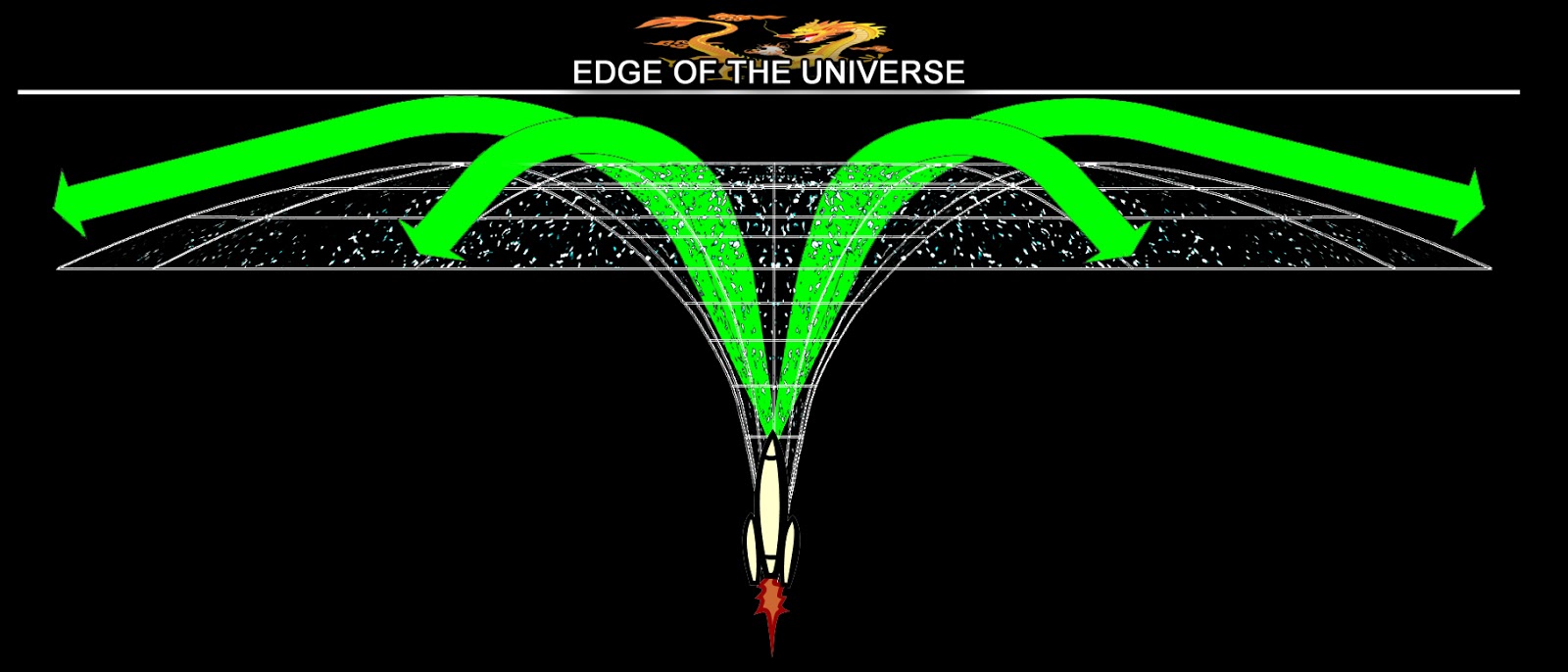 The maybe part is that perhaps we can see the edge of the universe or at least a portion of it every time we look at a black hole. This edge might be the event horizon or it may be the singularity itself. In my story it’s the latter. As for what we'd find beyond the universe, we don't know and, in my story and probably in reality as well, anything outside the universe is unknowable. However, if a singularity is the edge then we can see the effects from outside and those indicate that a unistate (AKA a singularity) exists beyond the edge. Here is a very interesting documentary on this subject—it’s a bit long but really worth watching!In the next post we’ll talk about probably one of the more controversially elements of my story; traveling between galactic super clusters and across the Observably Universe while observing light’s speed limit. Rusty Williamson


August 4, 2013
Hi,I'm going to try to break up my previous posts so that...
Hi,
I'm going to try to break up my previous posts so that they (as well as future ones) are shorter.
r
I'm going to try to break up my previous posts so that they (as well as future ones) are shorter.
r
July 27, 2013
The dream particle: The super speck.
In the Spiral Slayer universe the super speck is the smallest, most elementary particle.
The super speck or speck particle has some amazing properties.
1. It vibrates and has three trillion different vibrations.
2. It is a reflective particle which means that if surrounded by a single state3. The super speck’s reflective burst (A.K.A. the Big Bang) begins by only expanding space time (i.e. in the beginning reflections only differ in directional alignment). Then, over the course of the burst, begin switching to the expansion of timelines (i.e. reflections also differ in phase alignment). After about four billion years the changeover is complete and all reflections expand the number of timelines. This soon fills up quantum space becoming the cause of the universe’s expansion. As more space is created this creates more timelines. This self-feeding circle causes accelerating expansion.
4. Within its three trillion vibrations is encoded all the information needed to create a universe.
5. When an intelligent species reaches the Rho level of development, Speculators, who translate the speck’s vibrations, begin to replace scientists and the scientific method.
6. When an intelligent species has translated all of the speck’s vibrations, they will ‘know’ everything that is knowable7. When an intelligent species comes to understand all of the knowledge from the speck, they will ‘know and understand’ everything knowable and be at the uppermost level of development: the Omega Level.
8. Universes die when their expansion has stretched out the speck particles so much that their vibrations vanish and speck reflections die until only one speck particle is left.
9. When only one speck particle is left (this is always the original and only real speck particle) the dynamics of the cosmos changes and the remaining speck becomes the only thing that exists which means it contains all the energy that exists and is surrounded by a single state. This triggers the reflection burst that creates the next universe.
10. Speck particles that are aligned join to form speck strings or sStrings and these create space time.
11. Aligned sStrings become tangled creating permanent knots (the quirks and gluons that create matter) and temporary knots (virtual quirks and gluons).
12. The sStrings (and therefore sString knots) can only interact with other sStrings whose speck particles are aligned creating the macro here and now space time we know.
(The following discussion is greatly simplified in some areas)
There are two types of speck alignment. To interact, both must be aligned. The speck particle can be pictured as a vibrating line of energy. Vibrations differ in frequency, distance along the string, distance from line when straight, direction(s) in 3D space, speed, curve(s) and shape. There is directional alignment (direction of the string in 3D space) and there is phase alignment, which is alignment of the vibration cycle.
Directional alignment:
Below the level (size) of quarks and gluons, macro space time as we know it falls apart. When a universe is born, reflections of the speck particle explode outward tumbling this way and that. As this happens, aligned specks bond into sStrings. Only specks (and sStrings they form) that are ‘aligned’ can interact with each other and they do this no matter where they are physically located in the realm of the sStrings (A.K.A. foam). In our macro view of space time this inability to interact appears as space time—a distance in space time between objects.
If your finger pushes an object, the sStrings in your finger and the object are aligned but maybe anywhere in the realm of sStrings. Likewise, an sString in a star does not interact with an sString in your finger because they are out of alignment even though in the realm of the sStrings they may be right next to each other and again, this alignment difference and inability to interact translate to distance and time in our macro view.
This of course means that only aligned sStrings can interact to form real or virtual quarks or gluons but to tangle and knot together they must also be next to each other in the sString realm.
Wormholes are possible within the realm of the sString because of this difference between our macro space time and the virtual physical layout within the sString’s realm. Wormholes are pipe-like structures formed by sStrings that can change the alignment of sStrings passing through them therefore changing their physical location in our macro space time.
Phase alignment:
The second type of alignment is phase or rhythm alignment meaning the alignment of the vibrations. The alignment of the sStrings (ergo the speck particles that form them) are what creates the macro space time probability timelines. As you look towards a distant star, the space time perceived between you and the star is a gradual change of the speck particle’s directional alignment. You see the star as it was in the past when its speck particles were the same alignment as yours and everything you see around you, you see in the macro space time past. This is all directional alignment.
However, the change of phase alignment determines and separates the timelines. This is the probability wave observed in the two slit experiment where light passing through the two slits (in the two slit experiment) forms a wave pattern. Different realities are timelines whose speck particle’s phase alignment has changed. The inability to interact in this case does not translate to time space or distance. It does not translate at the macro at all. Even though we can only see and interact with the timeline we are on, it is there and takes up time and space in the quantum realm. Our universe ran out of quantum room about four billion years ago and at this point the ever accelerating expansion of the universe began as more and more alternate timelines came into being and needed more quantum room.
In the next post we will switch from the quantum realm to the cosmic realm and discuss where the edge of the universe is and how it is possible to travel across the universe.
A single state means that everywhere you look is the same. Examples of this are a singularity or an absolute vacuum (where there are not virtual particles are anything else). A single state cannot exist within a universe. Anything within the universe is knowable. Anything beyond the realm of the universe is unknowable.
July 19, 2013
Development of the Spiral Slayer Universe Part 2 :What happened to strings and the birth of a dream particle.
Hello!
This is an interesting, though complex, story!
Between the late eighties and the early 2000s I was totally into string theory. I was there for the five different theories, the bane worlds and M-theory that combined the five theories. The downfall of superstring theory, at least for myself, was only months away but, in reality, for myself anyway, was already happening due to a number of items.
I had no issue with string theory’s biggest problem, which was that it could not make any predictions that could readily be tested. Because I was a ‘believer’, I even had my own arguments for this quandary. They went like this: in fact, there were predictions strings could make… it’s just that Relativity and/or quantum mechanics and/or QED had already made these predictions and lab tests had already confirmed them. Not only did it sound good, it was true…for instance, ‘strings’ could absolutely predict gravity but so could an apple.
The first crack in my stringy beliefs was no more than just an uneasy feeling I got when I heard Mr. Stringman himself--Brian Green—pronounce, “(string theory) is too elegant to be wrong.” OK, I’ve been sitting here for many minutes trying and I cannot explain why this hit me as so wrong.
There were other minor things—especially ‘M-Theory’ that supposedly explained the five different string theories but not, it seemed, itself. However, the absolute showstopper was the big lie and I’m just now realizing it’s something that’s going to be a little hard to explain but I’ll do my best.
One of the bedrocks of any theory’s reliability is that the math behind it is finite. That is to say, that it produces few or no answers that are infinite. It’s called or referred to as the theory’s level of approximation. The leading contenders in quantum physics—superstrings and Loop Quantum Gravity (LQG)—had both been proven ‘finite’. Article after article since the mid-80s had stated that the superstring theory was proven finite. That foundation supporting string theory, after all these years, was simply a given or, so they said.
Around 2002 a physicist named Lee Smolin—a giant in the field--was asked to write a report on the state of all the different quantum theories currently on the table and, to make a long story short, he discovered that no one had ever proven any of the five string theories to be finite! To my knowledge, no one has done it yet. Evidently, someone, somewhere, at some time had just stated this and everyone had just jumped on board--unbelievable!
Personally, I pretty much gave the big finger to string theory.
Understand that I had based The Spiral Slayers universe on string theory! Bane worlds were playing key parts in the story. I almost completely give up on the story…hell, I almost decided to chuck science and writing sci-fi completely. I went into a deep depression and stopped all work on The Spiral Slayers book, the trailer and definitely on my reading of science books.
Perhaps three months later, I tried to convert to LQG but my heart wasn’t into putting my faith into any quantum theory being worked on. I needed my own and I remember thinking, I’ll have to sleep on it.
Believe it or not that night I had a dream in which I was talking to a scientist in a white lab coat who told me that the universe was just a reflection of itself--that this was why every part of the universe was like every other part. I proclaimed ‘the holographic theory’ but he shook his head.
He went on to say that, this was because the most elementary particle was a new type of particle--a 'reflection particle' that it reflected itself. This was the reason for the universe’s past expansion periods.
Also, and this made perfect sense, this most elementary particle contained all the information needed to build our universe. This data, he continued, was not stored like data on a disk drive but rather within the way the particle’s vibrations affected and fit or didn’t fit with the other vibrating particles around it. Also, any change to one particle affected every particle because each one was just a reflection of itself and, this changed propagated very quickly defining, BTW, the speed of light. This smallest particle was called… *
*... and, I woke up. I looked over at my wife next to me in bed and she reached over and rubbed the tip of my nose. I jerked away in surprise and give her a quizzical look and she said that I had had a speck of something on my nose…
…and right then the super speck particle replaced string theory.
In the next post, well see how this new ‘dream’ particle fit perfectly with my story even solving some problems I’d been agonizing over.
r
This is an interesting, though complex, story!
Between the late eighties and the early 2000s I was totally into string theory. I was there for the five different theories, the bane worlds and M-theory that combined the five theories. The downfall of superstring theory, at least for myself, was only months away but, in reality, for myself anyway, was already happening due to a number of items.
I had no issue with string theory’s biggest problem, which was that it could not make any predictions that could readily be tested. Because I was a ‘believer’, I even had my own arguments for this quandary. They went like this: in fact, there were predictions strings could make… it’s just that Relativity and/or quantum mechanics and/or QED had already made these predictions and lab tests had already confirmed them. Not only did it sound good, it was true…for instance, ‘strings’ could absolutely predict gravity but so could an apple.
The first crack in my stringy beliefs was no more than just an uneasy feeling I got when I heard Mr. Stringman himself--Brian Green—pronounce, “(string theory) is too elegant to be wrong.” OK, I’ve been sitting here for many minutes trying and I cannot explain why this hit me as so wrong.
There were other minor things—especially ‘M-Theory’ that supposedly explained the five different string theories but not, it seemed, itself. However, the absolute showstopper was the big lie and I’m just now realizing it’s something that’s going to be a little hard to explain but I’ll do my best.
One of the bedrocks of any theory’s reliability is that the math behind it is finite. That is to say, that it produces few or no answers that are infinite. It’s called or referred to as the theory’s level of approximation. The leading contenders in quantum physics—superstrings and Loop Quantum Gravity (LQG)—had both been proven ‘finite’. Article after article since the mid-80s had stated that the superstring theory was proven finite. That foundation supporting string theory, after all these years, was simply a given or, so they said.
Around 2002 a physicist named Lee Smolin—a giant in the field--was asked to write a report on the state of all the different quantum theories currently on the table and, to make a long story short, he discovered that no one had ever proven any of the five string theories to be finite! To my knowledge, no one has done it yet. Evidently, someone, somewhere, at some time had just stated this and everyone had just jumped on board--unbelievable!
Personally, I pretty much gave the big finger to string theory.
Understand that I had based The Spiral Slayers universe on string theory! Bane worlds were playing key parts in the story. I almost completely give up on the story…hell, I almost decided to chuck science and writing sci-fi completely. I went into a deep depression and stopped all work on The Spiral Slayers book, the trailer and definitely on my reading of science books.
Perhaps three months later, I tried to convert to LQG but my heart wasn’t into putting my faith into any quantum theory being worked on. I needed my own and I remember thinking, I’ll have to sleep on it.
Believe it or not that night I had a dream in which I was talking to a scientist in a white lab coat who told me that the universe was just a reflection of itself--that this was why every part of the universe was like every other part. I proclaimed ‘the holographic theory’ but he shook his head.
He went on to say that, this was because the most elementary particle was a new type of particle--a 'reflection particle' that it reflected itself. This was the reason for the universe’s past expansion periods.
Also, and this made perfect sense, this most elementary particle contained all the information needed to build our universe. This data, he continued, was not stored like data on a disk drive but rather within the way the particle’s vibrations affected and fit or didn’t fit with the other vibrating particles around it. Also, any change to one particle affected every particle because each one was just a reflection of itself and, this changed propagated very quickly defining, BTW, the speed of light. This smallest particle was called… *
*... and, I woke up. I looked over at my wife next to me in bed and she reached over and rubbed the tip of my nose. I jerked away in surprise and give her a quizzical look and she said that I had had a speck of something on my nose…
…and right then the super speck particle replaced string theory.
In the next post, well see how this new ‘dream’ particle fit perfectly with my story even solving some problems I’d been agonizing over.
r
What happened to string theory and the birth of a dream particle: the super speck.
Hello!
This is an interesting, though complex, story!
Between the late eighties and the early 2000s I was totally into string theory. I was there for the five different theories, the bane worlds and M-theory that combined the five theories. The downfall of superstring theory, at least for myself, was only months away but, in reality, for myself anyway, was already happening due to a number of items.
I had no issue with string theory’s biggest problem, which was that it could not make any predictions that could readily be tested. Because I was a ‘believer’, I even had my own arguments for this quandary. They went like this: in fact, there were predictions strings could make… it’s just that Relativity and/or quantum mechanics and/or QED had already made these predictions and lab tests had already confirmed them. Not only did it sound good, it was true…for instance, ‘strings’ could absolutely predict gravity but so could an apple.
The first crack in my stringy beliefs was no more than just an uneasy feeling I got when I heard Mr. Stringman himself--Brian Green—pronounce, “(string theory) is too elegant to be wrong.” OK, I’ve been sitting here for many minutes trying and I cannot explain why this hit me as so wrong.
There were other minor things—especially ‘M-Theory’ that supposedly explained the five different string theories but not, it seemed, itself. However, the absolute showstopper was the big lie and I’m just now realizing it’s something that’s going to be a little hard to explain but I’ll do my best.
One of the bedrocks of any theory’s reliability is that the math behind it is finite. That is to say, that it produces few or no answers that are infinite. It’s called or referred to as the theory’s level of approximation. The leading contenders in quantum physics—superstrings and Loop Quantum Gravity (LQG)—had both been proven ‘finite’. Article after article since the mid-80s had stated that the superstring theory was proven finite. That foundation supporting string theory, after all these years, was simply a given or, so they said.
Around 2002 a physicist named Lee Smolin—a giant in the field--was asked to write a report on the state of all the different quantum theories currently on the table and, to make a long story short, he discovered that no one had ever proven any of the five string theories to be finite! To my knowledge, no one has done it yet. Evidently, someone, somewhere, at some time had just stated this and everyone had just jumped on board--unbelievable!
Personally, I pretty much gave the big finger to string theory.
Understand that I had based The Spiral Slayers universe on string theory! Bane worlds were playing key parts in the story. I almost completely give up on the story…hell, I almost decided to chuck science and writing sci-fi completely. I went into a deep depression and stopped all work on The Spiral Slayers book, the trailer and definitely on my reading of science books.
Perhaps three months later, I tried to convert to LQG but my heart wasn’t into putting my faith into any quantum theory being worked on. I needed my own and I remember thinking, I’ll have to sleep on it and believe it or not the weirdest thing happened. That night I had a dream in which I was talking to a scientist in a white lab coat who told me that the universe was just a reflection of itself and that this was why every part of the universe was like every other part. I proclaimed ‘the holographic theory’ but he shook his head. He went on to say that, this was because the most elementary particle was a new type of particle called a refection particle and that it reflected itself and this was the reason for the universe’s past expansion periods. Also, and this made perfect sense, this most elementary particle contained all the information needed to build our universe. This data, he continued, was not stored like data on a disk drive but rather within the way the particle’s vibrations affected and fit or didn’t fit with the other vibrating particles around it. Also, any change to one particle affected every reflection of itself and this changed propagated very quickly defining, btw, the speed of light. The particle was called…
And, I woke up. I looked over at my wife next to me in bed and she reached over and rubbed the tip of my nose. I jerked away from her and give her a quizzical look and she said that I had had a speck of something on my nose…
…and right then the super speck particle replaced string theory.
In the next post, well see how this new ‘dream’ particle fit perfectly with my story even solving some problems I’d been agonizing over.
r
This is an interesting, though complex, story!
Between the late eighties and the early 2000s I was totally into string theory. I was there for the five different theories, the bane worlds and M-theory that combined the five theories. The downfall of superstring theory, at least for myself, was only months away but, in reality, for myself anyway, was already happening due to a number of items.
I had no issue with string theory’s biggest problem, which was that it could not make any predictions that could readily be tested. Because I was a ‘believer’, I even had my own arguments for this quandary. They went like this: in fact, there were predictions strings could make… it’s just that Relativity and/or quantum mechanics and/or QED had already made these predictions and lab tests had already confirmed them. Not only did it sound good, it was true…for instance, ‘strings’ could absolutely predict gravity but so could an apple.
The first crack in my stringy beliefs was no more than just an uneasy feeling I got when I heard Mr. Stringman himself--Brian Green—pronounce, “(string theory) is too elegant to be wrong.” OK, I’ve been sitting here for many minutes trying and I cannot explain why this hit me as so wrong.
There were other minor things—especially ‘M-Theory’ that supposedly explained the five different string theories but not, it seemed, itself. However, the absolute showstopper was the big lie and I’m just now realizing it’s something that’s going to be a little hard to explain but I’ll do my best.
One of the bedrocks of any theory’s reliability is that the math behind it is finite. That is to say, that it produces few or no answers that are infinite. It’s called or referred to as the theory’s level of approximation. The leading contenders in quantum physics—superstrings and Loop Quantum Gravity (LQG)—had both been proven ‘finite’. Article after article since the mid-80s had stated that the superstring theory was proven finite. That foundation supporting string theory, after all these years, was simply a given or, so they said.
Around 2002 a physicist named Lee Smolin—a giant in the field--was asked to write a report on the state of all the different quantum theories currently on the table and, to make a long story short, he discovered that no one had ever proven any of the five string theories to be finite! To my knowledge, no one has done it yet. Evidently, someone, somewhere, at some time had just stated this and everyone had just jumped on board--unbelievable!
Personally, I pretty much gave the big finger to string theory.
Understand that I had based The Spiral Slayers universe on string theory! Bane worlds were playing key parts in the story. I almost completely give up on the story…hell, I almost decided to chuck science and writing sci-fi completely. I went into a deep depression and stopped all work on The Spiral Slayers book, the trailer and definitely on my reading of science books.
Perhaps three months later, I tried to convert to LQG but my heart wasn’t into putting my faith into any quantum theory being worked on. I needed my own and I remember thinking, I’ll have to sleep on it and believe it or not the weirdest thing happened. That night I had a dream in which I was talking to a scientist in a white lab coat who told me that the universe was just a reflection of itself and that this was why every part of the universe was like every other part. I proclaimed ‘the holographic theory’ but he shook his head. He went on to say that, this was because the most elementary particle was a new type of particle called a refection particle and that it reflected itself and this was the reason for the universe’s past expansion periods. Also, and this made perfect sense, this most elementary particle contained all the information needed to build our universe. This data, he continued, was not stored like data on a disk drive but rather within the way the particle’s vibrations affected and fit or didn’t fit with the other vibrating particles around it. Also, any change to one particle affected every reflection of itself and this changed propagated very quickly defining, btw, the speed of light. The particle was called…
And, I woke up. I looked over at my wife next to me in bed and she reached over and rubbed the tip of my nose. I jerked away from her and give her a quizzical look and she said that I had had a speck of something on my nose…
…and right then the super speck particle replaced string theory.
In the next post, well see how this new ‘dream’ particle fit perfectly with my story even solving some problems I’d been agonizing over.
r
July 11, 2013
Development of the Spiral Slayer Universe Part 1
Hi!
The cosmic and quantum universe used in The Spiral Slayers Quadrilogy is based on current state of cosmology and the standard model of quantum mechanics. It is then extended up to and including what dark matter and energy are as well as why we and the universe exists. Unfortunately, you will have to wait for the fourth and final installment for the answer to the latter.
Concerning the extensions to cosmology and quantum physics, one of the cornerstones of the Spiral Slayer Universe is this strange and intriguing fact:
The properties of infinite density (a singularity) and an absolute vacuum (this means no vacuum energy, no virtual particles, absolutely nothing) are identical. Actually, neither have any properties but, if you were to try to break it down then:
A singularity (infinite density or a black hole):· Is completely uniform, that is, it is the same everywhere.
· Has no events
· Has no time
· Has no temperature
· Has no volume
· It cannot exist within the universe (one like ours anyway)
An absolute vacuum... has the exact same properties (or lack of them). Therefore, in The Spiral Slayers sci-fi series, the two things are the same.
There is one more property—one which in reality is probably different but, in the Spiral Slayer universe since both states are the same, this final property is also the same. That property is:
· Space time is infinitely warped (or, it has infinite gravity)
Since the two are the same, both can be called a singularity or, as it is called in the series, a unistate. This means it has only one state (where ‘state’ represents a condition like electricity can have two states, negative and positive or, a computer byte can have two states, on or off).
How can this be viewed? If you picture the face of a clock, and say that twelve o’clock is the unistate (i.e. the singularity or the absolute vacuum) then one minute to twelve might be a neutron star and one minute after twelve might be just the vacuum energy and virtual particles.
What this means is that everything is not pulled towards mass but rather is pulled towards fewer states.
Assuming the above is true changes quite a lot! Now not only does matter produce gravity (or bend space-time), emptiness (or the absence of matter) does too! This actually takes care of dark matter, as the gravitational effects of this unseen ‘dark’ matter is now just the balance of the gravity of matter and gravity of emptiness or, the approach to a lessor number of states (by stretching those states out until they are just one or, by condensing those states until they are just one). We know what matter’s gravitational falloff is. For the universe to work the way it does with these strange new rules simply depends on the proper setting of emptiness’ gravitational fall off.
Book one of The Spiral Slayers establishes the first cosmic law of the (Spiral Slayer) universe.The first cosmic law: There must always be more than one state.
In a unistate (either a singularity or an absolute vacuum), there is only one state. It is the same everywhere. Therefore, nothing exists. Therefore, the first cosmic law simply says that ‘something’ must exist. Think about that one!
In the next post, we will look at the Super Speck (and discuss what happened to the Super String) and see how the universe exists between the 12:01 and 11:59 on that clock we talked about.
Rusty
The cosmic and quantum universe used in The Spiral Slayers Quadrilogy is based on current state of cosmology and the standard model of quantum mechanics. It is then extended up to and including what dark matter and energy are as well as why we and the universe exists. Unfortunately, you will have to wait for the fourth and final installment for the answer to the latter.
Concerning the extensions to cosmology and quantum physics, one of the cornerstones of the Spiral Slayer Universe is this strange and intriguing fact:
The properties of infinite density (a singularity) and an absolute vacuum (this means no vacuum energy, no virtual particles, absolutely nothing) are identical. Actually, neither have any properties but, if you were to try to break it down then:
A singularity (infinite density or a black hole):· Is completely uniform, that is, it is the same everywhere.
· Has no events
· Has no time
· Has no temperature
· Has no volume
· It cannot exist within the universe (one like ours anyway)
An absolute vacuum... has the exact same properties (or lack of them). Therefore, in The Spiral Slayers sci-fi series, the two things are the same.
There is one more property—one which in reality is probably different but, in the Spiral Slayer universe since both states are the same, this final property is also the same. That property is:
· Space time is infinitely warped (or, it has infinite gravity)
Since the two are the same, both can be called a singularity or, as it is called in the series, a unistate. This means it has only one state (where ‘state’ represents a condition like electricity can have two states, negative and positive or, a computer byte can have two states, on or off).
How can this be viewed? If you picture the face of a clock, and say that twelve o’clock is the unistate (i.e. the singularity or the absolute vacuum) then one minute to twelve might be a neutron star and one minute after twelve might be just the vacuum energy and virtual particles.
What this means is that everything is not pulled towards mass but rather is pulled towards fewer states.
Assuming the above is true changes quite a lot! Now not only does matter produce gravity (or bend space-time), emptiness (or the absence of matter) does too! This actually takes care of dark matter, as the gravitational effects of this unseen ‘dark’ matter is now just the balance of the gravity of matter and gravity of emptiness or, the approach to a lessor number of states (by stretching those states out until they are just one or, by condensing those states until they are just one). We know what matter’s gravitational falloff is. For the universe to work the way it does with these strange new rules simply depends on the proper setting of emptiness’ gravitational fall off.
Book one of The Spiral Slayers establishes the first cosmic law of the (Spiral Slayer) universe.The first cosmic law: There must always be more than one state.
In a unistate (either a singularity or an absolute vacuum), there is only one state. It is the same everywhere. Therefore, nothing exists. Therefore, the first cosmic law simply says that ‘something’ must exist. Think about that one!
In the next post, we will look at the Super Speck (and discuss what happened to the Super String) and see how the universe exists between the 12:01 and 11:59 on that clock we talked about.
Rusty
June 17, 2013
How the Spiral Slayers became a quadrilogy
Hi,
As promised, I'll explain how The Spiral Slayers became a quadrilogy.
In 2005 I switched from attempting to start a company that created animated book trailers (www.virtualmediastudios.com) to writing my book. Actually, I had started writing another one of my stories in 2001--'The Tale of the Blood Rose Mantis' and had made significant when my hard drive went out and I lost all of it. I was not doing backups. This disaster hurt so much that I stopped writing for over three years.
The Spiral Slayers was suppose to be a single book however, when you start on something new it is easy to make the simplest of mistakes. I had the entire story planned out and was about 20% through the story when I had a thought...'word count', I wonder what the word count is supposed to be for a new sci-fi novel. This detail hadn't even crossed my mind so I Googled it and found that 120,000 words was the limit. I checked my word count and saw that it was over 200,000 words! Whoops.
For three months I struggled with a solution. First I tried to reduce the story but the amount I needed to reduce it was too much. Then I wrestled with trying to divide it into three parts. Finally I gave in and settled for four parts. This meant that I would not be able to send it to an agent or publisher--no one was going to look at a new author offering a quadrilogy. So, I considered switching to a different story but I was so in the groove on this one. Once I decided I was just going to have to continue with a four book series and self publish it, I then had to divide the story into four books which took another month.
Live and learn.
My next entry will explain how I created extensions to the (quantum) standard model and cosmology to create the Spiral Slayer universe.
Rusty Williamson
As promised, I'll explain how The Spiral Slayers became a quadrilogy.
In 2005 I switched from attempting to start a company that created animated book trailers (www.virtualmediastudios.com) to writing my book. Actually, I had started writing another one of my stories in 2001--'The Tale of the Blood Rose Mantis' and had made significant when my hard drive went out and I lost all of it. I was not doing backups. This disaster hurt so much that I stopped writing for over three years.
The Spiral Slayers was suppose to be a single book however, when you start on something new it is easy to make the simplest of mistakes. I had the entire story planned out and was about 20% through the story when I had a thought...'word count', I wonder what the word count is supposed to be for a new sci-fi novel. This detail hadn't even crossed my mind so I Googled it and found that 120,000 words was the limit. I checked my word count and saw that it was over 200,000 words! Whoops.
For three months I struggled with a solution. First I tried to reduce the story but the amount I needed to reduce it was too much. Then I wrestled with trying to divide it into three parts. Finally I gave in and settled for four parts. This meant that I would not be able to send it to an agent or publisher--no one was going to look at a new author offering a quadrilogy. So, I considered switching to a different story but I was so in the groove on this one. Once I decided I was just going to have to continue with a four book series and self publish it, I then had to divide the story into four books which took another month.
Live and learn.
My next entry will explain how I created extensions to the (quantum) standard model and cosmology to create the Spiral Slayer universe.
Rusty Williamson
June 13, 2013
The Spiral Slayers...how it happened...
Hello, [I doubt that anyone is reading this...if I'm wrong let me know.]
My first novel--actually a four book series of which I've finished book one and am working on book two--came about in a strange way. In fact, I'll start with how I became a sci-fi fan.
I was medevaced home from Vietnam in 1972. After getting out of the hospital I did the easiest thing, I moved back in with my parents. The first night I was there I saw Star Trek for the first time and became a sci-fi fan.
I can vividly remember the first time I came up with a sci-fi story idea. It was 1978, I was married and had a three year old daughter and a new born son and we'd had our first house. I was in the garage stoned and I came up with a fantastic story idea called Net World. It really was way ahead of its time.
Over the years I've come up with exactly one dozen story ideas and I hope to be able to tell all of them.
The primary idea for 'The Spiral Slayers' came to me in 1992. This was a monumental year for me. My title was Systems Programmer and I had just finished a six month project to completely redo GE Retail Systems' computer room. I did this in a single weekend and got a special award and a new title for my efforts. Newly promoted to System Administrator my first job was to visit each department head and compose an estimate of the total HW/SW expenses for 1993. This effort would lead to yet another title--Manager of Internal Systems.
I was lying in the sun next to the pool in the buildings Fitness Center day dreaming and bingo! Can't tell you what I came up with without ruining the story but I can tell you that it was both at the quantum and cosmic level.
It evolved for over ten years before I started writing the book.
In my next blog I'll explain how it became a quadrilogy.
Rusty
My first novel--actually a four book series of which I've finished book one and am working on book two--came about in a strange way. In fact, I'll start with how I became a sci-fi fan.
I was medevaced home from Vietnam in 1972. After getting out of the hospital I did the easiest thing, I moved back in with my parents. The first night I was there I saw Star Trek for the first time and became a sci-fi fan.
I can vividly remember the first time I came up with a sci-fi story idea. It was 1978, I was married and had a three year old daughter and a new born son and we'd had our first house. I was in the garage stoned and I came up with a fantastic story idea called Net World. It really was way ahead of its time.
Over the years I've come up with exactly one dozen story ideas and I hope to be able to tell all of them.
The primary idea for 'The Spiral Slayers' came to me in 1992. This was a monumental year for me. My title was Systems Programmer and I had just finished a six month project to completely redo GE Retail Systems' computer room. I did this in a single weekend and got a special award and a new title for my efforts. Newly promoted to System Administrator my first job was to visit each department head and compose an estimate of the total HW/SW expenses for 1993. This effort would lead to yet another title--Manager of Internal Systems.
I was lying in the sun next to the pool in the buildings Fitness Center day dreaming and bingo! Can't tell you what I came up with without ruining the story but I can tell you that it was both at the quantum and cosmic level.
It evolved for over ten years before I started writing the book.
In my next blog I'll explain how it became a quadrilogy.
Rusty
June 12, 2013
My progress with Marketing my book...
I love my wife Denise (40 years next month!)! After the Kirkus review she agreed to help me do the marketing for my book so I give her my to-do list and forwarded her a dozen articles to read. She's smart and lazy (the best combo) so she said 'shit on all that!' and decided to short-circuit the process--after work today she's going by the library to research getting a literary agent who will do all that promotion stuff so I can write and she can spend. If I don't tell her all the reasons that won't work she'll probably find a way to do it! Anyway I have to keep on marketing until then so... BUY MY BOOK DAMN IT! THE PAPERBACK IS ON SALE SO DO IT RIGHT NOW! I'LL EVEN GIVE YOU THE FRIGGIN LINK! (how am I doing?)
http://www.amazon.com/The-Spiral-Slayers-Encounters-ebook/dp/B008STATCO/
My next blog will be something more interesting: How I extended current cosmology and the standard model of quantum physics to create the Spiral Slayer universe. You don't have to be a science nerd to understand my book, however the a part of the plot is mostly based in these areas (if I say the universe is ending you don't need to know what particle is decaying to understand, right?).
Cheers,
Rusty
http://www.amazon.com/The-Spiral-Slayers-Encounters-ebook/dp/B008STATCO/
My next blog will be something more interesting: How I extended current cosmology and the standard model of quantum physics to create the Spiral Slayer universe. You don't have to be a science nerd to understand my book, however the a part of the plot is mostly based in these areas (if I say the universe is ending you don't need to know what particle is decaying to understand, right?).
Cheers,
Rusty
June 7, 2013
Book Promotion: Initial 'to-do' (or task) list
Hi,
Continuing from my last post... Now that I have a framework to put and sort tasks I need to figure out what those tasks are. I know a lot of them so I just enter those with no regard to order. Then I search the sites I know of--Direct Publishing and CreateSpace--and also go to their community forums and post there asking basically 'what do I do' and ask the same question of support. There are 'how to' ebooks and blogs on marketing your book and I read through these. Along the way I'm adding to my list. When I see I'm reaching the end of what I can consult right now I then fill in the 'sort' column using 0-9, 0 being the items I'll do first. In assigning these numbers I consider importance as well as how long the item will take to do. For instance 'adding the Kirkus review to my Amazon book detail page' won't take much time but 'add kirkus review to trailer' will take perhaps two weeks so I will put this off while I knock out quick and easy stuff first. After filling out the sort column I sort my list.
My list now looks like this:
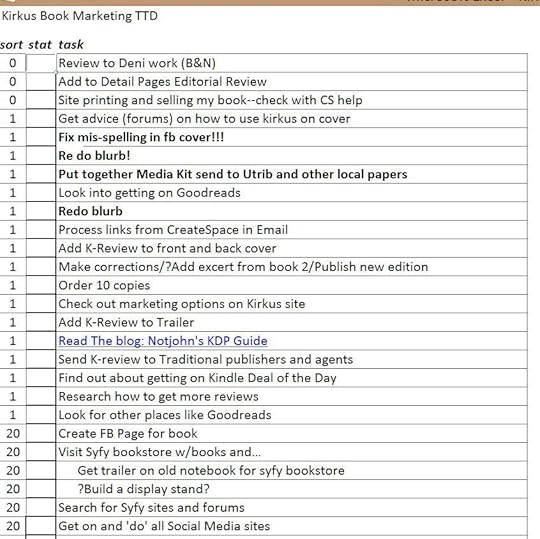
I'm showing about half the list to save space. Notice the item near the bottom 'Visit Syfy bookstore w/books and…' . Here I've placed sub-tasks which are intented. When I reach a task that has a lot of steps I create these sub-tasks mainly to remind me where I'm at with the main task. I often jump around multi-tasking and find I need to leave a task for an extended length of time so this tracks where I'm at when I return to it.
I'll get better at blogging as I go, promise.
Rusty Williamson
Continuing from my last post... Now that I have a framework to put and sort tasks I need to figure out what those tasks are. I know a lot of them so I just enter those with no regard to order. Then I search the sites I know of--Direct Publishing and CreateSpace--and also go to their community forums and post there asking basically 'what do I do' and ask the same question of support. There are 'how to' ebooks and blogs on marketing your book and I read through these. Along the way I'm adding to my list. When I see I'm reaching the end of what I can consult right now I then fill in the 'sort' column using 0-9, 0 being the items I'll do first. In assigning these numbers I consider importance as well as how long the item will take to do. For instance 'adding the Kirkus review to my Amazon book detail page' won't take much time but 'add kirkus review to trailer' will take perhaps two weeks so I will put this off while I knock out quick and easy stuff first. After filling out the sort column I sort my list.
My list now looks like this:

I'm showing about half the list to save space. Notice the item near the bottom 'Visit Syfy bookstore w/books and…' . Here I've placed sub-tasks which are intented. When I reach a task that has a lot of steps I create these sub-tasks mainly to remind me where I'm at with the main task. I often jump around multi-tasking and find I need to leave a task for an extended length of time so this tracks where I'm at when I return to it.
I'll get better at blogging as I go, promise.
Rusty Williamson