
Gretchen Griffith's Blog, page 2
May 11, 2025
Poetry Workshop
Hip! Hip! Hooray for Foothills Writers! I love this group of motley authors! We are a strange mix that has come together with one goal in mind...become better writers. We were featured in the March issue of Our State magazine, that's how established we are. Now we are going to have a delightful event, a poetry reading under the gazebo...picnic shelter really, but gazebo sounds so much more poetic!

We meet regularly on Wednesdays at the museum in Gamewell and share the good times of publishing and sympathize with the not-so-good times of rejections of someone's latest submission. After a meet-and-greet (and eat) time, we rattle our brains and warm up our typing fingers with a six-minute prompt. The topics we address come from out of the blue and have taken me into spaces I never would have imagined I would be. We share our compositions with each other, if we wish. Or not. Some are so personal that we don't want to hear our words spoken aloud.
After these preliminaries, the leader of the day presents a writing-related lesson. During the month of April, three of us per session taught about one form or another of poetry...in honor of Poetry Month. One person chose ballads. Another did open verse. One did a variation of haiku. Another did conversational poems and on a different day did Taurograms, where each word in the poem starts with the same letter, not an easy task if I say so myself. I signed up for three different dates to teach and looked through the list of varying poetry formats to find the styles that I wanted to share. I need structure as I write, so I looked for poetry that had a cadence and a rhyming scheme...like a cinquain. I had actually studied that in school somewhere along the way. Five lines. Varying rhymes - ABAAB; ABABB, any combination of words that rhyme. For my other class sessions, I wanted something eccentric, something so unusual it would make a fun time. Both of the ones I selected were from the Welsh tradition. Those poets really know how to complicate life in a most interesting way.
First I chose the Cyhydedd Fer poem structure. This is a poem made up of couplets, pairs of rhyming lines, which attracted me to them in the first place, but, and here's the kicker, each line must have eight syllables. Not so difficult, once I learned how to pronounce the name. We meet in a museum and are surrounded with mannequins displaying uniforms...military, sports, Scouts. I assigned everyone to imagine the person who once wore those uniforms and write a Cyhydedd Fer to tell a story. What we came up with!
On a different week, I taught another poem format I couldn't pronounce...will I ever learn!! This one was a clerihew, a more recent poem structure with a four-line AABB rhyme scheme, comical or whimiscal themed, and about a noted person. First we all wrote about the same person, Edgar Allen Poe. The fact that Edgar had so many variations was a testament to the wide range of brain philosophers in our Foothills Writer's group. Next I had everyone trace a six degree of separation from a famous person to themselves (think Kevin Bacon) and then write a clerihew about it. What fun!
Now we want to share the product of our labors with you. We invite you to celebrate with us this Wednesday afternoon, May 14, one o'clock at the Gamewell Walking Park. No telling what you will hear!

Catch of the Day,
Gretchen
PS There will be food!


April 18, 2025
The Eighteenth of April
If you want to know what generation someone is, just start reciting Paul Revere's Ride by Henry Wadsworth Longfellow. If they continue reciting it after you finish the second line, they are a Boomer. We are the ones who believed every myth and exaggeration our teachers told us. Did George really chop down a cherry tree? Did Abe really help his brother make footprints on the ceiling? Did ole Dan'l really kill a bear with his bare hands? Did Paul Revere really shout, "The British are coming! The British are coming!" as he spread the alarm?
I don't know about the first few questions, but since America250 is upon us and so is the eighteenth of April, I decided to investigate Paul and the claims made about him. Henry Wadsworth Longfellow immortalized this act of patriotism in his classic poem (the bane of schoolchildren of my era), Paul Revere's Ride. Check it out on this site, the real story. The facts weren't like I remembered. It was more like history vs literature. Longfellow took liberties with history in order to make a good story. "One if by land and two if by sea, and I on the opposite shore shall be." Not accurate. Close. Two lanterns only before Paul stopped off at his house and picked up his boots before he took the rowboat to ride to the other shore. In 1931, artist Grant Wood painted The Midnight Ride of Paul Revere. He said the poem inspired him. I wonder if he also had to memorize it.
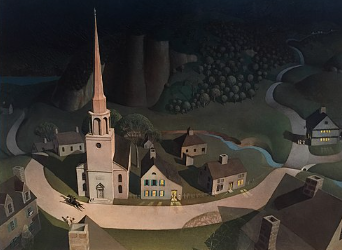
All this is leading up to the celebration of America's fight to be free two hundred fifty years ago. I've been surprised at the number of people who had to memorize it from top to bottom. I didn't go all out. I learned enough to count for credit and then stopped. Reading through it now, however, I wish I had continued. It graphically describes each stop along the way, the passion of the people, and the desperation in the countryside. A must read!! I'm posting the full poem at the bottom of this; no copyright since it was published well over a hundred years ago. Give it a read...and a memory test. You'll be glad you did.
Catch of the day,
Gretchen
Paul Revere's Ride
The Landlord's Tale
HenryWadsworth Longfellow
Listen,my children, and you shall hear
Ofthe midnight ride of Paul Revere,
Onthe eighteenth of April, in 'Seventy-five;
Hardlya man is now alive
Whoremembers that famous day and year.
Hesaid to his friend, "If the British march
Byland or sea from the town to-night,
Hanga lantern aloft in the belfry arch
Ofthe North Church tower as a signal light, --
One,if by land, and two, if by sea;
AndI on the opposite shore will be,
Readyto ride and spread the alarm
Throughevery Middlesex village and farm,
Forthe country folk to be up and to arm."
Thenhe said, "Good night!" and with muffled oar
Silentlyrowed to the Charlestown shore,
Justas the moon rose over the bay,
Whereswinging wide at her moorings lay
Thesomerset, British man-of-war;
Aphantom ship, with each mast and spar
Acrossthe moon like a prison bar,
Anda huge black hulk, that was magnified
Byits own reflection in the tide.
Meanwhile,his friend, through alley and street,
Wandersand watches with eager ears,
Tillin the silence around him he hears
Themuster of men at the barrack door,
Thesound of arms, and the tramp of feet,
Andthe measured tread of the grenadiers,
Marchingdown to their boats on the shore.
Thenhe climbed the tower of the Old North Church
Bythe wooden stairs, with stealthy tread,
Tothe belfry-chamber overhead,
Andstartled the pigeons from their perch
Onthe somber rafters, that round him made
Massesand moving shapes of shade, --
Bythe trembling ladder, steep and tall,
Tothe highest window in the wall,
Wherehe paused to listen and look down
Amoment on the roofs of the town,
Andthe moonlight flowing over all.
Beneath,in the churchyard, lay the dead,
Intheir night-encampment on the hill,
Wrappedin silence so deep and still
Thathe could hear, like a sentinel's tread,
Thewatchful night-wind, as it went
Creepingalong from tent to tent,
Andseeming to whisper, "All is well!"
Amoment only he feels the spell
Ofthe place and the hour, and the secret dread
Ofthe lonely belfry and the dead;
Forsuddenly all his thoughts are bent
On ashadowy something far away,
Wherethe river widens to meet the bay, --
Aline of black that bends and floats
Onthe rising tide, like a bridge of boats.
Meanwhile,impatient to mount and ride,
Bootedand spurred, with a heavy stride,
Onthe opposite shore walked Paul Revere.
Nowhe patted his horse's side,
Nowgazed at the landscape far and near,
Then,impetuous, stamped the earth,
Andturned and tightened his saddle-girth;
Butmostly he watched with eager search
Thebelfry-tower of the Old North Church,
Asit rose above the graves on the hill,
Lonelyand spectral and somber and still.
Andlo! As he looks, on the belfry's height
Aglimmer, and then a gleam of light!
Hesprings to the saddle, the bridle he turns,
Butlingers and gazes, till full on his sight
Asecond lamp in the belfry burns!
Ahurry of hoofs in a village street,
Ashape in the moonlight, a bulk in the dark,
Andbeneath, from the pebbles, in passing, a spark
Struckout by a steed flying fearless and fleet:
Thatwas all! And yet, through the gloom and the light,
Thefate of a nation was riding that night;
Andthe spark struck out by that steed, in his flight,
Kindledthe land into flame with its heat.
Hehas left the village and mounted the steep,
Andbeneath him, tranquil and broad and deep,
Isthe Mystic, meeting the ocean tides;
Andunder the alders, that skirt its edge,
Nowsoft on the sand, now loud on the ledge,
Isheard the tramp of his steed as he rides.
Itwas twelve by the village clock
Whenhe crossed the bridge into Medford town.
Heheard the crowing of the cock,
Andthe barking of the farmer's dog,
Andfelt the damp of the river fog,
Thatrises after the sun goes down.
Itwas one by the village clock
Whenhe galloped into Lexington.
Hesaw the gilded weathercock
Swimin the moonlight as he passed,
Andthe meeting-house windows, blank and bare,
Gazeat him with a spectral glare,
Asif they already stood aghast
Atthe bloody work they would look upon.
Itwas two by the village clock
Whenhe came to the bridge in Concord town.
Heheard the bleating of the flock,
Andthe twitter of birds among the trees,
Andfelt the breath of the morning breeze
Blowingover the meadows brown.
Andone was safe and asleep in his bed
Whoat the bridge would be first to fall,
Whothat day would be lying dead,
Piercedby a British musket-ball.
Youknow the rest. In the books you have read,
Howthe British Regulars fired and fled, --
Howthe farmers gave them ball for ball,
Frombehind each fence and farm-yard wall,
Chasingthe redcoats down the lane,
Thencrossing the fields to emerge again
Underthe trees at the turn of the road,
Andonly pausing to fire and load.
Sothrough the night rode Paul Revere;
Andso through the night went his cry of alarm
Toevery Middlesex village and farm, --
Acry of defiance and not of fear,
Avoice in the darkness, a knock at the door,
Anda word that shall echo forevermore!
Forborne on the night-wind of the Past,
Throughall our history, to the last,
Inthe hour of darkness and peril and need,
Thepeople will waken and listen to hear
Thehurrying hoof-beats of that steed
Andthe midnight message of Paul Revere.
March 22, 2025
An Interview with Author Carol Baldwin
There's a new book in town. Half-Truths. Although it was designed for teens, this novel by Carol Baldwin should be read by every adult in America. It is a powerful narrative of a history that we often push under our carpet of shame. It takes the reader into the Jim Crow fifties of Charlotte and Tabor City, North Carolina. It's the story of my youth, even though I lived through it in another city. After I finished reading it, I told her it could have been named Hard-Truths, because it told facts that were hard to hear.

I asked Carol a few questions, mostly from a fellow author's point of view. Here's our discussion:
Setting is so important to the unfolding of action in Half-Truths. Why did you write about actual towns rather than create fictional ones?
When my children were young, they always asked me if something was "real" in a book they were reading. I think it adds a deeper dimension to a book when the reader realizes that a place or person is "real." Since I wanted to explore what life was like in Charlotte before civil rights, I never thought of placing the story elsewhere. That option was suggested to me but I felt as if it would take away from the reality of what life was like in Charlotte. After that decision, it only made sense that I would find a "real" place where Kate grew up.
And how about the editors of the newspapers? Did I read somewhere that they were real as well?
Horace Carter, the editor of The Tabor City Tribune, was a very real force in Tabor City, NC in the early fifties. A UNC graduate, he started a paper in this North Carolina tobacco town that's across the border from South Carolina. In his thirties he won the 1953 Pulitzer Prize for his reporting on the KKK.
Speaking of newspapers, the way you start each chapter with a "ripped from the headlines" clip is fascinating. What do you think those add to your story?
Thank you, I'm glad you like them. I actually borrowed that technique from Kathleen Burkinshaw; that is what she did in her middle-grade book, The Last Cherry Blossom. I think it adds another layer of authenticity to the story, mirroring Kate's desire to be a journalist, as well as giving readers a taste of what was reported on and advertised during that period.
Not all were from glaring headlines. What did you change in those cases?
I wanted as many real headlines as possible but sometimes I couldn't find what I was looking for. That's one reason I would create a headline. The other reason is that I wanted to show how the local newspaper, The Charlotte Observer, reported on social events, like Kate's luncheon or the May Day parade.
You had to have done mountains and mountains of research. Where did you go for your information beyond back issues of newspapers?
I consulted a lot of books; this is a picture of just some of them.

Since I'm White and was writing about a Black girl who was light-skinned, I read several books about being biracial. I also read several MG and YA books with Black protagonists. You can find a list of my blog posts which include books I read here. I also conducted several books and online articles about Charlotte, the South, goats, tobacco, the KKK and just about everything in the book! I interviewed close to a hundred people who either lived in Charlotte during this time or had family that did. Many of their stories are threaded through Half-Truths.
Much of what you researched must have been hard to read. Did you ever turn away because you couldn't go into that darkness?
No. Some of the books about what Blacks experienced were difficult and painful to read. But I suppose there's a journalist in me, too. I wanted to report the way life really was.
Did you develop Kate's desire to be a reporter from all your research?
Interesting question. Early on I saw her as wanting to be a photographer for the school paper, but then I realized that I knew a lot more about writing and could write that with more authenticity.
The goat. I must ask about what part it played in developing your characters. Could the story have been the same with only the dog?
Ha Ha! In early drafts, I had only a dog who disrupted her luncheon. Eileen Heyes, an author friend of mine, said that everyone had dogs in their stories and I needed something different! I hit on a goat and it fit. Initially, I even named her Eileen, but then I realized that name was too close to Lillian.
Kate's fellow students in both towns were so real to me. Did you dislike any of them but included them anyway? If so, then why?
Yes, I'm not too keen on Hank and Lola Mae in Tabor City, but I needed to show the atmosphere of the town and how racism had been passed on to young people, too. I'm also not a fan of Kenneth. Many girls have met boys like him. They need to see how Kate's mother says, they can be "loose cannons."
Authors often slide in a homage to people or events or places from their personal lives. Tell us about something you might have included.
My mother was a painter. I didn't even realize that I had modeled Nora Jean after her until I described the painting she gives Kate. My mother also loved to paint gladiolas! Vermelle, Lillian's mother, is named after Vermelle Ely, one of my Black experts, who although she is blind, was the first to "read" Half-Truths. She had her phone read it to her!
I read that writing this took eighteen years for you to go from day one blank page to publication. How did it change over that time?
Another great question. There were many outlines and drafts. Since the period is the Jim Crow South, I knew there were racial issues that would be addressed. Over time I realized that most of that racial struggle was not my story to tell. As a result, Half-Truths became more about Kate's journey to find her voice as a budding journalist rather than a book about race relations.
What stories did you uncover that you would like to have written into the book but chose not to?
There are too many to count!
Could those be for future books? Will we see more of Kate or Lillian?
I don't have another book in mind for Kate and Lillian, but you never know. My next book takes place fifty years earlier and it's about Kate's grandfather as a thirteen-year-old glassblowing apprentice in South Jersey.
Oh, my goodness, Carol, that sounds fascinating! I can't wait to read it! I can only imagine the research you have ahead of you. Thank you for taking the time to share a part of your writing process with us. I'm so glad I had a chance to ask questions. I can't wait for everyone to read her book. Half-Truths comes out in April, so please be on the lookout for it.
If you want to add your name to my drawing for a free book, post a comment below. I will draw the winner on April 12 so please make sure I have a contact email address in case you are the lucky winner of this book.
Also, anyone who preorders now on Barnes and Noble, can send their receipt to Carol for a courtesy swag! Contact her through her website.
Catch of the day,
Gretchen
March 13, 2025
Important to Read
Sometimes books are hard on me as a reader. They bring tears. They cause deep thinking. My stomach churns. Time stops while I digest what just went into my brain and deep into my soul. Two recent books I read set me back a step or two: The Nightingale by Kristin Hannah and Half-Truths by Carol Baldwin. As with real estate's location, location, location, literature has setting, setting, setting. Both of these books are historical fiction set in a time period that could not have happened in any other era, (please God), France during World War II and North Carolina during segregation.
This morning I came to the final Nightingale page, in tears I might add. This book is a tale of man's inhumanity to man...and woman. Yes, I had heard of the Holocaust, studied it in a superficial way, read other historical fictions, but not until I read The Nightingale did I really feel the horror on a character level. It was all about women and their resistance to Nazi takeover of their lives. It didn't end well for most of the characters, yet all was well in the end, at least as well as it could be.
I seek out books about strong women, and the women in this book were indeed strong even though they lived through a starvation that weakened them, or maybe because of it. They stood up to impossible odds and when one particular character was liberated from the evils of a concentration camp at the end of the war, she said something to another that stuck in my mind: "We made it." I've said those words before at the top of a mountain or at the end of a long road trip, but this...this was different. They survived not only brutal, unimaginable tortures brought on them by a merciless invasion, they helped others survive and escape. They hid children. They guided downed British and American pilots to freedom. All while risking their own lives. Indeed, they made it!
I'm an author. I read like an author now, and I wanted to know the back story of this book, how Kristin Hannah came to write such a gripping saga. She told us at the end of the copy I had, explaining her discovery of the part women played in the European War, how it touched her into giving them a voice. She researched. She interviewed. She visited the sites she described and the Holocaust Museum. She turned her findings into a superb book, important to read...lest we forget and repeat.
This could not happen in America, I thought to myself. We wouldn't let people minimize others so much they thought of them as nothings. And then I remembered Carol Baldwin's book about the south during the Jim Crow days, days that I lived through myself. Days that happened on another continent before, during and a decade after the Germans were defeated. Days filled with Ku Klux Klan rallies and lynchings and cross burnings.
This book had a strong woman, too, except that she was only in junior high school. She was just learning the inequities of Jim Crow and saw what it was doing to the black society that lived parallel to, but apart from her. I had read this book like a writer also. I was drawn to it by the main character, a white girl, who wanted to be a newspaper reporter and tell about what she saw.
I know this author, Carol Baldwin, so I sent her a list of questions to find the back story of how she came about writing it, how she structured the telling of a very difficult subject. How she herself felt after spending long hours interviewing, researching and uncovering unthinkable actions against fellow humans. Again, important to read...lest we forget and repeat.
Next blog post, I'll share her answers.
Catch of the day,
Gretchen
February 23, 2025
Hard Truths
I usually fill my blog posts with pictures I've taken to showcase our wonderful foothills of western North Carolina. Not this time. This time I want to share a part of the state not mentioned in tourist magazines.
There was an underbelly of society that preferred to stay hidden when I was a white child growing up in a segregated community, and I've recently been reminded of this fact through a book I read. I'll talk about the book in a future post. I want to preface it with my own experiences.
I'm talking about the KKK. The Klu Klux Klan.
I had no idea of its existence when I was in grade school. Life was just peachy. We had our school. The black community had theirs. It's the way it was. Our bus passed the black kids waiting in line for their bus. There was no interaction except the normal back of the bus meanines who screamed less than nice jeers out the window while the rest of us (including me) snickered. I drank from the correct water fountains. I entered the theater through the front door while black children entered through the side. I was too caught up in my own world to question things.
I don't remember many individual sermons preachers preached to me, the ADHD kid before it was ever a diagnosis. I was labeled squirmy. But the Sunday before school started when I was in sixth grade, Rev. Crawley spoke to us from his heart and I listened. It was the day before school integration at a time when people were pulling their children out of public schools and heading to church-sponsored schools. He was announcing that his son would be sitting in the classroom with black children the very next day. His Christian faith led him to stand up and speak out. About fairness. About Jesus loving all the children. My conscience began chipping at me.
My senior year in high school, a boy at my lunch table bragged that he was going to a klan rally the next Saturday night. We laughed about his plans to grab a sheet out of the linen close on his way sneaking out the door. I joined in the giggles, a little uncomfortable, but not enough to stand up and speak out.. It was the thrill of it all. The shrouding. The slinking. Monday he didn't offer much commentary other than he was not going back.
Years ago the husband of a friend of mine told me he wanted to attend a KKK rally that was planned in his neighborhood. I had some suggestions.
"Don't let them know you are from up north."
"Why not?"
"They might think you are a carpetbagger. And don't let them know your last name is Polish."
"I like my last name. Why wouldn't they?"
"They don't think you are American." I watched him shake his head in disbelief. "And don't let them know you are Catholic."
"Are you kidding me?"
"Just who do you think these people are? They look for someone to hate and if you are not one of them, then you will be convenient to turn on."
So he went to the rally. No one wore a sheet, which disappointed him. He said they just sat around and complained about the Mexicans taking their jobs. He didn't offer much additional commentary other than he was not going back.
For both of these guys, the thrill turned into slime. They felt dirty.
This post isn't rosy. I needed to write it to begin the conversation about kindness and goodness replacing hatred, and I see hatred growing in this world. Strong hatred that, if not checked, will cause us to turn against ourselves and eat at us.
Stop the madness!
Catch of the day,
Gretchen
January 12, 2025
A New Door Opens
Things don't always work the way they started out. Take for example, my experience with KindleVella. The concept seemed foolproof, offer online books a bit at a time. Serial writing. Charles Dickens did it using newspapers as his format. Vella offered the same to authors like me. Upload episodes so the reader can taste a bit at a time. Sounded like a plan to me.
But this is not London in 1849. It's America in 2025. We are instant gratification people. We don't like waiting.
KDP of Amazon, Vella's publishing company, learned this the hard way. I received a notification from them that they were ceasing this publishing format. I was given options for my Vellas. One Vella I will not republish, but the other, my passion piece, I moved over to their ebook system. It's too dear to my heart to let it die. It's my memoir.
Or sort of.
You'll find more about others in my life than you will about me. I was unfortunate enough to be born in the midst of a tragedy. I'd heard the story my entire life and always wanted to learn more about it. I began researching a couple decades ago, put it to the side, and when Vella became an option, I sprang back into action and finished the project. I had no intention of offering it in any other platforms, but here we are. When one door closes, another opens. And here it is.
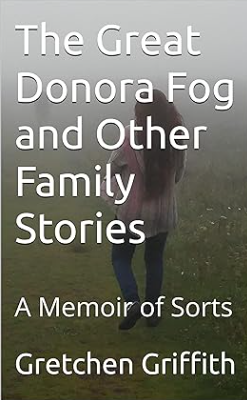
When I was designing the cover, I thought about using a picture of smog since that was the gist of the tragedy. Yet I didn't want something depressing because people are steadfast and resilient when they face challenges. That's what I wanted to get across in this book. I settled on fog, not only for the cover picture, but the title. It's actually the Donora Smog story. Industrial smokestacks did that, and I'm not giving that more credit than it deserves, hence fog, not smog.

Here's the picture I selected. It's my daughter following my husband into the fog at a beautiful spot on earth known as Max Patch. I took this photo several years ago and when the time came to find a cover picture, I knew it was the one. It's an homage to the family I have now and to those the stories are about. There are some good stories from my extraordinary family tree. For a mere $2.99 you can see what I'm talking about. Download from Amazon and give it a read. Click over to this: The Great Donora Fog and Other Family Stories.
In the end, changing from one ebook format to another might make it simpler for those people like me who want the whole book at once rather than bits and pieces one week at a time. At least it didn't die in the clouds!
Catch of the day,
Gretchen
December 17, 2024
Holiday Spirit
Merry Christmas!
If I say that enough, maybe I'll get in the holiday spirit. I'm getting there. Being in the mountains with a dose of snowflakes helped me.

Does that help you?
How about this? The reason I was in the mountains, the reason for the season?
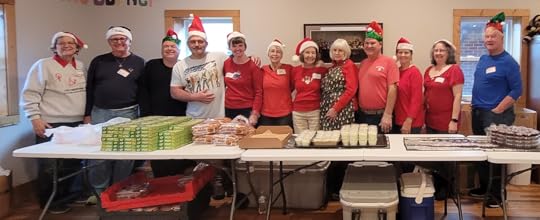
Here we are, several members of my church, me on one end, my husband on the other. The purpose of our being at Newland United Methodist Church was to serve a meal to the people of their small Appalachian town. Hurricane Helene tried to squelch the joy of Christmastide. She might have walloped a blow, but she didn't destroy the spirit of recovery. Helene arrived in late September, so by now the immediate needs of the mountain communities have been patchworked enough to get by. What the people need now, now that winter is setting in, is sustained support that warms their hearts as well as their tents or damaged homes. A good, warm lunch fits the bill.
The Western North Carolina Conference of the United Methodist Church has worked tirelessly to aid in recovery. Many of our own churches were damaged, yet we reached out to others first, to assist in any way we could. For years congregations across the area prepared flood buckets and sent them off to hurricane-stricken areas, never imagining we would be the ones who one day needed them. Helene struck on a Thursday night. Here we are the following Monday, in the dark from lack of power, packing flood buckets to send.
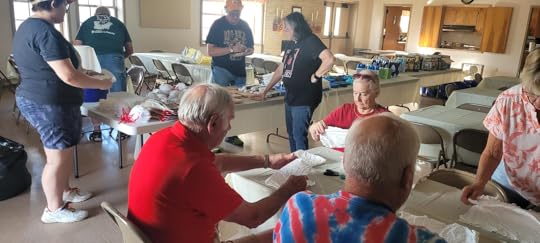
So many of us worked with our neighbors to clear brush and remove downed trees from roofs. We checked on each other and took meals to those who had no electricity. Our minister called each member of our congregation for a wellness check, asking what we could do to help them recover. One member pulled a trailer stuffed with clothing and household items we collected to Asheville, the largest city that Helene devastated. Another collected hay for farmers who lost their supply to the floods. Another delivered wood to a Tennessee state park for the locals without heat to help themselves to a wood supply.
Happy birthday Jesus. This is our church's present to you this year. Matthew recorded your comment about this in chapter 25, verse 40:
Merry Christmas to all,
And the King shall answer and say unto them, Verily I say unto you, Inasmuch as ye have done it unto one of the least of these my brethren, ye have done it unto me.
Catch of the day,
Gretchen
October 19, 2024
Recovery
On the list of things I never thought I'd see in my community, a FEMA disaster recovery center sign ranks up there at the top.

I thank God that I do not need to stand in line for hurricane recovery assistance. We never lost electric power, so I didn't suffer like many around me. I don't drive the back roads of the county, so I have no idea of extended damages. I listen to others tell their stories, and yes, even though we are on the edge of major destruction and not as broken as the counties farther west, our people need help.
 For several weeks I have heard helicopters flying over my house, like the one I hurried outside to capture in this photo. These metallic birds of paradise were taking things to other, more needy places. But not to us. We have been helping those more hurting than ourselves. My community is taking survivors food, clothing, and flood buckets, and now blankets and wood for heat since the first snowfall has graced our beautiful mountains in the past few days.
 I've been so concerned about those in the mountains that I ignored my own back yard...people who lost their homes due to trees landing on their roofs...people who had no water because the electricity was off, and therefore their well's pump couldn't operate...people who lost everything in their deep freeze (that was my mother's words for the big, white box in our basement). We are a rural community. This time of year, our freezers are filled to the brim with summer harvests and butchered cows, but the joy of eating the fruits of our sweat-filled labor just won't happen this year for some of us. Food prices are high enough, so my friends who depended on saving money through home-grown deliciousness will not have that to fall back on to stretch the weekly paycheck. FEMA, those people DO need you. Thank you for being here.

As we drove past the main entrance of the county health department (FEMA ground zero) to loop around and take these pictures, I saw a line of cars waiting for the clipboard-bearing workers to bring forms to them. Sad occasion. My heart goes out to them. This, the extension of government for the people, is necessary help for those who are desperate. Tax money at work.
Catch of the day, Gretchen
October 7, 2024
Lingle School
Much of what I write on this blog is about western North Carolina and its beauty, its history, its people. The world has seen all this melt away in one evil swipe from Hurricane Helene. My husband and I were fortunate that we had no trees crush our cars or power lines fall in our street. We didn't lose power, only cable and internet for five days, mere inconveniences compared to what I saw on the news.
On the third day after the hurricane hit, we ventured out. Our aim was to check on Tuttle State Forest, which we had heard through the facebook grapevine, had sustained major damages. Saddest of all I saw was this schoolhouse.

This is/was Lingle School, established 1867. It was renovated and placed at the state forest for display and safekeeping. Imagine the hurricanes this building weathered in its span of existence. Until now. A tree found its way down and landed square on the roof. With the accompanying deluge of rain, the inside artifacts were damaged. Hopefully some can be salvaged, but for now, no one dares enter the building.

This view shows more damage, but note that the well beside the schoolhouse survived quite well, as well as a well could do. So did the outhouse behind the school...both well and outhouse are non-functional, only for educational purposes.

Not so fortunate, however, was this construction outhouse, that was, on the day before the hurricane, quite functional.

Tuttle Educational State Forest is in the process of adding a full size classroom building. Fortunately, it had little damage beyond the outhouse beside it for construction workers.
Losing Lingle School is sad, but in the wider scope of the extreme losses in the region, it is a small sadness. No one was killed. No one was injured. The history of the school is preserved in other venues. Perhaps the building called Lingle School will be salvaged to rebuild. Perhaps not. For now, we wait.
Catch of the day, Gretchen
September 4, 2024
Uplift North Carolina
Thank you Uplift North Carolina for your support of the Gamewell History Museum. I was present yesterday when Justin Vertefeuille, a videographer working with Uplift NC, visited the museum where I have been volunteering.

In our preplanning stage, I developed a list of shots I wanted him to take in order of priority. How to decide what was more important to our town's history than another, I never figured out, but I made a stab. School wall? Sport center? Veteran display? Family history notebooks? He filmed it all both inside and outside our beautiful one-room museum. We do pack a lot in there.
With the input of many others, I wrote the script to voice over the video. We were limited to ninety seconds. How could I get an overview of two hundred-plus years into ninety seconds!!! I had timed it by reading the script aloud and had to cut out a great deal. I didn't realize I would be the one actually recording it, but I was. The museum itself is located beside a busy five-lane highway, so the noise level was too distracting. Instead, we went inside the town hall into the conference room, which was practically soundproof, and recorded there. The first taping came in six seconds too long, the second three under.

So it's a done deal and in the hands of the editor. When it is finished, I'll post it here for you all to view. I can't wait.
Catch of the day,
Gretchen


