A.C. Flory's Blog, page 51
February 19, 2021
Timing in fiction…
There are actually two types of timing in fiction – the pace of the story and the passage of time in the story. They are not the same.
Pace has to do with how quickly one event follows the other. For example, in an action story, events tend to follow each other like a ten car pile up, with very little ‘slow’ time in between. On the other hand, in character driven stories, the action is always precipitated by some kind of internal motivation. For example, the serial killer had a rotten childhood and maybe has a flashback prior to choosing their next victim, who may bear some resemblance to their childhood tormentor. Or you could have a more literary style story where the motivation is the story and the action, what there is of it, simply illustrates the character of the protagonist. In these kind of stories, the pace is generally slow, but the immersion is deep.
By contrast, the passage of time in a story has nothing to do with the characters. It’s all about how the Reader perceives the passing of time.
One oft used technique is to provide the Reader with actual dates. For example, in the short prologue to Miira, I used the date and title of the news article – ‘September 22, 2101 – Three dead in Stradwick‘ – to place the Reader squarely in the future. I did something similar at the start of Nabatea – ‘…the voice of the AI seemed unnecessarily loud as it confirmed brain death at 1:46 pm, Sunday the 25th of December, 2101.’ but I was a little sneakier about it.
And that provides me with a neat segue into why writers shouldn’t use dates too often – they don’t always work. I’m pretty sure the date of Alex Tang’s death would have registered with Readers, but I suspect most people would have skimmed over the date at the very beginning of book 1.
A far more effective way to show the passage of time in a story is to make the Reader feel it. Yes, I know, easier said than done. Before the evolution of the current fast paced, smack ’em first and smack ’em hard style of writing, authors used to be able to get away with things like:
And two weeks later, Joe Bloggs did XXXXTwo years before, when Mary Bloggs did XXXXX etcThere is a place for this kind of technique, but it is [excuse the pun] dated. A more cogent reason not to use it is physiological; the human brain builds memories by creating multiple connections to them. Teachers know this by the name of ‘repetition’. The word strikes terror into the hearts of all students, but repetition does not have to be dull and boring.
Want the reader to see your Main Character as blond and blue eyed? Then show them, every now and then, by some oblique reference that may not register at a conscious level but will register at the level of the subconscious. I sometimes think of this kind of gentle, subtle repetition as painting a portrait in layers of colour and shape and edges. As writers, we have to apply those layers using words instead of paint, but the building of layers remains the same.
Making the Reader feel the passage of time is a bit more complicated than building the image of a face, but changing the chapter and the POV [Point of View] acts as a circuit breaker. The steady, sequential flow of events stops, and the Reader is suddenly elsewhere, looking out through someone else’s eyes. When the story eventually returns to the first character, there is a sense of distance, of time having passed…as in fact it has.
But be warned, constantly jumping from one character to another can be incredibly disorientating. Yes, there may well be a sense of time having passed, but the technique could also cause a nasty case of confusion. Changing the POV just to simulate the passage of time is not such a great idea. Simulating time should be one of many different techniques used to tell a story with the Reader in mind. What does the Reader need to know and what is the best way of presenting that information?
I like using multiple POVs, but I know that some of you prefer to tell stories from the perspective of just one character, so I’d love to know how you tackle the problem of time.
cheers
Meeks
p.s. the free period for Nabatea ends tomorrow at midnight, February 20 for Northern Hemisphere people, or about 6 or 7pm February 21 for Southern hemisphere bods. 
Apologies if I missed your local Amazon website.


February 17, 2021
Some new music via Soundcloud
To hear any of these tracks, just click the bright orange button.
First up is a piano piece that I’ve fallen in love with, not just because it’s great writing music, but because the piano is ‘my’ instrument. It’s the instrument I studied for ten years, and it’s the one I wish I could play as well as this.
The second track, also by the same composer, is called ‘Vampire’. I know vampires are supposed to be scary, but this tracks seems more like an exploration of contrasts, inner and outer. Or perhaps the conflict between appearance and reality. It works perfectly for the character of Death in the second Vokhtah book. Death is a Healer on the outside, but inside it still has the loyalties and instincts of a Trader, traits it must never, ever reveal. A bit like Kenneth Wu, actually. It seems as if I really do like tortured characters:
Composer: Lucas King Song title: VampireThe third track is a more typical, ‘epic’ piece for orchestra and choir. It’s wild and aggressive with hints of an ‘Arabian’ theme coming through. Again, perfect writing music for high octane moments:
Composer: Samuel Kim Song title: BeastAnd to finish up a youtube video you may like. It shows how composer Samuel Kim – who appears ridiculously young! – brings in and controls the tracks or ‘threads’ of his compositions. Each new ‘line’ represents a new instrument or voice. I assume he must have created each track separately, but how did he hear them all as a complete orchestration? The nerd in me is jumping up and down with excitement.
I hope you enjoy these tracks as much as I do!
cheers,
Meeks
February 16, 2021
Nabatea, book 3 of Innerscape…it’s free!
Just checked the amazon.com website and the ebook of Nabatea is now officially free:

Nabatea will remain free until February 20, 2021. Please grab a copy with my compliments. 
cheers
Meeks
February 14, 2021
My Favourite Bits…Nabatea
Due to the difficulty of finding excerpts that don’t give too much away, I’m only going to post one favourite bit from Nabatea, and this is it:
The control room of the Innerscape facility was hushed as all eyes watched the numbers counting down on the wrap-around wall monitors.
“Any second now,” the duty tech said softly.
Standing right behind the tech, Phil Jacobs could see for himself that Alex Tang, murdered two days before by Kenneth Wu, was finally breathing his last.
The AI and specialist medical teams had done their best, but the outcome had never really been in doubt. It had simply been a matter of time. Now, all the monitors focused on Alex Tang’s vital statistics told the same story – he had put up a heroic fight, but the battle was almost over.
Relief and sadness jostled for position in Phil’s mind as he stared at the heart monitor.
“Flatline,” the duty tech said, his voice almost drowned out by the bleep of the alarm.
The heart monitor was joined a moment later by the Brain Interface Monitor.
Patting the tech on the shoulder, Phil signalled for the alarms to be turned off. In the sudden silence, the voice of the AI seemed unnecessarily loud as it confirmed brain death at 1:46 pm, Sunday the 25th of December, 2101.
Merry Christmas, Phil thought as he affixed his biometric signature to the death certificate.
“Inform the police forensic team that death is confirmed.”
“Yes, sir.”
Glancing up at the wraparound screen, Phil watched as the yellow-clad technicians waiting in the Catacombs sprang into action. They, too, had been waiting for Alex Tang to die, and now that he was gone, they were free to take possession of his containment unit…with him still in it.
Once the unit was disconnected, the forensic team would put it inside one of their huge Hospice trucks and take it away for examination.
“I don’t get it,” the duty tech said as he watched the frenzied activity on the central monitor. “Why all the portable batteries? It’s not as if they need to keep him alive during transit. And why take his AI as well?”
“They probably don’t want to miss anything,” Phil replied, his tone bleak.
“But we already know how he died.”
“No one’s ever been murdered by the common cold before,” Phil replied, his eyes never leaving the monitor. “So this is all new territory. And they don’t trust our systems.”
In fact, the police had found a great deal not to trust, from Innerscape’s reliance on the AI to Phil’s own handling of security.
“Dr Jacobs, can you explain why you didn’t revoke Dr Wu’s permissions when he left Innerscape?”
Just thinking of that interview made Phil’s ears burn hot. He had been forced to explain that, as Kenneth had not, technically, been fired, he could not, technically, have his permissions revoked. It had even, technically, been true as the AI did assign security permissions automatically, based on the employee’s position in the company.
What Phil had left unsaid was that those permissions could have been changed manually, using the CEO’s executive override, had anyone foreseen the need to do so. But no one had.
Least of all me, he thought as he forced his eyes away from the monitors. If he had, Alex Tang might still be alive. But then again, who could have guessed that Kenneth Wu would turn rogue?

For those who have never read any of Innerscape, each patient’s body is kept in a containment unit, about the size of a large coffin. Each containment unit has its own AI whose job it is to keep the body alive and functioning. Once the patient is in the containment unit, nothing is allowed to enter the sealed internal environment because even a breath of outside air could introduce a virus or bacteria. Nothing deadly. Just the common cold. Opening the door to the containment unit is a death sentence.
Why did I choose this short excerpt from the very start of book 3? Because every time I read it, I’m surprised that I wrote it.
Since publishing Vokhtah in 2013, I’ve become a lot more comfortable calling myself a writer, but there are times when I still feel like a bit of a fraud. Me? A writer? Yeah, right. But when I read this bit I feel as if yes, maybe I do deserve that title after all.
I really like the epilogue as well, but I can’t tell you about that, or about Kenneth’s grandmother, or the scent of lemon, or sensory deprivation, or a host of other things. All I can do is hope that you take a chance and read Nabatea for yourselves on February 16th when it begins its five days of free on Amazon.
cheers
Meeks
February 12, 2021
5 stars for The Godsend!
This day really couldn’t get any better. Just found this new review for The Godsend:
‘WOW the action certainly ramps up in this second book of the series. Miira and Jamie are trapped outside Innerscape and in mortal danger, there’s an assassin determined to kill The Burned Man, the falsely accused Kenneth Wu reappears, and much, much more.
Excuse me, Book 3 is calling my name – loudly…’

Click here to see the review on Amazon UK. Click the link to see The Godsend on Amazon US or Amazon Australia.
I am so happy I could pop! My thanks to the wonderful Chris Graham, otherwise known as the Story Reading Ape. Not only is this an awesome review, it would make a brilliant blurb. -dance-
Have a wonderful weekend my friends!
love,
Meeks
February 10, 2021
Ten writing rules I hate…or do I?
Elmore Leonard’s Ten Rules for writing inspired this post, but not quite the way I planned. I thought I’d hate them all. Now that I’ve actually read them, I’m in the uncomfortable position of having to admit that I agree with some of them. Embarrassing.
Before I hold forth on what I do and do not like, it might help if we all knew what those 10 rules say:
 Courtesy of https://www.writingclasses.com/toolbox/tips-masters/elmore-leonard-10-rules-for-good-writing
The site is a good resource so check it out : https://www.writingclasses.com/toolbox/tips-masters/elmore-leonard-10-rules-for-good-writing.
So, no. 1 ‘Never open with the weather’. As soon as I read this one, I immediately thought of a 19th century novel that begins with:
‘It was a dark and stormy night; the rain fell in torrents—except at occasional intervals, when it was checked by a violent gust of wind which swept up the streets (for it is in London that our scene lies), rattling along the housetops, and fiercely agitating the scanty flame of the lamps that struggled against the darkness.[3]‘
Taken from: https://en.wikipedia.org/wiki/It_was_a_dark_and_stormy_night
Now apparently this opening is considered to be a prime example of ‘purple prose’ and to be avoided at all costs because…to modern readers it is boring. As someone who grew up with the classics, I love the first phrase – ‘It was a dark and stormy night’. The rest I could do without because it’s kind of pretentious to my ears. Back in the day though, it would have been considered quite normal.
The following is the opening sentence from Fyodor Dostoyevsky’s ‘Crime and Punishment’, published in 1866:
‘At the beginning of July, during an extremely hot spell, towards evening, a young man left the closet he rented and….’
The young man in question is a student who talks himself into killing a moneylender and her sister. The story is possibly the first psychological novel ever written. So much that we now take for granted was pioneered by Dostoyevsky, and yet, gosh…he starts with the weather. Why? Because he’s actually ‘showing’ the reader the world in which the story will unfold. The problem with weather is not about quality but quantity. Too much of anything is boring.
On that basis, I give rule no. 1 a big thumbs down.
Rule no. 2 says to avoid prologues. Why? I assume because they’re considered boring by modern readers. Fair enough, boring prologues should probably be avoided, but prologues don’t have to be either boring or long, and in some stories they are almost a necessity. Which stories? Fantasy and science fiction stories because both are set in worlds that are unfamiliar to the reader.
I like throwing readers in at the deep end, but that’s a preference only. If a story needs a prologue I’ll give it one. I give rule no 2. another thumbs down.
Rule no. 3 ‘Never use a verb other than ‘said’ to carry dialogue’. Dialogue tags were discussed in Audrey Driscoll’s recent blog post so I’ll just say…”Bah humbug. Thumbs down.”
Rule no. 4 ‘Never use an adverb to modify the verb ‘said’. Mmm…this is a kind of damned if you do and damned if you don’t one. I have no problem with a few adverbs but I probably wouldn’t use one to modify ‘said’, but I reserve the right to use one if it’s really necessary.
I think I’d better give this one half a thumbs up. Or half a thumbs down, depending on your preference.
Rule. 5 ‘Keep your exclamation points under control…’ I confess, my first draft is likely to be full of these. They’re a kind of shorthand from my subconscious to the keyboard: ‘this is meant to be exciting, make it so’. After that first pass though, I try really hard to make the sentence do the work instead of the exclamation mark. As with adverbs and internal monologues, too many exclamation marks are annoying [to the reader].
Sadly, no. 5 gets a thumbs up.
Rule no. 6 ‘Never use the word ‘suddenly…’ I object to the word ‘never’. Adverbs are a legitimate part of the English language. ‘Suddenly’ is an adverb therefore banning it completely is ridiculous. It is a perfectly okay word. What’s not okay is to use it ten times before breakfast. Anything repetitive becomes boring.
I give no. 6 a thumbs down on principle.
Rule no. 7 ‘Use regional dialogue, patois, sparingly’. This is one of those common sense things: if your reader has to dig out a dictionary to understand the dialogue, you’re in trouble. Why? Because said reader is going to become bored with the whole thing, and then they’ll stop reading entirely. Notice how ‘boring’ is cropping up rather a lot?
But…I truly loathe books that avoid all patois because they think their readers are too stupid to cope with anything but standard English. That’s dumbing storytelling down to a ridiculous level.
I’m giving rule no. 7 a thumbs up because ‘sparingly’ does not mean ‘never’.
Rule no. 8 ‘Avoid detailed descriptions of characters’. -sigh- Thumbs UP. When I first meet someone in the real world, I might notice general things – tall vs short, fat vs thin, attractive vs ugly, but I cannot remember a single time I’ve noticed that her eyes were a ‘cornflower blue’ or that his ‘manly chest rippled with muscles beneath the tight fitting t-shirt’. Okay, I might notice, but it would probably be accompanied by a mental eye-roll and a ‘really?’
My point here is the same whether I’m reading about a new world or a new character – info. dumps are incredibly boring, and they don’t work because most readers either skip them or don’t retain them. So there is no point hitting the reader over the head with one. Please…just no.
Rule no. 9 ‘Don’t go into great detail describing places and things’. Thumbs UP for the same reason as rule no. 8.
Rule no. 10 ‘Try to leave out the part that the readers tend to skip’. Yes. Thumbs UP.
Of course, the real trick is to recognize those parts in the first place, especially when they involve the darlings that Stephen King tells us to kill.
As a science fiction writer, you may have noticed that I love tech. Without fail, my first attempt at writing techie stuff is way over the top. I write it for me. The next day I re-read it and ask, ‘is this really needed?’ Sometimes it is. Yay! Sometimes only some of it is needed. Sigh. And sometimes none of it is needed, or it’s not needed at that spot. Bugger. Just because we love something doesn’t mean the reader will.
And finally the last rule that rules them all: ‘If it sounds like writing…rewrite it’. Yes.
Many years ago, I began reading a story that should have been strong, powerful, persuasive. Instead, the author inserted himself and his soapbox into every line. I hate it, and the fact that I actually agreed with his worldview only made it worse. As writers, all of our material comes from within, one way or another, but that does not mean we’re allowed to hit the reader over the head with it.
The power of ‘show’ is that readers get to see and feel things for themselves. They also get to come to their own conclusions. If we try to take that away from them, they’ll stop reading. Writing is easy. Telling stories that other people want to read is hard. It’s work. We may not get it right every time, but that’s no excuse not to try.
Well, I had fun with this. What do the rest of you feel about Leonard’s 10 rules, and yes, I’m asking readers as well as writers. What makes you stop reading?
cheers
Meeks
P.S. you’re allowed to disagree with me. -looks angelic-
February 9, 2021
Laughter Lines by Sue Vincent
I just left a 5 star review for Laughter Lines: Life at the Tail End by Sue Vincent. And I still haven’t stopped smiling. The review should be up on amazon.com in a day or two, but this is what I said:
I have never been a poetry person, but there’s something about Sue Vincents poems that really strikes a chord. They’re earthy, and funny, and poignant, and paint word pictures of things we’re all familiar with. Who has not dunked a biscuit [cookie] in coffee only to have it break and fall in the cup? Such a small, every day thing, and yet Vincent makes it laugh-out-loud funny.
And then there are the poems about the author’s dog, Ani. Those ones are particularly hilarious because Ani is like every dog I have ever known and loved – affectionate, intelligent, voracious, and just a little bit cunning.
But not all of the poems are funny. Some, like the one about Valentine’s Day, speak to the meaning of love. It’s a gentle reminder that we give and receive love every day of the year, in small heartfelt ways that cost nothing and mean everything.
And that, to me, is the essence of Sue Vincent’s poetry. It’s gentle, self-deprecating and utterly human. I would recommend Laughter Lines: Life from the Tail End to everyone, even those, like me, who don’t like poetry!
What I forgot to mention in the review is how satisfying it is to read poems that rhyme! My Dad used to spout poetry [in Hungarian] when I was a kid, and every poem had a distinct rhythm to it that was both mesmerising and easy on the ear. I guess I like that kind of poetry more than I thought!
To get a taste of Vincents verses, click on the Look Inside pic below:
lol – and no, that isn’t Ani monstering someone. I think she’s actually singing…or something.
Seriously, this book is wonderful. It will make you laugh, it will lift you up, and it will touch your heart.
cheers
Meeks
February 5, 2021
Characters – how close is too close?

I just finished a scifi space opera that could have been very good, but wasn’t. A big part of the reason was the author’s over use of internal monologue. I left a 3 star review, something I haven’t done in years, and a long explanation of why I felt the story only deserved a 3, but it’s still annoying me, hence this post.
For those who don’t know what I mean by ‘internal monologue’ it’s the character, talking to herself, but not out loud, hence ‘monologue’. In books, this internal monologue is usually shown in italics, to distinguish it from spoken dialogue.
When used properly, internal monologue is a powerful tool that betrays the character’s true feelings without the author having to say so. For example, I could say:
Jane smiled sweetly at her boss, but inside she was seething with rage.
Or I could make it more ‘show’ than ‘tell’ by changing it to:
Incompetent fool! Jane thought as she smiled sweetly at her boss.
The internal monologue of the second example provides an inside-outside view of the character that can be very powerful. Unfortunately, like all powerful tools, it should be used sparingly, and only when it actually serves a purpose. The story that earned my 3 star review used internal monologue almost constantly, for the most trivial of reasons. Something like:
Jane walked into the party and surveyed the crowd. Oh my. She was familiar with most of the party goers and did not like them. Then she spotted Tom. Thank god. Someone intelligent to talk to. etc etc etc
In the actual book, sentences like this were not exceptional. They happened with monotonous regularity, even during action scenes when the last thing you want to do is slow things down.
There’s another reason internal monologue should be used sparingly – a character with too many ‘warts’ is rarely likeable. Instead, they come across as whiny and self-obsessed, or arrogant smartarses. This can also happen with First Person POV – i.e. where the character tells the story from her own perspective saying things like “I did this” and “I felt that” etc.
In fairness I have to say that while I don’t generally like First Person POV, some of my favourite stories have been written from that very close perspective. C.J. Cherryh does it with the Foreigner series, and Audrey Driscoll did it with the Herbert West series. It can be done, and it can be done brilliantly, but First Person POV requires a mastery of the tool that far too many new authors do not possess.
The author of that 3 star story did not use First Person POV. Instead, the story is written in what’s called ‘Close Third’ – i.e. “She did this and she felt that”. There is distance between the character and the reader, but we get to see more of the internal workings of the character’s mind.
One of the tools used to create closeness is, of course, internal monologue, but it is not the only tool available to us. Describing a character’s body language can be a far more effective tool because it allows the reader to picture the scene and come to their own conclusions about what the character is doing or feeling. Showing the character from the perspective of another character is also very powerful because they can often see us as we really are instead of as we see ourselves…
-sigh-
And this is the point at which I have to say…’in my not so humble opinion’. I don’t often write process posts because I truly do not believe there is only one ‘correct’ way of writing a story, but sometimes I can’t help myself. This is one of those times.
Does this annoy anyone else, or am I being a ‘difficult woman’ again? lol Would love to know, but feel free to add any of your own pet peeves as well.
Meeks
February 2, 2021
Sue Vincent Rodeo Classic


I’m so pleased to share this, and you bet I’m saddling up!
For those of you who don’t know Sue Vincent, she’s one of those special bloggers in our community who inspires people all over the world with her beautiful posts and #writephoto prompts. Sue has tirelessly supported other bloggers and it shows. She now has 19,000 followers and counting.
Recently, Sue encountered a new and difficult challenge: lung cancer. To make matters worse, the Covid-19 pandemic not only poses a serious threat to someone with a severe respiratory illness but has resulted in the loss of human connection when it’s needed most.
Now it’s time for Sue to receive something back from the community she’s supported for a decade. Let’s come together with hearts full of joy.
Join us for theSue Vincent Rodeo Classicat theCarrot Ranch!
One way to participate in the Classic is to…
View original post 223 more words
February 1, 2021
My Favourite Bits…The Godsend [3]
To be quite blunt, I believe that digital innovation will be driven by three things: porn, gaming and medicine. Internet porn is already a huge industry, and so are MMO’s – massively multiplayer online games. Medicine will be the last of the triumvirate to arrive, but it will come because escaping from the real world has been a part of our DNA since early humans painted their hopes and dreams on the walls of caves.
I introduced gaming with Jaimie Watson, and the idea of gaming+porn with Leon in book 1 [Miira], but the focus remained on the purely digital world of Innerscape. In The Godsend, the gaming world of the Shogunate becomes the focus because that is where pure digital and real world escapism intersect for Miira and Jaimie.
The following is a scene that most gamers will recognize. In deference to non-gamers, I’ve kept it very short. lol
Feral Cat Whiskers And Other Junk“I still don’t see why we have to kill all this low level junk,” Miira grumbled as she despatched her ninth wild dog. “I mean, did they even have wild dogs back then?”
“Yes, they did. Now stop complaining and hurry up,” Jaimie said. “I’m up to fifteen already.”
Miira glared at her partner but kept her mouth shut as she turned and shot an arrow at the next wild dog. Ten.
She and Jaimie had been killing low level vermin for hours, and she was bored to tears. Jaimie, however, was adamant, insisting that building their reputations with the villagers was more important than anything else.
When Miira asked why, Jaimie had simply said that a high reputation would stand them in good stead later, when they went up against bands of enemy players. Just exactly how this was supposed to work, though, he did not say.
…fifteen…
Given Jaimie’s knowledge of the game, Miira could not argue with his strategy, but that did not stop her from wishing she was elsewhere, doing something a bit more interesting.
Watching grass grow would be more interesting, she thought as she dispatched yet another wild dog.
“Twenty!” Jaimie announced with satisfaction. “You almost done?”
“Four more to go,” Miira said with a sigh. So far, the day’s total of useless quest items included 46 wild dog pelts, 90 rodent tails and 20 feral cat whiskers…
I’ve included this short scene amongst my Favourite Bits because ‘the grind’ – the time consuming, mindless repetition of pointless actions – has been a part of every single game* I have ever played, and I suspect it will be part of every game I play in the future. The grind also features in every LitRPG story I have ever read, so this scene is a nod to both.
For those who have never stumbled across the category of LitRPG on Amazon, it’s a subgenre of fiction based on the idea of a gamer, or a whole group of gamers, suddenly finding themselves ‘living’ in the game world. This always involves full sensory immersion – i.e. the game suddenly feels completely real – and the plot revolves around a) surviving in a game that can now kill you, and b) discovering how and why the game has become real.
Some LitRPG is really awful because the grind is described in excruciating detail, as is the process of ranking up. At the other end of the scale, however, I’ve read LitRPG that made me want to live in that world. [see Forever Fantasy Online by Rachel Aaron or Ready Player One by Ernest Cline].
Innerscape is not LitRPG, but as a gamer, know what it feels like to become so immersed in a game that it starts to feel real…even in 2D. That feeling led me to ask ‘what would it take to make a digital world feel real?’ The answer became Innerscape.
And now, because this is supposed to be a marketing post, here’s the punchline:
The Godsend, book 2 of Innerscape, will be free on Amazon when the clock ticks around to February 2, 2021 in the US. For those of us in Australia, that’s at about 5pm today [Melbourne time]. The Godsend will remain free for five days, and then it will revert to the special promotion price of $1 until the last book comes off free on April 3, 2021. At that time all six books will revert to their pre-promotion pricing.
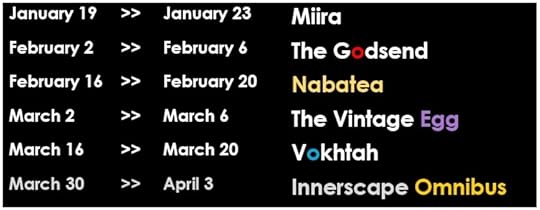
My aim with this long promotion is to force myself to do some marketing, give you some freebies, and help Miira and Vokhtah reach the magic 20 review mark [both are on 19 at the moment]. If you know anyone who enjoys scifi and wants some free books, please point them towards mine! Reviews are not necessary, but I’d be lying if I said I didn’t want some! Of course I do, but only if my stories have managed to help people escape the mundane for a little while.
Okay, that’s it. -breathes a sigh of relief-
Thanks for sticking with me,
cheers
Meeks
…*… If anyone is interested in the gaming side of things, you can find my gaming posts on the sidebar, under the category ‘Games for big kids’.