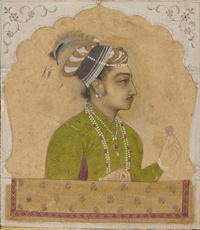
Muhammad Dara Šikoh, also known as Dara Shikoh or Dara Shukoh (Persian: دارا شِکوہ), (20 March 1615 – 30 August 1659) was the eldest son and heir-apparent of the Mughal emperor Shah Jahan. Dara was designated with the title Padshahzada-i-Buzurg Martaba ("Prince of High Rank") and was favoured as a successor by his father and his older sister, Princess Jahanara Begum. In the war of succession which ensued after Shah Jahan's illness in 1657, Dara was defeated by his younger brother Prince Muhiuddin (later, the Emperor Aurangzeb). He was executed in 1659 on Aurangzeb's orders in a bitter struggle for the imperial throne.
Dara was a liberal-minded unorthodox Muslim as opposed to the orthodox Aurangzeb; he aAlternate spelling Muhammad Dara Šikoh
Muhammad Dara Šikoh, also known as Dara Shikoh or Dara Shukoh (Persian: دارا شِکوہ), (20 March 1615 – 30 August 1659) was the eldest son and heir-apparent of the Mughal emperor Shah Jahan. Dara was designated with the title Padshahzada-i-Buzurg Martaba ("Prince of High Rank") and was favoured as a successor by his father and his older sister, Princess Jahanara Begum. In the war of succession which ensued after Shah Jahan's illness in 1657, Dara was defeated by his younger brother Prince Muhiuddin (later, the Emperor Aurangzeb). He was executed in 1659 on Aurangzeb's orders in a bitter struggle for the imperial throne.
Dara was a liberal-minded unorthodox Muslim as opposed to the orthodox Aurangzeb; he authored the work The Confluence of the Two Seas, which argues for the harmony of Sufi philosophy in Islam and Vedanta philosophy in Hinduism. A great patron of the arts, he was also more inclined towards philosophy and mysticism rather than military pursuits. The course of the history of the Indian subcontinent, had Dara Shikoh prevailed over Aurangzeb, has been a matter of some conjecture among historians.
Dara Shikoh is widely renowned as an enlightened paragon of the harmonious coexistence of heterodox traditions on the Indian subcontinent. He was an erudite champion of mystical religious speculation and a poetic diviner of syncretic cultural interaction among people of all faiths. This made him a heretic in the eyes of his orthodox younger brother and a suspect eccentric in the view of many of the worldly power brokers swarming around the Mughal throne. Dara Shikoh was a follower of the Armenian Sufi-perennialist mystic Sarmad Kashani, as well as Lahore's famous Qadiri Sufi saint Mian Mir, whom he was introduced to by Mullah Shah Badakhshi (Mian Mir's spiritual disciple and successor). Mian Mir was so widely respected among all communities that he was invited to lay the foundation stone of the Golden Temple in Amritsar by the Sikhs.
Dara Shikoh subsequently developed a friendship with the seventh Sikh Guru, Guru Har Rai. Dara Shikoh devoted much effort towards finding a common mystical language between Islam and Hinduism. Towards this goal he completed the translation of fifty Upanishads from their original Sanskrit into Persian in 1657 so that they could be studied by Muslim scholars. His translation is often called Sirr-e-Akbar ("The Greatest Mystery"), where he states boldly, in the introduction, his speculative hypothesis that the work referred to in the Qur'an as the "Kitab al-maknun" or the hidden book, is none other than the Upanishads. His most famous work, Majma-ul-Bahrain ("The Confluence of the Two Seas"), was also devoted to a revelation of the mystical and pluralistic affinities between Sufic and Vedantic speculation. The book was authored as a short treatise in Persian in 1654–55....more

 Sign in with Facebook