
Greg Mitchell's Blog, page 266
June 2, 2013
My First 'Mad Men" Speaking Role!
[image error]
Playing a key role in the first half of tonight's trippy episode, background and foreground, was the TV coverage of the 1968 Democratic National Convention and police riot in the streets of Chicago. It was fun hear Don refer to his old pal Connie Hilton's hotel--the riot took place directly in front of it. I was at the Hilton that night and then in the street below. Could have been meet in the chant, "the whole world is watching," born that night. Here's my account and video, for the young 'uns.


Will MSNBC Bounce Back?
Conservatives have been sniping at MSNBC recently over a ratings decline, and the slowish start for Chris Hayes' new program. Now there are more ratings facts to raise concern: Bill Carter's NYT piece just up finds ratings at the network down 20% and instead of running second to Fox it even fell to fourth behind CNN and Headlines News (gasp) one week recently. Problem: A lot of breaking news (real or hyped) lately which is not exactly strong suit of MSNBC evening lineup. Still, CNN has soared before in such times and then fallen. But it may not be that simple.
Rock 'n Roll Animal
Lou Reed, fresh off a liver transplant--I saw him recently at a Leonard Cohen concert in NYC and he did look like death (a thin Reed indeed)--sends out this message via Facebook. Responses here.
I am a triumph of modern medicine, physics and chemistry. I am bigger and stronger than ever. My Chen Taiji and health regimen has served me well all of these years, thanks to Master Ren Guang-yi. I look forward to being on stage performing, and writing more songs to connect with your hearts and spirits and the universe well into the future.Apparently for Lou this is The Beginning of a New Age.
June 1, 2013
2000 March for Manning
From email via Bradley Manning Support Network. And see new updated (to this week) edition of my Manning book with Kevin Gosztola. Photos. More photos.
Nearly two thousand supporters of US Army PFC Bradley Manning rallied and marched on Fort Meade, Maryland, this afternoon for the young whistle-blower. Under a sweltering sun, Pentagon Papers whistle-blower Daniel Ellsberg, former political prisoner-turned-human rights advocate Sarah Shourd, LGBT activist and US Army LT Dan Choi, and retired US Army Col. Ann Wright addressed supporters at the Llewellyn Gate, nearest the military courtroom.
The demonstration, which lasted several hours, comes two days before Manning’s trial is set to begin at Ft. Meade, on June 3, and three years after his arrest. The government is charging Manning with indirectly “aiding the enemy” for releasing hundreds of thousands of war logs, diplomatic cables, and military videos to the transparency website WikiLeaks.
PFC Manning has said that he hoped the releases would “spark a domestic debate on the role of the military and our foreign policy in general as well as it related to Iraq and Afghanistan.”
A dozen chartered buses brought supporters from across the northeast, including three buses from New York City. Military veterans and activists traveled from around North America—some arriving from as far as Michigan, Montreal, and Mexico City.“People came from great distances to stand with a true American hero,” said Jeff Paterson, director of the Bradley Manning Support Network. “From Bradley’s demeanor in court, it’s clear he takes strength from the outpouring of support.”
Today’s rally was held with the assistance of many national organizations, including Veterans for Peace, Iraq Veterans Against the War, CODEPINK Women for Peace, World Can’t Wait, and Courage to Resist.
In addition to today’s event, the Bradley Manning Support Fund is also responsible for 100% of PFC Manning’s legal fees. Twenty thousand supporters have contributed over $1.25 million dollars in defense of PFC Manning and towards associated public education efforts, since his arrest in Iraq in May 2010.
Assange, 'NYT' Writer
Surprised and amused to see byline of Julian Assange show up at the NYT site tonight, and in print on Sunday, in the weekly Opinion section. Of course, the Times, and especially former editor Bill Keller and London ed. John Burns, have savaged Assange. He hits the new The New Digital Age by Schmidt and Cohen.
“The New Digital Age” is, beyond anything else, an attempt by Google to position itself as America’s geopolitical visionary — the one company that can answer the question “Where should America go?” It is not surprising that a respectable cast of the world’s most famous warmongers has been trotted out to give its stamp of approval to this enticement to Western soft power. The acknowledgments give pride of place to Henry Kissinger, who along with Tony Blair and the former C.I.A. director Michael Hayden provided advance praise for the book.
In the book the authors happily take up the white geek’s burden.
Bernstein, Beethoven, Berlin
 My new piece at The Nation--an excerpt from updated edition of my Journeys With Beethoven book with Kerry Candaele on Leonard Bernstein conducting the Ninth Symphony in 1989 to mark the fall of the Berlin Wall. Reminder: Kerry's great film Following the Ninth, which I helped with a bit, gets world premiere Tuesday night in Santa Barbara.
May 31, 2013
Bradley Manning Book: New and Expanded
Updated, expanded edition of my Bradley Manning book Truth and Consequences (co-author: Kevin Gosztola) out today as e-book, print coming this weekend.
May 30, 2013
Zevon Needs Hall Pass
Yes, there's an "Induct Warren Zevon Into the Rock 'n Roll Hall of Fame" Facebook page and it has 14,000 likes. I was a big Zevon fan from the start--just ask David Corn--but not sure where I stand on the Hall. First, who cares about it anyway. Second, I tend to think too many people get into various Halls--baseball, rock, whatever. Warren would probably just throw himself against the Hall. He never did say that if he did "swear to God I'll change." But if you want to join the crusade, send lawyers, guns, money--maybe Roland.
Imagine If the Grammar Was (Were?) Wrong
 Wildest story of the day: Man walks into Teacher's Commission office in Oregon and places a pressure cooker bomb (a la Boston blast on a desk) with wire sticking out of it on a desk and complains that he had just tried to blow up sign outside and bomb didn't work. He said he was mad about an education office having a sign outside with a typo or missing letter: "an" instead of "and." So what kind of education could kids be getting? Then he complained that the instructions he's downloaded for bomb also had typos or errors. Then he walked out, carrying bomb with him. He was arrested a bit later, with his non-working bomb.
Lifton On Killing With--And Living With--Drones
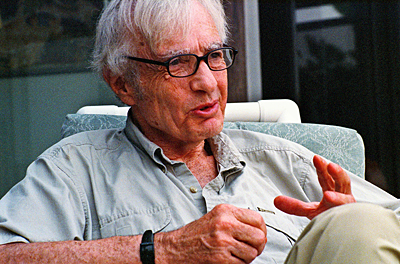 Few observers or writers are better qualified to discuss the impact of drone warfare not just on our policies but on our psyche than Robert Jay Lifton. Since the 1950s, the famed psychiatrist—and often, activist—has produced one landmark study after another on vital issues of our day, from nuclear weapons to Nazi doctors, from soldiers at war to policymakers who send them into battle. As it happens, I have written two books with Lifton, Hiroshima in America and Who Owns Death? (on capital punishment).
Lifton recently wrote what I consider the most far-reaching and important essay on the many dangers, and ethical challenges, of drone warfare (in two parts, here and here). Nothing reveals more about this subject than the famous phrase he introduced to our language decades ago: ”psychic numbing.” This month I interviewed him about that and another aspect: the media failure to cover this extremely important issue in any kind of deep, sustained way.
Lifton called his lengthy piece for Huff Post “Ten Reflections on Drones.” He introduced it this way: “Drones have entered our consciousness. Suddenly they seem to be everywhere. The following reflections—they could as easily be called meditations—do not address legal, political, or military issues, though these have great importance. Rather I seek to begin a conversation about our relationship as human beings to these robotic objects as weapons.” To give you some of the flavor, here are a few of his ten reflections:
The lure of an intelligent, nonhuman killing machine. We can give the job of killing to an advanced technological entity, a compelling robotic instrument entirely devoid of feelings, and thereby suppress our own feelings in relation to that killing.Our interview follows.
The illusion that we can fight wars without our own people, our soldiers, dying. As a military man (quoted by P. W. Singer) put it: “When a robot dies, you don’t have to write a letter to its mother.”
Another illusion is that of the drones’ capacity for what is called “targeted” or surgical killing, meaning the dispatching of a particular person and no one else.
Another illusory stance, also associated with a static view of history, is that of ignoring highly negative responses or blowback. Yet 97 percent of Pakistanis oppose our drones policy, as do high percentages of people in other Middle Eastern countries.
The illusion of a “rescue technology” that can turn around a failed policy. Drones have become a cure for the disarray and defeat associated with our doctrine of counterinsurgency warfare.
The ultimate issue of human and nonhuman agency. We are in a sense sharing human agency with a robot. There are accounts of varying degrees of loss of human control over the drones. And there are envisioned more and more occurrences in which action would be so rapid as to allow no time for human intervention and the drones would have to make “decisions” on their own.
Why did the media, until recently, provide little in-depth coverage of drones, even fail to confront official secrecy?
The media have had difficulty covering this subject and that’s partly because it is a revolutionary technology of killing and the media have trouble confronting what it is. There is now a certain amount of discussion of the political and legal side of drones. That’s important but not itself fully sufficient. One has to look at why drones are so much depended on and so much an expression of executive power in our use of them. And one does have to raise legal questions about using them against American citizens but also others—especially when the purposes are not tied to war but to assassination.
Yes, some of the more thoughtful media have raised these questions but almost no one has raised the fundamental questions about drones—questions of the mind and technology. And I’m struck by the basic illusion of fighting a war without undergoing casualties. That’s at the heart of things. What that means is you don’t have to undergo the pain of losing young men and women or the related requirement of insisting that they “did not die in vain.” That’s the central image of any war fighting. No one asks whether a drone died in vain when it explodes.
This illusory release from that level of meaning is dangerous in a democracy because a major means of preventing military belligerence and war-making is that painful sentiment for the citizens, and the media, of our soldiers being sent to die for an insufficient reason or to die in vain. And that hasn’t been discussed by the media to speak of. And that’s a major illusion.
And we don’t seem worried that drones can be turned on us.
That’s the added danger of enabling war-making to be made easier. It’s an illusion because there are seventy-five countries with drones now. Even non-governmental groups, including terrorists, could readily acquire and use them
We have a sense of American ownership of the technology, like with nuclear weapons after World War II. But no technology, as we’ve found, is limited to any country, no matter how big a part they had in developing it.
The other thing that is so illusory that is not emphasized sufficiently: the extremity of the destruction. The accuracy of drones has been enormously exaggerated. And they terrify and enrage people and bring about a quality of humiliation and fear. This strange object in the sky that can wreak havoc causes a particular amount of humiliation—and that more than any other emotion can be a source of a retaliatory impulse.
These are the things that the media on the whole have not probed. But then, they are generally lazy and collapse before power. There has been great secrecy and barriers to coverage, true. Now the issue is surfacing, and suddenly the drones are in our consciousness and all over the place. Given today’s information structure, given the Internet and other sources, you can’t keep these things as secret for long.
Why such weak coverage of the attacks themselves? Hard to get to the scene?
You can’t say the media can’t go investigate on the ground—the Stanford group [that produced a valuable recent study] did. What better way to cover them than to see what they’re causing? That’s negligent behavior on the part of the media. Some investigative journalism groups have sent people on the ground. So that’s not an excuse.
You’ve made connections to capital punishment in the US.
This death-by-drone, carried out by killing professionals, is the idea of a speedy, “humane” killing, like with our death penalty. Every new means of putting people to death is always described as more humane than the last, from hanging to the electric chair to the gas chamber to lethal injections. By engaging in what is considered more humane killing the claim can lead to more willingness to kill, as it does with the drone.
Apart from news coverage, what about media commentary pieces?
Much of the analysis concerns a president’s right to conduct drone killing and raises the question of executive power. There have been some good pieces. One a few months ago captured some of the drone subculture around the White House. It conveyed the sense of the president involving himself so actively in the use of drones so he could be a kind of restraining force. That may be accurate, but the problem is that the claim of restraint legitimates the use of drones, and seems to eliminate the legal considerations that should be invoked.
Other commentaries find professionals endorsing drones or expressing legal opinions to say they are okay—like the legal briefs sought by the Bush administration to endorse torture.
It seems the focus of complaints, even by many liberals, is often limited to concerns about targeting Americans.
Using them on our own citizens can be held out as an egregious action, turning a technology of killing against our own people. But I agree that using them anywhere in the world against anyone deserves careful legal and ethical consideration. It’s easier for media to look critically at use of drones against Americans and thereby avoid the use of drones to kill anyone. The seemingly more egregious violation is easier to criticize but the larger significance of drone warfare is overlooked or suppressed.
I’ll go along with the Stanford report—it makes you almost proud to be an academic. It found drone warfare is causing more harm for our national security than whatever it is accomplishing. It’s a dubious technology and the pinpoint targeting is illusory.
So should all use of drones be banned?
It’s the responsibility of the press to look very critically at the use of drones in any case. We need sanctions against their use. We also need international law standards.
One has to quickly now look at drones as an international, human issue. It is a revolutionary technology and it has to be controlled. It will effect humankind, not just Americans and terrorists, and one has to examine critically the psychological aspects, such as getting the machines to do the killing for us and exonerating us ethically.
Greg Mitchell’s latest book, published this month, is Hollywood Bomb: The Unmaking of ‘The Most Important Movie’ Ever Made.


![[image error]](http://www.donberryman.info/BrassUnion/BrassUnion1968_Chicago02.jpg)