
Chris Baty's Blog, page 149
January 13, 2016
I Published My NaNo-Novel: 4 Things I Learned from Teaching Revision
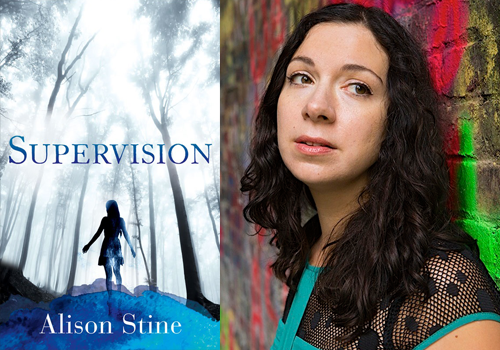
During January of our “Now What?” Months, we’re talking to Wrimos who’ve published their NaNoWriMo projects and asking them how they got there. Today, Alison Stine, author of
Supervision
, shares the novel-revision lessons she learned as a teacher of English Composition:
For years I taught English Composition to first-year college students. And while grading 90 or more three-paragraph essays every other week is probably not the best day job for a writer in need of time and creative reserves, it did teach me a lot about revision. The best way to learn something, really learn it, is to teach it. And there’s no greater crash course in revision than staring down a pack of hungry teenagers who want specific ways to improve their writing.
My first published novel, Supervision, was written one hectic November. I wrote fast and I wrote hard. I wrote messy. Very very messy. And what I was left with at the end of the month was a single-spaced, frequently-misspelled, sometimes confusing ball of words.
What comes next is still my favorite part.
I always encouraged free writing in my students, as I practice it to generate my own first drafts. But while “first thought, best thought” works for an initial draft, revision requires much more consideration. This is the thinking part. You need to slow down and see. I told my students, as I recommend to anyone working on revision: print out a hard copy to revise.
It’s easier to miss mistakes, and opportunities for change, on a screen. Reading a hard copy is slower. Printing out the pages allows you to live with them. I took my printed manuscript and a red pen with me everywhere. A lot of work was done on the subway, over lunch, waiting at bars for my friends to arrive. Revision happened then, and it happened later when I typed the handwritten changes into my document, usually adding or subtracting even more.
I also recommended that my college students, after writing their first drafts, make a reverse outline. This goes for your novel, too. Maybe you made an outline before you started to write, maybe you didn’t. But make one now. Go back through your novel and make a list of all the major plot points. Does every chapter have a point? Do they all move the plot along? Are the stories of any characters lost in the shuffle? You’ve got the bulk of the story down; now figure out what the whole picture means and how to connect everything. Revision is the time to structure purposefully.
I used to give my students advice that one of my own first-year English professors had given me: You often come up with your best ideas at the end. Students may reach the conclusion of their paper and discover their actual thesis. You may read your own novel draft for years before discovering its true heart (I did). It takes living with an idea or story for some time to understand it, even the stories we tell ourselves. Make sure you give yourself that time.
A last lesson you can take from the English Composition classroom? Find peers. You need other eyes to help you see your own work, outside readers to help you find your way through it. For Supervision, it was my mom and sister, and my friend Ellee. Make your own workshop, and share your writing with people you trust before sharing it with the world.
Alison Stine is the author of
Supervision
, a novel written during National Novel Writing Month and published by HarperVoyager UK in 2015. Also the author of two books of poems and a chapbook, she lives in the foothills of Appalachia.
Author photo above by Kari Gunter-Seymour.


January 11, 2016
Now What? A Roadmap for Revising Your Novel

You wrote a novel! Now what? NaNoWriMo’s “Now What?” Months are here—this January and February, we’ll be helping you guide your novel through the revision and publishing process. Today, James Scott Bell, author and editor, shares his revision road map:
Ah December! It follows November, and a good thing, too. It gives you a month to let your NaNo-novel cool off in the meat locker of your writer’s brain. Then cometh January, of which Day 1 is given to recovery from the night before, sleep, football, and food.
And a little planning, too––a plan to revise your novel with more than just a slapdash run through. Here are the steps:
1. The cooling off periodAs mentioned, don’t think about the book for a month. Work on other projects. Let your novel stew.
2. Print out a hard copySome may prefer to read their draft on a tablet or e-reader. I prefer paper because I can make quick notations faster.
3. Read through the draft as fast as you comfortably canYou want to replicate the feeling of being a reader picking up a new book by a new writer. Keep telling yourself to be objective.
4. Take minimal notesYou’ll be tempted to stop many times for extensive marking and revising. Resist the urge. The first time through, limit yourself to marks in the margin setting off:
Dull sectionsSections that needs fleshing out
Confusing parts
5. When you’re finished, ask the big questions first
Don’t start at page one and just go. Assess the big picture:
Does this story make sense?Is there enough at stake? (A novel should be about a character’s fight with some form of death––physical, professional, or psychological.)
Do the characters act like real people would in a similar situation?
Does my main character “jump off the page”?
Are there parts where a busy editor or reader would be tempted to put the book down?
Get to work on solving these major issues. Write a 2-3 page synopsis of your book, tweaking it as needed to reflect the changes you’ve made in response to the above questions.
Next, go scene by scene through the book, looking to increase the conflict. If there is no conflict, consider cutting that scene.
Work your way through to a second draft. Then get it to some beta readers.
A good beta reader is someone who gives you specific feedback. What you don’t want is, “I loved this! Can’t wait to see it published. Let me know when it comes out!”
Or, “It just didn’t work for me. I don’t know why. Sorry.”
To find beta readers, make up a list of all the people you know who might be able to offer you feedback. Attending a good writer’s conference is one way to network with others with whom you can exchange manuscripts.
Take all that feedback, revise again, and think about hiring a good freelance editor. Get recommendations. See what other clients have to say about their services. Compare prices.
Oh yes, and while you’re doing all this, be writing your next novel.
Repeat over and over the rest of your life.

James Scott Bell is a #1 bestselling author of Plot & Structure , Write Your Novel From the Middle , Super Structure , and Voice . He is also a bestselling thriller writer and former fiction columnist for Writer’s Digest magazine. A list of his novels and writing books can be found at JamesScottBell.com
Top photo by Flickr user Canned Muffins.
January 8, 2016
I Published My NaNo-Novel: Learn How to Tell Your Story
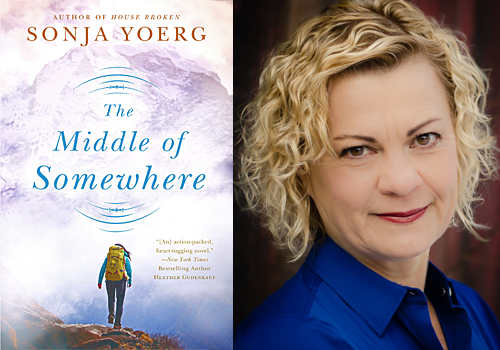
During January of our “Now What?” Months, we’re talking to Wrimos who’ve published their NaNoWriMo projects and asking them how they got there. Today, Sonja Yoerg, author of The Middle of Somewhere , shares why each individual book requires you to learn how to write all over again:
To me, the prospect of writing 50,000 words in a month was as daunting as a dog-paddler standing on the Dover shore contemplating a Channel crossing; I was certain to drown before I reached the shipping lanes. I’m a painstaking writer, at the mercy of my in-line editor, more comfortable splashing around in the shallows of what I’d already written than in the dark waters ahead.
NaNoWriMo would be good for me, I reasoned, forcing my speed to increase in a sink-or-swim fashion. I had another motivation, too. During the fall of 2012, I was querying agents with my first novel and the NaNo challenge seemed the perfect distraction from that arduous, soul-destroying process.
My story was set on the John Muir Trail, a 220-mile hike my husband and I had recently completed. Writing during November was a lot like that trek—strenuous, repetitive, rewarding—but without the views and blisters. I’m stubborn as hell, and competitive, so there was no way I was not going to “win NaNo.” (Note: I was also lucky enough not to have another job, or kids at home at the time. Hats off to those who manage to write at all with those constraints.)
What happened after NaNo? Life. We put our California house on the market, and moved across the country. I spent a couple months in England caring for an ill relative. During one of those trips, I got The Call and, just like that, I had representation for my first novel. I had a lot of jumping up and down to do, and revisions.
While life swirled around me, I worked on my NaNo book, mostly going forward, but sometimes going back to the beginning, because my agent wanted to read it, or because so much time had passed I’d forgotten my own story. Lurching forward, reaching back, again and again and again. A year passed before I finished—a total of 80,000 words. The same week, Penguin offered on my debut. I had a book deal, a two-book deal! My NaNo book, which my editor hadn’t read a word of, had been invited to the party.
Cinderella story? I sure felt lucky. But when my editor finally got around to reading the NaNo book, there was a small problem. The last third, she said, pretty much everything I’d written since NaNo, had to go.
Let’s have a laugh here, because it’s funny now. Then? Not so much.
Don’t think for a minute the take-home message is that what you wrote in November is gold, and the rest horse-pucky. I revised those 50,000 words several times, and again as part of writing a new ending. Does this mean that I should write fast all the time? Maybe, but probably not, because each book takes along on a different road, and what worked before may not work again. I like it that way, because as soon as I figure out how to write, once and for all, I’ll stop.
My NaNo book is called The Middle of Somewhere. When you pull your 50,000 words out of the marinade this month, that’s probably an apt description of where you are with your story, whether you think you know how it ends or not. And that, my fellow writers, is a wonderful place to be.
Sonja Yoerg, author of House Broken and Middle of Somewhere, earned her Ph.D. in Biopsychology from the University of California at Berkeley. She also published a non-fiction book about animal intelligence, Clever as a Fox (Bloomsbury USA). Sonja lives in Virginia’s Shenandoah Valley.
How to Publish a NaNo-Novel: Learn How to Write Your Book
During January of our “Now What?” Months, we’re talking to Wrimos who’ve published their NaNoWriMo projects and asking them how they got there. Today, Sonja Yoerg, author of The Middle of Somewhere , shares why each individual book requires you to learn how to write all over again:
To me, the prospect of writing 50,000 words in a month was as daunting as a dog-paddler standing on the Dover shore contemplating a Channel crossing; I was certain to drown before I reached the shipping lanes. I’m a painstaking writer, at the mercy of my in-line editor, more comfortable splashing around in the shallows of what I’d already written than in the dark waters ahead.
NaNoWriMo would be good for me, I reasoned, forcing my speed to increase in a sink-or-swim fashion. I had another motivation, too. During the fall of 2012, I was querying agents with my first novel and the NaNo challenge seemed the perfect distraction from that arduous, soul-destroying process.
My story was set on the John Muir Trail, a 220-mile hike my husband and I had recently completed. Writing during November was a lot like that trek—strenuous, repetitive, rewarding—but without the views and blisters. I’m stubborn as hell, and competitive, so there was no way I was not going to “win NaNo.” (Note: I was also lucky enough not to have another job, or kids at home at the time. Hats off to those who manage to write at all with those constraints.)
What happened after NaNo? Life. We put our California house on the market, and moved across the country. I spent a couple months in England caring for an ill relative. During one of those trips, I got The Call and, just like that, I had representation for my first novel. I had a lot of jumping up and down to do, and revisions.
While life swirled around me, I worked on my NaNo book, mostly going forward, but sometimes going back to the beginning, because my agent wanted to read it, or because so much time had passed I’d forgotten my own story. Lurching forward, reaching back, again and again and again. A year passed before I finished—a total of 80,000 words. The same week, Penguin offered on my debut. I had a book deal, a two-book deal! My NaNo book, which my editor hadn’t read a word of, had been invited to the party.
Cinderella story? I sure felt lucky. But when my editor finally got around to reading the NaNo book, there was a small problem. The last third, she said, pretty much everything I’d written since NaNo, had to go.
Let’s have a laugh here, because it’s funny now. Then? Not so much.
Don’t think for a minute the take-home message is that what you wrote in November is gold, and the rest horse-pucky. I revised those 50,000 words several times, and again as part of writing a new ending. Does this mean that I should write fast all the time? Maybe, but probably not, because each book takes along on a different road, and what worked before may not work again. I like it that way, because as soon as I figure out how to write, once and for all, I’ll stop.
My NaNo book is called The Middle of Somewhere. When you pull your 50,000 words out of the marinade this month, that’s probably an apt description of where you are with your story, whether you think you know how it ends or not. And that, my fellow writers, is a wonderful place to be.
Sonja Yoerg, author of House Broken and Middle of Somewhere, earned her Ph.D. in Biopsychology from the University of California at Berkeley. She also published a non-fiction book about animal intelligence, Clever as a Fox (Bloomsbury USA). Sonja lives in Virginia’s Shenandoah Valley.
January 6, 2016
Now What? Why Resilience is Necessary

You wrote a novel! Now what? NaNoWriMo’s “Now What?” Months are here—this January and February, we’ll be helping you guide your novel through the revision process and eventually help you dip your toe into the world of publishing. To kick things off, Warren Adler, author of The War of the Roses, talks about rejection and renewal in this note to aspiring authors.
(Plus, Warren is looking for your stories of why you write! Check out Writers of the World and share the reason you write.)
You’ve spent months, perhaps years, composing your novel. You’ve read and reread it hundreds of times. You’ve rethought it, rewritten it, and revised it, changed characters, dialogue and plot lines. Writing your novel is the most important thing in your life. It has absorbed your attention, almost exclusively. You have read parts of it to your friends, family, former teachers. Most think it’s wonderful.
You have finally considered it finished. Armed with optimism and self-confidence, you obtain from the Internet a list of agents and begin to canvas. You agonize over whether to send your precious manuscript to one agent at a time or to a number of agents. You choose the first option. You have high hopes. You are aware of the massive changes in the publishing business, but have chosen to take the traditional path as your first option.
Weeks go by, then months. The agents are, you believe, reading it in the office, passing it around, deciding to take it on. You live on such hopes. Finally you call the agent’s office. They haven’t a clue as to who you are. Somehow, they are reminded and search through the piles of manuscripts in their office, find yours and send you back a standardized letter, perhaps out of politeness made to look like an original.
Well then, you tell yourself, it is only one agent’s opinion. You send it off to another agent. A letter comes back swiftly, similarly worded. You get bolder, send your manuscript to two agents at a time, then three, then every agent you can find. Nothing happens. “Good luck on getting published,” they tell you. “Not for us.” Sometimes there is a personal, scribbled note that says something nice and you live in its glow for days.
Years go by. You start another novel, but you are less optimistic now, less confident, unsure. You tell yourself you have not paid enough attention to the marketplace. You begin to analyze what is selling, what is not selling, what is being published. You read books on the bestseller lists and are certain you can do a lot better. You try to use these books as a guide to what is selling and you write accordingly. Nothing helps. You are continuously rejected.
You begin to read on various websites about how you can publish your own books and get them marketed on electronic venues. Some sites promise that they can get your book in front of movie producers for a price. Some say they have the magic to make you a successful career novelist, again, for a price. For even more money, you will be told how best to market your book. You debate the idea and as your pile of rejection letters mount, you give it a try.
You spend money. A book is produced in print-on-demand format and an e-book is created and placed on every electronic sales venue on the net. Your family buys copies and sends them to friends. It is even reviewed in publications that review self-published books, yet again for a price. There is a word or two of praise in the review and you send it around to the media and everybody you know. Unfortunately, there is little or no sales, no afterlife. Despite your confidence in your ability, despite the fact that you truly believe your novel is certainly worthy of publication, you feel the full impact of rejection and failure.
Still, you cannot shake the certainty or your talent. You write another novel. Perhaps a third. Perhaps more. You go through the same process. Again and again you are rejected. You begin to question your ability, your ideas and your talent. Is it a fantasy, an exercise in unrealistic aspirations? You are becoming embittered. Your dream is crashing.
If you are fortunate, your wife, husband, partner and family continue to encourage your dream, help you keep it alive. Other realities begin to chip away at the dream. You have financial obligations. Your kids are growing up.
You feel lost, adrift. Rejection after rejection has beaten you down. You see this as the end of your world, the end of your hopes and aspirations. Your high hopes and self-confidence in your own talent is petering away.
What now?
If you’ve read this far without your stomach congealing, I suppose you are awaiting some prescription offering a magic pill for coping. Sorry, there isn’t any available your corner drug store, and you won’t find it here. Luck–that strange, illusive, heaven sent, burst of good fortune–has not fired a missile in your direction. Not yet.
You have three choices. The first is personal surrender. You’ve been on a fool’s errand following an adolescent dream. Time to throw in the towel and concentrate on your day job. At least you tried.
The second choice is postponement. You weren’t ready. You needed more experience of life. But you continue to believe it will come. Some talented people are late bloomers. Give the dream a rest. Wishing won’t make it so. There are enough popular clichés to give you courage.
Now, for your third choice, the clincher. It is not recommended for the faint of heart. Never give up. Never, never, never. It may be impractical, unwise, foolish, pure madness, but if you truly believe in yourself, your talent, your ideas, your calling, your personal mission, why not, as Lewis Carroll wrote, “go on until the end, and then stop.”
To do this requires a monumental ego, total self-confidence in your talent, and an unshakeable belief that you have been anointed with the right stuff. You will require obsessive focus, singleness of purpose, a draconian ruthlessness and total devotion to a belief in your artistic ability. Fancy words, I know, but with the absence of luck, you will need these attributes to sustain you through the process.
What this means for the true novelist is that he or she must continue to soldier on, keep writing, keep trying, taking the increasingly painful hits of rejection after rejection until, well, until someone out there catches on…or doesn’t.
We are all waiting for Godot. Sometimes he comes.
Warren Adler has just launched Writers of the World, an online community for writers to share their stories about why they began writing. Warren Adler’s latest novel, Torture Man, which explores Jihadist terrorism, is available now. His Film/TV projects currently in development include the Hollywood sequel to The War of the Roses - The Children of the Roses, along with other projects including Capitol Crimes, a television series based on Warren Adler’s Fiona Fitzgerald mystery novels, as well as a feature film based on Warren Adler and James Humes’ WWII thriller, Target Churchill, in association with Myles Nestel and Lisa Wilson of The Solution Entertainment Group.
Writers of the World is a popular online community for writers to share their stories about why they began writing. Founded by bestselling novelist Warren Adler, Writers of the World brings together writers from across the globe with one passion in common. Reflections are shared on a weekly basis by burgeoning and established writers. Share your story here.
Top photo by Flickr user Giuseppe Milo.
December 25, 2015
8 Things You Learn by Writing a Novel in 30 Days
Everyone has a different NaNoWriMo experience. We’ve asked some wonderful NaNoWriMo writers to share theirs. Today, Marquessa Matthews, NaNoWriMo participant, shares what she learned from writing a novel in 30 days:
Though it’s over and put to bed, I’m still on the topic of NaNoWriMo. Like so many other writers post-NaNoWriMo, I wanted to share what I learned from the experience.
So here we go! I learned that:
I love the writing process so much that I saw it through to the end, even after deciding to give up on Day 29;Writing 1667 words a day is difficult but it is achievable. I’ll be using 800 words as my daily goal after I perform “surgery” on all of my storyline inconsistencies that resulted from creating content so fast;Even if I hadn’t succeeded in the 50K challenge, I still would have been happy because it was more about trying to achieving the goal than not trying at all;It’s futile to discuss “writing” with non-writers. They just don’t understand my interest and semi-obsession with main characters, potential tropes and daily word counts; The support of the writing forums and community were important to keep my motivation going… and providing support to others definitely led to feel-good moments;NaNoWriMo’s Virtual Write-In sessions were amazing for creating jump-off points. When I had no ideas for next scenes, I used their prompts and massaged them into a usable scene in my storyline. It was pretty interesting to write and chat in “real-time” with others online;If I really want to find time to write, I can find creative ways to squeeze it in. Buying an inexpensive wireless Bluetooth keyboard to use with my smartphone allowed me to access my Evernote and write in some unusual places;What writers say about characters taking on a “life of their own” and the characters telling you what they want to do is absolutely 100% true. My main characters have been taking me on a ride I had not planned on since the beginning of November. And they haven’t stopped!If you’ve never done NaNoWriMo, I strongly encourage you to give a go. And if you tried and didn’t make it to November 30, there’s always next November or Camp NaNoWriMo in April and July.
It’s all about acquiring a daily writing habit and putting time aside for what you love to do!
See you next year!

A born and bred Montrealer, Marquessa Matthews works as a project consultant but has always had a passion for writing fiction. She put her pen aside for many years, but is now returning to what she still loves. A smooth pen, a crisp new notebook and a little imagination… there’s nothing better!
Top photo by Anne Davis 773.
December 23, 2015
How I Cured My Writing Phobia
Everyone has a different NaNoWriMo experience. We’ve asked some wonderful NaNoWriMo writers to share theirs. Today, Shimona Patel, NaNoWriMo participant, shares how she diagnosed… then cured her writing phobia:
“Doctor,” I said. “I have a phobia.”
The doctor furrowed his brow and asked, “What kind of phobia? What are you scared of?”
“Doctor, I think I have a writing phobia…”
Ever felt like your fingers won’t move to let you type or write? Have you ever felt like your brain just freezes or shut downs? Like your body refuses you to come closer to your laptop, or journal, or typewriter?
Well, these are the symptoms of what I call a “writing phobia.”
Fear not, your doctor is here!
Writing phobias can happen to anyone. It’s a fear and it can enter into anyone’s mind, whether you are a New York Times bestseller or a rookie writer. Fear is something we all have to fight and make our way through, towards the light.
Our fear makes us wonder if we’re not able to produce something awesome or creative. Don’t listen! Every mind is creative; you just need to be able to reach out for that spark from the deepest corners of your mind.
NaNoWriMo challenges us to fight this fear by giving us a deadline. A deadline can be good medicine for a writing phobia. In the end it’s us, the authors, that must defeat this phobia. Here’s how I defeated mine.
The Story of How I Cured My Writing PhobiaI remember, sitting on my Google Nexus tablet and watching people fuss and chat about #NaNoWriMo2015 on Twitter/Instagram. When I first joined Wattpad, I had seen several people talk about it. I never knew what it meant, until this year. Three days before NaNoWriMo, I stumbled upon it again when someone told me she was going to try and write 50K words to which I laughed saying it was impossible.
Later I Googled NaNoWriMo, got to know it better and talked about it to different people. I didn’t want to commit to it. Heck, I have been trying to complete my book on Wattpad for the past year and a half. So how could I win this challenge?
I was already depressed about my writing skills. I did have an idea for a novel: I knew its ending but the middle… that’s the hardest part of a writer’s job. I never made it past the middle, in either of my two books on Wattpad. So how could I even think about NaNoWriMo?
Well, you never know until you try, right?
I decided to take on the NaNoWriMo challenge and tried my best. I increased my coffee intake. I wrote in places I shouldn’t have been writing, e.g, during college lectures, etc.
And in the end? I did it. I wrote 50K words in a month, and, heck, am I amazed by it. Something that felt so impossible a few weeks ago was possible now. And I have been doing very well in my other projects, too.
NaNoWriMo gives you a platform, a challenge and so much inspirational advice. What else could one ask? Defeating writing phobia seems so easy now that I realized this mantra: Impossible actually means = “I’m possible.”
Don’t give up. Butt in the chair, coffee by your side, and your laptop/typewriter/ notebook in front of you… you can do it!
Here are 6 techniques I used to beat my writing phobia:I always listened to music while writing. It not only creates an imaginative atmosphere around you, it also keeps you from distracting yourself.Use writing prompts. They really help.
Listen/read to inspirational quotes and use them as writing prompts.
Have too many ideas? Well, combine them into one long book.
Keep a word-count goal for everyday
Talk/commiserate with another writer.
Hope this all helps and you can beat that ‘writing phobia!’

Shimona is the author of the winning NaNoWriMo 2015 novel, Teaching Him. You can connect with her on Twitter—@Shimonap04—or on Wattpad. She is not a published author but hopes to be one soon. Shimona is an average teenage, Indian girl, who loves to draw and write in her free time.
Top photo by Flickr user Han Shot First.
December 21, 2015
How I Reignited My Love for Writing

Everyone has a different NaNoWriMo experience. We’ve asked some wonderful NaNoWriMo writers to share theirs. Today, Justin Isaacs, NaNoWriMo participant, shares how he rediscovered his passion for writing:
When I was in first grade, I wrote my first story. It wasn’t particularly good. However, that didn’t stop me from using writing as a creative outlet.
Even at a young age I was fascinated with the macabre. Fueled by R.L. Stine’s Fear Street series, and later, Stephen King, I began my writing career early on with horror stories. (I was sent to the guidance counselor on more than one occasion throughout grade school. They eventually confirmed that I was able to mentally separate fiction from reality, and thankfully allowed me to continue writing unabated.)
I wrote dozens of short stories and novellas throughout grade school. On Halloween, during my sophomore year in high school, my little brother destroyed all of my manuscripts by gluing them to a desk and painting on them. I was absolutely devastated. All of my hard work had been completely eradicated, and so had my passion for writing. I thought I would never write again.
Then, six years later, during my junior year of college, I was introduced by a friend to NaNoWriMo. I was hesitant, but I had been working on a graphic novel idea at the time, and wondered how it would fare as a novel. I was nervous, having not written in so long, but I decided to go for it.
I failed spectacularly, but I never considered it a defeat. My passion for writing had rekindled. I rewrote the same novel the following year and locked in my first win. Even while juggling file corruption, girlfriends, and deadline panic at work, I managed to win three more times in the last ten years.
NaNoWriMo has given me the confidence to write more seriously. I have started reading short stories with a critical eye, and I have already scheduled a writing class. I plan on actually sharing my writing with others, and engaging in mutual critiquing. I intend for writing to become a major component of my life. One day I even hope to publish one of my novels.
NaNoWriMo has never been about completion, and I have the win rate to prove it. NaNoWriMo is about proving to myself that I have a story within me, and that I have what it takes to be a writer. I am thankful that NaNoWriMo has returned writing to my life, and I’ve never been more exited about the future.

Justin Isaacs is a mechanical engineer living and working in Connecticut in the aerospace industry. He started writing when he was in first grade, and still has the first story he ever wrote. His wife, Chia-Ying, has always been there to support him.
Top photo by Flickr user Jon Scally.
December 16, 2015
4 Things I Learned from Writing a Novel in a Month

Everyone has a different NaNoWriMo experience. We’ve asked some wonderful NaNoWriMo writers to share theirs. Today, Lynne Powell Assa, NaNoWriMo participant, shares the four key lessons she learned from her first time participating in NaNoWriMo:
It all started with a friend’s cajoling Facebook post:
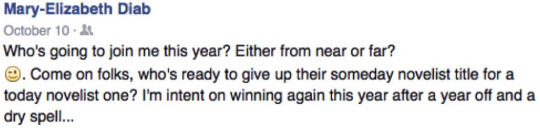
What qualifications did I have? Fiction writing is not a skill I developed working 26 years as an engineer. Sure, outside of work my favorite past time was reading, but never did I write creatively. My last short story was written in grade school. So besides being a retired empty nester, I will never know what possessed me to respond, but mid-October I was in!

And here’s what this NaNoWriMo newbie learned about writing and myself.
Planning is helpful, and Pantsing works, tooA planner by nature, such short notice meant foregoing my desire for extensive plot outlines and character development. I sketched a rough plot triangle to organize key rising and falling actions, and scribbled random ideas in an old spiral notebook.
Starting November 1st, I made sure to sit at the computer every day and type. Type whatever popped into my head next. Just like life, you don’t go into a situation or conversation knowing what’s about to occur or be said. Roll with it. I was continually surprised by what events and thoughts unfolded, sometimes forgetting that I was the source. Pantsing was fun, and the yin to my planning yang.
Something’s gotta giveGoing in to NaNoWriMo, be prepared to let go of something. Almost simultaneously with NaNoWriMo, I had started a 90-day yoga challenge. I convinced myself that I had time to do both; it was just a matter of prioritizing.
The first week, the bargain I had struck with myself was to exercise first, then write. By the second week, my word-count columns were creeping below that cursed diagonal line, so my daily plan switched to write first, then exercise.
By mid-month, writing got pushed to later in the day, sometimes after midnight, and so yoga dropped into a virtual child’s pose until NaNoWriMo ended.
Everyone can tell a story, all experience mattersThough I was not in a creative career, my job did include a lot of writing: proposals, presentations, reports, and articles. In order to make our technical writing engaging to readers—most often a potential or active client—my boss (and my best mentor) would coach me to “tell a story” with the data and plans. That phrase always stuck with me and other skills I’d honed at my job—like organizing information and adhering to a schedule—contributed to my first NaNoWriMo win.
Let it goBorrowing the words of a Disney heroine: let go of perfectionist tendencies. My idealized vision of a novelist was someone who wrote from beginning to end, preening over each paragraph and—voila!—printed out a masterpiece at the end of the first draft. I wish a long time ago someone told me that writers wrote a lot of crappy first drafts and then did extensive rewrites before getting to the final polished product.
Thanks to all the forums and pep talks, NaNoWriMo taught me to not judge every word, every punctuation mark. Just get it out of your brain and on to the page.

Lynne Powell Assa is a first time NaNoWriMo writer living in Abu Dhabi, UAE. Currently a self-professed pampered ex-pat wife, she is also a Registered Civil Engineer and in her past life worked on the planning, design and construction of airports around the world.
Top photo by Flickr user Daniel Y. Go.
December 14, 2015
What to Do When Someone’s Already Written Your Novel Idea

Everyone has a different NaNoWriMo experience. We’ve asked some wonderful NaNoWriMo writers to share theirs. Today, Dan Shick, NaNoWriMo participant, shares why discovering your novel has an evil twin doesn’t have to be a dealbreaker:
If we could buy inspiration shrink-wrapped with hand soap at the shopping center, or if we could press a button protruding from our collarbones to make ideas flow from our suddenly glowing fingertips, we might not need National Novel Writing Month. But we definitely can’t, and we definitely do.
My forays on that bejeweled, lofty and very slippery 50,000-word mountain have taught me to create space for inspiration in my life—and when it comes, to write it down like a madman.
But that’s not what I learned this year: the fateful Year of the Evil Twin.
Some years, as November approaches, I’ve trudged across the Marslike landscape of my Evernote, seeking the merest viable microbe of an idea. But in 2015 my idea simply dropped onto me like a sweet, rich clump of bird poop, chock full of seeds. To see if it might bear fruit, I shared it with my trusted advisors, who cried, “Start digging!"
In October, I started work—plot outline, character sketches, scene list. Hallowe'en night, I forwent parties and, at the stroke of midnight, started burning up Scrivener. My word count soared with my confidence.
And so it went until Guy Fawkes Day—until the fun but ultimately doomed write-in with my pal Jen. With both of us at 3K for the day, she asked, "What kind of novel are you writing? Mine’s young adult.”
“Mine too!” I chirped.
“Oh yeah? Awesome! There’s so much great YA these days. In fact, I just finished a great one…”
And she described the plot.
I stared at her disbelievingly. She was describing *my* novel’s premise! My face (and confidence) fell, and in the bleak days to follow, so did my word count. My novel had an Evil Twin! Motivation froze like January’s bird poop.
I read the Evil Twin’s reviews — big mistake. “Five stars!“ "Bestselling author!” Fellow Wrimos sympathized, while Evil Twins lurked in their bookbags.
Demoralized, I fantasized about switching to another idea… or just quitting for the year.
But what would I say to my writing buddies? What about The Night of Writing Dangerously? And hey, how could I abandon my beloved characters?
In the end, my characters saved me. Knowing their unique stories needed telling by the person who knew them best—me—thawed my bird poop and helped my seeds grow into a story in its own right, that only I could write.
And the experience reminded me that today’s great idea isn’t the only idea.
Great minds think alike—I’m bound to have another idea that I might turn into a bestseller someday. My novel didn’t have an evil twin — it had a friendly sibling on the path ahead, pointing toward success.

Dan Shick has won NaNoWriMo in seven of twelve consecutive, valiant attempts. He lives across the street from his writing buddy Jen in Portland, Oregon, soon to be the proud parent of a second draft.
Chris Baty's Blog

- Chris Baty's profile
- 63 followers

