Malcolm R. Campbell's Blog, page 7
June 5, 2024
‘Darkening of the Light,’ by Robert Hays
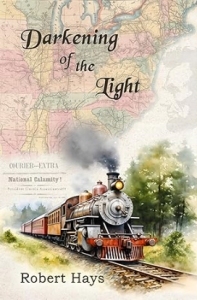 Disclaimer: I am a colleague of Robert Hays at Florida’s Thomas-Jacob Publishing.
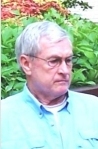
Darkening of the Light was published on June 4 by Robert Hays, Prof. Emeritus (journalism) at the University of Illinois Urbana-Champaign, and the author of Blood on the Roses, A Shallow River of Mercy, and other fiction and nonfiction titles.
From the Publisher“Although he misses Melinda, the girl he left behind, after his time as a homeless orphan on the streets of Paducah, Jeter thinks being a groom in the White House stables, and life in general in the nation’s capital is all he’ll ever want. His friend and mentor, Shakespeare-quoting Union Army Captain Joseph Emerson, is an advisor to President Lincoln. With the President just re-elected and the war with the Confederacy won, they all see bright days ahead.
 Hays
Hays
“But an assassin’s bullet brings their world crashing down, and Jeter and the Captain see their own grief reflected in the mourning of millions of citizens as the captain commands an Honor Guard on the funeral train that bears Lincoln’s remains on the long cross-country trip home to Illinois.
“As Jeter explores the cities where the train stops en route, he adds his own real-life stories and comes to appreciate the cultural mix that makes America one great nation.”


June 2, 2024
‘Edge of Edisto’ by C. Hope Clark
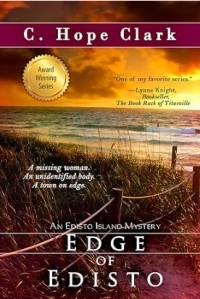 I’ve enjoyed the books in the “Edisto Island Series,” set in South Carolina, by the prolific C. Hope Clark, who also writes the compelling “Carolina Slade Mystery Series,” and the “Craven County Mysteries.” Edge of Edisto is book eleven in this police procedural/mystery series released by Bell Bridge Books on May 17th.
“A missing woman.
An unidentified body.
Summer is just getting started…
Police Chief Callie Jean Morgan’s hope for a day of nothing but traffic tickets is shattered when one of five women who regularly vacation together on Edisto Island is reported missing. Hours later, a body washes up on the sand—but not the body of the missing young lady.
Unable to identify the dead woman, leaving her with a possible murder on her hands, Callie worries the clock might be ticking down to yet another tragedy. She has no choice but to dig into the secrets of the women’s group, who now seem unconcerned about their missing member. Tracking down information on the ladies is like chasing air. Even the older residents of Edisto are unwilling to talk about the well-established, yet evasive group known as “The Summer Ladies.”
Edisto is heating up, and so is Callie Jean Morgan.”
About the Author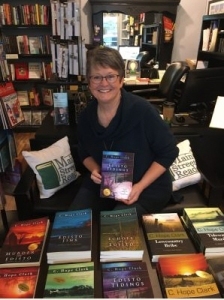 “C. HOPE CLARK has a fascination with the mystery genre and is author of the Carolina Slade Mystery Series, and the Craven County Mysteries as well as the Edisto Island Mysteries, all set in her home state of South Carolina. In her previous federal life, she performed administrative investigations and married the agent she met on a bribery investigation. She enjoys nothing more than editing her books on the back porch with him, overlooking the lake, with bourbon in hand. She can be found either on the banks of Lake Murray or Edisto Beach with one or two dachshunds in her lap. Hope is also editor of the award-winning FundsforWriters.”
June 1, 2024
Wow, Swedish knighthood for ABBA
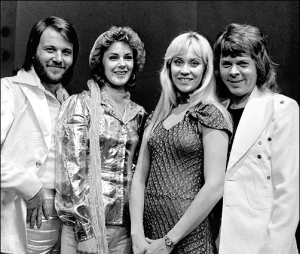 They don’t look like this anymore. (1974)
“COPENHAGEN, Denmark — The four members of the Swedish pop quartet ABBA, who triumphed at the 1974 Eurovision Song Contest with the peppy love song “Waterloo,” on Friday got one of the most prestigious knighthoods in Sweden from the Swedish King Carl XVI Gustaf.
‘The Order of the Vasa was handed out for the first time in almost 50 years. Agnetha Faltskog, Björn Ulvaeus, Benny Andersson, and Anni-Frid Lyngstad became ‘Commander of the First Class’ of the order for “very outstanding efforts in Swedish and international music life.'” –Associated Press– I’ve heard their music for years. I liked it, too. Never figured they’d become knights. Something to smile about when there’s so much strange news out there. –MalcolmMay 30, 2024
Libertarian Delegates Select Chase Oliver as Presidential Nominee at the Libertarian National Convention
Washington, DC, May 26, 2024 —
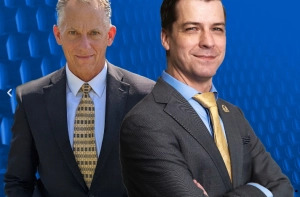 Delegates at the 2024 Libertarian National Convention voted to select Chase Oliver as the 2024 party nominee for president, and Mike ter Maat as his vice-presidential running mate late Sunday night on May 26th, 2024.
From a field of more than ten candidates, through several rounds of voting, Mr. Oliver emerged as the favorite to take on GOP presidential candidate Donald Trump, who spoke at the convention the previous evening, Robert F. Kennedy, who addressed the convention Friday, and Democrat incumbent Joe Biden.
Candidates on the ballot for delegates to choose from included: Michal Rectenwald, Mike ter Maat, Joshua Smith, Art Olivier, Charles Ballay, Joshua “Toad” Anderson, Lars Mapstead, Jacob Hornberger, and Robert F. Kennedy Jr.
 “I am proud and honored to accept the Libertarian nomination for president,” said Chase Oliver, 38, of Atlanta. “Voters across the country need a voice that is distant from the two-party system. In particular, Generation Z needs a voice that loudly and firmly opposes war around the world and supports peace and individual rights both at home and abroad.”
Presidential candidate Mike ter Maat was nominated on the floor for Vice President after the presidential nomination was ceded to Mr. Oliver and was voted into that position. Unlike most political parties, the Libertarian Party selects both POTUS and VP through delegate voting.
–
There is a third option if you don’t like Trump or Biden.
May 29, 2024
Good Plants: Goldenrod
“Goldenrods take the blame for a lot of allergies, but most of it’s undeserved. There are people allergic to goldenrod and they should not use the plant. However, most of the allergies are caused by ragweed and other similar flowering plants. Goldenrod are pollinated by bees and don’t release pollen into the air like ragweeds. ” – “The Lost Book of Herbal Remedies.”
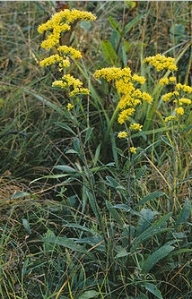 Solidago nemoralis, old field goldenrod
Goldenrod has medicinal uses or is eaten in salads, however, you need to make sure you can tell the difference between them and similar plants such as groundsel and ragwort before consuming them. Please don’t take any natural remedies without consulting an herbalist.
According to Healthline, “To reap its benefits, people consume the parts of the plant that grow above ground — particularly the flowers and leaves You can buy goldenrod as a tea or dietary supplement as well. The tea may have a somewhat bitter aftertaste, and some prefer it lightly sweetened.”
Goldenrod adds nitrogen to the soil, so it makes a good plant to place at the edge of your yard, if not in the garden.
Web MD reports that “Goldenrod contains chemicals that might increase urine flow and reduce swelling. It might also kill bacteria and fungi. People use goldenrod for enlarged prostate, kidney stones, urinary tract infections (UTIs), tooth plaque, and many other conditions, but there is no good scientific evidence to support these uses. “
Goldenrod, which blooms in the fall, is a native Florida wildflower whose scientific name (Solidago) means “to make whole.”
May 27, 2024

May 24, 2024
John Huston’s final film
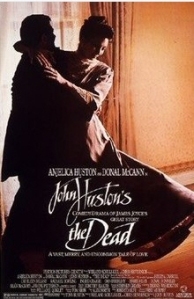 John Huston was dying while working on “The Dead,” a 1987 film closely based on James Joyce’s 1914 short story in The Dubliners collection. The film won a post-humus Best Director Oscar for Huston and a Best Supporting Actress award for his daughter Anjelica. I was drawn to the film because I was a fan of the Hustons and, most definitely of James Joyce.
According to Wikipedia, “The film takes place in Dublin in 1904 at an Epiphany party hosted by two sisters and their niece. The story focuses on the academic Gabriel Conroy (Donal McCann) and his discovery of his wife Gretta’s (Anjelica Huston) memories of a deceased lover. The ensemble cast also includes Helena Carroll, Cathleen Delany, Dan O’Herlihy, Marie Kean, Donal Donnelly, Seán McClory, Frank Patterson, and Colm Meaney.”
I was happy that my favorite passage from Joyce’s story–often cited as among the most beautifully written in the English language from, perhaps the best English story story–was included in the film as a voice-over reading:
“It had begun to snow again. He watched sleepily the flakes, silver and dark, falling obliquely against the lamplight. The time had come for him to set out on his journey westward. Yes, the newspapers were right: snow was general all over Ireland. It was falling on every part of the dark central plain, on the treeless hills, falling softly upon the Bog of Allen and, farther westward, softly falling into the dark mutinous Shannon waves. It was falling, too, upon every part of the lonely churchyard on the hill where Michael Furey lay buried. It lay thickly drifted on the crooked crosses and headstones, on the spears of the little gate, on the barren thorns. His soul swooned slowly as he heard the snow falling faintly through the universe and faintly falling, like the descent of their last end, upon all the living and the dead.”
The New York Times review began:
 ”’ONE by one we’re all becoming shades,’ says Gabriel Conroy, looking out into Dublin’s bleak winter dawn. Gretta, the wife he loves and suddenly realizes he has never known, lies asleep on the bed nearby. His own life now seems paltry: ‘Better pass boldly into that other world, in the full glory of some passion, than fade and wither dismally with age.’
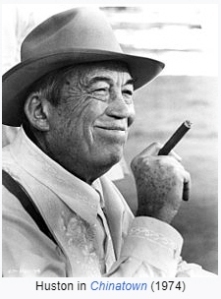
“These words are spoken toward the end of ‘The Dead,’ John Huston’s magnificent adaptation of the James Joyce story that was to be the director’s last film.
“Some men pass boldly into that other world at 17. Huston was 81 when h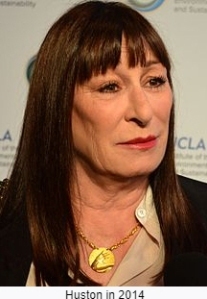 e died last August. He failed physically, but his talent was not only unimpaired, it was also richer, more secure and bolder than it had ever been. No other American filmmaker has ended a comparably long career on such a note of triumph.”
Pauline Kael wrote that “The announcement that John Huston was making a movie of James Joyce’s ‘The Dead’ raised the question ‘Why?’ What could images do that Joyce’s words hadn’t? And wasn’t Huston pitting himself against a master who, though he was only twenty-five when he wrote the story, had given it full form? (Or nearly full—Joyce’s language gains from being read aloud.) It turns out that those who love the story needn’t have worried. Huston directed the movie, at eighty, from a wheelchair, jumping up to look through the camera, with oxygen tubes trailing from his nose to a portable generator; most of the time, he had to watch the actors on a video monitor outside the set and use a microphone to speak to the crew. Yet he went into dramatic areas that he’d never gone into before— funny, warm family scenes that might be thought completely out of his range. He seems to have brought the understanding of Joyce’s ribald humor which he gained from his knowledge of Ulysses into this earlier work; the minor characters who are shadowy on the page now have a Joycean vividness. Huston has knocked the academicism out of them and developed the undeveloped parts of the story. He’s given it a marvelous filigree that enriches the social life. And he’s done it all in a mood of tranquil exuberance as if moviemaking had become natural to him, easier than breathing.”
Wikipedia Noted: “The Japanese filmmaker Akira Kurosawa cited The Dead as one of his 100 favorite films. The Dead received mostly positive critical reviews. The film holds a 94% rating on Rotten Tomatoes, based on 31 reviews.”
As a work of love and a work of art, the movie wasn’t a blockbuster. But that doesn’t matter. It doesn’t need any validation other than the appreciation of those who saw it and saw it for what it was.
–Malcolm
 Malcolm R. Campbell is the author of “Conjure Woman’s Cat.”
May 23, 2024
DISPROPORTIONATE USE OF FORCE AGAINST PEACEFUL STUDENT PROTESTERS IN FLORIDA CANNOT STAND, COALITION SAYS
FOR IMMEDIATE RELEASE
May 22, 2024PEN AMERICA (MIAMI)— A coalition of Florida and national organizations replied to a letter from the State University System of Florida (SUS) today, again urging Florida university leadership to adhere to constitutional obligations by rejecting the use of disproportionate police force and harsh tactics against student protests.The coalition first wrote to the presidents of Florida’s colleges and universities on May 3, raising alarm about the disturbing use of force against pro-Palestanian student protests on campuses, and expressing concerns about safety and basic free speech rights. In his response on May 9, Chancellor Ray Rodrigues alleged that Florida’s response was appropriate and within constitutional boundaries, applauding Florida’s “unapologetically partnering with law enforcement.”
Today, the coalition responded to Chancellor Rodrigues, challenging the justification offered for the use of force, and noting the worrisome mischaracterization of constitutionally protected student speech as violence or harassment. The coalition raised concerns about evidence of viewpoint-based discrimination seen in statements by senior administration officials, and emphasized the importance of preserving academic freedom and free speech on campuses amid rising student unrest. Coalition members also invited SUS leadership to meet to discuss these concerns and their resolution.
Katie Blankenship, director of PEN America Florida, said: “Student protests on Florida campuses have rarely been met with this level of unnecessary hostility and violence. Even when it involves civil disobedience, peaceful protest should be met with a proportional response that does not physically harm students or suppress their constitutionally protected speech. Under a governor who has incited hostility towards peaceful student demonstrators and called for their expulsion, the actions of many Florida universities have been worrisome and dangerous, posing risk to student and faculty safety. We hope the SUS will take our response as an opportunity for productive conversation about how to protect all students and their free speech rights.”
May 19, 2024
‘A Skeleton Key to Finnegans Wake’ by Campbell and Robinson
When the comic, mythic, and dream-like epic Finnegans Wake was released in 1939 after a 17-year effort by James Joyce, most readers–including top reviewers–dismissed it as gibberish. Four years later, Joseph Campbell (The Hero With a Thousand Faces) and Henry Morton Robinson (The Cardinal) explained Joyce’s novel so well that for years A Skeleton Key to Finnegans Wake was the only book that covered the entire novel rather than simply annotating “difficult” references in its text.
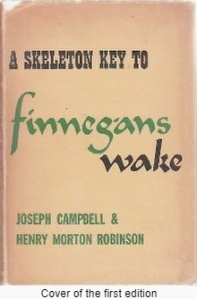 The Joseph Campbell Foundation (JCF), which maintains all of Campbell’s published and unpublished materials, has kept a skeleton key in print with a new introduction. I appreciate the work of JCF and while its website has evolved over the years, I enjoy spending time there where Campbell’s mythic look at the world is kept alive along with books like A Skeleton Key that are still viable long after their publication.
James Joyce is my favorite author and Finnegan’s Wake is my favorite novel, in part for its humor and scope and in part because it’s a vital component of linked novels that constituted his life’s work. Suffice it to say, the work of Campbell (March 26, 1904 – October 30, 1987) and Henry Robinson (September 7, 1898 – January 13, 1961) made my frequent journeys through the Wake much more easier. Like carrying a strong flashlight in a dark cave.
Edmund Wilson of “The New Yorker” said, “Campbell and Robinson deserve a citation from the Republic of Letters for having succeeded in bringing out their Skeleton Key at this time….The chance to be among the first to explore the wonders of Finnegans Wake is one of the few great intellectual and aesthetic treats that these last bad years have yielded.”
Max Lerner of “The New York Times” said, “Joyce has found in Mr. Campbell and Mr. Robinson the ideal readers who approach his book with piety, passion, and intelligence, and who have devoted several years to fashioning the key that will open its treasures.”
From the Publisher
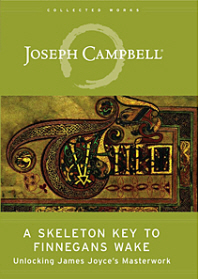 “Countless would-be readers of Finnegans Wake — James Joyce’s 1939 masterwork, on which he labored for a third of his life — have given up after a few pages and dismissed the book as a perverse triumph of the unintelligible. In 1944, a young professor of mythology and literature named Joseph Campbell, working with novelist and poet Henry Morton Robinson, wrote the first guide to understanding the fascinating world of Finnegans Wake. Page by page, chapter by chapter, A Skeleton Key to Finnegans Wake outlines the basic action of Joyce’s book, simplifies and clarifies the complex web of images and allusions, and provides an understandable, continuous narrative from which the reader can venture out on his or her own. This edition includes a foreword and updates by Joyce scholar Dr. Edmund L. Epstein that add the context of sixty subsequent years of scholarship.”
“Running riddle and fluid answer, Finnegans Wake is a mighty allegory of the fall and resurrection of mankind. It is a strange book, a compound of fable, symphony, and nightmare–a monstrous enigma beckoning imperiously from the shadowy pits of sleep. “
As they say, it’s a monomyth, not just about residents of Dublin “but the dreamlike saga of a guilt-stained, evolving humanity.”
The festivities begin when laborer Tim Finnegan gets drunk, falls off a ladder, and dies, but then comes to back to life during his wake when whisky gets splashed on him. This sets the tone for the novel with its cycles of death and rebirth.
May 15, 2024
Strange Fruit on Florida Trees
“A 1993 study indicates that between 1882 and 1930, one out of every 1,250 African Americans in Florida was lynched. A black person was almost twice as likely to be lynched in Florida as in Georgia, and seven times more likely in Florida than in North Carolina. ” – Florida Historical Society
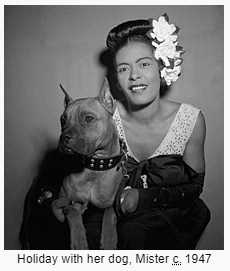 The title of this post refers to the Billy Holiday song “Strange Fruit” about the African American lynchings that begins: “Southern trees bear a strange fruit
Blood on the leaves and blood at the root
Black bodies swinging in the Southern breeze
Strange fruit hanging from the poplar trees”
Scholars are argue about whether or not Holiday’s career ended prematurely after the recorded this song. I don’t know if it did, but I wouldn’t be surprised. It’s not easy to listen to–just reading the lyrics is repulsive, especially to those of us who grew up in a Florida that had the most lynchings per capita of all states.
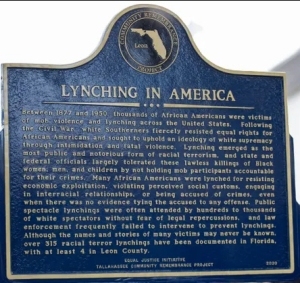 Tallahassee put up this marker in in 2021, better late than never
This song has been on my mind as I debate whether or not to include a lynching in my novel in progress, one described in some detail. The research has made me sick. Growing up in Florida during the Jim Crow era, I heard and read about lynchings in the news. They weren’t stories from one hundred years ago, but from “today and last night.” Saying anything in private conversations, much less in public, was dangerous because the Klan and its sympathizers were everywhere, next door perhaps or at club and church meetings. Express displeasure about a lynching, and you might be next. Or you might find a cross burning on your lawn and then find our friends disappearing to avoid being seen associating with you.
Suffice to say, I have good reason to include a lynching in a novel because strange fruit, although not part of the citrust industry, was part of the scenery.
I should, but I don’t think I can.
–Malcolm